




Blog / Buying Guides

2021 Jeep Grand Cherokee Towing & Capability Guide: Q&A With Dustin Zeck

2021 Jeep Grand Cherokee Towing Capacity: 6,200 to 7,200 lbs Maximum Rating

2021 Jeep Grand Cherokee Towing & Capability Guide: Q&A With Dustin Zeck

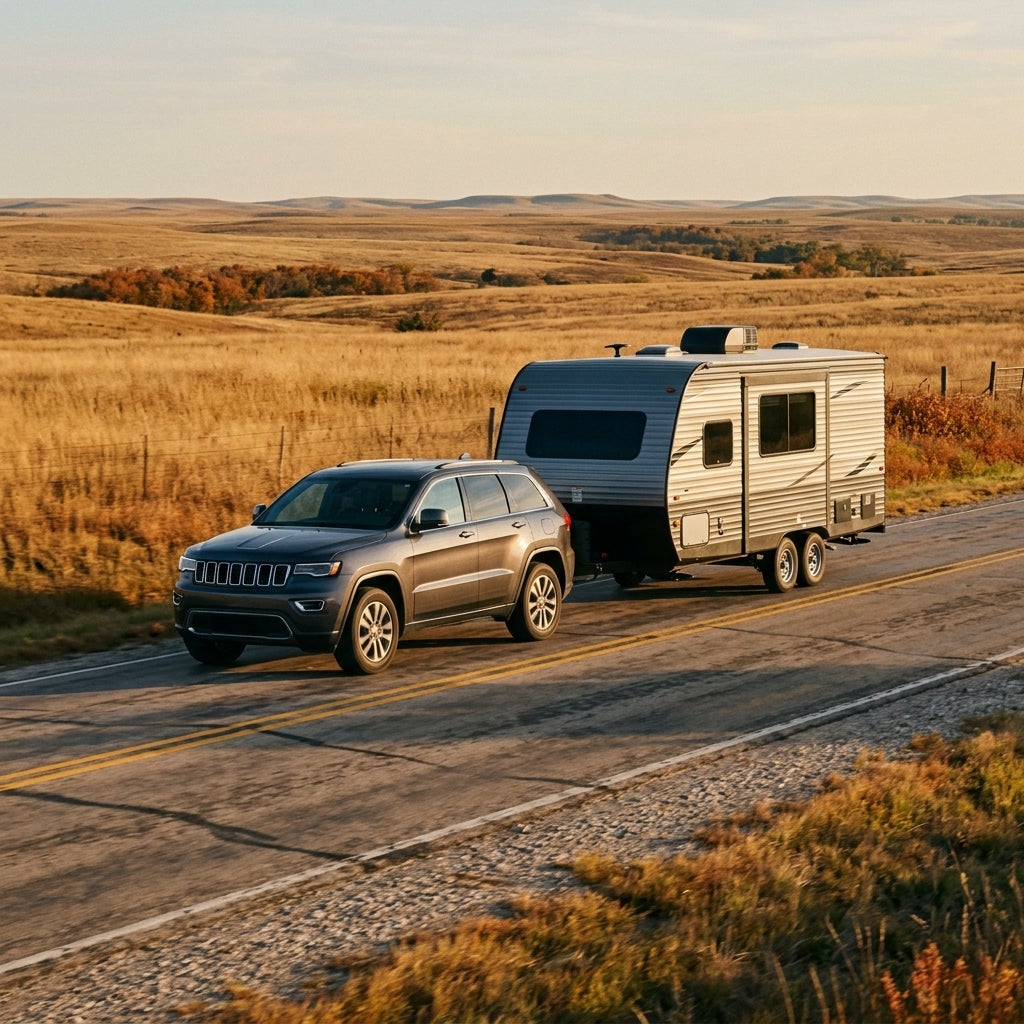
When hauling a travel trailer or boat, a 2021 Jeep Grand Cherokee typically achieves a practical highway driving range of 250 to 300 miles on a single tank of gas. To break down the trailering limits, factory equipment requirements, and fuel expectations of this popular SUV, we interviewed Dustin Zeck, Dealer Principal at Valor CDJR, who brings 36 years of automotive industry experience to help local drivers tow with complete confidence.

Q: How Far Can a 2021 Jeep Grand Cherokee Go on a Tank of Gas While Towing?

A: Drivers can expect a 2021 Jeep Grand Cherokee to travel between 250 and 300 miles on a full tank while pulling a loaded trailer under normal highway conditions. The vehicle features a 25-gallon fuel tank, and when trailering weight approaches maximum ratings, real-world fuel economy generally settles between 11 mpg and 13 mpg. On an unladen highway cruise, a model with the 3.6-liter Pentastar V6 reaches up to 26 mpg highway, but the aerodynamic drag and mass of a travel trailer or boat pull those figures down significantly.

A range of 250 miles gives you plenty of margin to reach your destination without stressing over the next fuel station, even when pulling heavy loads across windy Kansas highways. If you opt for the 5.7-liter HEMI V8, fuel consumption will be slightly higher under heavy acceleration, though its Fuel Saver Technology helps deactivate cylinders during steady cruising to preserve range. Before setting out on a long trip with a camper in tow toward Milford Lake near Junction City, I always recommend calculating your fuel stops around a conservative 200-mile mark. If you have questions about prepping your vehicle for long-distance trailering, you can reach our service team with a quick call or drop by our Junction City showroom address to speak with our experts.

Q: What Is the Maximum Towing Capacity of the 2021 Jeep Grand Cherokee and What Equipment Is Required?

A: Maximum towing capacity reaches 6,200 pounds on models powered by the 3.6-liter Pentastar V6 and tops out at 7,200 pounds on models equipped with the 5.7-liter HEMI V8, provided the vehicle has the factory tow package. It is critical to recognize that any 2021 Grand Cherokee lacking the factory setup is restricted to a bumper rating of just 3,500 pounds. Reaching those higher thresholds requires the factory-installed Trailer Tow Group IV package, which equips the SUV for the thermal and structural demands of heavy trailering.

The Trailer Tow Group IV package installs a heavy-duty Class IV hitch receiver, a dual 7-and-4-pin wiring harness, high-output engine cooling, a 180-amp or 220-amp alternator, rear load-leveling suspension, and a full-size spare tire. For pull weights above 3,500 pounds, Jeep recommends using a weight distribution hitch to balance the vehicle's front and rear axles, which prevents headlight aim distortion and keeps front-wheel steering traction firm. Maximum tongue weight is capped at 620 pounds for V6 models and 720 pounds for V8 configurations, adhering to the standard 10 percent tongue weight guideline. If you are planning to upgrade your current vehicle to handle a larger camper, you can start by using our online trade-in evaluation tool to see what your current ride is worth.

Q: Does the 2021 Jeep Grand Cherokee Come With an Integrated Brake Controller?

A: The 2021 Jeep Grand Cherokee does not include an integrated electronic trailer brake controller from the factory, but every model equipped with the factory tow package comes pre-wired with a dedicated harness plug located under the driver-side dashboard. This factory wiring connector allows for a clean, plug-and-play installation of an aftermarket brake controller without slicing into existing vehicle electrical lines.

Because electric trailer brakes are required by law for heavier loads, installing a quality brake controller is essential before hitching up a dual-axle travel trailer or car hauler. The pre-wired harness connects directly into the vehicle's electrical infrastructure, feeding signal to the rear 7-pin wiring harness. Our certified technicians can easily wire and mount a sleek controller right below the steering column. You can order genuine towing accessories through our parts department and book an installation appointment using our online service scheduler.

"A proper tow package does far more than bolt a hitch receiver to the back frame of an SUV."

Q: How Does the 2021 Jeep Grand Cherokee Towing Capacity Compare to the Dodge Durango?

A: When comparing standard trim levels, the Grand Cherokee and Dodge Durango offer identical maximum ratings of 6,200 pounds with the 3.6-liter Pentastar V6 and 7,200 pounds with the 5.7-liter HEMI V8. Both midsize SUVs share a strong unibody architecture engineered for heavy trailering stability. However, the Durango offers specialized performance packages that raise its peak capacity higher than the Grand Cherokee.

Specifically, the Durango offers the Tow N Go package on its V8 variants, which increases maximum towing capacity up to 8,700 pounds. While the Durango takes the lead on absolute maximum pulling weight, the Grand Cherokee counters with superior off-road trailering capability. With its available multi-mode 4x4 drive systems and adjustable air suspension, the Grand Cherokee is better prepared to pull trailers over unpaved launch ramps, muddy pastures, and rutted trails where ground clearance and traction matter most.

Q: What Inspection Points Are Important When Buying a Used 2021 Grand Cherokee Used for Towing?

A: When inspecting a pre-owned 2021 Grand Cherokee that was previously used for trailering, buyers should start by evaluating the rear differential fluid and transmission fluid condition. Continuous heavy pulling generates high operating temperatures that can degrade gear oil and automatic transmission fluid prematurely. Smooth transmission shift performance during a test drive is a clear sign that the internal clutch packs and torque converter remain in healthy condition.

Next, examine the rear load-leveling shocks or air suspension bladders for signs of fluid weeping, cracking, or physical wear. Inspect the front brake rotors for heat scoring or warping, as heavy stopping duty places extra stress on friction hardware. Finally, check the receiver hitch for heavy rust or stress cracks around the mounting welds, and review the vehicle's maintenance history to verify regular severe-duty service intervals. Shoppers can explore our thoroughly inspected pre-owned inventory or look at our new vehicle inventory to compare options, and our team can help you get started with an online credit pre-approval application.

Q: How Do Quadra-Lift Air Suspension and 4x4 Systems Enhance Towing Capability?

A: Quadra-Lift air suspension automatically levels the vehicle when a heavy trailer tongue is lowered onto the hitch ball, preventing rear-end squat and maintaining proper headlight alignment and front tire contact. The system replaces standard steel coil springs with air bladders at all four wheels, automatically inflating to compensate for cargo and tongue weight. It also provides adjustable ride height modes, allowing the vehicle to lift up to about 11 inches of ground clearance for off-road navigation or lower for easier trailer hitching.

Complementing the suspension are Jeep's advanced four-wheel-drive systems, including Quadra-Trac II with a two-speed transfer case and Quadra-Drive II with a rear Electronic Limited-Slip Differential. When pulling a heavy boat up a slippery ramp or navigating rolling prairie highways around Manhattan, these systems continuously monitor wheel slip and transfer engine torque to the tires with the most grip. Furthermore, standard Trailer Sway Control uses yaw sensors within the Electronic Stability Control system to detect trailer oscillation, automatically applying individual wheel brakes to pull the trailer back into a straight line without driver panic.

Q: Where Can You Find a Pre-Owned 2021 Jeep Grand Cherokee With a Tow Package in Junction City?

A: You can find high-quality pre-owned 2021 Jeep Grand Cherokee models equipped with factory tow packages right here at Valor CDJR. When shopping for a tow-ready SUV, it is vital to verify that the vehicle was built with the Trailer Tow Group IV package from the factory rather than equipped with an aftermarket bumper hitch later. Our sales team can pull the original factory build sheet and review the door jamb payload ratings to ensure the exact vehicle you choose matches your trailering requirements.

Our showroom is conveniently located at 1825 Goldenbelt Blvd, Junction City, KS 66441, where our experienced staff can walk you through hitch setup, tongue weight limits, and four-wheel-drive controls in person. Whether you need assistance verifying equipment options or setting up a test drive, give our team a call at (785) 238-5114 today to get expert guidance on your next tow-ready SUV.
© 2026 Valor CDJR. All rights reserved.


Posted in:

Related Posts

How Do You Buy a Custom Jeep from a Local Dealership?

How Do You Buy a Custom Jeep from a Local Dealership?

How Do You Buy a Custom Jeep from a Local Dealership? To buy a custom factory-ordered Jeep from a local dealership, you select your exact model, trim, paint color, powertrain, and equipment packages online or in our showroom, verify the build sheet with our sales team, and submit a finalized factory order backed by a small deposit. Factory ordering locks in your chosen specifications directly with the manufacturer, ensuring you receive the exact configuration you want without paying for unwanted dealer accessories or compromising on essential features. When building a custom vehicle, the process moves through four straightforward stages: Digital Configuration: Build your preferred model using the online configurator or work directly alongside our sales staff to review the order guide, selecting exact axle gear ratios, roof styles, electrical packages, and interior materials. Pricing and Order Verification: Review the factory build sheet, confirm equipment availability, establish trade-in parameters, and verify transparent vehicle pricing before signing the purchase order. Production Tracking: Once the factory accepts the order, a Vehicle Order Tracking System identification number is generated, allowing you to follow your build through staging, assembly, paint, and transit. Delivery and Drive-Off: When the carrier transports your vehicle to our lot, we complete the final pre-delivery inspection, apply any available manufacturer incentives, finalize your purchase agreement, and hand you the keys. Ordering a custom vehicle guarantees that specialized preferences, such as heavy-duty axle assemblies or specific roof packages, arrive built to your standard. Whether you are planning weekend boating excursions at Milford Lake or outfitting a rig for daily military base commuting, you can confirm your build details by planning a visit via our Junction City showroom directions or by speaking directly with our ordering specialists through (785) 238-5114. Table of Contents How Much Does a New Jeep Wrangler Cost Across Trims and Transmission Options? What 4x4 Systems Are Available on Modern Jeep Models? Ford Bronco vs. Jeep Wrangler: Which Offers Better Highway Quietness, Payload, and Towing? Where Can You Test Drive and Buy a New or Certified Pre-Owned Jeep Near Junction City? How Do You Find and Buy the Right Jeep Near You? What Buyers Ask Most About Choosing a Jeep How Can You Shop for a New Jeep at Valor CDJR? How Much Does a New Jeep Wrangler Cost Across Trims and Transmission Options? A new Jeep Wrangler generally ranges from approximately $33,000 for a bare-bones entry two-door Sport to over $60,000 for an extensively equipped Rubicon X, with high-output specialty variants reaching higher price brackets. The classic six-speed manual transmission remains standard equipment on models powered by the proven 3.6-liter Pentastar V6 engine, while an eight-speed automatic transmission is optional on the V6 and comes standard on configurations equipped with the 2.0-liter turbocharged four-cylinder engine. The Wrangler lineup spans several distinct trim levels designed around different capability thresholds and budgets: Sport and Sport S: Serving as accessible entry points, these trims feature standard Command-Trac 4WD, removable doors, soft top configurations, and the responsive 12.3-inch touchscreen running the modern Uconnect infotainment platform. Willys: Adding functional trail hardware without Rubicon-level pricing, the Willys trim includes a rear locking differential, rock protection rails, aggressive 33-inch all-terrain tires, and heavy-duty steel bumpers. Sahara: Exclusive to the four-door platform, the Sahara combines body-color fender flares, refined interior appointments, heated seats, and the standard turbocharged engine paired with an automatic transmission for balanced commuting refinement. Rubicon and Rubicon X: Engineered for extreme off-road terrain, Rubicon models integrate Tru-Lok electronic front and rear locking differentials, an electronic front sway bar disconnect, heavy-duty Dana 44 axles, and a dedicated 4:1 crawl ratio transfer case. Choosing between the standard manual gearbox and the eight-speed automatic comes down to driving engagement versus overall utility. The manual transmission delivers complete driver engagement and a crawl ratio tailored for low-speed modulation, while the automatic provides seamless shifting, elevated crawl control, and higher towing ratings on select four-door trims. If you are preparing to upgrade, you can calculate the equity in your current vehicle by submitting a vehicle trade-in evaluation to lower your net financing balance. What 4x4 Systems Are Available on Modern Jeep Models? Jeep models utilize four primary four-wheel-drive configurations engineered for specific traction requirements, ranging from everyday weather security to severe rocky terrain navigation. These systems distribute engine output through mechanical gear reduction, full-time multi-plate clutches, or electronically controlled differentials to maintain relentless forward momentum. The systems feature distinct operational mechanics: Command-Trac Part-Time 4WD: Standard on Wrangler Sport and Willys trims, this mechanical shift-on-the-fly system locks the front and rear driveshafts together in 4H mode, delivering a balanced 50/50 torque split. Its low range uses a 2.72:1 gear ratio to multiply torque when navigating deep snow, thick mud, or loose gravel. Selec-Trac Full-Time 4WD: Designed for variable road conditions, Selec-Trac utilizes an internal transfer case clutch to automatically route torque between the front and rear axles. Drivers can keep it in 4H Auto on dry pavement, allowing the system to instantly react to icy patches or wet highway expansion joints without mechanical binding. Rock-Trac 4WD: Standard on Rubicon models, Rock-Trac delivers extreme trail control with a heavy-duty 4:1 low-range gear ratio. When engaged in 4LO, the system multiplies engine torque substantially, allowing slow, controlled creeping over tall boulders and technical washouts. It is available in both standard part-time and 4H Auto full-time variants. Quadra-Trac and Quadra-Drive II: Found across the Grand Cherokee lineup, Quadra-Trac I provides active full-time all-wheel engagement without driver input. Quadra-Trac II introduces an active two-speed transfer case with sensor-driven torque management and a 2.72:1 low range. Quadra-Drive II adds a rear Electronic Limited-Slip Differential capable of routing up to 100% of available rear torque to a single tire with traction. Paired with the Selec-Terrain Traction Management System on vehicles like the Grand Cherokee, these drivelines allow drivers to toggle specific calibrations for Auto, Snow, Sand, Mud, and Rock. Electronic throttle mapping, transmission shift points, and stability control thresholds adjust instantly to handle seasonal Kansas freezes or muddy riverbed trails. Ford Bronco vs. Jeep Wrangler: Which Offers Better Highway Quietness, Payload, and Towing? The Ford Bronco registers slightly quieter interior decibel levels at sustained highway speeds due to its independent front suspension and double-pane sound dampening, but the Jeep Wrangler delivers higher maximum towing capacity when properly configured with its full-floating rear axle. For buyers balancing long interstate drives against heavy utility demands, these architectural differences establish clear functional tradeoffs. Wind noise and road isolation differ noticeably between the two off-roaders: Cabin Acoustics: The Wrangler utilizes a solid front axle, an upright windshield angle, and modular roof panels that generate noticeable acoustic presence over 65 mph. The Bronco incorporates an independent front suspension that tracks straighter with less steering correction, along with thicker composite hardtop insulation that reduces high-frequency wind buffeting. Maximum Towing Capability: A properly equipped four-door Jeep Wrangler with the heavy-duty full-float Dana 44 rear axle achieves a maximum towing capacity of up to 5,000 pounds, easily hauling medium-sized travel trailers or twin utility cargo haulers. In comparison, four-door Bronco models max out between 3,500 and 4,500 pounds, depending on equipment packages and engine selection. Payload Capacity: Maximum payload ratings remain highly competitive between both platforms. Depending on specific trim, doors, and suspension hardware, both vehicles typically support between 1,000 and 1,350 pounds of total occupant and cargo payload capacity. Cabin Volume: The Bronco offers slightly wider shoulder dimensions and cargo volume behind the second row at roughly 38 cubic feet, while the four-door Wrangler provides about 32 cubic feet of rear storage. However, the Wrangler counterbalances this with superior rear passenger legroom measuring 38 inches compared to the four-door Bronco's 36 inches. While the Bronco provides a mild edge in high-speed acoustic isolation, the Wrangler remains the dominant choice for drivers demanding higher trail articulation, greater maximum towing thresholds, and a solid-axle platform renowned for rugged durability. Where Can You Test Drive and Buy a New or Certified Pre-Owned Jeep Near Junction City? You can test drive and purchase an extensive lineup of new and certified pre-owned Jeep models at Valor CDJR, conveniently located off Interstate 70 in Junction City. Our inventory features an array of configurations, from trail-ready two-door Wranglers to family-sized three-row Grand Cherokee L models, ready for side-by-side floor comparisons and active road evaluations. Evaluating a vehicle in person lets you experience how different powertrains and suspensions perform across real-world driving environments. When scheduling a test drive, shoppers frequently compare critical interior attributes: Two-Row vs. Three-Row Utility: Experience the seating ergonomics of the standard two-row Grand Cherokee, offering five-passenger accommodation and 38 cubic feet of rear cargo room, alongside the Grand Cherokee L, which provides six- or seven-passenger seating with 17 cubic feet behind row three and up to 85 cubic feet with seats folded flat. Open-Air Roof Functionality: Test the effortless operation of the Sky One-Touch Power Top on the Wrangler floor model compared to the traditional modular three-piece Freedom Top hardtop. Infotainment and Visibility: Walk through the intuitive 12.3-inch Uconnect 5 touchscreen, testing wireless smartphone integration and verifying sightlines through high-definition trail cameras. To explore available platforms, examine our current selection of brand-new vehicles or browse our thoroughly vetted pre-owned vehicle inventory. Every certified pre-owned model includes a rigorous inspection process, manufacturer-backed powertrain warranty coverage, and dedicated roadside assistance, giving you complete confidence on every journey. How Do You Find and Buy the Right Jeep Near You? Finding the ideal vehicle requires matching engine output, seating capacity, and driveline capabilities to your daily transportation patterns and regional recreation habits. Buyers commuting between rural agricultural properties and central employment centers need a platform capable of handling shifting weather conditions while preserving cabin comfort and utility. To streamline your purchase path, consider these essential selection parameters: Drivetrain Capability: Select standard all-wheel-drive configurations like those found on the Grand Cherokee for automatic rain and winter road grip, or step up to a dedicated Wrangler 4x4 with low-range transfer gears for uneven trails. Powertrain Priorities: The 2.0-liter turbocharged engine provides rapid low-end torque with 295 lb-ft and an EPA-rated 20 mpg city / 25 mpg highway on models like the Grand Cherokee, making it a great match for daily commuting. Drivers seeking classic throttle linearity and manual transmission availability can opt for the 285-hp Pentastar V6. Financing Preparation: Streamline your visit by establishing purchasing parameters before arriving on the lot. You can submit our quick form to get pre-approved for financing online, allowing our finance specialists to structure competitive rates and customized payment schedules tailored to your household budget. What Buyers Ask Most About Choosing a Jeep Q: Which Jeep model offers the highest towing capacity for recreation trailers? The Jeep Grand Cherokee and three-row Grand Cherokee L lead the brand's midsize SUV lineup with a maximum towing capacity of up to 6,200 pounds when properly equipped. This rating easily accommodates medium-sized boats, horse trailers, and dual-axle camping trailers. Four-door Wrangler models equipped with the factory full-floating rear axle tow up to 5,000 pounds, while standard two-door Wrangler configurations are rated to pull up to 2,000 pounds. Q: How does the Sky One-Touch Power Top differ from the standard Wrangler hardtop? The Sky One-Touch Power Top is an integrated, power-retractable canvas roof system that opens or closes at the push of a button in approximately 20 seconds at speeds up to 60 mph. Unlike the traditional three-piece Freedom Top, which requires manually unlatching and removing individual overhead panels for storage, the Sky One-Touch retracts along fixed roof rails. The rear quarter windows can also be quickly unlatched and removed for added open-air exposure. Q: Can modern Jeep 4x4 models be flat-towed behind a motorhome? Yes, Jeep models equipped with a two-speed transfer case that features a true mechanical neutral position—such as the Wrangler equipped with Command-Trac or Rock-Trac, and Grand Cherokee models equipped with Quadra-Trac II or Quadra-Drive II—can be flat-towed behind an RV with all four wheels on the ground. Vehicles with single-speed transfer cases lacking a dedicated neutral mode cannot be flat-towed without driveline disconnection or a trailer. Q: What manufacturer warranty coverage is included with a new Jeep purchase? Every new Jeep SUV purchased at an authorized dealership includes a 3-year or 36,000-mile bumper-to-bumper basic limited warranty along with a 5-year or 60,000-mile powertrain limited warranty. The powertrain warranty covers vital mechanical components, including the engine block, cylinder heads, transmission, transfer case, and drive axles. Owners also receive 24/7 roadside assistance coverage for the duration of the powertrain warranty period. Q: Does the 2.0-liter turbocharged four-cylinder require premium fuel? The turbocharged 2.0-liter engine found in models like the Wrangler and Grand Cherokee is calibrated to operate reliably on regular 87-octane unleaded fuel. While the engine management system can optimize timing for premium 91-octane gasoline during heavy towing or extreme ambient temperatures, premium fuel is strictly recommended for peak performance rather than required for normal daily vehicle operation. How Can You Shop for a New Jeep at Valor CDJR? Finding the right SUV begins with an attentive team that values your time, budget, and driving preferences. Whether you are building a custom order from the factory floor, securing financing for a trail-ready Wrangler, or upgrading your family to a spacious Grand Cherokee L, our staff is dedicated to delivering a transparent, stress-free dealership experience. Visit our showroom today by following our easy route directions to Valor CDJR at 1825 Goldenbelt Blvd, Junction City, KS 66441, or connect with our sales team by calling (785) 238-5114 to lock in your next test drive. Keep Your Vehicle Running Strong Keep your vehicle performing at its best with our service team: Parts Department Service Scheduler © 2026 Valor CDJR. All rights reserved. Vehicle specification data © JATO Dynamics Limited.

Does Servicing Your Vehicle at an Independent Shop Void Your Factory Warranty?

Does Servicing Your Vehicle at an Independent Shop Void Your Factory Warranty?

Does Servicing Your Vehicle at an Independent Shop Void Your Factory Warranty? The short answer is a definitive no: servicing your car, truck, or SUV at an independent repair facility does not automatically void your factory warranty coverage. Under federal law—specifically the Magnuson-Moss Warranty Act —automotive manufacturers cannot mandate that you complete routine maintenance exclusively at an authorized dealership to maintain your factory warranty protection. Whether you choose a local repair shop in Junction City or handle basic upkeep in your garage, your manufacturer warranty remains fully intact as long as required maintenance schedules are followed and proper records are kept. However, keeping your warranty valid requires adhering to strict maintenance standards. If an independent mechanic uses non-compliant fluids, installs sub-standard aftermarket parts, or damages a system during service, the manufacturer has legal grounds to deny warranty claims related to that specific failure. Below, our team at Valor CDJR breaks down your legal protections, documentation requirements, OEM parts considerations, and exclusive military service incentives available to drivers in Junction City and surrounding communities. Understanding the Law: How the Magnuson-Moss Warranty Act Protects Vehicle Owners Enacted by Congress in 1975, the Magnuson-Moss Warranty Act was established to protect consumers from deceptive warranty practices. In the automotive industry, the law explicitly prohibits vehicle manufacturers from conditioning their warranty coverage on the use of a specific brand of article or service—a practice known as a 'tie-in sales requirement.' This means a manufacturer cannot force you to visit a dealership for routine oil changes, tire rotations, brake pad replacements, or fluid flushes to maintain warranty validity. Under the law, the Federal Trade Commission (FTC) makes it clear that automotive companies cannot void a consumer's warranty simply because maintenance was completed by an independent facility. The burden of proof rests entirely on the manufacturer or dealership: if a warranty claim is denied, they must demonstrate that an aftermarket component or improper independent service directly caused the system failure. What Maintenance Documentation Must You Keep to Protect Your Factory Warranty? While federal law protects your freedom of choice, it does not excuse neglected upkeep. When presenting a warranty claim for major engine, transmission, or electrical components, manufacturers have the legal right to request proof that routine maintenance was performed at recommended intervals. Maintaining organized records is your primary defense against denied claims. Itemized Receipts & Invoices Keep detailed repair shop invoices listing the specific services performed. General totals without descriptions (e.g., 'Service Performed: $85') may not satisfy a factory audit. Ensure receipts break down labor and replacement components clearly. VIN, Mileage & Service Dates Every invoice or service receipt must record your vehicle's 17-digit Vehicle Identification Number (VIN), exact odometer reading on the date of service, and clear completion dates matching the owner's manual schedule. Fluid & Part Specifications Verify that receipts detail oil viscosity (e.g., 0W-20 Full Synthetic) and exact fluid certifications (MS-6395, Dexos, etc.). Using fluids that do not meet factory specifications can void warranty coverage if system failure occurs. OEM Parts vs. Aftermarket Components: How Repairs Impact Your Warranty Coverage Installing aftermarket or generic auto parts does not immediately void your entire warranty. However, there is an important legal distinction regarding failures caused by non-OEM (Original Equipment Manufacturer) components. If an aftermarket oil filter collapses and causes oil starvation, resulting in engine damage, the manufacturer is legally allowed to deny repairs for that engine under warranty. Conversely, if an aftermarket exhaust system is installed and your vehicle's air conditioning compressor fails, the factory warranty must still cover the compressor because the modification did not cause the defect. Choosing original factory components through an authorized hub like our Parts Department ensures reduced risk of warranty disputes. When Can a Service Department Legally Deny Warranty Repairs After Independent Service? While federal protections are robust, dealerships and auto manufacturers can legally refuse warranty work under specific, documentable circumstances. Recognizing these risk factors helps you protect your investment: Improper Installation: Incorrect torque settings, cross-threaded drain plugs, or loose fasteners during independent service that lead to mechanical failure. Incorrect Fluid Weight or Specification: Using generic fluids that do not comply with factory recommendations (e.g., wrong transmission fluid grade). Lack of Maintenance Records: Inability to prove routine services were completed when investigating sludge accumulation or progressive system failures. Aftermarket Performance Tunes: ECM flash modifications that alter engine parameters beyond factory tolerances. Unresolved Factory Recalls: Allowing unaddressed recall conditions to cause damage to associated vehicle components over extended periods. Avoid these risks by utilizing authorized routine maintenance at our Express Lane center, where factory specifications are followed on every quick maintenance visit. Visit Our Express Lane Service Who Is Eligible for Military and Veteran Auto Service Department Discounts? Located just minutes from Fort Riley, Valor CDJR takes immense pride in supporting military personnel and their families throughout Junction City, Manhattan, and Geary County. To honor your service, our military and veteran service department program offers service benefits across routine maintenance and major repairs. Eligible participants include active duty service members across all branches (Army, Navy, Air Force, Marines, Coast Guard, Space Force), National Guard and Reserve personnel, military retirees, honorably discharged veterans, and immediate family members (spouses and dependents) carrying valid military identification credentials. How Is the current offer Calculated Between Labor Hours and Replacement Parts? Understanding how your current offer applies to service bills ensures transparent pricing every time you visit. Automotive service invoices generally consist of two distinct categories: labor charges and replacement component costs. Labor Hours Discount Applied directly to the certified technician labor hours required to diagnose and repair your vehicle. A percentage discount reduces the total billed labor rate on work orders. Genuine OEM Parts Savings Applied to factory replacement parts, OEM filters, batteries, and fluids used during repairs. This ensures factory-grade components remain accessible and affordable. Combined Service Package When scheduled together, current offer credits apply across both labor and parts line items, maximizing overall savings on comprehensive maintenance packages. What Happens If a Published Service Coupon Offers Greater Savings Than the current offer? At Valor CDJR, our policy is straightforward: our team will help identify the best currently available offer. While current offers generally cannot be stacked or combined on the same work order, our service advisors automatically evaluate active specials during checkout. If a seasonal oil change promotional coupon or brake service special yields a higher dollar savings than your standard current offer, our team will automatically apply the higher-value current service pricing to your bill. You never have to worry about missing out on seasonal savings or calculating percentages yourself. You can also reach our team directly at Call (785) 238-5114 to verify current promotional rates. Call (785) 238-5114 Does the Military Service Discount Apply to Over-the-Counter OEM Auto Parts? Yes! For DIY enthusiasts and military vehicle owners across Riley County who prefer servicing their own trucks or cars at home, military savings extend directly to counter purchases at our Parts Department. Simply present your military credentials at our parts desk when purchasing genuine OEM brake pads, cabin filters, engine air filters, batteries, spark plugs, fluids, or factory accessories. Keeping your vehicle outfitted with authentic parts guarantees precision fitment while preserving remaining factory warranty coverage. What Documentation Is Required to Qualify for Military and Veteran Vehicle Service Discounts? To ensure military discounts are granted quickly and securely during your service write-up, please present one of the following accepted verification documents to your service advisor: Active / Reserve Cards Common Access Card (CAC) or Department of Defense Uniformed Services Identification Card for Active Duty, Reservists, and National Guard personnel. Veteran Health Identification Veteran Health Identification Card (VHIC) or state-issued driver's license displaying official military service designation icons. DD-214 & Dependent IDs Official Certificate of Release/Discharge Papers (DD-214) accompanied by photo ID, or valid US Military Dependent ID cards. Do Luxury Auto Dealership Service Departments Offer Military Discounts Similar to Volume Brands? When comparing service programs across automotive segments, military discounts vary significantly between volume dealerships and luxury import brands. While luxury brand service centers often feature high hourly labor costs with restricted seasonal military offers, volume brands in military-adjacent regions—such as Chrysler, Dodge, Jeep, and Ram hubs—typically maintain consistent, year-round current offer structures. At Valor CDJR in Junction City, our military incentives are designed specifically around the needs of local active duty personnel and veterans from Fort Riley. We prioritize accessible labor rates, predictable pricing, and immediate parts availability so you get competitive value compared to luxury service centers. Why Vehicle Owners Near Junction City Choose Authorized Dealer Service for Complex Maintenance While routine oil changes can legally be completed anywhere, complex diagnostic work, advanced electrical repairs, and powertrain maintenance are best handled by factory-authorized dealerships. Here is why drivers near Junction City choose our service center: Certified Technicians Our service department is staffed by factory-trained master technicians who specialize in CDJR models, receiving ongoing instruction on modern powertrain and electrical systems. Direct Factory Software Independent shops lack access to proprietary OEM software update tools. We can perform critical ECM/TCM recalibrations and technical service updates as needed during service. Seamless Warranty & Recalls We verify and perform open safety recall work free of charge while processing factory warranty claims directly, and helping reduce paperwork for eligible repairs. Get Directions to Valor CDJR How to Schedule Authorized Warranty-Safe Maintenance and Claim Your Service Discounts Scheduling your factory-safe maintenance at Valor CDJR is simple and convenient. Follow these straightforward steps to reserve your appointment and review your current military offer: Access our online Service Scheduler to select your desired date and appointment time. Indicate required service items (oil change, multi-point inspection, brake inspection, etc.). Mention your military status or requested promotional discount in the appointment comments. Bring your military ID or documentation to your service write-up appointment. Considering upgrading your vehicle while in for service? Check out our latest New Vehicle Listings or explore your vehicle's value using our online Trade In Evaluation tool. Schedule Authorized Factory-Safe Service at Valor CDJR Today Protect your factory warranty coverage while receiving top-tier maintenance and exclusive military savings. Visit Valor CDJR in Junction City, KS, where our certified technicians deliver expert service with a streamlined process. Book your appointment online today or browse our Used Vehicle Listings and Get Pre-Approved for financing options prior to your visit. Schedule Service

How Is Fair Market Value Determined for a Vehicle? Direct Valuation Factors Explained

How Is Fair Market Value Determined for a Vehicle? Direct Valuation Factors Explained

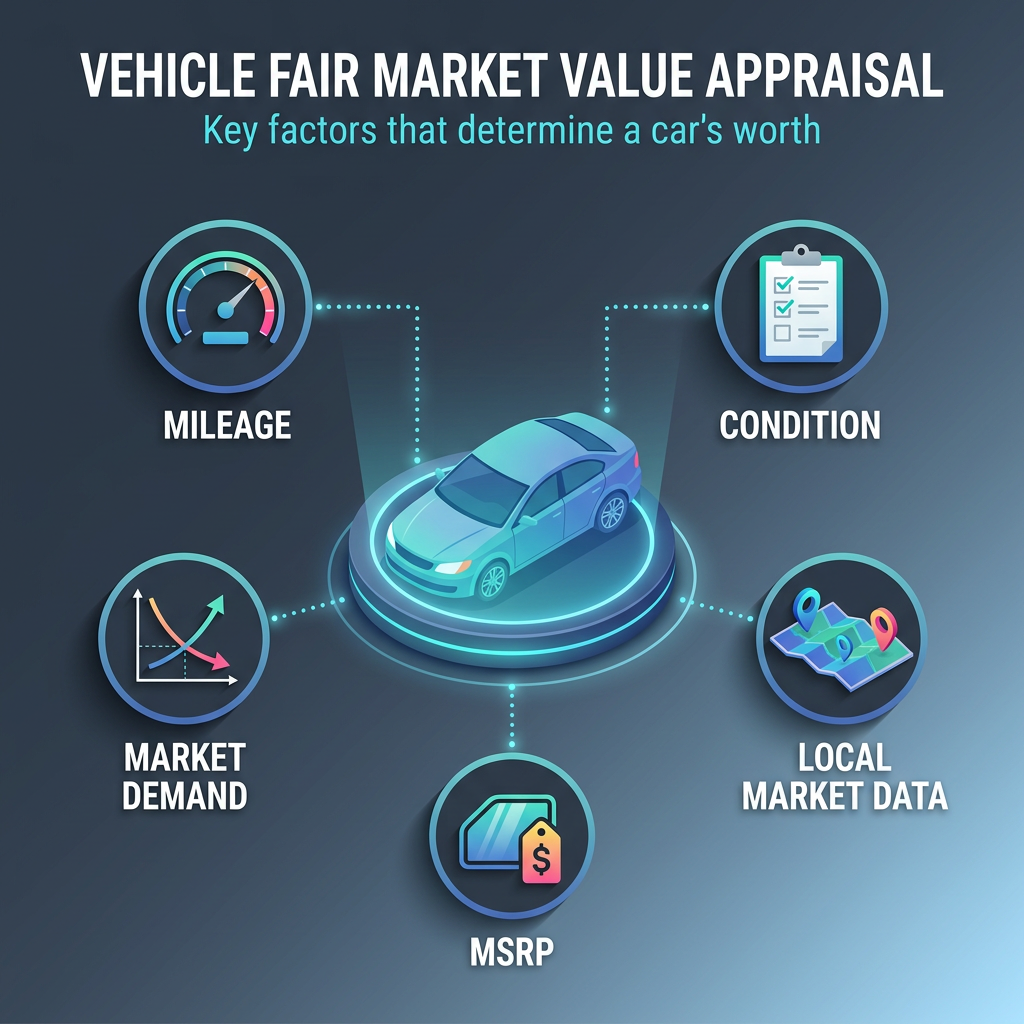
How Is Fair Market Value Determined for a Vehicle? Direct Valuation Factors Explained Determining the true Fair Market Value (FMV) of a vehicle requires looking beyond simple online price tags. At its core, fair market value represents the monetary price that a willing, informed buyer would pay and a willing, informed seller would accept in an open, competitive market—neither being under any compulsion to buy or sell. Establishing this baseline is essential whether you are buying a new vehicle, trading in your current ride, or selling a used vehicle outright. Automotive valuation experts evaluate several critical baseline metrics to calculate accurate market values. These factors include real-time regional transaction data, overall mileage, vehicle age, physical and mechanical condition, trim level, and factory-installed options. In active vehicle markets like Junction City, Manhattan, and the broader Flint Hills region of Kansas, localized supply and demand dynamic exert significant weight on final pricing numbers. What Does MSRP Stand for in Automotive Sales and How Does It Differ From Retail Price? Understanding MSRP Baseline Metrics: MSRP stands for Manufacturer's Suggested Retail Price. It is the baseline dollar figure established by the vehicle manufacturer that represents the baseline retail price before optional packages, dealer accessories, local taxes, title, or destination delivery charges are calculated. Because MSRP is set nationally by the manufacturer, it remains identical across dealerships nationwide regardless of geographic location. It provides a standardized starting point for buyers to compare model pricing across different trim levels. MSRP vs Actual Retail Selling Price: While MSRP serves as the manufacturer's benchmark recommendation, the actual retail price is determined by real-world market equilibrium. In periods of high vehicle availability, retail prices may vary based on current market conditions and available manufacturer incentives. Conversely, when specific models experience high demand or low supply around Geary and Riley counties, transaction prices align closely with or occasionally exceed MSRP. Understanding this baseline distinction helps car shoppers negotiate with clarity and confidence. What Federal Law Requires Window Stickers on New Cars and What Information Must They Display? Every brand-new vehicle sold in the United States must legally display a standardized window sticker commonly referred to as a Monroney sticker. This mandatory document was established under the Automobile Information Disclosure Act of 1958, authored by Oklahoma Senator Almer Stillwell 'Mike' Monroney. Before this legislation, car buyers faced considerable confusion regarding base pricing, optional features, and shipping costs. The Monroney Act protects consumers by requiring clear, transparent labeling directly on new vehicles before they enter dealer inventory. Mandatory Information Standardized on Window Stickers: • Official Base MSRP breakdown • Factory-installed optional packages and pricing • Destination and handling delivery charges • Official EPA fuel economy ratings (MPG city/highway) • NHTSA 5-Star Safety Ratings breakdown • Engine, transmission, and final assembly point details Do Car Dealerships Actually Pay Full Invoice Price for Vehicles? Factory Invoice Price Explained: The factory invoice price represents the initial dollar amount billed from the automaker to the dealership when a vehicle is shipped. While many buyers assume invoice price reflects actual net dealer cost, wholesale accounting involves additional structural nuances. Dealer Holdback Programs: Automakers typically provide a financial payment to dealers known as holdback—usually 2% to 3% of the base MSRP or invoice amount. Holdback assists dealerships in offsetting inventory financing expenses, facility operations, and floor-plan interest costs. Volume Incentives & Allowances: Manufacturers offer tiered performance allowances, quarterly sales goal cash incentives, and regional advertising funds. These factory-to-dealer programs reduce true net dealer cost, supporting competitive retail pricing for car shoppers. Explore New Vehicle Listings Can You Decline Dealer-Installed Options on a New Car When Negotiating Price? Factory-Installed vs Dealer-Added Accessories: It is vital to distinguish between options installed directly on the assembly line versus accessories added after arrival at a dealership. Factory-installed packages appear directly on the Monroney sticker and cannot be physically removed. Dealer-added accessories, such as custom tinting, paint protection film, wheel locks, or all-weather floor guards, are listed on a supplemental window addendum. Buyers have full consumer rights to discuss, negotiate, or decline non-factory add-on items when establishing a fair market purchase price. Practical Negotiation Strategies: 1. Review the vehicle pricing breakdown line-by-line prior to finalize agreement terms. 2. Request clear separation between base MSRP, factory packages, and dealer addenda. 3. Decide which protective accessories offer genuine practical value for your daily driving habits in Kansas. Key Physical and Operational Factors That Impact Used Car Appraisal Values Mileage & Mechanical Wear: Mileage remains one of the fastest impact points in pre-owned valuation. Average annual usage sits around 12,000 to 15,000 miles. Crossing key milestones (such as 30k, 60k, or 100k miles) affects valuation thresholds based on major upcoming service intervals. Body & Interior Condition: Physical aesthetics directly sway market appraisals. Inspectors evaluate exterior paint clarity, body panel integrity, frame alignment, upholstery wear, and cabin odor. Vehicles rated in 'Excellent' condition command distinct market premiums. Vehicle History & Maintenance: Comprehensive history reports (CARFAX/AutoCheck) reveal clean title status, structural repair history, airbag deployment, single-owner pedigree, and consistent scheduled maintenance records that boost consumer resale confidence. How Local Geography and Regional Demand Influence Fair Market Value in Junction City and Riley County Automotive market values are heavily influenced by geographic region. Vehicle demand in central Kansas reflects the unique lifestyle needs, seasonal weather conditions, and terrain of the Flint Hills region. In Junction City, Manhattan, and surrounding Riley and Geary counties, four-wheel-drive (4WD) trucks and all-wheel-drive (AWD) SUVs command higher relative market value than they might in sunbelt states. Local drivers require durable traction for winter snow, agricultural operations, and rural gravel roads. Additionally, military service members commuting around Fort Riley create strong demand for reliable, well-maintained pre-owned commuter vehicles. Value Your Trade-In Online Comparing Black Book, Kelley Blue Book, Edmunds, and NADA Value Reports Kelley Blue Book (KBB) & Edmunds: Consumer-focused valuation guides heavily weight asking prices on retail dealer websites and private seller listing aggregators. They provide easy-to-read market ranges for everyday buyers. NADA Values (J.D. Power): NADA guides rely heavily on actual transaction data from lender financing records and dealership sales reports. Financial institutions and credit unions often utilize NADA for loan underwriting standards. Black Book Wholesale Data: Black Book updates weekly based on real-time dealer wholesale auto auction transaction prices nationwide. Dealership appraisers rely on Black Book to measure current wholesale acquisition values. Understanding the Gap Between Trade-In Value, Private Party Price, and Dealer Retail Value Car shoppers often notice distinct pricing tiers for the exact same vehicle year, make, and model. Understanding these differences clarifies why trade-in offers, private sales, and dealership retail prices vary: • Trade-In Wholesale Value: The immediate wholesale offer extended by a dealership. This figure accounts for reconditioning expenses, state safety inspection costs, titled transfer logistics, and market holding risk. • Private Party Value: The price negotiated directly between individual private sellers. While higher than trade-in offers, private sales lack buyer protections, certified warranties, and trade-in tax savings allowances. • Dealer Retail Price: The final sticker price for a fully reconditioned, professionally inspected vehicle complete with reconditioning investment, warranty backing, and dealer facility support. Step-by-Step Checklist for Determining a Fair Market Price Before Buying or Selling Step 1: Research Local Comps Search active vehicle listings within a 50-to-100-mile radius of Junction City and Manhattan to establish realistic local market pricing benchmarks. Step 2: Verify Exact Options Confirm specific engine configurations, drivetrain (4WD vs AWD vs FWD), and option packages that add tangible resale value. Step 3: Perform Physical Check Conduct a detailed physical inspection for paint scratches, tire tread depth, brake life, glass chips, and interior wear. Step 4: Pull History Report Examine official vehicle history reports to confirm accident history, title status, ownership count, and service records. Step 5: Compare Guides Cross-reference valuations from KBB, Edmunds, NADA, and Black Book to evaluate fair price boundaries. Step 6: Get Professional Appraisal Obtain a professional in-person appraisal from a trusted local dealer to receive an estimated trade-in value. Browse Pre-Owned Inventory How Lenders Use Fair Market Value for Auto Loans and GAP Insurance Coverage Loan-to-Value (LTV) Ratios & Financing: Financial institutions rely heavily on accurate fair market values when establishing maximum auto loan limits. Lenders calculate a metric known as the Loan-to-Value (LTV) ratio, comparing total financing amount against recognized vehicle value (NADA or wholesale valuation). If purchase price exceeds established fair market guidelines, lenders may require larger down payments or offer adjusted interest rates. Maintaining proper alignment between sales price and FMV ensures smoother credit approvals and favorable financing terms. GAP Insurance Mechanics: In the event of a total loss accident or theft, standard auto insurance policies payout based on the vehicle's fair market value at the time of the incident—not your original loan balance. GAP (Guaranteed Asset Protection) insurance covers the financial gap between insurance FMV payouts and remaining loan balances. Get an Accurate, Transparent Fair Market Value Quote at Valor CDJR Today Navigating automotive pricing doesn't have to be complicated. At Valor CDJR, we believe in upfront clarity, competitive pricing, and honest appraisals for every driver in Junction City, Manhattan, Fort Riley, and throughout Riley County. Whether you are shopping for a new vehicle, evaluating pre-owned options, or seeking a fair trade-in quote for your current vehicle, our team is ready to deliver accurate market insights. Visit our showroom at 1825 Goldenbelt Blvd in Junction City, KS 66441 or reach out directly by phone. Get Directions to Valor CDJR or Call (785) 238-5114 today to get started with a transparent, professional market quote. Get Pre-Approved Online