Blog

2023 DODGE DURANGO Recall: STRUCTURE:BODY:HATCHBACK/LIFTGATE — What Valor CDJR Customers Need to Know

2023 DODGE DURANGO Recall: STRUCTURE:BODY:HATCHBACK/LIFTGATE — What Valor CDJR Customers Need to Know

2023 Dodge DURANGO Recall: STRUCTURE:BODY:HATCHBACK/LIFTGATE — What Valor CDJR Customers Need to Know

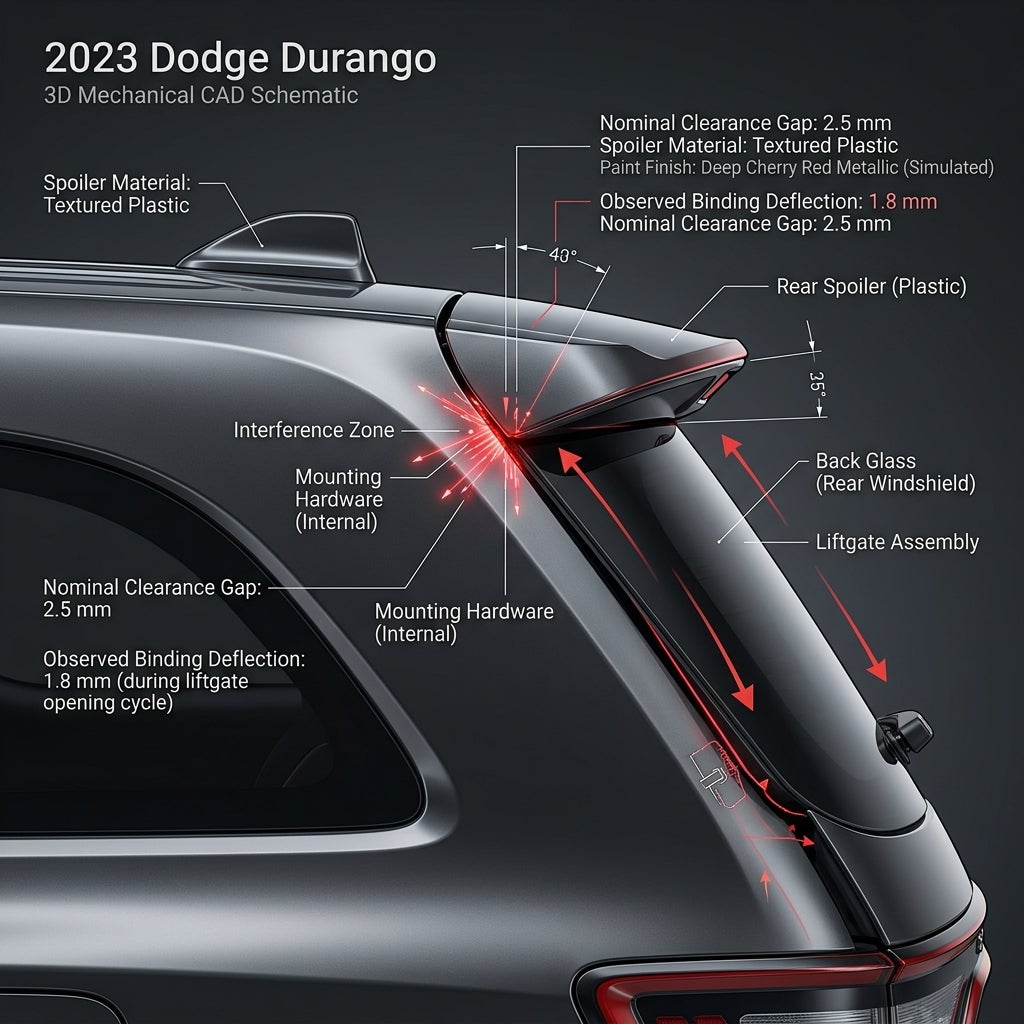
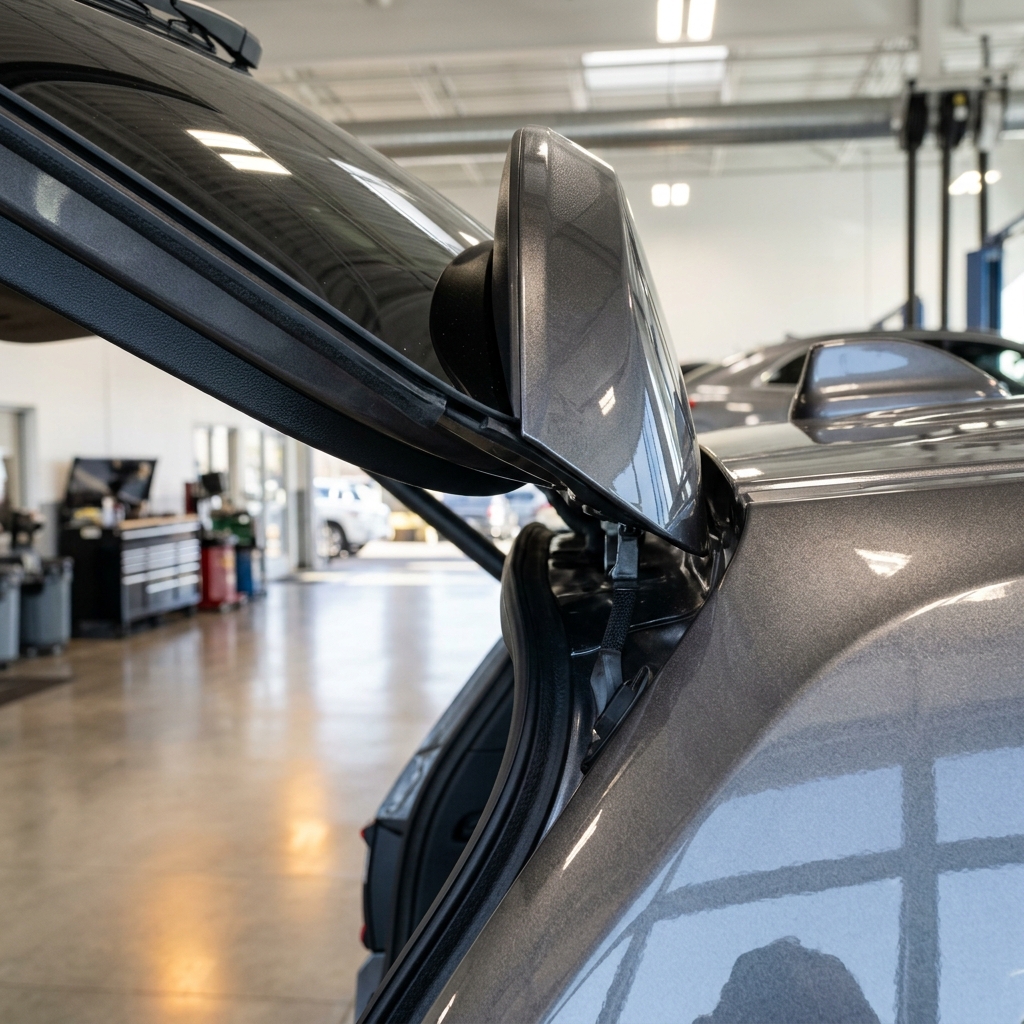
Close-up view of an open grey SUV rear liftgate and hinge mechanism inside an auto repair shop. (Representative image for illustration purposes only. Actual vehicle may vary based on trim and configuration.)
If you drive a 2023 Dodge Durango in Junction City, Fort Riley, or the surrounding Riley County area, you may have heard about an important safety bulletin regarding the rear body structure. Specifically, safety officials and FCA US LLC have issued a safety recall under the classification STRUCTURE:BODY:HATCHBACK/LIFTGATE. Yes, certain 2023 Dodge Durango models are actively recalled due to a clearance issue where the factory-installed rear spoiler can make unintended contact with the roof line whenever the liftgate is operated.
The core safety hazard stems from misaligned or over-torqued rear spoiler assemblies. When the power or manual liftgate raises, inadequate clearance causes the plastic spoiler to bind or grind against the painted metal roof panel. Over time, or even during a single actuation, this force can crack the spoiler structure, chip paint down to raw metal, break glass components, or cause the spoiler to completely detach from the vehicle while driving at highway speeds along I-70. A detached spoiler creates a major road hazard for following motorists, increasing the risk of a crash.
At Valor CDJR, our factory-certified service team is fully equipped to perform this safety recall repair at at no charge to you. If you own or lease a 2023 Durango, we strongly encourage you to verify your 17-digit Vehicle Identification Number (VIN) soon using our online portal or by contacting our service team directly.

Is There a Liftgate Recall on the 2023 Dodge Durango and What Is the Safety Concern?

The National Highway Traffic Safety Administration (NHTSA) alongside FCA US LLC officially identified an engineering and assembly anomaly regarding 2021–2023 Dodge Durango models. Under NHTSA Campaign Number 23V-115 (and FCA recall 10A), the rear spoiler may have been installed with insufficient clearance relative to the rear roof line.
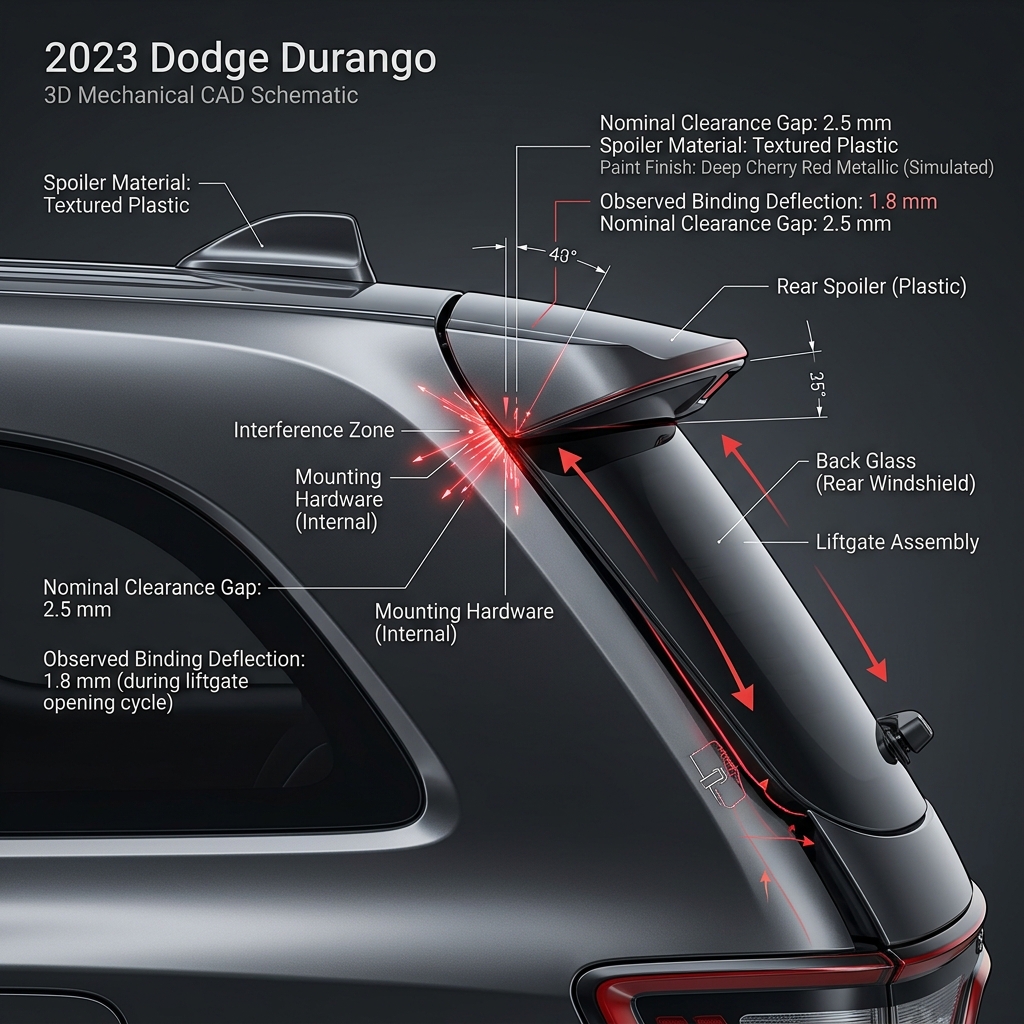
When the hatch opens, the leading edge of the spoiler presses firmly against the roof panel. Beyond the immediate cosmetic paint abrasion, this physical interference places tremendous mechanical stress on the plastic mounting tabs and glass fasteners. Repeated liftgate operations flex the spoiler beyond its structural tolerances.
3D CAD schematic showing rear spoiler clearance and interference zone on a 2023 Dodge Durango. (Representative image for illustration purposes only. Actual vehicle may vary based on trim and configuration.)
The primary safety concern is that damaged or cracked spoilers can completely break away from the body structure while driving. If a spoiler separates at high speeds on highway roads near Manhattan or Fort Riley, it becomes an unguided projectile that can strike behind-following vehicles, shatter windshields, or force drivers into dangerous evasive maneuvers.

Is My 2023 Dodge Durango Included in the Liftgate/Spoiler Structural Recall?

Step 1: Locate Your 17-Digit VIN

Not every single 2023 Durango produced fell victim to this assembly defect, so confirming your vehicle's specific status is critical. Start by locating your 17-character VIN. You can easily find this on your vehicle registration card, insurance documents, or on the driver's side dashboard visible through the bottom corner of the windshield. Alternatively, look at the safety certification label stuck to the driver's side door jamb.
Once you have your VIN, visit the official Mopar recall website or contact the team at Valor CDJR. By entering your VIN, our certified technicians can instantly pull official Chrysler Dodge Jeep Ram factory database records to see if recall 10A / 23V-115 remains open on your vehicle.

Step 2: Physical Inspection at Home

While waiting for your appointment, you can conduct a quick visual inspection of the rear hatch area. Park on level ground and slowly open the rear power liftgate while standing to the side. Watch the upper corners of the rear spoiler where it approaches the roof panel.
Look for visible signs of friction: chipped paint along the edge of the roof, fine plastic dust around the hinges, hairline cracks on the plastic spoiler shell, or a distinct popping or rubbing sound during the opening cycle. If you notice any of these signs, avoid using the power liftgate until it can be serviced at Valor CDJR.

What Repair Should a Junction City-Area Owner Request for the Durango Liftgate Structural Recall?

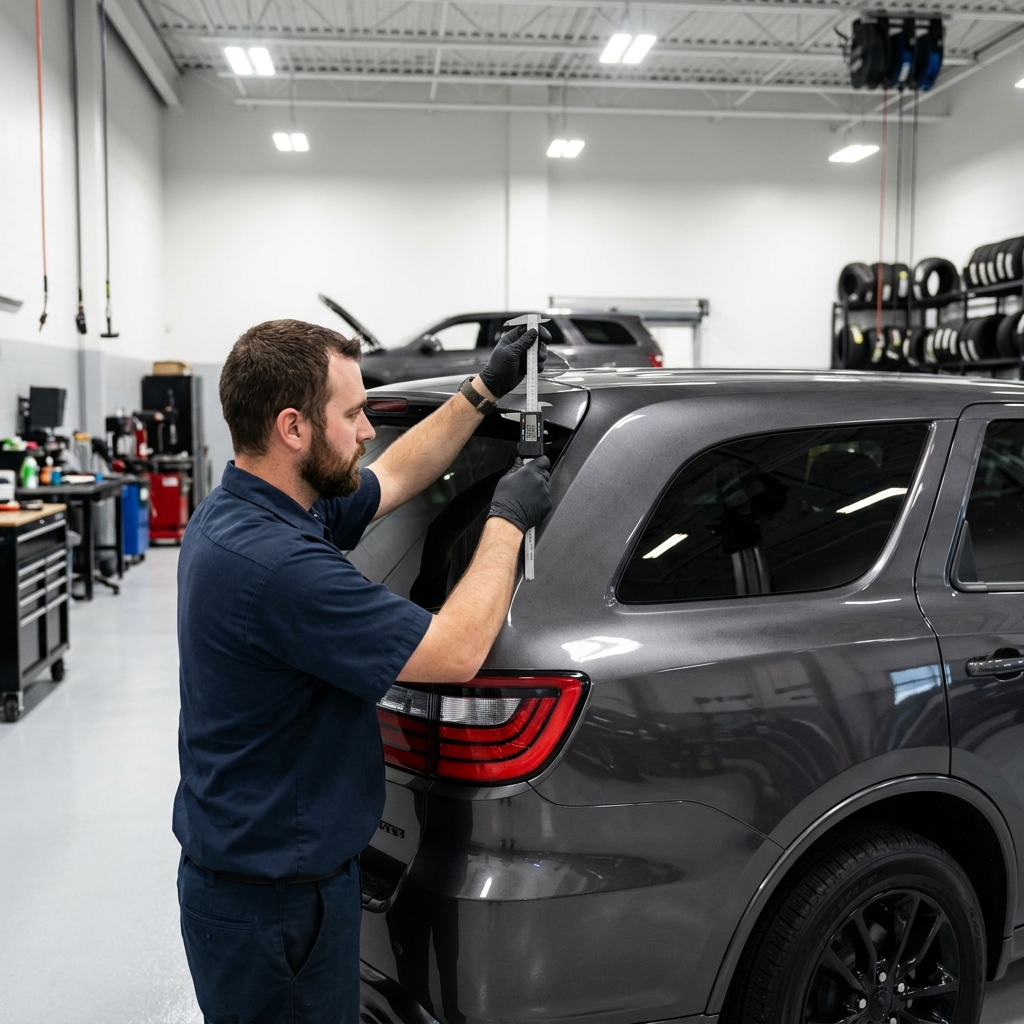
A mechanic wearing black gloves uses a digital caliper to measure the rear panel gap on a dark grey SUV. (Representative image for illustration purposes only. Actual vehicle may vary based on trim and configuration.)

1. Clearance Inspection

Our factory-trained technicians measure the exact gap between the spoiler assembly and roof sheet metal using specialized Mopar clearance feeler tools. If clearance meets factory specs and no damage is detected, proper torque is verified.

2. Assembly Replacement

If the spoiler is cracked, damaged, or fails clearance requirements, our team removes the affected component and installs a brand-new, redesigned OEM rear spoiler assembly manufactured to revised tolerances.

3. Precision Calibration

All mounting hardware is re-torqued strictly to official FCA engineering specifications. We test liftgate travel and calibrate power liftgate motors to guarantee smooth, noise-free, and safe operation for years to come.

How Long Does a Dodge Durango Recall Repair Usually Take?

Service Timeframes

We respect your busy schedule at Valor CDJR. The actual labor time required for the Durango liftgate recall depends on whether your spoiler requires simple clearance verification or full replacement:
• Visual & Feeler Gauge Inspection: Approx. 20–30 minutes. • Full Spoiler Assembly Replacement: Approx. 1 to 2 hours. Our service advisors order necessary OEM replacement parts ahead of time whenever possible to minimize your wait time in our service bay.

Dealership Amenities near Fort Riley

While our factory-trained technicians complete your recall repair, enjoy our comfortable customer lounge featuring complimentary Wi-Fi, fresh coffee, and work stations. If you need routine maintenance performed simultaneously, our Express Lane service is ready to handle quick oil changes and tire rotations without extra delay.
For military personnel stationed at Fort Riley or local commuters in Junction City, we offer convenient scheduling options so you can get back on the road safely and quickly.

What Engine Comes Standard in the 2023 Dodge Durango?

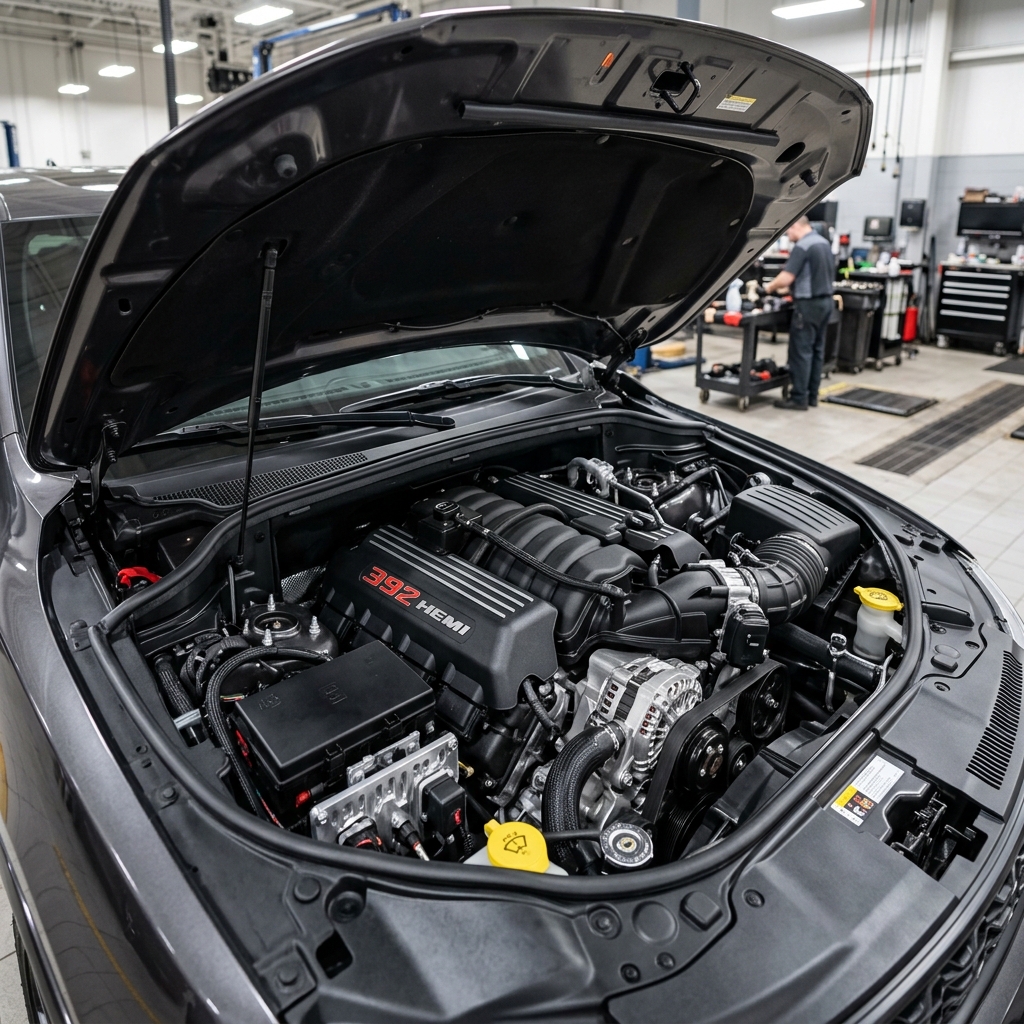
Open hood of a dark gray vehicle showcasing a detailed 392 HEMI V8 engine in an auto repair shop. (Representative image for illustration purposes only. Actual vehicle may vary based on trim and configuration.)

3.6L Pentastar® V6

Standard across most trims, the award-winning 3.6L Pentastar® V6 delivers 295 horsepower and 260 lb-ft of torque. Paired with a smooth 8-speed automatic transmission, it balances everyday efficiency with muscle SUV passing power.

5.7L HEMI® V8 Available

For drivers seeking extra muscle, the available 5.7L HEMI® V8 produces 360 horsepower and 390 lb-ft of torque. It incorporates Variable Valve Timing (VVT) and Fuel Saver Technology for optimal highway cruising performance.

Aerodynamic Stability

Proper roof spoiler alignment is critical for managing rear downforce and drag on windy Kansas highways across Riley County. Fixing structural defects maintains peak high-speed aerodynamics and stability.

Which Vehicle Can Tow More, the Dodge Durango or Ford Explorer?

When comparing maximum towing capabilities in the midsize three-row SUV segment, the 2023 Dodge Durango easily outperforms the Ford Explorer. When equipped with the 5.7L HEMI V8 or 392 HEMI V8 (with Tow N Go Package), the Durango achieves a best-in-class maximum towing capacity of up to 8,700 lbs. Even the standard 3.6L Pentastar V6 handles up to 6,200 lbs.
In comparison, the 2023 Ford Explorer tops out at 5,600 lbs maximum towing capacity when properly equipped with its 3.0L EcoBoost V6 engine. For hauling heavy boats to Milford Lake or pulling travel trailers across the Flint Hills, the Durango provides significantly higher muscle.

Specification

2023 Dodge Durango

2023 Ford Explorer

Standard Towing

6,200 lbs (3.6L V6)

5,300 lbs (2.3L I4)

Max Towing Capacity

8,700 lbs

5,600 lbs

Standard Engine HP

295 hp

300 hp

Available V8 Engine

Yes (5.7L / 6.4L HEMI)

No (V6 Max)

Maintaining your Durango's rear structural integrity—including resolving any liftgate spoiler contact—ensures airflow stability and rear structural safety while towing heavy trailers.

Warning Signs of Rear Spoiler Misalignment and Liftgate Damage on Your Durango

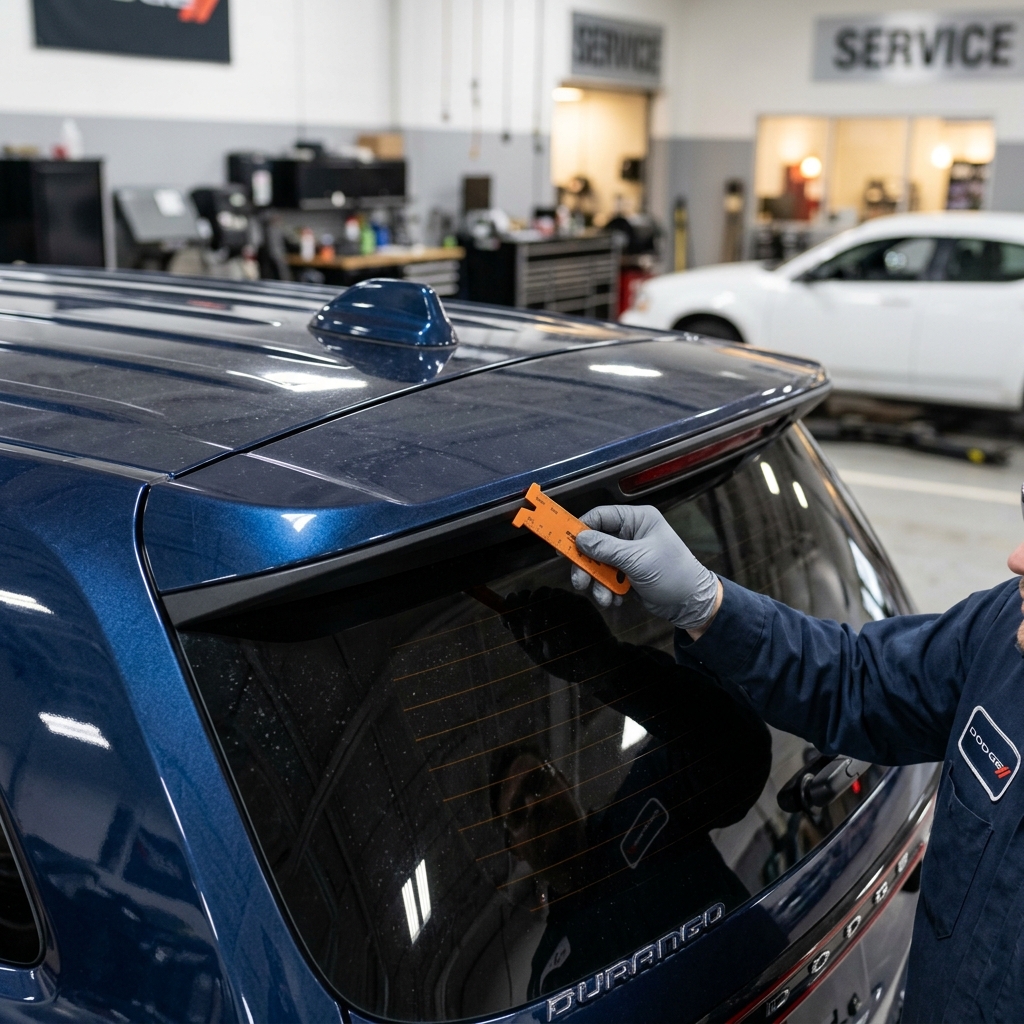
Mechanic using an orange gauge tool to inspect the rear spoiler gap on a blue Dodge Durango in a service shop. (Representative image for illustration purposes only. Actual vehicle may vary based on trim and configuration.)

Auditory Indicators

Listen for distinct scraping, groaning, or loud snapping/popping sounds as the automatic liftgate arm begins to push the hatch upward near its fully open position.

Visual Body Scuffs

Check for paint gouges, scuffs, or clearcoat scratches along the top trailing edge of the roof panel where it meets the forward edge of the rear upper spoiler trim.

Loose Trim & Water Leaks

Gently press on the outer plastic spoiler shell. If it feels loose or wobbly, mounting tabs may already be broken. Watch for moisture near top rear glass seals.

Why Official Recall Repairs Are Completely Free at OEM Dealerships

Federal Safety Mandates

Under federal law (the National Traffic and Motor Vehicle Safety Act), all safety recall repairs must be executed by authorized franchised dealerships at 100% zero cost to the vehicle owner. This includes all necessary diagnostic labor, repair hardware, replacement spoiler assemblies, and paint touch-ups related directly to the recall remedy.
There are no hidden shop fees, deductible charges, or mandatory service add-ons required when bringing your 2023 Durango to Valor CDJR for recall completion.

Protecting Warranty & Resale Value

Having your recall serviced at an authorized dealer ensures official completion is logged directly into Chrysler's global service database. Unregistered recalls can decrease your vehicle's market value when trading in or selling, and open safety recalls can complicate future warranty claims.
Whether you bought your Durango new or are exploring our Used Vehicle Listings, ensuring all safety recalls are closed preserves long-term dependability and resale confidence across Manhattan and Junction City.

How Can a 2023 Durango Owner in Junction City Contact Valor CDJR About Recall Service?

Online Service Booking

Visit our online Service Scheduler 24/7. Simply select 'Recall Inspection', enter your 17-digit VIN, and choose a time slot that fits your schedule.

Direct Phone Consultation

Prefer talking to a live service advisor? Call us at (785) 238-5114. Our team can quickly pull up your VIN history and arrange your appointment.

Visit Our Showroom

We are located at 1825 Goldenbelt Blvd, Junction City, KS 66441. Get Directions to Valor CDJR for fast local access.

Maintaining Your 2023 Dodge Durango Liftgate, Seals, and Exterior Body Hardware

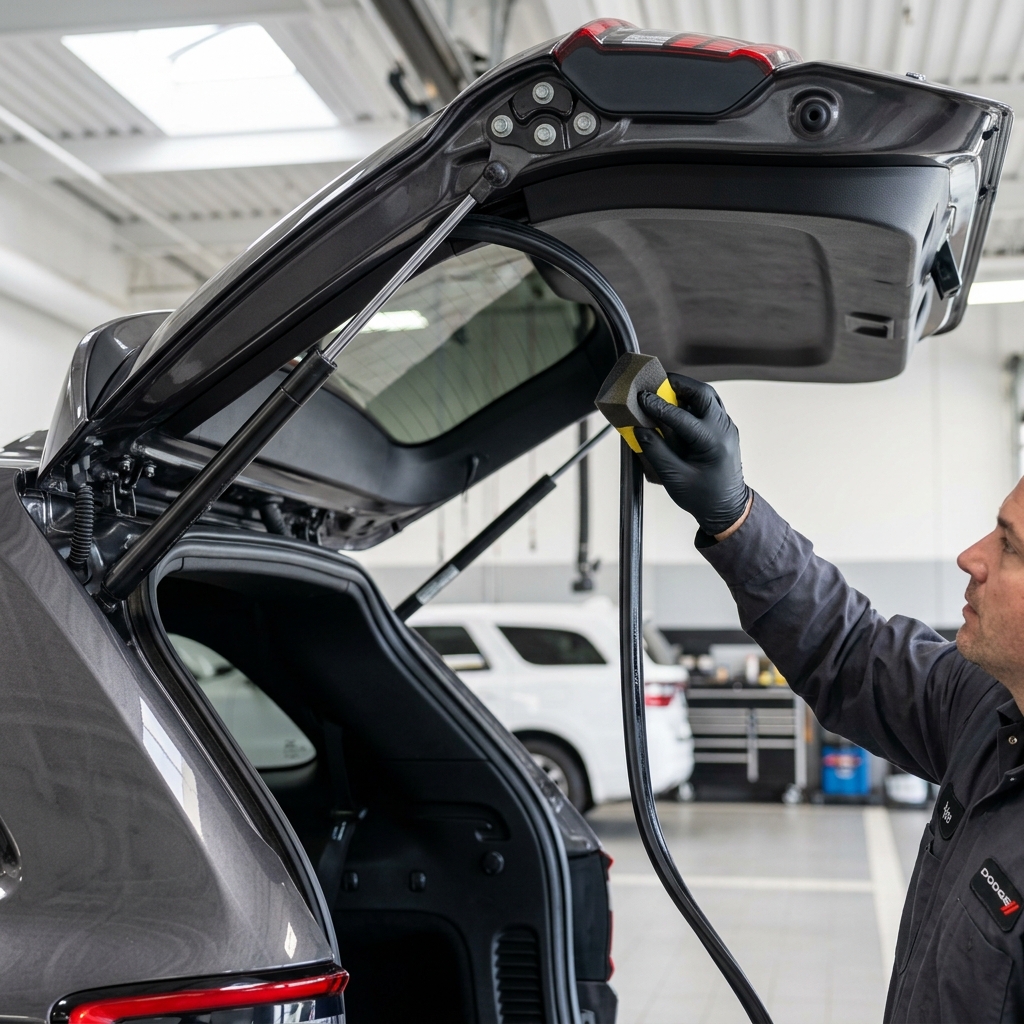
Mechanic in black gloves uses a foam applicator to condition the rubber weatherstrip seal on an open SUV tailgate. (Representative image for illustration purposes only. Actual vehicle may vary based on trim and configuration.)

Proactive Exterior Care Tips

• Protect Weatherstripping: Apply a silicone-based rubber conditioner to perimeter hatch seals before fall and winter to prevent freezing and cracking. • Clean Hinges & Drain Holes: Keep dirt and debris clear from upper hatch hinges and lower drain slots to avoid trapped moisture and rust. • Calibrate Power Liftgate: If your liftgate encounters resistance, avoid forcing it closed. Have technicians recalibrate the auto-reverse sensors. • Use Genuine OEM Components: For all repairs and trim enhancements, consult our Parts Department to ensure 100% factory fitment.

Schedule Your Free 2023 Dodge Durango Liftgate Recall Inspection at Valor CDJR

For your safety or allow liftgate binding to cause permanent body damage on your 2023 Dodge Durango. The certified service team at Valor CDJR in Junction City, KS is ready to inspect, align, or replace your rear spoiler assembly at no charge.
Whether you are interested in upgrading your vehicle through our Trade In Evaluation, exploring Get Pre-Approved options for a newer vehicle, or simply scheduling your complimentary recall service, Valor CDJR is your trusted local automotive partner across Riley County and Fort Riley.
Get Directions to Valor CDJR or Call us at (785) 238-5114 today to confirm your VIN status and book your free recall appointment!

Recommended Posts

Does Jeep Include Complimentary Routine Maintenance with the Grand Cherokee Laredo?

Does Jeep Include Complimentary Routine Maintenance with the Grand Cherokee Laredo?

Does Jeep Include Complimentary Routine Maintenance with the Grand Cherokee Laredo? Eligible Jeep Grand Cherokee models, including the Laredo trim, may include complimentary routine maintenance through the Jeep Wave customer care program for the initial 24 to 36 months of ownership. This factory-backed coverage covers scheduled engine oil changes and tire rotations performed by certified technicians during your first years on the road. Along with regular maintenance visits, the program provides dedicated owner support and trip interruption protection to ensure your SUV stays in peak operating condition from day one. In my 20 years overseeing service departments, I have found that complimentary maintenance programs dramatically improve long-term vehicle health because they encourage owners to establish consistent service habits right after purchase. The factory coverage aligns directly with the manufacturer maintenance schedule, ensuring your vehicle receives genuine fluids and filters before minor wear develops into a costly mechanical problem. When you visit our service center on Goldenbelt Boulevard, our factory-trained technicians log each completed service into the national Mopar database to maintain a clean vehicle history. Beyond scheduled maintenance, a new Jeep Grand Cherokee Laredo comes backed by robust factory warranty protection. You may receive a 3-year/36,000-mile basic warranty that covers many bumper-to-bumper components against manufacturing defects, alongside a 5-year/60,000-mile powertrain limited warranty covering the engine, transmission, and driveline assembly, depending on the model year and factory warranty terms. Jeep may also include roadside assistance coverage, giving you support for flat tires, battery jump-starts, and emergency towing. If you ever have questions regarding what your active warranty covers or want to verify your remaining Jeep Wave benefits, you can give our team a quick call to check your status. Table of Contents Recommended Engine Oil and Filter Intervals for the 3.6L Pentastar V6 Brake Pad and Rotor Replacement Intervals for Grand Cherokee Owners Performing Routine Maintenance at Home Without Voiding Your Factory Warranty How Heavy Towing Changes Your Grand Cherokee Laredo Maintenance Schedule Winter Readiness: Battery, Coolant, and Chassis Checks Recommended Engine Oil and Filter Intervals for the 3.6L Pentastar V6 The standard 3.6-liter Pentastar V6 engine requires SAE 0W-20 full synthetic engine oil certified to meet Chrysler Material Standard MS-6395. Using the correct synthetic formulation is essential because the Pentastar engine utilizes variable valve timing and hydraulic valve lifters that depend on immediate oil pressure across a wide range of operating temperatures. The oil capacity for this engine is 5.0 quarts with a fresh filter replacement, and cutting corners with conventional oil or incorrect viscosity grades can lead to premature valvetrain wear and camshaft sensor codes. Oil and filter service on the Jeep Grand Cherokee Laredo is managed by an automated oil-life monitoring system that analyzes engine operating temperatures, trip lengths, idle time, and overall load to calculate remaining fluid lifespan. Under normal highway driving conditions, the oil change indicator typically illuminates between 7,500 and 10,000 miles. However, the factory guidelines mandate that the interval between oil changes must never exceed 10,000 miles, 12 months, or 350 engine hours, whichever milestone comes first. If your daily driving involves frequent short trips or extended idling, the monitor will alert you much earlier, often closer to 5,000 miles. Regular filter replacement is just as critical as the oil itself. The Pentastar engine uses a top-mounted cartridge oil filter housed inside an upper manifold assembly, requiring careful torque application of 18 lb-ft on the plastic cap to prevent hairline cracks and oil seepage. During an oil service, our technicians also inspect the engine air filter, which typically requires replacement every 30,000 miles under normal conditions, and the cabin air filter, which should be changed every 12,000 to 20,000 miles to maintain crisp climate control airflow. To keep your SUV running smoothly, you can reserve an appointment through our online service scheduler at your convenience. Brake Pad and Rotor Replacement Intervals for Grand Cherokee Owners Front brake pads on a Jeep Grand Cherokee Laredo generally require replacement between 30,000 and 60,000 miles, while rear brake pads often last slightly longer, reaching 40,000 to 70,000 miles under normal highway driving conditions. Because the Grand Cherokee is a substantial midsize SUV with an unladen curb weight topping 4,200 pounds, driving style and cargo weight play major roles in how quickly friction materials wear down. Vehicles used primarily for stop-and-go commuting will naturally wear down pads much sooner than those driven predominantly on open rural highways. Brake rotors should be measured with a micrometer at every pad change to ensure they exceed minimum discard thickness specifications before being resurfaced or replaced. Front rotors endure significant kinetic energy and heat transfer, making them susceptible to surface grooving and thermal warping over time. If you feel a high-speed steering wheel pulsation when braking or hear a metallic squeal from the wear indicators, your pads have likely worn down to their final millimeters of usable friction material. Replacing worn pads promptly protects the rotors from metal-on-metal contact, preventing costly caliper damage. Routine brake maintenance also requires periodic hydraulic fluid care. Brake fluid is hygroscopic, meaning it absorbs moisture from ambient humidity over time, which lowers its boiling point and can create a spongy brake pedal during heavy braking. Jeep recommends inspecting brake fluid clarity and testing water content at every service interval, with a complete hydraulic fluid flush recommended every two to three years. When you need replacement friction components or factory hardware, our on-site parts department provides original-equipment Mopar brake pads and rotors engineered specifically for your vehicle's stopping requirements. Performing Routine Maintenance at Home Without Voiding Your Factory Warranty Vehicle owners can perform routine maintenance services at home without voiding their factory warranty, provided the work adheres strictly to manufacturer intervals and utilizes correct fluid specifications. The federal Magnuson-Moss Warranty Act protects consumer rights by prohibiting manufacturers from denying warranty coverage simply because maintenance was completed outside an authorized dealership. If you prefer changing your own engine oil, swapping cabin air filters, or replacing wiper blades in your home garage, your factory protections remain fully intact. To safeguard your warranty coverage against potential future disputes, documentation is essential. If an engine component experiences a mechanical failure and you submit a warranty claim, the manufacturer has the right to request proof that scheduled maintenance was performed according to factory requirements. You should maintain an organized service binder or digital folder containing: Itemized purchase receipts showing the exact date, brand, and part numbers for oil, filters, and fluids Packaging slips confirming that engine oil meets Chrysler Material Standard MS-6395 A written maintenance log noting the exact mileage, date, and procedure completed Tire rotation logs detailing tread depth measurements and rotation patterns Avoiding aftermarket components that fail to meet factory engineering tolerances is equally critical. Using an off-brand oil filter without an internal bypass valve or pouring non-specified fluids into the transfer case can cause mechanical failures that warranty adjusters will attribute directly to improper parts rather than factory defects. While basic filter and fluid changes are straightforward for experienced home mechanics, complex diagnostics, electronic module updates, and transfer case services are best handled by certified technicians equipped with factory diagnostic tools. How Heavy Towing Changes Your Grand Cherokee Laredo Maintenance Schedule Towing a utility trailer, camper, or boat shifts your Jeep Grand Cherokee Laredo from the standard maintenance schedule into the severe-duty service interval. Sustained trailering elevates operating temperatures inside the transmission, rear differential, and engine cooling circuit, which causes lubricants to shear and degrade significantly faster than during normal commuting. When you regularly tow loads across Highway 177 toward Manhattan, routine inspections must be performed at shorter intervals to prevent accelerated wear on mechanical components. Under severe operating conditions, engine oil should be replaced closer to 4,000 or 5,000 miles rather than waiting for the maximum 10,000-mile mark. Differential gear lubricants also demand closer attention. The front and rear axles use synthetic hypoid gear oil that breaks down under the sustained thermal stress of pulling heavy weights. Jeep recommends changing the rear differential fluid every 20,000 to 30,000 miles when vehicles are subjected to frequent towing, compared to much longer intervals for unladen highway cruisers. The eight-speed automatic transmission fluid should also be inspected regularly for heat discoloration. Achieving the full 6,200-lb towing capacity on a Laredo powered by the standard 3.6-liter Pentastar V6 requires specific factory equipment. The vehicle must be equipped with the optional Trailer Tow Prep Group or full factory tow package, which includes: A heavy-duty engine cooling system with a high-capacity radiator and auxiliary transmission cooler A sturdy Class IV receiver hitch integrated directly into the rear unibody frame Standard 7-pin and 4-pin electrical wiring harnesses for trailer brake and lighting control Rear load-leveling suspension shocks that maintain proper vehicle ride height and headlight aim A full-size spare tire matching the rolling diameter of the road wheels Without this factory cooling and electrical equipment, standard models are limited to a baseline towing capacity of 3,500 pounds, and attempting to tow heavier loads risks severe overheating and premature transmission failure. Winter Readiness: Battery, Coolant, and Chassis Checks Cold Midwestern winter mornings place extraordinary demands on your vehicle's starting, charging, and thermal management systems. Drivers commuting past Fort Riley face rapid temperature drops that strain 12-volt electrical systems, making pre-winter preventative maintenance crucial for dependable daily operation. A comprehensive cold-weather inspection ensures that chemical fluids retain their protective properties and mechanical parts perform reliably across freezing slush and icy asphalt. Your winter readiness checklist should begin with a digital battery conductance test. Automotive batteries lose roughly thirty to fifty percent of their cranking power when temperatures drop below freezing, while the engine simultaneously requires higher amperage to turn over cold, viscous motor oil. Our technicians inspect the battery terminals for corrosion, verify that the cold-cranking amperage output meets factory ratings, and inspect the charging system alternator output. Any battery displaying marginal reserve capacity should be replaced before the first severe freeze leaves you stranded. Cooling system chemistry and chassis components require equal vigilance before winter weather arrives: Test coolant antifreeze concentration using a refractometer to ensure freeze protection down to -34 degrees Fahrenheit Inspect the serpentine accessory drive belt for micro-cracks or tensioner slack that could slip on frosty pulleys Measure tire tread depth, ensuring at least 4/32 inches of remaining tread for adequate slush evacuation Verify tire inflation pressures, compensating for the natural drop of one pound per square inch for every ten-degree drop in outside temperature Inspect brake pads for even wear and examine hydraulic lines for road-salt corrosion or moisture intrusion Taking time to address these critical maintenance points before winter settles in protects your vehicle's mechanical longevity and keeps your SUV ready for challenging road conditions. If you want our certified technicians to complete a thorough multi-point inspection or winter service check, you can contact our service advisors at (785) 238-5114 or stop by our service drive on Goldenbelt Boulevard to ensure your vehicle is completely prepared for the season ahead. © 2026 Valor CDJR. All rights reserved.

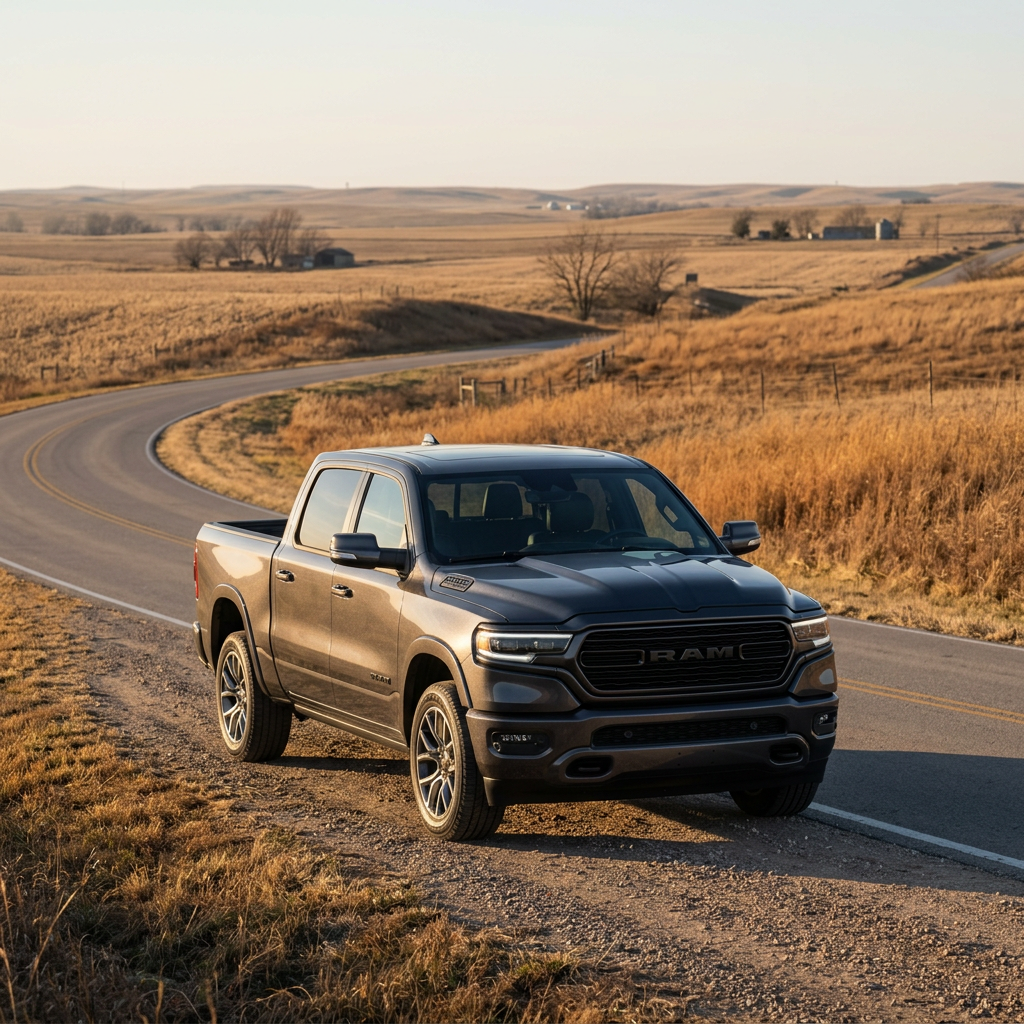
2026 ram 1500

2026 RAM 1500 Reliability and Long-Term Ownership: Expert Q&A with Valor CDJR General Manager Jace Grabouski

2026 RAM 1500 Reliability and Long-Term Ownership: Expert Q&A with Valor CDJR General Manager Jace Grabouski The 2026 Ram 1500 delivers proven mechanical durability with its 3.0-liter Hurricane twin-turbo inline-six, which earned the top spot in the Large Light Duty Pickup segment in the J.D. Power 2026 Vehicle Dependability Study. Today, we sit down with Jace Grabouski, General Manager at Valor CDJR, who brings 20 years of automotive experience to examine real-world maintenance, five-year operating expenses, and overall powertrain longevity across the lineup. How Reliable Is the 2026 Ram 1500 with the 3.0-Liter Hurricane Engine? Q: Jace, how durable is the 3.0-liter Hurricane engine when drivers put it through demanding everyday service? A: The twin-turbocharged 3.0-liter Hurricane inline-six is engineered from the ground up for commercial-grade durability, using a deep-skirt cast-aluminum block reinforced with cross-bolted steel main bearing caps and a forged steel crankshaft. Inside the cylinders, thermal-sprayed plasma transfer wire arc coatings replace traditional heavy iron liners, creating a surface that reduces friction while shedding heat rapidly. The standard-output version puts out 420 hp and 469 lb-ft of torque, while the high-output iteration generates 540 hp and 521 lb-ft of torque, giving drivers substantial muscle without working the rotating assembly to its mechanical limits. Modern twin-turbo platforms depend on efficient heat management, and the Hurricane utilizes dedicated water-to-air charge coolers alongside dual variable-displacement oil pumps to ensure immediate cooling and lubrication. Technicians who service these trucks see very clean internals when routine maintenance is respected, as the dual high-pressure fuel pumps maintain precise direct injection that prevents unburned fuel wash on cylinder walls. In the J.D. Power 2026 Vehicle Dependability Study, the Ram 1500 ranked highest among large light-duty pickups, demonstrating that the structural foundation translates into dependable real-world performance. For trade contractors hauling heavy tools and equipment out toward the river valley in Junction City, this powertrain delivers steady torque down low where you need it most. If you want to experience how this twin-turbo platform delivers power, you can stop by our showroom address on Goldenbelt Blvd or give our team a quick call to discuss build options. Table of Contents What Are the Projected Five-Year Ownership and Repair Costs for the 2026 Ram 1500? How Much Does It Cost to Maintain or Replace Air Springs on a Ram 1500? What Is the Real-World Towing Capacity and Payload Strength of the 2026 Ram 1500? What Standard Equipment and Value Does the 2026 Ram 1500 Big Horn Deliver? How Do Ram 1500 and Ford F-150 Annual Insurance and Operating Costs Compare? What Factory Incentives, Warranty Protections, and Trade Options Help Long-Term Ram 1500 Buyers? What Are the Projected Five-Year Ownership and Repair Costs for the 2026 Ram 1500? Q: What should prospective buyers budget for maintenance, depreciation, and repairs over a five-year ownership cycle? A: Industry ownership data from Kelley Blue Book calculates the five-year ownership cost for a 2026 Ram 1500 Quad Cab at $71,319, which places it squarely in the middle tier for full-size pickups. That total accounts for $23,956 in projected depreciation alongside $47,363 in out-of-pocket operating expenses over 75,000 miles of driving. When you isolate routine maintenance, the five-year estimate comes out to $5,072, while unscheduled mechanical repairs account for roughly $1,652 across that same period. Full-synthetic oil changes on the twin-turbo Hurricane engine should occur every 7,500 to 10,000 miles during normal highway commuting, though drivers who regularly tow heavy trailers should shorten that interval to 5,000 miles to preserve turbocharger bearings. The eight-speed automatic transmission and heavy-duty rear axle run on long-life fluid formulations that minimize recurring service visits. Keeping up with scheduled fluid exchanges and filter replacements prevents minor wear from compounding into major shop visits. Truck owners looking to maintain factory running tolerances can schedule their maintenance through our online service booking tool. Our certified technicians use components directly from our dedicated Mopar parts counter, ensuring factory fitment on every replacement. Buyers interested in exploring late-model options with established maintenance records can also examine our pre-owned truck inventory to evaluate how previous model years hold their residual value. How Much Does It Cost to Maintain or Replace Air Springs on a Ram 1500? Q: Air suspensions provide exceptional comfort, but what does replacement run if a corner develops a leak down the road? A: Replacing a single air spring or strut assembly on a Ram 1500 typically costs between $800 and $1,400 per corner for factory parts and labor, while an entire four-corner system overhaul can exceed $3,500 if neglected over many years. The factory Active-Level Four-Corner Air Suspension uses a closed-loop pressurized nitrogen system that protects the compressor and valve block from outside humidity and road debris. As long as the rubber air bladders remain free of tears and road grit, the system operates dependably for 100,000 miles or more before showing age. "Routine inspections catch moisture buildup before a valve or compressor ever sees unnecessary wear." Standard steel coil springs remain the base configuration on trims like the Tradesman and Big Horn, delivering an exceptionally smooth ride without the added complexity of pneumatic lines. However, drivers who regularly load heavy pallets into the bed often prefer the air setup because it automatically levels the truck to preserve steering geometry and headlight aim. If you plan to keep an air-ride truck well past the warranty period, inspecting the protective rubber boots during every tire rotation is the simplest way to prevent premature leaks. Long-term maintenance planning starts with choosing the right financing structure and warranty coverage from day one. Buyers exploring payment structures for air-ride equipped configurations can prequalify online to set a clear baseline for their monthly budget before making a final equipment decision. What Is the Real-World Towing Capacity and Payload Strength of the 2026 Ram 1500? Q: How do the towing limits and payload numbers break down across the different engine choices? A: Maximum towing capacity for the 2026 Ram 1500 reaches up to 11,610 pounds when configured with the standard-output 3.0-liter Hurricane engine, matching the top tow rating achieved with the 3.6L Pentastar V6 equipped with the eTorque mild-hybrid setup. For drivers carrying heavy cargo directly in the bed, maximum payload strength peaks at 2,360 pounds on a two-wheel-drive Tradesman Quad Cab equipped with the standard V6. Specifying the standard-output Hurricane engine provides a robust payload rating of 1,930 pounds, while the high-output Hurricane delivers 1,490 pounds of payload alongside a 10,000-pound maximum tow rating. The frame underneath every 2026 Ram 1500 is constructed with 98% high-strength steel, providing rigid structural backing that resists flex when towing near maximum capacity. The rear five-link coil suspension controls axle hop over broken pavement, keeping trailers tracking true without the jarring rebound typical of traditional multi-leaf setups. When properly equipped with the integrated trailer brake controller and available trailer reverse steering control, maneuvering large horse trailers or equipment flatbeds becomes remarkably predictable. Livestock haulers navigating the hilly prairie roads toward Manhattan frequently point out how quickly the twin-turbo Hurricane builds peak torque at just 3,500 RPM. That low-end delivery eliminates the high-RPM gear hunting that used to happen on steep grades with older naturally aspirated powertrains. What Standard Equipment and Value Does the 2026 Ram 1500 Big Horn Deliver? Q: Why does the Big Horn trim continue to be one of the most popular configurations for practical truck owners? A: The Big Horn trim strikes an ideal balance between rugged utility and modern convenience by packaging durable cloth seating, an eight-way power-adjustable driver seat, a leather-wrapped steering wheel, and a 12.0-inch Uconnect touchscreen as core equipment. On the exterior, the Big Horn features 18-inch cast aluminum wheels, chrome bumpers, chrome grille accents, and integrated front fog lamps that cut through heavy morning river fog. Standard keyless entry and push-button ignition streamline daily commercial operations, making it easy to jump in and get straight to work. Buyers who need additional trail capability can equip the Big Horn with the BackCountry package, which adds a 1-inch suspension lift, heavy-duty off-road shocks, protective underbody skid plates, an electronic locking rear differential, and 32-inch all-terrain tires. That package also includes durable vinyl bucket seats, heavy-duty rubber slush mats, and a MOLLE utility storage system integrated into the front seatbacks for organizing gear. It provides dedicated trail readiness without pushing the purchase price into luxury territory. Before finalizing a new truck build, getting an accurate appraisal on your current vehicle helps offset initial acquisition costs. Drivers can submit their current vehicle details into our trade-in evaluation form to receive an upfront assessment that can be applied directly to their down payment. How Do Ram 1500 and Ford F-150 Annual Insurance and Operating Costs Compare? Q: Does the Ram 1500 hold a clear operating cost advantage over the Ford F-150 when factoring in insurance premiums and repair frequency? A: Annual insurance premiums between the Ram 1500 and Ford F-150 remain nearly identical across national insurance indexes, averaging between $1,800 and $2,100 per year depending on driver history, geographic location, and trim level. Where the Ram establishes an advantage is in unscheduled maintenance frequency, with RepairPal data showing the Ram 1500 averages 0.72 shop visits per year compared to 0.98 visits for the overall full-size pickup segment. Annual repair costs for the Ram 1500 average $652, which undercuts the segment average of $752 per year. Safety performance also plays an active role in keeping commercial insurance classifications manageable. Kelley Blue Book reports a five-star overall crash-test safety rating from the National Highway Traffic Safety Administration for both Quad Cab and Crew Cab body styles. Standard driver-assist technology on every 2026 model includes full-speed forward collision warning with active braking, blind-spot monitoring with trailer coverage, rear cross-path detection, and active lane management. The Ford F-150 relies on an aluminum body construction that can result in higher labor rates and specialized tooling costs at independent collision repair facilities following minor impacts. The Ram 1500 uses high-strength steel outer body panels that traditional body shops can repair more conventionally, preventing minor sheet-metal incidents from triggering inflated repair bills. What Factory Incentives, Warranty Protections, and Trade Options Help Long-Term Ram 1500 Buyers? Q: Jace, what practical steps should truck buyers take to maximize their warranty coverage and purchase incentives? A: Factory warranty protection on the 2026 Ram 1500 provides a 3-year/36,000-mile basic limited warranty alongside powertrain coverage that spans 5 years or 60,000 miles, with select commercial programs eligible for extended 10-year/100,000-mile powertrain terms. In addition, new owners receive comprehensive factory roadside assistance that covers towing to an authorized dealer, flat tire changes, and emergency lockout support. If you ever face an unexpected mechanical stop, you can reach out directly to Ram Roadside Assistance: 1-800-521-2779 for dedicated factory support. Seasonal manufacturer incentives may be available on select configurations, so contact our team for current pricing and details. Combining regional consumer cash with trade appraisals can help you establish strong equity from the day you take delivery. The most effective next step is to sit down with our team, review the available cab styles, and verify which axle ratio and powertrain align with your towing weight. You can view our new Ram 1500 inventory to see incoming shipments, stop by our showroom at 1825 Goldenbelt Blvd, or reach our truck desk directly at (785) 238-5114 to set up a comprehensive road test. © 2026 Valor CDJR. All rights reserved.

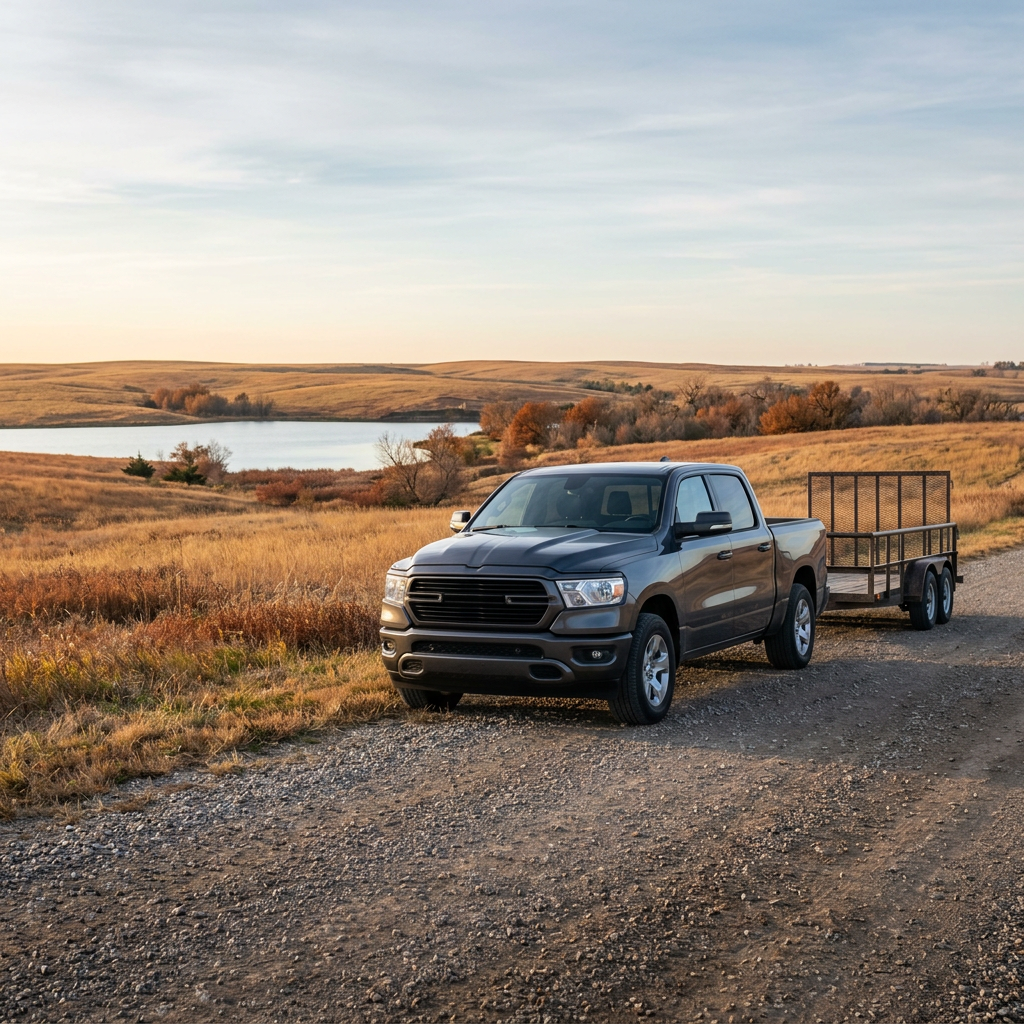
What 20 Years in the Service Bay Taught Me About RAM 1500 Reliability

What 20 Years in the Service Bay Taught Me About RAM 1500 Long-Term Reliability

What 20 Years in the Service Bay Taught Me About RAM 1500 Long-Term Reliability Does Continuous Heavy Towing Reduce the Overall Lifespan of the Ram 1500? Continuous heavy towing does not inherently shorten the total operational lifespan of a Ram 1500, provided maintenance intervals are adjusted for severe-duty operation. Towing regularly near the truck's maximum rating of 11,580 pounds accelerates fluid shear and thermal breakdown in the transmission, rear differential, and cooling system. Replacing gear oil, transmission fluid, and engine oil at shorter mileage thresholds prevents premature component degradation. In my 20 years as Service Director at Valor CDJR, I have seen hundreds of half-ton trucks pass through our service bays with over 150,000 miles on the odometer. The trucks that perform reliably long-term under heavy load are the ones whose owners follow a strict severe-duty maintenance regimen. When hauling equipment trailers or boats around Milford Lake near Junction City, thermal stress is the primary threat to drivetrain longevity. Heat breaks down transmission fluid viscosity, leading to clutch slippage and valve body wear if left unchanged past recommended service windows. To protect critical mechanical assemblies, severe-duty service guidelines require changing the automatic transmission fluid every 60,000 miles and servicing the rear axle fluid at similar intervals. Upgrading to a heavy-duty cooling package and monitoring transmission fluid temperatures during summer pulls prevents heat buildup. If you have questions about severe-duty maintenance schedules or need turn-by-turn guidance to our facility, you can find our Junction City location online or give our service desk a quick call at (785) 238-5114. Table of Contents Is the 3.6L Pentastar V6 Reliable for Daily Towing and Long-Term Hauling? How Can Owners Prevent Air Suspension Failures During Winters? Does Fuel Economy Degrade Significantly as a Ram 1500 Ages? What Long-Term Issues Affect the Uconnect Infotainment System? How Does Mileage Affect Ram 1500 Resale Value, Trade-In Figures, and Insurance Costs? Is the 3.6L Pentastar V6 Reliable for Daily Towing and Long-Term Hauling? The 3.6L Pentastar V6 engine paired with the eTorque mild-hybrid system delivers exceptional baseline reliability and low operating costs for daily driving and light-to-moderate towing up to 7,700 pounds. Its naturally aspirated design avoids turbocharger heat saturation, making it durable over 150,000 miles when paired with regular oil changes using synthetic fluid. This power unit generates 305 hp and 271 lb-ft of torque, utilizing a 48-volt belt-driven motor generator to assist low-rpm takeoff and smooth out stop-start transitions. For light agricultural work or utility trailers, the engine operates within a low-stress power band that minimizes internal wear over long ownership periods. While it lacks the top-end pulling power of the turbocharged 3.0L Hurricane inline-six engines—which push output to 420 hp or 540 hp [1]—the V6 remains a practical choice for buyers prioritizing low maintenance overhead. High-mileage Pentastar engines occasionally require rocker arm and oil filter housing inspections around 100,000 miles, but routine service keeps these units running cleanly. Drivers interested in exploring current configurations can review our new Ram inventory or source OEM filters and fluids directly through our parts department. How Can Owners Prevent Air Suspension Failures During Winters? Preventing cold-weather air suspension failures requires keeping moisture out of the pneumatic lines and maintaining air compressor filtration before winter temperatures drop below freezing. Freezing condensation inside the control valves causes system fault codes, compressor burnout, and ride-height sag. Injecting an approved air suspension line conditioner and inspecting rubber air bladders for cracking prevents winter valve freezes. During Midwestern winter transitions across the rolling Flint Hills around Manhattan, rapid temperature drops cause trapped atmospheric water inside the closed-loop system to ice up. When water freezes in the valve block, the air compressor works continuously to build pressure, which quickly overheats and damages the pump motor. Inspecting rubber air springs during routine tire rotations is equally critical. Road salt and gravel debris chafe the lower air bag sleeves, leading to slow leaks that force the compressor to overwork. For owners evaluating high-mileage pre-owned trucks equipped with four-corner air suspension, inspecting system performance on a rack is essential. You can examine factory-equipped models by browsing our pre-owned vehicle selection. Does Fuel Economy Degrade Significantly as a Ram 1500 Ages? Fuel economy does not degrade significantly as a Ram 1500 ages if core combustion and drivetrain components receive timely maintenance. Natural efficiency losses are typically limited to 1 to 2 mpg over 100,000 miles and stem directly from worn spark plugs, carbon-fouled fuel injectors, dirty air filters, or aging oxygen sensors. The base 3.6L Pentastar V6 achieves an EPA-estimated 22 mpg combined, while the standard-output 3.0L Hurricane inline-six returns an EPA-rated 20 mpg combined in four-wheel-drive configurations. As mileage accumulates, carbon deposits on intake valves and fuel injector nozzles disrupt spray patterns, causing incomplete combustion and reduced fuel mileage. Replacing spark plugs at the 100,000-mile service mark and flushing the fuel injection system restores factory air-fuel ratios. Additionally, drag caused by sticky brake calipers or worn wheel bearings can drag down highway efficiency without triggering an immediate warning light. Staying current on preventive maintenance using our online service scheduling tool keeps your truck running at peak miles per gallon throughout its lifespan. What Long-Term Issues Affect the Uconnect Infotainment System? Long-term issues affecting the Uconnect system primarily involve touchscreen display delamination, sluggish menu responsiveness, and occasional Bluetooth or smartphone pairing freezes. Screen delamination occurs when the adhesive layer between the outer glass and inner digitizer separates under prolonged sun exposure and cabin heat, creating bubble patterns or phantom touch inputs. The available 12.0-inch touchscreen and 14.5-inch touchscreen displays rely on complex software modules that process navigation, climate controls, and vehicle settings. Over time, memory fragmentation within the system module can cause slow boot times or delayed responses during climate adjustments. Many software glitches are resolved through over-the-air firmware updates or hard module resets performed in our service bay. When physical screen delamination occurs, replacing the digitizer display panel restores full touch response. Buyers planning long-term ownership can structure protective coverage by completing our online credit pre-approval application prior to purchase. How Does Mileage Affect Ram 1500 Resale Value, Trade-In Figures, and Insurance Costs? Mileage can impact Ram 1500 resale value through a typical depreciation curve, with trucks often retaining roughly 50% to 55% of their original MSRP after five years and 60,000 miles. Passing the 100,000-mile mark creates a sharper drop in trade-in valuation, while annual insurance premiums vary depending on driver history and trim level. Full-size trucks maintain strong residual demand due to their utility and body-on-frame construction. Well-maintained trucks with documented service records consistently command higher trade-in offers, even at elevated mileage thresholds. Trim level also plays a key role; popular mid-level configurations like the Big Horn and Laramie retain broad buyer appeal in the secondary market. When planning to upgrade or sell, obtaining an accurate vehicle valuation ensures you receive maximum equity for your truck. You can estimate your vehicle's current worth using our online trade-in evaluation tool. If you want to discuss trade-in options or inspect new inventory in person, feel free to visit our Goldenbelt Boulevard dealership or reach out to our team at (785) 238-5114. © 2026 Valor CDJR. All rights reserved.