Blog / Commercial Truck Reviews

What Cab Configurations and Frame Lengths Are Offered on the RAM 4500?

What Cab Configurations and Frame Lengths Are Offered on the RAM 4500?

What Cab Configurations and Frame Lengths Are Offered on the Ram 4500?

When configuring a commercial workhorse like the 2025 Ram 4500 Chassis Cab, matching your cab selection and frame dimensions precisely to your operational needs is the single most critical decision you will make. The Ram 4500 is engineered from the ground up to accommodate a vast range of commercial applications across Kansas, from heavy-duty ag operations in Geary County to municipal utility crews in Manhattan and construction sites in Junction City. Understanding how cab style and Cab-to-Axle (CA) measurements interact with body length, payload distribution, and overall turning geometry is essential before committing capital to a commercial fleet addition.
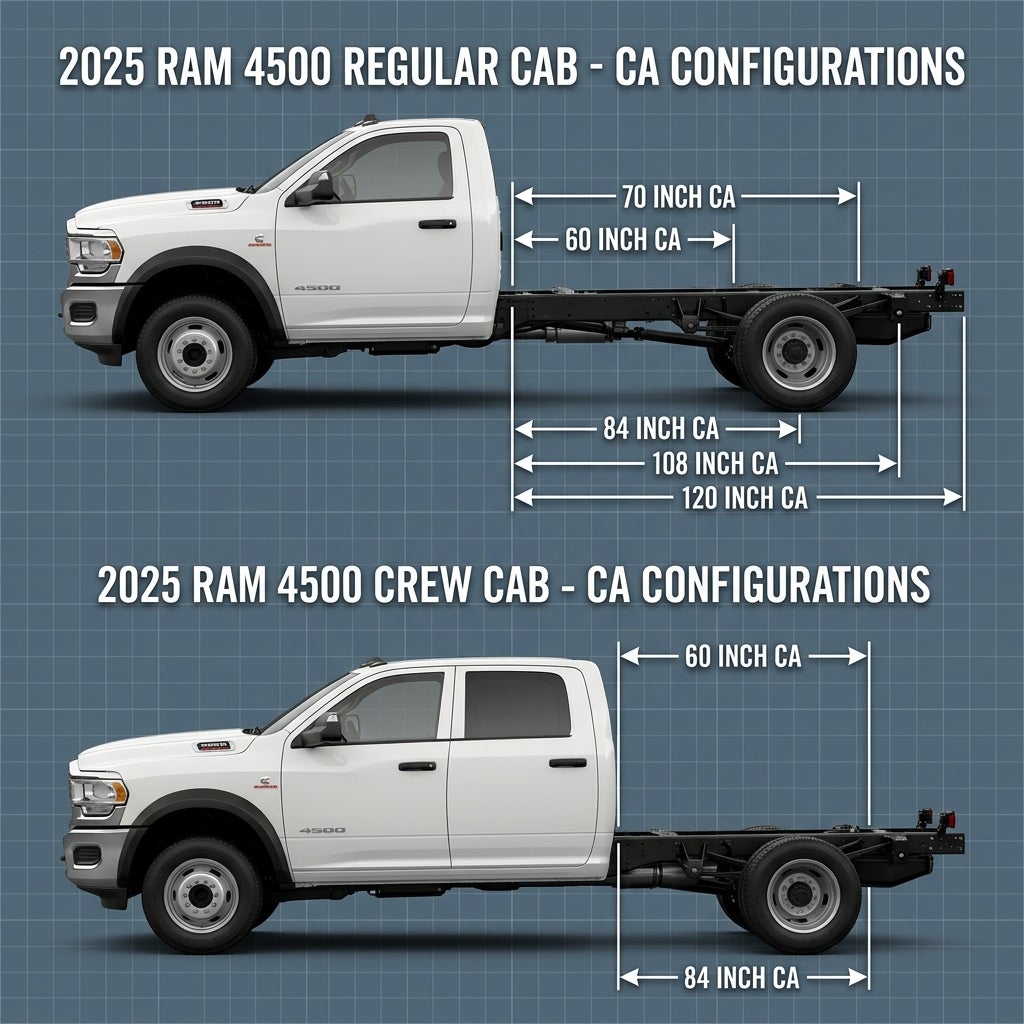
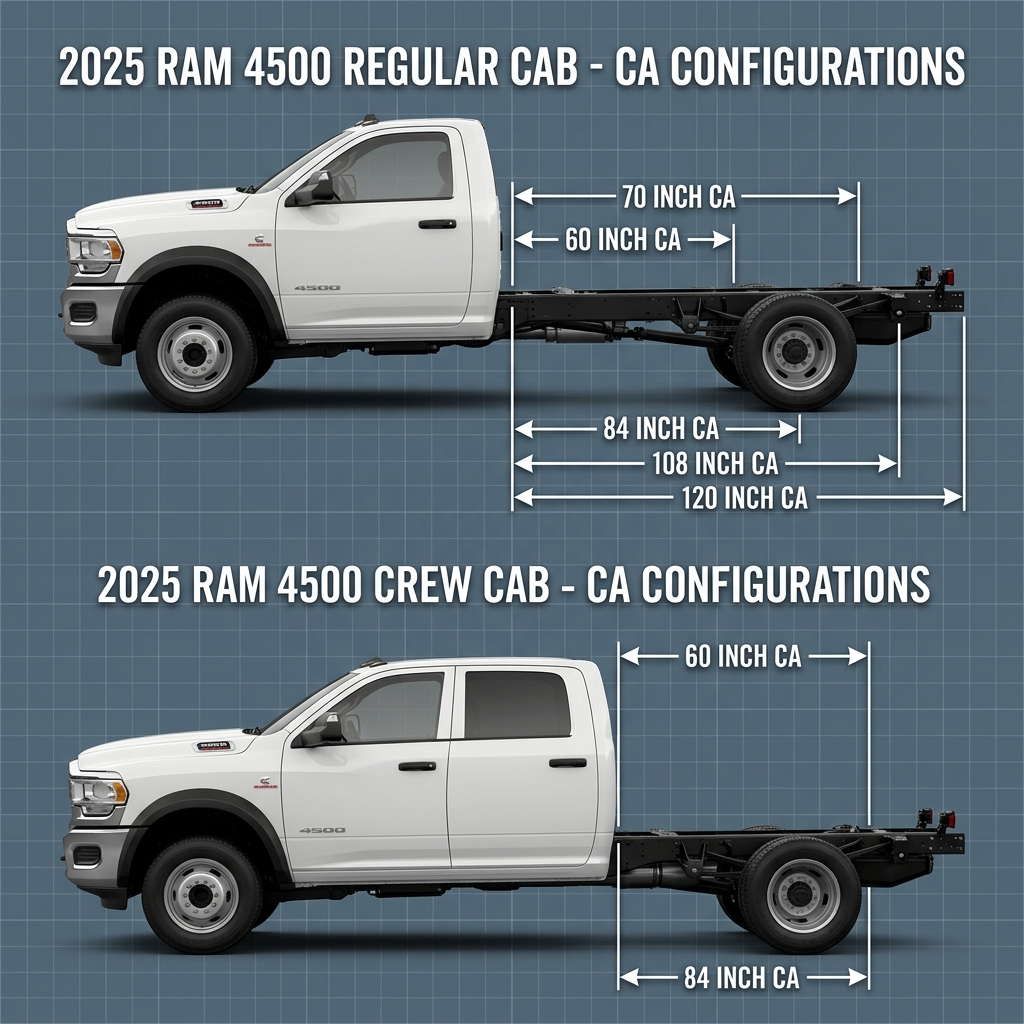
The Ram 4500 Chassis Cab is manufactured in two primary cab configurations: the Regular Cab(2-door, 3-passenger capacity) and the Crew Cab(4-door, 5-to-6 passenger capacity). The Regular Cab layout maximizes available frame space behind the rear window, offering four distinct Cab-to-Axle (CA) frame lengths: 60 inches(144.5-inch wheelbase), 84 inches(168.5-inch wheelbase), 108 inches(192.5-inch wheelbase), and 120 inches(204.5-inch wheelbase). In contrast, the spacious Crew Cab configuration is paired with two primary frame lengths: 60 inches CA(173.5-inch wheelbase) and 84 inches CA (197.5-inch wheelbase). Every frame length features standardized 34-inch wide, steel rear frame rails with flat top surfaces and through-the-frame rivet construction, allowing upfitters to mount bodies without needing complex adapter brackets or structural modifications.
Diagram showing cab-to-axle (CA) length options for the 2025 RAM 4500 Regular Cab and Crew Cab chassis models. (Representative image for illustration purposes only. Actual vehicle may vary based on trim and configuration.)

Ram 4500 Configuration & Upfit Compatibility Summary Matrix

Cab Type

Cab-to-Axle (CA)

Wheelbase

Recommended Body Length

Primary Upfit Applications

Regular Cab

60 inches

144.5 inches

9 ft – 10 ft

Short Service Body, MINI-Dump, Tight-Space Utility

Regular Cab

84 inches

168.5 inches

11 ft – 12 ft

Medium Service Body, Contractor Flatbed, Farm Hauler

Regular Cab

108 inches

192.5 inches

14 ft

Long Flatbed, Grain Body, Heavy Haul Stake Bed

Regular Cab

120 inches

204.5 inches

16 ft – 18 ft

Extended Flatbed, Rollback Tow Bed, Large Dry Freight

Crew Cab

60 inches

173.5 inches

9 ft – 10 ft

Crew Service Body, Utility Maintenance, Mobile Workshop

Crew Cab

84 inches

197.5 inches

11 ft – 12 ft

Crew Flatbed, Agricultural Transport, Municipal Crew Dump

Choosing the correct CA dimension dictates not only what size body you can physically bolt to the frame rails, but also how front-to-rear axle weight distribution behaves under full load. Selecting too short of a CA for a long flatbed causes excessive overhang behind the rear axle, taking weight off the front tires, degrading steering feel, and accelerating tire wear. Conversely, selecting an unnecessarily long frame increases your curb weight, expands your turning circle, and reduces payload headroom. Exploring our Commercial Vehicle Inventory is a great first step toward evaluating chassis units currently available on our lot in Junction City.

Meet Mike Hogg: 20 Years of Commercial Truck Service Insights in Geary and Riley Counties

Man with a beard wearing a red Valor Automotive polo shirt standing in front of a company branded backdrop.
Hello, I am Mike Hogg, Service Director here at Valor CDJR. Over my two decades managing heavy-duty commercial service operations in Junction City, I have worked hand-in-hand with hundreds of Kansas general contractors, cattle ranchers, grain farmers, and municipal utility managers across Geary, Riley, and Dickinson counties. I have seen firsthand what happens when a medium-duty chassis truck is properly specced from day one—and the costly head-aches that occur when a fleet operator buys the wrong frame length or cab setup for their operational reality. My philosophy on medium-duty chassis specification is straightforward:'Build the truck for the payload and jobsite access requirements of year five, not just day one.' Kansas working environments demand exceptional frame rigidity, predictable handling under heavy tongue-weight trailers, and rugged PTO integration. Whether you are navigating rutted field roads along the Smoky Hill River or maneuvering into tight commercial jobsites in downtown Manhattan, getting your cab configuration and frame specs right guarantees maximum uptime and long-term resale value.
If you ever have technical questions about PTO pump clearance, auxiliary harness routing, or rear axle load calculations, reach out directly to our specialized service department. You can Call us at (785) 238-5114 or stop by our dealership located at 1825 Goldenbelt Blvd. Get Directions to Valor CDJR to speak with our heavy-duty technicians in person.

Matching Ram 4500 Cab-to-Axle Dimensions to Flatbed, Dump Body, and Service Upfits

Understanding the functional connection between Cab-to-Axle (CA) length and body design is fundamental. CA is defined as the distance in inches from the back of the vehicle cab to the centerline of the rear axle. Upfit manufacturers design standard body lengths—such as 9-foot, 11-foot, 14-foot, and 16-foot bodies—specifically to align with standardized industry CA dimensions. Here is how each Ram 4500 frame offering performs in real-world Kansas trades:
1. The 60-Inch CA (Regular Cab & Crew Cab): Ideal for 9-foot to 10-foot utility service bodies, compact dump bodies, and short flatbeds. The 60-inch CA Regular Cab features a tight 144.5-inch wheelbase, making it highly maneuverable in residential neighborhoods, municipal alleyways, and congested construction zones. In Crew Cab form, the 60-inch CA accommodates a 4-man work crew while retaining a compact overall footprint for towing utility trailers. 2. The 84-Inch CA (Regular Cab & Crew Cab): The true multi-purpose workhorse of the Midwest. An 84-inch CA perfectly accepts 11-foot to 12-foot contractor flatbeds, crane service bodies, and heavy agricultural drop-side beds. It provides exceptional balance, leaving ample room behind the cab for hydraulic oil tanks, fuel transfer tanks, or behind-cab toolboxes without crowding the rear axle load centerline. 3. The 108-Inch CA (Regular Cab Only): Engineered for 14-foot body installations, this setup is widely favored by fencing contractors, farm suppliers, and bulk material distributors. The extra length allows for high-cube utility bodies or high-capacity flatbeds designed to transport palleted seed, fencing materials, or livestock feed around rural Kansas. 4. The 120-Inch CA (Regular Cab Only): The longest factory chassis cab offered in the Ram 4500 lineup, featuring a 204.5-inch wheelbase. Designed specifically for 16-foot to 18-foot flatbeds, car hauler rollback beds, and dry freight box bodies. It delivers maximum platform square footage for commercial haulers while maintaining strict factory GVWR ratings.
Upfitter Note from Mike Hogg: 'When selecting an upfit, never forget to calculate rear frame overhang. A common mistake is mounting a 12-foot bed on a 60-inch CA frame. That creates over 5 feet of tail swing behind the axle. Every pound placed at the rear gate acts like a lever, lifting weight off your steering axle and compromising control during rain or snow on Highway 77.'

Planning to upgrade an existing fleet vehicle? Evaluate your current truck's value today with our online Trade In Evaluation tool.

Explore Available Ram 4500 Chassis Cab Specs and Work Trucks at Valor CDJR

Ready to inspect raw chassis cabs or pre-built commercial work trucks on our lot in Junction City? Our dedicated commercial team will walk you through frame dimensions, axle weight ratings, and upfitter options tailored specifically to your trade requirements.

How Much Extra Does the 6.7L Cummins Diesel Engine Option Cost on a Ram 4500?

Selecting the powertrain for your Ram 4500 represents one of the largest single financial line items during spec configuration. The Ram 4500 comes standard with the heavy-duty 6.4L HEMI® V8 Heavy-Duty Gasoline Engine paired with an AISIN 6-speed automatic transmission. Opting for the available commercial-grade 6.7L Cummins® Turbo Diesel I6 Engine for current pricing, contact the dealership (depending on production trim and optional equipment packages). While $10,000 represents a significant initial capital investment, evaluating this decision through a total-cost-of-ownership (TCO) lens reveals why many Kansas commercial buyers elect the Cummins diesel powertrain:
  • Torque Under Heavy Towing: The 6.7L Cummins Diesel delivers up to 800 lb-ft of torque at low RPM (1,600 RPM), enabling effortless pull when launching heavy equipment trailers from muddy field gates or steep grades. The 6.4L HEMI V8 produces 429 lb-ft of torque at 4,000 RPM, requiring higher engine speeds to maintain momentum under load.
  • Fuel Efficiency Under Continuous Payload: When operating continuously near maximum Gross Combined Weight Ratings (GCWR), diesel combustion efficiency yields significantly lower fuel consumption per operating hour, offsetting up to 40% of the initial option cost over a 150,000-mile commercial service lifespan.
  • Commercial Engine Brakes & PTO: The Cummins diesel includes a fully integrated exhaust brake with manual and auto modes, reducing friction brake wear during steep hill descents. Furthermore, the left-side or right-side Power Take-Off (PTO) capability provides robust mechanical power for hydraulic pumps.
  • Resale Value Retention: In the commercial resale market throughout Kansas and Nebraska, diesel chassis cabs command a premium over gasoline chassis units, often recovering $5,000 to $7,000 of the original option cost at trade-in time.
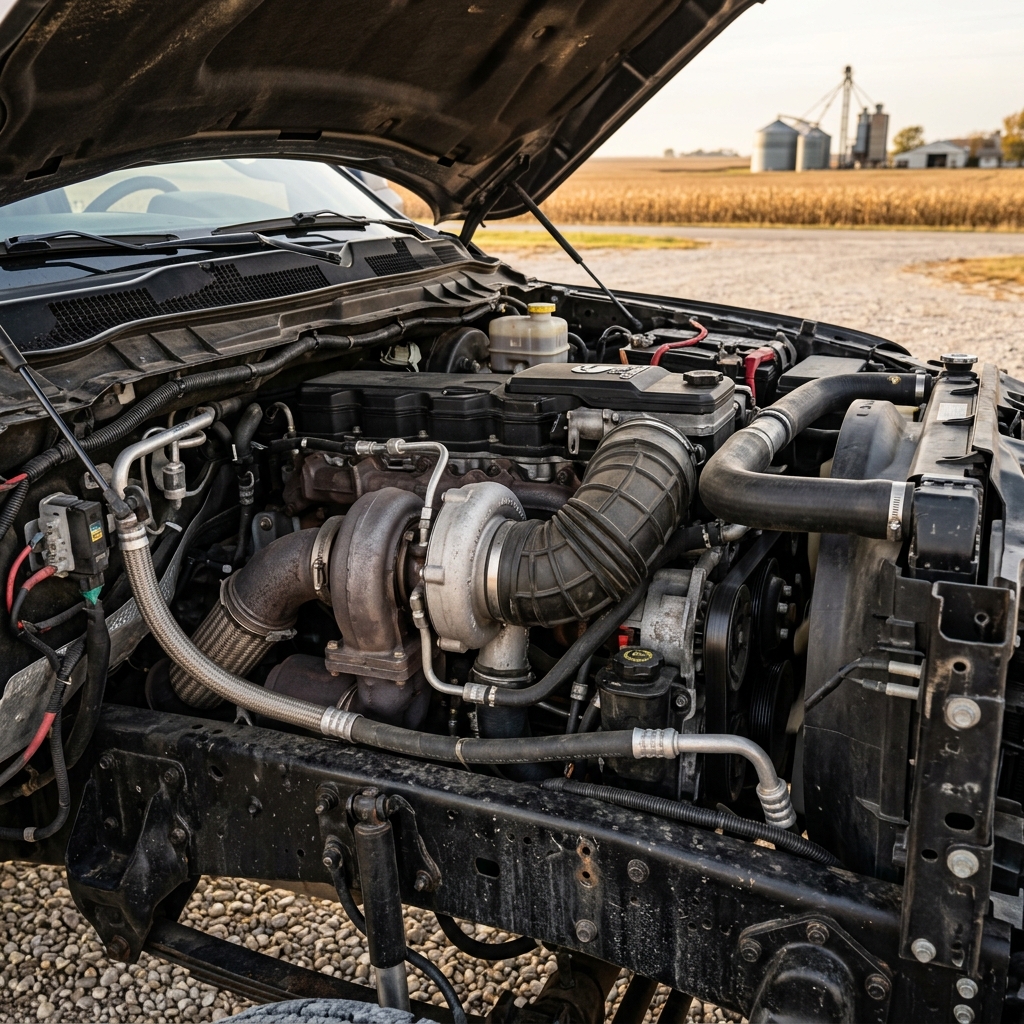
Detailed view of a heavy-duty diesel engine inside an open truck hood on a rural farm road. (Representative image for illustration purposes only. Actual vehicle may vary based on trim and configuration.)
Looking to structure engine upgrades and upfit costs into manageable monthly operating payments? Apply for commercial financing online with our Get Pre-Approved form.

What Tire and Wheel Setup Does the Ram 4500 Use Compared to the Ram 3500?

A frequent point of confusion among fleet managers step-up from Class 3 (Ram 3500) to Class 4 (Ram 4500) trucks is the running gear. While the Ram 3500 Dual Rear Wheel (DRW) utilizes consumer light-truck running gear, the Ram 4500 transitions entirely into medium-duty commercial hardware built for extreme duty cycles.

19.5-Inch Wheel Hardware

The Ram 4500 features heavy commercial 19.5 x 6.0-inch steel or forged aluminum wheels, compared to the 17-inch wheels standard on Ram 3500 DRW. Standard tire fitment is 225/70R19.5G commercial highway or traction tires, featuring substantially thicker sidewalls and higher load range G ratings.

10-Lug Heavy Duty Hub Pattern

While the Ram 3500 uses an 8-lug wheel bolt pattern, the Ram 4500 employs a robust 10-lug on 225mm bolt circle heavy commercial hub pattern. This massive hub assembly distributes wheel clamping forces far more effectively under severe cornering loads and heavy payload distribution.

Brake Thermal Management

The 19.5-inch wheel diameter creates extra internal clearance required to house massive 15.35-inch front rotors and heavy-duty dual-piston calipers. Larger commercial wheel cavities allow far greater air circulation, preventing heat soak during repeated high-payload downhill braking events.

Expert Perspective: Why Frame Rigidity and CA Sizing Drive Real-World Payload Profits

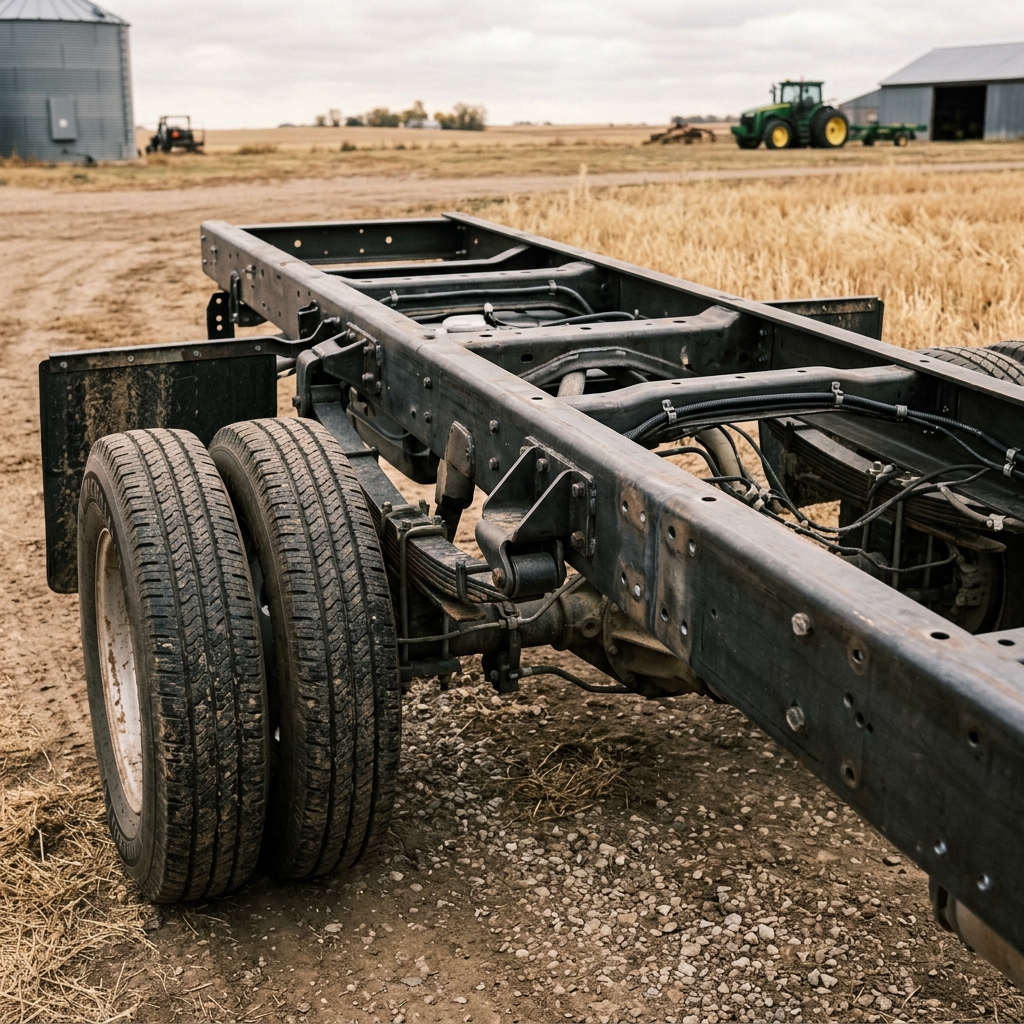
Close-up of a black heavy-duty truck chassis frame with dual rear tires parked on a farm gravel driveway. (Representative image for illustration purposes only. Actual vehicle may vary based on trim and configuration.)
'In commercial truck service, frame flex is the silent killer of bodies and drivelines,' explains Mike Hogg. 'The Ram 4500 uses high-strength 50,000 PSI steel frame rails with full C-channel rear crossmembers. When you mount a heavy dump body or a 14-foot crane service body, that structural rigidity prevents frame twist when operating on uneven ranch terrain or unpaved job sites.'
When a frame twists excessively under maximum load, it places torsional stress on the transmission output shaft, driveshaft U-joints, and rear differential bearings. By maintaining a flat 34-inch wide frame rail standard with zero top-rail rivets, Ram allows upfitters to mount bodies directly to high-tensile steel frame webs. This clean mounting design eliminates flex points, protects sensitive hydraulic lines, and keeps your truck out of the repair bay. Need replacement parts or specialized mounting brackets? Contact our dedicated Parts Department for factory-approved body builder hardware.

What Is the Maximum Towing Capacity and Payload for the 2025 Ram 4500 Chassis Cab?

The 2025 Ram 4500 Chassis Cab is engineered to deliver class-leading weight ratings across both Regular Cab and Crew Cab configurations:
  • Gross Vehicle Weight Rating (GVWR): Up to 16,500 lbs.
  • Maximum Payload Capacity: Up to 12,080 lbs(varies based on cab style, CA length, drivetrain, and upfit body weight).
  • Maximum Towing Capacity: Up to 29,770 lbs when equipped with the 6.7L Cummins Turbo Diesel and factory max-tow package.
  • Gross Combined Weight Rating (GCWR): Up to 37,500 lbs.
These ratings make the Ram 4500 an appropriate choice for towing heavy equipment trailers, backhoes, and multi-car haulers across Geary and Riley counties without crossing into Class 6 Commercial Driver License (CDL) requirements in many standard agricultural operations.
Ram 4500 Ratings by Drivetrain & Configuration

Engine

Max GVWR

Max Payload

Max Towing

Max GCWR

6.4L HEMI V8 Gas

16,500 lbs

12,080 lbs

21,500 lbs

28,500 lbs

6.7L Cummins Diesel

16,500 lbs

11,250 lbs

29,770 lbs

37,500 lbs

How Do Turning Radius Capability Figures Compare Between Ram 4500 and Ford F-450?

On crowded jobsites and narrow farm driveways throughout Geary County, maneuverability is just as important as raw horsepower. Ram engineers addressed this challenge by designing a dedicated wide-track front axle setup with link-coil front suspension, permitting up to a 52-degree wheel-cut angle. When compared directly to the Ford F-450 Chassis Cab, the Ram 4500 delivers remarkable tight-space turning diameter performance:
  • Ram 4500 Regular Cab (60-inch CA / 144.5" WB): Turning curb-to-curb diameter of approximately 42.1 feet.
  • Ford F-450 Regular Cab (60-inch CA / 145.3" WB): Turning curb-to-curb diameter of approximately 43.5 feet.
  • Ram 4500 Crew Cab (60-inch CA / 173.5" WB): Turning curb-to-curb diameter of approximately 49.8 feet.
That tighter turning radius allows drivers to navigate tight barns, maneuver around grain augers, and parallel park service bodies on downtown streets with significantly fewer multi-point turns.
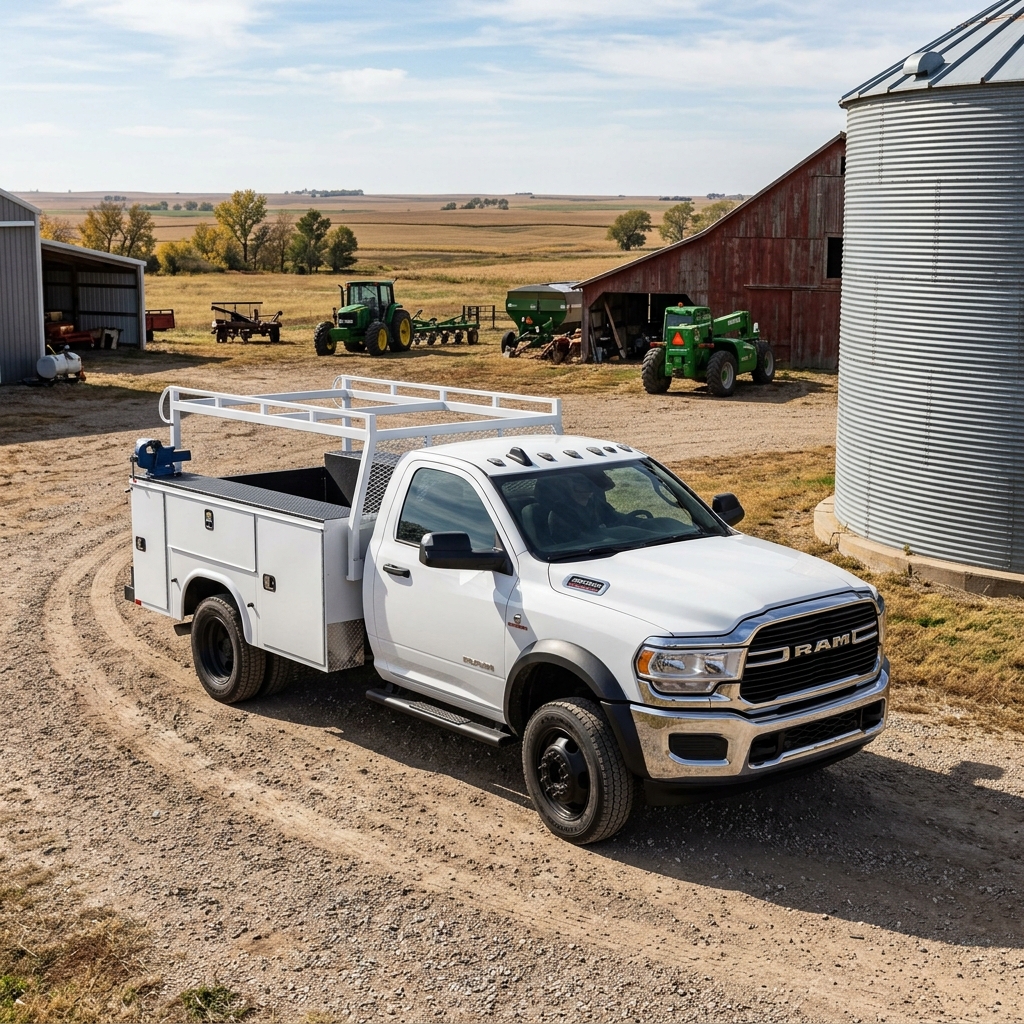
White Ram chassis cab truck with a utility service body parked on a dirt road in front of farm equipment and a silo. (Representative image for illustration purposes only. Actual vehicle may vary based on trim and configuration.)

What Should Kansas Farm and Contracting Buyers Verify Before Choosing a Service, Flatbed, or Dump-Body Upfit?

To eliminate costly rework or delays when partnering with body builders, run through this pre-purchase verification checklist with our commercial sales specialists:

1. Alternator & Electrical Outlets

Verify if your upfit requires dual alternators (up to 440 amps combined output) to charge auxiliary jobsite batteries, power electric-hydraulic hoists, or drive high-draw LED lightbars.

2. Power Take-Off (PTO) Left/Right Routing

Confirm whether your hydraulic pump mounts on the left or right side of the AISIN transmission. Ram 4500 provides dual-side PTO access capabilities to clear exhaust piping.

3. VSIM Module Interfacing

Ensure your vehicle is specced with the factory Vehicle System Interface Module (VSIM). It provides 70+ electrical circuits for seamless aftermarket body integration.

Do Kansas Agricultural Operations Qualify for Sales Tax Exemptions on Commercial Chassis Trucks?

Yes! Under Kansas Department of Revenue tax statutes, vehicles, machinery, and equipment purchased for direct and exclusive use in agricultural production can qualify for state sales tax exemptions. In Riley and Geary counties, qualifying farmers and ranchers utilizing a Ram 4500 for farming, livestock movement, or agricultural material transport can save thousands of dollars at purchase when proper documentation is completed. Key requirements to keep in mind:
  • Kansas Agricultural Exemption Certificate (Form ST-28A): Must be completed and kept on file at the dealership during the purchasing transaction.
  • Qualifying Use Cases: Transporting agricultural products, feeding livestock, spraying crops, or hauling machinery between agricultural parcels.
  • Commercial Line of Credit: Combining tax-exempt status with commercial fleet financing or specialized commercial leases maximizes capital efficiency for expanding agricultural businesses.

Commercial Chassis Cab Overview: Ram 4500 Capability for Kansas Farms and Contractors

Operating a commercial truck like the Ram 4500 requires a rigorous, proactive maintenance strategy. Unlike light-duty pickups, chassis cabs spend prolonged periods idling at jobsites to power PTO pumps, hydraulic lifts, and auxiliary tools. Under these severe duty cycles, routine fluid sampling, fuel filter changes, and valve clearances are vital to keeping your business operating without unscheduled downtime. At Valor CDJR, our certified commercial service department is equipped with heavy-duty lifts, specialized Cummins diagnostic equipment, and dedicated commercial bays. Our technicians are trained specifically on AISIN heavy-duty automatic transmissions, dual-alternator charging systems, and complex upfitter wiring interfaces.
Key preventative maintenance schedules for Ram 4500 commercial units:
  • Fuel Filter Maintenance: Dual-filter Cummins fuel system changes recommended every 15,000 miles or immediately upon water-in-fuel light warnings.
  • Transmission Fluid Services: AISIN 6-speed fluid and filter drain/fills every 30,000 to 45,000 severe-service miles.
  • Brake Pad & Rotor Inspections: Semi-annual checks on commercial 19.5-inch brake hardware during routine oil services.
  • Routine Maintenance: Utilize our dedicated Express Lane for quick oil and filter services to minimize fleet downtime.

Build and Spec Your Ram 4500 Work Truck with Valor CDJR in Junction City

Whether you need a single Ram 4500 Regular Cab with an 84-inch CA flatbed for your farm or a fleet of Crew Cab service bodies for your contracting business, the experts at Valor CDJR are ready to help you build, finance, and maintain your commercial inventory. Visit our showroom at 1825 Goldenbelt Blvd in Junction City, or contact Service Director Mike Hogg to discuss custom upfit specs today.
Valor Automotive logo featuring a blue shield with a red V and white A monogram above company text.

Posted in:

Related Posts

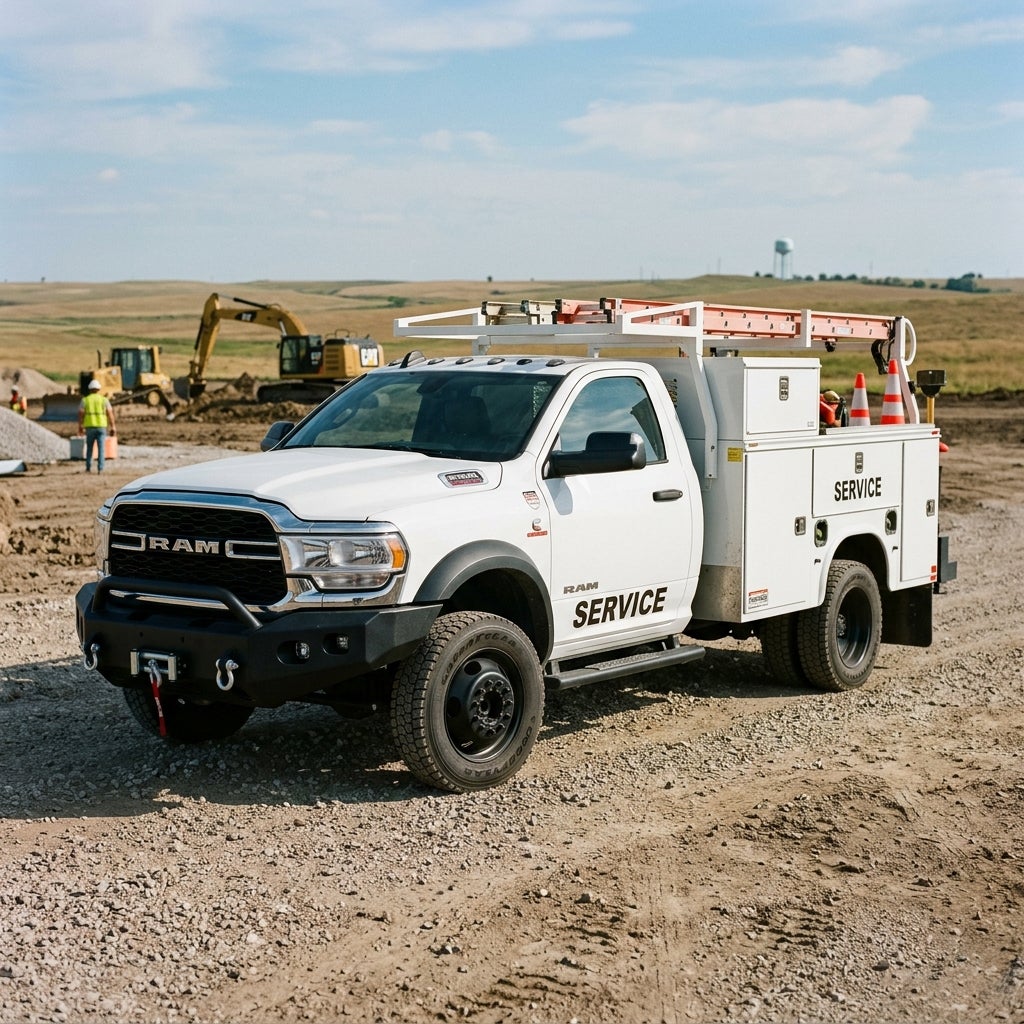
White Ram service truck parked on a gravel construction site with heavy machinery in the background. (Representative image for illustration purposes only. Actual vehicle may vary based on trim and configuration.)

2026 RAM 4500 vs RAM 3500 Chassis Comparison

2026 Ram 4500 vs Ram 3500 Chassis Comparison The 2026 Ram 4500 Chassis Tradesman/Big Horn is the better vehicle choice overall for severe commercial applications, delivering a class-leading maximum payload capacity of 9,390 lbs and a 16,500 lbs GVWR that easily outperforms the Ram 3500 Chassis. While the Ram 3500 offers higher maximum diesel towing figures, the Ram 4500 provides the heavier commercial axle rating, commercial 19.5-inch running gear, and structural frame rigidity required for massive utility bodies, heavy agricultural equipment, and demanding jobsite upfits. Commercial Vehicle Inventory Which 2026 Ram Chassis Is Best for Work and Family Needs? The 2026 Ram 4500 Chassis Tradesman/Big Horn wins this comparison for operators needing maximum payload strength and commercial frame capacity, boasting a 9,390 lbs maximum payload and standard Dual Rear Wheel (DRW) configuration compared to the Ram 3500 Chassis payload limit of 7,590 lbs. While both chassis cab models share the option for a 6-passenger Crew Cab to transport work crews or families comfortably, the Ram 4500 is engineered specifically for heavier commercial bodies and extreme structural loads. Choosing between these commercial powerhouses comes down to the nature of your daily workload. The Ram 4500 Chassis utilizes commercial-grade 19.5-inch steel wheels wrapped in 225/70R19.5G all-position tires, backed by a massive 16,500 lbs GVWR. This setup allows contractors, agricultural haulers, and utility fleets to mount heavy service bodies, flatbeds, or crane platforms without exceeding axle limits. On the other hand, the 2026 Ram 3500 Chassis offers a maximum Gross Vehicle Weight Rating of 14,000 lbs and comes standard in a Single Rear Wheel (SRW) configuration with DRW available. The Ram 3500 provides excellent flexibility for lighter commercial upfits and offers a higher maximum diesel towing rating of 37,060 lbs due to its lighter vehicle curb weight and specific gear tuning. However, when your primary requirement is hauling heavy onboard gear, liquid tanks, or permanent jobsite equipment, the Ram 4500 offers the uncompromising foundation necessary to get the job done safely. Both trucks provide outstanding cabin flexibility. In Tradesman or Big Horn trim, available configurations include a 3-passenger Regular Cab or a spacious 6-passenger Crew Cab featuring HD vinyl or premium cloth 40/20/40 split-bench seating. This ensures your commercial chassis doubles as a comfortable group transporter during off-hours or travel between job sites. How Do the 2026 Ram 4500 and 3500 Tradesman and Big Horn Trims Compare in Price and Value? The 2026 Ram 3500 Chassis carries a lower baseline entry cost starting at $48,105 MSRP for the Tradesman trim, but the 2026 Ram 4500 Chassis provides greater heavy-duty value starting at $55,370 MSRP by delivering 1,800 additional pounds of payload capacity and standard commercial-grade running gear. Upgrading to the Big Horn trim brings MSRP to $59,120 on the Ram 4500 and $52,340 on the Ram 3500, adding refined exterior styling and upgraded interior convenience features. Value in a commercial chassis is measured by capability per dollar over the lifetime of the truck. The Ram 4500 Tradesman at $55,370 MSRP includes standard heavy-duty features that would cost thousands to add to lighter chassis platforms, including a heavy-duty front axle, commercial 19.5-inch steel wheels, and a 4.44 axle ratio designed to launch heavy loads efficiently. Moving to the Ram 4500 Big Horn at $59,120 MSRP adds chrome grille surrounds, power windows and locks, keyless entry, and upgraded cloth interior trim that enhances driver comfort during long work hours. The Ram 3500 Tradesman starting at $48,105 MSRP and Big Horn at $52,340 MSRP serve as budget-friendly entry points for fleets that do not require a 16,500 lbs GVWR chassis. However, taking on heavy upfits on a 3500 platform can approach gross weight limits quickly. Investing in the Ram 4500 upfront prevents premature suspension wear and provides headroom for heavy commercial bodies. To help with your next steps, you can value your trade-in online before visiting our dealership to explore upfit options. At Valor CDJR, our inventory includes specific work-ready configurations like the new 2026 Ram 4500 Tradesman Crew Cab 4x4 in Bright White Clearcoat (Stock #26DT109) priced at $77,570 MSRP, equipped with the Cummins diesel engine and a 16,500 lbs GVWR package. We also stock options like the 2026 Ram 3500 Tradesman Crew Cab 4x4 (Stock #26DT108) priced at $70,875 MSRP, featuring dual alternators rated at 480 amps. Pricing Starting MSRP lineup comparison for Tradesman and Big Horn chassis cab models. 2026 Ram 4500 Chassis Tradesman/Big Horn Trim MSRP 2026 Ram 3500 Chassis Tradesman/Big Horn Trim MSRP Tradesman $55,370 Tradesman $48,105 Big Horn $59,120 Big Horn $52,340 Trade In Evaluation Cargo Capacity and Cabin Space: Which 2026 Ram Chassis Handles Hard Work and Weekend Trips Better? The 2026 Ram 4500 Chassis provides significantly higher onboard carrying capacity with its 9,390 lbs maximum payload and 16,500 lbs GVWR, making it the top choice for heavy commercial upfits, while both models offer identical interior passenger dimensions in 3-passenger Regular Cab and 6-passenger Crew Cab layouts. Passenger legroom and interior storage solutions remain equal across both chassis models, but the Ram 4500 carries heavier cargo on its back without sacrificing ride height or stability. Upfit flexibility is the primary reason commercial operators choose a Class 4 chassis cab. The Ram 4500 Chassis features flat frame rails with zero rivets on top of the rear frame flanges, allowing body builders to mount utility boxes, dump bodies, and flatbeds directly onto the chassis. Standard Dual Rear Wheels provide a wide rear track that enhances lateral stability when transporting top-heavy loads, tall cargo boxes, or full liquid tanks across uneven ground. Interior utility is engineered around the needs of working crews. In Crew Cab models, both the Ram 4500 and Ram 3500 feature a 40/20/40 split bench seat with integrated front armrest cupholders and under-seat storage compartments to organize tools, boots, and safety gear. Rear-seat passengers benefit from generous legroom and rear 2-way headrests, ensuring full-size adult crew members fit comfortably. For drivers who alternate between heavy work demands and family transportation, the Big Horn trim's interior finishes turn a heavy commercial truck into a pleasant daily driver. HD vinyl seating surfaces in Tradesman models provide water-resistant, easy-to-clean durability, while Big Horn models add soft-touch door panels and upgraded seating materials for a refined interior environment. Dimensions & Capacity Capability, weight ratings, dimensions, and wheel setups. Specification 2026 Ram 4500 Chassis Tradesman/Big Horn 2026 Ram 3500 Chassis Tradesman/Big Horn Seating Capacity 3 (Regular Cab) / 6 (Crew Cab) 3 (Regular Cab) / 6 (Crew Cab) Gross Vehicle Weight Rating (GVWR) 16,500 lbs 14,000 lbs Maximum Towing Capacity 21,240 lbs (Gas) / 28,500+ lbs (Diesel) 18,150 lbs (Gas) / 37,060 lbs (Diesel) Maximum Payload 9,390 lbs 7,590 lbs Rear Wheel Configuration Dual Rear Wheel (DRW) Standard Single Rear Wheel (SRW) Standard / DRW Available Wheel Size & Tire Spec 19.5-inch steel wheels (225/70R19.5G) 17-inch / 18-inch steel wheels Performance and Fuel Efficiency of the 2026 Ram 4500 vs 3500 for Commercial and Farm Operations The 2026 Ram 3500 Chassis holds the advantage in total diesel horsepower and maximum tow rating with its 430 hp Cummins turbo diesel output, but the 2026 Ram 4500 Chassis provides superior commercial durability and gear reduction with a 360 hp Cummins turbo diesel delivering 800 lb-ft of torque mated to a heavy-duty 6-speed Aisin automatic transmission. Both trucks come standard with a 6.4L Heavy-Duty HEMI V8 gas engine paired with an 8-speed TorqueFlite automatic transmission generating 429 lb-ft of torque. Under the hood, engine tuning differs based on vehicle weight class regulations and commercial duty cycles: 6.4L Heavy-Duty HEMI V8 (Gas): Produces 375 hp @ 5,600 rpm in the Ram 4500 and 405 hp @ 5,600 rpm in the Ram 3500, with both generating 429 lb-ft @ 4,000 rpm. 6.7L Cummins I6 Turbo Diesel: Delivers 360 hp and 800 lb-ft of torque in the Ram 4500 tuned for commercial longevity under continuous load, and 430 hp with 930 lb-ft of torque in the Ram 3500. Transmissions & Drivetrain: Gas models feature the 8-speed TorqueFlite automatic transmission, while diesel powertrains utilize the commercial 6-speed Aisin automatic transmission. Rear-Wheel Drive (4x2) is standard, with Four-Wheel Drive (4x4) available on both models. When towing severe loads, gear ratios play a critical role. The Ram 4500 Chassis utilizes aggressive axle ratios like 4.44, providing exceptional low-end torque amplification to launch heavy equipment trailers smoothly. The Ram 3500 relies on taller gearing options suited for highway trailering, yielding a maximum gas towing rating of 18,150 lbs and a maximum diesel towing capacity of 37,060 lbs, compared to the Ram 4500 towing limits of 21,240 lbs (Gas) and 28,500+ lbs (Diesel). Fuel economy ratings for Class 3 and Class 4 commercial chassis cab vehicles are exempt from EPA testing requirements. However, both models maximize jobsite range by offering a large about 52 gallons fuel tank capacity. This massive fuel reserve minimizes fuel stops during long-distance commercial trips or extended stationary operation while powering hydraulic equipment and PTO accessories. Engine & Performance Powertrain configurations, horsepower, and transmission specs. Specification 2026 Ram 4500 Chassis Tradesman/Big Horn 2026 Ram 3500 Chassis Tradesman/Big Horn Standard Gas Engine 6.4L Heavy-Duty HEMI V8 6.4L Heavy-Duty HEMI V8 Gas Engine Horsepower 375 hp @ 5,600 rpm 405 hp @ 5,600 rpm Gas Engine Torque 429 lb-ft @ 4,000 rpm 429 lb-ft @ 4,000 rpm Available Diesel Engine 6.7L Cummins I6 Turbo Diesel 6.7L Cummins I6 Turbo Diesel Diesel Engine Output 360 hp / 800 lb-ft torque 430 hp / 930 lb-ft torque Transmission 8-speed TorqueFlite automatic (Gas) / 6-speed Aisin automatic (Diesel) 8-speed TorqueFlite automatic (Gas) / 6-speed Aisin automatic (Diesel) Drivetrain Rear-Wheel Drive (4x2) standard, Four-Wheel Drive (4x4) available Rear-Wheel Drive (4x2) standard, Four-Wheel Drive (4x4) available Fuel Economy Fuel storage and efficiency parameters. Specification 2026 Ram 4500 Chassis Tradesman/Big Horn 2026 Ram 3500 Chassis Tradesman/Big Horn Fuel Economy (City/Highway/Combined) Exempt (Commercial Heavy-Duty) Exempt (Commercial Heavy-Duty) Fuel Tank Capacity 52.0 gallons 52.0 gallons Recommended Fuel Type Regular Unleaded (Gas) / Ultra-Low Sulfur Diesel (Diesel) Regular Unleaded (Gas) / Ultra-Low Sulfur Diesel (Diesel) New Vehicle Listings Tech Features That Keep 2026 Ram 4500 and 3500 Drivers Connected on Job Sites The 2026 Ram 4500 and 3500 Chassis share an identical suite of commercial technology, featuring standard Apple CarPlay, Google Android Auto, and an available 4G LTE Wi-Fi Hot Spot to transform the truck cab into a mobile office. Both models integrate Uconnect infotainment software and telematics compatibility, keeping drivers connected to fleet management software and navigation routes effortlessly. Modern commercial operations demand constant connectivity between field operators and dispatchers. Both Ram chassis cab models incorporate a Global Telematics Box Module and a GPS Antenna Input, enabling real-time vehicle tracking, diagnostic monitoring, and maintenance scheduling across working fleets. Integrated Voice Command with Bluetooth allows drivers to make hands-free calls and send messages without removing their hands from the steering wheel. Inside the cabin, convenient technology controls keep essential functions within arm's reach: Smartphone Integration: Seamless Apple CarPlay and Google Android Auto capability mirror navigation maps, communication apps, and job schedules directly on the center console display. Fleet Management Tools: Connectivity through DriveUconnect.com allows business owners to access vehicle telemetry and monitor fuel usage remotely. Power & Charging Access: Multiple USB ports and optional auxiliary power outlets ensure phones, tablets, and cordless tool batteries stay charged throughout the workday. Whether navigating busy commercial corridors or operating at remote worksites, the intuitive layout of Ram's infotainment controls ensures seamless operation without creating driver distraction. Safety Systems Tailored for Tradesmen and Families Navigating Roads in the 2026 Ram Chassis The 2026 Ram 4500 Chassis delivers enhanced baseline safety and vehicle control under extreme payloads due to its standard Dual Rear Wheel axle stability, commercial 19.5-inch braking systems, and heavy-duty frame strength compared to the single-rear-wheel standard configuration of the Ram 3500. Both chassis cabs feature advanced active safety technology, electronic stability control, and reinforced cab structures engineered to protect occupants across challenging driving environments. Stability & Control Electronic stability control with roll mitigation and trailer sway control monitors trajectory and manages wheel braking automatically. Passive Protection High-strength steel frame construction and advanced multi-stage airbag protection provide outstanding structural resilience. Visibility Options Heated power trailer-tow mirrors expand rearward vision around wide utility bodies, accompanied by auto-headlights. Navigating heavy loads across varied terrain requires robust driver assistance and braking control. The Ram 4500 and Ram 3500 feature sophisticated electronic stability control systems with roll mitigation and trailer sway control. These active systems monitor vehicle trajectory and automatically apply individual wheel braking or adjust engine power if trailer instability is detected. Passive safety starts with high-strength steel frame construction and advanced airbag protection throughout the front cabin. Commercial drivers benefit from large heated power trailer-tow mirrors that expand rearward visibility around wide cargo bodies and long trailers. Standard automatic headlights and daytime running lamps ensure high vehicle visibility when traveling through active construction zones, rural access roads, or heavy weather. Warranty, Maintenance, and Service Options for 2026 Ram 4500 and 3500 Owners in the Area The 2026 Ram 4500 and 3500 Chassis are supported by a comprehensive 5-year/60,000-mile Powertrain Limited Warranty on gas models and a 5-year/100,000-mile Powertrain Limited Warranty on Cummins diesel models, backed by 24-hour manufacturer roadside assistance. This extensive warranty coverage ensures commercial owners maintain predictable operating costs and maximum vehicle uptime throughout the working life of their chassis. Routine preventive maintenance is essential for preserving the durability of heavy-duty commercial equipment. The Cummins 6.7L turbo diesel engine features extended oil change intervals and heavy-duty fuel filtration systems designed to protect engine components from fuel contaminants. The 6-speed Aisin automatic transmission utilizes commercial-grade fluid and internal cooling circuits engineered for continuous heavy towing without thermal degradation. To maintain your commercial chassis in peak operating condition, our dedicated commercial technicians are ready to handle routine oil changes, brake inspections, and complex chassis maintenance. You can easily schedule a service appointment online to minimize vehicle downtime and keep your commercial fleet running reliably. Service Scheduler Frequently Asked Questions About Choosing Between the 2026 Ram 4500 and 3500 Chassis Q: What is the main difference between the Ram 4500 and Ram 3500 Chassis? The primary difference lies in GVWR and payload capacity. The 2026 Ram 4500 Chassis features a 16,500 lbs GVWR, a maximum payload of 9,390 lbs, and standard commercial 19.5-inch wheels with dual rear wheels. The Ram 3500 Chassis features a 14,000 lbs GVWR, a maximum payload of 7,590 lbs, standard single rear wheels, and a higher maximum diesel towing rating of 37,060 lbs. Q: Which chassis cab model is better for heavy utility bodies and dump beds? The 2026 Ram 4500 Chassis is better suited for heavy utility bodies, crane beds, and dump applications. Its 16,500 lbs GVWR provides nearly two additional tons of payload capacity over the Ram 3500, allowing operators to mount heavy onboard equipment without exceeding gross vehicle weight thresholds. Q: What are the horsepower and torque ratings for the diesel engines? The available 6.7L Cummins I6 Turbo Diesel produces 360 hp and 800 lb-ft of torque in the Ram 4500 Chassis, paired with a commercial 6-speed Aisin automatic transmission. In the Ram 3500 Chassis, the Cummins turbo diesel delivers 430 hp and 930 lb-ft of torque. Q: What fuel tank capacity do these commercial trucks offer? Both the 2026 Ram 4500 Chassis and Ram 3500 Chassis come standard with a massive about 52 gallons fuel tank capacity. This large capacity provides extended driving range and reduces down time during long-distance commercial trips and heavy agricultural work. Q: How can I view in-stock Ram chassis cab inventory or speak with a commercial specialist? You can explore our complete work truck selection in person at Valor CDJR. Check our Junction City showroom address at 1825 Goldenbelt Blvd, Junction City, KS 66441 to test drive our commercial inventory, or give our dedicated commercial sales team a quick call at (785) 238-5114 to discuss your specific upfit needs and commercial pricing options. The Superior Choice for Uncompromising Commercial Capability For operators requiring maximum payload capacity, commercial-grade frame strength, and structural reliability under severe working conditions, the 2026 Ram 4500 Chassis Tradesman/Big Horn stands out as a leading commercial vehicle. Its 16,500 lbs GVWR, 9,390 lbs maximum payload, standard dual rear wheel stability, and heavy-duty 19.5-inch running gear provide a level of heavy-duty performance that lighter Class 3 trucks simply cannot match. While the Ram 3500 Chassis provides excellent flexibility for lighter towing and utility tasks, the Ram 4500 delivers the heavy-duty foundation needed for permanent service bodies, liquid transport, and heavy equipment hauling. Combined with the comfort of available Crew Cab seating, modern Uconnect technology, and the proven power of the 6.7L Cummins turbo diesel engine, the Ram 4500 balances commercial productivity with everyday drivability. Visit Valor CDJR today at 1825 Goldenbelt Blvd in Junction City to inspect our current inventory of 2026 Ram 4500 and 3500 chassis cabs. Our experienced commercial team is ready to help you compare trim levels, evaluate upfit configurations, and select the exact Ram chassis built to handle your toughest jobs. Commercial Vehicle Inventory Get Pre-Approved © 2026 Valor CDJR. All rights reserved.

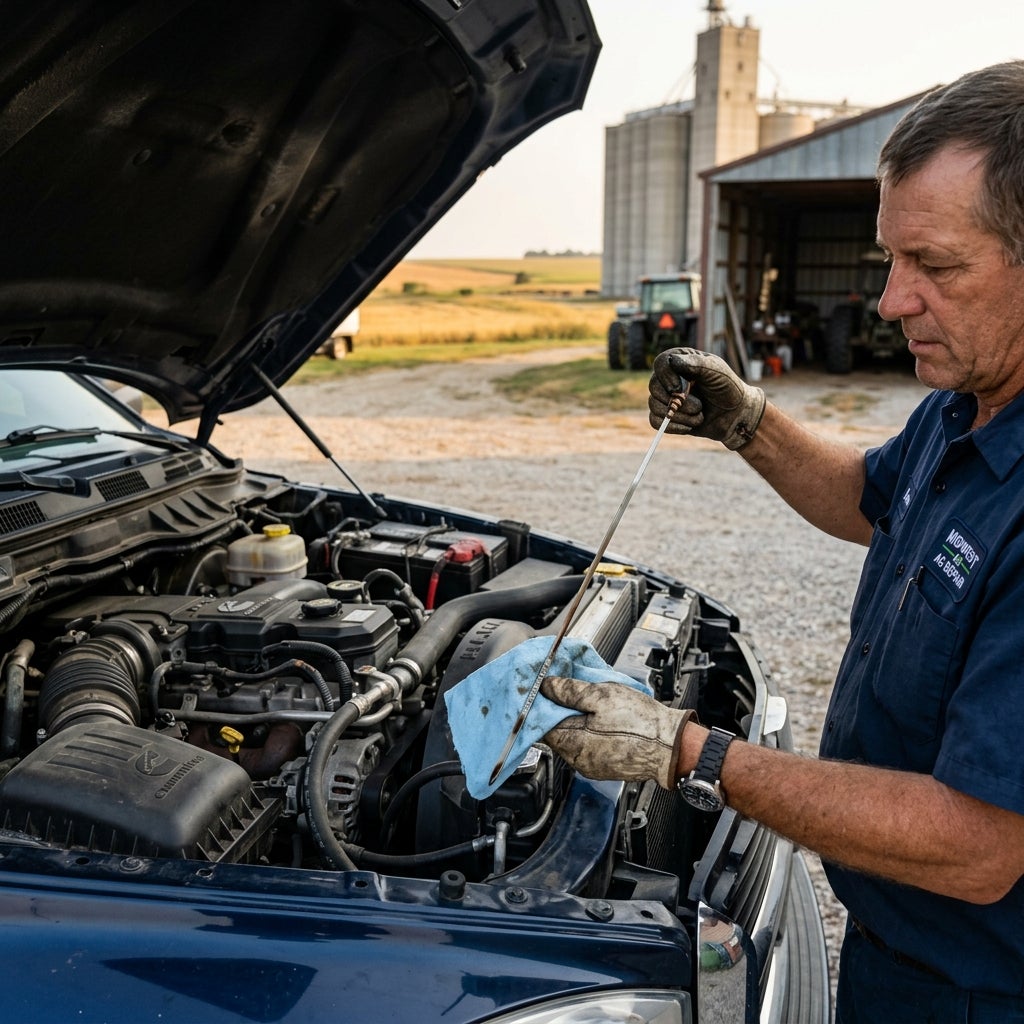
A mechanic wearing work gloves checks the oil dipstick under the hood of a blue truck on a farm. (Representative image for illustration purposes only. Actual vehicle may vary based on trim and configuration.)

Why Should You Inspect Engine Fluids When the Engine Is Cold?

Why Should You Inspect Engine Fluids When the Engine Is Cold? Checking your vehicle's engine fluids when the motor is completely cold is not merely a old-school mechanic's rule of thumb—it is an absolute physical necessity for diagnostic accuracy and personal safety. When an engine has sat overnight or for several hours, every drop of engine oil, coolant, brake fluid, and power steering fluid has stabilized into its true static equilibrium. Operating temperatures inside a modern internal combustion engine or heavy-duty turbodiesel range between 190°F and 230°F. At these high operating temperatures, fluid mechanics change dramatically: liquids expand in volume, oil actively circulates through tight engine passages, high-pressure cooling circuits build upwards of 18 PSI, and fluid levels on dipsticks become significantly distorted. When you pull a dipstick out of an engine that was turned off just minutes prior, you are viewing an inaccurate picture. Up to a quart of oil remains trapped in the upper cylinder heads, lifter valley, valve train, oil cooler lines, and internal passages waiting to drain back down into the crankcase oil pan. If you read the dipstick at that exact moment, the level will appear falsely low. A well-meaning vehicle owner who immediately dumps a quart of oil into the filler neck will severely overfill the crankcase. Once the vehicle reaches full highway operating temperature on I-70 or Highway 77, that excess oil is churned into a thick, aerated foam by the rapidly spinning crankshaft. This aerated foam starves critical bearings of lubrication, ruins engine seals, and can cause catastrophic engine failure. Beyond preventing costly misreadings, cold fluid inspections protect you from life-altering physical injuries. Modern pressurized cooling expansion tanks contain superheated ethylene glycol and water under immense thermal pressure. Opening a hot radiator cap or pressurized surge tank forces instantaneous depressurization, causing boiling liquid to flash into steam and erupt in a scalding shower. Inspecting fluids when the powertrain is resting cold eliminates the danger of pressurized fluid spray, protects your skin from burning hot metal components, and guarantees that every measurement you take matches OEM dipstick calibration marks. Meet Mike Hogg: 20 Years of Service Direction in Northeast Kansas For over two decades, Mike Hogg has served as the Service Director at Valor CDJR in Junction City, Kansas. Having overseen tens of thousands of repair orders, routine service procedures, fleet maintenance programs, and complex powertrain overhauls, Mike has established himself as one of Northeast Kansas's premier mechanical authorities. His diagnostic background spans heavy agricultural equipment, commercial haulers, Ram HD work trucks, and daily passenger commuters across Geary, Riley, and Dickinson counties. Mike's technical perspective is rooted in real-world prairie conditions. In Northeast Kansas, vehicles contend with severe temperature swings—ranging from sub-zero winter mornings to 105°F summer harvest heat. 'In my 20 years in this shop,' Mike notes, 'the single most common reason we see blown crankshaft seals, leaking valve covers, or premature turbocharger bearing wear on heavy-duty diesels is poor fluid maintenance habits. People check their oil at a gas station right after running 70 mph down I-70, see a low reading on a bone-hot dipstick, dump in extra oil, and accidentally destroy their engine seals. Understanding basic fluid physics saves drivers thousands of dollars.' Under Mike's leadership, the service department at Valor CDJR has expanded its specialized diagnostic suites for Mopar powertrains, including the 5.7L and 6.4L HEMI V8s, 3.6L Pentastar V6s, and high-output 6.7L Cummins Turbo Diesel engines. Mike works directly with agricultural operators, commercial fleet managers, and local family drivers to establish proactive preventative maintenance routines tailored to local terrain and severe duty cycles. Thermal Expansion and Fluid Physics: How Engine Heat Distorts Volume Readings 1. Volumetric Thermal Expansion All liquid automotive fluids expand as their kinetic temperature increases. Engine oil, transmission fluid, and glycol-based coolants have specific volumetric expansion coefficients. When engine oil warms from a room temperature of 68°F to an operating temperature of 210°F, its total volume expands by approximately 4% to 6%. In a large commercial engine or a 12-quart Cummins 6.7L Turbo Diesel system, that thermal expansion accounts for nearly half a quart of liquid volume expansion. Inspecting hot fluid without accounting for expansion leads to misjudging true oil mass. 2. Drain-Back & Retention Delays When a engine runs, the high-displacement oil pump forces several gallons of fluid per minute through internal oil galleries, pushrods, overhead camshaft channels, variable valve timing phasers, and turbocharger cooling circuits. When you shut off the ignition, gravity slowly draws this oil back into the lower pan. Completing full thermal drain-back takes anywhere from 15 to 30 minutes. Reading the dipstick immediately after engine shutdown guarantees a reading that misses the substantial volume still coating internal engine surfaces. 3. Hydraulic Sloshing & Aeration In a running or recently stopped engine, fluid sloshes vigorously inside reservoirs and oil pans. Rapid mechanical motion introduces micro-air bubbles into the fluid matrix—a phenomenon known as fluid aeration. Aerated oil clings to dipsticks unevenly, producing streaky, inaccurate oil lines above or below the true level mark. Cold engine fluids have settled completely, releasing all trapped air pockets, providing a crisp, sharp, non-distorted liquid line against factory gauge cross-hatch marks. Preventing Severe Burns: Pressurized Cooling Systems and Hot Fluid Hazards Safety is the paramount reason automobile manufacturers universally recommend cold fluid inspections in owner manuals. Automotive cooling systems operate under pressure—typically 14 to 18 pounds per square inch (PSI). Raising the system pressure elevates the boiling point of the 50/50 coolant mixture from 212°F to upwards of 265°F. When you loosen a pressure cap on a hot expansion tank, you instantly reduce system pressure back to ambient atmospheric level. Superheated fluid immediately violently boils into expanding steam. The sudden expansion causes scalding coolant spray to erupt from the filler neck, posing extreme risk of severe second- and third-degree facial and hand burns. Furthermore, engine exhaust manifolds, turbochargers, and EGR piping reach temperatures well over 500°F during normal driving. Reaching around hot manifolds to pull oil dipsticks or open brake fluid reservoirs presents severe burn hazards. Inspecting fluids when the vehicle has cooled completely eliminates all pressure risks and thermal burn hazards. If you suspect a cooling leak or need professional assistance checking your powertrain safety, schedule an appointment through our Service Scheduler today. Schedule Professional Inspection In 20 Years of Service, Overfilling from Hot Dipstick Checks Is the Most Common DIY Mistake "Over my 20 years directing automotive service in Junction City, I've seen hundreds of engines severely damaged not because drivers ignored their fluid levels, but because they checked them at the wrong time," explains Mike Hogg, Service Director at Valor CDJR. When a driver stops at a highway rest stop or fueling station and immediately pulls the dipstick, 15% to 20% of the engine's oil is still clinging to internal cylinder walls, timing chains, and cylinder head drain passages. The dipstick reads below the 'SAFE' crosshatch zone. Thinking the engine is dangerously low, the driver adds a quart or two from an auto parts store shelf. When that vehicle sits overnight and all the oil drains back down, the crankcase is now overfilled by up to 1.5 quarts. During high-RPM highway driving, the rotating crankshaft counterweights physically whip the surface oil into a frothy air-filled whip. Oil pumps cannot pump aerated foam effectively. Oil pressure drops, hydraulic valve lifters collapse, crankcase pressure blows out main rear radial seals, and turbocharger oil seals fail. All of this damage traces back to a single hot dipstick check. Cold Engine Fluid Checklist: Step-by-Step Breakdown for Oil, Coolant, and Brake Fluid Engine Oil Check Procedure 1. Park on Flat Level Ground: Vehicle angle severely shifts oil pan liquid level. 2. Pull & Wipe Clean: Pull dipstick out completely, wipe clean with lint-free shop towel. 3. Full Re-Insertion: Push dipstick all the way down until seat locks. 4. Verify Level: Ensure oil line rests between MIN and MAX crosshatches. Liquid should be amber to light brown. Coolant Reservoir Check 1. Cold System Only: Verify engine has been off for at least 3-4 hours. 2. Visual Translucent Tank Check: Look at translucent expansion tank side wall. 3. Observe COLD FILL Line: Liquid must align precisely with external COLD MIN/MAX indicators. 4. Inspect Fluid Integrity: Check for cloudy contamination, oil sheen, or rust discoloration. Brake & Steering Check 1. Master Cylinder Reservoir: Inspect translucent reservoir level without opening cap to prevent moisture contamination. 2. Fluid Clarity: Fresh DOT 3/4 brake fluid is clear/amber; dark moisture-contaminated fluid requires flushing. 3. Power Steering Cold Indicator: Dipsticks have distinct HOT and COLD hash marks; read COLD side only. Fluid Type Optimal Cold Inspection Condition Target Gauge Level Common Warning Signs Engine Oil Cold engine, 30+ mins after shutoff Middle of crosshatch grid Milkshake emulsion, milky residue Engine Coolant Ambient morning temperature COLD FILL line on translucent tank Oily film surface, rusty brown color Brake Fluid Cold vehicle on level surface MAX line on master cylinder Dark brown/black color (moisture absorbed) Power Steering Engine off, unpressurized COLD mark on reservoir dipstick Burnt odor, foamy micro-bubbles Preparing Your Ram Heavy-Duty Truck for the Northeast Kansas Harvest Season Late summer and early autumn bring intensive harvest operations across Geary, Riley, and Dickinson counties. Farmers and commercial livestock transporters rely heavily on Ram 2500 and Ram 3500 workhorses to move massive grain hoppers, equipment trailers, and livestock trailers. Harvest season driving demands continuous maximum duty cycles under ambient prairie heat that often exceeds 95°F. Before hitching up heavy loads, performing a comprehensive morning cold fluid inspection is vital. A 6.7L Cummins Turbo Diesel pulling 15,000+ pounds up rolling Flint Hills inclines generates tremendous thermal stress. Oil viscosity breaks down exponentially faster under continuous thermal load. Verifying correct cold oil, coolant, transmission, and differential fluid levels each morning before starting harvest operations prevents roadside breakdowns during time-critical farm schedules. Need quick walk-in maintenance before header transport starts? Stop by our quick-service Express Lane for quick fluid checks and filter services. Can a Ram 2500 Legally Haul a Fully Loaded 14,000 lb Livestock or Grain Trailer in Kansas? Yes, a properly configured 2024 Ram 2500 Heavy Duty can legally and safely pull a 14,000 lb livestock or grain trailer in Kansas. When equipped with the 6.7L Cummins Turbo Diesel I6 engine, the 2024 Ram 2500 delivers a maximum conventional towing capacity of up to 19,990 lbs and a maximum gooseneck/5th-wheel towing capacity approaching 20,000 lbs (depending on cab configuration, axle ratio, and option packages). However, legal compliance in Kansas depends on Gross Combination Weight Rating (GCWR), Gross Axle Weight Ratings (GAWR), tongue/pin weight limits, and class of driver's license (CDL requirements kick in when combined GVWR exceeds 26,001 lbs in commercial usage). Hauling 14,000 lbs subjects the transmission fluid, rear axle differential lubricant, and engine cooling system to extreme mechanical forces. Verifying pristine cold fluid integrity prior to hitching up is critical to prevent severe thermal degradation and rear axle bearing failure. Looking to upgrade your farm or business workhorses? Explore our Commercial Vehicle Inventory or apply online to Get Pre-Approved for financing options. Ram 2500 Heavy-Duty Towing Overview • Engine: 6.7L Cummins Turbo Diesel / 6.4L Heavy Duty HEMI V8 • Max Conventional Towing: Up to 19,990 lbs • Max Payload: Up to 4,010 lbs (6.4L HEMI) • Target Trailer Weight: 14,000 lbs (Well within capacity limits) • Critical Maintenance: Cold fluid checks on engine oil, 68RFE transmission fluid, transfer case, and AAM rear differential. Explore Work Trucks Which Truck Has a Higher Payload Capacity Between the Ram 3500 and Ford F-350? Ram 3500 Dual Rear Wheel Capabilities When maxed out in Regular Cab 4x2 Dually configuration with the 6.4L HEMI V8, the Ram 3500 delivers an impressive maximum payload capacity of up to 7,680 lbs. When equipped with the High-Output 6.7L Cummins Diesel, payload remains elite while offering an astounding 1,075 lb-ft of torque for heavy trailer pin loads. Ford F-350 DRW Payload Comparison The Ford F-350 DRW in Regular Cab 4x2 gas configuration offers a maximum payload capacity of up to 8,000 lbs. Both heavy-duty trucks trade top ranks depending on specific cab, bed, engine, gas vs diesel, and axle trim specifications selected. Thermal Fluid Strain Under Max Payload Carrying 7,000+ lbs of payload in the truck bed exerts intense load on rear axle differential fluids and heavy-duty transmission torque converters. Higher payload forces fluid temperatures over 220°F. Checking cold differential fluid level and clarity before loading heavy farm supplies is vital. Spec Category 2024 Ram 3500 Heavy Duty 2024 Ford F-350 Super Duty Max Gas Payload Up to 7,680 lbs (6.4L V8) Up to 8,000 lbs (7.3L V8) Max Diesel Torque 1,075 lb-ft (6.7L HO Cummins) 1,050 lb-ft (6.7L Power Stroke) Max Gooseneck Towing Up to 37,090 lbs Up to 38,000 lbs Rear Differential Oil Capacity 4.2 Quarts (AAM 12.0 Axle) 4.0 Quarts (Dana M300) Can a Dealer Set Up a Maintenance Plan for My Work Truck or Commercial Fleet? Absolutely. Valor CDJR specializes in customized commercial fleet maintenance plans designed specifically for agricultural operations, trade contractors, municipal vehicles, and business fleets in Junction City, Manhattan, and surrounding Geary County. We recognize that downtime directly impacts your bottom line. Our structured commercial maintenance plans incorporate scheduled fluid analysis, OEM Mopar synthetic lubricant refills, heavy-duty cooling system flushes, transmission service, and routine multi-point inspections. We set up pre-scheduled morning drop-offs or priority bay servicing to ensure cold fluid checks and routine maintenance are performed with zero disruption to your daily work schedule. Need genuine OEM fluids or thinking about updating your commercial fleet? Visit our Parts Department or schedule a commercial fleet appraisal with our Trade In Evaluation team. Where Is the Nearest Dealership for Ram Service and Fluid Maintenance in Junction City? Valor CDJR Service Center Location Valor CDJR is conveniently located at 1825 Goldenbelt Blvd, Junction City, KS 66441. Located directly off Interstate 70 and Highway 77, our service center is easily accessible for drivers from Junction City, Manhattan, Fort Riley, Abilene, and surrounding rural communities across Northeast Kansas. Get Directions to Valor CDJR and experience professional, factory-certified Chrysler, Dodge, Jeep, and Ram powertrain service. Contact & Express Lane Service Our service center features factory-trained Mopar master technicians, high-capacity heavy-duty hydraulic lifts capable of accommodating commercial Ram trucks, full fluid analysis tools, and complete genuine Mopar parts inventory. Have questions about fluid intervals or need to speak directly to Mike Hogg's expert team? Call us at (785) 238-5114 today. Schedule Your Heavy-Duty Service and Professional Fluid Inspection at Valor CDJR Don't gamble with inaccurate fluid readings or thermal engine wear. Protect your heavy-duty truck, commercial fleet, or daily family vehicle with expert maintenance backed by 20 years of regional service experience in Northeast Kansas. Book your appointment online today or visit Valor CDJR in Junction City. Schedule Service Online Browse New Inventory

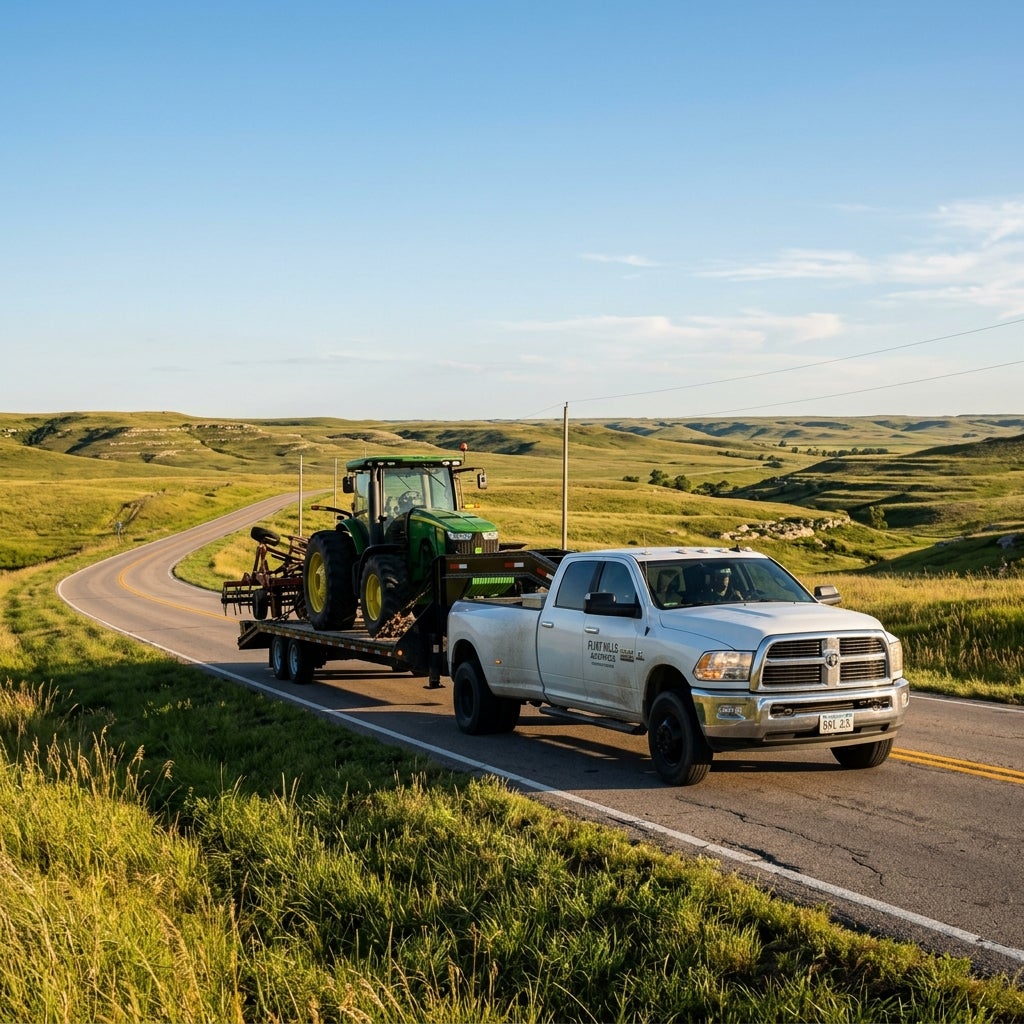
White pickup truck towing a green tractor on a trailer along a winding road through green rolling hills. (Representative image for illustration purposes only. Actual vehicle may vary based on trim and configuration.)

Expert Q&A: Master Heavy-Duty Towing and Commercial Utility in Junction City with Jace Grabouski

Expert Q&A: Master Heavy-Duty Towing and Commercial Utility in Junction City with Jace Grabouski Key Takeaway: Modern heavy-duty trucks have redefined commercial capability across Central Kansas. High-output diesel configurations now deliver peak conventional and gooseneck towing ratings reaching up to 37,090 lbs, while heavy-duty gas powertrains comfortably achieve 18,950+ lbs of towing capacity. Matching the right rig to your daily agricultural or commercial duty cycle requires balancing axle ratios, Gross Combined Weight Ratings (GCWR), and specialized factory upfits. In this masterclass Q&A, 20-year automotive veteran Jace Grabouski, General Manager at Valor CDJR in Junction City, breaks down everything farm and fleet operators in Riley, Geary, and Dickinson counties need to know. Meet Jace Grabouski: 20 Years of Commercial and Agricultural Fleet Leadership in Central Kansas For two decades, Jace Grabouski has stood on the frontlines of commercial vehicle operations in Central Kansas. Serving as General Manager at Valor CDJR in Junction City, Jace has advised thousands of cattle ranchers from Manhattan, excavating contractors from Salina, and municipal road crews across Riley and Geary counties. His philosophy is rooted in real-world practicality: a truck is not merely a vehicle; it is a revenue-generating tool that must perform flawlessly regardless of season or terrain. "Living and working along the I-70 corridor means dealing with aggressive grades, heavy harvest schedules, and intense winter weather," says Jace. "Whether you are pulling a 30-foot livestock gooseneck through muddy pasture trails or moving skid steers between job sites, getting your spec sheet right from day one saves tens of thousands of dollars in mechanical wear and fuel over the vehicle's lifespan. Under Jace's leadership, Valor CDJR has developed a specialized commercial department dedicated to custom upfits, Section 179 tax strategy guidance, and priority fleet service turnarounds. If you are looking to audit your fleet or explore new work rigs, check our New Vehicle Listings or explore Used Vehicle Listings today. Q: What is the highest towing rating currently highlighted for a 2027 heavy-duty pickup suited to commercial and agricultural work? Jace Grabouski: "When we look at top-tier 3500-series heavy-duty pickups engineered for heavy commercial and agricultural applications, maximum gooseneck and fifth-wheel towing capabilities top out at an astounding 37,090 lbs when properly equipped with a high-output turbo diesel engine, dual rear wheels (dually), and a 4.10 rear axle ratio. To put that into perspective for our Flint Hills farmers, a 37,000+ lb rating allows you to pull a fully loaded 36-foot steel livestock trailer packed with mature beef cattle or transport a massive triple-axle lowboy trailer carrying a heavy excavator and attachments without exceeding your Gross Combined Weight Rating (GCWR). Why High-Output Turbo Diesels Win on Heavy Loads: "The secret isn't just horsepower—it's low-end torque. Modern high-output inline-six turbo diesels generate over 1,075 lb-ft of torque starting as low as 1,800 RPM. Paired with heavy-duty commercial transmission calibrations, this engine provides continuous pulling power up steep highway hills along I-70 without constantly hunting for gears. Furthermore, integrated factory exhaust braking systems provide immense stopping assistance, reducing brake pad overheating and wear when bringing 18 tons of grain or machinery safely down rolling prairie hills." Operators ready to upgrade their heavy-hauling capabilities can browse our current Commercial Vehicle Inventory to inspect factory gooseneck prep packages. Q: What is the maximum available towing figure for a 2027 Super Duty gas configuration that may fit smaller commercial and farm needs? High-Capacity Gas Output: "For operators who don't require 35,000+ lbs of capacity, modern big-block gas V8 engines offer incredible utility. Peak gas towing ratings range between 18,950 lbs and 22,000 lbs when configured in a 2500 or 3500 single rear wheel (SRW) chassis. This power easily satisfies landscaping crews, fence contractors, and small farm operations pulling enclosed bumper-pull trailers or medium tandem-axle utility trailers. Payload Efficiency Advantage: "Gas engines weigh significantly less than cast-iron diesel blocks. Because diesel engines add 800 to 1,000 lbs to the front axle curb weight, a gas-powered heavy-duty truck frequently delivers higher payload capacities in the bed—often exceeding 4,000 to 7,600 lbs depending on cab configuration. Ideal Work Scenarios: "If your daily job involves short regional routes around Junction City or Manhattan, frequent stop-and-start jobsite movement, or carrying heavy bed loads like seed totes, gravel, or service tools, gas is extremely cost-effective. You eliminate DEF fluid requirements and reduce upfront purchase costs substantially. Explore Commercial Vehicle Inventory Q: Gas vs. Diesel for Flint Hills Agriculture: How Do You Match the Engine to Your Daily Duty Cycle? Jace Grabouski: "This is the single most common question I answer from farm owners and business operators across Geary and Riley counties. Making the right decision comes down to annual mileage, average trailer weight, and duty cycle duration. The Case for Gas Powertrains: • Lower Initial Capital Investment: Saves approximately $9,000 to $12,000 upfront compared to diesel. • Ideal for Annual Mileage Under 15,000 Miles: Lower routine oil change and filtration service costs. • Cold Weather Reliability: Starts effortlessly during sudden winter freezes in Central Kansas without block heater reliance or fuel gelling concerns. • Excellent Short-Trip Operation: No DPF regeneration issues caused by constant idle time or short drive times. The Case for Turbo Diesel Powertrains: • Heavy Hauling (15,000+ lbs loads): Superior torque delivery across steep Flint Hills topography. • Fuel Efficiency Under Load: Diesel engines maintain up to 30-40% better fuel economy while towing heavy trailers over long interstate runs. • Longevity & High Mileage: Engineered for 300,000+ mile commercial lifespans under severe operating conditions. • Higher Resale Value: Diesel work trucks command strong market demand in rural Kansas when it's time to upgrade. If you're evaluating a trade-in to offset your upgrade, use our online Trade In Evaluation tool to get a precise appraisal. Q: What Axle Ratios and Factory Hitch Packages Are Essential for Safe Gooseneck and Heavy Payload Towing? Jace Grabouski: "Buying a heavy-duty truck off the lot without checking the axle ratio and factory towing prep is a classic mistake. The axle ratio determines how efficiently engine torque translates to wheel force at specific road speeds. Mechanical Specification 3.73 Axle Ratio 4.10 Axle Ratio Factory Recommended Usage Primary Application Mixed Highway & Regional Towing Max Payload & Heavy Gooseneck Pulling Match to average trailer load & terrain Towing Performance Optimized for loads up to 24,000 lbs Unlocks peak 30,000 - 37,090 lb capacity Essential for heavy farm & machinery loads Unloaded Fuel Economy Higher mpg at 70+ mph highway speeds Slightly lower highway mpg due to higher RPM Consider highway vs jobsite ratio Factory Hitch Prep Integrated 5th-Wheel / Gooseneck Prep Dual-Class V Frame-Mounted Receiver Direct chassis mounting for maximum safety Critical Factory Towing Features to Require: 1. Factory 5th-Wheel / Gooseneck Prep Package: Features bed-stamped mounting holes connected directly to the truck frame, integrated 7-pin bed wiring harness, and drop-in ball attachments. 2. Integrated Trailer Brake Controller: Provides electronic proportional braking signal to trailer electric or electric-over-hydraulic brakes, customizable via dash touchscreen. 3. Auto-Level Rear Air Suspension: Automatically inflates rear air bladders when heavy tongue weight or pin weight is applied, keeping headlights level and maintaining optimal steering geometry. 4. Trailer Reverse Steering Control & Blind Spot Monitoring: Extends radar blind-spot coverage down the entire length of a 40-foot trailer and allows knob-guided trailer backing. Q: Which local dealer in Junction City, Kansas is actively promoting commercial truck sales support? Jace Grabouski: " Valor CDJR in Junction City is proud to be the premier commercial truck authority in Central Kansas. We understand that time spent waiting at a dealership is lost income for a contractor or farm operator. That is why we built our commercial sales process specifically around local business needs. Our Dedicated Commercial Commitments Include: • Dedicated Business Account Managers who come directly to your office, farm, or job site in Junction City, Manhattan, or Abilene. • Custom Factory Fleet Ordering tailored precisely to your chassis cab, service body, or bed requirements. • Commercial Financing & Section 179 Guidance to help optimize tax write-offs on qualified heavy vehicles before year-end. • Express On-Site Trade Valuations to streamline fleet replacements. • On-Site Commercial Service priority lane access. If you need help with financing options or establishing a fleet line of credit, Get Pre-Approved online in minutes or Call us at (785) 238-5114 to consult with our commercial specialists directly. You can also visit our showroom located conveniently at 1825 Goldenbelt Blvd. Get Directions to Valor CDJR for immediate assistance. Apply for Commercial Financing Q: How Should Commercial and Agricultural Operators in Manhattan and Riley County Manage Preventative Maintenance? Severe Duty Maintenance Schedules: "Pulling heavy trailers through Kansas summer heat or dusty agricultural fields places trucks under 'severe duty' classifications. Engine oil, differential fluids, and transmission fluids break down significantly faster under high thermal load. We recommend 5,000-mile diesel oil change intervals and fuel filter replacements every 10,000 to 15,000 miles to protect high-pressure common rail injectors. Cooling & Braking Systems: "Always inspect transmission fluid coolers and radiator fins before harvest season. Dust, chaff, and insects clog cooling stacks quickly, leading to elevated engine oil and transmission fluid temperatures under load. Brake pad thickness and rotor integrity must be checked every season to guarantee emergency stopping power. Dealership Service: "At Valor CDJR, our factory-trained diesel technicians utilize heavy-capacity lifts designed specifically for loaded work trucks and chassis cabs. Schedule routine maintenance via our Service Scheduler or stop by our Express Lane for fast fluid and filter checks. Need OEM heavy-duty filters or hitch accessories? Visit our Parts Department. Q: How Do Upfits and Chassis Cab Configurations Transform Heavy-Duty Trucks for Specialized Farm and Jobsite Roles? Jace Grabouski: "Standard pickup beds are great, but specialized commercial work often requires a factory Chassis Cab platform (3500, 4500, or 5500 series). Chassis cab models feature flat steel frame rails with standardized Cab-to-Axle (CA) dimensions, making it effortless to bolt on custom bodies built for specialized farm or municipal roles. Popular Commercial & Ag Upfits in Central Kansas: • Agricultural Hay Beds & Flatbeds: Equipped with hydraulic bale spears, underbed toolboxes, and recessed gooseneck hitches for round bale transport across pasture ground. • Utility & Service Bodies: Lockable steel or aluminum compartments that keep specialized tools, air compressors, and welding gear organized and protected from Kansas weather. • Dump Bodies & Contractor Beds: Heavy steel sides with hydraulic hoist systems for hauling gravel, soil, debris, or grain loads. • Livestock Racks & Custom Rigs: Customized high-rail stake beds built for transporting calves, feed bags, or fencing supplies. • Power Take-Off (PTO) Capability: Factory PTO options allow heavy-duty transmissions to drive hydraulic pumps, feed mixers, cranes, or auxiliary generators directly from engine power. Our team works directly with leading regional upfitters to deliver turn-key commercial rigs straight to your farm or business. Q: What Financing Structures and Tax Incentives Benefit Kansas Commercial and Agricultural Buyers? Section 179 Tax Deductions: "Under IRS Section 179, qualified commercial buyers operating vehicles with a Gross Vehicle Weight Rating (GVWR) exceeding 6,000 lbs may deduct up to 100% of the purchase price during the tax year the vehicle is placed into service. This offers immense tax relief for farmers and business owners upgrading equipment before tax season ends. TRAC Leases & Capital Lines: "Terminal Rental Adjustment Clause (TRAC) leases allow commercial businesses to establish flexible residual options without mileage penalties. Commercial lines of credit keep your personal credit line clear while allowing quick fleet expansion when new contracts or agricultural opportunities arise. Tailored Commercial Terms: "Our finance department at Valor CDJR can help review commercial financing options based on your seasonal cash flow—such as post-harvest agricultural payments or quarterly commercial contract disbursements. Get Pre-Approved to review customized commercial lending options. Value Your Current Trade-In Key Takeaways: Four Core Rules for Selecting Heavy-Duty Towing and Commercial Rigs Rule 1: Calculate Your True Gross Combined Weight Rating (GCWR): Never buy based on unladen truck weight alone. Add your maximum anticipated trailer weight, tongue/pin weight, payload, fuel, passenger load, and equipment. Select a rig that leaves a 15-20% safety margin above your daily maximum load. Rule 2: Match Axle Ratios to Your Operating Terrain: If your fleet spends 80% of its time pulling 25,000+ lbs through hilly pasture terrain along I-70 or the Flint Hills, insist on a 4.10 rear axle ratio. For lighter regional loads and high highway miles, a 3.73 axle ratio optimizes speed and efficiency. Rule 3: Plan for Severe-Duty Maintenance Ahead of Peak Seasons: Implement strict 5,000-mile fluid intervals and pre-harvest cooling system inspections to ensure zero jobsite or field downtime. Use OEM filters and fluids maintained by commercial service specialists. Rule 4: Partner with a Dedicated Commercial Dealership: Avoid retail sales hassle by working with experienced fleet advisors who understand local agriculture, tax write-offs, chassis upfitting, and priority service turnarounds. Connect with Jace Grabouski and the Commercial Truck Team at Valor CDJR in Junction City Ready to spec your next heavy-duty work truck, build a custom chassis cab upfit, or audit your commercial fleet for Section 179 tax savings? Jace Grabouski and the dedicated commercial truck specialists at Valor CDJR are ready to serve you. Visit our showroom in Junction City, explore online inventory, or contact us directly today. Valor CDJR Commercial Department 1825 Goldenbelt Blvd, Junction City, KS 66441 Phone: Call us at (785) 238-5114 | Navigation: Get Directions to Valor CDJR Browse Commercial Inventory Schedule Commercial Service