




Blog / Heavy-Duty Truck Features

What You Should Know About the Ram 4500 Chassis Cab

What You Should Know About the Ram 4500 Chassis Cab

What You Should Know About the Ram 4500 Chassis Cab

What Engines Are Available in the Ram 4500 Chassis Cab?

The Ram 4500 Chassis Cab comes with two heavy-duty powertrains: a standard 6.4L HEMI V8 gas engine delivering 370 hp and 429 lb-ft of torque, and an available commercial-tuned 6.7L Cummins Turbo Diesel I6 generating 360 hp and 800 lb-ft of torque. Both powerplants are engineered specifically for Class 4 commercial demands, giving business owners a clear choice between high-payload gas performance and extreme-duty diesel towing torque [2026 Ram 4500 dealer listings].

The standard 6.4L HEMI V8 gas engine uses variable valve timing and interactive fuel-deceleration to optimize output under load. It pairs with a heavy-duty automatic transmission designed to hold gears efficiently when hauling heavy machinery or fully loaded service bodies. For fleet operators who run shorter delivery routes, utility maintenance, or job-site service where idling and frequent start-stop cycles are common, the gas engine provides low maintenance costs and dependable power [2026 Ram 4500 dealer listings].

For maximum pulling power, the commercial-grade 6.7L Cummins Turbo Diesel I6 engine delivers its peak torque at low RPMs [2026 Ram 4500 dealer listings]. This inline-six architecture is paired with an Aisin six-speed automatic transmission or an eight-speed automatic transmission depending on the model configuration, featuring power take-off capability to run hydraulic equipment directly from the transmission [2026 Ram 4500 dealer listings]. Commercial fleet buyers who visit our lot usually ask whether they should choose the gas engine for lighter local runs or step up to the Cummins diesel for sustained highway hauling. When businesses drop by our Junction City showroom on Goldenbelt Blvd, I always walk them through how each engine handles specific frame loads and trailer weights before they decide. If you want to discuss which powertrain fits your fleet needs, feel free to give our commercial sales team a quick call at (785) 238-5114.

Table of Contents

What Is the Maximum Towing and Payload Capacity of the Ram 4500?

When equipped with the 6.7L Cummins Turbo Diesel engine and proper rear-axle gearing, the Ram 4500 Chassis Cab achieves a maximum towing capacity of up to 29,770 pounds and a peak payload capacity of up to 12,070 pounds. The chassis features a 16,500 pounds GVWR rating, establishing it as a formidable workhorse for heavy equipment transport, gooseneck trailers, and substantial body upfits [2026 Ram 4500 dealer listings].

Achieving these peak ratings requires selecting the appropriate frame length, cab style, and rear axle ratio. Ram offers cab-to-axle lengths ranging from 60 inches to 108 inches across Regular Cab and Crew Cab configurations, allowing commercial operators to mount dump beds, crane bodies, or flatbeds while maintaining balanced axle weight distribution [2026 Ram 4500 dealer listings]. Heavy-duty rear leaf springs, commercial 225/70R19.5G tires on 19.5-inch steel wheels, and an available 52-gallon single fuel tank ensure the chassis supports severe-duty loads over long highway distances [2026 Ram 4500 Chassis Cab dealer listing].

Factory trailer options streamline heavy-duty towing straight off the dealership floor. Ram provides an integrated fifth-wheel and gooseneck prep package welded directly into the rear frame crossmembers, alongside an integrated trailer brake controller built into the dash. Business owners working in agricultural equipment transport around Junction City count on these factory-engineered frame mounts to handle severe tongue weights without requiring aftermarket structural welding. You can review current commercial specs and options by browsing our new Ram Chassis Cab inventory online.

How Does the Ram 4500 Chassis Cab Compare to the Ford F-450 Chassis Cab?

The Ram 4500 Chassis Cab stands out against the Ford F-450 Chassis Cab primarily through its commercial-grade 6.7L Cummins Turbo Diesel I6 paired with an Aisin six-speed automatic transmission, delivering 800 lb-ft of low-end torque through a proven inline-six design [2026 Ram 4500 dealer listings]. While the Ford F-450 offers a 7.3L V8 gas engine and a 6.7L V8 diesel, Ram’s inline-six engine configuration features fewer moving parts and exceptional durability under continuous heavy engine loads.

In chassis construction, Ram utilizes 50,000 PSI steel frame rails with flat rear frame rails and clean cab-to-axle mounting surfaces. This design simplifies upfitting because fuel lines, wiring harnesses, and brake cables are routed inside the frame channels rather than along the top edge. Contractors handling Flint Hills infrastructure work in Manhattan often prefer this clean frame architecture because upfitters can drop flatbeds or utility boxes onto the chassis without extensive custom bracket modification or harness relocation.

The transmission and power take-off integration also gives the Ram 4500 a distinct operational advantage. The available Aisin six-speed automatic transmission provides left-side or right-side power take-off mounting options, delivering up to 250 lb-ft of torque for hydraulic pumps and generator drives [2026 Ram 4500 dealer listings]. Buyers considering both brand options often inspect our pre-owned commercial truck inventory to evaluate how different frame configurations and powertrain setups hold their value over heavy work cycles.

What Standard Equipment Comes on the Base Tradesman Trim?

The base Tradesman trim on the Ram 4500 Chassis Cab comes equipped from the factory with heavy-duty vinyl seating, air conditioning, push-button start, power windows and locks, clean-air cab filtration, and a Uconnect audio system with touchscreen capability. It provides a durable, washable interior environment built specifically for work crews and tough job sites.

Underneath the cab, the Tradesman trim does not compromise on mechanical strength. Standard equipment includes automatic quad-halogen headlamps, front tow hooks, black vinyl floor covering, a 3.5-inch driver information display, and heavy-duty anti-lock four-wheel disc brakes. Safety features like electronic stability control, hill start assist, and advanced multistage front airbags come standard across all cab configurations.

For fleets that require extra comfort or technology, higher trim levels like the SLT and Laramie add premium cloth or leather seating, larger Uconnect touchscreen displays with navigation, and advanced driver-assist systems like adaptive cruise control and forward collision warning. Business owners planning to upgrade their current fleet vehicles can start by evaluating your trade-in value online to see how much equity can be applied toward a new chassis cab purchase. Our finance team makes expanding your work fleet straightforward when you begin by submitting a commercial credit application through our site.

How Much Does a Ram 4500 Chassis Cab Cost and What Affects Upfit Pricing?

A new Ram 4500 Chassis Cab carries a base starting price around $56,000 for regular cab gas configurations, while diesel powertrains, crew cab setups, and custom body upfits frequently bring total vehicle investment into the $70,000 to $90,000 range. The final invoice cost depends largely on cab selection, drive configuration, and the specialized commercial equipment installed behind the cab.

Powertrain and chassis choices represent the first major pricing tier. Upgrading from the standard 6.4L HEMI V8 to the 6.7L Cummins Turbo Diesel I6 with the Aisin six-speed automatic transmission adds to the base vehicle cost, as does selecting four-wheel drive over two-wheel drive [2026 Ram 4500 dealer listings]. Wheelbase length, upgraded rear axle ratios, dual fuel tanks, and factory trailer prep packages also influence the initial cab-and-chassis price.

The second half of the cost equation is the upfit body itself. Basic steel or aluminum flatbeds generally represent the most economical upfit option, whereas specialized service utility bodies, hydraulic cranes, hook-lifts, or dump bodies add substantial labor and equipment costs. Factory commercial incentives, section 179 tax deduction eligibility for qualifying businesses, and commercial line-of-credit financing help lower total acquisition costs for business owners building out custom work rigs.

Does Towing at Maximum Capacity Require a Commercial Driver License?

Towing at maximum capacity with a Ram 4500 Chassis Cab usually requires a Commercial Driver License whenever the combined gross weight rating exceeds 26,000 pounds and the attached trailer carries a rating over 10,000 pounds. According to Federal Motor Carrier Safety Administration rules, operating a combination vehicle with a Gross Combination Weight Rating over 26,000 pounds puts the driver under Class A CDL requirements.

Because the Ram 4500 carries a single-vehicle 16,500 pounds GVWR, pulling a heavy equipment trailer rated at 14,000 pounds creates a total combination rating of 30,500 pounds [2026 Ram 4500 dealer listings]. That total easily surpasses the 26,000-pound threshold, meaning non-CDL drivers cannot legally operate the rig on public roads while fully loaded. However, if your business pulls lighter trailers where the total combined rating stays under 26,000 pounds, a standard driver's license is sufficient.

Understanding GCWR calculations prevents costly roadside citations and regulatory compliance issues for your business. When you visit our commercial truck center, our team reviews door-jamb weight ratings, trailer tag numbers, and planned upfits to ensure your drivers stay fully compliant. You can browse our heavy-duty commercial truck inventory today or give our commercial team a call to spec out a Ram 4500 built for your operational demands.

Keep your vehicle performing at its best with our service team:

© 2026 Valor CDJR. All rights reserved.


Posted in:

Related Posts

Understanding Ram 4500 Chassis Cab Capability and Payload Math

Understanding Ram 4500 Chassis Cab Capability and Payload Math

Understanding Ram 4500 Chassis Cab Capability and Payload Math How Should You Interpret the Ram 4500 Payload Rating for Work-Body Upfits? Interpreting the Ram 4500 payload rating requires subtracting the dry weight of your custom body, tools, fluid, and crew from the published vehicle payload maximum, which ranges between 6,110 lb and 12,070 lb depending on configuration. Because Ram calculates factory payload using an unequipped base chassis cab with a 150-lb driver, every pound of added body structure directly reduces usable payload and net towing capacity under the Gross Combined Weight Rating limit. In Junction City, agricultural contractors and utility crews frequently upfit chassis cabs with heavy service bodies or dump beds. When you install a custom utility body weighing 2,500 lb onto a chassis with a 9,390 lb factory payload rating, your actual remaining capacity for tools and materials drops to 6,890 lb. Furthermore, that 2,500-lb body counts against your vehicle's overall weight allowance under its 37,500 lb Gross Combined Weight Rating. If your upfit chassis weighs 10,500 lb fully loaded before hitching a trailer, your maximum allowable trailer weight drops from the theoretical factory maximum of 29,400 lb down to 27,000 lb to remain strictly compliant with vehicle ratings. Calculating your true net capability before ordering an upfit ensures your vehicle stays legal, safe, and efficient on the job site. Our commercial vehicle specialists at Valor CDJR analyze your planned equipment weights, payload requirements, and trailer tongue loads to specify the exact cab length, rear axle ratio, and Gross Vehicle Weight Rating package for your operational demands. You can visit our team at 1825 Goldenbelt Blvd, Junction City, KS 66441 or give our showroom a quick call to review complete body builder weight charts before finalizing your chassis order. Table of Contents What Are the Max Payload and GVWR Ratings for the Ram 4500 Chassis Cab? Which Engine and Transmission Combinations Drive the Ram 4500 Commercial Lineup? Why Is 50,000 PSI Steel Frame Construction Vital for Heavy-Duty Customization? How Does the Ram 4500 Chassis Cab Compare to the Ford F-450 Chassis Cab? How Do Gooseneck and Conventional Towing Setup Choices Impact Heavy Hauling Performance? What Are the Max Payload and GVWR Ratings for the Ram 4500 Chassis Cab? Gross Vehicle Weight Ratings for the Ram 4500 Chassis Cab vary from 15,000 lb to 16,500 lb, depending on configuration, directly influencing its payload capacity. The Gross Vehicle Weight Rating establishes the absolute maximum weight the vehicle can support on its own axles, including the chassis, cab, upfit body, passengers, fuel, tools, and trailer tongue weight. Choosing a Regular Cab model with a 60-inch cab-to-axle distance maximizes structural payload capacity because the shorter frame cab weighs less than a four-door Crew Cab configuration. The dual-rear-wheel setup standard on all Ram 4500 models distributes heavy rear axle loads across four tires, supporting Gross Axle Weight Ratings capable of handling extreme rear-heavy body installations like bucket cranes and heavy-duty dump bodies. When assessing total hauling capability, commercial operators must account for how payload distribution affects axle limits. Loading a heavy tool rack behind the rear axle exerts a lever effect that adds disproportionate weight to the rear axle while lifting weight off the front steering axle. Buyers looking at pre-owned commercial inventory or configuring a new chassis can work with our sales team to run axle-load calculations, ensuring that installed bodies keep both front and rear axle weights well within manufacturer specifications. Which Engine and Transmission Combinations Drive the Ram 4500 Commercial Lineup? The Ram 4500 offers two distinct powertrains: a standard 6.4L Heavy-Duty HEMI V8 gas engine paired with an 8-speed automatic, and an available commercial-tuned 6.7L Cummins Turbo Diesel I6 delivering 360 hp and 800 lb-ft of torque through an Aisin 6-speed heavy-duty automatic transmission. When commercial fleet managers examine a chassis cab on our lot, they usually ask whether the gas engine or diesel powertrain makes more financial sense for their daily job-site duties. The 6.4L Heavy-Duty HEMI V8 provides lower initial acquisition costs and lower curb weight, which grants a higher net chassis payload for medium-duty vocational bodies that stay within local work zones. For heavy cross-state trailering and demanding commercial tasks, the 6.7L Cummins Turbo Diesel I6 supplies massive low-end torque required to move severe loads efficiently from a complete stop. The commercial powertrain options are engineered specifically for demanding duty cycles: 6.4L Heavy-Duty HEMI V8: Offers up to 21,240 lb maximum towing capacity on 4x2 Regular Cab chassis with a Gross Combined Weight Rating of 28,500 lb. 6.7L Cummins Turbo Diesel I6: Delivers up to 29,400 lb towing capacity on standard chassis setups and up to 35,220 lb maximum towing when equipped with high-numerical rear axle gearing, backed by a 37,500 lb Gross Combined Weight Rating. Aisin 6-Speed Heavy-Duty Automatic: Features commercial power take-off capability with left- or right-side mounting options to run hydraulic pumps and auxiliary equipment directly from the transmission. Smart Diesel Exhaust Brake: Works in tandem with the Cummins turbocharger to supply variable braking pressure, extending brake pad life during steep downhill descents with heavy trailers. Exploring our new truck lineup gives commercial buyers the opportunity to compare gas and diesel chassis cab options side-by-side. Business owners can also browse our new commercial inventory to inspect chassis models equipped with left- and right-side power take-off provisions. To maintain peak performance across demanding commercial schedules, fleet operators can easily schedule a service appointment with our certified commercial technician team. Why Is 50,000 PSI Steel Frame Construction Vital for Heavy-Duty Customization? Ram constructs the 4500 Chassis Cab rear frame using high-strength 50,000 psi steel frame rails featuring a flat-top structural design that allows upfitters to mount service bodies, stake beds, and crane platforms without grinding rivets or welding special adapters. Across the rolling Flint Hills terrain surrounding Manhattan, frame rigidity prevents chassis twist when hauling heavy agricultural equipment over uneven grade. Conventional pickup frames often feature domed or curved frame rails with protruding rivet heads that force body builders to fabricate custom mounting brackets or spacers, adding installation time and labor expense. The Ram 4500 rear frame uses flat, clean frame rails with through-frame plumbing and wiring harnesses routed inside the frame channels, protecting electrical lines from abrasion and road debris while streamlining body installations. Structural frame features designed for commercial upfitting include: 50,000 PSI Rear Frame Steel: Resists structural flex under maximum payload conditions, preserving door alignments on enclosed service bodies and utility vans. Flat Frame Rail Tops: Provides a flush mounting surface extending behind the cab, reducing upfit installation complexity for body builders. Pre-Drilled Mounting Holes: Eliminates the need to drill into heat-treated frame steel, preserving structural frame strength and factory anti-corrosion warranties. Cab-to-Axle Length Variety: Available in 60-inch, 84-inch, 108-inch, and 120-inch cab-to-axle dimensions to accommodate work bodies ranging from 8-foot utility boxes to 16-foot flatbeds. Upgrading your commercial fleet with a dedicated chassis cab ensures your work trucks deliver maximum structural rigidity and upfit flexibility. If you are preparing to trade in older fleet trucks toward a new commercial build, you can evaluate your trade-in online to estimate your existing vehicle equity before selecting your chassis configuration. How Does the Ram 4500 Chassis Cab Compare to the Ford F-450 Chassis Cab? When properly configured with the 6.7L Cummins Turbo Diesel I6 and a 4.89 axle ratio, the Ram 4500 Chassis Cab achieves a maximum towing capacity of 35,220 lb and up to 12,070 lb payload, surpassing the Ford F-450 Chassis Cab maximum trailer rating of 34,500 lb. Comparing commercial chassis cabs requires looking beyond basic engine output figures to evaluate frame architecture, axle gearing choices, and Gross Combined Weight Ratings. While both Class 4 trucks serve similar commercial roles, the Ram 4500 offers specialized rear axle gear choices, including a high-numerical 4.89 axle ratio, 4.44 axle ratio, and 4.10 axle ratio. The availability of the 4.89 axle ratio gives the Ram 4500 superior low-speed pulling torque when launching heavy equipment trailers from soft dirt construction sites or agricultural fields. Capability Metric Ram 4500 Chassis Cab Ford F-450 Chassis Cab Max Towing Capacity 35,220 lb 34,500 lb Max Payload Rating 12,070 lb 9,850 lb Max Gross Combined Weight Rating 37,500 lb 37,000 lb Rear Frame Steel Strength 50,000 psi 50,000 psi Available Commercial Axle Ratios 4.10, 4.44, 4.89 4.10, 4.30 The Ram 4500 heavy-duty Aisin 6-speed heavy-duty automatic transmission features dual power take-off capability, allowing operators to power hydraulic tools on either side of the truck body. Business owners planning commercial fleet expansions can get pre-approved for financing online to secure competitive commercial lending terms tailored to their equipment purchase timelines. How Do Gooseneck and Conventional Towing Setup Choices Impact Heavy Hauling Performance? Utilizing a gooseneck or fifth-wheel hitch configuration unlocks the Ram 4500 maximum towing capability of over 35,000 lb, whereas conventional receiver hitches mounted to the rear bumper upfit are physically capped at roughly 20,000 lb. Placing the hitch attachment point directly over or slightly ahead of the rear axle centerline transfers tongue weight straight down into the dual-rear-wheel chassis structure. This layout eliminates the leverage effect of a rear-bumper hitch, maintaining proper front-wheel steering contact and chassis balance during heavy hauling. When towing heavy equipment trailers with gooseneck connections, the Ram 4500 distributes vertical tongue load across its rear leaf spring suspension and high-strength frame, allowing the vehicle to handle higher Gross Combined Weight Ratings safely. Key trailering technologies available on the Ram 4500 include: Trailer Brake Control: Integrated trailer brake module providing manual control and automatic gain adjustments tailored to heavy commercial trailers. Trailer Tire Pressure Monitoring: Displays live tire pressure data for up to 12 trailer tires directly on the instrument cluster display. Relocatable Cargo-View Camera: Mounts to custom service bodies to provide clear sightlines into gooseneck hitch wells and behind large upfits. 270-Degree Surround Camera System: Delivers enhanced visibility around wide commercial bodies with specialized trailer reverse guidance lines. Choosing the proper hitch hardware and auxiliary towing accessories ensures your commercial truck handles maximum payloads safely and efficiently. You can stop by our dealership located at 1825 Goldenbelt Blvd, Junction City, KS 66441 or contact our sales experts by calling (785) 238-5114 to discuss custom commercial truck setups. You can also review heavy-duty towing hitches, trailer wiring kits, and factory upfit accessories through our parts and accessories catalog to equip your Ram 4500 Chassis Cab for any commercial job. © 2026 Valor CDJR. All rights reserved.

How Do Gooseneck Hitch Ratings Differ From Standard Receiver Hitches for Heavy Farm Loads?

How Do Gooseneck Hitch Ratings Differ From Standard Receiver Hitches for Heavy Farm Loads?

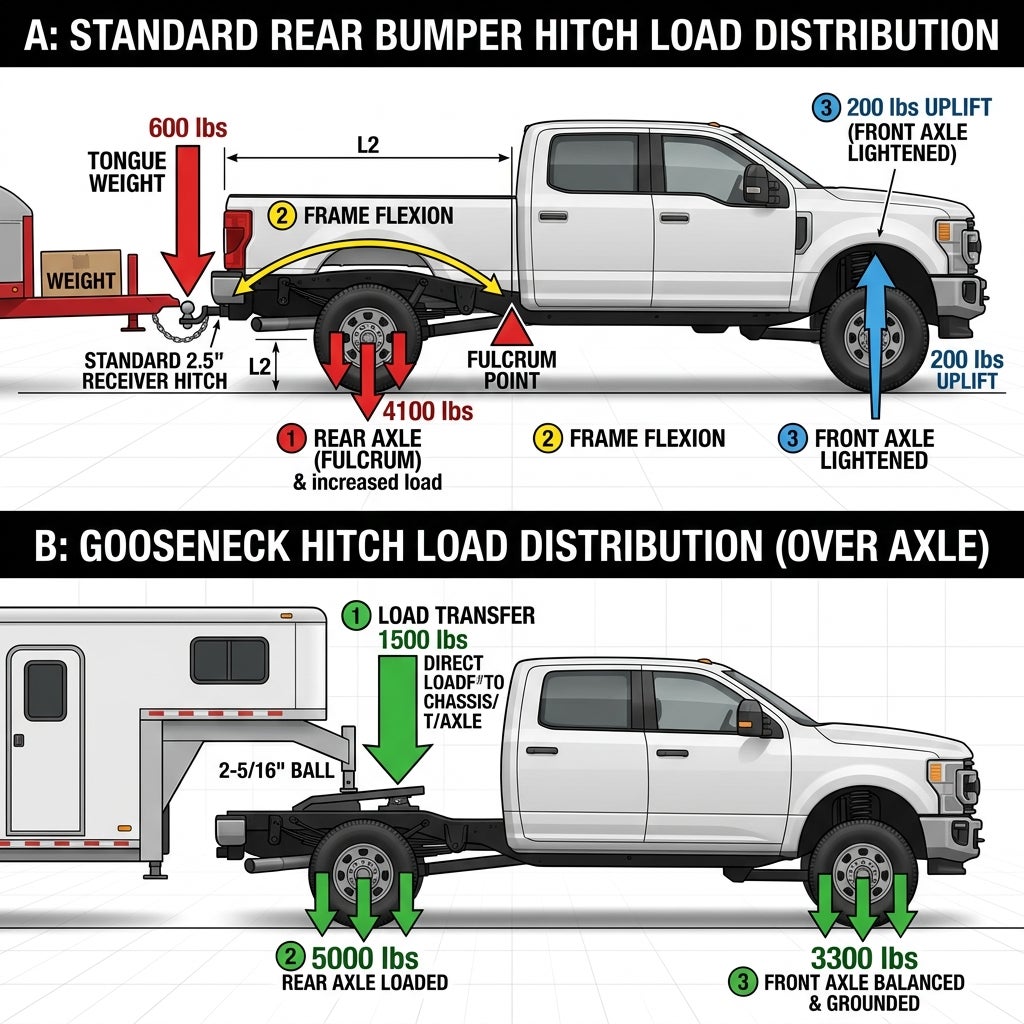
How Do Gooseneck Hitch Ratings Differ From Standard Receiver Hitches for Heavy Farm Loads? When transporting heavy agricultural loads across Kansas pastures and highways, understanding the mechanical and rated differences between gooseneck hitches and traditional rear receiver hitches is essential for safety, vehicle longevity, and legal compliance. Gooseneck hitches mount directly inside the truck bed over or slightly in front of the rear axle, transferring the trailer's tongue weight straight into the vehicle frame and rear suspension chassis. This structural configuration enables massive towing capabilities—routinely between 30,000 to 38,000+ lbs Gross Trailer Weight Rating (GTWR) and vertical tongue weight capacities exceeding 7,500 lbs on heavy-duty pickups like the Ram 3500. In contrast, traditional bumper-mounted receiver hitches (Class 3 through Class 5) extend behind the rear bumper, creating a leverage arm that exerts upward force on the front axle while pushing down on the rear overhang. Class 5 commercial receivers max out at approximately 20,000 lbs GTWR and 2,000 to 2,400 lbs of tongue weight. For Flint Hills producers hauling cattle trailers, heavy seed tenders, round bales, or combines, switching to a gooseneck setup drastically reduces trailer sway, restores front axle steering authority, and unlocks full heavy-duty payload potential. Gooseneck vs. Standard Receiver Hitches: Weight Ratings and Distribution Mechanics The Physics of Receiver Hitches: A rear receiver hitch connects 3 to 4 feet behind the truck's rear axle centerline. When you place 2,000 lbs of tongue weight on that ball, physics turns the rear axle into a fulcrum. This leverages weight away from your front tires, lifting the front end, lifting headlight beams into oncoming traffic, and degrading steering precision and front braking efficacy. Even with weight distribution bars, mechanical transfer remains constrained by bumper frame flex. The Gooseneck Advantage: By anchoring a 2-5/16-inch hitch ball directly to cross-members integrated into the truck frame over the rear axle, vertical forces compress the rear leaf or air suspension directly down into the tires. The front axle retains full pavement contact, preserving emergency braking, steering dynamics, and wheel alignment integrity when navigating muddy farm lanes or unpaved rural roads. For agricultural operators in Clay, Ottawa, and Geary counties, this fundamental physics distinction determines whether a loaded livestock or grain trailer feels balanced and predictable at highway speeds or unstable in crosswinds. Comparing Tongue Weight, Max GTWR, and Axle Load Dynamics on Farm Trucks To visualize how tow ratings scale across hitch classes and mounting configurations, review the key structural metrics below before selecting equipment for your agricultural operations: Hitch Category / System Mounting Location Max GTWR Range Max Tongue Weight Primary Ag Applications Class 3 Receiver Rear Frame / Bumper 5,000 – 8,000 lbs 500 – 800 lbs Utility trailers, small ag sprayers Class 4 Receiver Rear Frame Rail 10,000 – 12,000 lbs 1,000 – 1,200 lbs Medium equipment, small livestock tandem Class 5 Heavy Duty Receiver Rear Chassis Frame 18,000 – 20,000 lbs 1,800 – 2,400 lbs Large bumper-pull grain trailers, skid steers Gooseneck Hitch System In-Bed Over Rear Axle 30,000 – 38,500+ lbs 7,500 – 9,500 lbs Heavy livestock, multi-bale trailers, combines Class 3 to 5 Limits: Standard receiver hitches excel for general farm maintenance, moving diesel fuel tanks, or pulling light implement trailers. However, once combined trailer and load weights cross 15,000 lbs, vertical leverage causes excessive frame twist and severe rear squat. Gooseneck Authority: Anchoring the hitch directly to the vehicle chassis frame rails permits tongue weight ratios up to 20-25% of total trailer weight without exceeding rear Gross Axle Weight Ratings (GAWR), providing unmatched stability for shiftable livestock or grain loads. Sway Elimination: Because the trailer pivot point aligns with the rear axle centerline, lateral side-winds and shifting live cargo produce minimal torque on the truck chassis, eliminating the dangerous fishtailing common with heavy bumper-pull trailers. What Are the Payload Limit Differences Between Fifth-Wheel and Gooseneck Hitches? While both fifth-wheel and gooseneck hitches mount inside the truck bed over the rear axle, their mechanical designs serve distinct purposes on Kansas farms. Fifth-wheel hitches utilize a large plate mechanism and pin box primary to large recreational vehicles and specialized semi-style haulers. Gooseneck hitches utilize a compact 2-5/16-inch ball coupler that occupies minimal bed footprint. When unhitched or equipped with a flip-ball design, the gooseneck system leaves an entirely flat truck bed for hauling feed sacks, toolboxes, hay bales, or fencing materials. Furthermore, gooseneck ball hitches provide superior multi-axis articulation when traversing rutted pasture trails, steep terrace dips, and uneven field entrances. While fifth-wheel heads have limited side-to-side tilt angles, a gooseneck coupler rotates smoothly over a spherical ball, preventing binding and frame stress under extreme off-road terrain angles. Factory-installed Mopar gooseneck prep packages on Ram 2500 and Ram 3500 trucks include heavy-duty frame cross-members, integrated bed pucks, and chassis electrical connectors engineered specifically for maximum agricultural durability. Explore Commercial Work Trucks What Gross Vehicle Weight Rating (GVWR) Determines If a Harvest Truck Needs a CDL in Kansas? Federal & Kansas GCWR Thresholds: In Kansas, a Commercial Driver's License (CDL) is required when the Gross Combination Weight Rating (GCWR)—the manufacturer's assigned weight rating of the truck plus trailer—exceeds 26,001 lbs, provided the trailer's GVWR exceeds 10,000 lbs. Because gooseneck trailers routinely carry GVWRs of 14,000 to 24,000 lbs, pairing one with a Ram 3500 (GVWR 14,000 lbs) easily surpasses the 26,001 lb threshold on paper. Kansas Agricultural Exemptions: Kansas law provides critical exemptions for farmers, farm employees, and family operators. Under Kansas Statute, covered farm vehicles operated by a farmer, carrying ag products, machinery, or supplies within 150 air miles of the farm are exempt from CDL requirements when registered under farm plates, even if the GCWR exceeds 26,001 lbs. Note: Custom harvest operators, commercial custom haulers, or trips crossing state lines outside reciprocal ag boundaries must strictly maintain CDL compliance and DOT health cards. What Are the Registration and Insurance Fee Differences Between Class 3 and Class 5 Trucks in Kansas? Class 3 Heavy-Duty (e.g., Ram 3500): GVWR: 10,001 to 14,000 lbs. • Annual Kansas Tag Fee: $150 – $350 depending on farm vs. commercial designation. • Personal Property Tax: Assessed locally in Geary, Clay, or Ottawa county based on vehicle value. • Commercial Insurance: Lower baseline rates for personal/farm utilization. Class 5 Medium-Duty (e.g., Ram 5500 Chassis Cab): GVWR: 16,001 to 19,500 lbs. • Annual Tag Fee: $450 – $800+ under registered gross weight schedules. • Commercial Fleet Policies: Requires commercial liability coverage brackets. • Property Tax: Classified under commercial or agricultural equipment schedules. Financial Strategy for Ag Operators: Choosing between a Class 3 pickup and a Class 5 chassis cab involves weighing higher registration and policy premiums against massive frame payload upgrades, larger braking packages, and prolonged service life when pulling maximum 30,000+ lb harvest loads daily. How Should Heavy-Duty Truck Tire Pressure Be Adjusted When Towing Maximum Harvest Payloads? Cold Inflation for Full Payloads: Tire pressure management is critical when subjecting heavy-duty trucks to gooseneck pin weights exceeding 6,000 lbs. When operating unloaded around town, running maximum cold pressure (e.g., 80 PSI rear) causes severe center tread wear and harsh ride quality. However, when hitching to maximum harvest loads, tires MUST be inflated to their full sidewall cold rating (typically 80 PSI for Load Range E/F) to prevent excessive sidewall flexing. Dual Rear Wheel (DRW) Considerations: On dual-rear-wheel Ram 3500 trucks, equal inflation between inner and outer duals is vital. Unequal pressure causes the tighter tire to carry disproportionate weight, leading to thermal buildup, ply separation, or sudden blowout under heavy field loads. Under-inflated sidewalls generate rapid internal thermal friction at highway speeds. Always check tire pressures in the cold morning before heading out into the Flint Hills fields. Explore Heavy-Duty Ag-Ready Trucks and Towing Accessories at Valor CDJR At Valor CDJR in Junction City, KS, we specialize in equipping Central Kansas agriculture producers with heavy-duty vehicles built for serious work. Our inventory includes factory-prepped Ram 2500, Ram 3500, and Ram Chassis Cab models equipped with the legendary 6.7L Cummins® Turbo Diesel engine, factory fifth-wheel/gooseneck prep packages, integrated trailer brake controllers, power-folding trailer tow mirrors, and auto-level rear air suspension. View our New Vehicle Listings today to find your harvest-ready pickup. Browse New Ram Truck Inventory How Often Should Transmission Fluid Be Changed on Heavy-Duty Trucks Towing Heavy Loads? Severe-Duty Schedule: While owner manuals quote normal fluid intervals up to 60,000+ miles, agricultural towing falls strictly under severe-duty operation. Continuous heavy gooseneck hauling breaks down fluid friction modifiers rapidly. We recommend transmission fluid and filter changes every 30,000 to 45,000 miles for Aisin and 68RFE automatic transmissions. Thermal Friction Control: Fluid temperatures spiking above 220°F cause oxidation and varnish accumulation on valve bodies and clutch plates. Timely fluid flushes remove particulate wear debris generated during heavy low-speed maneuvering in field entrances. Cooler System Checks: During every service, ensure transmission cooler fins are cleared of chaff, dirt, and road debris. Proper airflow through auxiliary coolers is your primary defense against transmission overheating during hot September harvest runs. Fall Harvest Towing Checklist: Preparing Heavy-Duty Trucks in Clay and Ottawa Counties Before hauling grain or heavy machinery across Clay, Ottawa, and Geary county routes this fall, perform this critical pre-harvest safety check: • Gooseneck Ball & Latch: Inspect hitch ball for pitting or excessive wear; grease hitch ball and verify safety latch spring mechanism moves freely. • Trailer Wiring Harness: Test 7-way blade connector pins for corrosion; verify electric brake power and turn signals. • Emergency Breakaway System: Test breakaway switch cable and verify 12V breakaway battery holds full charge. • Brake Pad Thickness: Inspect front and rear truck brake pads; ensure at least 5mm friction material remains. • Differential Fluid: Check rear axle differential fluid level and change if contaminated after river crossings or heavy mileage. Need quick maintenance before harvest peaks? Stop by our Express Lane for quick oil changes, tire pressure checks, and fluid inspections without an appointment. How Much Does a Pre-Harvest Heavy-Duty Truck Inspection and Service Cost? Multipoint Inspection & Safety Check: Estimated Cost: $120 – $220 Includes complete chassis, brake pad depth, suspension linkage, gooseneck hardware, and 7-way lighting diagnostic. Fluid Flush & Filter Service: Estimated Cost: $350 – $650 Severe-duty transmission fluid swap, heavy-duty fuel filter dual replacements (Cummins® diesel), and rear differential gear lube service. Hitch & Brake Maintenance: Estimated Cost: $150 – $300 Integrated brake controller output calibration, gooseneck puck torque verification, and electric brake system testing via our certified Service Scheduler. Maximize Trade-In Value and Secure Ag Financing in Junction City, KS Upgrading your harvest fleet is a strategic business decision. At Valor CDJR, we work directly with local producers across Junction City, Manhattan, and rural Kansas to maximize trade-in allowances on older farm trucks and commercial haulers. Submit your vehicle details via our Trade In Evaluation tool to receive a competitive valuation. We offer flexible agricultural finance programs, seasonal payment schedules aligned with crop harvest cycles, and guidance on Section 179 tax deductions for qualifying commercial farm equipment. Fill out our online application to Get Pre-Approved in minutes. Visit us in person or Get Directions to Valor CDJR located conveniently at 1825 Goldenbelt Blvd. Value Your Farm Trade-In Schedule Your Pre-Harvest Truck Service or Heavy-Duty Test Drive at Valor CDJR Avoid downtime when grain bins are filling and harvest deadlines approach. Whether you need gooseneck hitch installation support, severe-duty transmission servicing, or a powerful new Ram 3500 dually with factory prep, Valor CDJR is your trusted heavy-duty truck partner in Geary, Riley, Clay, and Ottawa counties. Call us at (785) 238-5114 or book your service appointment online today. Schedule Pre-Harvest Service Now

Ram 2500 vs. 3500 Cummins Heavy Duty Workhorses: Key Performance Capabilities

Ram 2500 vs. 3500 Cummins Heavy Duty Workhorses: Key Performance Capabilities

Ram 2500 vs. 3500 Cummins Heavy Duty Workhorses: Key Performance Capabilities When heavy machinery, multi-car trailers, or massive agricultural loads need to move across Kansas, commercial operators and serious truck enthusiasts turn to a legendary moniker: the Cummins Turbo Diesel. Embedded in the Ram Heavy Duty line, the 6.7L inline-six turbo diesel engine has established itself as a benchmark in industrial-grade pulling power. However, deciding between the Ram 2500 and the Ram 3500 requires a thorough understanding of how these twin heavy-duty titans deploy their powertrain options, chassis engineering, and rear suspension systems to serve different work profiles. The Ram 2500 comes equipped with the Standard Output 6.7L Cummins Turbo Diesel engine, pushing out a formidable 370 horsepower and 850 lb-ft of low-end torque. Designed with an industry-exclusive five-link rear coil suspension system (or optional rear air suspension), the Ram 2500 delivers maximum trailering capability up to 19,980 pounds while providing an extraordinarily smooth highway ride. In contrast, the Ram 3500 unlocks the optional High Output 6.7L Cummins Turbo Diesel, unleashing an incredible 420 horsepower and a earth-moving 1,075 lb-ft of torque. Paired with traditional heavy-duty rear leaf springs and available dual rear wheels (dually), the Ram 3500 elevates maximum towing capacities to an astonishing 37,090 pounds. Capability Metric Ram 2500 6.7L Cummins Ram 3500 6.7L High Output Cummins Horsepower 370 hp @ 2,800 rpm 420 hp @ 2,800 rpm Torque 850 lb-ft @ 1,700 rpm 1,075 lb-ft @ 1,800 rpm Transmission 68RFE 6-Speed Automatic Aisin AS69RC Heavy-Duty 6-Speed Maximum Towing Capacity Up to 19,980 lbs Up to 37,090 lbs Maximum Payload Capacity Up to 3,150 lbs Up to 6,840 lbs Rear Suspension Architecture Five-Link Coil Springs (Air Optional) Multi-Leaf Springs (Air Optional) What Are the Horsepower and Torque Specifications for the 6.7L Cummins Diesel in the Ram 2500 vs 3500? Standard Output 6.7L Cummins (Ram 2500 & 3500) The Standard Output (SO) 6.7L Cummins Turbo Diesel inline-six engine produces 370 horsepower and 850 lb-ft of torque. Built around a high-strength Compacted Graphite Iron (CGI) block, this engine architecture increases cylinder wall rigidity and thermal efficiency while reducing overall mass compared to traditional cast iron. Equipped with a Holset variable-geometry turbocharger (VGT), the Standard Output engine provides immediate boost at low crankshaft speeds. Maximum torque is achieved at a low 1,700 RPM, delivering immediate throttle response when starting up steep inclines with heavily loaded gooseneck trailers. Power is routed through the proven Ram 68RFE six-speed automatic transmission, optimized for smooth shifts and long-term durability under commercial duty cycles. High Output 6.7L Cummins (Ram 3500 Exclusive) For extreme heavy-haul applications, the High Output (HO) 6.7L Cummins variant elevates output to 420 horsepower and a staggering 1,075 lb-ft of torque. To withstand this extreme force, the High Output engine incorporates lightweight forged pistons, upgraded connecting rods, high-flow fuel injectors operating at over 29,000 PSI, and a higher-boost Holset VGT turbocharger setup. Generating 1,075 lb-ft of torque creates significant thermal and mechanical stresses. Consequently, Ram pairs the HO engine exclusively with the heavy-duty Aisin AS69RC six-speed automatic transmission. Featuring steel clutch plates, a heavy-duty torque converter, and advanced transmission cooling circuits, the HO Cummins configuration allows the Ram 3500 to pull severe loads up mountain passes without thermal degradation. Can You Get the High Output Cummins Turbo Diesel in a Ram 2500? A frequent question among heavy-duty truck buyers is whether the High Output 6.7L Cummins engine can be ordered on a Ram 2500. The definitive answer is **no**—the High Output Cummins Turbo Diesel is reserved exclusively for the Ram 3500 model line. This structural decision comes down to engineering constraints regarding chassis classification, cooling dynamics, and transmission size. The High Output Cummins requires the commercial-grade Aisin AS69RC six-speed automatic transmission to handle 1,075 lb-ft of torque reliably. The Aisin transmission features a substantially larger case, larger bellhousing, and beefed-up clutch packs that physical dimensions cannot fit without sacrificing ground clearance and packaging limits on the Ram 2500 chassis. Furthermore, class 2b trucks like the Ram 2500 are limited to a 10,000-lb Gross Vehicle Weight Rating (GVWR) to maintain driver license accessibility and vehicle classification standards. Adding the physical weight of the HO engine, the heavier Aisin transmission, and larger cooling modules would significantly decrease the Ram 2500's net payload capacity. Buyers needing maximum torque and extreme gooseneck capacities naturally migrate to the Ram 3500 line. What Is the Difference Between Ram 2500 and Ram 3500 Towing Capacity with the Cummins Diesel Engine? Ram 2500 Towing Characteristics The Ram 2500 Cummins tops out at **19,980 lbs** max tow rating. Its signature engineering feature is the proprietary five-link rear coil suspension. Unlike rigid leaf spring setups, multi-link coil springs dramatically reduce unladen rear chassis harshness, making the Ram 2500 the most comfortable daily-driver heavy-duty truck on the market. Ram 3500 SRW Towing Setup In Single Rear Wheel (SRW) configuration, the Ram 3500 replaces coil springs with heavy-duty multi-leaf rear springs. This increases max towing capacity up to approximately **22,670 lbs**. It offers a middle ground for drivers pulling heavy 5th-wheel RVs or mid-sized livestock trailers without requiring the wider track of a dually. Ram 3500 DRW (Dually) Towing When equipped with Dual Rear Wheels (DRW), 4.10 axle ratios, and the High Output Cummins diesel engine, the Ram 3500 becomes an unstoppable pulling platform rated up to **37,090 lbs** gooseneck towing. Dual rear tires spread heavy pin weight over four contact patches for maximum lateral stability. Browse Commercial Vehicle Inventory Does the Ram 2500 or Ram 3500 Cummins Have a Higher Payload Capacity? The **Ram 3500 Cummins** possesses a far higher payload capacity than the Ram 2500 Cummins. Payload represents the total weight a vehicle can carry in its bed and cabin, calculated by subtracting the curb weight from the Gross Vehicle Weight Rating (GVWR). Because the 6.7L Cummins cast-iron engine block weighs roughly 1,100 lbs (over 500 lbs heavier than a standard gas engine), it consumes a sizable portion of the Ram 2500’s fixed 10,000-lb GVWR limit. As a result, payload capacity for a diesel Ram 2500 typically ranges between **1,800 lbs and 3,150 lbs** depending on cab layout and trim level. The Ram 3500 operates under higher GVWR thresholds—up to 12,300 lbs for SRW models and up to 14,000 lbs for DRW dually models. This expanded structural rating allows the Ram 3500 Cummins to deliver net payload capabilities up to **6,840 lbs**. For commercial operators hauling heavy slide-in campers, bed-mounted auxiliary fuel tanks, or dense gravel, the Ram 3500 is necessary to stay legal and safe. How Does the Ram 2500/3500 Cummins Compare to the Ford F-250/F-350 Super Duty Power Stroke Diesel? Engine Architecture & Layout The fundamental difference lies in cylinder orientation: Ram utilizes an **Inline-6 (I-6)** engine design, whereas Ford utilizes a 6.7L Power Stroke V8. The inline layout features fewer moving parts (6 pistons vs 8, 1 cylinder head vs 2), providing unmatched mechanical simplicity and under-hood maintenance clearance. Torque Delivery & Exhaust Braking While Ford’s Power Stroke produces higher peak horsepower numbers on paper, the inline-six Cummins delivers its massive torque much earlier in the RPM band. Furthermore, Ram's smart variable-geometry exhaust brake provides superior hold-back control when descending steep grade hills without riding friction brakes. Cab Refinement & Longevity Ram Heavy Duty trucks are famous for class-leading interior quietness and premium cabin material options (such as Laramie, Limited Longhorn, and Limited trims). Combined with the long-term commercial heritage of Cummins industrial power plants, Ram offers superior overall cabin luxury and long-distance comfort. How Does Maximum Towing Compare Between Ram 3500 and Ford F-350 Super Duty? At the highest competitive levels of heavy-duty towing, both the Ram 3500 Cummins HO and Ford F-350 High Output Power Stroke push trailering metrics beyond 37,000 pounds. While raw paper figures trade back and forth across model years, real-world towing dynamics involve much more than just peak numbers. The Ram 3500 features a fully boxed hydroformed steel frame built with 98% high-strength steel and ten crossmembers. This ultra-rigid structural backbone minimizes frame flex when maneuvering tight gooseneck trailers into construction sites or barn yards. Factory gooseneck/5th-wheel prep packages integrate hitch mounting points directly into the frame crossmembers, complete with in-bed 7-pin electrical connectors. Additionally, Ram’s Trailer Reverse Steering Control and integrated digital rearview mirror system allow drivers to navigate long commercial trailers with heightened precision and reduced driver stress compared to Ford’s system. Browse New Vehicle Listings Does the Cummins Diesel Engine Option Hold Better Resale Value Than the Gas Engine? Historically and consistently in the pre-owned truck market, the **6.7L Cummins Turbo Diesel retains significantly higher resale value** over time compared to the 6.4L HEMI V8 gas engine. While the diesel engine carries a higher upfront option cost, buyers regularly recover a substantial percentage of that investment when trading in or selling their truck years down the line. The reason for this residual value gap comes down to operational lifespan and market demand. While a heavy-duty gas engine typically approaches overhaul considerations between 150,000 and 200,000 miles, a properly maintained 6.7L Cummins diesel engine is engineered for B10/B50 life durability extending well beyond 300,000 to 500,000 miles. In agricultural hubs and commercial hubs across Kansas, demand for clean, used Cummins-powered trucks remains exceptionally strong. Whether you plan to keep your truck for three years or ten, choosing the Cummins diesel platform shields you from rapid depreciation curves. Ready to see what your current truck is worth on trade toward a new Ram Cummins? Get an exact market estimate today with our fast Trade In Evaluation tool. Hauling Heavy Loads across Junction City and the Flint Hills Agricultural Corridor Flint Hills Agriculture & Ranching Ranchers moving cattle stock trailers through rolling hills around Geary, Riley, and Morris counties depend on the low-RPM grunt of the Cummins engine. Steeper terrain and rutted pasture routes demand maximum low-speed control and high thermal cooling capacities during hot Kansas summers. Fort Riley & Defense Logistics Contractors supporting operations near Fort Riley frequently transport heavy tracked equipment, generator trailers, and tactical supply loads. The Ram 3500 dually configuration offers stability against high crosswinds along open Kansas highway stretches. Routine Maintenance Tips to Maximize 6.7L Cummins Diesel Engine Lifespan To ensure your 6.7L Cummins Turbo Diesel reaches its full multi-hundred-thousand-mile potential, disciplined maintenance is essential. Key maintenance priorities include: 1. **Dual Fuel Filter Service**: The Ram 6.7L Cummins relies on a two-filter system—one engine-mounted 3-micron filter and one rear frame-mounted water separator. Replace both filters every 15,000 miles or 12 months without exception to protect delicate 29,000+ PSI common-rail injectors from water and debris contamination. 2. **Oil & Filter Changes**: Change heavy-duty diesel motor oil and filter every 7,500 to 10,000 miles (or according to severe duty oil life monitor prompts). Use high-grade 15W-40 or synthetic 5W-40 motor oil during cold Kansas winters. 3. **DEF & Emissions Maintenance**: Keep your Diesel Exhaust Fluid (DEF) tank filled with fresh, high-grade DEF fluid to prevent crystal buildup in injectors and SCR catalysts. Avoid storing DEF in direct sunlight during high heat periods. 4. **Winter Warm-Up Protocol**: When Kansas winter temps drop below freezing, utilize the factory engine block heater and allow the engine to warm up before towing heavy loads. Need genuine OEM Mopar diesel filters or quick maintenance service? Visit our dedicated Parts Department or pull into our Express Lane for fast oil and filter maintenance. Schedule Service Online Choosing the Right Cab, Bed, and Axle Ratio Configuration for Your Worksite Tailoring your Ram Heavy Duty truck to match your exact work demands requires selecting the optimal combination of cab size, bed length, and rear axle ratio: * **Cab Styles**: Choose **Crew Cab** for exceptional rear seat legroom and under-seat storage, or upgrade to the legendary **Mega Cab** for additional rear cabin comfort and reclining rear seats. * **Bed Lengths**: Pair your cabin with either a 6'4" standard bed (ideal for daily parking maneuverability and fifth-wheel trailering with a slider hitch) or an 8' long bed (maximum cargo area and direct fifth-wheel mount placement). * **Axle Ratios**: Select a **3.42 axle ratio** for optimal highway fuel economy during long unloaded trips, or opt for a **3.73 / 4.10 axle ratio** to maximize launch acceleration and heavy gooseneck towing power. Explore our latest New Vehicle Listings to filter Ram 2500 and 3500 inventory by cab, bed length, and gear ratios. Test Drive a Cummins-Powered Ram 2500 or 3500 at Valor CDJR in Junction City Whether you need the refined riding comfort and 19,980-lb towing capacity of a Ram 2500 Cummins, or the up to 37,090-lb pulling force of a Ram 3500 High Output dually, Valor CDJR is your premier heavy-duty truck center in central Kansas. Our knowledgeable truck specialists understand towing specs, GVWR limits, and commercial outfit requirements inside and out. Visit our showroom at 1825 Goldenbelt Blvd in Junction City to experience Cummins torque firsthand. You can Get Directions to Valor CDJR or Call us at (785) 238-5114 to speak directly with our commercial vehicle team. You can also start your purchase online today—simply apply online to Get Pre-Approved for flexible auto financing. Contact Us for Financing Information