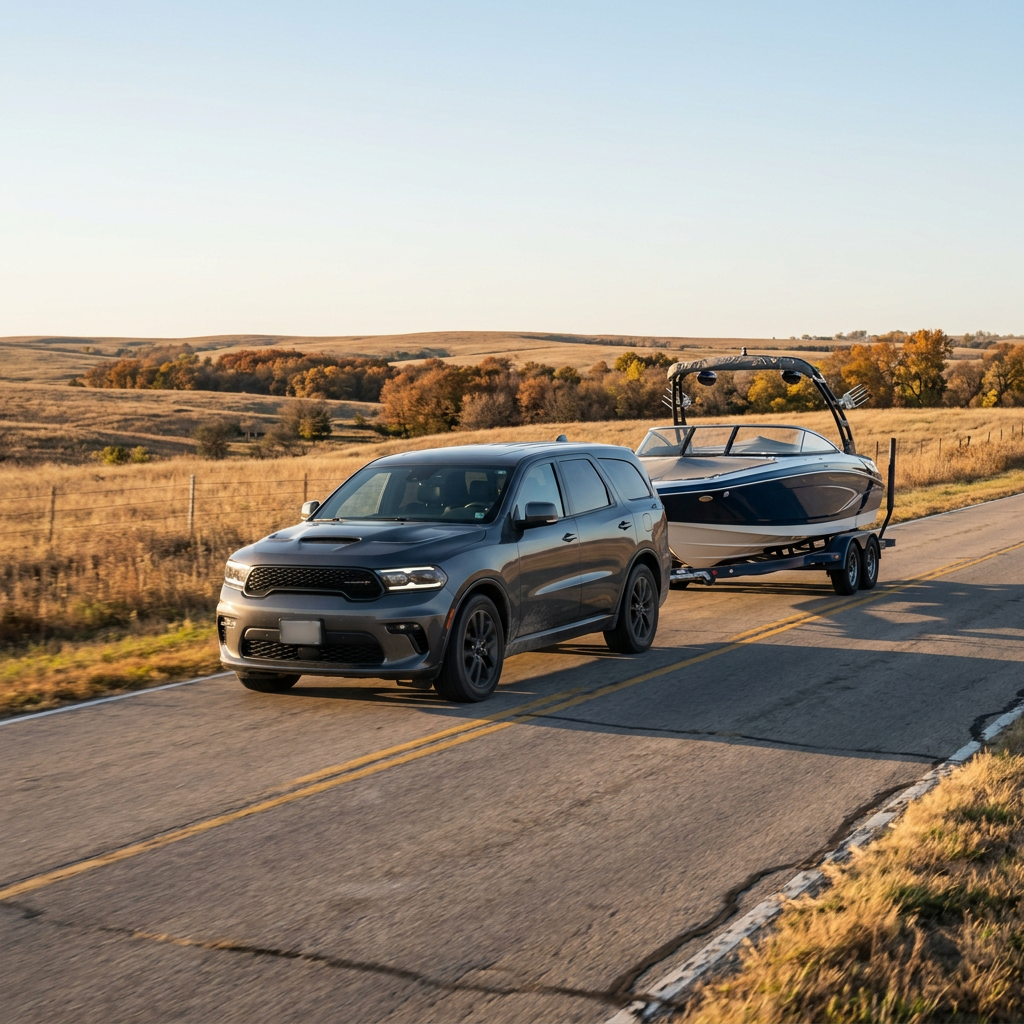
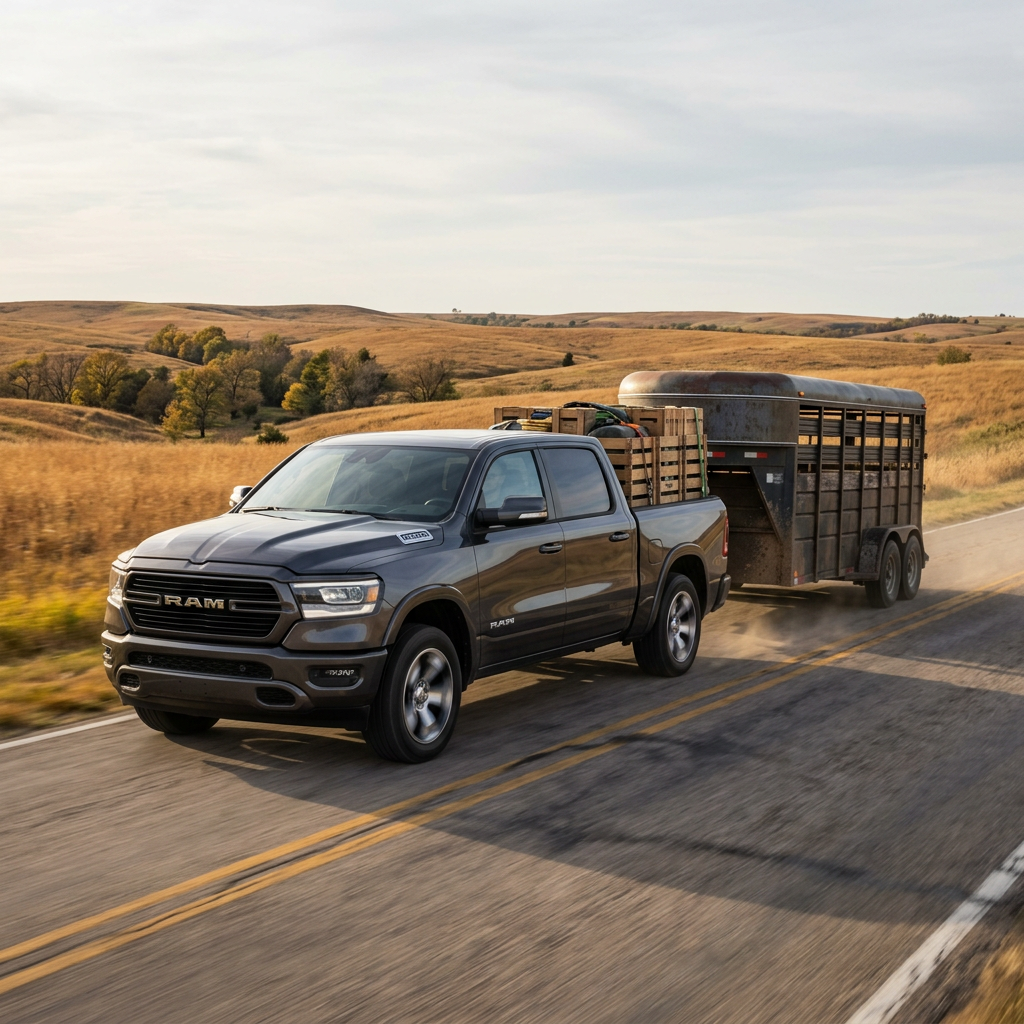
2025 Dodge Durango Towing Capacity Guide: Real-World Specs and Setup Insights What towing equipment can help a 2025 Dodge Durango tow safely around Junction City? To tow safely with a 2025 Dodge Durango around Junction City, you need a factory-installed Class IV trailer hitch receiver, an integrated trailer brake controller, 7-pin and 4-pin wiring harnesses, and a heavy-duty rear load-leveling suspension. For trailers weighing over 3,500 pounds, adding a weight distribution hitch with sway control is essential to balance tongue weight across both axles and preserve front-wheel steering control. When local drivers come to our showroom asking how to set up their SUV for pulling boats at Milford Lake or hauling livestock trailers across Geary County, I walk them through the physical hardware first. The 2025 Dodge Durango offers built-in Trailer Sway Control as a standard electronic safety feature. This system automatically senses unwanted lateral motion from crosswinds or sudden lane maneuvers and selectively applies individual vehicle wheel brakes to pull the trailer back into line. Having the proper hitch receiver setup makes all the difference when pulling heavy gear. A standard 2-inch Class IV receiver rated for up to 8,700 pounds gives you the structural backbone needed for serious pulling power. Meanwhile, the factory-integrated trailer brake controller is neatly mounted right on the center stack dashboard, letting you adjust electrical brake gain on the fly without cluttering your knee space with aftermarket control boxes. If you are setting up your vehicle for camping trips or heavy equipment transport, stop by our Junction City showroom at 1825 Goldenbelt Blvd or give our team a quick call at (785) 238-5114 so we can verify your exact hitch rating and brake wiring configuration. Table of Contents What is the maximum towing capacity of the 2025 Dodge Durango across engine options? Which 2025 Dodge Durango engine achieves the 8,700-pound maximum towing capacity? What does the Dodge Durango Tow N Go Package include for heavy trailering? Why can the Dodge Durango tow more than other 3-row midsize SUVs? What is the gross vehicle weight rating (GVWR) and payload limits of the 2025 Dodge Durango? Does the 2025 Dodge Durango require a weight distribution hitch for heavy loads? What is the maximum towing capacity of the 2025 Dodge Durango across engine options? The maximum towing capacity of the 2025 Dodge Durango spans from 6,200 pounds on entry V6 models up to 8,700 pounds on performance V8 trim levels. Baseline models equipped with the 3.6L Pentastar V6 deliver standard pulling strength that offers strong capability for a midsize three-row crossover. Across the 2025 model lineup, Dodge structures towing ratings around specific engine architectures, trim setups, and drivetrain choices: The GT RWD trim powered by the 3.6L Pentastar V6 delivers a maximum towing rating of 6,200 pounds, a curb weight of 4,875 lbs, a payload rating of 1,625 lbs, and seating for 7 passengers. The GT AWD and GT Plus AWD trims with the 3.6L Pentastar V6 maintain the 6,200-pound max tow rating while offering a curb weight of 4,986 lbs and a payload rating of 1,514 lbs. Stepping up to the R/T AWD, R/T Plus AWD, and R/T Premium AWD trims brings standard 5.7L V8 power with a 7,200-pound towing capacity, a curb weight of 5,313 lbs, and a payload strength of 1,787 lbs. The flagship SRT Hellcat AWD, alongside special editions like the SRT Hellcat Silver Bullet AWD, tops the lineup with an impressive 8,700-pound maximum towing capacity, a curb weight of 5,710 lbs, a payload capacity of 1,390 lbs, and a 6-passenger cabin layout featuring second-row captain's chairs. Starting at an accessible base MSRP of $40,495, the Durango provides muscle car character paired with functional utility. If you are researching pre-owned options alongside new models, take a look through our pre-owned Dodge SUV inventory to compare towing specs and trim packages across model years. Engine & Performance Powertrain specs by trim Feature GT AWD GT Plus AWD GT RWD Police Pursuit Vehicle AWD (Fleet) R/T 20th Anniversary Plus AWD R/T 20th Anniversary Premium AWD Engine 3.6L 3.6L 3.6L 3.6L 5.7L 5.7L Horsepower 295 hp 295 hp 295 hp 295 hp 360 hp 360 hp Torque 260 lb-ft 260 lb-ft 260 lb-ft 260 lb-ft 390 lb-ft 390 lb-ft Transmission TorqueFlite® TorqueFlite® TorqueFlite® TorqueFlite® TorqueFlite® TorqueFlite® Drivetrain All-wheel drive All-wheel drive Rear-wheel drive All-wheel drive All-wheel drive All-wheel drive Engine & Performance (continued) Feature R/T AWD R/T Plus AWD R/T Premium AWD SRT Hellcat AWD SRT Hellcat Brass Monkey AWD SRT Hellcat Hammerhead AWD Engine 5.7L 5.7L 5.7L 6.2L 6.2L 6.2L Horsepower 360 hp 360 hp 360 hp 710 hp 710 hp 710 hp Torque 390 lb-ft 390 lb-ft 390 lb-ft 645 lb-ft 645 lb-ft 645 lb-ft Transmission TorqueFlite® TorqueFlite® TorqueFlite® TorqueFlite® TorqueFlite® TorqueFlite® Drivetrain All-wheel drive All-wheel drive All-wheel drive All-wheel drive All-wheel drive All-wheel drive Engine & Performance (continued) Feature SRT Hellcat Silver Bullet AWD Engine 6.2L Horsepower 710 hp Torque 645 lb-ft Transmission TorqueFlite® Drivetrain All-wheel drive Dimensions & Capacity Capacity and dimensions by trim Feature GT AWD GT Plus AWD GT RWD Police Pursuit Vehicle AWD (Fleet) R/T 20th Anniversary Plus AWD R/T 20th Anniversary Premium AWD Seating 7 7 7 5 6 6 Cargo 17.2 cu ft 17.2 cu ft 17.2 cu ft 17.2 cu ft 17.2 cu ft 17.2 cu ft Curb weight 4,986 lbs 4,986 lbs 4,875 lbs 4,823 lbs 5,313 lbs 5,313 lbs Towing 6,200 lbs 6,200 lbs 6,200 lbs 6,200 lbs 7,200 lbs 7,200 lbs Payload 1,514 lbs 1,514 lbs 1,625 lbs 1,677 lbs 1,787 lbs 1,787 lbs Dimensions & Capacity (continued) Feature R/T AWD R/T Plus AWD R/T Premium AWD SRT Hellcat AWD SRT Hellcat Brass Monkey AWD SRT Hellcat Hammerhead AWD Seating 7 7 7 6 6 6 Cargo 17.2 cu ft 17.2 cu ft 17.2 cu ft 17.2 cu ft 17.2 cu ft 17.2 cu ft Curb weight 5,313 lbs 5,313 lbs 5,313 lbs 5,710 lbs 5,710 lbs 5,710 lbs Towing 7,200 lbs 7,200 lbs 7,200 lbs 8,700 lbs 8,700 lbs 8,700 lbs Payload 1,787 lbs 1,787 lbs 1,787 lbs 1,390 lbs 1,390 lbs 1,390 lbs Dimensions & Capacity (continued) Feature SRT Hellcat Silver Bullet AWD Seating 6 Cargo 17.2 cu ft Curb weight 5,710 lbs Towing 8,700 lbs Payload 1,390 lbs Which 2025 Dodge Durango engine achieves the 8,700-pound maximum towing capacity? The 8,700-pound maximum towing capacity is achieved by the 5.7L HEMI V8 when paired with the optional Tow N Go Package, as well as the supercharged 6.2L Supercharged V8 engine found on SRT Hellcat models. Both engines combine high-torque output with specialized heavy-duty cooling hardware to sustain maximum load pulling. The naturally aspirated 5.7L HEMI V8 produces 360 horsepower and 390 lb-ft of torque. In its standard configuration, it pulls a respectable 7,200 pounds. However, equipping the Tow N Go Package adds specialized rear axle gear ratios, heavy-duty engine cooling components, and active exhaust systems that increase its rating to the 8,700-pound mark. For ultimate speed and capability, the supercharged 6.2L Supercharged V8 delivers a massive 710 horsepower and 645 lb-ft of torque. Paired with the heavy-duty TorqueFlite® 8-speed automatic transmission and full-time active all-wheel drive, the SRT Hellcat handles heavy tandem-axle travel trailers or enclosed car haulers with total ease. If you already own a Dodge SUV and want to make sure your cooling systems and brake pads are ready for heavy summer trailering, you can schedule a service appointment with our factory-trained technicians. What does the Dodge Durango Tow N Go Package include for heavy trailering? The available Tow N Go Package transforms the Durango R/T into a heavy-duty towing rig by adding track-tested hardware, mechanical cooling upgrades, and advanced electronics. It is specifically engineered to bridge the gap between standard midsize utility and full-size truck pulling capability. Key components integrated into the Tow N Go Package include: High-Performance Brembo Brakes: Heavy-duty 6-piston front calipers and large vented rotors provide exceptional stopping power when managing heavy downhill trailer momentum. Adaptive Damping Suspension: Electronic shock tuning continuously adjusts suspension firmness to eliminate trailer bounce and preserve flat cornering control. Electronic Limited-Slip Rear Differential (eLSD): Automatically routes rear wheel torque to the tire with maximum grip, aiding launch traction on slippery boat ramps. Heavy-Duty Engine Cooling & Active Exhaust: Enhanced radiator capacity and transmission oil coolers maintain safe operating fluid temperatures during steep highway climbs. Integrated Controls & Styling: Features a factory dashboard trailer brake controller, Class IV hitch receiver, 20-inch aluminum wheels, and drive mode selections including Tow Mode. Upgrading to this package allows working families and outdoor enthusiasts to haul substantial loads without upgrading to a larger, bulkier full-size vehicle. If you are looking to trade in your current vehicle for a tow-ready SUV, you can evaluate your trade-in online to estimate your purchasing power. Why can the Dodge Durango tow more than other 3-row midsize SUVs? The Dodge Durango tows significantly more than rival three-row midsize crossovers because it is built on a rear-wheel-drive platform architecture rather than a front-wheel-drive car chassis. Rear-wheel-drive platforms naturally distribute trailer tongue weight over the driven rear axle, improving rear tire traction and maintaining directional stability under heavy loads. Most modern three-row crossovers rely on transverse-mounted 4-cylinder or small V6 engines driving front-wheel-drive transaxles, capping their towing capacity around 3,500 to 5,000 pounds. When pulling a heavy load up steep highway grades or rolling hills around Manhattan, front-wheel-drive platforms can experience front-end lift, which reduces front-tire steering traction and lightens brake response. In contrast, the Durango features a longitudinal engine layout paired with near 50/50 weight distribution. Combined with robust unibody construction, optional rear load-leveling shocks, and high-torque V8 engines, the Durango handles heavy trailering duties without strain. When you add available full-time active all-wheel drive, the transfer case dynamically redistributes power between axles, keeping your setup surefooted across wet pavement, dirt roads, and highway passing zones. Drivers looking to secure financing for a tow-capable SUV can easily prequalify online to streamline their buying process. What is the gross vehicle weight rating (GVWR) and payload limits of the 2025 Dodge Durango? The gross vehicle weight rating (GVWR) of the 2025 Dodge Durango ranges from approximately 6,500 pounds on V6 models up to 7,100 pounds on high-output V8 all-wheel-drive variants. Payload capacities range from 1,390 pounds on the high-performance SRT Hellcat AWD up to 1,787 pounds on the R/T AWD trim level. Understanding how GVWR and payload interact with towing capacity is critical for safe hauling. GVWR represents the absolute maximum allowable weight of the vehicle itself, including passengers, interior cargo, accessories, and the tongue weight exerted by your trailer hitch. Payload is the total combined weight of everything you put inside or on top of the vehicle. To calculate your available payload while towing: Check your Durango's specific door-jamb tire and loading placard for its maximum payload number (for example, 1,787 lbs on an R/T AWD model). Subtract the total weight of all onboard passengers and cargo gear. The remaining balance is the maximum tongue weight your trailer can safely apply to the rear hitch ball (typically 10% to 15% of total trailer weight). Keeping within these ratings ensures your brakes, tires, and rear axle bearings operate well within factory safety margins. You can explore our new Dodge Durango inventory to review specific door-jamb weight ratings across trims, view our new commercial vehicle lineup for heavier business hauling needs, or visit our parts and accessories department for heavy-duty hitch inserts and trailer wiring components. Does the 2025 Dodge Durango require a weight distribution hitch for heavy loads? Dodge recommends using a weight distribution hitch when towing trailers that weigh over 3,500 pounds with the Durango. While the chassis and Class IV receiver are structurally rated for heavy loads, a weight distribution hitch utilizes spring bars to leverage a portion of the trailer tongue weight forward onto the front axle and back onto the trailer axles. Using a weight distribution setup provides several critical safety advantages during highway travel: Level Ride Height: Prevents rear-end sag, keeping your headlights aimed properly on dark rural roads. Front Axle Traction: Keeps adequate weight on the front tires to preserve crisp steering control and firm front braking power. Integrated Sway Mitigation: Friction-based or cam-style sway bars prevent wind gusts and passing semi-trucks from initiating dangerous trailer oscillation. When you pair a quality weight distribution hitch with the Durango’s standard Trailer Sway Control and available rear load-leveling shocks, you get a solid, confidence-inspiring setup that handles long highway journeys with total composure. If you have questions about matching a trailer's gross weight to the right Durango trim, come by our dealership location or try calling our team directly. We are always here to help you tow safely and maximize your vehicle's capability. © 2026 Valor CDJR. All rights reserved. Vehicle specification data © JATO Dynamics Limited.