How to Calibrate and Inspect the Integrated Trailer Brake Controller on a Ram HD Truck
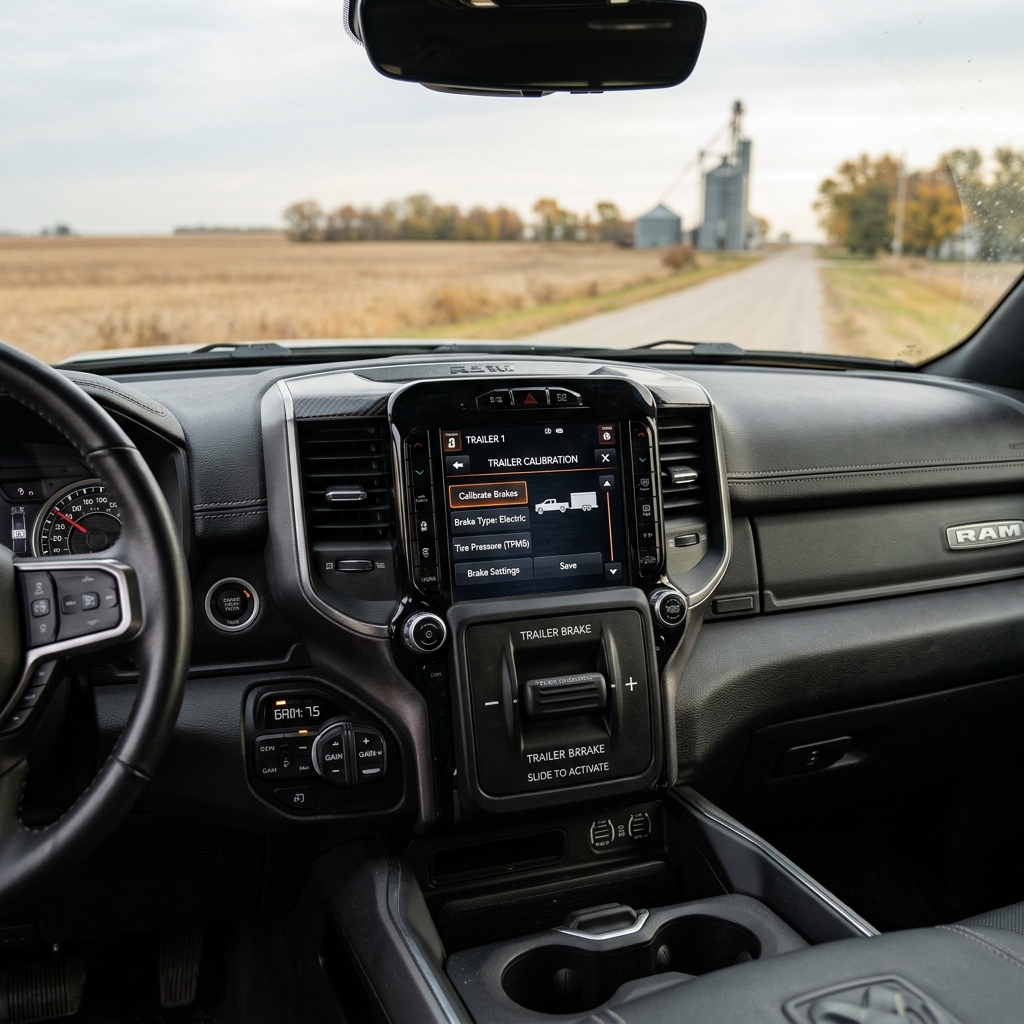
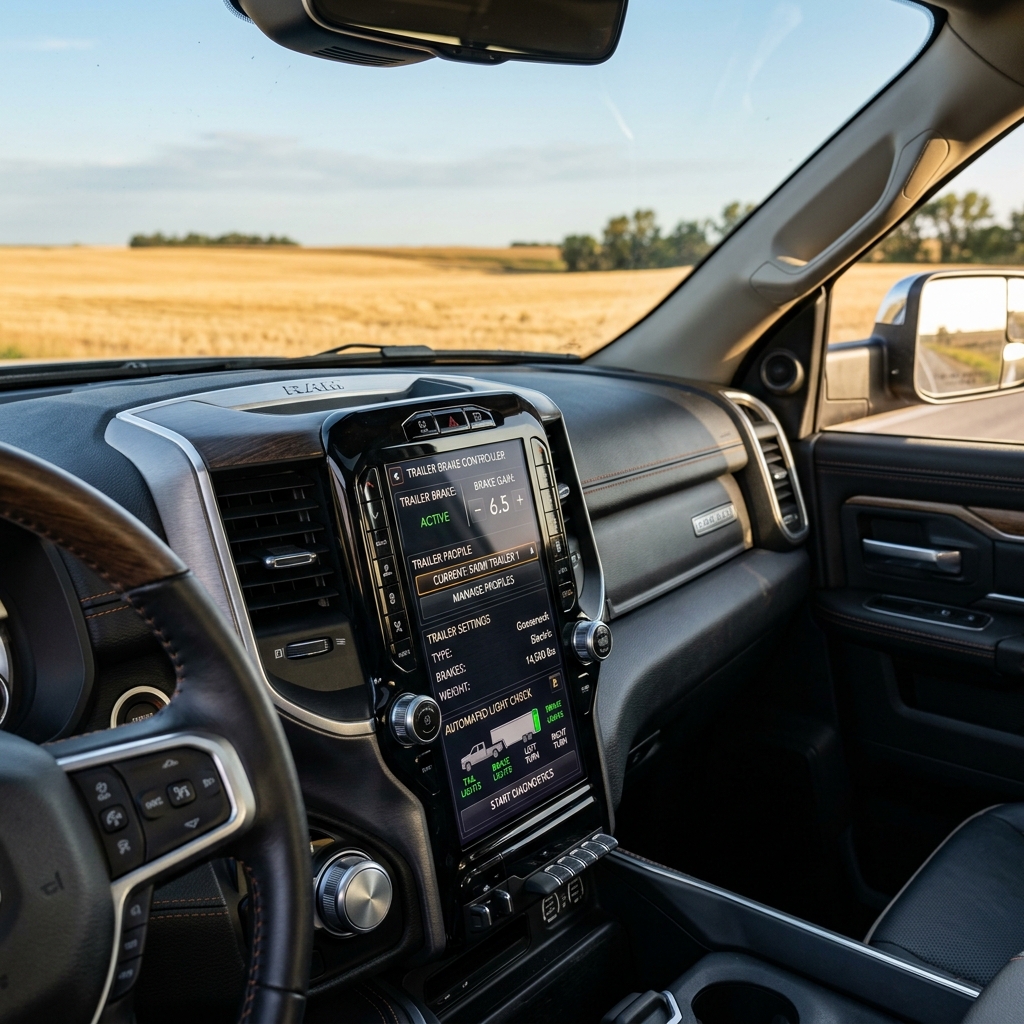
Calibrating and inspecting the Integrated Trailer Brake Controller (ITBC) on your Ram 2500 or Ram 3500 Heavy Duty truck is the foundation of safe, confident hauling across Kansas highways and rural farm roads. To calibrate the system correctly, start inside your truck’s cab using the EVIC (Driver Information Display) or Uconnect 5 touchscreen menu. Navigate to Trailer Tow settings and select the precise brake type equipped on your rig: Light Electric, Heavy Electric, Electric-Over-Hydraulic (EOH) Light, or Electric-Over-Hydraulic (EOH) Heavy. Selecting the proper mode dictates the pulse-width modulation (PWM) signal sent from the factory ITBC module under the instrument panel down to the rear bumper harness.
Once the correct trailer brake type is saved, establish an initial baseline gain setting between 5.0 and 6.0 using the (+/-) gain buttons integrated into the dashboard switch bank. Drive your truck and trailer onto a clean, flat, level paved road at approximately 20 mph. Squeeze the manual trailer brake lever fully without touching the truck’s brake pedal. If the trailer brakes lock up and slide the tires, decrease the gain by 0.5 increments. If you feel the trailer pushing the truck forward, increase the gain. The goal is maximum deceleration force right up to the threshold of wheel lockup. For comprehensive maintenance, inspect the bumper-mounted 7-pin connector for corrosion, test voltage on Pin #2 with a digital multimeter, and verify emergency breakaway switch battery output prior to towing heavy livestock or grain loads.
Step-by-Step Ram HD Trailer Brake Controller Setup and Gain Adjustment
Phase 1: Uconnect & Cluster Mode Selection
Before adjusting gain numbers, your Ram HD must know what brake actuation system is attached. On the 12-inch or 8.4-inch Uconnect display, enter Vehicle Settings > Trailer Tow > Trailer Select. Choose or name your profile, then open Brake Type.
• Light Electric: Tailored for single or tandem axle utility/camper trailers under 10,000 lbs gross trailer weight.
• Heavy Electric: Engineered for triple-axle flatbeds, heavy goosenecks, and loaded commercial trailers requiring rapid voltage ramp-up.
• Electric-Over-Hydraulic (EOH) Light/Heavy: Adjusts timing curves to eliminate hydraulic pump lag on disc brake actuators commonly found on large marine or heavy agricultural equipment.
Phase 2: The 20 MPH Road Test Protocol
1. Connect your trailer 7-pin plug securely and verify the Instrument Cluster confirms connection.
2. Set initial digital gain readout to 5.5 using the dash switches.
3. Accelerate to 20 mph on smooth, dry pavement in a safe open area.
4. Fully pinch the manual squeeze slider together without applying the service brake pedal.
5. Observe braking reaction: If tires lock, tap the (-) button to drop gain to 5.0. If the truck feels pulled or pushed excessively, tap (+) up to 6.5 or 7.0.
6. Re-test after adding payload; a fully loaded grain wagon requires significantly higher gain settings than an empty trailer returning from the elevator.
Inspecting the Rear Bumper 7-Pin Harness, Wiring, and Signal Output
Physical Inspection
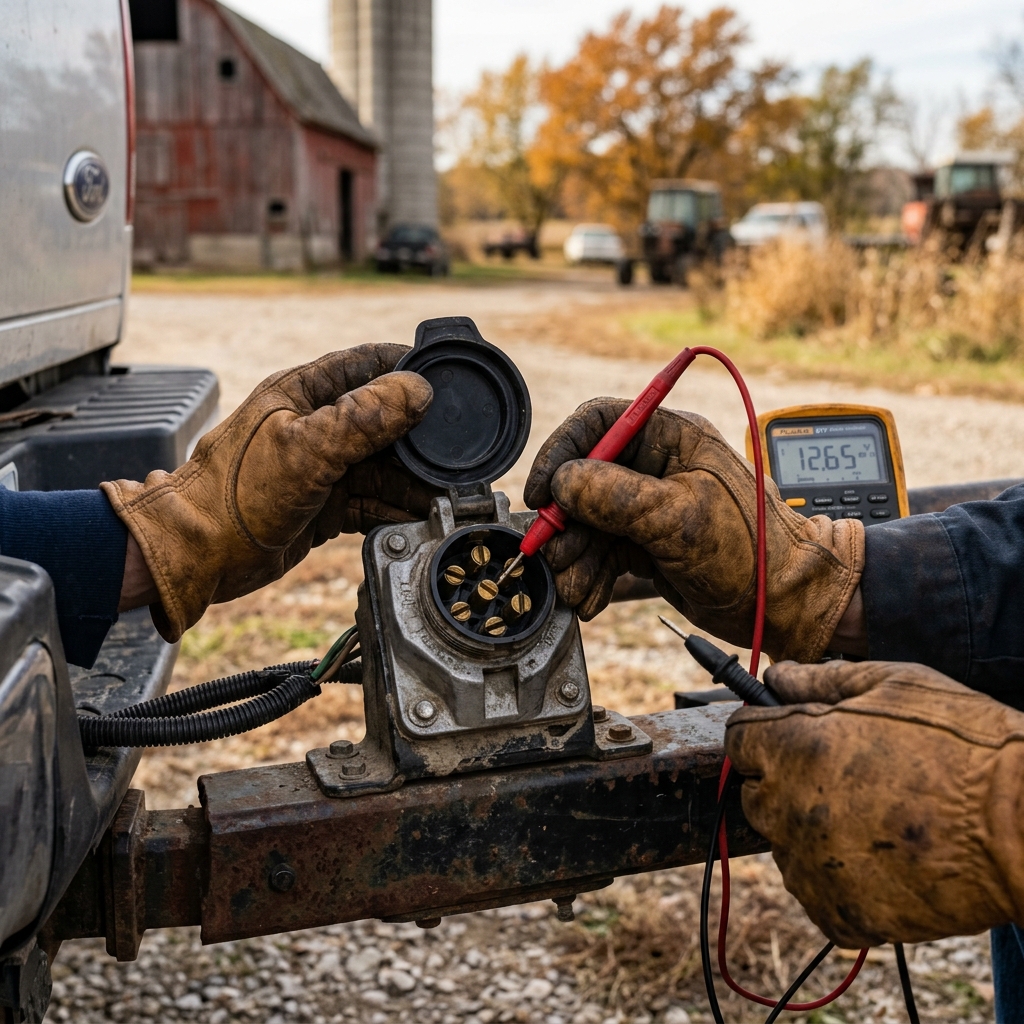
Examine the rear bumper 7-pin blade socket for green copper corrosion, dirt build-up, or bent contact pins. Wash out debris using electrical contact cleaner spray and pack non-conductive dielectric grease into the socket terminals. Check the spring-loaded dust cover door to ensure it seals tightly against water and gravel spray.
Multimeter Voltage Testing
Connect a digital multimeter lead to Pin #2 (Brake Power output, usually 5 o’clock position) and Pin #1 (Ground). Have an assistant squeeze the manual slider inside the cab. You should observe smooth DC voltage scaling from 0V up to full battery voltage (~12.6V to 13.8V with engine running) proportionate to slider displacement.
Breakaway & Ground Checks
Inspect the trailer frame ground wire junction where it bolts to the tongue chassis; rust here is the #1 cause of intermittent ITBC disconnect warnings. Check the emergency breakaway switch lanyard cable and test the onboard 12V breakaway battery using a load tester to guarantee emergency locking if unhitched.
Troubleshooting Common ITBC Error Messages: 'Trailer Brake Disconnected' and Blown Fuses
Few things are more frustrating during harvest haulage than seeing an alert chime accompanied by a red or amber instrument cluster warning: ‘Trailer Brake Disconnected’ or ‘Check Trailer Wiring’. Understanding the root causes of these ITBC fault codes saves hours of downtime on the farm.
• Blown ITBC Power Fuses: Check the Power Distribution Center (PDC) fuse box located under the hood near the battery. On Ram HD models, inspect Fuse F30 (30A or 40A Cartridge Fuse for Trailer Tow Electric Brakes) and Fuse F11 (Trailer Tow Control Module). A short circuit in the trailer wiring or a pinched wire near the trailer axle will instantly pop this fuse.
• Resistance Output Errors: The Ram ITBC continuously sends a small, harmless micro-amp sensing pulse down Pin #2 to detect the presence of brake magnet coils. If trailer brake magnets are worn through to the casing, rusty, or have high electrical resistance (above 3.8 to 4.2 ohms across the circuit), the module assumes the trailer has disconnected.
• Poor Chassis Grounding: Agricultural trailers exposed to mud and fertilizer often lose ground continuity through the frame hitch ball. Always run a dedicated heavy-gauge white ground wire directly from the 7-pin plug to the trailer frame and brake magnets.
What Engine Options Are Available in the 2025 Ram 2500 and 3500 Heavy Duty Trucks?
6.4L HEMI® V8 Gasoline Engine
Standard across the Ram 2500 and 3500 lineup, the proven 6.4L HEMI V8 delivers an impressive 410 horsepower at 5,600 rpm and 429 lb-ft of torque at 4,000 rpm. Featuring variable valve timing (VVT) and Fuel Saver Technology (cylinder deactivation), this gas powerplant provides excellent payload capability and responsive acceleration for daily farm duties, equipment transfer, and utility trailering without needing diesel exhaust fluid (DEF).
6.7L Cummins® Turbo Diesel I6
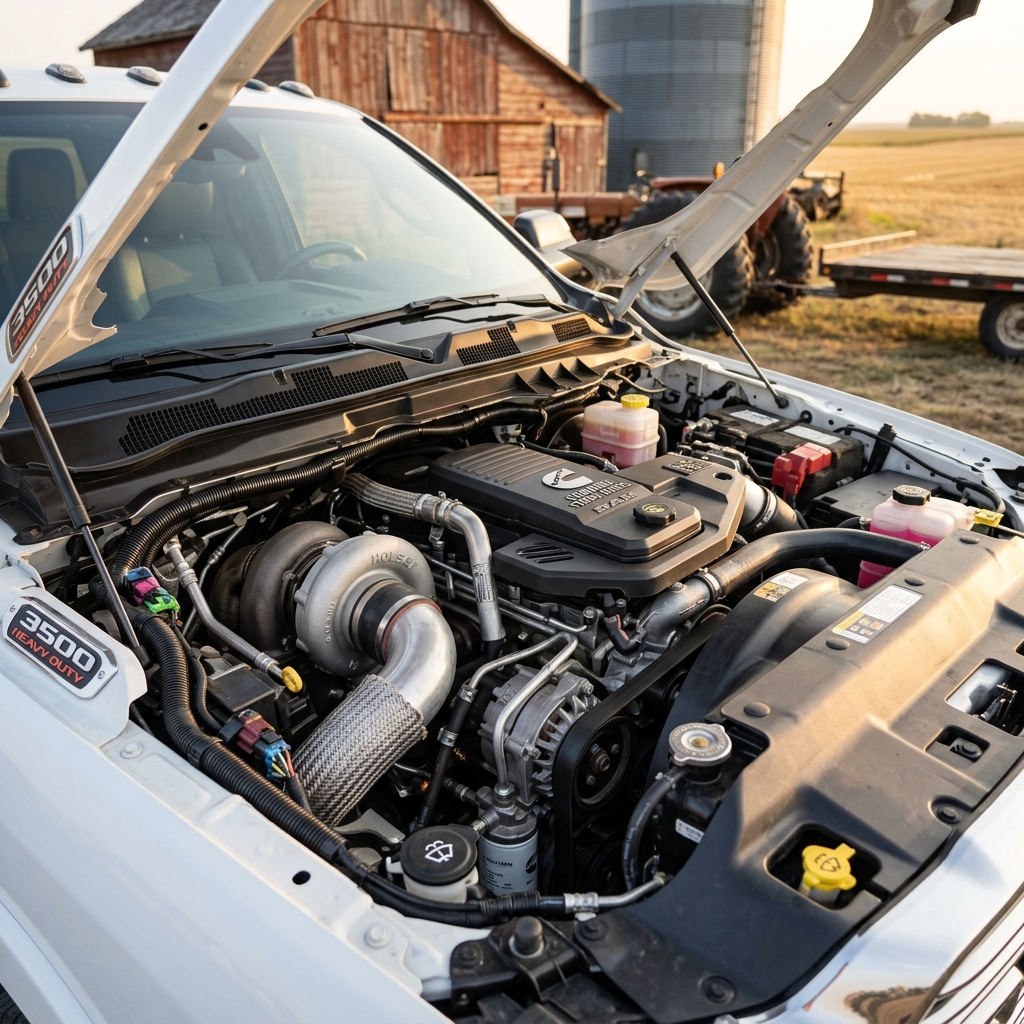
For extreme heavy-haul towing, the legendary 6.7L Cummins Turbo Diesel inline-six reigns supreme. The standard output version produces 370 hp and 850 lb-ft of torque. On Ram 3500 models, the available High-Output 6.7L Cummins Turbo Diesel ramps up output to a earth-moving 420 hp and 1,075 lb-ft of low-end torque, allowing max gooseneck towing capacities exceeding 37,000 lbs.
What Transmission Is Paired with the Cummins Turbo Diesel in 2025 Ram HD Trucks?
AISIN® 6-Speed Heavy-Duty
Paired exclusively with the High-Output 6.7L Cummins on Ram 3500 models, the AISIN AS69RC 6-speed automatic transmission features commercial-grade steel gear sets, high-capacity clutch packs, and advanced thermal management to withstand 1,075 lb-ft of continuous torque.
68RFE 6-Speed Automatic
Paired with the standard output 6.7L Cummins (370 hp / 850 lb-ft), the sophisticated 68RFE transmission offers smooth electronically controlled shifting, driver-selectable gear range limits, and adaptive pressure controls designed for long-distance highway hauling.
Tow/Haul & Exhaust Brake
When Tow/Haul mode is activated, transmission shift schedules aggressively downshift during deceleration. This works in perfect harmony with Cummins Smart Exhaust Braking and the ITBC to hold heavy loads safely on steep down-grades with minimal pedal effort.
How Does the 2025 Ram 2500 Compare to the Ford F-250 Super Duty for Agricultural Towing?
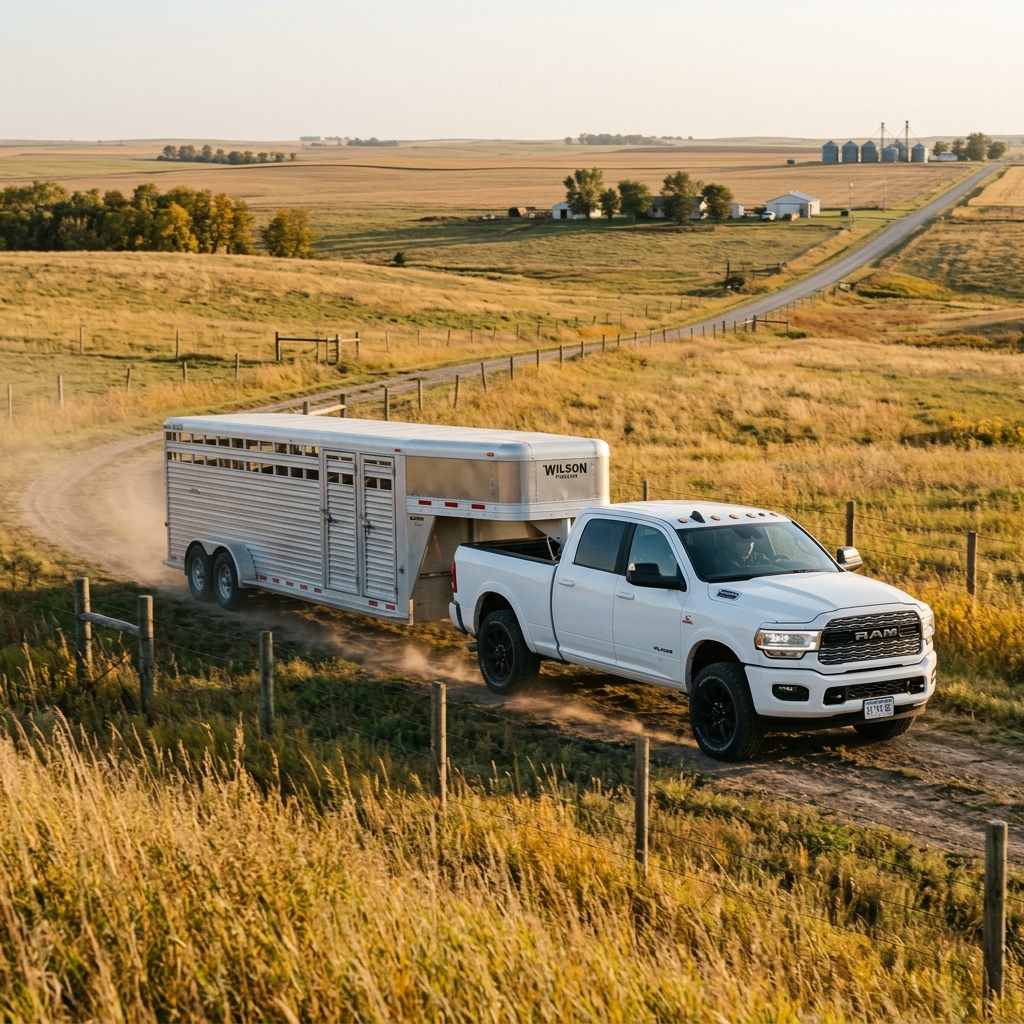
For farm and ranch owners in Clay, Dickinson, and Riley Counties, selecting between the Ram 2500 Heavy Duty and Ford F-250 Super Duty comes down to real-world chassis dynamics, towing integration, and ride comfort. While both trucks offer stout diesel options, the Ram 2500 holds distinct advantages when transporting livestock, grain carts, and heavy machinery.
|
Feature / Spec
|
2025 Ram 2500 HD
|
2025 Ford F-250 Super Duty
|
|
Rear Suspension Architecture
|
Exclusive 5-Link Coil Springs or Auto-Level Air Suspension
|
Traditional Leaf Springs
|
|
Diesel Torque (Standard Output)
|
850 lb-ft @ 1,700 rpm (6.7L Cummins)
|
1,050 lb-ft @ 1,600 rpm (6.7L PowerStroke)
|
|
Brake Controller Integration
|
Factory ITBC w/ Uconnect 5 Memory & EOH Modes
|
Integrated Trailer Brake Controller
|
|
High-Tongue Weight Stability
|
Superior coil/air dampening; reduced unladen bounce
|
Firm leaf spring stiffness when unladen
|
|
Infotainment / Profile Memory
|
12-Inch Screen w/ Multiple Saved Brake Profiles
|
12-Inch SYNC 4 System
|
The standout feature for Ram 2500 is its segment-exclusive five-link rear coil suspension and optional Auto-Level Rear Air Suspension. Traditional leaf springs on the F-250 can cause severe harshness and wheel hop over rutted farm lanes when unladen. In contrast, Ram’s air suspension dynamically levels the truck bed under high gooseneck tongue weights, preserving proper headlight aiming, steering geometry, and trailer brake controller weight distribution across all four truck wheels.
Fall Agricultural Harvest Guide: Preparing Your Ram 2500 and 3500 for Heavy Towing in Clay and Dickinson Counties
Pre-Harvest Mechanical Checkup
As Kansas autumn harvest gets underway in early September, local producers in Clay Center, Abilene, and Junction City prepare for heavy corn and soybean hauling. Inspect transmission fluid levels and cooler lines—sustained high ambient temperatures combined with heavy trailering put severe thermal stress on automatic transmissions.
Check brake pad thickness on both truck and trailer axles. Ensure tires are load range E or F and inflated to maximum cold PSI specified on the door jamb platen (typically 60 PSI front / 80 PSI rear for maximum payload stability). Explore our Parts Department for factory hitch hardware, OEM brake pads, and heavy-duty towing accessories.
Trailer Recalibration & Hitch Rating
A trailer sitting idle all summer often develops rust on magnetic brake shoes or seized actuator pivot pins. Perform a trial recalibration run prior to loading the first bushel of grain.
Verify receiver hitch ratings, safety chain grade specs (Grade 70 transport chain required for heavy loads), and inspect fifth-wheel or gooseneck ball torque specs. If you are upgrading your harvest fleet, view our current Commercial Vehicle Inventory for chassis cabs and factory gooseneck prep-equipped Ram HD trucks.
What Driver's License Requirements Apply When Towing Heavy Farm Trailers in Kansas with a Ram 3500?
26,001 LB GCWR Rules
Under federal FMCSA and Kansas law, a Class A Commercial Driver’s License (CDL) is required if the Gross Combination Weight Rating (GCWR) of truck and trailer exceeds 26,001 lbs AND the trailer’s GVWR alone exceeds 10,000 lbs. A Ram 3500 Dually (GVWR 14,000 lbs) pulling a 20,000 lb gooseneck easily crosses this threshold in commercial operation.
Kansas Farm Exemption
Per K.S.A. 8-2,127, authentic farmers and farm employees operating covered farm vehicles are exempt from CDL requirements when transporting agricultural products, farm machinery, or supplies to or from a farm within 150 air miles of the farm location, provided the vehicle is not operated for-hire.
KHP Highway Safety
Even under farm exemptions, Kansas Highway Patrol enforces safety rules: working breakaway system, operational integrated trailer brake controller, dual safety chains, functioning turn signals/brake lights, and proper wide-load flags/slow-moving vehicle (SMV) emblems when transporting oversized equipment across state routes.
Programming Custom Trailer Profiles and Memory Settings in Uconnect 5
The Uconnect 5 system in the 2025 Ram HD allows producers to store parameters for up to five distinct trailer profiles. You can manually recalibrate brake gain and recalculate blind-spot dimensions each time you switch from a grain wagon to a horse trailer.
To set up a new profile, tap Vehicle > Towing > Add Trailer Profile. Input custom names such as ’30ft Gooseneck’ or ‘Tandem Livestock’. Set the brake actuation type (Electric vs. EOH) and lock in your dialed-in gain level.
Advanced Uconnect Towing Features:
• Trailer Light Check: Cycle all exterior brake lights and turn signals automatically from inside the cab or via key fob without an assistant.
• Blind Spot Monitoring w/ Trailer Detection: Measure trailer length from hitch ball to rear bumper; Uconnect automatically expands blind-spot radar coverage down the full length of your towed load.
• Trailer Tire Pressure Monitoring (TTPM): Connect internal valve-stem sensors to display individual trailer tire pressures directly on the dashboard display.
Navigating Flint Hills Terrain: Calibrating Gain for Steep Grades and Wet Gravel Roads
Towing heavy agricultural loads through the rugged Flint Hills region around Junction City, Manhattan, and Geary County presents unique terrain challenges. Transitioning from smooth asphalt on K-18 or I-70 onto steep, unpaved gravel farm roads requires active adjustments to your trailer brake controller gain.
On loose gravel or rain-slicked clay lanes, a high brake gain setting (e.g., 7.5 or 8.0) that worked well on highway asphalt will cause trailer tires to lock up immediately upon braking. Locked trailer tires turn into skids, causing the trailer tail to swing out of alignment (jackknife). When leaving paved routes for gravel, tap the (-) gain button down by 1.5 to 2.0 units.
Rely on your Cummins Smart Exhaust Brake in ‘Auto’ or ‘Full’ mode to handle engine retardation down steep Flint Hills grades, allowing the trailer brakes to remain cool and ready for emergency stops. Browse our New Vehicle Listings or explore Used Vehicle Listings to find heavy-duty trucks built to conquer Kansas topography.
Schedule Ram Heavy Duty Service and Towing Diagnostics at Valor CDJR in Junction City, KS
Whether you need a factory Integrated Trailer Brake Controller module replacement, 7-pin bumper harness rewiring, gooseneck/fifth-wheel prep kit installation, or a pre-harvest multi-point safety inspection, trust the certified Mopar technicians at Valor CDJR. We take pride in supporting the farmers, ranchers, and commercial haulers throughout Junction City, Manhattan, Fort Riley, Abilene, and Clay Center.