




Is the Ram Hurricane Inline-6 Better Than the 5.7L HEMI V8?
For most farm operations and heavy towing demands, the 3.0L Hurricane twin-turbo inline-six outperforms the traditional 5.7L HEMI V8 by delivering higher horsepower, superior low-end torque, and an increased maximum towing capacity of up to 11,550 pounds compared to the V8's 9,590 pounds. The Hurricane engine provides a broader torque curve from low engine speeds while achieving better overall fuel efficiency.
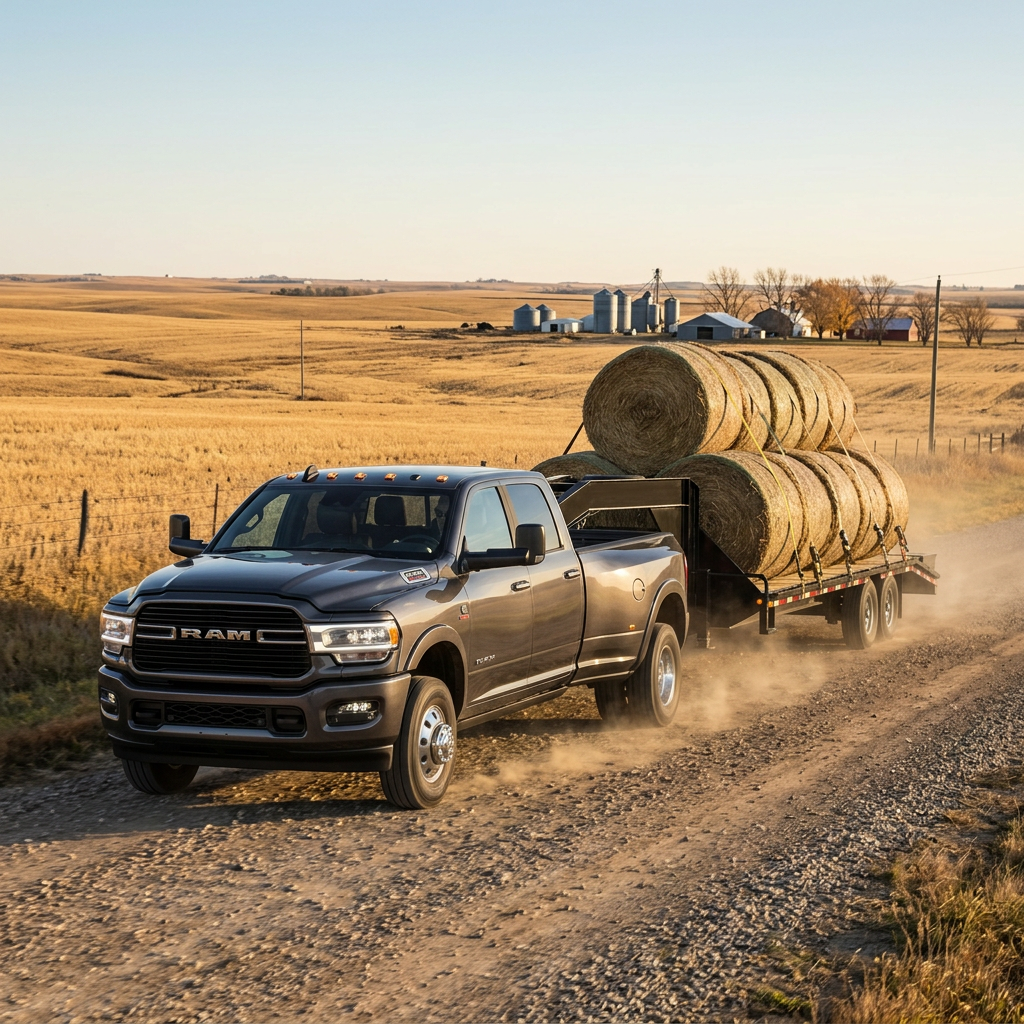
Moving heavy implements, livestock trailers, or agricultural supplies across the fertile agricultural land and river valleys around Junction City requires dependable torque right from low gear. Ram trucks handle tough jobs with ease, providing the payload strength and rugged durability needed for daily agricultural work. While the 5.7L HEMI V8 eTorque system built a solid reputation over decades of farm duty with its 395 hp output, forced-induction engine technology delivers more pulling capability across a wider rpm range.
The inline-six layout inherently balances primary and secondary engine forces, leading to smoother power delivery during sustained heavy pulls. Paired with a robust eight-speed automatic transmission, the Hurricane powertrain keeps the engine within its optimal powerband when ascending steep grades or accelerating from a complete stop with a fully loaded trailer.
Drivers interested in experiencing the pulling strength of the twin-turbo setup firsthand can visit our team at 1825 Goldenbelt Blvd or give our staff a quick call to set up a real-world demonstration.
Table of Contents
- What Are the Horsepower and Torque Specifications for the Hurricane I6 vs. 5.7L HEMI V8?
- Does the Hurricane Twin-Turbo Engine Experience Turbo Lag Under Heavy Farm Loads?
- How Does Towing Capacity and Payload Compare Between the Hurricane I6 and 5.7L HEMI V8?
- Which Ram 1500 Trims Feature the Hurricane Engine and Does It Require Premium Fuel?
- What Maintenance, Oil Grade, and Temperature Monitoring Are Required for the 3.0L Hurricane?
- Common Questions About the Ram Hurricane I6 vs. 5.7L HEMI V8
What Are the Horsepower and Torque Specifications for the Hurricane I6 vs. 5.7L HEMI V8?
The standard-output 3.0L Hurricane twin-turbo inline-six produces 420 hp and 469 lb-ft of torque, while the high-output variant generates 540 hp and 521 lb-ft of torque. Both twin-turbo configurations exceed the output of the 5.7L HEMI V8, which delivers 395 hp and 410 lb-ft of torque with its mild-hybrid eTorque system.
| Engine Option | Horsepower | Torque (lb-ft) | Max Towing (lbs) |
|---|---|---|---|
| 3.0L Hurricane I6 (Standard) | 420 hp | 469 lb-ft | 11,550 lbs |
| 3.0L Hurricane I6 (High Output) | 540 hp | 521 lb-ft | 10,740 lbs |
| 5.7L HEMI V8 eTorque | 395 hp | 410 lb-ft | 9,590 lbs |
Peak torque in the standard-output Hurricane engine arrives at 3,500 rpm, offering 59 lb-ft more torque than the naturally aspirated V8. That extra torque makes a noticeable difference when accelerating up highway ramps with a heavy load. The high-output Hurricane pushes torque levels higher to 521 lb-ft, giving drivers exceptional passing power even when hauling near gross vehicle weight ratings.
Every Hurricane engine features a cast-aluminum block, plasma transfer-wire arc cylinder wall coatings for reduced friction, and dual overhead camshafts. Combined with direct fuel injection and an eight-speed automatic transmission, the inline-six delivers responsive performance power across all operating speeds.
Shoppers exploring power options across the Ram lineup can view our inventory of new Ram 1500 trucks to compare available engine configurations and trim levels.
Does the Hurricane Twin-Turbo Engine Experience Turbo Lag Under Heavy Farm Loads?
The 3.0L Hurricane twin-turbo inline-six does not experience noticeable turbo lag when hauling heavy farm equipment or trailer loads. Dual low-inertia turbochargers each feed three dedicated cylinders, enabling rapid boost development and immediate torque delivery right off idle.
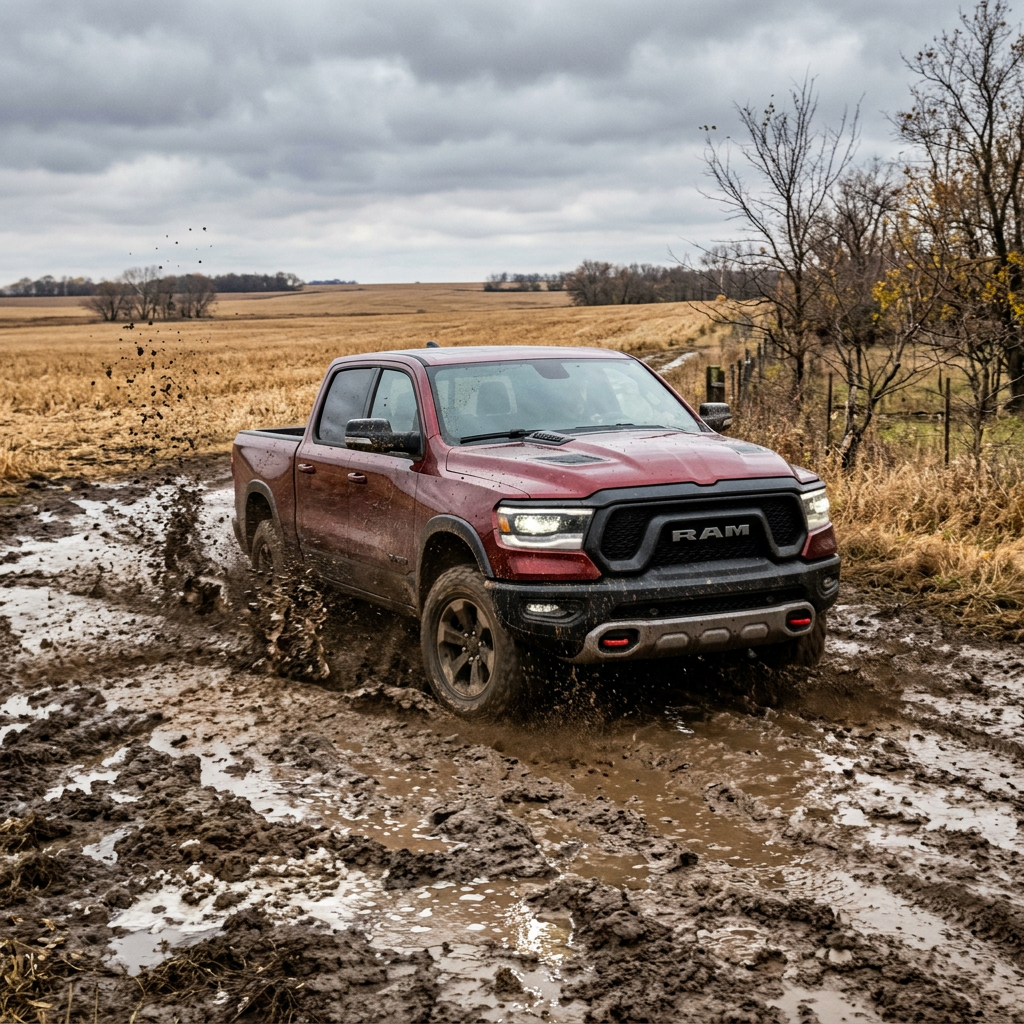
In demanding agricultural conditions—such as pulling a loaded grain wagon out of a muddy field or towing equipment up rolling hills across Riley County—low-end throttle response is critical. Older single-turbo systems often required high engine speeds before building boost pressure. The Hurricane design uses small, lightweight turbine wheels that spool up quickly under light exhaust flow, delivering boost pressure almost instantly when the accelerator pedal is depressed.
Our service technicians and sales specialists regularly walk farm operators through real-world test drives. Buyers hauling cattle trailers or farm implements report that boost onset occurs right from low rpm, mimicking the immediate off-the-line pull of a larger-displacement V8 while continuing to pull hard into the upper rev range.
For truck buyers considering pre-owned work vehicles, browsing our pre-owned truck options provides access to reliable towing platforms tested for real-world farm durability.
How Does Towing Capacity and Payload Compare Between the Hurricane I6 and 5.7L HEMI V8?
In Ram's lineup, the 1500 with the 3.0L Hurricane engine offers a towing capacity that surpasses many competitors, handling up to 11,550 pounds and a payload of 2,300 pounds. Models powered by the 5.7L HEMI V8 top out at a maximum towing capacity of 9,590 pounds.
Achieving peak towing performance depends on vehicle gearing and chassis configuration. Specifying a 3.92 rear axle ratio provides the highest mechanical leverage, maximizing pulling power for heavy farm trailers compared to the standard taller 3.21 rear axle ratio.
Weight distribution also shifts positively with the inline-six setup. Because the aluminum-block Hurricane engine weighs less than traditional cast-iron engine blocks, less mass rests over the front axle. This improved front-to-rear weight balance leaves additional margin for heavy tongue weights on the rear bumper hitch receiver.
Long-term durability is backed by factory coverage, as Warranty coverage may vary by model and should be confirmed with the dealership. Furthermore, in J.D. Power's 2026 Vehicle Dependability Study, the Ram 1500 ranked highest in the Large Light Duty Pickup segment, confirming its structural integrity under heavy work cycles.
If you plan to upgrade your current work truck, you can evaluate your trade-in online to determine your existing vehicle's market value toward a new model.
Which Ram 1500 Trims Feature the Hurricane Engine and Does It Require Premium Fuel?
The standard-output 420 hp Hurricane engine comes standard or available on popular trims including the Tradesman, Big Horn, and Laramie, and operates on standard regular unleaded gasoline. The high-output 540 hp engine requires 91-octane premium fuel for maximum performance power, though premium fuel is also recommended on standard-output models during heavy towing duty.
Standard-output Hurricane availability spans several distinct model trims tailored for work or daily driving:
- Tradesman: Available as an optional powertrain package, bringing twin-turbo pulling power to a practical work truck layout.
- Big Horn: Features the standard-output Hurricane engine option, combining comfort and safety features with advanced towing tech.
- Laramie: Comes standard with the 420 hp Hurricane inline-six, offering heated and ventilated leather seating, intuitive infotainment systems, and 4WD capability.
- Rebel: Includes the Hurricane engine paired with off-road suspension tuning and aggressive terrain tires for demanding field conditions.
- Tungsten: Serves as the luxury benchmark, coming standard with the high-output 540 hp Hurricane engine.
Running regular 87-octane fuel in the standard-output Hurricane during routine driving helps keep daily operating costs low. When hitching up a heavy trailer during warm weather, using 91-octane premium fuel helps the engine management system maintain optimal ignition timing and maximum boost pressure without knock retardation.
Buyers preparing for their next truck purchase can start the process early by contacting our team for current financing information from home.
What Maintenance, Oil Grade, and Temperature Monitoring Are Required for the 3.0L Hurricane?
The 3.0L Hurricane twin-turbo inline-six requires full synthetic 0W-20 motor oil meeting Stellantis MS-6395 material standards, with change intervals recommended every 7,500 miles to 10,000 miles under standard driving conditions. Every Ram 1500 features real-time digital instrument cluster displays that monitor transmission fluid temperature, engine oil temperature, coolant temperature, and turbo boost pressure.
| Maintenance Item | Requirement / Specification |
|---|---|
| Engine Oil Grade | Full Synthetic 0W-20 (Stellantis MS-6395 standard) |
| Standard Change Interval | 7,500 to 10,000 miles or 1 year |
| Severe Duty Change Interval | 5,000 miles (heavy farm towing, dusty gravel roads) |
| Real-Time Cluster Gauges | Coolant temp, oil temp, trans fluid temp, boost |
Farm work often involves severe operating conditions—such as pulling heavy loads at low speeds, prolonged idling in fields, and driving on dusty gravel roads. Under these conditions, changing engine oil closer to 5,000 miles protects twin-turbo bearings and internal components from heat degradation and particulate contamination.
Monitoring fluid temps during summer hauling is straightforward thanks to the fully configurable digital instrument cluster. Drivers can bring up live digital gauges to check transmission fluid and oil temperatures when pulling steep grades under load, ensuring engine components remain within safe operating thresholds.
To keep your truck running smoothly, you can schedule a service appointment online with our certified technicians, or source genuine filters and fluids directly through our genuine parts department.
Common Questions About the Ram Hurricane I6 vs. 5.7L HEMI V8
Q: Does the standard-output 3.0L Hurricane engine require 91-octane premium fuel? No, the standard-output version generating 420 hp is engineered to run on regular 87-octane unleaded gasoline. However, using 91-octane or higher premium fuel is recommended when pulling maximum trailer weights to maintain peak thermal efficiency and engine output under heavy load conditions.
Q: Is the 5.7L HEMI V8 still available alongside the Hurricane engine? The 5.7L HEMI V8 eTorque engine remains available in select trim configurations alongside the new 3.0L Hurricane twin-turbo inline-six, giving truck buyers a choice between traditional V8 exhaust note and forced-induction inline-six torque delivery.
Q: What axle ratio is recommended when ordering a Ram 1500 with the Hurricane engine for heavy farm towing? Selecting a 3.92 rear axle ratio delivers the highest towing capacity and best initial pulling power when moving heavy agricultural trailers or machinery, compared to the standard taller 3.21 rear axle ratio which is geared for highway fuel economy.
Q: How does front-end weight balance differ between the Hurricane I6 and the HEMI V8 when pulling heavy trailers? The 3.0L Hurricane twin-turbo inline-six utilizes a lighter aluminum block foundation compared to the cast-iron cylinder block of the 5.7L HEMI V8. This lower engine weight over the front suspension improves front-to-rear weight distribution when carrying heavy trailer tongue weights.
Q: What factory warranty protects the Hurricane twin-turbo engine on Ram 1500 trucks? Every Ram 1500 equipped with the Hurricane engine includes a 10-year/100,000-mile powertrain warranty along with a 3-year/36,000-mile basic warranty, delivering long-term coverage for internal mechanical components, turbochargers, and oil lubrication systems.
Ready to Test Drive the Ram 1500 in Junction City?
Whether you need maximum towing capacity for farm equipment or impressive fuel efficiency for daily commutes, our team is here to help you compare engine options in person. Visit Valor CDJR at 1825 Goldenbelt Blvd or get in touch by placing a quick call to schedule your test drive today.