Blog / Buying Guides

What Does the Factory Invoice Price Include?

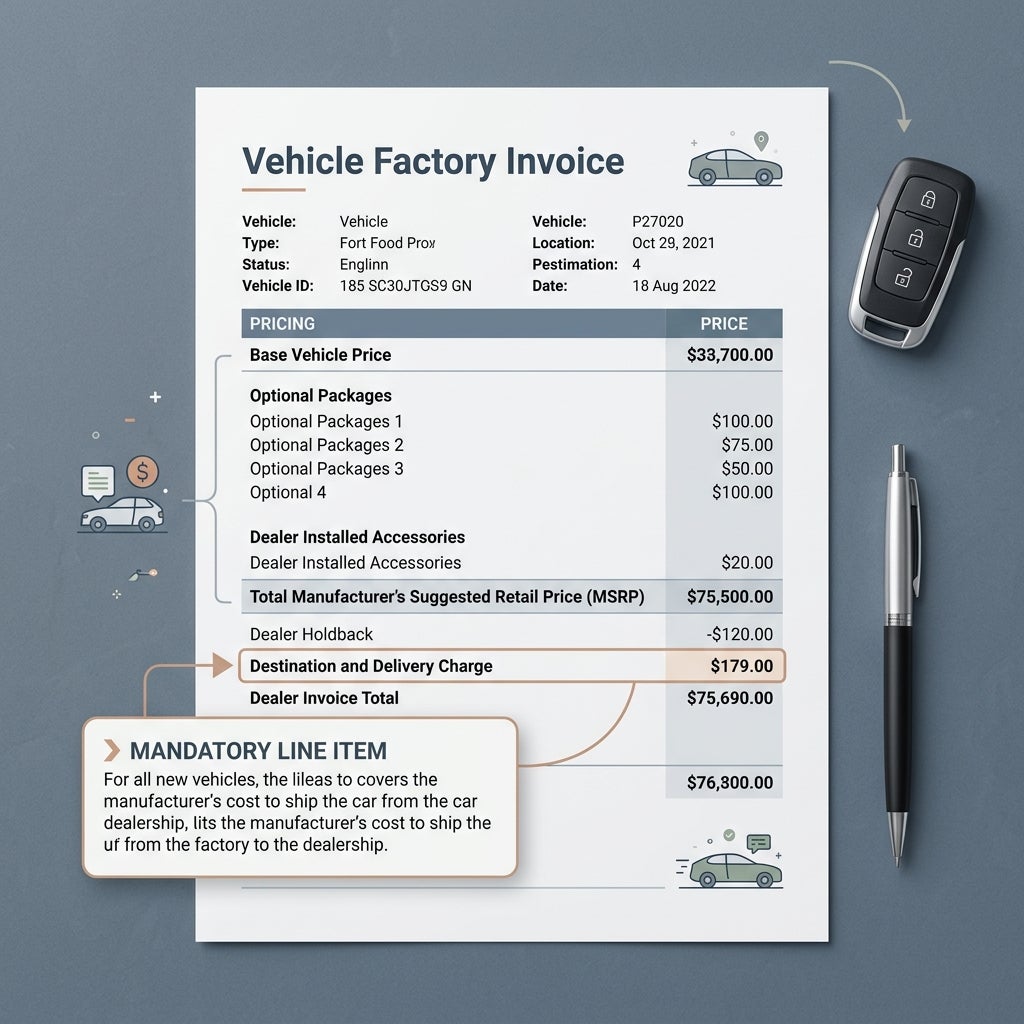
A car invoice document explaining the mandatory destination and delivery charge line item next to a car key and pen. (Representative image for illustration purposes only. Actual vehicle may vary based on trim and configuration.)

Does the Factory Invoice Price Include Destination and Delivery Charges? The Direct Answer

Yes, unequivocally. The factory invoice issued by vehicle manufacturers—including Stellantis for Chrysler, Dodge, Jeep, and Ram vehicles—explicitly lists the destination and delivery charge (frequently categorized as freight) as a mandatory line item. This is not a fee added arbitrarily by the dealership at retail; it is a standardized wholesale cost assessed directly by the vehicle manufacturer to transport the automobile from the assembly line to the dealership lot.
When analyzing automotive wholesale documentation, car buyers in Junction City, Manhattan, and across Geary County often assume that the "Factory Invoice Price" represents the base vehicle before shipping expenses. In reality, manufacturer invoicing structure treats freight as an integral component of the total wholesale invoice baseline. Every authorized dealer across the continental United States pays the exact same destination fee for a specific trim and model, regardless of whether the dealership is located ten miles or two thousand miles from the assembly plant.
Understanding this foundational line item is essential for evaluating vehicle quotes and dealer pricing claims. Because the factory destination charge is already baked into the total invoice figure provided by the OEM, any attempt by a seller to add a secondary "dealer destination fee" on top of an invoice-based quote represents a duplicate charge. At Valor CDJR, line-item clarity is paramount. By breaking down the exact mechanics of manufacturer freight assessment, wholesale pricing architecture, and local market dynamics, this guide provides complete transparency into what vehicle invoice numbers truly represent.

36 Years Behind the Desk: Dustin Zeck on Auto Pricing Transparency

Hello, I am Dustin Zeck, Dealer Principal at Valor CDJR. Over my 36 years in automotive retail, I have sat across the desk from thousands of car buyers—from first-time military buyers stationed at Fort Riley to generational farm families in Riley and Geary counties. During my nearly four decades managing dealership operations, I have witnessed the evolution of automotive pricing from closed-door paper catalogs to the hyper-transparent digital ecosystem we operate in today.
One constant throughout my career is that confusion surrounding wholesale terminology—such as factory invoice, destination fees, holdback, and dealer cash—causes unnecessary friction for vehicle buyers. Consumers often arrive with online printouts believing invoice price represents our absolute rock-bottom cost. Others suspect destination fees are hidden dealer profit margins. Both assumptions stem from a lack of clear industry communication.
My philosophy at Valor CDJR is simple: an informed buyer is our best customer. If you have questions about how a specific invoice is calculated or want to review line-item pricing on any truck or SUV on our lot, feel free to Call us at (785) 238-5114 directly. Let's peel back the curtain and examine how factory pricing actually functions.
Smiling man in a black Valor Automotive polo shirt standing in front of a company logo backdrop.

Expert Insights: Why Invoice Pricing Isn't the Whole Story

"Treating the factory invoice as the dealership's absolute true bottom line is one of the most common misconceptions in modern car buying," explains Dustin Zeck. "Twenty or thirty years ago, buying a car at 'invoice price' meant the dealer was breaking even on the wholesale transaction. Today, manufacturer financial structures involve complex backend allowances, quarterly volume targets, and floorplan assistance that shift the dealership's true accounting baseline well below the published invoice total."
However, the inverse is equally true: landed expenses, regional advertising levies, and pre-delivery conditioning can raise a vehicle's wholesale operational cost above the base invoice figure. The psychological shift for consumers lies in recognizing that the factory invoice is an standardized accounting document between the manufacturer (OEM) and the franchise dealer—it is not an itemized retail receipt. Understanding where destination charges live within that wholesale calculation is the first crucial step toward mastering vehicle negotiations.
When manufacturers issue an invoice to Valor CDJR, every single option code, trim package, floor mat set, and transportation fee is coded and tallied. The bottom-line invoice figure includes the destination charge automatically. Therefore, when negotiating a deal phrased as '$100 below invoice' or '$500 over invoice,' both buyer and seller are operating off a baseline that ALREADY accounts for bringing the vehicle from the assembly plant to Junction City, Kansas.

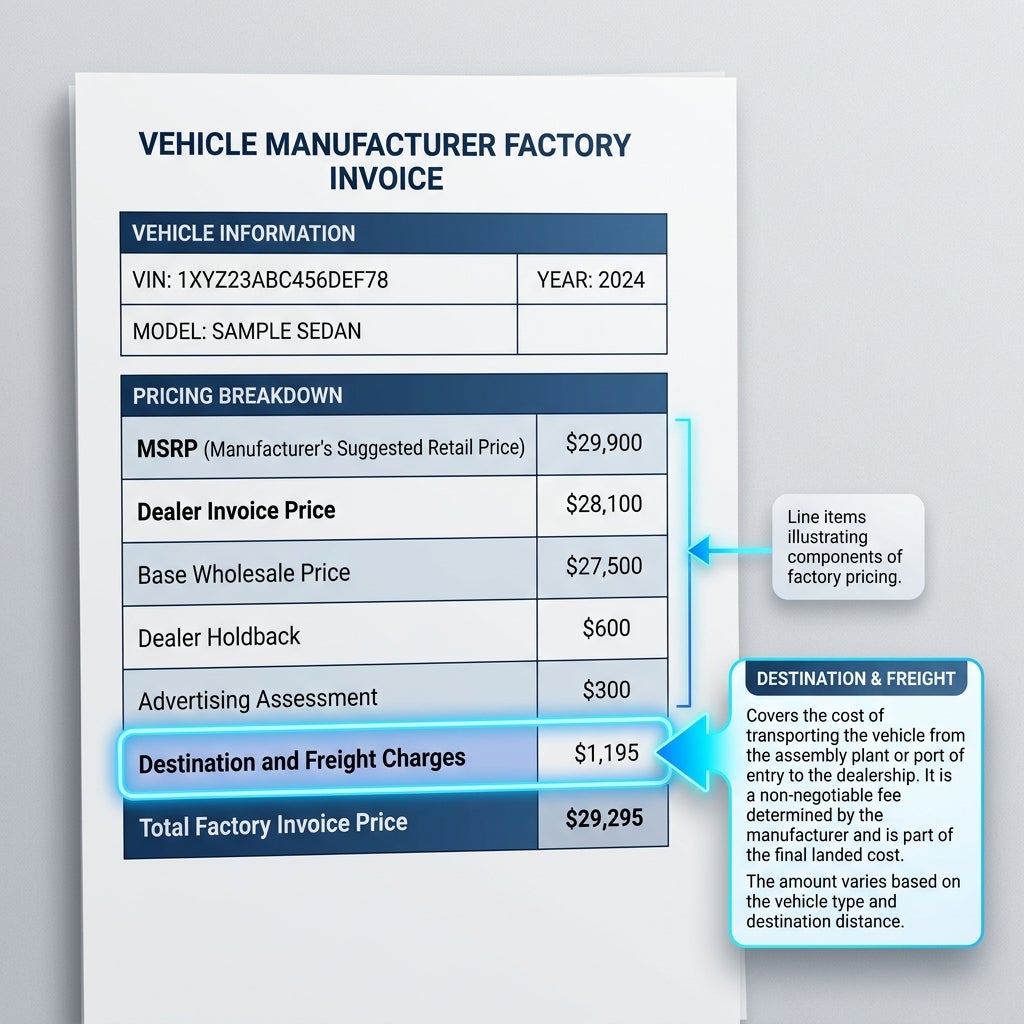
How Destination and Freight Charges Appear on a Manufacturer Invoice

On a physical manufacturer invoice—whether for a Ram 1500 built in Sterling Heights, Michigan or a Jeep Wrangler assembled in Toledo, Ohio—the document is structured in two parallel columns: Wholesale Invoice (Dealer Cost) and Monroney MSRP (Suggested Retail Price). Destination charges appear prominently across both columns.
Under federal law (the Automobile Information Disclosure Act of 1958), manufacturers must list equalized freight charges. Equalization means the OEM averages logistics costs across all nationwide shipments. A dealership in Junction City, Kansas pays the exact same destination fee as a dealer located next door to the assembly plant. You can examine current model pricing directly through our New Vehicle Listings to see window sticker breakdowns.
Crucially, the destination amount listed in the Wholesale column is virtually identical to the destination amount listed on the retail window sticker. The dealership does not receive a wholesale discount on shipping charges; we pay the factory full price for logistics.

What Is the Difference Between Dealer Cost and Factory Invoice?

To understand automotive pricing, shoppers must distinguish between the published factory invoice and true net dealer cost. While the factory invoice is a fixed baseline document, several financial mechanisms alter what the dealer ultimately pays the manufacturer over time.

1. Dealer Holdback

Holdback is a OEM financial credit—typically 2% to 3% of the MSRP or Base Invoice—returned to the dealership quarterly. It assists dealers in offsetting floorplan financing interest and overhead operational costs.

2. Floorplan & Allowances

Manufacturers offer wholesale assistance credits for inventory holding costs, rapid turn incentives, and volume bonuses when monthly quotas are achieved. These credits lower true net cost behind the scenes.

3. Baseline vs. Net Cost

Because holdback and volume incentives are contingent on performance and timeline, the invoice remains the standardized starting baseline. If you are trading in a vehicle toward your purchase, check your Trade In Evaluation to see how equity applies.

Why Landed Cost Is Often Significantly Higher Than the Factory Invoice Quote

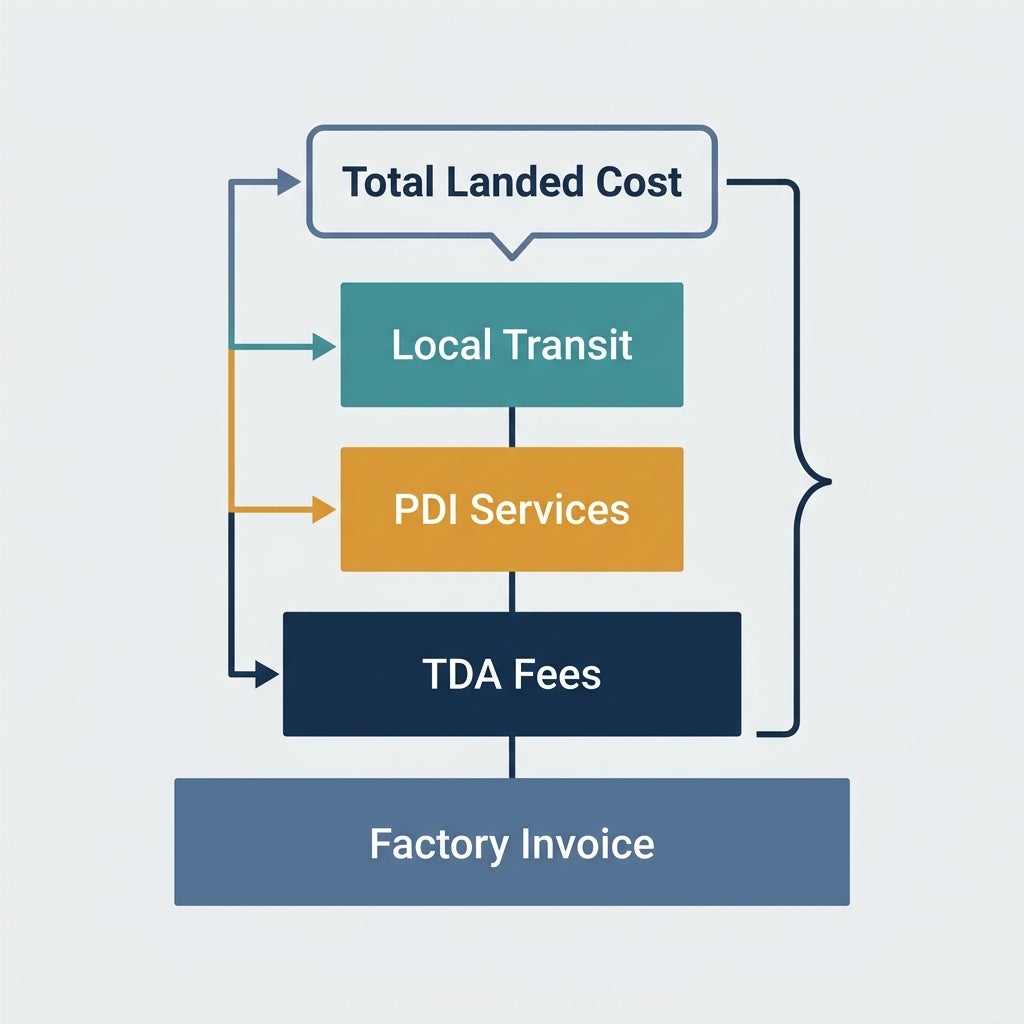
While factory incentives reduce true dealer cost below invoice, regional operational expenses increase what is known as the dealership's Landed Cost. Landed cost represents the total capital invested in putting a specific vehicle on the showroom floor ready for delivery in Junction City.
Primary factors elevating Landed Cost above basic factory invoice include: • Regional Advertising Association (TDA) Fees: OEM-mandated regional marketing contributions added directly to wholesale billing. • Dealer Inspection & Pre-Delivery Conditioning (PDI): Uncrating, safety inspections, fluid top-offs, software updates, and detailing. • Local Inventory Transit & Handling: Fuel charges, secondary transport from rail yards in Kansas City or Topeka, and vehicle storage protection.
Understanding landed cost prevents confusion when evaluating transparent quotes across Manhattan, Fort Riley, and Junction City dealers.
Diagram showing elements of Total Landed Cost including Local Transit, PDI Services, TDA Fees, and Factory Invoice. (Representative image for illustration purposes only. Actual vehicle may vary based on trim and configuration.)

What Is the Difference Between Dealer Cash and Customer Rebates?

Dealer Cash (Incentives)

Dealer cash consists of unadvertised factory-to-dealer financial incentives. The manufacturer pays these dollars to the dealership to help move specific slow-selling models or trim levels without changing public MSRPs.

Customer Rebates

Customer rebates are public factory incentives applied directly to reduce the retail transaction price at checkout (or taken as cash back). Before structuring your deal, Get Pre-Approved to see available APR bonuses.

Stacking & Deal Structure

Dealer cash reduces the internal wholesale threshold, allowing competitive pricing. Customer rebates reduce the retail figure *after* price negotiations are complete.

What Does '$50 Over Factory Invoice Pricing' Really Mean for Buyers?

Advertisements promoting deals like "$50 Over Invoice" or "Buy at Factory Invoice Price" are compelling, but buyers must examine how the entire transaction is constructed. In reality, a deal quoted at $50 over invoice can vary significantly between dealerships based on fee structures.
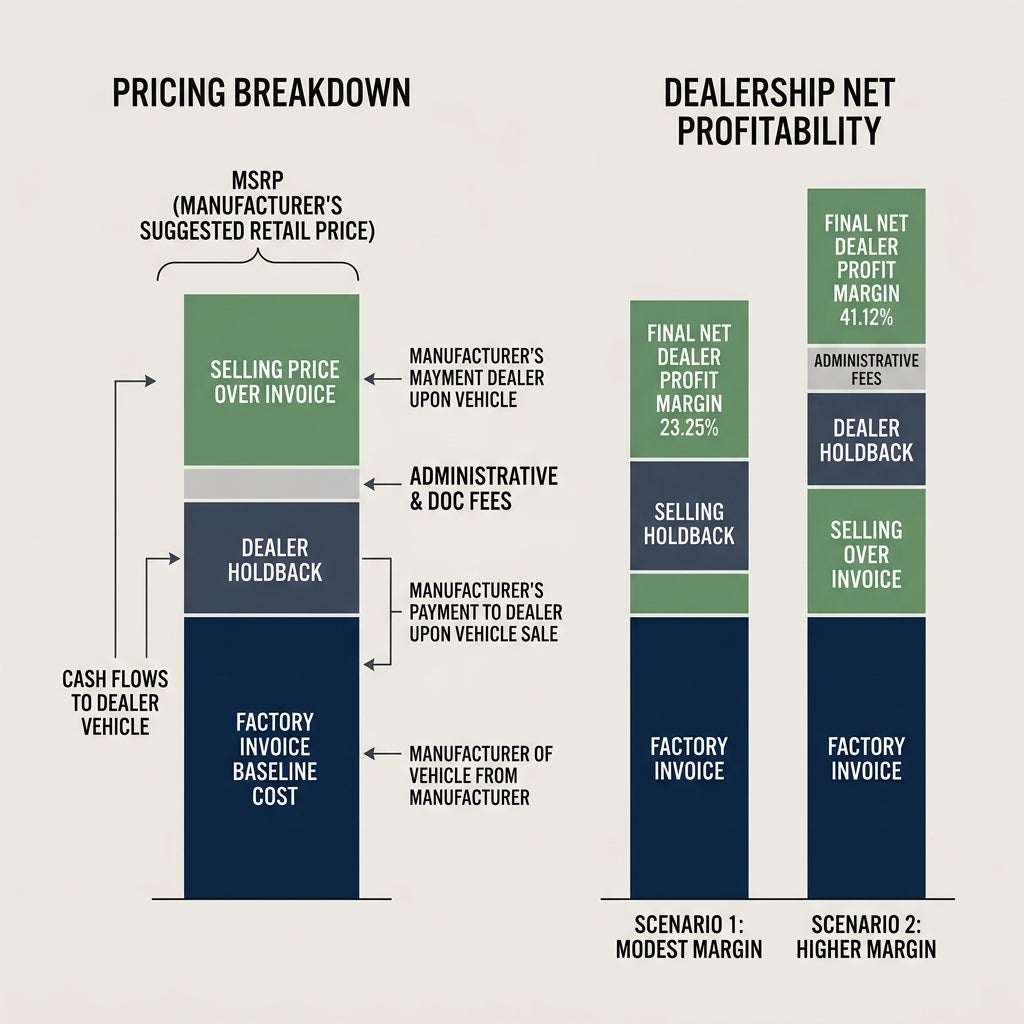
When a dealer sells a vehicle for $50 over factory invoice, the immediate front-end profit on the vehicle body is exactly $50. However, the dealership retains the manufacturer holdback (typically $1,000 to $1,800 depending on total vehicle MSRP) and earns financial reserve if the buyer finances through dealership lender networks.
Beware of dealers who advertise "$50 Over Invoice" only to add mandatory administrative documentation fees of $800+, forced protection packages, or re-adding destination charges. At Valor CDJR, an invoice-based quote is straightforward—no hidden re-additions or deceptive fees.
Diagram detailing MSRP pricing breakdown and dealership net profitability across modest and higher margin scenarios. (Representative image for illustration purposes only. Actual vehicle may vary based on trim and configuration.)

Understanding the Difference Between Markup and Margin in Car Pricing

Wholesale Markup %

Markup is calculated as profit divided by wholesale invoice cost. If an invoice is $50,000 and selling price is $52,000, profit is $2,000. Expressed as markup on cost: $2,000 / $50,000 = 4.0%.

Retail Margin %

Margin is calculated as profit divided by final retail selling price. Using the same transaction ($2,000 profit / $52,000 retail price), profit margin equals 3.84%. Commercial buyers viewing our Commercial Vehicle Inventory rely heavily on these exact calculations.

Commercial Clarity

Automotive retail operates on slim margins—often between 2% and 5% total gross margin on new vehicles. Distinguishing markup from margin helps buyers evaluate commercial-grade fleet quotes accurately.

Does Out-the-Door Price Match the Selling Price Over Invoice?

No. The agreed selling price (e.g., $100 over factory invoice) is merely one line item in calculating the final Out-the-Door (OTD) Price. Buyers must account for statutory government taxes, mandatory state registration fees, and dealer documentation fees.
For residents in Junction City, Geary County, or nearby Manhattan, KS, the OTD calculation follows this exact formula: • Negotiated Vehicle Selling Price (e.g. Invoice + $50) • Kansas State Sales Tax + Local Municipal/County Taxes • Title, Registration, and License Plate Fees • Dealer Documentation Fee • Minus Customer Factory Rebates and Trade-in Tax Credits.
Visit our showroom in person— Get Directions to Valor CDJR—to receive an exact itemized OTD quote sheet for any vehicle.

Component

Sample Quote Basis

Factory Invoice (inc. Freight)

$45,200

Agreed Selling Price (+ $50)

$45,250

KS State & Local Sales Tax (Est.)

$3,393

Doc Fee & Registration

$495

Customer Rebate Credit

-$2,000

Final Out-the-Door (OTD)

$47,138

Are Near-Invoice Deals Harder to Get on Brand-New Future Model Years?

Supply & Demand Dynamics

When a brand-new model year or redesign launches, market demand outpaces factory production. During early release cycles, factory discounts and dealer cash incentives are minimal or non-existent.

Initial Production Allocation

Dealerships receive limited allocation during initial production runs. Because inventory holding times are near zero, dealers do not face floorplan interest pressure, making invoice pricing less common initially.

Military & Local Buyers

For Fort Riley military members and regional drivers, special OEM order programs or factory pre-orders can secure competitive pricing. Maintaining your current vehicle via our Service Scheduler or utilizing our Express Lane while waiting for new model allocations is a practical strategy.

How to Use Valor CDJR's Digital Tools to Calculate Your Real Cost

At Valor CDJR, we equip our customers with digital suite tools to analyze true vehicle costs from the comfort of home. You do not need to sit in a showroom for hours to get transparent figures.
Follow these practical steps on our website: 1. Browse our real-time online inventory for new or Used Vehicle Listings. 2. Click 'View Factory Pricing' or request the OEM invoice sheet for any in-stock model. 3. Utilize our instant trade appraisal engine to calculate net trade-in equity. 4. Apply active regional customer rebates and current finance options.
By leveraging these digital resources, shoppers across Junction City and Manhattan arrive with complete clarity regarding invoice baselines, destination charges, and final landed price.
A digital tablet showing a car pricing overview dashboard on a wooden desk next to a modern car key fob. (Representative image for illustration purposes only. Actual vehicle may vary based on trim and configuration.)

Get Straight Answers and Transparent Vehicle Quotes at Valor CDJR

To summarize: Yes, factory invoice pricing ALWAYS includes factory destination and delivery charges. It is an OEM-mandated standardized fee that dealers pay to transport vehicles from manufacturing plants to our dealership in Junction City.
With 36 years of automotive experience, Dealer Principal Dustin Zeck and the entire team at Valor CDJR are committed to straightforward, line-item transparency. Whether you are inquiring about invoice breakdowns, holdback, factory rebates, or out-the-door pricing, we are here to provide clear answers.
Need genuine factory parts or accessories? Check out our dedicated Parts Department online or visit us today.
Posted in:

Related Posts

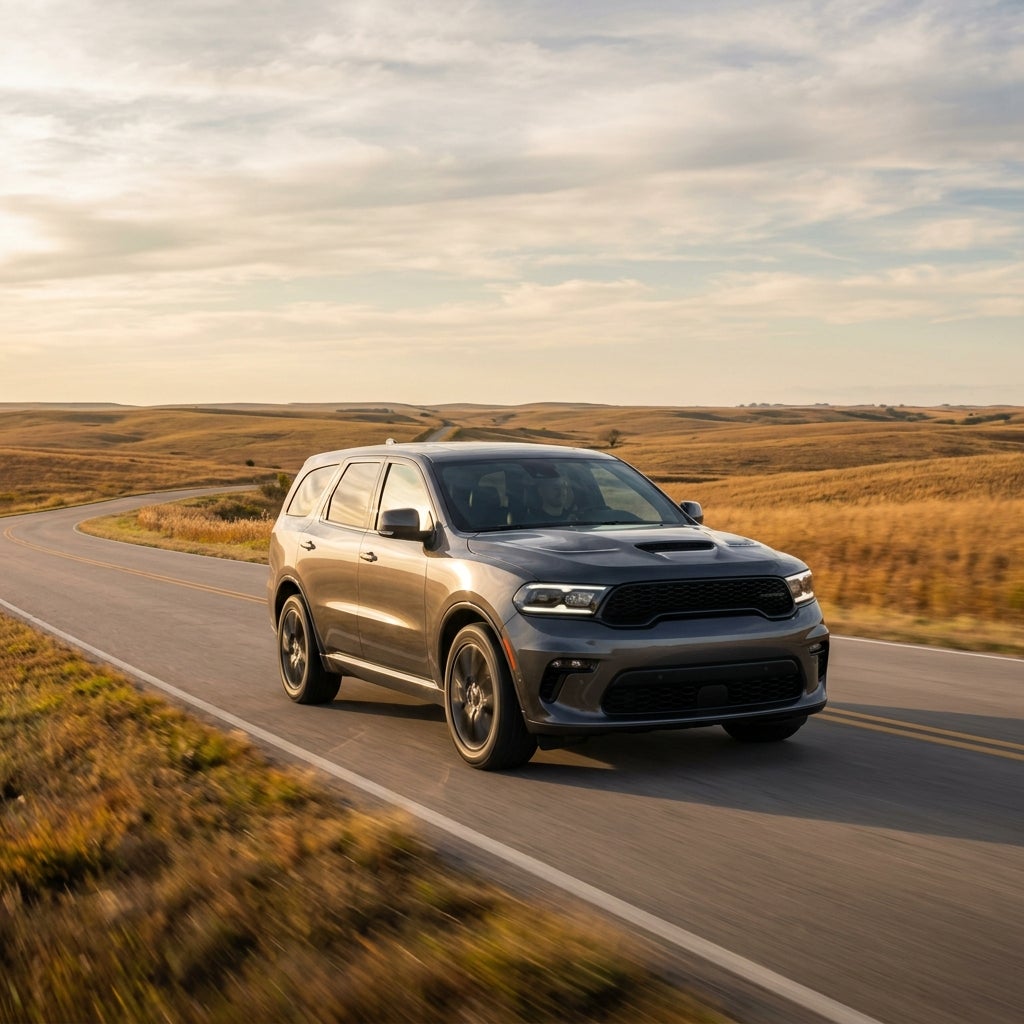
2025 Dodge Durango Local Market Evidence in Junction City, KS

2025 Dodge Durango Local Market Evidence in Junction City, KS

2025 Dodge Durango Local Market Evidence in Junction City, KS When evaluating whether there is strong local market evidence for shopping a 2025 Dodge Durango in Junction City, Kansas, the data points overwhelmingly to yes. Central Kansas buyers, particularly across Geary County and neighboring Riley County, consistently prioritize versatile three-row SUVs that blend true muscle-car performance with heavy-duty towing capability and confident all-weather control. The 2025 Dodge Durango fulfills these regional demands better than almost any alternative in the midsize SUV segment. Local market evidence is reflected in three distinct trends: steady incoming inventory allocations at local dealerships like Valor CDJR, exceptional regional resale values for all-wheel-drive three-row vehicles, and specialized lifestyle demand. Families commuting daily between Junction City and Fort Riley or driving into Manhattan require winter-ready traction during severe Kansas weather spells. Concurrently, outdoor enthusiasts pulling boats to Milford Lake require serious trailering stamina. Whether comparing the efficient SXT or the muscular R/T trim, the 2025 Durango stands out as a prime investment tailored for life in the Kansas River Valley. To explore live inventory allocations and test drive a new Durango in person, Get Directions to Valor CDJR today. Durango Metric 2025 Dodge Durango SXT 2025 Dodge Durango R/T Engine Option 3.6L Pentastar V6 5.7L HEMI V8 Horsepower & Torque 295 hp / 260 lb-ft 360 hp / 390 lb-ft Max Towing Capacity Up to 6,200 lbs Up to 8,700 lbs Drive System Available AWD Performance AWD Standard/Available Infotainment Uconnect 5 w/ 8.4-inch or 10.1-inch Uconnect 5 w/ 10.1-inch Display Browse New Durango Inventory Key Local Factors Driving 2025 Durango Demand Near Fort Riley and Riley County Living and working around Junction City involves unique geographic and demographic considerations. A major engine of local demand is the active military community at Fort Riley. Service members and military families frequently undergo Permanent Change of Station (PCS) moves, requiring versatile vehicles capable of cross-country highway travel, carrying full family loads, and towing trailers without breaking a sweat. Furthermore, winter commuting along Interstate 70 between Junction City, Ogden, and Manhattan can quickly turn hazardous during sudden plains snowstorms and freezing rain. The Dodge Durango's available all-wheel-drive system continuously monitors road conditions, automatically distributing power between front and rear axles to maintain stability on icy overpasses. Beyond winter safety, the rolling topography of the Flint Hills demands responsive power. Negotiating steep grades along Highway 77 or carrying heavy weekend cargo requires an engine and chassis tuned for endurance. The Durango delivers muscle-car heritage in a utility framework, explaining why it remains a top choice throughout Geary County. What Are the Main Performance Differences Between the 2025 Dodge Durango SXT and R/T? 2025 Dodge Durango SXT: 3.6L Pentastar V6 Engine The entry point to the Durango lineup features the proven 3.6-liter Pentastar V6 engine paired with a smooth TorqueFlite 8-speed automatic transmission. Generating 295 horsepower and 260 lb-ft of torque, the SXT provides energetic acceleration for everyday highway merging and town driving. It offers a strong maximum towing capacity of up to 6,200 pounds when properly equipped, making it ideal for lighter campers, small utility trailers, and family watercraft. 2025 Dodge Durango R/T: 5.7L HEMI V8 Engine Stepping up to the Durango R/T unleashes legendary V8 rumble. Powered by the 5.7-liter HEMI V8, the R/T delivers 360 horsepower and 390 lb-ft of torque. Featuring performance transmission calibration, sport-tuned steering, and an available active exhaust, the R/T accelerates with authority. More importantly for local towers, maximum towing capacity increases to an impressive 8,700 pounds, effortlessly handling heavy travel trailers and larger ski boats. Performance Feature Durango SXT (3.6L V6) Durango R/T (5.7L V8) Horsepower 295 hp @ 6,400 rpm 360 hp @ 5,150 rpm Torque 260 lb-ft @ 4,000 rpm 390 lb-ft @ 4,250 rpm Transmission 8-Speed Automatic 8-Speed Performance Auto Standard Towing 6,200 lbs 7,400 lbs (Up to 8,700 lbs w/ Tow N Go) Exhaust Note Quiet / Smooth Signature Performance Active Exhaust How Much More Expensive Is the 2025 Dodge Durango R/T Than the SXT? Trim MSRP Gaps The entry-level Durango SXT offers an accessible starting price point for value-focused families. Stepping up to the R/T typically represents an MSRP increment of roughly $9,000 to $12,000, depending on optional packages like the Tow N Go or Blacktop Package. Standard Equipment Value That price bump brings significant standard upgrades beyond the 5.7L V8 engine. The R/T includes standard Uconnect 5 10.1-inch navigation touchscreen, leather-trimmed sport seating, power liftgate, 20-inch aluminum wheels, and Dodge Performance Pages. Monthly Financing & Trade Offset On a standard 60-month or 72-month finance term, the monthly payment difference usually ranges between $150 and $220. However, utilizing high trade-in valuations at Valor CDJR can significantly offset this monthly gap. Get Pre-Approved Online Standard Features vs Upgrades Across 2025 Durango SXT vs R/T Configurations Uconnect 5 Infotainment The SXT comes standard with an 8.4-inch display, while higher configurations and the R/T boast the crisp 10.1-inch high-definition Uconnect 5 screen. Both systems support wireless Apple CarPlay and Android Auto, dual-phone Bluetooth connectivity, and over-the-air map updates. Seating & Interior Flex The SXT features comfortable 7-passenger seating with a 60/40 fold-flat second row. The R/T unlocks available second-row captain's chairs for effortless pass-through to the third row, combined with heated/ventilated front seats and leather seating surfaces. Safety & Exterior Style Standard driver assistance includes Blind Spot Monitoring and Rear Cross Path Detection. R/T adds Adaptive Cruise Control with Stop, Forward Collision Warning with Active Braking, performance hood scoops, and optional dark exterior accents via the Blacktop Package. Real-World Highway and Flint Hills Fuel Economy for V6 vs V8 Models 3.6L V6 Daily Efficiency For commuters traveling back and forth between Junction City, Fort Riley, and Manhattan on I-70, the 3.6L Pentastar V6 delivers great highway fuel efficiency. Achieving an EPA-estimated rating up to 26 mpg highway in rear-wheel drive or 25 mpg highway with AWD, the V6 maximizes range on long weekly drives while maintaining plenty of passing power. 5.7L V8 Fuel Saver MDS Technology While the 5.7L HEMI V8 yields around 22 mpg highway, Dodge engineers integrated clever Fuel Saver Multi-Displacement System (MDS) technology. Under light throttle conditions during steady highway cruising across flat stretches of Geary County, MDS seamlessly deactivates four cylinders to conserve fuel without sacrificing engine responsiveness when accelerating up Flint Hills grades. Trade-In Valuation and Resale Trends in Central Kansas Pre-owned three-row SUVs remain in extremely high demand throughout Central Kansas. Due to constant PCS cycles at Fort Riley and the strong preference for AWD capability among regional buyers, high-quality trade-in vehicles command premium appraisal values. Dodge Durango models historically retain strong resale equity thanks to their muscular styling, durable drivetrains, and versatile towing capacity. At Valor CDJR, our trade valuation experts leverage real-time local market data to provide top market value for your current sedan, truck, or crossover. Start your appraisal online with our quick Trade In Evaluation tool to see how much equity you can apply toward your new 2025 Dodge Durango. Value Your Trade-In Now Towing Boats, Campers, and Trailers Around Milford Lake and the Kansas River Valley Milford Lake—the largest body of water in Kansas—is located right in Junction City's backyard. Weekend outdoor recreation is a way of life for local residents, whether hauling ski boats, pontoon craft, camper trailers, or jet skis to local boat ramps. The Durango standard trailer sway control tech automatically detects trailer movement and applies targeted brake pressure to maintain rock-solid tracking. While the SXT model's 6,200-pound limit easily handles personal watercraft and midsize pop-up campers, the R/T model's 8,700-pound maximum rating with the Tow N Go package equips you to tow full-size double-axle travel trailers and heavy speedboats without strain. Total Cost of Ownership: Maintenance, Insurance, and Service Support Routine Maintenance Both V6 and V8 Durango engines feature proven Mopar engineering designed for long-term reliability. Quick oil changes, tire rotations, and multi-point inspections can be handled rapidly at our dedicated Express Lane service center in Junction City without needing an advance appointment. Insurance Considerations Insurance rates for the Durango SXT typically reflect standard midsize family SUV insurance brackets. The R/T trim may carry slightly higher premiums due to its V8 performance package, though advanced standard driver safety suites help keep policy rates competitive. Certified Service & Parts Valor CDJR maintains a comprehensive stock of OEM Mopar components via our local Parts Department. You can easily schedule scheduled maintenance through our online Service Scheduler or Call us at (785) 238-5114. How to Compare 2025 Dodge Durango Inventory in Junction City and Manhattan Shopping for a 2025 Durango across Junction City and nearby Manhattan is straightforward when working with Valor CDJR. Rather than driving between multiple dealer lots, buyers can filter online inventory by trim, engine, exterior paint color, and trailering packages. Browse our New Vehicle Listings or explore pre-owned models in our Used Vehicle Listings. If you have specific preferences for paint shades or interior seating configurations, our sales team can track incoming factory allocations or assist with a direct custom order from Dodge. Buyer Decision Framework: Choosing the Right 2025 Durango Trim for Your Needs Step 1: Determine Towing Capacity Needs If your recreational towing involves lightweight trailers or boats under 6,000 lbs, the SXT V6 is fully capable. If pulling heavy travel trailers over 7,000 lbs, select the R/T with the 5.7L V8. Step 2: Calculate Commute & Fuel Priorities High-mileage daily commuters driving I-70 between Junction City and Manhattan will appreciate the Pentastar V6's 25+ highway mpg. Weekend cruisers and performance fans will prefer the HEMI V8 sound. Step 3: Evaluate Interior Tech & Budget Compare monthly finance targets against desired tech features like the 10.1-inch Uconnect 5 display or captain's chairs. Use our online financing tools to lock in rates. Apply for Durango Financing Test Drive the 2025 Dodge Durango at Valor CDJR in Junction City Ready to experience the 2025 Dodge Durango for yourself? Visit Valor CDJR at 1825 Goldenbelt Blvd in Junction City, KS. Our knowledgeable sales staff is ready to help you compare SXT and R/T models side-by-side, answer questions about military incentive programs, and walk you through competitive financing options. Whether you are stopping by after work or visiting from nearby Manhattan or Fort Riley, we welcome you to schedule a relaxed, no-pressure test drive today. Take the wheel and discover why the Durango remains the premier 3-row SUV for Kansas drivers. Schedule Your Test Drive Today

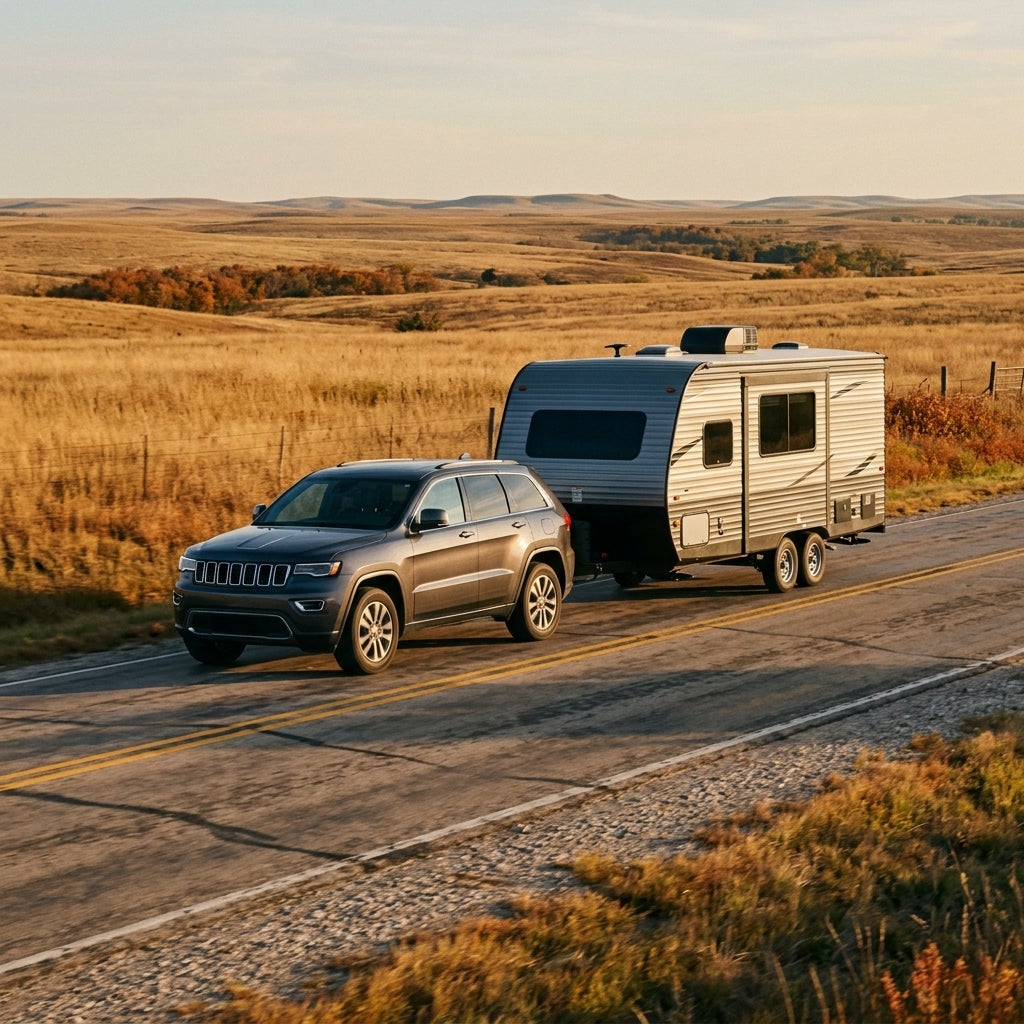
2021 Jeep Grand Cherokee Towing Capacity: 6,200 to 7,200 lbs Maximum Rating

2021 Jeep Grand Cherokee Towing & Capability Guide: Q&A With Dustin Zeck

2021 Jeep Grand Cherokee Towing & Capability Guide: Q&A With Dustin Zeck When hauling a travel trailer or boat, a 2021 Jeep Grand Cherokee typically achieves a practical highway driving range of 250 to 300 miles on a single tank of gas. To break down the trailering limits, factory equipment requirements, and fuel expectations of this popular SUV, we interviewed Dustin Zeck, Dealer Principal at Valor CDJR, who brings 36 years of automotive industry experience to help local drivers tow with complete confidence. Q: How Far Can a 2021 Jeep Grand Cherokee Go on a Tank of Gas While Towing? A: Drivers can expect a 2021 Jeep Grand Cherokee to travel between 250 and 300 miles on a full tank while pulling a loaded trailer under normal highway conditions. The vehicle features a 25-gallon fuel tank, and when trailering weight approaches maximum ratings, real-world fuel economy generally settles between 11 mpg and 13 mpg. On an unladen highway cruise, a model with the 3.6-liter Pentastar V6 reaches up to 26 mpg highway, but the aerodynamic drag and mass of a travel trailer or boat pull those figures down significantly. A range of 250 miles gives you plenty of margin to reach your destination without stressing over the next fuel station, even when pulling heavy loads across windy Kansas highways. If you opt for the 5.7-liter HEMI V8, fuel consumption will be slightly higher under heavy acceleration, though its Fuel Saver Technology helps deactivate cylinders during steady cruising to preserve range. Before setting out on a long trip with a camper in tow toward Milford Lake near Junction City, I always recommend calculating your fuel stops around a conservative 200-mile mark. If you have questions about prepping your vehicle for long-distance trailering, you can reach our service team with a quick call or drop by our Junction City showroom address to speak with our experts. Q: What Is the Maximum Towing Capacity of the 2021 Jeep Grand Cherokee and What Equipment Is Required? A: Maximum towing capacity reaches 6,200 pounds on models powered by the 3.6-liter Pentastar V6 and tops out at 7,200 pounds on models equipped with the 5.7-liter HEMI V8, provided the vehicle has the factory tow package. It is critical to recognize that any 2021 Grand Cherokee lacking the factory setup is restricted to a bumper rating of just 3,500 pounds. Reaching those higher thresholds requires the factory-installed Trailer Tow Group IV package, which equips the SUV for the thermal and structural demands of heavy trailering. The Trailer Tow Group IV package installs a heavy-duty Class IV hitch receiver, a dual 7-and-4-pin wiring harness, high-output engine cooling, a 180-amp or 220-amp alternator, rear load-leveling suspension, and a full-size spare tire. For pull weights above 3,500 pounds, Jeep recommends using a weight distribution hitch to balance the vehicle's front and rear axles, which prevents headlight aim distortion and keeps front-wheel steering traction firm. Maximum tongue weight is capped at 620 pounds for V6 models and 720 pounds for V8 configurations, adhering to the standard 10 percent tongue weight guideline. If you are planning to upgrade your current vehicle to handle a larger camper, you can start by using our online trade-in evaluation tool to see what your current ride is worth. Q: Does the 2021 Jeep Grand Cherokee Come With an Integrated Brake Controller? A: The 2021 Jeep Grand Cherokee does not include an integrated electronic trailer brake controller from the factory, but every model equipped with the factory tow package comes pre-wired with a dedicated harness plug located under the driver-side dashboard. This factory wiring connector allows for a clean, plug-and-play installation of an aftermarket brake controller without slicing into existing vehicle electrical lines. Because electric trailer brakes are required by law for heavier loads, installing a quality brake controller is essential before hitching up a dual-axle travel trailer or car hauler. The pre-wired harness connects directly into the vehicle's electrical infrastructure, feeding signal to the rear 7-pin wiring harness. Our certified technicians can easily wire and mount a sleek controller right below the steering column. You can order genuine towing accessories through our parts department and book an installation appointment using our online service scheduler. "A proper tow package does far more than bolt a hitch receiver to the back frame of an SUV." Q: How Does the 2021 Jeep Grand Cherokee Towing Capacity Compare to the Dodge Durango? A: When comparing standard trim levels, the Grand Cherokee and Dodge Durango offer identical maximum ratings of 6,200 pounds with the 3.6-liter Pentastar V6 and 7,200 pounds with the 5.7-liter HEMI V8. Both midsize SUVs share a strong unibody architecture engineered for heavy trailering stability. However, the Durango offers specialized performance packages that raise its peak capacity higher than the Grand Cherokee. Specifically, the Durango offers the Tow N Go package on its V8 variants, which increases maximum towing capacity up to 8,700 pounds. While the Durango takes the lead on absolute maximum pulling weight, the Grand Cherokee counters with superior off-road trailering capability. With its available multi-mode 4x4 drive systems and adjustable air suspension, the Grand Cherokee is better prepared to pull trailers over unpaved launch ramps, muddy pastures, and rutted trails where ground clearance and traction matter most. Q: What Inspection Points Are Important When Buying a Used 2021 Grand Cherokee Used for Towing? A: When inspecting a pre-owned 2021 Grand Cherokee that was previously used for trailering, buyers should start by evaluating the rear differential fluid and transmission fluid condition. Continuous heavy pulling generates high operating temperatures that can degrade gear oil and automatic transmission fluid prematurely. Smooth transmission shift performance during a test drive is a clear sign that the internal clutch packs and torque converter remain in healthy condition. Next, examine the rear load-leveling shocks or air suspension bladders for signs of fluid weeping, cracking, or physical wear. Inspect the front brake rotors for heat scoring or warping, as heavy stopping duty places extra stress on friction hardware. Finally, check the receiver hitch for heavy rust or stress cracks around the mounting welds, and review the vehicle's maintenance history to verify regular severe-duty service intervals. Shoppers can explore our thoroughly inspected pre-owned inventory or look at our new vehicle inventory to compare options, and our team can help you get started with an online credit pre-approval application. Q: How Do Quadra-Lift Air Suspension and 4x4 Systems Enhance Towing Capability? A: Quadra-Lift air suspension automatically levels the vehicle when a heavy trailer tongue is lowered onto the hitch ball, preventing rear-end squat and maintaining proper headlight alignment and front tire contact. The system replaces standard steel coil springs with air bladders at all four wheels, automatically inflating to compensate for cargo and tongue weight. It also provides adjustable ride height modes, allowing the vehicle to lift up to about 11 inches of ground clearance for off-road navigation or lower for easier trailer hitching. Complementing the suspension are Jeep's advanced four-wheel-drive systems, including Quadra-Trac II with a two-speed transfer case and Quadra-Drive II with a rear Electronic Limited-Slip Differential. When pulling a heavy boat up a slippery ramp or navigating rolling prairie highways around Manhattan, these systems continuously monitor wheel slip and transfer engine torque to the tires with the most grip. Furthermore, standard Trailer Sway Control uses yaw sensors within the Electronic Stability Control system to detect trailer oscillation, automatically applying individual wheel brakes to pull the trailer back into a straight line without driver panic. Q: Where Can You Find a Pre-Owned 2021 Jeep Grand Cherokee With a Tow Package in Junction City? A: You can find high-quality pre-owned 2021 Jeep Grand Cherokee models equipped with factory tow packages right here at Valor CDJR. When shopping for a tow-ready SUV, it is vital to verify that the vehicle was built with the Trailer Tow Group IV package from the factory rather than equipped with an aftermarket bumper hitch later. Our sales team can pull the original factory build sheet and review the door jamb payload ratings to ensure the exact vehicle you choose matches your trailering requirements. Our showroom is conveniently located at 1825 Goldenbelt Blvd, Junction City, KS 66441, where our experienced staff can walk you through hitch setup, tongue weight limits, and four-wheel-drive controls in person. Whether you need assistance verifying equipment options or setting up a test drive, give our team a call at (785) 238-5114 today to get expert guidance on your next tow-ready SUV. © 2026 Valor CDJR. All rights reserved.

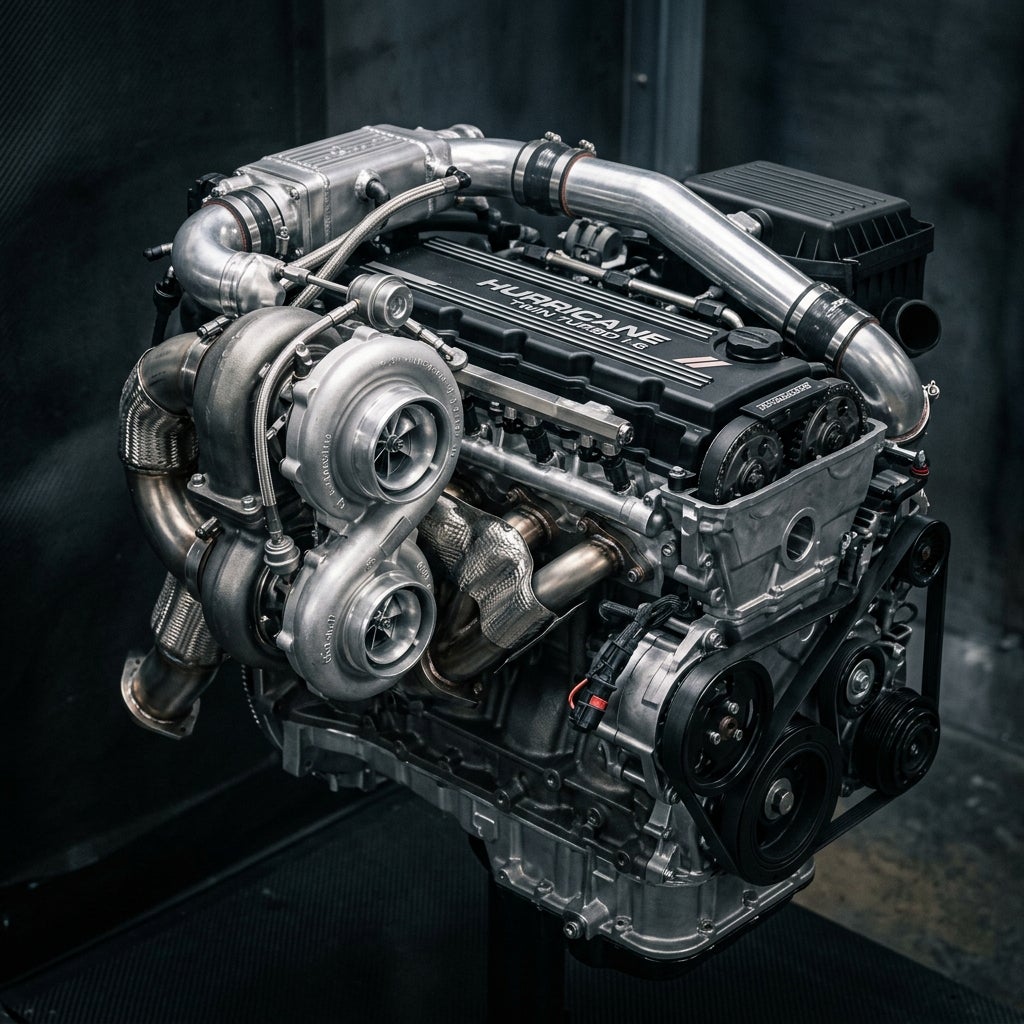
2027 Dodge Charger Sixpack Engine Options and Power Outputs: The Bottom Line

2027 Dodge Charger Sixpack Engine Options and Power Outputs: The Bottom Line

2027 Dodge Charger Sixpack Engine Options and Power Outputs: The Bottom Line For generations, American muscle was defined exclusively by eight cylinder exhaust rumbles. The 2027 Dodge Charger Sixpack boldly redefines that heritage through state-of-the-art forced induction, delivering breathtaking acceleration, precise engineering, and unprecedented all-weather control. At the core of this transformation is the groundbreaking 3.0-liter Twin-Turbo Hurricane Inline-6 engine—a modern engineering marvel that produces higher output and broader torque bands than traditional naturally aspirated V8s. Drivers looking at the 2027 Dodge Charger Sixpack can select between two powerhouse factory tunes: the Standard Output (S.O.) delivering a staggering 420 horsepower and 469 lb-ft of torque, or the High Output (H.O.) pushing boundaries with 550 horsepower and 521 lb-ft of torque. Crucially for Kansas drivers who navigate shifting seasonal conditions, all-wheel drive comes standard across every gas-powered Charger Sixpack model, offering supreme stability whether accelerating onto I-70 or driving through winter slush in Junction City. Engine Spec Sixpack S.O. (Standard Output) Sixpack H.O. (High Output) Engine Displacement 3.0-Liter Twin-Turbo Inline-6 3.0-Liter Twin-Turbo Inline-6 Horsepower 420 hp 550 hp Torque 469 lb-ft 521 lb-ft Drivetrain Standard Intelligent AWD Standard Intelligent AWD Transmission TorqueFlite 8-Speed Automatic TorqueFlite 8-Speed Automatic Inside the 3.0L Twin-Turbo Hurricane Engine Architecture To understand the raw capability of the 2027 Charger Sixpack, one must look beneath its sculpted aluminum hood. The 3.0-liter Hurricane Inline-6 engine is engineered from a clean-sheet design using a deep-skirt cast-aluminum block and a structural aluminum oil pan. Rather than relying solely on engine displacement, Dodge engineers utilized dual low-inertia turbochargers. Each turbo feeds three individual cylinders, allowing rapid spooling and near-instantaneous throttle response that eliminates traditional turbo lag. Combustion efficiency is maximized via a high-pressure direct fuel injection system operating at 5,075 psi (350 bar), ensuring precise fuel atomization directly into the cylinder chambers. Furthermore, the Hurricane architecture incorporates Plasma Transfer Wire Arc (PTWA) spray-bore cylinder coatings—a technological breakthrough that replaces heavy iron cylinder liners with a ultra-thin, hyper-durable thermal spray coating. This drastically reduces internal friction and overall engine weight, boosting both high-RPM responsiveness and overall fuel economy. Comparing Performance Ratings: Sixpack S.O. (420 HP) vs. Sixpack H.O. (550 HP) Sixpack Standard Output (420 HP) The Standard Output (S.O.) Hurricane engine is engineered for an ideal balance of linear muscle power and effortless everyday usability. Producing 420 horsepower and 469 lb-ft of torque, the S.O. delivers punchy off-the-line torque across a wide operational band. Turbo boost levels are tuned to optimize throttle smoothness in urban traffic while retaining massive power reserves for passing on highway stretches. It utilizes cast-aluminum pistons and twin turbochargers tuned specifically for rapid low-end boost response. Sixpack High Output (550 HP) For track enthusiasts and power purists, the High Output (H.O.) variant elevates performance to 550 horsepower and 521 lb-ft of torque. To handle this immense combustion stress, the H.O. engine upgrades to forged aluminum pistons, higher peak boost pressures, dual fuel pumps, and a modified intake manifold. Paired with a recalibrated TorqueFlite 8-speed automatic transmission, shift times are aggressively quickened, ensuring relentless pull all the way to redline. Explore New Charger Inventory Is the Dodge Charger Available in All-Wheel Drive for Winter Commuting in Kansas? Yes, every 2027 Dodge Charger Sixpack model comes factory-equipped with intelligent All-Wheel Drive (AWD) as standard equipment. Traditional rear-wheel-drive muscle cars often struggle when winter weather hits Kansas, but the modern Charger platform solves this challenge effortlessly. Intelligent Traction The active transfer case constantly monitors wheel slip, steering angle, and throttle input to instantly redirect torque to the front wheels when extra traction is needed on slick Junction City roads. Front-Axle Disconnect During mild dry highway conditions along I-70, the front axle automatically disconnects. This reduces driveline drag and optimizes highway fuel efficiency while maintaining instant re-engagement when needed. Dedicated Winter Modes Selecting Wet/Snow drive mode adjusts gear shift points, softens initial throttle mapping, and defaults torque distribution to keep the vehicle firmly grounded across icy streets in Manhattan and Riley County. What Standard Equipment is Included in the Base Dodge Charger Trim? Performance Chassis & Drivetrain Even entry-level Dodge Charger Sixpack trims come equipped with high-performance chassis components. Standard features include a mechanical limited-slip rear differential for improved traction out of sharp corners, performance-tuned multi-link suspension, heavy-duty disc brakes, and dynamic active exhaust valves that deliver an unmistakable engine roar under heavy acceleration. Selectable Drive Modes & Comfort Drivers can tailor vehicle dynamics using built-in selectable Drive Modes, including Auto, Eco, Sport, and Wet/Snow. Standard exterior features include full LED front headlights and signature rear cross-car lightbars, keyless Enter 'n Go proximity access, dual-zone automatic climate control, and acoustic windshield glass for a quiet highway cabin experience. What Interior Screen Tech is Included Standard on the Dodge Charger? 12.3-Inch Uconnect 5 The standard 12.3-inch central touchscreen runs on the ultra-fast Uconnect 5 infotainment system, offering crisp graphics, customizable home screens, and over-the-air software updates. Digital Driver Cluster A high-definition 10.25-inch digital instrument display comes standard directly behind the steering wheel, with an available 16-inch full-color cluster for augmented navigation routing and real-time telemetry. Performance Pages & Connectivity Standard wireless Apple CarPlay and Android Auto pair seamlessly. Integrated Dodge Performance Pages log real-time G-force metrics, turbo boost pressures, acceleration timers, and oil temperatures. Which Car Has More Rear Seat Legroom for Passengers? Coupe vs. Sedan Dimension Advantage When buyers ask which vehicle offers comfortable rear passenger seating, the 2027 Dodge Charger stands out due to its extended wheelbase architecture. Unlike traditional compact sports coupes that sacrifice rear legroom, both the 2-door coupe and 4-door sedan Charger share the exact same long wheelbase chassis, providing surprising stretch-out room for rear occupants. Adult Comfort & Liftback Versatility Adult passengers can easily relax in the rear row during long highway road trips across Kansas. Furthermore, the innovative hidden rear hatch design opens wide to reveal massive trunk storage capacity, giving the Charger superior daily practicality when compared to competing sports cars. Browse Pre-Owned & Pre-Approved Inventory Is Adaptive Cruise Control Standard on the Dodge Charger? Yes, Adaptive Cruise Control with Stop & Go functionality comes standard on the 2027 Dodge Charger Sixpack lineup. Safety and advanced driver-assistance systems have been integrated into the core architecture, making long highway commutes between Junction City, Manhattan, and Topeka effortless and stress-free. Alongside Adaptive Cruise Control, standard driver-assist systems include Active Lane Management, Blind Spot Monitoring with Rear Cross-Path Detection, Full-Speed Forward Collision Warning with Active Braking, and Traffic Sign Recognition. Whether cruising I-70 or navigating busy suburban traffic, the Charger protects its passengers through active radar and camera surveillance. Under What Specific Condition Could a Federal EV Credit Still Be Claimed? Charger Sixpack Gas Exemption The gas-powered 2027 Dodge Charger Sixpack utilizes internal combustion twin-turbo Hurricane engines. Because it operates strictly on gasoline, the Sixpack trim is exempt from clean vehicle federal tax credits aimed at zero-emission battery electric vehicles. Section 45W Commercial EV Lease Savings However, for buyers considering the electric Charger Daytona variant, contact the dealership for current tax credit and lease incentive details Evaluating the 2027 Dodge Charger as a Daily Driver in Kansas Flint Hills Ride Comfort The refined multi-link suspension dampens rough rural pavement and gravel roads throughout the Flint Hills region, maintaining smooth ride quality without compromising dynamic muscle car cornering stability. Highway Efficiency & Range Thanks to twin-turbo efficiency and front-axle disconnect AWD, the Charger Sixpack offers an impressive cruising range for long trips down I-70 or daily commutes across Fort Riley and Manhattan. Hidden Hatch Cargo Space The rear liftback design creates an expansive cargo area capable of holding luggage, sports equipment, or groceries, making it one of the most practical high-horsepower cars on the market today. Evaluate Your Current Trade-In Customizing and Servicing Your Charger Sixpack at Valor CDJR Mopar Parts & Performance Accessories Personalize your Charger Sixpack with factory-backed performance components. Our specialized Parts Department offers genuine Mopar exhaust upgrades, custom forged wheels, performance cold-air intakes, and all-weather interior floor mats engineered specifically for your vehicle. Certified Maintenance & Express Lane Maintaining high-output twin-turbo engines requires expert care. Our factory-trained technicians utilize specialized diagnostic tools for Hurricane inline-6 maintenance. Book quick oil changes and routine inspections through our online Service Scheduler or stop by for routine maintenance at our dedicated Express Lane. Financing and Trade-in Options for Kansas Muscle Car Enthusiasts At Valor CDJR, we make acquiring your dream 2027 Dodge Charger Sixpack simple and transparent. Whether you are interested in placing a custom factory pre-order for your preferred exterior color and package configuration or exploring current incentive programs, our dedicated finance specialists are here to assist. We proudly support active military personnel from nearby Fort Riley as well as residents across Manhattan and Riley County. Interested buyers can apply for pre-approval online via our secure tool to Apply for Pre-Approval in minutes. You can also get a fast market estimate on your current car using our instant Trade In Evaluation tool. If you are shopping for business or fleet applications, explore our specialized Commercial Vehicle Inventory options as well. Experience 2027 Dodge Charger Sixpack Power at Valor CDJR in Junction City Ready to feel the thrilling acceleration of the 420-hp or 550-hp 3.0L Twin-Turbo Hurricane engine firsthand? The expert sales team at Valor CDJR is standing by to walk you through specs, assist with custom factory orders, and get you behind the wheel for a test drive. Visit our dealership conveniently located in Junction City, KS. Get Directions to Valor CDJR today or Call us at (785) 238-5114 to speak directly with one of our muscle car representatives. Search New Charger Inventory