




Blog / Vehicle Pricing Strategies

Blog

All Vehicle Pricing Strategies Buying Guides New Vehicle Reviews Maintenance & Service Technology & Innovation Financing & Insurance Model Comparisons New Vehicle Inventory Safety Features Used Vehicle Guides Valor CDJR Trade in Advice Towing & Hauling Safety Family & Lifestyle Vehicles Vehicle Financing & Trade-In Tips Dealership Sales Strategies KS Community Parts & Accessories Junction City Military & Veteran Benefits Automotive Repair Buying Guides & Dealership Services Financing & Trade-In Options Seasonal Vehicle Care Service Military Vehicle Buying Guides Off-Road & Adventure Vehicles Vehicle Ownership Care Hybrid & Electric Vehicles Parts Performance & Powertrain Automotive Recalls Commercial Truck Reviews Dealership Inventory Highlights Dealership Visit Preparation Heavy-Duty Truck Features Inventory & Pricing Insights Jeep Lifestyle & Accessories Military & Community Car Buying Programs Repair & Diagnostics Vehicle Features & Accessories Vehicle Maintenance & Preparation Vehicle Safety & Compliance Vehicle Trade-In Tips Warranty & Coverage Automotive News Car Buying Tips Car Purchase Tips Dealer Profiles & Interviews Dealership Offers & Promotions Dealership Service Experience Financing & Insurance for Military Families Genuine Parts & Accessories Local Automotive Events OEM Parts & Warranty Coverage Pre-Owned Vehicle Sales Road Trip & Travel Tips Special Offers & Promotions Tailgating & Outdoor Adventures Tailgating & Outdoor Recreation Towing & Roadside Assistance Vehicle Registration & Legal Advice for Military Personnel Vehicle Repair & Diagnostics Vehicle Sales Experience Warranty & Protection Plans Brake System Care Certified Pre-Owned Programs Commercial Fleet Management Commercial Vehicle Comparisons Community & Military Support Initiatives Dealership Events Engine & Performance Insights Luxury SUVs Out-of-State Purchasing Guides Part & Warranty Services Parts & Repair Reimbursement Recall & Warranty Repairs Seasonal Sales Events Technology & Innovation in Vehicle Service Vehicle Incentives & Promotions Vehicle Maintenance & Winter Care Vehicle Technology & Features Weekend Dealership Events and Services
A smiling man with a mustache in a black polo shirt, standing in front of a Valor Automotive logo backdrop.

What’s the Best Way to Compare Two Complex Car Offers That Reference Invoice or MSRP?

.hrizn-visual-root a { color: #566BA1; } .hrizn-visual-root a { color: inherit; } .hrizn-visual-root p { margin: 0 0 1em; } .hrizn-visual-root p:last-child { margin-bottom: 0; } @media (max-width: 640px) { .hrizn-visual-root { text-align: center !important; } .hrizn-visual-root a { display: block; width: 100%; max-width: 320px; margin-left: auto; margin-right: auto; box-sizing: border-box; } .hrizn-visual-root + a { margin-top: 8px; } } @media (max-width: 640px) { #hrizn-cols-1 { flex-direction: column !important; align-items: stretch !important; } #hrizn-cols-1 > .hrizn-col { flex: 1 1 100% !important; width: 100% !important; } } @media (max-width: 640px) { #hrizn-cols-2 { flex-direction: column !important; align-items: stretch !important; } #hrizn-cols-2 > .hrizn-col { flex: 1 1 100% !important; width: 100% !important; } } @media (max-width: 640px) { #hrizn-3cols-1 { flex-direction: column !important; align-items: stretch !important; } #hrizn-3cols-1 > .hrizn-col { flex: 1 1 100% !important; width: 100% !important; } } #hrizn-table-tbl-msrp-vs-invoice-sample table{width:100%;table-layout:auto;border-collapse:collapse;font-family:'Open Sans',sans-serif;font-size:0.9rem} #hrizn-table-tbl-msrp-vs-invoice-sample th,#hrizn-table-tbl-msrp-vs-invoice-sample td{border:1px solid #e0e4ed;padding:8px;color:#595959;word-break:break-word;overflow-wrap:break-word} #hrizn-table-tbl-msrp-vs-invoice-sample th{background:#1a1a22;color:#ffffff;font-weight:700;font-size:14px;text-align:left;vertical-align:middle;padding:10px} #hrizn-table-tbl-msrp-vs-invoice-sample tr:nth-child(even) td{background:rgba(86,107,161,0.04)} #hrizn-table-tbl-msrp-vs-invoice-sample .tableWrapper{overflow-x:hidden} @media (max-width: 640px) { #hrizn-cols-3 { flex-direction: column !important; align-items: stretch !important; } #hrizn-cols-3 > .hrizn-col { flex: 1 1 100% !important; width: 100% !important; } } @media (max-width: 640px) { #hrizn-3cols-2 { flex-direction: column !important; align-items: stretch !important; } #hrizn-3cols-2 > .hrizn-col { flex: 1 1 100% !important; width: 100% !important; } } @media (max-width: 640px) { #hrizn-cols-4 { flex-direction: column !important; align-items: stretch !important; } #hrizn-cols-4 > .hrizn-col { flex: 1 1 100% !important; width: 100% !important; } } @media (max-width: 640px) { #hrizn-cols-5 { flex-direction: column !important; align-items: stretch !important; } #hrizn-cols-5 > .hrizn-col { flex: 1 1 100% !important; width: 100% !important; } } #hrizn-table-tbl-comparison-template table{width:100%;table-layout:auto;border-collapse:collapse;font-family:'Open Sans',sans-serif;font-size:0.9rem} #hrizn-table-tbl-comparison-template th,#hrizn-table-tbl-comparison-template td{border:1px solid #e0e4ed;padding:8px;color:#595959;word-break:break-word;overflow-wrap:break-word} #hrizn-table-tbl-comparison-template th{background:#1a1a22;color:#ffffff;font-weight:700;font-size:14px;text-align:left;vertical-align:middle;padding:10px} #hrizn-table-tbl-comparison-template tr:nth-child(even) td{background:rgba(86,107,161,0.04)} #hrizn-table-tbl-comparison-template .tableWrapper{overflow-x:hidden} @media (max-width: 640px) { #hrizn-3cols-3 { flex-direction: column !important; align-items: stretch !important; } #hrizn-3cols-3 > .hrizn-col { flex: 1 1 100% !important; width: 100% !important; } } @media (max-width: 640px) { #hrizn-cols-6 { flex-direction: column !important; align-items: stretch !important; } #hrizn-cols-6 > .hrizn-col { flex: 1 1 100% !important; width: 100% !important; } } What’s the Best Way to Compare Two Complex Car Offers That Reference Invoice or MSRP? Interviewer: Buying a new truck or SUV in Riley County or Geary County often turns into a maze of conflicting terms—MSRP, dealer invoice, factory holdback, regional ad fees, doc fees, and trade-in allowances. When two other dealerships present quotes using completely different baselines, how can a car buyer tell which deal actually costs less? To unpack the mechanics of automotive pricing, we sat down with Jace Grabouski, General Manager at Valor CDJR in Junction City, Kansas, who brings over 20 years of hands-on dealership management experience. Jace breaks down how to strip away confusing marketing headlines and uncover the true bottom-line figure. Jace Grabouski: "The short answer is that you have to completely ignore baseline labels like 'MSRP' during your initial comparison. Dealers use different baseline anchors to make quotes appear lower than they really are. The absolute best way to compare two complex offers is to normalize both quotes down to a total out-the-door (OTD) cash figure by stripping away baseline headlines, auditing every non-governmental dealer fee and mandatory add-on line item by line item, and calculating the exact net outlay after adjusting for true trade-in equity and current financing information. Interviewer: Why do headline discounts mislead buyers when comparing vehicle proposals from different stores? Jace Grabouski: "I've seen it thousands of times in my 20 years in this business. A buyer gets a quote from a dealership in Manhattan or Salina advertising and assumes it must beat a competing quote from a Junction City store. But when you inspect the back page of that proposal, you find a $799 documentation fee, a $495 mandatory paint protection package, a $295 nitrogen tire fee, and an undervalued trade-in allowance that strips away $1,500 in real equity. Meanwhile, the '$50 over invoice' offer carries a low standardized fee, zero dealer add-ons, and a true market-value trade allowance. To make an accurate side-by-side assessment, you must insist on seeing a complete, itemized buyer's order that lists the base vehicle price, individual factory option costs, destination charges, dealer documentation fees, dealer-installed accessories, government taxes, title fees, and trade-in valuation. If you want to explore transparent baseline pricing today, feel free to browse our New Vehicle Listings or start with an online Trade In Evaluation before stepping foot in the showroom. Explore New Inventory with Transparent Pricing What Is the Difference Between MSRP and Factory Invoice Pricing? Interviewer: Jace, let's start with basic definitions. Consumers see MSRP on the window sticker and hear about 'factory invoice' in car ads. What do these terms really mean under federal law and dealer accounting? Jace Grabouski: "Let's break them down clearly: 1. MSRP (Manufacturer's Suggested Retail Price): Also known as the Monroney sticker price, MSRP is the retail pricing calculated by the vehicle manufacturer (like Stellantis for Chrysler, Dodge, Jeep, and Ram). Federal law requires this sticker to remain on every new vehicle until delivery. It includes the base vehicle retail price, factory-installed options at retail, destination charges, and EPA fuel economy estimates. Crucially, MSRP is purely a *suggested* selling price—it is not what the dealership paid for the vehicle. 2. Factory Invoice Price: This represents the initial baseline charge sent from the manufacturer to the dealership when the vehicle is shipped. It reflects the base invoice cost of the vehicle plus option package invoice prices and destination charges. Many buyers mistakenly believe factory invoice is the dealer's absolute net cost, but that is rarely the case due to behind-the-scenes manufacturer allowances like holdback and quarterly volume bonuses. Interviewer: Why shouldn't a buyer in Junction City or Manhattan view either figure as the final benchmark of dealer cost? Jace Grabouski: "Because neither MSRP nor factory invoice accounts for local market realities, dealer operating overhead, or backend manufacturer financial credits. MSRP is an arbitrary ceiling set at headquarters; factory invoice is a standardized wholesale starting point. Neither number tells you what the vehicle is worth in Kansas today or what final out-the-door price a store can offer. When you buy at Valor CDJR, we show you the actual factory document line by line so you see both the retail sticker price and the invoice baseline side-by-side. Transparency removes the mystery. If you ever have questions on a specific Ram 1500 or Jeep Grand Cherokee invoice, you can simply Call us at (785) 238-5114 and our sales coordinators will walk you through every row. What Does '$50 Over Factory Invoice Pricing' Actually Mean on a Quote? Interviewer: A popular headline offer across Kansas is '$50 over factory invoice' or '$100 over invoice.' What does that actually mean when a customer receives a vehicle proposal? Jace Grabouski: "When a dealer quotes '$50 over factory invoice,' they are taking the sum of the total wholesale vehicle price, total factory option invoice charges, and factory destination fees as printed on the official manufacturer invoice sheet, and adding $50 to that subtotal as the vehicle selling price. For example, if a Ram 2500 Heavy Duty has a total factory invoice subtotal of $54,250 (including destination and cold weather packages), a '$50 over invoice' vehicle quote sets the selling price of the truck at $54,300 prior to dealer processing fees, state sales tax, title charges, and trade adjustments." Interviewer: What items are already included in that factory invoice starting figure, and what is added afterward? Jace Grabouski: "The official factory invoice sheet *includes* the base vehicle invoice price, optional packages (like 4WD trim, leather interior, towing packages), and the manufacturer destination fee (transporting the vehicle from factory to dealership). What it does *not* include are dealer administrative doc fees, local sales taxes, licensing fees, or dealer-installed items like bedliners or window tint. That's why '$50 over invoice' is an initial benchmark, not the final check amount. Are Factory-Installed Options Included in the Invoice Price? Interviewer: Jace, how do factory options like navigation, sunroofs, or trailer tow packages affect the invoice price? Are they billed at retail or invoice rates? Jace Grabouski: "Every factory-installed option code has both an MSRP retail price and an invoice wholesale price printed on the manufacturer's invoice sheet. When a quote references '$50 over invoice,' option packages are billed at their wholesale invoice amounts, not retail MSRP. Auditing Option Codes: "When inspecting an invoice sheet for a vehicle at our store or anywhere else, compare the sales code (e.g., 'A23' or 'XHC') against the window sticker. The invoice column shows the exact dealer charge for each package. For instance, a $1,800 technology package might carry a $1,602 invoice charge. A legitimate invoice quote uses the $1,602 figure as its baseline. Dealer-Installed vs Factory: "Beware of dealer-added accessories labeled as 'factory options.' Premium floor mats, rust proofing, or wheel locks added in a service department after delivery do not carry a factory invoice code. They are dealer add-ons and must be evaluated separately on the buyer's order. Vehicle Component / Option Code Factory MSRP (Retail) Factory Invoice (Wholesale) Wholesale Savings Baseline 2026 Ram 1500 Crew Cab 4x4 Base $47,200.00 $44,368.00 $2,832.00 5.7L HEMI V8 eTorque Engine $2,295.00 $2,066.00 $229.00 Level 2 Equipment Group (A23) $3,850.00 $3,465.00 $385.00 Anti-Spin Differential Rear Axle $495.00 $446.00 $49.00 Factory Destination Charge $1,995.00 $1,995.00 $0.00 Total Factory Baseline Subtotal $55,835.00 $52,340.00 $3,495.00 Get Pre-Approved for Modern Vehicle Financing Are Regional Advertising Fees Legitimate Dealer Charges? Interviewer: Many buyers notice charges labeled 'FAD,' 'FDAF,' or 'Regional Advertising Assessment' on custom quotes. Are these legitimate fees or hidden dealer markups? Jace Grabouski: "This is one of the most frequently asked questions from buyers in Junction City and Manhattan. The short answer is: it depends on where the fee appears on the paperwork. Factory Advertising Charges (Legitimate): Automotive manufacturers (including Stellantis, Ford, and GM) charge regional dealer advertising associations a standardized fee for regional marketing campaigns. This charge (often labeled FAD or FDAF, typically ranging from $250 to $600) is automatically billed by the OEM directly on the official factory invoice. It is part of the vehicle's true wholesale invoice cost charged by the manufacturer to every franchised dealer in that sales region. Dealer-Added Advertising Fees (Red Flag): If a dealership writes in a separate line item for 'Local Dealer Advertising Fee' or 'Market Admin Fee' on their dealer proposal sheet that is not printed on the factory invoice document, that is an internal dealer markup created to recapture overhead. When reviewing quotes, always ask to see the OEM factory invoice sheet to confirm whether the ad fee is a factory-billed charge or a dealer add-on. Why Might a Higher Quoted Price Over Invoice Still Be Cheaper at One Dealer Than Another? Documentation & Admin Fees: "In Kansas and neighboring states, dealer documentation fees vary widely. One store might charge $199 while a competing dealer in a major metro charges $699 or $899. A deal quoted at '$500 below invoice' with an $899 doc fee is more expensive than a deal quoted at '$50 over invoice' with a $199 doc fee. Mandatory Protection Packages: "Watch out for mandatory dealer prep add-ons. Etch protection, window tint, mud flaps, fabric protection, and nitrogen fill can add $1,200 to $2,500 to a quote. If store A offers $100 over invoice with no mandatory add-ons, and store B offers $500 below invoice with $1,800 in forced add-ons, store A wins easily. Trade-In Equity Realism: "The trade-in is where many deals fall apart. Dealer A might sell the new car at invoice but offer you $18,000 for your trade. Dealer B might quote $300 over invoice but give you $20,000 using real market valuation tools. Check your value on our Trade In Evaluation tool first to know your floor. Jace Grabouski: "This is why comparing selling prices alone is a trap. You have to sum the selling price + total dealer fees + mandatory protection packages - trade-in allowance = true net vehicle cost before government taxes. That net figure is the only number that tells you who has the better deal. How Do Dealers Still Profit When Selling a Car at $50 Over Factory Invoice? Interviewer: Jace, consumers often wonder: if a dealership sells a $50,000 Jeep or Ram for just $50 over invoice, how can the store stay open and pay its staff? What transparent revenue streams exist behind the front-end price? Jace Grabouski: "I believe in total transparency with our customers in Junction City. Dealerships operate on a multi-faceted revenue model. Selling a vehicle at or near invoice is a volume-based strategy supported by several backend mechanisms: 1. Factory Holdback: Manufacturers provide franchised dealers a cash allowance called holdback, typically calculated as 2% to 3% of total MSRP or invoice. When a vehicle is sold, the manufacturer refunds this holdback amount to the dealer on a monthly or quarterly basis. On a $50,000 vehicle, holdback can represent $1,000 to $1,500 in gross margin. 2. Wholesale Volume Incentives: Manufacturers set monthly and quarterly sales volume benchmarks for dealerships. Reaching these targets unlocks significant factory dealer-cash bonuses on every unit sold across the entire month. 3. Financing & Trade Resale: Auto lenders provide fee credits when dealerships place competitive financing contracts, and taking in quality pre-owned vehicles allows our service center to recondition and list them in our Used Vehicle Listings, keeping our technicians busy. How Do You Negotiate a Car Purchase Starting from Factory Invoice Price? Interviewer: Jace, what step-by-step negotiation strategy should a buyer use when comparing two complex quotes in Geary County or Riley County? Jace Grabouski: "Here is my step-by-step negotiation playbook for getting a clean, transparent deal every time: Step 1: Request the Factory Invoice Sheet First Before discussing monthly payments or trade-ins, ask the salesperson for a copy of the vehicle's official factory invoice sheet. A professional store will provide it willingly. Verify that the VIN matches the window sticker. Step 2: Demand an Itemized Out-the-Door (OTD) Worksheet Ask for a full line-item price breakdown. It must include: Base Selling Price, Mandatory Dealer Fees (Doc fee), Optional Accessories (if any), State Sales Tax, Title/Registration Fees, Trade Equity Allowance, and Factory Consumer Rebates. If a store refuses to give you an itemized sheet in writing, move on. Step 3: Separate Financing and Trade-In Discussions Negotiate the vehicle's net out-the-door price first. Once the OTD purchase price is fixed, bring in your trade-in evaluation using tools like our Trade In Evaluation. Finally, review finance rates—or get pre-approved ahead of time via our Get Pre-Approved portal to set a benchmark interest rate. Step 4: Line Up Competing Quotes Line-by-Line Place both deal worksheets side-by-side. If Dealer A is offering $200 less on vehicle price but charging $400 more in administrative fees, ask Dealer A to match the total out-the-door price of Dealer B. Focus entirely on the final check amount. Start Your Online Trade Valuation Today Is a Financial Deposit Required to Order a Car at Invoice Price? Interviewer: Many buyers order custom vehicles directly from the factory to lock in invoice pricing. Is a deposit required, and what protects the buyer against mid-year factory price increases? Jace Grabouski: "Custom factory ordering is a fantastic way to get the exact trim, axle ratio, color, and options you want without paying for lot accessories you don't need. Here is how deposit and price protection rules work at professional dealerships: 1. Standard Deposit Policies: Dealerships typically ask for a small deposit (usually $500 to $1,000) to submit a custom factory order. At Valor CDJR, deposits on standard production models are 100% refundable if your circumstances change prior to delivery. 2. Factory Price Protection: What happens if the manufacturer increases MSRP or invoice pricing while your vehicle is being built at the assembly plant? Stellantis offers factory price protection for custom sold orders. As long as your order is logged under your name with a signed order sheet, the factory locks in the wholesale price level at the time of order entry, protecting you against unexpected price increases. How Should Junction City and Manhattan Buyers Line Up Two Offers Side-by-Side? Interviewer: Jace, let's look at a practical example. Here is a side-by-side template showing how two seemingly equal offers can differ drastically once all line items are revealed. Quote Line Item Dealership A ('$500 Over Invoice') Dealership B / Valor CDJR ('$50 Over Invoice') Comparison Notes & Impact Base MSRP / Sticker Price $50,000.00 $50,000.00 Identical vehicle MSRP baseline Factory Invoice Baseline $47,000.00 $47,000.00 Identical factory wholesale invoice Advertised Selling Price $46,500.00 (-$500 off invoice) $47,050.00 (+$50 over invoice) Dealer A appears $550 cheaper initially Dealer Documentation Fee $799.00 $199.00 Dealer A adds $600 in extra admin fees Mandatory Add-On Packages $1,295.00 (Protection pkg) $0.00 (No forced add-ons) Dealer A forces paint/nitrogen add-ons Trade-In Allowance (2020 SUV) $18,500.00 $20,000.00 Dealer B gives fair trade equity Net Pre-Tax Customer Outlay $30,094.00 $27,249.00 Dealer B is $2,845 CHEAPER overall! 1. Audit Headline Price vs Admin Fees: Always check if a headline discount below invoice is offset by high processing or documentation fees. 2. Reject Forced Dealer Protection Add-Ons: Make sure optional protection packages are truly optional and not added without prior consent. 3. Demand Fair Market Trade Valuation: Evaluate trade offers using neutral resources like our Trade In Evaluation portal before agreeing to sales price. Jace Grabouski’s Key Takeaway: Out-the-Door Price Is the Only Metric That Matters Interviewer: Jace, as we wrap up this Q&A, what is your ultimate piece of advice for car shoppers in Junction City, Manhattan, and surrounding Kansas communities after 20 years in automotive leadership? Jace Grabouski: "My core advice is simple: forget marketing buzzwords and focus entirely on the bottom-line out-the-door check figure. 'Thousands off MSRP,' '$500 below invoice,' and 'market pricing' are marketing hooks designed to get you into the door. What pays for the vehicle is the final number written on the check or financed through your loan. When you evaluate offers, insist on an itemized worksheet, audit dealer fees, confirm trade value, and compare the final out-the-door numbers. At Valor CDJR, our sales policy is built on straightforward, line-item clarity—no hidden surprises, no mandatory protection add-ons, and no inflated admin fees." If you ever need routine maintenance on your current vehicle, you can schedule through our Service Scheduler or swing by our Express Lane. Need OEM parts? Visit our Parts Department or check our Commercial Vehicle Inventory for business fleets. Get Directions to Valor CDJR Get a Transparent, Line-Item Quote at Valor CDJR Today Ready to experience completely transparent car buying in Junction City, KS? Bring in any competing quote from Manhattan, Salina, or Topeka, and let Jace Grabouski and the team at Valor CDJR give you a clear, itemized out-the-door comparison. Visit us today at 1825 Goldenbelt Blvd, Junction City, KS 66441 or Call us at (785) 238-5114 to speak directly with our team. You can also Get Directions to Valor CDJR online. View Transparent New Vehicle Inventory
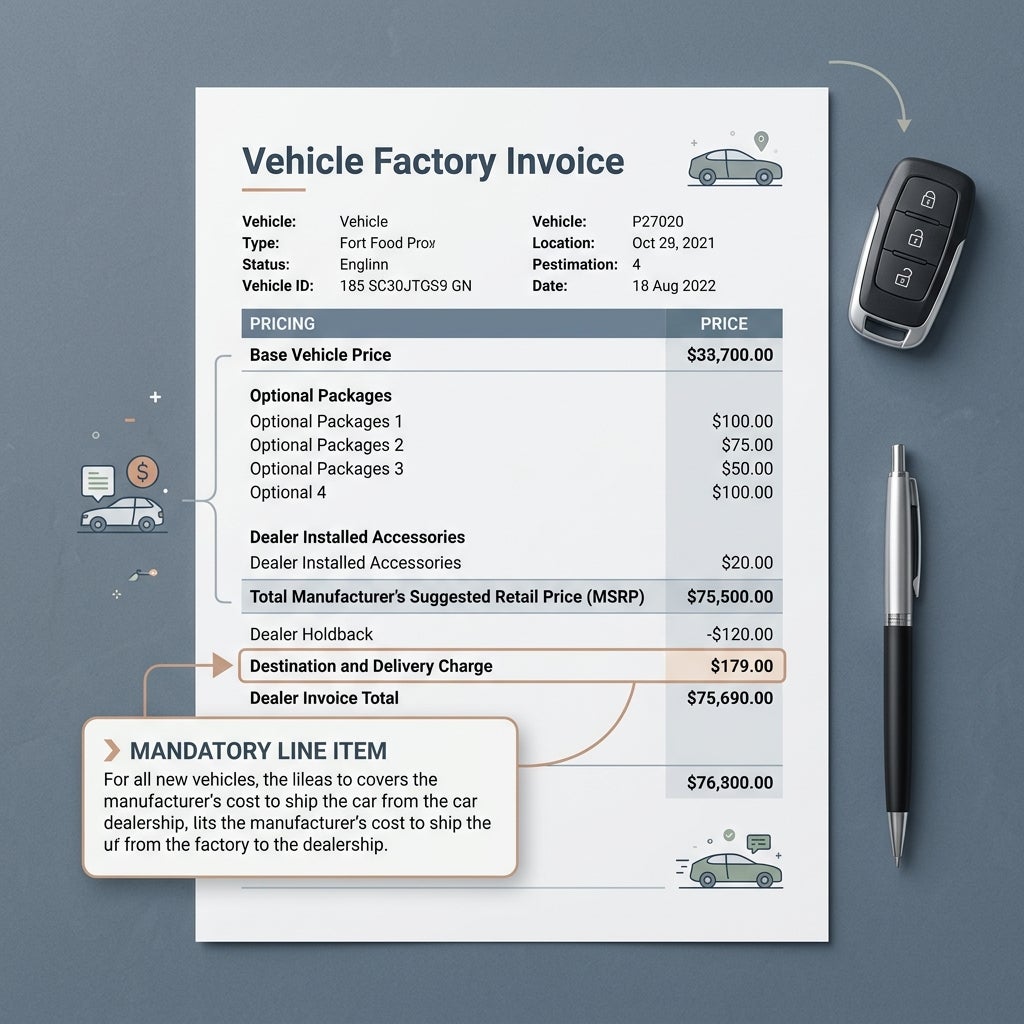
A car invoice document explaining the mandatory destination and delivery charge line item next to a car key and pen. (Representative image for illustration purposes only. Actual vehicle may vary based on trim and configuration.)

What Does the Factory Invoice Price Include?

.hrizn-visual-root a { color: #566BA1; } .hrizn-visual-root a { color: inherit; } .hrizn-visual-root p { margin: 0 0 1em; } .hrizn-visual-root p:last-child { margin-bottom: 0; } @media (max-width: 640px) { .hrizn-visual-root { text-align: center !important; } .hrizn-visual-root a { display: block; width: 100%; max-width: 320px; margin-left: auto; margin-right: auto; box-sizing: border-box; } .hrizn-visual-root + a { margin-top: 8px; } } @media (max-width: 640px) { #hrizn-cols-1 { flex-direction: column !important; align-items: stretch !important; } #hrizn-cols-1 > .hrizn-col { flex: 1 1 100% !important; width: 100% !important; } } @media (max-width: 640px) { #hrizn-cols-2 { flex-direction: column !important; align-items: stretch !important; } #hrizn-cols-2 > .hrizn-col { flex: 1 1 100% !important; width: 100% !important; } } @media (max-width: 640px) { #hrizn-3cols-1 { flex-direction: column !important; align-items: stretch !important; } #hrizn-3cols-1 > .hrizn-col { flex: 1 1 100% !important; width: 100% !important; } } @media (max-width: 640px) { #hrizn-cols-3 { flex-direction: column !important; align-items: stretch !important; } #hrizn-cols-3 > .hrizn-col { flex: 1 1 100% !important; width: 100% !important; } } @media (max-width: 640px) { #hrizn-3cols-2 { flex-direction: column !important; align-items: stretch !important; } #hrizn-3cols-2 > .hrizn-col { flex: 1 1 100% !important; width: 100% !important; } } @media (max-width: 640px) { #hrizn-cols-4 { flex-direction: column !important; align-items: stretch !important; } #hrizn-cols-4 > .hrizn-col { flex: 1 1 100% !important; width: 100% !important; } } @media (max-width: 640px) { #hrizn-3cols-3 { flex-direction: column !important; align-items: stretch !important; } #hrizn-3cols-3 > .hrizn-col { flex: 1 1 100% !important; width: 100% !important; } } @media (max-width: 640px) { #hrizn-cols-5 { flex-direction: column !important; align-items: stretch !important; } #hrizn-cols-5 > .hrizn-col { flex: 1 1 100% !important; width: 100% !important; } } #hrizn-table-tbl-10 table{width:100%;table-layout:auto;border-collapse:collapse;font-family:'Open Sans',sans-serif;font-size:0.9rem} #hrizn-table-tbl-10 th,#hrizn-table-tbl-10 td{border:1px solid #e0e4ed;padding:8px;color:#595959;word-break:break-word;overflow-wrap:break-word} #hrizn-table-tbl-10 th{background:#fafafa;color:#1a1a22;font-weight:700;font-size:14px;text-align:left;vertical-align:middle;padding:8px} #hrizn-table-tbl-10 tr:nth-child(even) td{background:rgba(86,107,161,0.04)} #hrizn-table-tbl-10 .tableWrapper{overflow-x:hidden} @media (max-width: 640px) { #hrizn-3cols-4 { flex-direction: column !important; align-items: stretch !important; } #hrizn-3cols-4 > .hrizn-col { flex: 1 1 100% !important; width: 100% !important; } } @media (max-width: 640px) { #hrizn-cols-6 { flex-direction: column !important; align-items: stretch !important; } #hrizn-cols-6 > .hrizn-col { flex: 1 1 100% !important; width: 100% !important; } } Does the Factory Invoice Price Include Destination and Delivery Charges? The Direct Answer Yes, unequivocally. The factory invoice issued by vehicle manufacturers—including Stellantis for Chrysler, Dodge, Jeep, and Ram vehicles—explicitly lists the destination and delivery charge (frequently categorized as freight) as a mandatory line item. This is not a fee added arbitrarily by the dealership at retail; it is a standardized wholesale cost assessed directly by the vehicle manufacturer to transport the automobile from the assembly line to the dealership lot. When analyzing automotive wholesale documentation, car buyers in Junction City, Manhattan, and across Geary County often assume that the "Factory Invoice Price" represents the base vehicle before shipping expenses. In reality, manufacturer invoicing structure treats freight as an integral component of the total wholesale invoice baseline. Every authorized dealer across the continental United States pays the exact same destination fee for a specific trim and model, regardless of whether the dealership is located ten miles or two thousand miles from the assembly plant. Understanding this foundational line item is essential for evaluating vehicle quotes and dealer pricing claims. Because the factory destination charge is already baked into the total invoice figure provided by the OEM, any attempt by a seller to add a secondary "dealer destination fee" on top of an invoice-based quote represents a duplicate charge. At Valor CDJR, line-item clarity is paramount. By breaking down the exact mechanics of manufacturer freight assessment, wholesale pricing architecture, and local market dynamics, this guide provides complete transparency into what vehicle invoice numbers truly represent. 36 Years Behind the Desk: Dustin Zeck on Auto Pricing Transparency Hello, I am Dustin Zeck, Dealer Principal at Valor CDJR. Over my 36 years in automotive retail, I have sat across the desk from thousands of car buyers—from first-time military buyers stationed at Fort Riley to generational farm families in Riley and Geary counties. During my nearly four decades managing dealership operations, I have witnessed the evolution of automotive pricing from closed-door paper catalogs to the hyper-transparent digital ecosystem we operate in today. One constant throughout my career is that confusion surrounding wholesale terminology—such as factory invoice, destination fees, holdback, and dealer cash—causes unnecessary friction for vehicle buyers. Consumers often arrive with online printouts believing invoice price represents our absolute rock-bottom cost. Others suspect destination fees are hidden dealer profit margins. Both assumptions stem from a lack of clear industry communication. My philosophy at Valor CDJR is simple: an informed buyer is our best customer. If you have questions about how a specific invoice is calculated or want to review line-item pricing on any truck or SUV on our lot, feel free to Call us at (785) 238-5114 directly. Let's peel back the curtain and examine how factory pricing actually functions. Expert Insights: Why Invoice Pricing Isn't the Whole Story "Treating the factory invoice as the dealership's absolute true bottom line is one of the most common misconceptions in modern car buying," explains Dustin Zeck. "Twenty or thirty years ago, buying a car at 'invoice price' meant the dealer was breaking even on the wholesale transaction. Today, manufacturer financial structures involve complex backend allowances, quarterly volume targets, and floorplan assistance that shift the dealership's true accounting baseline well below the published invoice total." However, the inverse is equally true: landed expenses, regional advertising levies, and pre-delivery conditioning can raise a vehicle's wholesale operational cost above the base invoice figure. The psychological shift for consumers lies in recognizing that the factory invoice is an standardized accounting document between the manufacturer (OEM) and the franchise dealer—it is not an itemized retail receipt. Understanding where destination charges live within that wholesale calculation is the first crucial step toward mastering vehicle negotiations. When manufacturers issue an invoice to Valor CDJR, every single option code, trim package, floor mat set, and transportation fee is coded and tallied. The bottom-line invoice figure includes the destination charge automatically. Therefore, when negotiating a deal phrased as '$100 below invoice' or '$500 over invoice,' both buyer and seller are operating off a baseline that ALREADY accounts for bringing the vehicle from the assembly plant to Junction City, Kansas. How Destination and Freight Charges Appear on a Manufacturer Invoice On a physical manufacturer invoice—whether for a Ram 1500 built in Sterling Heights, Michigan or a Jeep Wrangler assembled in Toledo, Ohio—the document is structured in two parallel columns: Wholesale Invoice (Dealer Cost) and Monroney MSRP (Suggested Retail Price). Destination charges appear prominently across both columns. Under federal law (the Automobile Information Disclosure Act of 1958), manufacturers must list equalized freight charges. Equalization means the OEM averages logistics costs across all nationwide shipments. A dealership in Junction City, Kansas pays the exact same destination fee as a dealer located next door to the assembly plant. You can examine current model pricing directly through our New Vehicle Listings to see window sticker breakdowns. Crucially, the destination amount listed in the Wholesale column is virtually identical to the destination amount listed on the retail window sticker. The dealership does not receive a wholesale discount on shipping charges; we pay the factory full price for logistics. Browse New Inventory What Is the Difference Between Dealer Cost and Factory Invoice? To understand automotive pricing, shoppers must distinguish between the published factory invoice and true net dealer cost. While the factory invoice is a fixed baseline document, several financial mechanisms alter what the dealer ultimately pays the manufacturer over time. 1. Dealer Holdback Holdback is a OEM financial credit—typically 2% to 3% of the MSRP or Base Invoice—returned to the dealership quarterly. It assists dealers in offsetting floorplan financing interest and overhead operational costs. 2. Floorplan & Allowances Manufacturers offer wholesale assistance credits for inventory holding costs, rapid turn incentives, and volume bonuses when monthly quotas are achieved. These credits lower true net cost behind the scenes. 3. Baseline vs. Net Cost Because holdback and volume incentives are contingent on performance and timeline, the invoice remains the standardized starting baseline. If you are trading in a vehicle toward your purchase, check your Trade In Evaluation to see how equity applies. Why Landed Cost Is Often Significantly Higher Than the Factory Invoice Quote While factory incentives reduce true dealer cost below invoice, regional operational expenses increase what is known as the dealership's Landed Cost. Landed cost represents the total capital invested in putting a specific vehicle on the showroom floor ready for delivery in Junction City. Primary factors elevating Landed Cost above basic factory invoice include: • Regional Advertising Association (TDA) Fees: OEM-mandated regional marketing contributions added directly to wholesale billing. • Dealer Inspection & Pre-Delivery Conditioning (PDI): Uncrating, safety inspections, fluid top-offs, software updates, and detailing. • Local Inventory Transit & Handling: Fuel charges, secondary transport from rail yards in Kansas City or Topeka, and vehicle storage protection. Understanding landed cost prevents confusion when evaluating transparent quotes across Manhattan, Fort Riley, and Junction City dealers. What Is the Difference Between Dealer Cash and Customer Rebates? Dealer Cash (Incentives) Dealer cash consists of unadvertised factory-to-dealer financial incentives. The manufacturer pays these dollars to the dealership to help move specific slow-selling models or trim levels without changing public MSRPs. Customer Rebates Customer rebates are public factory incentives applied directly to reduce the retail transaction price at checkout (or taken as cash back). Before structuring your deal, Get Pre-Approved to see available APR bonuses. Stacking & Deal Structure Dealer cash reduces the internal wholesale threshold, allowing competitive pricing. Customer rebates reduce the retail figure *after* price negotiations are complete. Get Pre-Approved Online What Does '$50 Over Factory Invoice Pricing' Really Mean for Buyers? Advertisements promoting deals like "$50 Over Invoice" or "Buy at Factory Invoice Price" are compelling, but buyers must examine how the entire transaction is constructed. In reality, a deal quoted at $50 over invoice can vary significantly between dealerships based on fee structures. When a dealer sells a vehicle for $50 over factory invoice, the immediate front-end profit on the vehicle body is exactly $50. However, the dealership retains the manufacturer holdback (typically $1,000 to $1,800 depending on total vehicle MSRP) and earns financial reserve if the buyer finances through dealership lender networks. Beware of dealers who advertise "$50 Over Invoice" only to add mandatory administrative documentation fees of $800+, forced protection packages, or re-adding destination charges. At Valor CDJR, an invoice-based quote is straightforward—no hidden re-additions or deceptive fees. Understanding the Difference Between Markup and Margin in Car Pricing Wholesale Markup % Markup is calculated as profit divided by wholesale invoice cost. If an invoice is $50,000 and selling price is $52,000, profit is $2,000. Expressed as markup on cost: $2,000 / $50,000 = 4.0%. Retail Margin % Margin is calculated as profit divided by final retail selling price. Using the same transaction ($2,000 profit / $52,000 retail price), profit margin equals 3.84%. Commercial buyers viewing our Commercial Vehicle Inventory rely heavily on these exact calculations. Commercial Clarity Automotive retail operates on slim margins—often between 2% and 5% total gross margin on new vehicles. Distinguishing markup from margin helps buyers evaluate commercial-grade fleet quotes accurately. Does Out-the-Door Price Match the Selling Price Over Invoice? No. The agreed selling price (e.g., $100 over factory invoice) is merely one line item in calculating the final Out-the-Door (OTD) Price. Buyers must account for statutory government taxes, mandatory state registration fees, and dealer documentation fees. For residents in Junction City, Geary County, or nearby Manhattan, KS, the OTD calculation follows this exact formula: • Negotiated Vehicle Selling Price (e.g. Invoice + $50) • Kansas State Sales Tax + Local Municipal/County Taxes • Title, Registration, and License Plate Fees • Dealer Documentation Fee • Minus Customer Factory Rebates and Trade-in Tax Credits. Visit our showroom in person— Get Directions to Valor CDJR —to receive an exact itemized OTD quote sheet for any vehicle. Component Sample Quote Basis Factory Invoice (inc. Freight) $45,200 Agreed Selling Price (+ $50) $45,250 KS State & Local Sales Tax (Est.) $3,393 Doc Fee & Registration $495 Customer Rebate Credit -$2,000 Final Out-the-Door (OTD) $47,138 Trade In Evaluation Are Near-Invoice Deals Harder to Get on Brand-New Future Model Years? Supply & Demand Dynamics When a brand-new model year or redesign launches, market demand outpaces factory production. During early release cycles, factory discounts and dealer cash incentives are minimal or non-existent. Initial Production Allocation Dealerships receive limited allocation during initial production runs. Because inventory holding times are near zero, dealers do not face floorplan interest pressure, making invoice pricing less common initially. Military & Local Buyers For Fort Riley military members and regional drivers, special OEM order programs or factory pre-orders can secure competitive pricing. Maintaining your current vehicle via our Service Scheduler or utilizing our Express Lane while waiting for new model allocations is a practical strategy. How to Use Valor CDJR's Digital Tools to Calculate Your Real Cost At Valor CDJR, we equip our customers with digital suite tools to analyze true vehicle costs from the comfort of home. You do not need to sit in a showroom for hours to get transparent figures. Follow these practical steps on our website: 1. Browse our real-time online inventory for new or Used Vehicle Listings. 2. Click 'View Factory Pricing' or request the OEM invoice sheet for any in-stock model. 3. Utilize our instant trade appraisal engine to calculate net trade-in equity. 4. Apply active regional customer rebates and current finance options. By leveraging these digital resources, shoppers across Junction City and Manhattan arrive with complete clarity regarding invoice baselines, destination charges, and final landed price. Get Straight Answers and Transparent Vehicle Quotes at Valor CDJR To summarize: Yes, factory invoice pricing ALWAYS includes factory destination and delivery charges. It is an OEM-mandated standardized fee that dealers pay to transport vehicles from manufacturing plants to our dealership in Junction City. With 36 years of automotive experience, Dealer Principal Dustin Zeck and the entire team at Valor CDJR are committed to straightforward, line-item transparency. Whether you are inquiring about invoice breakdowns, holdback, factory rebates, or out-the-door pricing, we are here to provide clear answers. Need genuine factory parts or accessories? Check out our dedicated Parts Department online or visit us today. Explore Commercial & New Inventory

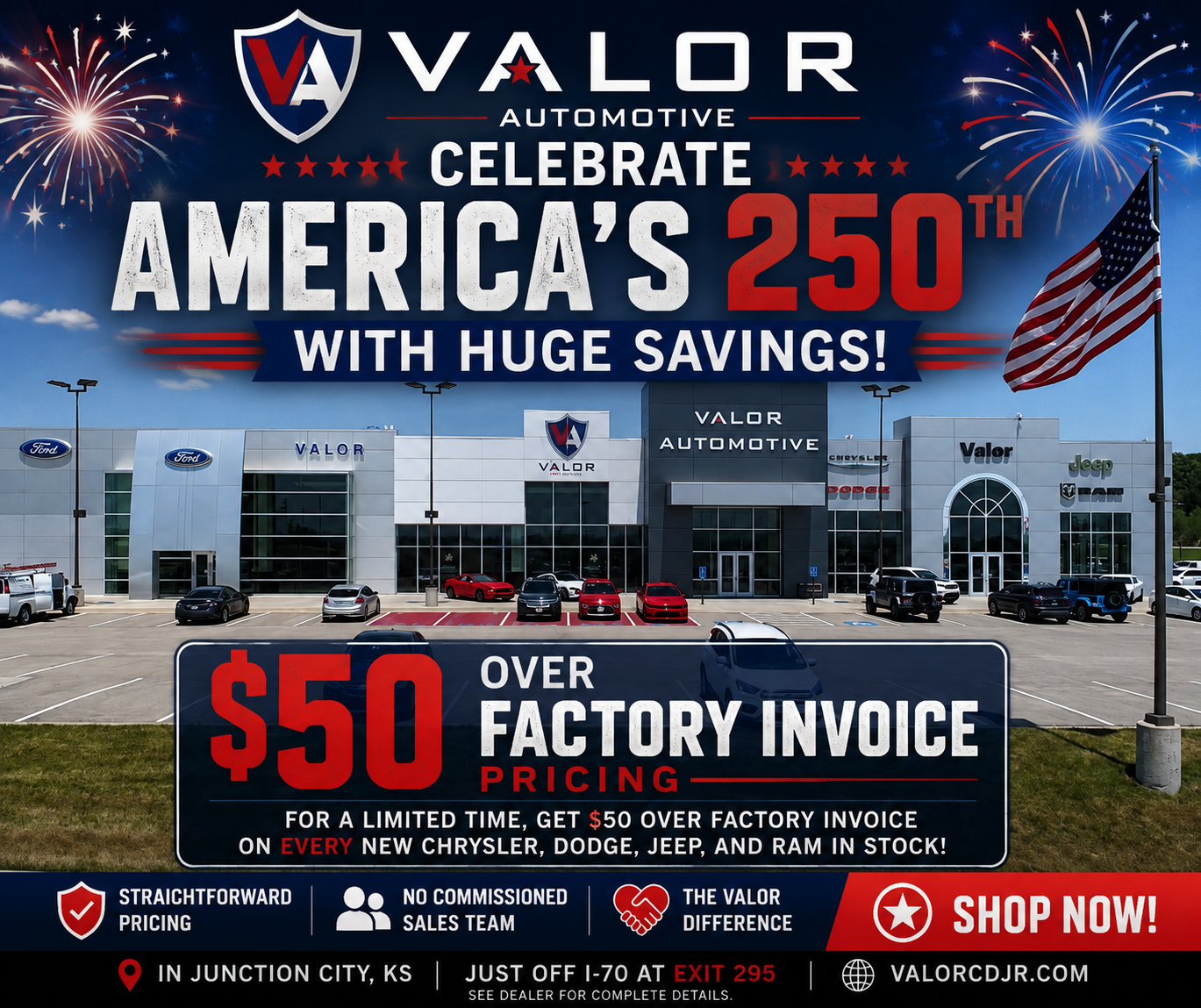
Save Big on $50 Over Invoice Purchases

.hrizn-visual-root a { color: #566BA1; } .hrizn-visual-root a { color: inherit; } .hrizn-visual-root p { margin: 0 0 1em; } .hrizn-visual-root p:last-child { margin-bottom: 0; } @media (max-width: 640px) { .hrizn-visual-root { text-align: center !important; } .hrizn-visual-root a { display: block; width: 100%; max-width: 320px; margin-left: auto; margin-right: auto; box-sizing: border-box; } .hrizn-visual-root + a { margin-top: 8px; } } @media (max-width: 640px) { #hrizn-cols-1 { flex-direction: column !important; align-items: stretch !important; } #hrizn-cols-1 > .hrizn-col { flex: 1 1 100% !important; width: 100% !important; } } @media (max-width: 640px) { #hrizn-3cols-1 { flex-direction: column !important; align-items: stretch !important; } #hrizn-3cols-1 > .hrizn-col { flex: 1 1 100% !important; width: 100% !important; } } @media (max-width: 640px) { #hrizn-cols-2 { flex-direction: column !important; align-items: stretch !important; } #hrizn-cols-2 > .hrizn-col { flex: 1 1 100% !important; width: 100% !important; } } #hrizn-table-tbl-5 table{width:100%;table-layout:auto;border-collapse:collapse;font-family:'Open Sans',sans-serif;font-size:0.9rem} #hrizn-table-tbl-5 th,#hrizn-table-tbl-5 td{border:1px solid #e0e4ed;padding:8px;color:#595959;word-break:break-word;overflow-wrap:break-word} #hrizn-table-tbl-5 th{background:#f5f5f5;color:#1a1a22;font-weight:700;font-size:14px;text-align:left;vertical-align:middle;padding:8px} #hrizn-table-tbl-5 tr:nth-child(even) td{background:rgba(86,107,161,0.04)} #hrizn-table-tbl-5 .tableWrapper{overflow-x:hidden} @media (max-width: 640px) { #hrizn-cols-3 { flex-direction: column !important; align-items: stretch !important; } #hrizn-cols-3 > .hrizn-col { flex: 1 1 100% !important; width: 100% !important; } } @media (max-width: 640px) { #hrizn-3cols-2 { flex-direction: column !important; align-items: stretch !important; } #hrizn-3cols-2 > .hrizn-col { flex: 1 1 100% !important; width: 100% !important; } } @media (max-width: 640px) { #hrizn-cols-4 { flex-direction: column !important; align-items: stretch !important; } #hrizn-cols-4 > .hrizn-col { flex: 1 1 100% !important; width: 100% !important; } } @media (max-width: 640px) { #hrizn-3cols-3 { flex-direction: column !important; align-items: stretch !important; } #hrizn-3cols-3 > .hrizn-col { flex: 1 1 100% !important; width: 100% !important; } } @media (max-width: 640px) { #hrizn-3cols-4 { flex-direction: column !important; align-items: stretch !important; } #hrizn-3cols-4 > .hrizn-col { flex: 1 1 100% !important; width: 100% !important; } } @media (max-width: 640px) { #hrizn-cols-5 { flex-direction: column !important; align-items: stretch !important; } #hrizn-cols-5 > .hrizn-col { flex: 1 1 100% !important; width: 100% !important; } } Save Big on $50 Over Invoice Pricing at Valor! What Does $50 Over Factory Invoice Pricing Actually Mean for Your Total Cost? To understand the true mechanics of $50 over factory invoice pricing, one must distinguish between top-down pricing (MSRP discounts) and bottom-up pricing (building up from wholesale dealer cost). The MSRP—Manufacturer's Suggested Retail Price—is the sticker price posted on the window. Factory invoice, on the other hand, represents the baseline cost charged by the manufacturer to the dealership for the specific vehicle build. When a dealership agrees to $50 over factory invoice, the starting baseline sale price (Vehicle Selling Price line item) on your contract should equal the total invoice amount listed on the official OEM invoice sheet plus exactly $50.00. This calculation occurs before applying government taxes, state licensing fees, and applicable customer rebates. It is crucial to remember that $50 over invoice is not necessarily your final 'out-of-the-door' price. Out-of-door price includes state and county sales taxes, motor vehicle registration/title fees, and dealer documentation fees. However, by establishing a firm, verified selling price at $50 above factory invoice, you eliminate inflated retail markups. Whether you are shopping for a heavy-duty truck or an efficient sedan, establishing an unassailable baseline gives you complete financial clarity during negotiations across Geary and Riley counties. What Is Included on an Official Car Factory Invoice Sheet? Base Wholesale & Options The top lines of an authentic manufacturer invoice list the base model wholesale price alongside factory-installed options and packages. Each package (such as leather interior, tow packages, or advanced safety tech) has both an MSRP cost and a lower invoice cost. Verify that option codes match the window sticker exactly. Destination & Freight Destination or transportation charges are set by the manufacturer to ship the vehicle from assembly plant to dealership. Freight charges are identical on both MSRP and invoice sheets. Pay close attention to ensure the contract does not add a second 'dealer freight' charge on top of factory destination. Regional Ad & Holdback Official invoices often include legitimate regional advertising association fees (such as FDAF or TDA fees mandatory for local dealer groups). In addition, factory invoices display the dealer holdback amount and wholesale financial codes used internally by the manufacturer. Can a Buyer Request to View the Actual Factory Invoice Document? Yes, absolutely. A reputable dealership offering invoice-based pricing will readily share a copy of the official OEM factory invoice sheet. In fact, requesting to view the document is standard practice when verifying a $50 over invoice arrangement. When reviewing the document, look for official manufacturer logos, specific vehicle identification numbers (VIN), vehicle order tracking numbers, and distinct columns showing 'MSRP' alongside 'Invoice'. Beware of internal computerized dealer quote sheets that mimic the layout of a factory invoice but are generated internally. At Valor CDJR, transparency is paramount. Whether you are reviewing New Vehicle Listings or visiting our showroom in Junction City, our team provides real factory documentation so you can audit every dollar with complete confidence. Explore New Inventory Offers How Documentation Fees and Dealer Add-ons Can Alter a $50 Over Invoice Deal The most common pitfall in invoice-based car buying involves backend administrative fees and dealer add-ons. You might successfully negotiate the selling price to $50 over invoice, only to find $1,200 in unexpected line items added to the final contract. Understanding these charges is essential to protecting your savings. Paperwork Line Item Legitimate vs. Red Flag What to Check On Your Contract Dealer Documentation Fee Legitimate within reasonable limits Ensure doc fee is stated upfront and not inflated post-negotiation. Dealer Protection Packages Red Flag if forced/unwanted Verify tint, fabric guard, or nitrogen fills are optional, not mandatory. Destination / Freight Charge Legitimate when matching OEM invoice Ensure destination fee isn't listed twice (once on invoice, once as dealer charge). VIN Etching / Theft Protection Red Flag if auto-added Check for pre-printed add-on lines and request removal if unrequested. If you notice mandatory add-on fees on your contract, ask for them to be removed or credited back. A true $50 over factory invoice offer remains clean and transparent without artificial padding. How Factory Incentives and Customer Rebates Apply to Invoice Pricing A frequent point of confusion is whether factory rebates are included in the $50 over invoice price or applied on top of it. In proper car purchase accounting, customer rebates are funded directly by the vehicle manufacturer, not the dealership. Therefore, rebates apply after establishing the agreed vehicle purchase price. For example, if factory invoice is $40,000 and you negotiate $50 over invoice, your starting sale price is $40,050. If the manufacturer offers $2,500 in consumer cash rebates, that rebate may be applied separately according to program rules and before taxes and state fees. The dealership still receives reimbursement from the factory for that $2,500 rebate. Special targeted incentives—such as military discounts, college graduate rebates, or trade-in assistance programs—should also reduce your out-of-pocket obligation line by line. Be sure to audit your rebate eligibility with our finance specialists. Ready to discuss financing options with rebate savings? You can easily Get Pre-Approved online to contact the dealership for current financing terms. What Is Dealer Holdback and How Does It Impact Invoice Pricing? Definition of Holdback Dealer holdback is a financial allowance paid by the automaker to the dealer after a vehicle is sold. It typically ranges between 2% and 3% of either the total MSRP or total invoice amount, depending on the manufacturer brand. Why Dealers Offer It Because holdback provides backend revenue to offset inventory floor plan expenses, a dealership can sell a vehicle at or near factory invoice while remaining financially viable and sustaining daily dealership operations. Contract Accounting Holdback is an internal factory accounting line item and is rarely deducted directly on consumer purchase agreements. However, understanding holdback gives buyers peace of mind that $50 over invoice is a fair, sustainable business model. Is It Better to Negotiate Off MSRP or Off Factory Invoice When Looking for Value? Top-down negotiation involves taking the window sticker price (MSRP) and asking for arbitrary dollar amounts or percentages off. While common, top-down negotiating can lead to confusion when comparing different vehicle trims, factory options, or competing dealer offers. Bottom-up negotiation starting from factory invoice provides an objective financial anchor. Because factory invoice directly reflects manufacturer wholesale baseline numbers, negotiating $50 above invoice creates absolute consistency across diverse inventory choices. Whether you are trading in a vehicle or buying outright, invoice-based clarity simplifies every aspect of the transaction. You can instantly test vehicle trade values using our online Trade In Evaluation tool before finalizing contract numbers. Value Your Current Vehicle Does Factory Invoice Pricing Vary From Dealer to Dealer? For two identical vehicles with the exact same equipment, options, and trim levels, the base factory invoice price issued by the manufacturer is completely identical across dealerships nationwide. A Ram 1500 or Jeep Grand Cherokee ordered with identical package codes will have the exact same wholesale factory invoice sheet whether delivered in Kansas or elsewhere. However, minor invoice differences can arise due to regional destination adjustments or factory price updates during mid-model-year production shifts. When comparing offers across local dealerships in Junction City, Manhattan, or Salina, inspecting the physical invoice sheet confirms whether you are looking at true identical vehicle specs. Line-by-Line Paperwork Audit Checklist Before Signing Your Contract Step 1: Match Invoice Baseline Compare the top line item of the contract ('Vehicle Selling Price') against the OEM factory invoice sheet. Ensure it equals the invoice total plus exactly $50 before any additions. Step 2: Audit Destination Charge Confirm that factory destination and delivery charges are included in the invoice total, not listed a second time on the buyer's order as a separate line item. Step 3: Review Documentation Fees Verify that the dealer doc fee matches what was disclosed during negotiations and is clearly itemized without unexpected administrative surcharge additions. Step 4: Confirm Rebate Credits Ensure all consumer cash rebates, bonus cash, or military incentives are subtracted below the vehicle purchase price line, reducing total tax burden where applicable. Step 5: Check Trade Allowance Verify your agreed trade-in value is accurately entered along with remaining loan payoff figures, ensuring correct tax credit application in Kansas. Step 6: Remove Mandatory Add-Ons Check for dealer accessories, tire protection, or window etch fees. Ensure optional protection plans are included only if specifically requested by you. How Invoice Pricing Compares to Market Evaluation Pricing Tools Third-party valuation platforms like Kelley Blue Book (Fair Purchase Price) and Edmunds (True Market Value) aggregate local transaction data to report average regional vehicle sale prices. Comparing these metrics against a $50 over invoice offer gives shoppers immediate context. In most competitive vehicle markets across Flint Hills, negotiating a new vehicle at $50 over invoice lands well below the median market price reported by third-party tools. This confirms you are receiving a top-tier price without drawn-out negotiations. Why $50 Over Invoice Is Considered Fair for Buyers and Dealers in Junction City A transparent $50 over factory invoice pricing structure represents a true win-win model for military service members, university personnel, and families near Fort Riley and Junction City. For buyers, it delivers complete pricing certainty and eliminates stressful hours spent haggling over retail margins. For dealerships, it builds long-term community trust and supports sustainable business operations through steady transaction volume. Whether you are looking for dependable work vehicles from our Commercial Vehicle Inventory or seeking a personal vehicle, straightforward invoice-based pricing guarantees equal financial respect for every customer. Browse Commercial Vehicles Review Transparent Invoice Pricing and Plan Your Visit to Valor CDJR If you are ready to experience a modern, transparent vehicle purchase, our dedicated team at Valor CDJR is here to assist. We invite you to review our transparent invoice offers, browse our quality pre-owned selection in Used Vehicle Listings, or stop by our Quick-Service Express Lane for quick vehicle care. Need maintenance support or genuine OEM components for your current vehicle? Easily schedule service with our Service Scheduler or order replacement parts through our Parts Department. Conveniently located in Junction City, KS— Get Directions to Valor CDJR or Call us at (785) 238-5114 today to schedule your VIP consultation. Schedule Your Visit Today

Contact Us

Fill out this form below and we'll contact you shortly
*Required Fields