




Blog / Dealership Sales Strategies

Blog

All Dealership Sales Strategies Buying Guides New Vehicle Reviews Maintenance & Service Technology & Innovation Financing & Insurance Model Comparisons New Vehicle Inventory Safety Features Used Vehicle Guides Valor CDJR Trade in Advice Towing & Hauling Safety Family & Lifestyle Vehicles Vehicle Financing & Trade-In Tips KS Community Parts & Accessories Junction City Military & Veteran Benefits Automotive Repair Buying Guides & Dealership Services Financing & Trade-In Options Seasonal Vehicle Care Service Military Vehicle Buying Guides Off-Road & Adventure Vehicles Vehicle Ownership Care Hybrid & Electric Vehicles Parts Performance & Powertrain Automotive Recalls Commercial Truck Reviews Dealership Inventory Highlights Dealership Visit Preparation Heavy-Duty Truck Features Inventory & Pricing Insights Jeep Lifestyle & Accessories Military & Community Car Buying Programs Repair & Diagnostics Vehicle Features & Accessories Vehicle Maintenance & Preparation Vehicle Pricing Strategies Vehicle Safety & Compliance Vehicle Trade-In Tips Warranty & Coverage Automotive News Car Buying Tips Car Purchase Tips Dealer Profiles & Interviews Dealership Offers & Promotions Dealership Service Experience Financing & Insurance for Military Families Genuine Parts & Accessories Local Automotive Events OEM Parts & Warranty Coverage Pre-Owned Vehicle Sales Road Trip & Travel Tips Special Offers & Promotions Tailgating & Outdoor Adventures Tailgating & Outdoor Recreation Towing & Roadside Assistance Vehicle Registration & Legal Advice for Military Personnel Vehicle Repair & Diagnostics Vehicle Sales Experience Warranty & Protection Plans Brake System Care Certified Pre-Owned Programs Commercial Fleet Management Commercial Vehicle Comparisons Community & Military Support Initiatives Dealership Events Engine & Performance Insights Luxury SUVs Out-of-State Purchasing Guides Part & Warranty Services Parts & Repair Reimbursement Recall & Warranty Repairs Seasonal Sales Events Technology & Innovation in Vehicle Service Vehicle Incentives & Promotions Vehicle Maintenance & Winter Care Vehicle Technology & Features Weekend Dealership Events and Services
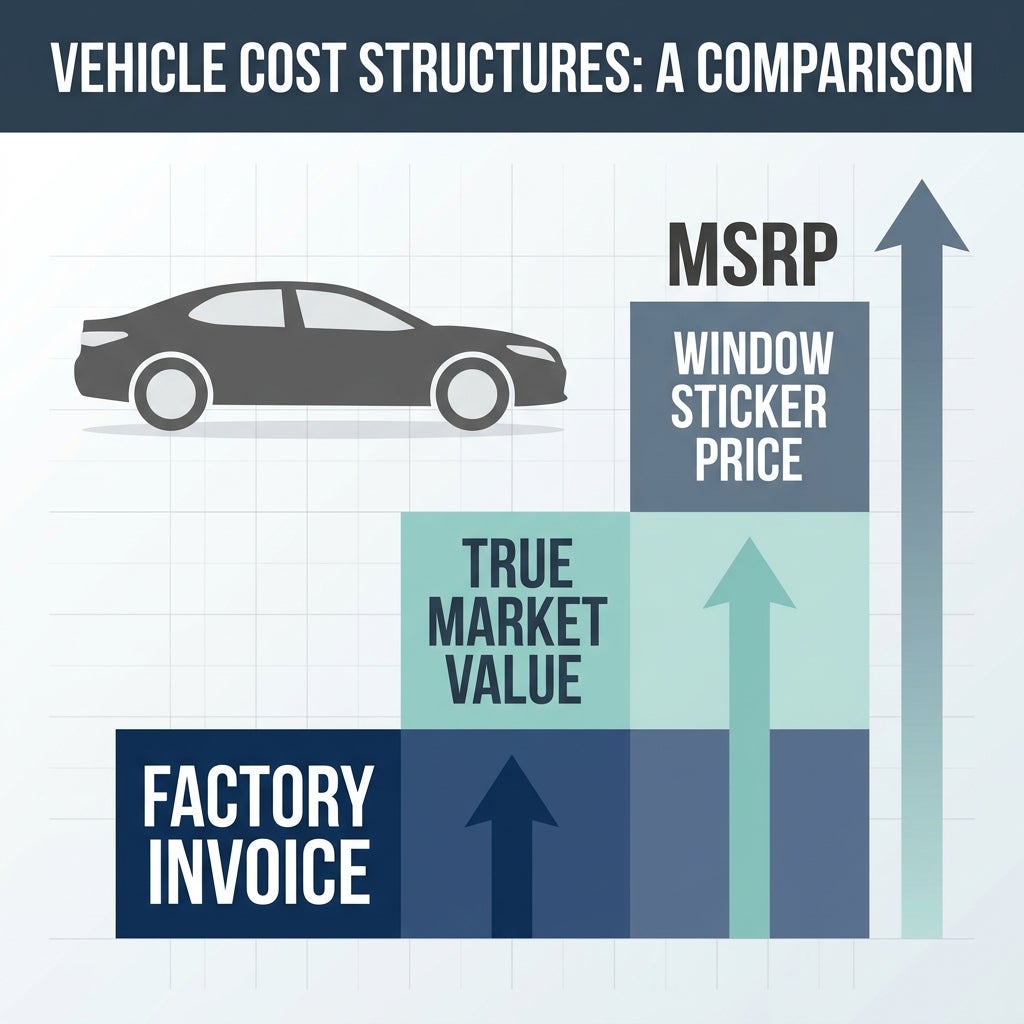
Infographic comparing vehicle pricing structures: Factory Invoice, True Market Value, and MSRP Window Sticker Price. (Representative image for illustration purposes only. Actual vehicle may vary based on trim and configuration.)

Is Factory Invoice Price Lower Than True Market Value? The Direct Answer for Buyers

.hrizn-visual-root a { color: #566BA1; } .hrizn-visual-root a { color: inherit; } .hrizn-visual-root p { margin: 0 0 1em; } .hrizn-visual-root p:last-child { margin-bottom: 0; } @media (max-width: 640px) { .hrizn-visual-root { text-align: center !important; } .hrizn-visual-root a { display: block; width: 100%; max-width: 320px; margin-left: auto; margin-right: auto; box-sizing: border-box; } .hrizn-visual-root + a { margin-top: 8px; } } @media (max-width: 640px) { #hrizn-3cols-1 { flex-direction: column !important; align-items: stretch !important; } #hrizn-3cols-1 > .hrizn-col { flex: 1 1 100% !important; width: 100% !important; } } @media (max-width: 640px) { #hrizn-cols-1 { flex-direction: column !important; align-items: stretch !important; } #hrizn-cols-1 > .hrizn-col { flex: 1 1 100% !important; width: 100% !important; } } @media (max-width: 640px) { #hrizn-cols-2 { flex-direction: column !important; align-items: stretch !important; } #hrizn-cols-2 > .hrizn-col { flex: 1 1 100% !important; width: 100% !important; } } #hrizn-table-tbl-sec5 table{width:100%;table-layout:auto;border-collapse:collapse;font-family:'Open Sans',sans-serif;font-size:0.9rem} #hrizn-table-tbl-sec5 th,#hrizn-table-tbl-sec5 td{border:1px solid #e0e4ed;padding:8px;color:#595959;word-break:break-word;overflow-wrap:break-word} #hrizn-table-tbl-sec5 th{background:#f0f4fa;color:#1a1a22;font-weight:700;font-size:14px;text-align:left;vertical-align:middle;padding:10px} #hrizn-table-tbl-sec5 tr:nth-child(even) td{background:rgba(86,107,161,0.04)} #hrizn-table-tbl-sec5 .tableWrapper{overflow-x:hidden} @media (max-width: 640px) { #hrizn-3cols-2 { flex-direction: column !important; align-items: stretch !important; } #hrizn-3cols-2 > .hrizn-col { flex: 1 1 100% !important; width: 100% !important; } } @media (max-width: 640px) { #hrizn-cols-3 { flex-direction: column !important; align-items: stretch !important; } #hrizn-cols-3 > .hrizn-col { flex: 1 1 100% !important; width: 100% !important; } } @media (max-width: 640px) { #hrizn-cols-4 { flex-direction: column !important; align-items: stretch !important; } #hrizn-cols-4 > .hrizn-col { flex: 1 1 100% !important; width: 100% !important; } } @media (max-width: 640px) { #hrizn-3cols-3 { flex-direction: column !important; align-items: stretch !important; } #hrizn-3cols-3 > .hrizn-col { flex: 1 1 100% !important; width: 100% !important; } } @media (max-width: 640px) { #hrizn-cols-5 { flex-direction: column !important; align-items: stretch !important; } #hrizn-cols-5 > .hrizn-col { flex: 1 1 100% !important; width: 100% !important; } } #hrizn-table-tbl-sec11 table{width:100%;table-layout:auto;border-collapse:collapse;font-family:'Open Sans',sans-serif;font-size:0.9rem} #hrizn-table-tbl-sec11 th,#hrizn-table-tbl-sec11 td{border:1px solid #e0e4ed;padding:8px;color:#595959;word-break:break-word;overflow-wrap:break-word} #hrizn-table-tbl-sec11 th{background:#f0f4fa;color:#1a1a22;font-weight:700;font-size:14px;text-align:left;vertical-align:middle;padding:10px} #hrizn-table-tbl-sec11 tr:nth-child(even) td{background:rgba(86,107,161,0.04)} #hrizn-table-tbl-sec11 .tableWrapper{overflow-x:hidden} Is Factory Invoice Price Lower Than True Market Value? The Direct Answer for Buyers The direct answer is yes — under typical market conditions, factory invoice price is generally lower than True Market Value (TMV) and Manufacturer's Suggested Retail Price (MSRP). However, car buying in today's economy is rarely one-size-fits-all. True Market Value is a fluid metric driven dynamically by regional supply, localized demand, and vehicle availability. During periods of tight inventory or high demand for specific trucks and SUVs in Kansas, TMV can equal or even surpass MSRP. Conversely, during year-end clearance events, high-inventory quarters, or aggressive manufacturer incentive pushes, True Market Value can drop down to match—or even dip below—factory invoice. Understanding where factory invoice sits relative to True Market Value is your single most effective tool as a shopper. Factory invoice represents the initial wholesale charge billed by the vehicle manufacturer to the dealership on paper. True Market Value represents what actual buyers in your area are currently paying out-the-door for that exact trim level and feature configuration. When you know both numbers, you transform from a passive customer into an informed, confident car buyer. Understanding the Technical Differences Between Invoice Price, MSRP, and True Market Value Factory Invoice Price The baseline dollar figure listed on the manufacturer's invoice document to the dealership. It includes the base model cost, factory-installed options, and destination charges. While it reflects the initial wholesale transaction, it does not factor in hidden factory subsidies, performance bonuses, or holdbacks that lower the dealer's final net cost. MSRP (Window Sticker) The Manufacturer's Suggested Retail Price, visible on the official Monroney sticker affixed to the side window. It is set uniformly across the nation by the automaker and acts as the recommended retail ceiling. MSRP serves as the starting point for consumer retail pricing before discounts, incentives, or trade credits. True Market Value (TMV) Also known as Fair Purchase Price, TMV calculates the real-time average purchase price paid by customers in a specific geographic area for a specific vehicle. Calculated by aggregating thousands of recent sales transactions, TMV dynamically adjusts for local supply, buyer demand, and regional promotional pushes. How Does a Dealer Make Money When Selling a Car for $50 Over Invoice? It sounds almost impossible on the surface: how can a full-service dealership maintain facilities, pay certified technicians, and employ sales consultants if they sell a brand-new car for just $50 above the paper invoice price? The answer lies in the multi-tiered revenue ecosystem of automotive retail. Dealership profitability relies heavily on back-end manufacturer programs and finance operations rather than front-end vehicle markups: 1. Dealer Holdback: Automakers return a percentage (typically 2% to 3% of MSRP or total invoice) to the dealership after the sale. On a $45,000 truck, a 3% holdback generates $1,350 in profit for the dealer even if sold exactly at invoice. 2. Manufacturer Volume Bonuses: Dealerships earn substantial quarterly bonuses by hitting factory-set target thresholds. 3. Floorplan Interest Credits: Manufacturers provide interest allowances for inventory management. 4. Finance & Insurance (F&I): Back-end commissions from competitive financing rates, extended protection plans, and GAP insurance. Because high-volume dealerships benefit significantly from factory performance bonuses, selling vehicles at or near factory invoice is a sustainable, win-win sales philosophy. Is $50 Over Factory Invoice Pricing Considered a Good Deal for a New Vehicle? In virtually every vehicle segment across Kansas, securing a purchase contract structured at $50 over factory invoice represents an exceptionally favorable transaction for the buyer. Because MSRP is frequently several thousand dollars above factory invoice, buying at $50 over invoice eliminates the traditional high-margin retail markup. When evaluating a $50 over invoice offer, shoppers should consider overall market trends. On high-demand modern pickup trucks or family SUVs, MSRP or near-MSRP is common across many regions. Finding a dealer willing to transparently present factory invoice pricing plus a minimal $50 margin saves buyers substantial money upfront. To maximize total savings, pair an invoice-based purchase price with an updated Trade In Evaluation to maximize the equity from your current vehicle. Key Considerations for Invoice Pricing Deals: • Vehicle Popularity: On high-demand limited trims, invoice pricing is extremely rare. • Factory Rebates: Customer rebates apply ON TOP of invoice pricing, lowering your price even further. • Trade-In Equity: Capturing top market value for your trade-in produces maximum total out-the-door savings. • Clear Line Items: Ensure fees are transparent without hidden reconditioning charges. Value Your Trade-In Can a Vehicle Be Bought Below Factory Invoice Price? Yes, buying a vehicle below factory invoice price occurs regularly in modern automotive sales. When manufacturers offer direct consumer Cash Back Rebates or targeted military and bonus allowances, those incentives reduce the transaction price directly below invoice cost on the final bill of sale. Furthermore, when automakers offer Dealer Cash or unadvertised factory-to-dealer subsidies, dealerships can sell a vehicle below factory invoice price on paper while remaining profitable thanks to back-end factory compensation and quarterly volume targets. Pricing Level Typical Scenario Buyer Advantage MSRP Retail High demand / new release vehicles Standard retail pricing ceiling Factory Invoice Pricing Transparent volume dealership pricing Saves $1,500 - $3,500 over MSRP Below Invoice Pricing Model year clearance + active factory rebates Maximum possible consumer savings What Extra Fees Can Be Added to a $50 Over Invoice Agreement? Mandatory Factory Fees Destination & Freight Charges: Uniform transportation charges assessed by the vehicle manufacturer to ship the automobile from assembly plant to dealership. This mandatory line item appears on both invoice and window stickers. State & Administrative Documentation Fees & Taxes: Kansas state sales tax, county licensing, title, and standard dealer administrative documentation fees (doc fees). Legitimate doc fees cover title work, compliance processing, and registration filings. Optional Dealer Additions Dealer Accessories: Optional protection packages, tint, wheel locks, or floor liners. Transparent dealers list these optionally so buyers decide whether to include them in the final out-the-door agreement. How Much Do Regional Advertising Fees Cost on an Invoice? Regional advertising fees—often listed as FDAF (Ford Dealer Advertising Fund), TDA (Toyota Dealer Advertising), or regional marketing association line items—are official expenses assessed directly by the vehicle manufacturer. Typical Cost Ranges: • Fixed amounts ranging from $200 to $600 per vehicle • Percentage-based charges between 1% and 2% of the base vehicle price Because the factory bills these charges directly to the dealership on the master invoice sheet, they are genuine wholesale expenses paid by the dealer when receiving the vehicle from the factory assembly facility. Can Regional Advertising Fees Be Negotiated Out of the Invoice Price? A common point of confusion for vehicle shoppers is whether official regional advertising fees can be negotiated away or removed. Because genuine regional ad fees are printed directly on the automaker's factory invoice sheet, the dealership actually pays that exact dollar amount to the manufacturer. While a dealer cannot alter line items on a factory-issued invoice document, buyers can always negotiate the net out-the-door purchase price. When evaluating your purchase contract, focus on the total bottom-line figure rather than individual factory cost components. Browse our extensive New Vehicle Listings to compare models and see upfront, transparent pricing options. Out-the-Door Negotiation Strategy: 1. Ask to see the official factory invoice sheet. 2. Verify that the ad fee is printed directly on the manufacturer document. 3. Negotiate your selling price based on the total net out-the-door price including rebates, incentives, and dealer fees. 4. Avoid focusing on individual factory mandatory charges when total discounts exceed factory line item costs. Explore New Vehicle Listings How Can You Tell a Real Ad Fee from a Fake Dealer Markup? Step 1: Inspect Factory Paperwork Request to view the computer-printed factory invoice document. Real ad fees are embedded directly into the factory line items printed by the manufacturer prior to delivery. Step 2: Check Supplemental Stickers Examine the window addendum sticker next to the official Monroney label. If an ad fee or 'marketing charge' appears on a dealer-printed sticker, it is a dealer markup rather than a factory fee. Step 3: Verify Line Items Watch for duplicate charges. If an official ad fee already appears on the factory invoice, ensure no second 'dealer preparation fee' or 'administrative marketing fee' is added to the worksheet. Navigating New Vehicle Market Pricing in Junction City and Riley County For military families serving at Fort Riley, faculty and students in Manhattan, and long-time residents across Geary and Riley Counties, transparent auto buying is paramount. Finding a straightforward dealership near home makes all the difference when shopping for your next truck, SUV, or sedan. At Valor CDJR, located right off Goldenbelt Blvd in Junction City, KS, we believe in complete pricing transparency. Whether you are seeking factory invoice pricing, researching competitive finance rates, or seeking a trade valuation, our team is dedicated to providing clear, upfront details every step of the way. Ready to visit us? Get Directions to Valor CDJR or Call us at (785) 238-5114 to speak with a specialist today. Explore tailored financing tools before visiting: start with our online pre-approval application to get pre-approved, or review our curated Used Vehicle Listings for additional value-oriented choices. Key Checklist Before Signing an Out-the-Door Purchase Agreement Before placing your signature on a final buyer's order, complete this quick 5-point audit to ensure you are receiving maximum transparency and every savings credit available: Checklist Item Action Required What to Verify 1. Factory Invoice Review Compare worksheet against paper invoice Confirm base invoice, options, and freight match 2. Customer Rebates Audit active factory incentives Ensure all qualifying rebates are subtracted 3. Trade-In Allowance Review final trade credit Verify trade value matches evaluation quote 4. Mandatory Fees Inspect doc fee & state taxes Check that doc fees are standard and transparent 5. Out-the-Door Total Review final bottom line Ensure no duplicate or mandatory dealer add-ons Get Pre-Approved Online Experience Transparent Pricing and Value at Valor CDJR in Junction City At Valor CDJR, our commitment to our Kansas community goes far beyond standard automotive sales. We believe that empowering car buyers with full pricing clarity—explaining factory invoice, MSRP, and True Market Value—creates lifelong customer relationships built on trust. Whether you are shopping for a powerful truck for work, a family-friendly SUV, or a versatile commercial vehicle from our Commercial Vehicle Inventory, our dedicated sales team is here to answer your questions clearly without high-pressure tactics. We also support vehicle owners throughout their vehicle ownership journey. Visit our fully stocked Parts Department, utilize our online Service Scheduler for maintenance appointments, or drop by our quick-service Express Lane for quick oil changes and tire rotations. Browse New Inventory at Valor CDJR
A smiling man with a mustache in a black polo shirt, standing in front of a Valor Automotive logo backdrop.

What’s the Best Way to Compare Two Complex Car Offers That Reference Invoice or MSRP?

.hrizn-visual-root a { color: #566BA1; } .hrizn-visual-root a { color: inherit; } .hrizn-visual-root p { margin: 0 0 1em; } .hrizn-visual-root p:last-child { margin-bottom: 0; } @media (max-width: 640px) { .hrizn-visual-root { text-align: center !important; } .hrizn-visual-root a { display: block; width: 100%; max-width: 320px; margin-left: auto; margin-right: auto; box-sizing: border-box; } .hrizn-visual-root + a { margin-top: 8px; } } @media (max-width: 640px) { #hrizn-cols-1 { flex-direction: column !important; align-items: stretch !important; } #hrizn-cols-1 > .hrizn-col { flex: 1 1 100% !important; width: 100% !important; } } @media (max-width: 640px) { #hrizn-cols-2 { flex-direction: column !important; align-items: stretch !important; } #hrizn-cols-2 > .hrizn-col { flex: 1 1 100% !important; width: 100% !important; } } @media (max-width: 640px) { #hrizn-3cols-1 { flex-direction: column !important; align-items: stretch !important; } #hrizn-3cols-1 > .hrizn-col { flex: 1 1 100% !important; width: 100% !important; } } #hrizn-table-tbl-msrp-vs-invoice-sample table{width:100%;table-layout:auto;border-collapse:collapse;font-family:'Open Sans',sans-serif;font-size:0.9rem} #hrizn-table-tbl-msrp-vs-invoice-sample th,#hrizn-table-tbl-msrp-vs-invoice-sample td{border:1px solid #e0e4ed;padding:8px;color:#595959;word-break:break-word;overflow-wrap:break-word} #hrizn-table-tbl-msrp-vs-invoice-sample th{background:#1a1a22;color:#ffffff;font-weight:700;font-size:14px;text-align:left;vertical-align:middle;padding:10px} #hrizn-table-tbl-msrp-vs-invoice-sample tr:nth-child(even) td{background:rgba(86,107,161,0.04)} #hrizn-table-tbl-msrp-vs-invoice-sample .tableWrapper{overflow-x:hidden} @media (max-width: 640px) { #hrizn-cols-3 { flex-direction: column !important; align-items: stretch !important; } #hrizn-cols-3 > .hrizn-col { flex: 1 1 100% !important; width: 100% !important; } } @media (max-width: 640px) { #hrizn-3cols-2 { flex-direction: column !important; align-items: stretch !important; } #hrizn-3cols-2 > .hrizn-col { flex: 1 1 100% !important; width: 100% !important; } } @media (max-width: 640px) { #hrizn-cols-4 { flex-direction: column !important; align-items: stretch !important; } #hrizn-cols-4 > .hrizn-col { flex: 1 1 100% !important; width: 100% !important; } } @media (max-width: 640px) { #hrizn-cols-5 { flex-direction: column !important; align-items: stretch !important; } #hrizn-cols-5 > .hrizn-col { flex: 1 1 100% !important; width: 100% !important; } } #hrizn-table-tbl-comparison-template table{width:100%;table-layout:auto;border-collapse:collapse;font-family:'Open Sans',sans-serif;font-size:0.9rem} #hrizn-table-tbl-comparison-template th,#hrizn-table-tbl-comparison-template td{border:1px solid #e0e4ed;padding:8px;color:#595959;word-break:break-word;overflow-wrap:break-word} #hrizn-table-tbl-comparison-template th{background:#1a1a22;color:#ffffff;font-weight:700;font-size:14px;text-align:left;vertical-align:middle;padding:10px} #hrizn-table-tbl-comparison-template tr:nth-child(even) td{background:rgba(86,107,161,0.04)} #hrizn-table-tbl-comparison-template .tableWrapper{overflow-x:hidden} @media (max-width: 640px) { #hrizn-3cols-3 { flex-direction: column !important; align-items: stretch !important; } #hrizn-3cols-3 > .hrizn-col { flex: 1 1 100% !important; width: 100% !important; } } @media (max-width: 640px) { #hrizn-cols-6 { flex-direction: column !important; align-items: stretch !important; } #hrizn-cols-6 > .hrizn-col { flex: 1 1 100% !important; width: 100% !important; } } What’s the Best Way to Compare Two Complex Car Offers That Reference Invoice or MSRP? Interviewer: Buying a new truck or SUV in Riley County or Geary County often turns into a maze of conflicting terms—MSRP, dealer invoice, factory holdback, regional ad fees, doc fees, and trade-in allowances. When two other dealerships present quotes using completely different baselines, how can a car buyer tell which deal actually costs less? To unpack the mechanics of automotive pricing, we sat down with Jace Grabouski, General Manager at Valor CDJR in Junction City, Kansas, who brings over 20 years of hands-on dealership management experience. Jace breaks down how to strip away confusing marketing headlines and uncover the true bottom-line figure. Jace Grabouski: "The short answer is that you have to completely ignore baseline labels like 'MSRP' during your initial comparison. Dealers use different baseline anchors to make quotes appear lower than they really are. The absolute best way to compare two complex offers is to normalize both quotes down to a total out-the-door (OTD) cash figure by stripping away baseline headlines, auditing every non-governmental dealer fee and mandatory add-on line item by line item, and calculating the exact net outlay after adjusting for true trade-in equity and current financing information. Interviewer: Why do headline discounts mislead buyers when comparing vehicle proposals from different stores? Jace Grabouski: "I've seen it thousands of times in my 20 years in this business. A buyer gets a quote from a dealership in Manhattan or Salina advertising and assumes it must beat a competing quote from a Junction City store. But when you inspect the back page of that proposal, you find a $799 documentation fee, a $495 mandatory paint protection package, a $295 nitrogen tire fee, and an undervalued trade-in allowance that strips away $1,500 in real equity. Meanwhile, the '$50 over invoice' offer carries a low standardized fee, zero dealer add-ons, and a true market-value trade allowance. To make an accurate side-by-side assessment, you must insist on seeing a complete, itemized buyer's order that lists the base vehicle price, individual factory option costs, destination charges, dealer documentation fees, dealer-installed accessories, government taxes, title fees, and trade-in valuation. If you want to explore transparent baseline pricing today, feel free to browse our New Vehicle Listings or start with an online Trade In Evaluation before stepping foot in the showroom. Explore New Inventory with Transparent Pricing What Is the Difference Between MSRP and Factory Invoice Pricing? Interviewer: Jace, let's start with basic definitions. Consumers see MSRP on the window sticker and hear about 'factory invoice' in car ads. What do these terms really mean under federal law and dealer accounting? Jace Grabouski: "Let's break them down clearly: 1. MSRP (Manufacturer's Suggested Retail Price): Also known as the Monroney sticker price, MSRP is the retail pricing calculated by the vehicle manufacturer (like Stellantis for Chrysler, Dodge, Jeep, and Ram). Federal law requires this sticker to remain on every new vehicle until delivery. It includes the base vehicle retail price, factory-installed options at retail, destination charges, and EPA fuel economy estimates. Crucially, MSRP is purely a *suggested* selling price—it is not what the dealership paid for the vehicle. 2. Factory Invoice Price: This represents the initial baseline charge sent from the manufacturer to the dealership when the vehicle is shipped. It reflects the base invoice cost of the vehicle plus option package invoice prices and destination charges. Many buyers mistakenly believe factory invoice is the dealer's absolute net cost, but that is rarely the case due to behind-the-scenes manufacturer allowances like holdback and quarterly volume bonuses. Interviewer: Why shouldn't a buyer in Junction City or Manhattan view either figure as the final benchmark of dealer cost? Jace Grabouski: "Because neither MSRP nor factory invoice accounts for local market realities, dealer operating overhead, or backend manufacturer financial credits. MSRP is an arbitrary ceiling set at headquarters; factory invoice is a standardized wholesale starting point. Neither number tells you what the vehicle is worth in Kansas today or what final out-the-door price a store can offer. When you buy at Valor CDJR, we show you the actual factory document line by line so you see both the retail sticker price and the invoice baseline side-by-side. Transparency removes the mystery. If you ever have questions on a specific Ram 1500 or Jeep Grand Cherokee invoice, you can simply Call us at (785) 238-5114 and our sales coordinators will walk you through every row. What Does '$50 Over Factory Invoice Pricing' Actually Mean on a Quote? Interviewer: A popular headline offer across Kansas is '$50 over factory invoice' or '$100 over invoice.' What does that actually mean when a customer receives a vehicle proposal? Jace Grabouski: "When a dealer quotes '$50 over factory invoice,' they are taking the sum of the total wholesale vehicle price, total factory option invoice charges, and factory destination fees as printed on the official manufacturer invoice sheet, and adding $50 to that subtotal as the vehicle selling price. For example, if a Ram 2500 Heavy Duty has a total factory invoice subtotal of $54,250 (including destination and cold weather packages), a '$50 over invoice' vehicle quote sets the selling price of the truck at $54,300 prior to dealer processing fees, state sales tax, title charges, and trade adjustments." Interviewer: What items are already included in that factory invoice starting figure, and what is added afterward? Jace Grabouski: "The official factory invoice sheet *includes* the base vehicle invoice price, optional packages (like 4WD trim, leather interior, towing packages), and the manufacturer destination fee (transporting the vehicle from factory to dealership). What it does *not* include are dealer administrative doc fees, local sales taxes, licensing fees, or dealer-installed items like bedliners or window tint. That's why '$50 over invoice' is an initial benchmark, not the final check amount. Are Factory-Installed Options Included in the Invoice Price? Interviewer: Jace, how do factory options like navigation, sunroofs, or trailer tow packages affect the invoice price? Are they billed at retail or invoice rates? Jace Grabouski: "Every factory-installed option code has both an MSRP retail price and an invoice wholesale price printed on the manufacturer's invoice sheet. When a quote references '$50 over invoice,' option packages are billed at their wholesale invoice amounts, not retail MSRP. Auditing Option Codes: "When inspecting an invoice sheet for a vehicle at our store or anywhere else, compare the sales code (e.g., 'A23' or 'XHC') against the window sticker. The invoice column shows the exact dealer charge for each package. For instance, a $1,800 technology package might carry a $1,602 invoice charge. A legitimate invoice quote uses the $1,602 figure as its baseline. Dealer-Installed vs Factory: "Beware of dealer-added accessories labeled as 'factory options.' Premium floor mats, rust proofing, or wheel locks added in a service department after delivery do not carry a factory invoice code. They are dealer add-ons and must be evaluated separately on the buyer's order. Vehicle Component / Option Code Factory MSRP (Retail) Factory Invoice (Wholesale) Wholesale Savings Baseline 2026 Ram 1500 Crew Cab 4x4 Base $47,200.00 $44,368.00 $2,832.00 5.7L HEMI V8 eTorque Engine $2,295.00 $2,066.00 $229.00 Level 2 Equipment Group (A23) $3,850.00 $3,465.00 $385.00 Anti-Spin Differential Rear Axle $495.00 $446.00 $49.00 Factory Destination Charge $1,995.00 $1,995.00 $0.00 Total Factory Baseline Subtotal $55,835.00 $52,340.00 $3,495.00 Get Pre-Approved for Modern Vehicle Financing Are Regional Advertising Fees Legitimate Dealer Charges? Interviewer: Many buyers notice charges labeled 'FAD,' 'FDAF,' or 'Regional Advertising Assessment' on custom quotes. Are these legitimate fees or hidden dealer markups? Jace Grabouski: "This is one of the most frequently asked questions from buyers in Junction City and Manhattan. The short answer is: it depends on where the fee appears on the paperwork. Factory Advertising Charges (Legitimate): Automotive manufacturers (including Stellantis, Ford, and GM) charge regional dealer advertising associations a standardized fee for regional marketing campaigns. This charge (often labeled FAD or FDAF, typically ranging from $250 to $600) is automatically billed by the OEM directly on the official factory invoice. It is part of the vehicle's true wholesale invoice cost charged by the manufacturer to every franchised dealer in that sales region. Dealer-Added Advertising Fees (Red Flag): If a dealership writes in a separate line item for 'Local Dealer Advertising Fee' or 'Market Admin Fee' on their dealer proposal sheet that is not printed on the factory invoice document, that is an internal dealer markup created to recapture overhead. When reviewing quotes, always ask to see the OEM factory invoice sheet to confirm whether the ad fee is a factory-billed charge or a dealer add-on. Why Might a Higher Quoted Price Over Invoice Still Be Cheaper at One Dealer Than Another? Documentation & Admin Fees: "In Kansas and neighboring states, dealer documentation fees vary widely. One store might charge $199 while a competing dealer in a major metro charges $699 or $899. A deal quoted at '$500 below invoice' with an $899 doc fee is more expensive than a deal quoted at '$50 over invoice' with a $199 doc fee. Mandatory Protection Packages: "Watch out for mandatory dealer prep add-ons. Etch protection, window tint, mud flaps, fabric protection, and nitrogen fill can add $1,200 to $2,500 to a quote. If store A offers $100 over invoice with no mandatory add-ons, and store B offers $500 below invoice with $1,800 in forced add-ons, store A wins easily. Trade-In Equity Realism: "The trade-in is where many deals fall apart. Dealer A might sell the new car at invoice but offer you $18,000 for your trade. Dealer B might quote $300 over invoice but give you $20,000 using real market valuation tools. Check your value on our Trade In Evaluation tool first to know your floor. Jace Grabouski: "This is why comparing selling prices alone is a trap. You have to sum the selling price + total dealer fees + mandatory protection packages - trade-in allowance = true net vehicle cost before government taxes. That net figure is the only number that tells you who has the better deal. How Do Dealers Still Profit When Selling a Car at $50 Over Factory Invoice? Interviewer: Jace, consumers often wonder: if a dealership sells a $50,000 Jeep or Ram for just $50 over invoice, how can the store stay open and pay its staff? What transparent revenue streams exist behind the front-end price? Jace Grabouski: "I believe in total transparency with our customers in Junction City. Dealerships operate on a multi-faceted revenue model. Selling a vehicle at or near invoice is a volume-based strategy supported by several backend mechanisms: 1. Factory Holdback: Manufacturers provide franchised dealers a cash allowance called holdback, typically calculated as 2% to 3% of total MSRP or invoice. When a vehicle is sold, the manufacturer refunds this holdback amount to the dealer on a monthly or quarterly basis. On a $50,000 vehicle, holdback can represent $1,000 to $1,500 in gross margin. 2. Wholesale Volume Incentives: Manufacturers set monthly and quarterly sales volume benchmarks for dealerships. Reaching these targets unlocks significant factory dealer-cash bonuses on every unit sold across the entire month. 3. Financing & Trade Resale: Auto lenders provide fee credits when dealerships place competitive financing contracts, and taking in quality pre-owned vehicles allows our service center to recondition and list them in our Used Vehicle Listings, keeping our technicians busy. How Do You Negotiate a Car Purchase Starting from Factory Invoice Price? Interviewer: Jace, what step-by-step negotiation strategy should a buyer use when comparing two complex quotes in Geary County or Riley County? Jace Grabouski: "Here is my step-by-step negotiation playbook for getting a clean, transparent deal every time: Step 1: Request the Factory Invoice Sheet First Before discussing monthly payments or trade-ins, ask the salesperson for a copy of the vehicle's official factory invoice sheet. A professional store will provide it willingly. Verify that the VIN matches the window sticker. Step 2: Demand an Itemized Out-the-Door (OTD) Worksheet Ask for a full line-item price breakdown. It must include: Base Selling Price, Mandatory Dealer Fees (Doc fee), Optional Accessories (if any), State Sales Tax, Title/Registration Fees, Trade Equity Allowance, and Factory Consumer Rebates. If a store refuses to give you an itemized sheet in writing, move on. Step 3: Separate Financing and Trade-In Discussions Negotiate the vehicle's net out-the-door price first. Once the OTD purchase price is fixed, bring in your trade-in evaluation using tools like our Trade In Evaluation. Finally, review finance rates—or get pre-approved ahead of time via our Get Pre-Approved portal to set a benchmark interest rate. Step 4: Line Up Competing Quotes Line-by-Line Place both deal worksheets side-by-side. If Dealer A is offering $200 less on vehicle price but charging $400 more in administrative fees, ask Dealer A to match the total out-the-door price of Dealer B. Focus entirely on the final check amount. Start Your Online Trade Valuation Today Is a Financial Deposit Required to Order a Car at Invoice Price? Interviewer: Many buyers order custom vehicles directly from the factory to lock in invoice pricing. Is a deposit required, and what protects the buyer against mid-year factory price increases? Jace Grabouski: "Custom factory ordering is a fantastic way to get the exact trim, axle ratio, color, and options you want without paying for lot accessories you don't need. Here is how deposit and price protection rules work at professional dealerships: 1. Standard Deposit Policies: Dealerships typically ask for a small deposit (usually $500 to $1,000) to submit a custom factory order. At Valor CDJR, deposits on standard production models are 100% refundable if your circumstances change prior to delivery. 2. Factory Price Protection: What happens if the manufacturer increases MSRP or invoice pricing while your vehicle is being built at the assembly plant? Stellantis offers factory price protection for custom sold orders. As long as your order is logged under your name with a signed order sheet, the factory locks in the wholesale price level at the time of order entry, protecting you against unexpected price increases. How Should Junction City and Manhattan Buyers Line Up Two Offers Side-by-Side? Interviewer: Jace, let's look at a practical example. Here is a side-by-side template showing how two seemingly equal offers can differ drastically once all line items are revealed. Quote Line Item Dealership A ('$500 Over Invoice') Dealership B / Valor CDJR ('$50 Over Invoice') Comparison Notes & Impact Base MSRP / Sticker Price $50,000.00 $50,000.00 Identical vehicle MSRP baseline Factory Invoice Baseline $47,000.00 $47,000.00 Identical factory wholesale invoice Advertised Selling Price $46,500.00 (-$500 off invoice) $47,050.00 (+$50 over invoice) Dealer A appears $550 cheaper initially Dealer Documentation Fee $799.00 $199.00 Dealer A adds $600 in extra admin fees Mandatory Add-On Packages $1,295.00 (Protection pkg) $0.00 (No forced add-ons) Dealer A forces paint/nitrogen add-ons Trade-In Allowance (2020 SUV) $18,500.00 $20,000.00 Dealer B gives fair trade equity Net Pre-Tax Customer Outlay $30,094.00 $27,249.00 Dealer B is $2,845 CHEAPER overall! 1. Audit Headline Price vs Admin Fees: Always check if a headline discount below invoice is offset by high processing or documentation fees. 2. Reject Forced Dealer Protection Add-Ons: Make sure optional protection packages are truly optional and not added without prior consent. 3. Demand Fair Market Trade Valuation: Evaluate trade offers using neutral resources like our Trade In Evaluation portal before agreeing to sales price. Jace Grabouski’s Key Takeaway: Out-the-Door Price Is the Only Metric That Matters Interviewer: Jace, as we wrap up this Q&A, what is your ultimate piece of advice for car shoppers in Junction City, Manhattan, and surrounding Kansas communities after 20 years in automotive leadership? Jace Grabouski: "My core advice is simple: forget marketing buzzwords and focus entirely on the bottom-line out-the-door check figure. 'Thousands off MSRP,' '$500 below invoice,' and 'market pricing' are marketing hooks designed to get you into the door. What pays for the vehicle is the final number written on the check or financed through your loan. When you evaluate offers, insist on an itemized worksheet, audit dealer fees, confirm trade value, and compare the final out-the-door numbers. At Valor CDJR, our sales policy is built on straightforward, line-item clarity—no hidden surprises, no mandatory protection add-ons, and no inflated admin fees." If you ever need routine maintenance on your current vehicle, you can schedule through our Service Scheduler or swing by our Express Lane. Need OEM parts? Visit our Parts Department or check our Commercial Vehicle Inventory for business fleets. Get Directions to Valor CDJR Get a Transparent, Line-Item Quote at Valor CDJR Today Ready to experience completely transparent car buying in Junction City, KS? Bring in any competing quote from Manhattan, Salina, or Topeka, and let Jace Grabouski and the team at Valor CDJR give you a clear, itemized out-the-door comparison. Visit us today at 1825 Goldenbelt Blvd, Junction City, KS 66441 or Call us at (785) 238-5114 to speak directly with our team. You can also Get Directions to Valor CDJR online. View Transparent New Vehicle Inventory

$50 Over Factory Invoice Meaning

Understanding Factory Invoice Pricing and Vehicle Value at Valor CDJR What Does a set amount over factory invoice Pricing Actually Mean for Vehicle Buyers? For decades, smart vehicle shoppers have viewed a rate of a set amount over factory invoice as a gold standard for retail transparency. Securing a new truck, SUV, or sedan for a nominal fee above wholesale baseline removes stressful haggling while establishing a clear, predictable purchase price. To fully appreciate this pricing structure, buyers must understand what the factory invoice represents and how backend dealership economics operate behind the scenes. The factory invoice price is the standardized initial wholesale amount charged by manufacturers such as Chrysler, Dodge, Jeep, or Ram when transferring a vehicle to a franchised dealership. When a transaction is structured at $50 over invoice, the vehicle cost is calculated by taking that official wholesale baseline and adding fifty dollars. For instance, if a rugged 4x4 or heavy-duty truck carries an invoice figure of $52,400, the agreed pre-tax vehicle price becomes $52,450 prior to state taxes, title fees, and documentation charges. However, factory invoice is not an absolute zero-profit floor for the dealership. Automakers design financial buffers into wholesale billing structures to support retail operations. The most significant element is dealer holdback, which typically equals 2% to 3% of the vehicle MSRP or total invoice amount. Manufacturers also offer floorplan assistance allowances to offset daily interest charges incurred while housing inventory on the lot. These factory-to-dealer credits enable sustainable operations and cover dealership overhead even when vehicles are sold directly at wholesale billing levels. With 36 years of automotive leadership, Dealer Principal Dustin Zeck has prioritized complete pricing clarity at Valor CDJR. Understanding the precise math behind wholesale costs empowers drivers across Leavenworth County to make confident purchasing decisions. You can explore our current inventory of Chrysler, Dodge, Jeep, and Ram models by viewing our new vehicle inventory online today. If you have questions regarding specific vehicle invoice sheets or want to discuss pricing details, give our sales team a quick call or stop by our dealership located at 1825 Goldenbelt Blvd in Junction City. Why Is MSRP Displayed on Monroney Stickers Instead of Wholesale Invoice Cost? Every new vehicle sitting on a retail lot features a comprehensive window sticker displaying the Manufacturer's Suggested Retail Price (MSRP). This legal disclosure stems from a federal mandate established by the Automobile Information Disclosure Act of 1958, introduced by Senator A.S. Mike Monroney. Before this federal requirement, automobile sales suffered from a complete lack of price standardization. Dealerships could apply arbitrary price adjustments, leaving consumers without a reliable reference point to determine fair market value. The Monroney label acts as a universal benchmark across the entire automotive industry. It mandates that manufacturers publicly display essential vehicle details, including base vehicle pricing, factory-installed optional packages, destination charges, safety ratings, and official EPA fuel economy figures. Because wholesale supply agreements and factory transport costs vary depending on retail franchise structures, federal regulations dictate that window labels display a unified national MSRP rather than dynamic wholesale dealer costs. This guarantees that whether a buyer examines a retail passenger SUV or explores specialized work trucks in our Commercial Vehicle Inventory, the starting baseline remains perfectly transparent. In contrast, a factory wholesale invoice is an internal billing document generated when an assembly plant transfers a vehicle to an authorized franchise dealer. While the window sticker informs shoppers of suggested retail pricing, examining the wholesale invoice document provides a transparent window into original factory line items. Comparing these numbers helps drivers evaluate overall transaction value, helping them decide between buying new or exploring cost-effective choices within our Used Vehicle Listings. How Modern Safety Tech, EV Mandates, and Supply Costs Affect Invoice Margins Historically, automotive pricing allowed comfortable margins between the manufacturer wholesale document and the Monroney window sticker on standard gas-powered cars and trucks. However, significant systemic changes across the auto industry are systematically narrowing those traditional profit margins. Understanding these economic headwinds explains why baseline wholesale margins are compressing across every vehicle segment. First, electrification mandates and hybrid powertrain development demand substantial upfront capital expenditures from manufacturers. Automakers invest billions into battery manufacturing facilities, specialized software engineering, and supply chain logistics. To recover these tremendous development expenditures, factories are tightening the wholesale price spread on new production. Consequently, the delta between wholesale invoice and retail MSRP is far slimmer than it was a decade ago. Second, federally required Advanced Driver Assistance Systems (ADAS) have permanently raised baseline manufacturing costs. Features like automated emergency braking, blind-spot monitoring, radar units, and lane-keeping software are now standard on most trim packages. Incorporating complex sensor networks increases base production costs without adding matching retail markup. Maintaining these sophisticated camera arrays and calibration systems requires specialized technicians, which vehicle owners can easily arrange through our center when they schedule a service appointment through our Service Scheduler for routine maintenance. Third, elevated interest rates directly amplify inventory holding costs, commonly known as floorplan expense. Dealerships pay daily interest on every vehicle sitting on the sales lot. When interest rates rise, holding a heavy-duty pickup or family SUV for sixty days drastically reduces dealer profitability. In agricultural areas like Ottawa County, where farm-ready trucks require specific trim packages and heavy payload options, extended lot stays directly eat into dealer margins. Together, these compounding factors have reduced average dealer invoice margins across the board. While flat wholesale-based pricing remains an incredible customer benefit, shrinking factory margins make clear financial guidance essential for buyers navigating modern auto acquisitions. Understanding Holdbacks, Regional Advertising Fees, and Price Protection on Factory Orders To fully evaluate a factory invoice sheet, it helps to understand the specific wholesale line items that appear alongside the base vehicle price. When reviewing an invoice, buyers often notice entries for regional advertising association fees, destination charges, and factory holdbacks. Each of these components plays a distinct structural role in the overall vehicle pricing model. Regional advertising fees, often listed as Ad or DA fees on the wholesale invoice, are standardized line items billed directly by the manufacturer. These funds support broader marketing campaigns that drive brand awareness across the region. Destination and freight charges cover the logistical expense of shipping a vehicle from the assembly plant to the showroom. Because destination fees are federally equalized across the contiguous United States, every dealership incurs the exact same shipping cost regardless of proximity to the manufacturing facility. Factory holdback is another critical financial element embedded in wholesale pricing dynamics. Automakers typically allocate a holdback credit calculated at 2% to 3% of total MSRP or invoice value. Paid back to the store after a vehicle is sold, this allowance helps offset daily inventory floorplan interest and facility overhead. Holdback funding provides the operational buffer that allows dealerships to offer transactions at or near invoice while maintaining sound business operations. For buyers interested in placing custom factory orders, understanding price protection is equally vital. When building a specialized truck or SUV tailored to exact performance specifications, several months may elapse between order submission and delivery. Under factory price protection, any wholesale or retail price increases enacted by the automaker during the build window are fully reimbursed by the factory to the dealer. This policy ensures your agreed baseline selling price remains completely locked from order placement to final vehicle arrival. Custom-order buyers also retain eligibility for whichever retail cash allowances or promotional finance programs are active when the vehicle arrives. Completing a quick Get Pre-Approved online credit pre-qualification before submitting a custom order establishes clear financial parameters, allowing you to lock in pricing and transition smoothly into your new vehicle upon delivery. How Is Out-the-Door Price and Sales Tax Calculated on Invoice Deals? Calculating the true out-the-door cost of a vehicle begins with the factory invoice figure, but that wholesale baseline is only one component of the final figure. Understanding how administrative fees, factory rebates, and tax structures interact prevents financial surprises when finalizing purchase paperwork. To determine your total transaction amount, start with the factory invoice price, add the $50 markup, and subtract any eligible retail cash incentives. From that adjusted subtotal, required government fees are added, including state title charges, license plate fees, local documentation fees, and applicable sales tax. In Kansas, state sales tax applies directly to the final negotiated selling price rather than the original window sticker MSRP. Purchasing a vehicle on an invoice-based structure automatically lowers your overall taxable base, yielding additional savings on state tax charges. Furthermore, state tax guidelines offer a significant financial benefit for buyers trading in a vehicle. The appraised value of your trade-in is deducted from the vehicle purchase price before sales tax is applied. For instance, if you purchase a vehicle at a $45,000 negotiated price and receive $20,000 for your current vehicle, sales tax is calculated only on the remaining $25,000 difference. Annual vehicle property taxes and registration charges are handled separately through local government authorities. County treasurers, including those issuing registrations in Leavenworth County, calculate annual property taxes using official state valuation formulas and vehicle age brackets rather than the invoice transaction price. While local registration rates remain fixed by state law, minimizing your purchase price keeps your initial capital requirement as low as possible. If you decide to customize your vehicle with all-weather floor liners, bed covers, or side steps, incorporating these items into your purchase agreement maintains complete financial clarity. Ordering authentic components through our factory-supported Parts Department guarantees that all accessories match manufacturer standards while keeping your out-the-door calculation transparent. Can Current Financing Options and Trade-Ins Be Combined with Invoice Pricing? A common point of confusion for shoppers purchasing a new Chrysler, Dodge, Jeep, or Ram model is whether invoice-based pricing limits access to manufacturer promotional financing or trade-in equity. At Valor CDJR, the short answer is yes. Factory invoice pricing can absolutely be paired with OEM interest rates and vehicle trade-ins, though understanding how incentives are structured helps maximize your overall savings. Automakers generally offer available financing programs through two primary structures during purchase promotions: Promotional Current Financing Options: Subsidized interest rates offered directly through Stellantis Financial Services in lieu of full standalone cash allowances. Standard rates with available cash offers: Standard competitive auto loan rates paired with substantial factory rebates deducted directly from the invoice purchase price. Because factory invoice pricing is established between you and the dealership, our finance specialists honor your agreed baseline under either incentive path. We perform side-by-side rate comparisons to illustrate whether reduced APR or lump-sum retail cash yields a lower monthly payment and reduced total cost over the lifespan of your loan. Incorporating a trade-in into an invoice deal provides additional financial advantages. Applying pre-existing equity reduces the total financed amount and lowers your tax obligation. Utilizing our simple Trade In Evaluation allows you to submit your current car's details and receive a competitive offer prior to visiting our showroom. You can also give our finance specialists Call us at (785) 238-5114 to discuss specific incentive combinations or map out total monthly scenarios. When you are ready to finalize your paperwork, stop by our physical location at 1825 Goldenbelt Blvd, Junction City, KS 66441 or view Get Directions to Valor CDJR to complete your purchase smoothly and efficiently. © 2026 Valor CDJR. All rights reserved.

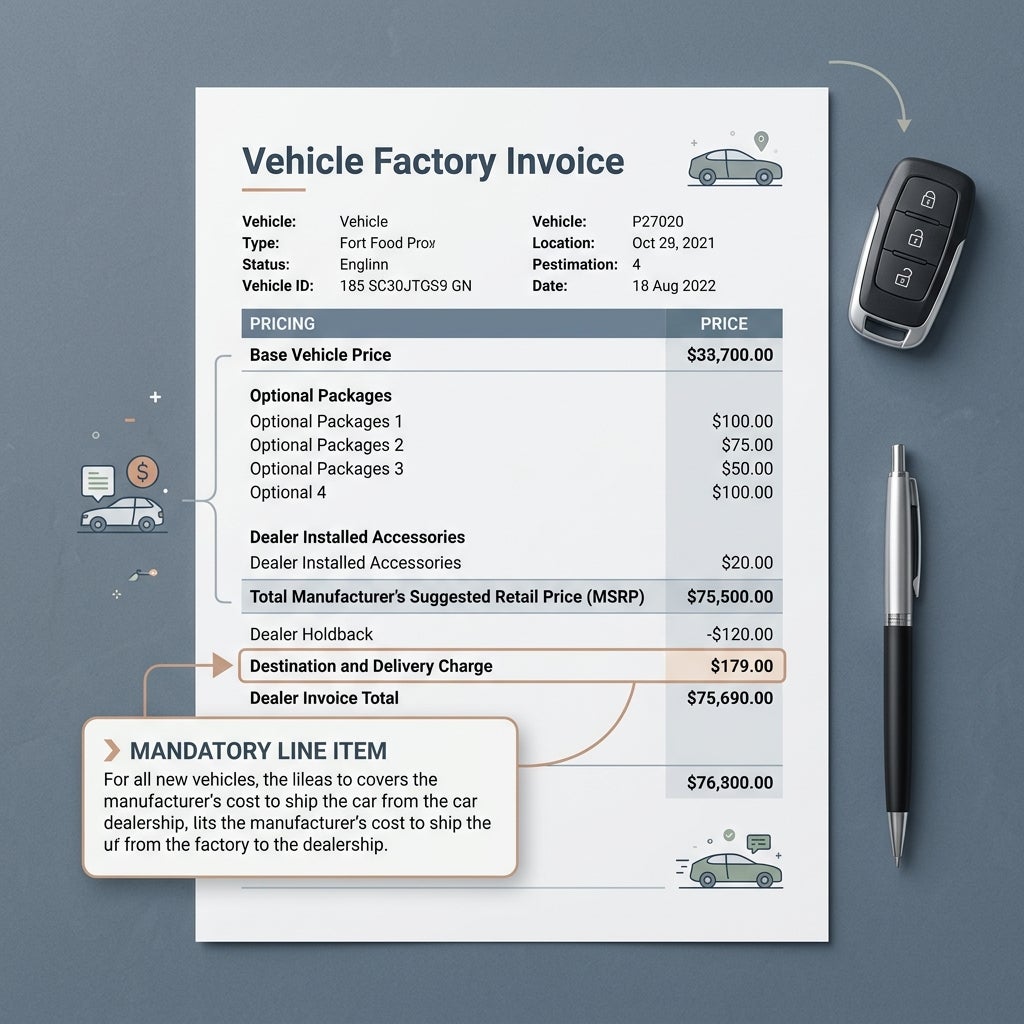
A car invoice document explaining the mandatory destination and delivery charge line item next to a car key and pen. (Representative image for illustration purposes only. Actual vehicle may vary based on trim and configuration.)

What Does the Factory Invoice Price Include?

.hrizn-visual-root a { color: #566BA1; } .hrizn-visual-root a { color: inherit; } .hrizn-visual-root p { margin: 0 0 1em; } .hrizn-visual-root p:last-child { margin-bottom: 0; } @media (max-width: 640px) { .hrizn-visual-root { text-align: center !important; } .hrizn-visual-root a { display: block; width: 100%; max-width: 320px; margin-left: auto; margin-right: auto; box-sizing: border-box; } .hrizn-visual-root + a { margin-top: 8px; } } @media (max-width: 640px) { #hrizn-cols-1 { flex-direction: column !important; align-items: stretch !important; } #hrizn-cols-1 > .hrizn-col { flex: 1 1 100% !important; width: 100% !important; } } @media (max-width: 640px) { #hrizn-cols-2 { flex-direction: column !important; align-items: stretch !important; } #hrizn-cols-2 > .hrizn-col { flex: 1 1 100% !important; width: 100% !important; } } @media (max-width: 640px) { #hrizn-3cols-1 { flex-direction: column !important; align-items: stretch !important; } #hrizn-3cols-1 > .hrizn-col { flex: 1 1 100% !important; width: 100% !important; } } @media (max-width: 640px) { #hrizn-cols-3 { flex-direction: column !important; align-items: stretch !important; } #hrizn-cols-3 > .hrizn-col { flex: 1 1 100% !important; width: 100% !important; } } @media (max-width: 640px) { #hrizn-3cols-2 { flex-direction: column !important; align-items: stretch !important; } #hrizn-3cols-2 > .hrizn-col { flex: 1 1 100% !important; width: 100% !important; } } @media (max-width: 640px) { #hrizn-cols-4 { flex-direction: column !important; align-items: stretch !important; } #hrizn-cols-4 > .hrizn-col { flex: 1 1 100% !important; width: 100% !important; } } @media (max-width: 640px) { #hrizn-3cols-3 { flex-direction: column !important; align-items: stretch !important; } #hrizn-3cols-3 > .hrizn-col { flex: 1 1 100% !important; width: 100% !important; } } @media (max-width: 640px) { #hrizn-cols-5 { flex-direction: column !important; align-items: stretch !important; } #hrizn-cols-5 > .hrizn-col { flex: 1 1 100% !important; width: 100% !important; } } #hrizn-table-tbl-10 table{width:100%;table-layout:auto;border-collapse:collapse;font-family:'Open Sans',sans-serif;font-size:0.9rem} #hrizn-table-tbl-10 th,#hrizn-table-tbl-10 td{border:1px solid #e0e4ed;padding:8px;color:#595959;word-break:break-word;overflow-wrap:break-word} #hrizn-table-tbl-10 th{background:#fafafa;color:#1a1a22;font-weight:700;font-size:14px;text-align:left;vertical-align:middle;padding:8px} #hrizn-table-tbl-10 tr:nth-child(even) td{background:rgba(86,107,161,0.04)} #hrizn-table-tbl-10 .tableWrapper{overflow-x:hidden} @media (max-width: 640px) { #hrizn-3cols-4 { flex-direction: column !important; align-items: stretch !important; } #hrizn-3cols-4 > .hrizn-col { flex: 1 1 100% !important; width: 100% !important; } } @media (max-width: 640px) { #hrizn-cols-6 { flex-direction: column !important; align-items: stretch !important; } #hrizn-cols-6 > .hrizn-col { flex: 1 1 100% !important; width: 100% !important; } } Does the Factory Invoice Price Include Destination and Delivery Charges? The Direct Answer Yes, unequivocally. The factory invoice issued by vehicle manufacturers—including Stellantis for Chrysler, Dodge, Jeep, and Ram vehicles—explicitly lists the destination and delivery charge (frequently categorized as freight) as a mandatory line item. This is not a fee added arbitrarily by the dealership at retail; it is a standardized wholesale cost assessed directly by the vehicle manufacturer to transport the automobile from the assembly line to the dealership lot. When analyzing automotive wholesale documentation, car buyers in Junction City, Manhattan, and across Geary County often assume that the "Factory Invoice Price" represents the base vehicle before shipping expenses. In reality, manufacturer invoicing structure treats freight as an integral component of the total wholesale invoice baseline. Every authorized dealer across the continental United States pays the exact same destination fee for a specific trim and model, regardless of whether the dealership is located ten miles or two thousand miles from the assembly plant. Understanding this foundational line item is essential for evaluating vehicle quotes and dealer pricing claims. Because the factory destination charge is already baked into the total invoice figure provided by the OEM, any attempt by a seller to add a secondary "dealer destination fee" on top of an invoice-based quote represents a duplicate charge. At Valor CDJR, line-item clarity is paramount. By breaking down the exact mechanics of manufacturer freight assessment, wholesale pricing architecture, and local market dynamics, this guide provides complete transparency into what vehicle invoice numbers truly represent. 36 Years Behind the Desk: Dustin Zeck on Auto Pricing Transparency Hello, I am Dustin Zeck, Dealer Principal at Valor CDJR. Over my 36 years in automotive retail, I have sat across the desk from thousands of car buyers—from first-time military buyers stationed at Fort Riley to generational farm families in Riley and Geary counties. During my nearly four decades managing dealership operations, I have witnessed the evolution of automotive pricing from closed-door paper catalogs to the hyper-transparent digital ecosystem we operate in today. One constant throughout my career is that confusion surrounding wholesale terminology—such as factory invoice, destination fees, holdback, and dealer cash—causes unnecessary friction for vehicle buyers. Consumers often arrive with online printouts believing invoice price represents our absolute rock-bottom cost. Others suspect destination fees are hidden dealer profit margins. Both assumptions stem from a lack of clear industry communication. My philosophy at Valor CDJR is simple: an informed buyer is our best customer. If you have questions about how a specific invoice is calculated or want to review line-item pricing on any truck or SUV on our lot, feel free to Call us at (785) 238-5114 directly. Let's peel back the curtain and examine how factory pricing actually functions. Expert Insights: Why Invoice Pricing Isn't the Whole Story "Treating the factory invoice as the dealership's absolute true bottom line is one of the most common misconceptions in modern car buying," explains Dustin Zeck. "Twenty or thirty years ago, buying a car at 'invoice price' meant the dealer was breaking even on the wholesale transaction. Today, manufacturer financial structures involve complex backend allowances, quarterly volume targets, and floorplan assistance that shift the dealership's true accounting baseline well below the published invoice total." However, the inverse is equally true: landed expenses, regional advertising levies, and pre-delivery conditioning can raise a vehicle's wholesale operational cost above the base invoice figure. The psychological shift for consumers lies in recognizing that the factory invoice is an standardized accounting document between the manufacturer (OEM) and the franchise dealer—it is not an itemized retail receipt. Understanding where destination charges live within that wholesale calculation is the first crucial step toward mastering vehicle negotiations. When manufacturers issue an invoice to Valor CDJR, every single option code, trim package, floor mat set, and transportation fee is coded and tallied. The bottom-line invoice figure includes the destination charge automatically. Therefore, when negotiating a deal phrased as '$100 below invoice' or '$500 over invoice,' both buyer and seller are operating off a baseline that ALREADY accounts for bringing the vehicle from the assembly plant to Junction City, Kansas. How Destination and Freight Charges Appear on a Manufacturer Invoice On a physical manufacturer invoice—whether for a Ram 1500 built in Sterling Heights, Michigan or a Jeep Wrangler assembled in Toledo, Ohio—the document is structured in two parallel columns: Wholesale Invoice (Dealer Cost) and Monroney MSRP (Suggested Retail Price). Destination charges appear prominently across both columns. Under federal law (the Automobile Information Disclosure Act of 1958), manufacturers must list equalized freight charges. Equalization means the OEM averages logistics costs across all nationwide shipments. A dealership in Junction City, Kansas pays the exact same destination fee as a dealer located next door to the assembly plant. You can examine current model pricing directly through our New Vehicle Listings to see window sticker breakdowns. Crucially, the destination amount listed in the Wholesale column is virtually identical to the destination amount listed on the retail window sticker. The dealership does not receive a wholesale discount on shipping charges; we pay the factory full price for logistics. Browse New Inventory What Is the Difference Between Dealer Cost and Factory Invoice? To understand automotive pricing, shoppers must distinguish between the published factory invoice and true net dealer cost. While the factory invoice is a fixed baseline document, several financial mechanisms alter what the dealer ultimately pays the manufacturer over time. 1. Dealer Holdback Holdback is a OEM financial credit—typically 2% to 3% of the MSRP or Base Invoice—returned to the dealership quarterly. It assists dealers in offsetting floorplan financing interest and overhead operational costs. 2. Floorplan & Allowances Manufacturers offer wholesale assistance credits for inventory holding costs, rapid turn incentives, and volume bonuses when monthly quotas are achieved. These credits lower true net cost behind the scenes. 3. Baseline vs. Net Cost Because holdback and volume incentives are contingent on performance and timeline, the invoice remains the standardized starting baseline. If you are trading in a vehicle toward your purchase, check your Trade In Evaluation to see how equity applies. Why Landed Cost Is Often Significantly Higher Than the Factory Invoice Quote While factory incentives reduce true dealer cost below invoice, regional operational expenses increase what is known as the dealership's Landed Cost. Landed cost represents the total capital invested in putting a specific vehicle on the showroom floor ready for delivery in Junction City. Primary factors elevating Landed Cost above basic factory invoice include: • Regional Advertising Association (TDA) Fees: OEM-mandated regional marketing contributions added directly to wholesale billing. • Dealer Inspection & Pre-Delivery Conditioning (PDI): Uncrating, safety inspections, fluid top-offs, software updates, and detailing. • Local Inventory Transit & Handling: Fuel charges, secondary transport from rail yards in Kansas City or Topeka, and vehicle storage protection. Understanding landed cost prevents confusion when evaluating transparent quotes across Manhattan, Fort Riley, and Junction City dealers. What Is the Difference Between Dealer Cash and Customer Rebates? Dealer Cash (Incentives) Dealer cash consists of unadvertised factory-to-dealer financial incentives. The manufacturer pays these dollars to the dealership to help move specific slow-selling models or trim levels without changing public MSRPs. Customer Rebates Customer rebates are public factory incentives applied directly to reduce the retail transaction price at checkout (or taken as cash back). Before structuring your deal, Get Pre-Approved to see available APR bonuses. Stacking & Deal Structure Dealer cash reduces the internal wholesale threshold, allowing competitive pricing. Customer rebates reduce the retail figure *after* price negotiations are complete. Get Pre-Approved Online What Does '$50 Over Factory Invoice Pricing' Really Mean for Buyers? Advertisements promoting deals like "$50 Over Invoice" or "Buy at Factory Invoice Price" are compelling, but buyers must examine how the entire transaction is constructed. In reality, a deal quoted at $50 over invoice can vary significantly between dealerships based on fee structures. When a dealer sells a vehicle for $50 over factory invoice, the immediate front-end profit on the vehicle body is exactly $50. However, the dealership retains the manufacturer holdback (typically $1,000 to $1,800 depending on total vehicle MSRP) and earns financial reserve if the buyer finances through dealership lender networks. Beware of dealers who advertise "$50 Over Invoice" only to add mandatory administrative documentation fees of $800+, forced protection packages, or re-adding destination charges. At Valor CDJR, an invoice-based quote is straightforward—no hidden re-additions or deceptive fees. Understanding the Difference Between Markup and Margin in Car Pricing Wholesale Markup % Markup is calculated as profit divided by wholesale invoice cost. If an invoice is $50,000 and selling price is $52,000, profit is $2,000. Expressed as markup on cost: $2,000 / $50,000 = 4.0%. Retail Margin % Margin is calculated as profit divided by final retail selling price. Using the same transaction ($2,000 profit / $52,000 retail price), profit margin equals 3.84%. Commercial buyers viewing our Commercial Vehicle Inventory rely heavily on these exact calculations. Commercial Clarity Automotive retail operates on slim margins—often between 2% and 5% total gross margin on new vehicles. Distinguishing markup from margin helps buyers evaluate commercial-grade fleet quotes accurately. Does Out-the-Door Price Match the Selling Price Over Invoice? No. The agreed selling price (e.g., $100 over factory invoice) is merely one line item in calculating the final Out-the-Door (OTD) Price. Buyers must account for statutory government taxes, mandatory state registration fees, and dealer documentation fees. For residents in Junction City, Geary County, or nearby Manhattan, KS, the OTD calculation follows this exact formula: • Negotiated Vehicle Selling Price (e.g. Invoice + $50) • Kansas State Sales Tax + Local Municipal/County Taxes • Title, Registration, and License Plate Fees • Dealer Documentation Fee • Minus Customer Factory Rebates and Trade-in Tax Credits. Visit our showroom in person— Get Directions to Valor CDJR —to receive an exact itemized OTD quote sheet for any vehicle. Component Sample Quote Basis Factory Invoice (inc. Freight) $45,200 Agreed Selling Price (+ $50) $45,250 KS State & Local Sales Tax (Est.) $3,393 Doc Fee & Registration $495 Customer Rebate Credit -$2,000 Final Out-the-Door (OTD) $47,138 Trade In Evaluation Are Near-Invoice Deals Harder to Get on Brand-New Future Model Years? Supply & Demand Dynamics When a brand-new model year or redesign launches, market demand outpaces factory production. During early release cycles, factory discounts and dealer cash incentives are minimal or non-existent. Initial Production Allocation Dealerships receive limited allocation during initial production runs. Because inventory holding times are near zero, dealers do not face floorplan interest pressure, making invoice pricing less common initially. Military & Local Buyers For Fort Riley military members and regional drivers, special OEM order programs or factory pre-orders can secure competitive pricing. Maintaining your current vehicle via our Service Scheduler or utilizing our Express Lane while waiting for new model allocations is a practical strategy. How to Use Valor CDJR's Digital Tools to Calculate Your Real Cost At Valor CDJR, we equip our customers with digital suite tools to analyze true vehicle costs from the comfort of home. You do not need to sit in a showroom for hours to get transparent figures. Follow these practical steps on our website: 1. Browse our real-time online inventory for new or Used Vehicle Listings. 2. Click 'View Factory Pricing' or request the OEM invoice sheet for any in-stock model. 3. Utilize our instant trade appraisal engine to calculate net trade-in equity. 4. Apply active regional customer rebates and current finance options. By leveraging these digital resources, shoppers across Junction City and Manhattan arrive with complete clarity regarding invoice baselines, destination charges, and final landed price. Get Straight Answers and Transparent Vehicle Quotes at Valor CDJR To summarize: Yes, factory invoice pricing ALWAYS includes factory destination and delivery charges. It is an OEM-mandated standardized fee that dealers pay to transport vehicles from manufacturing plants to our dealership in Junction City. With 36 years of automotive experience, Dealer Principal Dustin Zeck and the entire team at Valor CDJR are committed to straightforward, line-item transparency. Whether you are inquiring about invoice breakdowns, holdback, factory rebates, or out-the-door pricing, we are here to provide clear answers. Need genuine factory parts or accessories? Check out our dedicated Parts Department online or visit us today. Explore Commercial & New Inventory

A dark grey Toyota Highlander SUV driving along a winding rural road through rolling grassy hills. (Representative image for illustration purposes only. Actual vehicle may vary based on trim and configuration.)

Drive Confidently: The 4 Game-Changing Safety Features to Spot in Used Cars After 2018

.hrizn-visual-root a { color: #566BA1; } .hrizn-visual-root a { color: inherit; } .hrizn-visual-root p { margin: 0 0 1em; } .hrizn-visual-root p:last-child { margin-bottom: 0; } @media (max-width: 640px) { .hrizn-visual-root { text-align: center !important; } .hrizn-visual-root a { display: block; width: 100%; max-width: 320px; margin-left: auto; margin-right: auto; box-sizing: border-box; } .hrizn-visual-root + a { margin-top: 8px; } } @media (max-width: 640px) { #hrizn-3cols-1 { flex-direction: column !important; align-items: stretch !important; } #hrizn-3cols-1 > .hrizn-col { flex: 1 1 100% !important; width: 100% !important; } } @media (max-width: 640px) { #hrizn-cols-1 { flex-direction: column !important; align-items: stretch !important; } #hrizn-cols-1 > .hrizn-col { flex: 1 1 100% !important; width: 100% !important; } } @media (max-width: 640px) { #hrizn-cols-2 { flex-direction: column !important; align-items: stretch !important; } #hrizn-cols-2 > .hrizn-col { flex: 1 1 100% !important; width: 100% !important; } } #hrizn-table-puck-tbl-passive-ratings table{width:100%;table-layout:auto;border-collapse:collapse;font-family:'Open Sans',sans-serif;font-size:0.9rem} #hrizn-table-puck-tbl-passive-ratings th,#hrizn-table-puck-tbl-passive-ratings td{border:1px solid #e0e4ed;padding:8px;color:#595959;word-break:break-word;overflow-wrap:break-word} #hrizn-table-puck-tbl-passive-ratings th{background:#1a1a22;color:#ffffff;font-weight:700;font-size:14px;text-align:left;vertical-align:middle;padding:10px} #hrizn-table-puck-tbl-passive-ratings tr:nth-child(even) td{background:rgba(86,107,161,0.04)} #hrizn-table-puck-tbl-passive-ratings .tableWrapper{overflow-x:hidden} @media (max-width: 640px) { #hrizn-3cols-2 { flex-direction: column !important; align-items: stretch !important; } #hrizn-3cols-2 > .hrizn-col { flex: 1 1 100% !important; width: 100% !important; } } @media (max-width: 640px) { #hrizn-cols-3 { flex-direction: column !important; align-items: stretch !important; } #hrizn-cols-3 > .hrizn-col { flex: 1 1 100% !important; width: 100% !important; } } #hrizn-table-puck-tbl-test-drive-checklist table{width:100%;table-layout:auto;border-collapse:collapse;font-family:'Open Sans',sans-serif;font-size:0.9rem} #hrizn-table-puck-tbl-test-drive-checklist th,#hrizn-table-puck-tbl-test-drive-checklist td{border:1px solid #e0e4ed;padding:8px;color:#595959;word-break:break-word;overflow-wrap:break-word} #hrizn-table-puck-tbl-test-drive-checklist th{background:#1a1a22;color:#ffffff;font-weight:700;font-size:14px;text-align:left;vertical-align:middle;padding:10px} #hrizn-table-puck-tbl-test-drive-checklist tr:nth-child(even) td{background:rgba(86,107,161,0.04)} #hrizn-table-puck-tbl-test-drive-checklist .tableWrapper{overflow-x:hidden} @media (max-width: 640px) { #hrizn-cols-4 { flex-direction: column !important; align-items: stretch !important; } #hrizn-cols-4 > .hrizn-col { flex: 1 1 100% !important; width: 100% !important; } } @media (max-width: 640px) { #hrizn-3cols-3 { flex-direction: column !important; align-items: stretch !important; } #hrizn-3cols-3 > .hrizn-col { flex: 1 1 100% !important; width: 100% !important; } } @media (max-width: 640px) { #hrizn-cols-5 { flex-direction: column !important; align-items: stretch !important; } #hrizn-cols-5 > .hrizn-col { flex: 1 1 100% !important; width: 100% !important; } } @media (max-width: 640px) { #hrizn-cols-6 { flex-direction: column !important; align-items: stretch !important; } #hrizn-cols-6 > .hrizn-col { flex: 1 1 100% !important; width: 100% !important; } } Safety Features to Look for When Buying a Used Vehicle at Valor When shopping for modern pre-owned vehicles, the single most impactful step you can take toward protecting your family is prioritizing active driver-assistance systems alongside verified crash-test integrity. Automotive engineering underwent a massive revolution over the past decade, transforming safety technology from passive crash-absorption structures into intelligent, proactive collision-prevention suites. If you are browsing pre-owned vehicles around Geary and Riley Counties, focusing on models produced from 2018 onward will give you the highest concentration of factory-installed advanced safety tech at an accessible price point. To get maximum peace of mind, your baseline checklist for a modern pre-owned sedan, SUV, or truck should center on four critical active safety innovations: Automatic Emergency Braking (AEB), Forward Collision Warning (FCW), Blind-Spot Monitoring (BSM), and Lane Keeping Assist (LKA). Paired with crash-test top ratings from the Insurance Institute for Highway Safety (IIHS) and the National Highway Traffic Safety Administration (NHTSA), these features drastically lower the statistical probability of high-speed impacts and urban fender-benders alike. At Valor CDJR, located near Fort Riley and Manhattan, our team inspects every pre-owned vehicle to verify that radar sensors, cameras, and restraint systems perform to original factory specifications. Browse our latest Used Vehicle Listings to discover pre-owned cars equipped with cutting-edge driver-assist technology. Must-Have Active Driver Assistance Systems: AEB, Blind Spot Monitoring, and Lane Keep Assist Active safety systems act as a second set of eyes on the road, monitoring traffic conditions milliseconds faster than human reaction time. Whether you navigate busy military commuter routes between Junction City and Fort Riley or travel long stretches of Interstate 70, these three core technologies form an essential defense layer. Automatic Emergency Braking (AEB) AEB systems utilize front-facing radar, camera sensors, or lidar to continuously scan for obstacles ahead. If a vehicle suddenly slows on Washington Street or Highway 77, AEB alerts the driver instantly. If you do not react in time, the system automatically applies maximum braking force to mitigate or completely prevent a front-end crash. Studies show standard AEB reduces rear-end collisions by up to 50%. Blind-Spot Monitoring (BSM) Changing lanes on multi-lane highways like I-70 or K-18 requires constant vigilance. Blind-Spot Monitoring relies on rear bumper radar sensors to detect hidden vehicles in adjacent lanes. Visual indicators illuminate in side mirrors when a car occupies your blind spot, accompanied by an audible warning if you activate your turn signal. Rear Cross-Path Detection often comes bundled with BSM to protect you when backing out of tight parking spots. Lane Keep Assist & Departure Warning Fatigue or momentary distraction can cause a vehicle to drift out of its travel lane. Lane Departure Warning alerts drivers via steering wheel vibration or audio chimes if the vehicle crosses painted lane markers without signaling. Advanced Lane Keeping Assist takes a step further by gently nudging the electronic power steering to guide the vehicle back into the center of the lane safely. Are Forward Collision Warning Systems Standard on Used Vehicles Made After 2018? In 2016, twenty leading automotive manufacturers representing over 99% of the U.S. auto market entered a historic voluntary agreement with the NHTSA and IIHS. They committed to making Forward Collision Warning (FCW) and Automatic Emergency Braking (AEB) standard equipment across virtually all new passenger vehicles by September 2022. Because of this phased rollout, model year 2018 marked a major turning point in used vehicle inventory accessibility. By 2018, top automakers—including Chrysler, Dodge, Jeep, Ram, Toyota, Honda, Subaru, and Ford—began including FCW as standard or near-standard features on core trim levels. When shopping pre-owned models from 2018, 2019, or 2020, you will find that safety suites like Full-Speed Forward Collision Warning with Active Braking are commonplace rather than costly luxury add-ons. If you want to compare late-model safety equipment against brand-new technology, explore our New Vehicle Listings to see how features have evolved. Passive Safety Essentials: Structural Integrity, Airbag Coverage, and Crash Test Ratings While active safety technology works diligently to prevent collisions, passive safety systems dictate how well occupants are shielded when an accident is unavoidable. Structural integrity forms the backbone of vehicle protection. Modern unibody construction utilizes ultra-high-strength steel safety cages and engineered crumple zones designed to absorb and divert kinetic force away from the passenger cabin during impact. When evaluating a pre-owned vehicle, confirm complete supplemental restraint coverage: advanced multi-stage front airbags, seat-mounted side airbags, front knee airbags, and full-length side-curtain airbags extending to all seating rows. Always review IIHS Top Safety Pick designations and NHTSA 5-Star Overall Safety Ratings. Our safety-tested vehicles are meticulously checked by our certified mechanics; you can maintain long-term safety by contacting our Parts Department for original factory replacement safety components. Safety Evaluation Category Key Elements to Inspect on Used Cars IIHS Top Safety Pick Evaluates moderate overlap front, side, roof strength, head restraints, AEB effectiveness, and headlight quality. NHTSA 5-Star Rating Tests front crash, side crash, and rollover resistance with star ratings from 1 to 5. Crumple Zones & Steel Cage Monocoque frame design engineered to absorb impact energy while preserving occupant cabin space. Curtain Airbags Protects outboard passengers in side-impact and rollover events across row 1 and row 2. Seatbelt Pre-tensioners Instantly retract seatbelts during rapid deceleration to hold occupants firmly in position. Browse Safety-Inspected Used Inventory Weather and Terrain Safety: All-Wheel Drive and Lighting Tech for Flint Hills Driving Driving around Junction City and rural Riley County poses distinct environmental challenges. Severe summer thunderstorms, sudden winter icy patches on bridges over the Smoky Hill and Republican Rivers, and unpaved gravel backroads through the Flint Hills demand specialized drivetrain and visibility technology. All-Wheel Drive & 4x4 Capability Intelligent AWD and four-wheel-drive systems continuously monitor wheel slip, routing power to tires with the most traction within milliseconds. In summer rain squalls or winter snowstorms, AWD keeps your vehicle planted securely on asphalt and gravel alike. LED Headlights & Auto High-Beams Rural Kansas county highways lack overhead lighting. Pre-owned vehicles with LED projector headlights cast a longer, wider beam pattern than older halogen bulbs, giving you critical extra seconds to spot deer and wildlife on dark country roads. Rain-Sensing Wipers & Fog Lamps Automated moisture-sensing windshield wipers instantly adjust wipe speed during sudden downpours, keeping your vision unobstructed without requiring manual adjustment while driving. Integrated fog lamps slice through low-lying river valley fog. What Should I Look For During a Test Drive of a Used Car Near Junction City? Taking a test drive is far more than testing engine acceleration and climate control—it is your hands-on opportunity to verify that every sensor and driver-assistance feature functions flawlessly. When you take a test drive route on Highway 77 or through Junction City neighborhoods, follow a structured verification process to evaluate camera clarity, brake responsiveness, and warning displays. Pay extra attention to warning light diagnostic cycles when starting the ignition: all safety indicators (ABS, Airbag, BSM, FCW) should illuminate briefly and turn off completely without triggering persistent warning codes. If maintenance or software recalibrations are needed, our professional technicians at the Service Scheduler inspect and service used vehicles prior to sale. Safety Tech Item What to Verify During Test Drive Backup Camera & Sensors Shift into Reverse to verify clear camera screen resolution, dynamic grid lines, and audible park assistance warning chimes. Adaptive Cruise Control Engage cruise control on highway sections; observe how smoothly the car maintains a preset follow distance as traffic slows. Blind-Spot Indicators Check side mirror icons for clear brightness when traffic passes in adjacent lanes during highway driving. Brake Feel & Anti-Lock Test firm brake pedal pressure; ensure immediate engagement without pedal pulsation, squealing, or pulling to one side. Dashboard Warning Lights Confirm that key safety symbols light up at engine start and turn off completely after self-diagnostic checks. CPO vs. Standard Used: Can You Negotiate the Price on a Certified Pre-Owned Vehicle? When comparing pre-owned vehicles, buyers often weigh Certified Pre-Owned (CPO) models against non-certified used inventory. A Certified Pre-Owned Chrysler, Dodge, Jeep, or Ram vehicle must pass a rigorous 125-point quality inspection conducted by factory-trained mechanics. This comprehensive process evaluates mechanical performance, structural safety, airbag deployment history, and radar sensor calibration. In addition, CPO vehicles include factory-backed powertrain warranty extensions, 24/7 roadside assistance, and complete CARFAX vehicle history reports. A common question among pre-owned car shoppers in Junction City is whether CPO prices are open to negotiation. The short answer is yes: while CPO vehicles carry premium value due to warranty coverage and reconditioning investment, dealerships work with buyers on total deal structure, trade-in values, and financing terms. You can get a head start on your purchase planning by utilizing our easy online application to Get Pre-Approved before visiting our showroom. Apply for Pre-Approval Online Today Why Might Buyers Near Junction City Prefer Franchise Dealers for Used Cars? Purchasing a pre-owned vehicle from an established franchise dealership like Valor CDJR offers distinct safety and financial advantages over independent used car lots or private sellers. Franchise dealers hold direct factory authorization and direct access to OEM technical databases, meaning every incoming trade-in is checked against open NHTSA safety recall databases before being offered for sale. Private sellers and independent lots lack OEM diagnostic tools needed to recalibrate radar modules or perform complex software updates required after bumper or windshield service. At Valor CDJR, factory-trained technicians recondition every vehicle using genuine OEM parts. Quick maintenance service is also available through our dedicated Express Lane facility. In addition to safety checks, franchise dealers offer clear vehicle history transparency with official CARFAX reports detailing ownership history, service intervals, and structural incident disclosures. For local business operators looking for high-capacity work vehicles with verified safety records, explore our specialized Commercial Vehicle Inventory options. Franchise dealerships provide established financing partnerships with local Kansas banks and national lenders, competitive trade-in evaluations, and long-term customer care guarantees that small independent lots simply cannot match. Understanding Used Car Purchase Costs: Sales Tax, Licensing, and Extra Dealer Fees in Geary & Riley Counties Understanding the total out-of-the-door price ensures a smooth and transparent pre-owned car buying experience in Junction City, Kansas. Here is a clear breakdown of state tax requirements, county licensing fees, trade-in tax credits, and standard documentation charges. Kansas State & Local Sales Tax In Kansas, vehicle sales tax is determined by your residence county. For buyers residing in Junction City (Geary County), the combined state, county, and city sales tax rate applies to the net vehicle purchase price. If you reside in nearby Manhattan or Riley County, your registered residence rate dictates the tax collected. Trade-In Tax Credit Savings Kansas tax law grants a major financial benefit when trading in your current vehicle. You only pay sales tax on the net difference between your trade-in allowance and the pre-owned vehicle's purchase price, saving hundreds or thousands of dollars. Licensing & Documentation Fees Additional fixed costs include county title registration fees, tag transfer charges, and standard dealer documentation fees. Valor CDJR provides upfront, line-item transparency on all documentation and government fees with zero surprise add-ons. Can I Start the Used Car Buying Process Online and Finish at a Junction City Dealership? Yes! Modern automotive retailing allows you to complete up to 90% of your pre-owned vehicle purchase online from the comfort of your home in Junction City or Fort Riley. Our digital showroom tools allow you to browse safety-inspected pre-owned inventory, analyze window stickers, and review detailed CARFAX reports on demand. You can contact us for current payment information, submit a secure online credit application, and obtain an accurate market value for your current vehicle in minutes by visiting our Trade In Evaluation tool. Once your financing and deal structure are arranged online, visit our showroom for a quick final test drive and sign your vehicle delivery documents. This streamlined digital workflow saves hours of waiting in dealership lounges. Our sales team preps the vehicle, verifies all safety technology calibrations, and sanitizes the interior before your scheduled arrival time. Whether you choose to handle negotiations online or prefer in-person consultation at our Goldenbelt Boulevard facility, Valor CDJR delivers a flexible shopping experience tailored to your lifestyle. Calculate Your Trade-In Valuation How Do I Schedule a Test Drive for a Used Car in Junction City? Scheduling a test drive at Valor CDJR is fast and convenient. You can reserve your preferred pre-owned vehicle online via our website or by contacting our friendly sales consultants directly. When scheduling your appointment, let our team know which specific safety features you wish to evaluate—such as adaptive cruise control, blind-spot monitoring, or backup camera systems—and we will ensure a specialist is prepared to demonstrate them. Prefer to arrange your visit over the phone? Call us at (785) 238-5114 to speak directly with our pre-owned sales department. If you need navigation assistance to our facility, click here to Get Directions to Valor CDJR. Find Your Next Safety-Checked Used Vehicle at Valor CDJR in Junction City Prioritizing modern driver-assistance technology and passive crash safety guarantees that your next pre-owned vehicle delivers lasting value, comfort, and protection for every journey. From daily commutes down I-70 to gravel road adventures through the Flint Hills, having reliable safety systems onboard keeps your loved ones secure. Valor CDJR is proud to serve car buyers in Junction City, Fort Riley, Manhattan, and Salina with complete transparency, factory-certified vehicle inspections, and flexible financing solutions. Visit us today at 1825 Goldenbelt Blvd, Junction City, KS 66441 or schedule your service appointment online using our Service Scheduler tool. Schedule Your VIP Test Drive Appointment

Save Big on $50 Over Invoice Purchases

.hrizn-visual-root a { color: #566BA1; } .hrizn-visual-root a { color: inherit; } .hrizn-visual-root p { margin: 0 0 1em; } .hrizn-visual-root p:last-child { margin-bottom: 0; } @media (max-width: 640px) { .hrizn-visual-root { text-align: center !important; } .hrizn-visual-root a { display: block; width: 100%; max-width: 320px; margin-left: auto; margin-right: auto; box-sizing: border-box; } .hrizn-visual-root + a { margin-top: 8px; } } @media (max-width: 640px) { #hrizn-cols-1 { flex-direction: column !important; align-items: stretch !important; } #hrizn-cols-1 > .hrizn-col { flex: 1 1 100% !important; width: 100% !important; } } @media (max-width: 640px) { #hrizn-3cols-1 { flex-direction: column !important; align-items: stretch !important; } #hrizn-3cols-1 > .hrizn-col { flex: 1 1 100% !important; width: 100% !important; } } @media (max-width: 640px) { #hrizn-cols-2 { flex-direction: column !important; align-items: stretch !important; } #hrizn-cols-2 > .hrizn-col { flex: 1 1 100% !important; width: 100% !important; } } #hrizn-table-tbl-5 table{width:100%;table-layout:auto;border-collapse:collapse;font-family:'Open Sans',sans-serif;font-size:0.9rem} #hrizn-table-tbl-5 th,#hrizn-table-tbl-5 td{border:1px solid #e0e4ed;padding:8px;color:#595959;word-break:break-word;overflow-wrap:break-word} #hrizn-table-tbl-5 th{background:#f5f5f5;color:#1a1a22;font-weight:700;font-size:14px;text-align:left;vertical-align:middle;padding:8px} #hrizn-table-tbl-5 tr:nth-child(even) td{background:rgba(86,107,161,0.04)} #hrizn-table-tbl-5 .tableWrapper{overflow-x:hidden} @media (max-width: 640px) { #hrizn-cols-3 { flex-direction: column !important; align-items: stretch !important; } #hrizn-cols-3 > .hrizn-col { flex: 1 1 100% !important; width: 100% !important; } } @media (max-width: 640px) { #hrizn-3cols-2 { flex-direction: column !important; align-items: stretch !important; } #hrizn-3cols-2 > .hrizn-col { flex: 1 1 100% !important; width: 100% !important; } } @media (max-width: 640px) { #hrizn-cols-4 { flex-direction: column !important; align-items: stretch !important; } #hrizn-cols-4 > .hrizn-col { flex: 1 1 100% !important; width: 100% !important; } } @media (max-width: 640px) { #hrizn-3cols-3 { flex-direction: column !important; align-items: stretch !important; } #hrizn-3cols-3 > .hrizn-col { flex: 1 1 100% !important; width: 100% !important; } } @media (max-width: 640px) { #hrizn-3cols-4 { flex-direction: column !important; align-items: stretch !important; } #hrizn-3cols-4 > .hrizn-col { flex: 1 1 100% !important; width: 100% !important; } } @media (max-width: 640px) { #hrizn-cols-5 { flex-direction: column !important; align-items: stretch !important; } #hrizn-cols-5 > .hrizn-col { flex: 1 1 100% !important; width: 100% !important; } } Save Big on $50 Over Invoice Pricing at Valor! What Does $50 Over Factory Invoice Pricing Actually Mean for Your Total Cost? To understand the true mechanics of $50 over factory invoice pricing, one must distinguish between top-down pricing (MSRP discounts) and bottom-up pricing (building up from wholesale dealer cost). The MSRP—Manufacturer's Suggested Retail Price—is the sticker price posted on the window. Factory invoice, on the other hand, represents the baseline cost charged by the manufacturer to the dealership for the specific vehicle build. When a dealership agrees to $50 over factory invoice, the starting baseline sale price (Vehicle Selling Price line item) on your contract should equal the total invoice amount listed on the official OEM invoice sheet plus exactly $50.00. This calculation occurs before applying government taxes, state licensing fees, and applicable customer rebates. It is crucial to remember that $50 over invoice is not necessarily your final 'out-of-the-door' price. Out-of-door price includes state and county sales taxes, motor vehicle registration/title fees, and dealer documentation fees. However, by establishing a firm, verified selling price at $50 above factory invoice, you eliminate inflated retail markups. Whether you are shopping for a heavy-duty truck or an efficient sedan, establishing an unassailable baseline gives you complete financial clarity during negotiations across Geary and Riley counties. What Is Included on an Official Car Factory Invoice Sheet? Base Wholesale & Options The top lines of an authentic manufacturer invoice list the base model wholesale price alongside factory-installed options and packages. Each package (such as leather interior, tow packages, or advanced safety tech) has both an MSRP cost and a lower invoice cost. Verify that option codes match the window sticker exactly. Destination & Freight Destination or transportation charges are set by the manufacturer to ship the vehicle from assembly plant to dealership. Freight charges are identical on both MSRP and invoice sheets. Pay close attention to ensure the contract does not add a second 'dealer freight' charge on top of factory destination. Regional Ad & Holdback Official invoices often include legitimate regional advertising association fees (such as FDAF or TDA fees mandatory for local dealer groups). In addition, factory invoices display the dealer holdback amount and wholesale financial codes used internally by the manufacturer. Can a Buyer Request to View the Actual Factory Invoice Document? Yes, absolutely. A reputable dealership offering invoice-based pricing will readily share a copy of the official OEM factory invoice sheet. In fact, requesting to view the document is standard practice when verifying a $50 over invoice arrangement. When reviewing the document, look for official manufacturer logos, specific vehicle identification numbers (VIN), vehicle order tracking numbers, and distinct columns showing 'MSRP' alongside 'Invoice'. Beware of internal computerized dealer quote sheets that mimic the layout of a factory invoice but are generated internally. At Valor CDJR, transparency is paramount. Whether you are reviewing New Vehicle Listings or visiting our showroom in Junction City, our team provides real factory documentation so you can audit every dollar with complete confidence. Explore New Inventory Offers How Documentation Fees and Dealer Add-ons Can Alter a $50 Over Invoice Deal The most common pitfall in invoice-based car buying involves backend administrative fees and dealer add-ons. You might successfully negotiate the selling price to $50 over invoice, only to find $1,200 in unexpected line items added to the final contract. Understanding these charges is essential to protecting your savings. Paperwork Line Item Legitimate vs. Red Flag What to Check On Your Contract Dealer Documentation Fee Legitimate within reasonable limits Ensure doc fee is stated upfront and not inflated post-negotiation. Dealer Protection Packages Red Flag if forced/unwanted Verify tint, fabric guard, or nitrogen fills are optional, not mandatory. Destination / Freight Charge Legitimate when matching OEM invoice Ensure destination fee isn't listed twice (once on invoice, once as dealer charge). VIN Etching / Theft Protection Red Flag if auto-added Check for pre-printed add-on lines and request removal if unrequested. If you notice mandatory add-on fees on your contract, ask for them to be removed or credited back. A true $50 over factory invoice offer remains clean and transparent without artificial padding. How Factory Incentives and Customer Rebates Apply to Invoice Pricing A frequent point of confusion is whether factory rebates are included in the $50 over invoice price or applied on top of it. In proper car purchase accounting, customer rebates are funded directly by the vehicle manufacturer, not the dealership. Therefore, rebates apply after establishing the agreed vehicle purchase price. For example, if factory invoice is $40,000 and you negotiate $50 over invoice, your starting sale price is $40,050. If the manufacturer offers $2,500 in consumer cash rebates, that rebate may be applied separately according to program rules and before taxes and state fees. The dealership still receives reimbursement from the factory for that $2,500 rebate. Special targeted incentives—such as military discounts, college graduate rebates, or trade-in assistance programs—should also reduce your out-of-pocket obligation line by line. Be sure to audit your rebate eligibility with our finance specialists. Ready to discuss financing options with rebate savings? You can easily Get Pre-Approved online to contact the dealership for current financing terms. What Is Dealer Holdback and How Does It Impact Invoice Pricing? Definition of Holdback Dealer holdback is a financial allowance paid by the automaker to the dealer after a vehicle is sold. It typically ranges between 2% and 3% of either the total MSRP or total invoice amount, depending on the manufacturer brand. Why Dealers Offer It Because holdback provides backend revenue to offset inventory floor plan expenses, a dealership can sell a vehicle at or near factory invoice while remaining financially viable and sustaining daily dealership operations. Contract Accounting Holdback is an internal factory accounting line item and is rarely deducted directly on consumer purchase agreements. However, understanding holdback gives buyers peace of mind that $50 over invoice is a fair, sustainable business model. Is It Better to Negotiate Off MSRP or Off Factory Invoice When Looking for Value? Top-down negotiation involves taking the window sticker price (MSRP) and asking for arbitrary dollar amounts or percentages off. While common, top-down negotiating can lead to confusion when comparing different vehicle trims, factory options, or competing dealer offers. Bottom-up negotiation starting from factory invoice provides an objective financial anchor. Because factory invoice directly reflects manufacturer wholesale baseline numbers, negotiating $50 above invoice creates absolute consistency across diverse inventory choices. Whether you are trading in a vehicle or buying outright, invoice-based clarity simplifies every aspect of the transaction. You can instantly test vehicle trade values using our online Trade In Evaluation tool before finalizing contract numbers. Value Your Current Vehicle Does Factory Invoice Pricing Vary From Dealer to Dealer? For two identical vehicles with the exact same equipment, options, and trim levels, the base factory invoice price issued by the manufacturer is completely identical across dealerships nationwide. A Ram 1500 or Jeep Grand Cherokee ordered with identical package codes will have the exact same wholesale factory invoice sheet whether delivered in Kansas or elsewhere. However, minor invoice differences can arise due to regional destination adjustments or factory price updates during mid-model-year production shifts. When comparing offers across local dealerships in Junction City, Manhattan, or Salina, inspecting the physical invoice sheet confirms whether you are looking at true identical vehicle specs. Line-by-Line Paperwork Audit Checklist Before Signing Your Contract Step 1: Match Invoice Baseline Compare the top line item of the contract ('Vehicle Selling Price') against the OEM factory invoice sheet. Ensure it equals the invoice total plus exactly $50 before any additions. Step 2: Audit Destination Charge Confirm that factory destination and delivery charges are included in the invoice total, not listed a second time on the buyer's order as a separate line item. Step 3: Review Documentation Fees Verify that the dealer doc fee matches what was disclosed during negotiations and is clearly itemized without unexpected administrative surcharge additions. Step 4: Confirm Rebate Credits Ensure all consumer cash rebates, bonus cash, or military incentives are subtracted below the vehicle purchase price line, reducing total tax burden where applicable. Step 5: Check Trade Allowance Verify your agreed trade-in value is accurately entered along with remaining loan payoff figures, ensuring correct tax credit application in Kansas. Step 6: Remove Mandatory Add-Ons Check for dealer accessories, tire protection, or window etch fees. Ensure optional protection plans are included only if specifically requested by you. How Invoice Pricing Compares to Market Evaluation Pricing Tools Third-party valuation platforms like Kelley Blue Book (Fair Purchase Price) and Edmunds (True Market Value) aggregate local transaction data to report average regional vehicle sale prices. Comparing these metrics against a $50 over invoice offer gives shoppers immediate context. In most competitive vehicle markets across Flint Hills, negotiating a new vehicle at $50 over invoice lands well below the median market price reported by third-party tools. This confirms you are receiving a top-tier price without drawn-out negotiations. Why $50 Over Invoice Is Considered Fair for Buyers and Dealers in Junction City A transparent $50 over factory invoice pricing structure represents a true win-win model for military service members, university personnel, and families near Fort Riley and Junction City. For buyers, it delivers complete pricing certainty and eliminates stressful hours spent haggling over retail margins. For dealerships, it builds long-term community trust and supports sustainable business operations through steady transaction volume. Whether you are looking for dependable work vehicles from our Commercial Vehicle Inventory or seeking a personal vehicle, straightforward invoice-based pricing guarantees equal financial respect for every customer. Browse Commercial Vehicles Review Transparent Invoice Pricing and Plan Your Visit to Valor CDJR If you are ready to experience a modern, transparent vehicle purchase, our dedicated team at Valor CDJR is here to assist. We invite you to review our transparent invoice offers, browse our quality pre-owned selection in Used Vehicle Listings, or stop by our Quick-Service Express Lane for quick vehicle care. Need maintenance support or genuine OEM components for your current vehicle? Easily schedule service with our Service Scheduler or order replacement parts through our Parts Department. Conveniently located in Junction City, KS— Get Directions to Valor CDJR or Call us at (785) 238-5114 today to schedule your VIP consultation. Schedule Your Visit Today

Cross-State Trade-Ins: Dustin Zeck on Maximizing Vehicle Value

Cross-State Trade-Ins: Dustin Zeck on Maximizing Vehicle Value Trading a vehicle across state lines can feel like navigating a maze of conflicting regulations, tax structures, and title requirements. To help clear up the confusion for buyers in the Midwest, we sat down with Dustin Zeck, the Dealer Principal at Valor CDJR, who brings 36 years of automotive retail expertise to the table. In this exclusive interview, Dustin explains how to seamlessly handle out-of-state titles, navigate sales tax rules, and maximize your vehicle's trade-in value. Q: Can Drivers Easily Trade In Their Vehicles Across State Lines? A: Absolutely, and it is a much more common scenario than many people realize. Many of our military customers stationed nearby at Fort Riley bring vehicles with out-of-state titles into Junction City when they are ready to upgrade. Our team handles these transactions daily, ensuring that the transition from your current vehicle to a new model is completely seamless. Whether you are looking to trade in an older sedan for a rugged Ram 1500 featuring a 5.7L HEMI V8 engine and an impressive 12,750-pound towing capacity, or you need to upgrade your business fleet, the process is highly straightforward when you work with an experienced dealership. To get started, you can easily use our online trade-in evaluation tool to get an initial estimate of what your current vehicle is worth before you even set foot on our lot. From there, you can explore our comprehensive new-vehicle listings to find the perfect Chrysler, Dodge, Jeep, or Ram model that fits your lifestyle. For local business owners, we also maintain a dedicated commercial vehicle inventory designed to handle heavy-duty workloads. If you prefer to discuss your options in person or want to take a test drive, you can get turn by turn directions to our showroom at 1825 Goldenbelt Blvd, Junction City, KS 66441 by accessing our dealership location map, or you can give our sales team a quick call to schedule an appointment. Q: What Extra Steps and Inspections Are Involved When Transferring an Out-of-State Title? A: The primary difference when trading in a vehicle with an out-of-state title in Kansas is the requirement for a physical vehicle inspection. Kansas law dictates that any vehicle brought in from another state must undergo a Kansas Highway Patrol motor vehicle examination, which generates Form MVE-1. This inspection verifies the vehicle identification number to prevent title fraud and ensure the vehicle is legally cleared for transfer. When you trade your vehicle to us, we assist with this process to ensure all paperwork is completed correctly, including securing the pink copy of the MVE-1 receipt required for the subsequent title application. Additionally, Kansas statutes require new owners to apply for registration within 60 days of acquiring a vehicle, and the transaction must be filed with the county treasurer's motor vehicle office where the vehicle will be garaged. When filling out the transfer documents, both parties must complete the odometer disclosure on the back of the physical title using blue or black ink only, as any corrections or use of white-out can completely void the document. If you are looking to trade in your current vehicle for one of our high-quality pre-owned models, you can browse our used-vehicle listings to see our current stock of thoroughly inspected cars, trucks, and SUVs that are ready for immediate delivery. Q: How Do We Handle an Active Lien on Your Out-of-State Trade-In? A: Having an active loan on your vehicle is one of the most common scenarios we encounter, and it does not prevent you from trading it in. If your out-of-state title lists a lienholder, we coordinate directly with your lender to obtain the exact payoff amount and secure a formal lien release. Under Kansas law, obtaining this formal release—either executed directly on the physical title, via a notarized release letter on official letterhead, or by utilizing Form TR-150 —is mandatory before the title can be legally assigned and transferred to a new owner. If your vehicle is registered in Nebraska, which utilizes an electronic lien and title system, the process requires a bit of coordination because we must wait for the lender to release the lien electronically so the department of motor vehicles can print a physical paper title. While our finance department handles all of the phone calls and administrative paperwork to clear the title, you can wait comfortably in our showroom or even take advantage of our Express Lane service lane to get quick maintenance completed on another family vehicle. "When you bring us an out-of-state trade, our job is to handle the red tape so you can focus on driving home your new vehicle." Q: How Do States Prevent Buyers From Paying Sales Tax Twice When Trading In Vehicles? A: This is a major concern for cross-state buyers, but both Kansas and Nebraska have clear reciprocity rules to ensure you are not double-taxed. When you trade in a vehicle, you only pay sales tax on the net purchase price—which is the cost of the new vehicle minus the value of your trade-in. If you buy a vehicle in Kansas but register it in your home state of Nebraska, you will pay Nebraska's sales tax on that net difference when you register the vehicle at your local county treasurer's office. Our finance team is highly experienced in structuring these out-of-state deals so that all tax calculations are precise and compliant with your home state's regulations. To make the purchasing process even faster and more convenient, we highly recommend that you get pre-approved online through our secure finance application before visiting the dealership. This allows us to have your financing options ready and tailored to your specific budget the moment you arrive. Q: How Much Can a Strong Trade-In Appraisal Realistically Lower Your Final Tax Bill? A: A higher trade-in appraisal does more than just lower your monthly payment; it acts as a direct shield against sales tax. Because sales tax is calculated on the net purchase price, every dollar we award you for your trade-in directly reduces the taxable amount of your new purchase. For example, if you are purchasing a premium SUV with a hypothetical purchase price of $50,000 and your trade-in is valued at $20,000, you are only taxed on the remaining $30,000. In a state with an combined state and local sales tax rate of roughly 9%, that $20,000 trade-in value saves you $1,800 in sales tax alone. If you were to sell that same vehicle privately, you would not receive this tax credit when purchasing your replacement vehicle, meaning you would have to pay sales tax on the full $50,000 purchase price. This built-in tax advantage significantly narrows the gap between a dealer's trade-in offer and a private sale price, making the dealership route much more financially lucrative than most people realize. Q: Which Quick and Low-Cost Upgrades Deliver the Best Return on Your Vehicle Value? A: You do not need to spend thousands of dollars to get a significantly higher appraisal offer on your vehicle. First impressions matter immensely to an appraiser, so a thorough detailing is the highest-return investment you can make. Dusty gravel roads winding through the rolling Flint Hills near Manhattan can leave a vehicle looking weathered, making a thorough exterior wash and wax crucial before an appraisal. Inside the cabin, vacuuming the carpets, wiping down the dashboard, and removing all personal items immediately elevates the perceived condition of the vehicle. Addressing minor cosmetic issues also yields excellent returns. Fixing a small windshield chip or replacing worn windshield wiper blades costs very little but prevents the appraiser from deducting reconditioning costs from your offer. Finally, gathering all vehicle keys, fobs, and physical maintenance records demonstrates that the vehicle has been well-cared for, which instills confidence and allows us to offer the absolute top market value for your trade. Q: Why Is a Dealer Trade-In More Advantageous Than a Private Sale Across State Lines? A: Selling a vehicle privately across state lines is incredibly time-consuming and carries significant financial risks, including potential payment scams and fraudulent wire transfers. When you sell privately, you have to manage listing the vehicle, taking phone calls from strangers, coordinating test drives, and handling the complex title transfer and lien payoff paperwork yourself. Furthermore, a private sale does not provide the immediate sales tax credit that you receive when trading in at a dealership, which often wipes out any slight premium you might get from a private buyer. Trading your vehicle to us eliminates all of these headaches in a single, secure transaction. We handle the entire payoff of your existing loan, manage the out-of-state title transfer, and apply the tax credit directly to your new purchase on the same day. When you are ready to experience a transparent and straightforward buying process, we invite you to visit our showroom or give our friendly team a call today to schedule your personalized appraisal. Keep Your Vehicle Running Strong Keep your vehicle performing at its best with our service team: Parts Department Service Scheduler © 2026 Valor CDJR. All rights reserved.

A grey SUV and a silver pickup truck parked on a gravel path overlooking rolling green hills. (Representative image for illustration purposes only. Actual vehicle may vary based on trim and configuration.)

Finding Reliable, High-Quality Vehicles Under $25,000 in Junction City

.hrizn-visual-root a { color: #566BA1; } .hrizn-visual-root a { color: inherit; } .hrizn-visual-root p { margin: 0 0 1em; } .hrizn-visual-root p:last-child { margin-bottom: 0; } @media (max-width: 640px) { .hrizn-visual-root { text-align: center !important; } .hrizn-visual-root a { display: block; width: 100%; max-width: 320px; margin-left: auto; margin-right: auto; box-sizing: border-box; } .hrizn-visual-root + a { margin-top: 8px; } } @media (max-width: 640px) { #hrizn-cols-1 { flex-direction: column !important; align-items: stretch !important; } #hrizn-cols-1 > .hrizn-col { flex: 1 1 100% !important; width: 100% !important; } } @media (max-width: 640px) { #hrizn-3cols-1 { flex-direction: column !important; align-items: stretch !important; } #hrizn-3cols-1 > .hrizn-col { flex: 1 1 100% !important; width: 100% !important; } } #hrizn-table-tbl-Ram-specs table{width:100%;table-layout:auto;border-collapse:collapse;font-family:'Open Sans',sans-serif;font-size:0.9rem} #hrizn-table-tbl-Ram-specs th,#hrizn-table-tbl-Ram-specs td{border:1px solid #e0e4ed;padding:8px;color:#595959;word-break:break-word;overflow-wrap:break-word} #hrizn-table-tbl-Ram-specs th{background:#1a1a22;color:#ffffff;font-weight:700;font-size:15px;text-align:left;vertical-align:middle;padding:12px} #hrizn-table-tbl-Ram-specs tr:nth-child(even) td{background:rgba(86,107,161,0.04)} #hrizn-table-tbl-Ram-specs .tableWrapper{overflow-x:hidden} @media (max-width: 640px) { #hrizn-cols-2 { flex-direction: column !important; align-items: stretch !important; } #hrizn-cols-2 > .hrizn-col { flex: 1 1 100% !important; width: 100% !important; } } #hrizn-table-tbl-truck-size-comparison table{width:100%;table-layout:auto;border-collapse:collapse;font-family:'Open Sans',sans-serif;font-size:0.9rem} #hrizn-table-tbl-truck-size-comparison th,#hrizn-table-tbl-truck-size-comparison td{border:1px solid #e0e4ed;padding:8px;color:#595959;word-break:break-word;overflow-wrap:break-word} #hrizn-table-tbl-truck-size-comparison th{background:#1a1a22;color:#ffffff;font-weight:700;font-size:15px;text-align:left;vertical-align:middle;padding:12px} #hrizn-table-tbl-truck-size-comparison tr:nth-child(even) td{background:rgba(86,107,161,0.04)} #hrizn-table-tbl-truck-size-comparison .tableWrapper{overflow-x:hidden} @media (max-width: 640px) { #hrizn-cols-3 { flex-direction: column !important; align-items: stretch !important; } #hrizn-cols-3 > .hrizn-col { flex: 1 1 100% !important; width: 100% !important; } } @media (max-width: 640px) { #hrizn-3cols-2 { flex-direction: column !important; align-items: stretch !important; } #hrizn-3cols-2 > .hrizn-col { flex: 1 1 100% !important; width: 100% !important; } } @media (max-width: 640px) { #hrizn-cols-4 { flex-direction: column !important; align-items: stretch !important; } #hrizn-cols-4 > .hrizn-col { flex: 1 1 100% !important; width: 100% !important; } } @media (max-width: 640px) { #hrizn-cols-5 { flex-direction: column !important; align-items: stretch !important; } #hrizn-cols-5 > .hrizn-col { flex: 1 1 100% !important; width: 100% !important; } } @media (max-width: 640px) { #hrizn-cols-6 { flex-direction: column !important; align-items: stretch !important; } #hrizn-cols-6 > .hrizn-col { flex: 1 1 100% !important; width: 100% !important; } } Finding Reliable, High-Quality Vehicles Within a $25,000 budget in Junction City For value-minded buyers in Geary County and the surrounding Flint Hills region, finding a vehicle that balances affordability with rock-solid reliability is often a top priority. Whether you are a newly stationed soldier at nearby Fort Riley looking for a rugged commuter, a growing family in Manhattan, KS seeking a safe secondary SUV, or a hardworking local contractor needing a dependable work truck, navigating the used car market a budget of $25,000 can feel like a daunting challenge. Fortunately, at Valor CDJR, we pride ourselves on curating a premium selection of pre-owned vehicles that meet strict quality standards while helping you explore current financing options. Shopping with a hard budget of $25K doesn't mean you have to settle for high-mileage clunkers or outdated safety systems; instead, it is an opportunity to discover highly capable, modern vehicles that still have decades of adventure left in them. The modern automotive landscape has evolved dramatically over the last decade. Today's vehicles are built to last longer, perform better under extreme weather conditions, and maintain their cabin integrity far past the 100,000-mile mark. In Junction City, where seasonal shifts bring hot, humid summer days in late July and freezing, snow-packed winter roads, having a vehicle equipped with reliable drivetrain components and modern traction control is essential. By focusing your search on the sweet spot under $25,000, you can capitalize on the steep initial depreciation curve of premium Chrysler, Dodge, Jeep, and Ram models, driving home in a vehicle that offers advanced infotainment, robust towing capabilities, and premium cabin comfort for a fraction of its original sticker price. If you want to start exploring our current selection, check out our online Used Vehicle Listings or stop by our showroom to see these vehicles up close. At Valor CDJR, located at 1825 Goldenbelt Blvd, Junction City, KS 66441, we believe in complete transparency and a stress-free car buying journey. We understand the unique challenges faced by military families transitioning to the area, as well as students and local professionals who need to keep their transportation overhead low. Our team is dedicated to helping you maximize your purchasing power by walking you through every step of the process, from selecting the right body style to finding flexible, competitive financing terms. To make your visit even easier, you can Get Directions to Valor CDJR online and plan your trip today. Let's dive deep into the best reliable options waiting for you on our lot under the $25,000 mark. Which Ram 1500 Model Years Are Most Likely to Be Available Under $25,000? The Ram 1500 is legendary for its class-leading ride comfort, upscale cabin materials, and unmistakable exterior styling. When you are shopping with a budget limit of $25,000, your sweet spot for securing a highly capable Ram 1500 lies squarely within the 2014 to 2018 model years. This range captures the highly refined fourth-generation (DS) platform and the early iterations of the Ram 1500 Classic, which continued to be produced alongside the fifth-generation (DT) redesign due to its immense popularity among truck buyers. Choosing a model from these years allows you to avoid the steep depreciation hit that brand-new trucks experience while still acquiring a modern, technologically integrated vehicle. These trucks are routinely available on our lot in highly sought-after configurations like the Quad Cab and Crew Cab, often equipped with robust 4WD systems that are essential for handling winter blizzards or muddy trails along the Kansas River. Because these years represent a mature stage in the DS platform's production life cycle, major mechanical components had been thoroughly perfected, making these trucks exceptionally reliable long-term investments. By targeting a 2015 or 2016 model, for example, you can frequently find well-maintained, mid-tier trims like the Big Horn or Lone Star that feature premium cloth upholstery, dual-zone climate control, and larger infotainment displays, all while comfortably sliding under your $25,000 budget. This ensures you do not have to sacrifice modern daily conveniences just to stay within your financial comfort zone. The fourth-generation Ram 1500 offers the perfect mix of ruggedness and everyday drivability, making it one of our most popular pre-owned trucks under $25,000. What Specs and Features Can I Expect From a Used Ram 1500 Truck Under $25,000? When shopping for a pre-owned Ram 1500 under $25,000, you will find a highly competitive array of powertrains, cabin configurations, and utility features. The DS platform was designed to cater to a massive variety of truck buyers, meaning the used market is filled with diverse options. Understanding the specifications of these trucks helps you target the exact blend of power, efficiency, and comfort that aligns with your lifestyle. Below is a breakdown of what you can expect to find when browsing our inventory. Engine Performance Under the hood, you will primarily encounter two highly reliable powerplants. The 3.6L Pentastar V6 engine delivers a balanced 305 horsepower and 269 lb-ft of torque, coupled with an ultra-smooth 8-speed automatic transmission. This setup is perfect for daily commuters seeking respectable fuel economy without sacrificing light towing capabilities. If you require maximum muscle, search for models with the legendary 5.7L HEMI V8. Producing 395 horsepower and 410 lb-ft of torque, this engine offers that classic V8 rumble and enough low-end torque to pull trailers, heavy payloads, or agricultural equipment across Central Kansas with ease. Interior Comfort & Tech Inside, Ram set the industry standard for cabin luxury. Under $25,000, you can routinely find models equipped with the acclaimed Uconnect infotainment system, featuring an intuitive 8.4-inch touchscreen display. Depending on the specific model year and trim, this system offers seamless Bluetooth connectivity, voice command, and integrated satellite radio navigation. You will also enjoy class-exclusive in-floor storage bins in Crew Cab models (perfect for stowing gear out of sight), supportive seating, and a whisper-quiet cabin insulated from highway wind noise and rough road surfaces, making long road trips highly enjoyable. Utility & Towing A used Ram 1500 is a workhorse first and foremost. With the 3.6L V6 engine, you can expect a respectable maximum towing capacity of up to 7,600 pounds when properly equipped. Stepping up to the robust 5.7L HEMI V8 boosts your towing potential significantly, topping out over 10,000 pounds. Additionally, the class-exclusive link-coil rear suspension design provides unmatched ride comfort when empty while preventing rear-end sag under heavy tongue weights. Keep an eye out for models featuring the innovative RamBox Cargo Management System, which adds lockable, illuminated, and drainable storage bins integrated directly into the bed rails. Engine Option Horsepower / Torque Max Towing Capacity Key Feature / Advantage 3.6L Pentastar V6 305 hp / 269 lb-ft Up to 7,620 lbs Excellent fuel economy with robust 8-speed automatic transmission 5.7L HEMI V8 395 hp / 410 lb-ft Up to 10,640 lbs Legendary V8 muscle, active fuel management, and peak towing capabilities Should I Choose a Full-Size or Midsize Truck to Stay Under My $25,000 Budget? Deciding between a pre-owned full-size truck like the Ram 1500 and a midsize alternative is one of the most critical decisions budget-conscious buyers face. Under $25,000, both segments offer outstanding value, but they serve vastly different daily needs. If your primary concerns revolve around cabin space, ultimate towing power, and a commanding view of the road, a full-size truck is almost always the superior choice. The Ram 1500, with its wide cabin architecture and massive bed volume, handles heavy payloads and large trailers with a level of stability and ease that smaller trucks simply cannot match. On the other hand, if you prioritize tight maneuverability, easier parallel parking on downtown streets, and better daily fuel economy for long highway commutes, a midsize truck is highly appealing. Midsize trucks are also exceptionally nimble on off-road trails and tight wooded paths, making them popular for weekend adventurers. However, midsize cabins can feel cramped for adult rear passengers, and their towing capacities are generally limited compared to their full-size counterparts. We recommend listing your non-negotiable vehicle needs before making a choice. Ask yourself: How often do I tow over 5,000 pounds? Do I regularly carry more than two adult passengers? Will this truck need to fit inside a standard residential garage? By answering these questions honestly, you will quickly identify which truck size aligns with your budget and lifestyle. No matter which direction you lean, our finance and sales professionals can guide you through our diverse selection of trucks to find the perfect fit. You can start exploring our current used trucks right now by checking out our Used Vehicle Listings. Browse Pre-Owned Truck Inventory Feature / Metric Full-Size (Ram 1500) Midsize Trucks Winner / Advantage Rear Passenger Space Exceptional (up to 40.3 in. legroom) Moderate (typically 30-35 in. legroom) Full-Size (Comfort) Max Towing Capacity Up to 10,640 lbs Typically 5,000 - 7,000 lbs Full-Size (Power) Fuel Economy Moderate (approx. 15-22 MPG) High (approx. 18-26 MPG) Midsize (Efficiency) Maneuverability Requires wide turns & large parking spaces Excellent for city driving and tight trails Midsize (Agility) Comparing Cabin Comfort: Which Budget-Friendly Model Has More Rear Passenger Legroom? For families, military carpools, and road-trippers in Junction City, rear-seat comfort is a non-negotiable feature. If you are comparing pre-owned trucks under $25,000, you will quickly notice a massive layout distinction between the Ram Crew Cab and the Ram Quad Cab. The Crew Cab is engineered with a primary focus on rear passenger comfort, offering a massive 40.3 inches of rear legroom. This space easily rivals high-end luxury sedans, allowing tall adults or bulky rear-facing infant car seats to fit with room to spare. On the other hand, the Quad Cab features shorter rear doors and a tighter rear bench with 34.7 inches of legroom, which is ideal if you primarily use the back seat for temporary storage, pets, or younger children, and prefer a longer cargo bed. But what if a truck isn't on your radar? If you're looking at affordable SUV alternatives under $25K, you'll find incredible cabin packaging. A pre-owned Jeep Cherokee, for instance, punches far above its weight class with a sliding rear seat that can expand rear legroom up to an impressive 40.3 inches—matching the full-size Ram Crew Cab. Meanwhile, the compact Jeep Compass offers a respectable 38.3 inches, which still beats out most midsize trucks. This incredible cabin packaging makes these versatile SUVs highly competitive options for families who need maximum comfort in a vehicle that is easy to park and highly efficient during daily commutes. Whether choosing a Crew Cab or a family SUV, interior passenger space is key to keeping everyone comfortable on road trips. Affordable SUV Alternatives: Jeep and Dodge Models Under $25K for Riley County Drivers While a rugged pickup truck is a dream vehicle for many, a highly capable SUV often offers a better balance of daily utility, weather protection, and overall fuel efficiency. Riley County drivers are no strangers to unpredictable winter driving conditions, dirt roads, and outdoor adventures along the surrounding reservoirs. For under $25,000, you can secure an exceptionally well-equipped pre-owned Jeep or Dodge SUV that offers the confidence of advanced 4x4 systems and the daily convenience of versatile folding cargo areas. Let's look at three highly popular, budget-friendly SUVs routinely found on our lot in Junction City. Jeep Compass The Jeep Compass is a compact SUV that punches far above its weight class in terms of styling and capability. Under $25K, you can easily secure a relatively new, low-mileage Compass (often from the 2018-2022 model years) featuring sleek modern styling inspired by the Grand Cherokee. Equipped with the Jeep Active Drive 4x4 system, the Compass handles slick, snow-dusted highways with absolute confidence. It is the perfect daily commuter for those who want that classic Jeep attitude in an easy-to-park, highly efficient package. Jeep Cherokee Stepping up to the midsize segment, a pre-owned Jeep Cherokee offers a highly refined cabin, advanced noise insulation, and impressive powertrain options, including a robust 3.2L Pentastar V6. Under $25,000, you can find luxurious high-tier trims like the Limited or the off-road-focused Trailhawk. The Trailhawk features a lifted suspension, locking rear differential, and underbody skid plates, making it the ultimate budget-friendly weekend rig for exploring the rolling Kansas landscape. Dodge Journey / Durango For families requiring three rows of seating on a budget, Dodge offers outstanding alternatives. A late-model pre-owned Dodge Journey provides unmatched passenger-to-dollar value, offering seven-passenger seating and clever in-floor storage solutions for a highly affordable price. If you require muscular towing power and a larger stance, searching for an older, well-maintained Dodge Durango under $25,000 secures a potent SUV capable of pulling boats, campers, and heavy utility trailers. Can I Get an Auto Loan with a Lower Credit Score at Valor CDJR? One of the most common anxieties when shopping for a vehicle is credit approval. Many buyers assume that having a less-than-perfect credit score means they cannot secure a reliable vehicle or that they will be forced into predatory lending terms. At Valor CDJR, we challenge that assumption head-on. We believe that everyone deserves to drive a safe, reliable vehicle, regardless of their past financial challenges. Our dedicated finance center has spent years building strong relationships with a vast network of local, regional, and national financial institutions, including military-friendly credit unions that specialize in helping active-duty service members and veterans stationed at Fort Riley. Whether you are dealing with a low credit score, no credit history at all, or complex financial situations like bankruptcy or divorce, our financial experts work tirelessly to construct an auto loan that fits your budget and lifestyle. We focus on finding realistic, manageable monthly payments that help you rebuild your credit score over time with consistent, on-time payments. To save time and remove the anxiety of waiting at the dealership, you can easily get started from the comfort of your home by submitting our secure online application. Our finance team will review your details immediately and begin negotiating competitive terms on your behalf. Apply for Financing Today How to Maximize Your Buying Power with a Vehicle Trade-In in Manhattan, KS For buyers in the Manhattan and Junction City area, one of the easiest and most effective ways to improve the value of an under-$25,000 vehicle is by leveraging the value of your current ride. Trading in your existing vehicle acts as a direct down payment, immediately reducing the principal amount of your new auto loan. This lower loan amount translates directly into smaller monthly payments, reduced interest costs over the life of the loan, and potentially more favorable financing approval rates. Additionally, trading your vehicle directly to Valor CDJR saves you the time, hassle, and safety risks associated with trying to sell a car privately. To help you make an informed decision, we offer an easy-to-use, transparent online valuation tool. By inputting basic details like your vehicle's make, model, mileage, and general condition, you will receive a fair, competitive market value estimate in minutes. When you arrive at our dealership, our expert appraisers will verify your vehicle's condition and apply its value directly to your purchase. This seamless process allows you to upgrade your daily drive quickly and confidently without any stressful negotiating. Take the first step toward lowering your monthly payments today. Evaluate your current car's worth using our simple online Trade In Evaluation tool and see just how affordable your next reliable vehicle can be. By trading in your current car, you can significantly reduce your loan amount and make your under-$25K purchase even more affordable. What Kind of Sales Experience Should I Expect When Shopping for a Budget Vehicle at Valor CDJR? At many traditional dealerships, budget-conscious buyers looking for vehicles under $25,000 are often treated as secondary priorities compared to those buying brand-new, top-tier models. At Valor CDJR, we strongly believe that every customer deserves the exact same high level of respect, integrity, and premium service, regardless of their budget size. We are proud to serve the Junction City community with a philosophy built on transparent pricing, low-pressure sales consultations, and a deep appreciation for our local military families. When you walk through our doors, our goal is to act as your trusted advisor, not as pushy salespeople chasing a quick commission. Our sales staff is fully committed to a transparent, consultative buying process. We present all pricing, vehicle histories, and financing options clearly upfront, so you are never surprised by hidden fees or unexpected costs. We take the time to listen to your specific needs, understand your daily commute, and help you compare various models side-by-side. Our low-pressure approach ensures you can explore our lot at your own comfortable pace, ask detailed questions, and make a confident, well-informed decision that you will feel great about for years to come. Experience the difference of a dealership that values your time and your budget. If you are ready to begin, feel free to explore our inventory online, Call us at (785) 238-5114 with any immediate questions, or stop by and visit us in person to see our friendly team in action. Long-Term Value: Certified Service and OEM Parts for Your Under-$25K Vehicle Buying a reliable vehicle under $25,000 is only the first step in maximizing your automotive investment. To ensure your truck or SUV continues to run smoothly, safely, and efficiently for years to come, regular routine maintenance is absolutely vital. At Valor CDJR, our commitment to your vehicle's health extends far past the initial sales delivery. Our state-of-the-art service center is staffed by factory-certified, highly trained technicians who know every detail of your Chrysler, Dodge, Jeep, or Ram vehicle. From basic fluid changes to complex mechanical repairs, we handle every job with precision and care. We understand that your schedule is busy, which is why we offer flexible options like our specialized Express Lane service. Our Express Lane allows you to pull in for rapid, high-quality oil changes, tire rotations, brake checks, and multi-point safety inspections with absolutely no appointment necessary, getting you back on the road in minutes. For more comprehensive maintenance needs, you can schedule your appointment in advance using our quick and intuitive online Service Scheduler. Additionally, when your vehicle does require replacement components, our dedicated Parts Department offers immediate access to genuine OEM Mopar parts. Engineered specifically for your vehicle's year and trim, these parts ensure perfect fitment and long-term durability, protecting your budget-friendly investment for the long haul. Our certified technicians use genuine OEM parts to maintain your vehicle's factory standards, ensuring it runs reliably for years to come. Drive Home Your Next Reliable Vehicle Under $25K from Valor CDJR Today Securing a reliable, high-quality, and modern vehicle under $25,000 does not require you to compromise on style, technology, or capability. At Valor CDJR, our diverse selection of pre-owned trucks and SUVs represents some of the best overall values available in the Junction City, Manhattan, and Riley County areas. Whether you are looking for the raw towing muscle of a 5.7L HEMI Ram 1500, the family-friendly comfort of a Jeep Cherokee, or the daily efficiency of a Jeep Compass, our team is standing by to help you find the ideal match for your specific lifestyle and budget. We invite you to take the next step in your car buying journey today. Browse our extensive, up-to-date Used Vehicle Listings from the comfort of your home, and discover the fantastic options waiting for you. When you are ready to experience these vehicles firsthand, Get Directions to Valor CDJR and join us in our showroom. Our friendly, low-pressure team is excited to assist you, answer your questions, and arrange a personalized test drive. Come visit us at 1825 Goldenbelt Blvd in Junction City, KS, and let us help you drive home in a reliable, budget-friendly vehicle you will love! Browse Under-$25K Inventory Contact Our Sales Team

Contact Us

Fill out this form below and we'll contact you shortly
*Required Fields