Blog / Automotive News

Which Active Safety Technologies Provide the Largest Reduction in Rear-End Collisions?

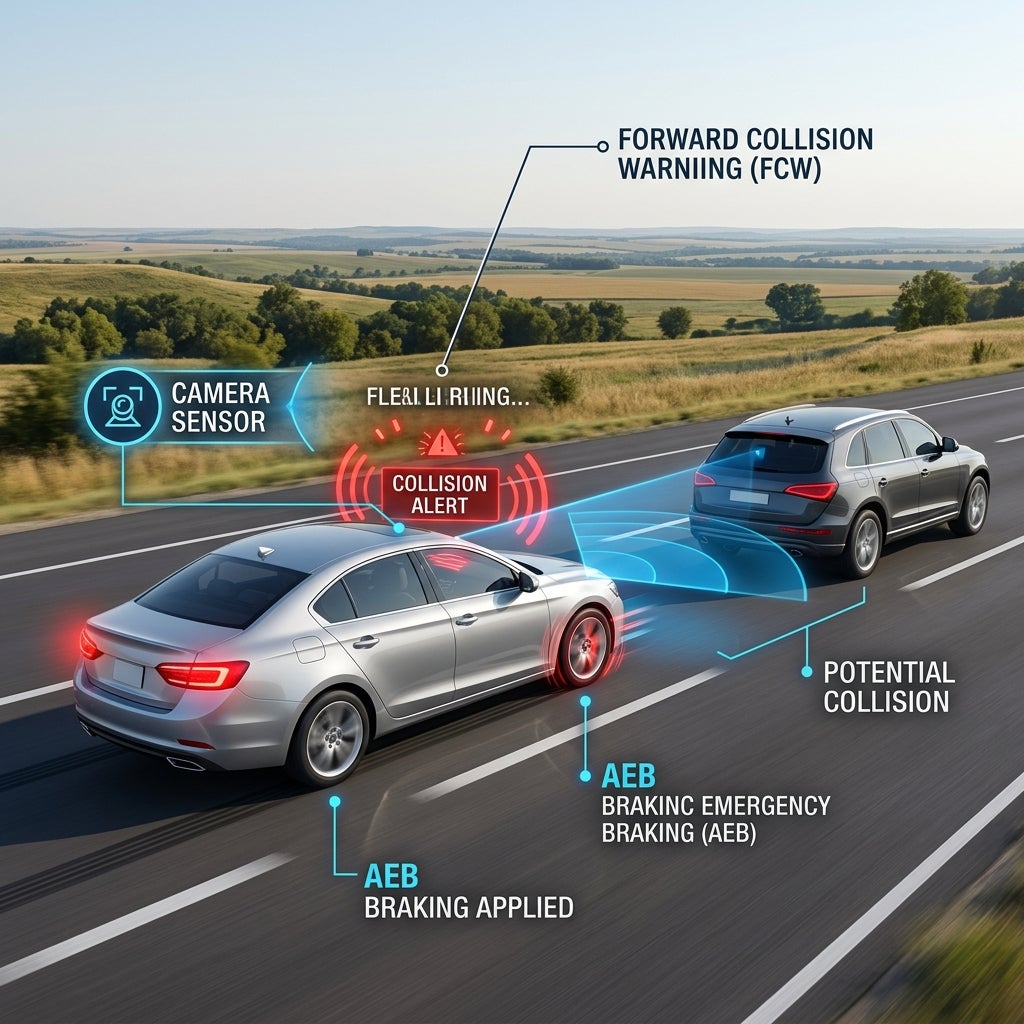
Diagram showing Forward Collision Warning and Automatic Emergency Braking technology between two cars on a highway. (Representative image for illustration purposes only. Actual vehicle may vary based on trim and configuration.)

Which Active Safety Technologies Provide the Largest Reduction in Rear-End Collisions?

When evaluating active driver-assist technologies for real-world crash avoidance, empirical data from both the Insurance Institute for Highway Safety (IIHS) and the National Highway Traffic Safety Administration (NHTSA) points to one clear champion: Automatic Emergency Braking (AEB) coupled with Forward Collision Warning (FCW). Comprehensive multi-year crash studies reveal that vehicles equipped with functional AEB and forward warning suites experience up to a 50 percent reduction in front-to-rear crashes compared to identical models without these systems.
Even more significantly, when considering crashes involving moderate to severe bodily injuries, the reduction rate jumps to an astonishing 56 percent. Forward Collision Warning acts as the immediate sensory extension for the driver, delivering audible, visual, and haptic alerts the millisecond closing speeds indicate an imminent impact. If the human driver fails to react or applies insufficient brake pedal pressure, Automatic Emergency Braking instantly engages hydraulic pressure to bring the vehicle to a complete stop or substantially mitigate crash energy. For commuters traversing Interstate 70 between Junction City and Manhattan or navigating heavy morning stop-and-go traffic near Fort Riley, AEB represents the single most effective technological safeguard available on modern vehicles.
While secondary driver-assist features like Lane-Keeping Assist and Blind Spot Information Systems offer valuable lateral protection, no other active safety feature matches the direct impact-prevention capability of forward emergency braking suites. As late-model pre-owned vehicles become increasingly standard with suites like Ford Co-Pilot360, understanding how these systems operate and verifying their calibration is essential for safety-conscious car buyers in Geary County.

How Automatic Emergency Braking (AEB) and Forward Collision Warning Prevent High-Speed Impacts

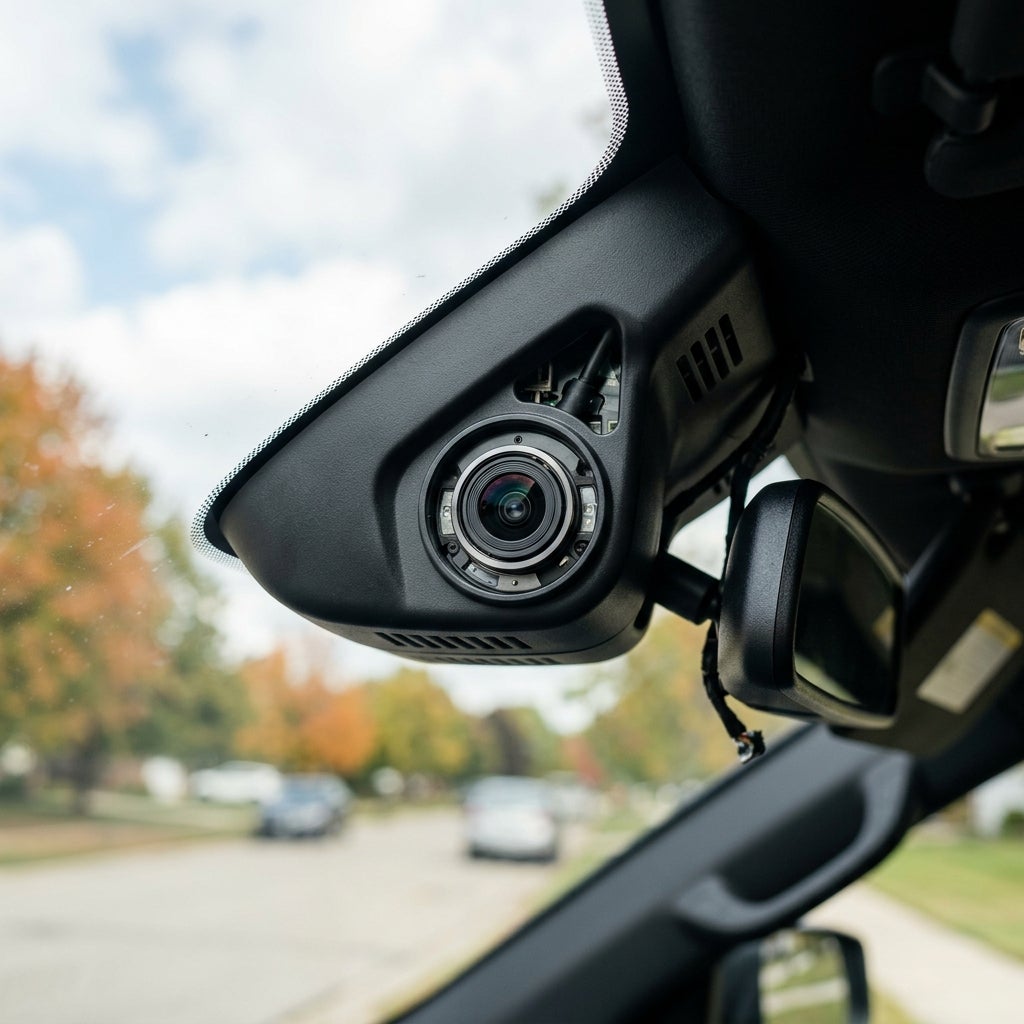
The mechanical precision behind modern AEB systems relies on sensor fusion—a sophisticated pairing of millimeter-wave radar modules mounted inside the front bumper grille and optical cameras positioned behind the upper windshield glass. Radar excels at measuring exact distances and relative velocity vectors even in heavy rain, dust, or darkness, while optical cameras analyze object geometry, brake light illumination, and lane positioning. When driving on high-speed corridors like US Highway 77 or I-70 near Junction City, traffic can decelerate abruptly due to highway construction, wildlife crossings, or base gate slowdowns. The radar and camera arrays scan hundreds of feet ahead up to 50 times per second. If closing speed exceeds safe safety thresholds, Forward Collision Warning initiates phase one: flashing red LED heads-up alerts on the windshield alongside high-frequency audible warning chimes.
Close-up of a camera lens mounted on a car windshield next to the rearview mirror. (Representative image for illustration purposes only. Actual vehicle may vary based on trim and configuration.)
Simultaneously, phase two prepares the braking hardware. Dynamic Brake Support pre-charges the brake hydraulics and pre-positions the pads closer to the rotors. If the driver taps the brake pedal, maximum stopping power is delivered instantly—eliminating human lag time. If the driver fails to respond entirely, phase three activates key emergency braking. Automated solenoids apply maximum fluid pressure to pull momentum out of the vehicle, reducing impact severity or avoiding contact completely.

Comparing Secondary Safety Tech: Blind Spot Monitoring, Adaptive Cruise Control, and Rear Cross-Traffic Alert

While Automatic Emergency Braking serves as the primary shield against severe front-to-rear impacts, secondary active safety technologies build a complete 360-degree protective bubble around your vehicle. During daily commutes across Junction City, Manhattan, and Fort Riley, these complementary systems work in tandem with AEB to prevent multi-vehicle chain-reaction accidents.

Blind Spot Monitoring (BLIS)

Utilizing short-range radar modules housed inside the rear quarter panels, Blind Spot Information Systems monitor zones extending approximately 10 feet back from the side mirrors and 30 feet behind the rear bumper. Bright warning icons illuminate in the exterior side mirrors whenever vehicles occupy adjacent lanes. When changing lanes on multi-lane stretches like Chestnut Street or I-70, BLIS eliminates visual blind spots and prevents side-swipe collisions that frequently trigger secondary rear-end impacts.

Adaptive Cruise Control (ACC)

Adaptive Cruise Control takes standard cruise functionality to the next level by automatically adjusting cruising speed to match the vehicle ahead. Utilizing front radar sensors, ACC maintains a user-selected gap distance (typically 1 to 2.5 seconds behind the lead vehicle). Late-model iterations with Stop-and-Go capability can bring the vehicle to a complete standstill in heavy traffic bottlenecks near Fort Riley gates and automatically resume speed when traffic clears, drastically reducing driver fatigue.

Rear Cross-Traffic Alert

Reversing out of tight parking stalls at crowded shopping plazas along Washington Street can be hazardous when SUV or truck sightlines are blocked. Rear Cross-Traffic Alert uses rear bumper radar sensors to detect oncoming vehicles approaching laterally from up to 45 feet away. Advanced Reverse Brake Assist systems will automatically engage vehicle brakes if an obstacle or pedestrian is detected behind the vehicle while reversing.

Should a Buyer Still Get a Professional Pre-Purchase Inspection If the Vehicle Looks Clean?

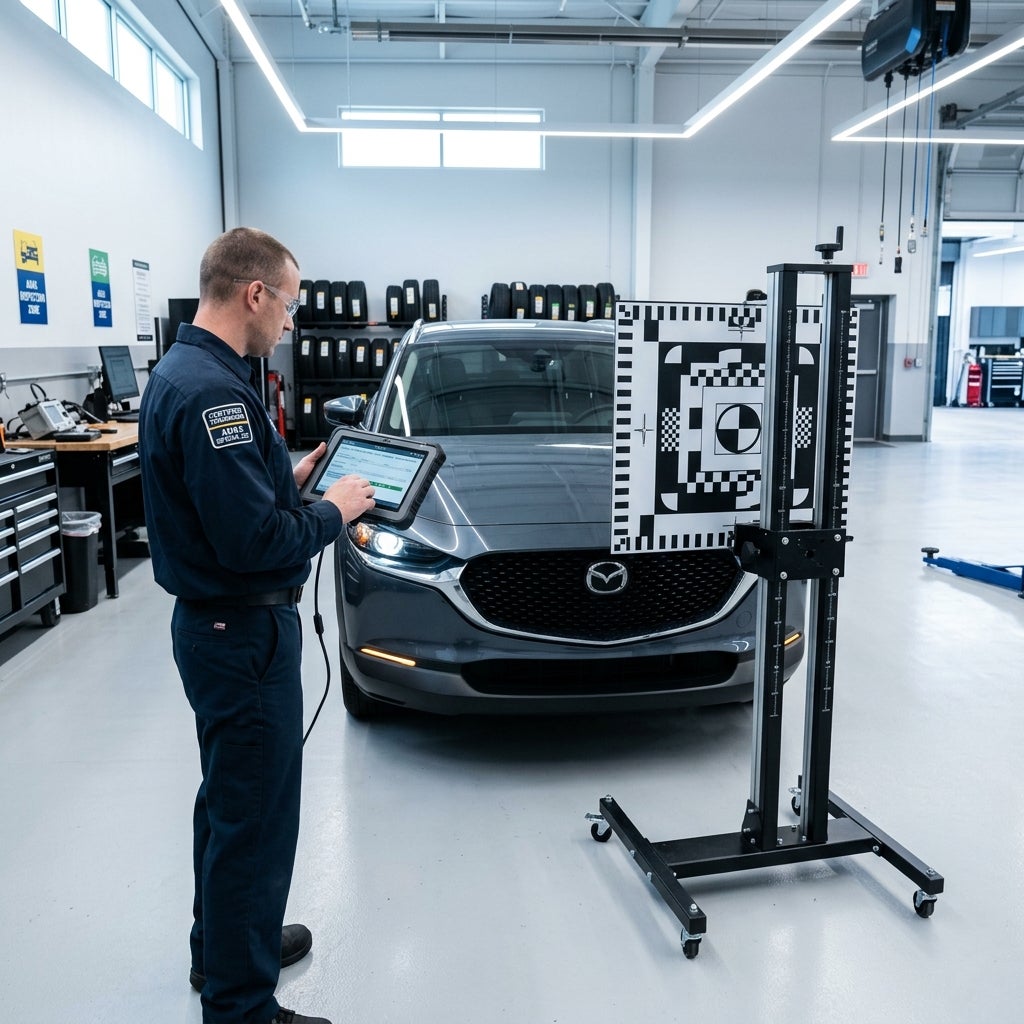
A pristine vehicle exterior and a clean history report can be deceptive when shopping for late-model pre-owned vehicles equipped with advanced safety suites. Radar modules and forward cameras operate on extreme angular precision—often within fractions of a single degree. A minor parking lot impact that leaves zero cosmetic scratches can knock a front radar bracket slightly out of spec, causing the Automatic Emergency Braking system to target empty space or fail to detect stopping vehicles altogether. Furthermore, aftermarket windshield replacements performed without specialized recalibration target boards can leave camera optics misaligned. If you are considering buying a pre-owned car from an independent private seller, getting a professional diagnostic check is imperative. You can easily Schedule Ford Service Today with factory-trained technicians at Valor Ford to verify radar targeting and camera alignment before signing any purchase contract.
Automotive technician holding a diagnostic tablet in front of a Mazda SUV and an ADAS calibration target stand. (Representative image for illustration purposes only. Actual vehicle may vary based on trim and configuration.)
Valor Ford's service department utilizes factory OBD-II scan tools to check for internal Diagnostic Trouble Codes (DTCs) within the ADAS (Advanced Driver Assistance System) control modules. These silent codes often do not trigger standard dashboard warning lights, yet they disable emergency braking capabilities. Investing in a pre-purchase verification guarantees that your vehicle's safety envelope functions exactly as engineered.

What Key Features Should Buyers Check When Inspecting a Used Car in Junction City, KS?

Inspecting a pre-owned vehicle in Junction City requires a dual focus: evaluating both physical mechanical wear and digital safety sensor integrity. Kansas seasonal climate swings—ranging from icy winter blizzards and road salt treatment to intense summer heat—place unique demands on sensors, braking systems, and tires. Use this comprehensive inspection checklist when evaluating any used vehicle:

Inspection Component

Key Checks & Vulnerabilities

Kansas Climate & Local Highway Impact

Diagnostic Verification Method

Radar Cover & Front Dome

Cracks, pitting, road debris damage, improper aftermarket grille installations.

Gravel kickback on I-70 and salt build-up during winter reduces radar transparency.

Visual inspection & factory OBD-II module communication test.

Upper Windshield Optics

Pitting, cracks in camera viewing sweep, aftermarket glass optical distortion.

Temperature swings cause stress cracks near camera bracket mounts.

Verify OEM glass logo stamp & camera alignment target test.

Brake System & Rotors

Pad thickness (< 4mm requires replacement), rotor lip rust, uneven pad wear.

Heavy salt exposure on rural Geary County roads accelerates rotor corrosion.

Micrometer pad thickness check & dynamic brake force test.

Tire Tread & Rubber Health

Tread depth (< 4/32"), uneven shoulder wear, dry rot checking between treads.

Crucial for maintaining AEB stopping distance on wet or icy Kansas roads.

Depth gauge check across inner, center, and outer tread blocks.

Dashboard Warning System

Bulb check upon start-up, stored historical fault logs in instrument cluster.

Battery voltage drops during cold winters can trigger false module codes.

Full DTC scan across PCM, ABS, and IPMA modules.

Never rely solely on visual appearance. An AEB system relies on optimal tire grip and clean mechanical braking components to fulfill its calculated stopping distances. If pads are worn or tires lack sufficient tread, even the most advanced emergency braking computer cannot overcome the physical limits of traction on slick highways.

Is It Better to Buy a Certified Pre-Owned (CPO) Car or a Standard Used Car for Active Safety Tech?

The Certified Pre-Owned Advantage

For buyers prioritising electronic safety reliability, a Certified Pre-Owned vehicle offers factory-backed assurances that standard used cars cannot match. Ford Blue Advantage CPO vehicles undergo a rigorous 172-point inspection covering every safety system. Technicians test front collision warning radar, recalibrate lane-keeping cameras, and verify that all software updates for safety modules are current. Furthermore, CPO vehicles come with factory-backed limited warranty coverage, giving families in Dickinson and Geary counties absolute confidence that their active safety suites are protected against sensor failures or module errors.

Standard Used Vehicle Considerations

Standard pre-owned vehicles often present a lower purchase price and wider selection across multiple vehicle makes and budget tiers. However, non-certified used cars require extra diligence on the buyer's part. Without factory inspection protocols, standard used cars may have unaddressed safety recalls or uncalibrated camera systems from previous repair work. At Valor Ford, every standard pre-owned vehicle on our lot undergoes a thorough safety check. You can readily Browse Used Inventory online to inspect vehicle history reports and safety feature packages before visiting our showroom.

How Much Does a Used Car Typically Cost in Junction City, KS When Equipped with AEB?

Because safety technology has trickled down from luxury trims to mainstream vehicles over the past decade, finding an affordable pre-owned car equipped with Automatic Emergency Braking in Junction City is easier than ever. Price ranges vary based on vehicle body style, mileage, and technology generation:

Sedans & Hatchbacks $14,000 - $22,000

Late-model compact and midsize sedans (model years 2018–2023) equipped with first- or second-generation AEB suites are available in the $14,000 to $22,000 range. Features often include forward collision alerts, automatic emergency braking, and lane-departure warnings—ideal for fuel-efficient daily commutes.

Compact & Midsize SUVs $18,000 - $32,000

Popular pre-owned family crossovers like the Ford Escape and Ford Explorer featuring Ford Co-Pilot360 typically fall between $18,000 and $32,000 depending on mileage and package level. These include pedestrian detection and blind-spot monitoring. Take time to Research Ford Explorer safety options.

Full-Size Trucks & Heavy Duty $26,000 - $55,000+

Pre-owned trucks equipped with advanced driver assistance suites, such as Ford Co-Pilot360 2.0 with Intersection Assist and Trailer Coverage, range from $26,000 for work-ready models up to $55,000+ for premium trims. Check details to Research Ford F-150 or Research Ford F-250.

Junction City Used Car Inventory Spotlight: Freshness and Volume Trends

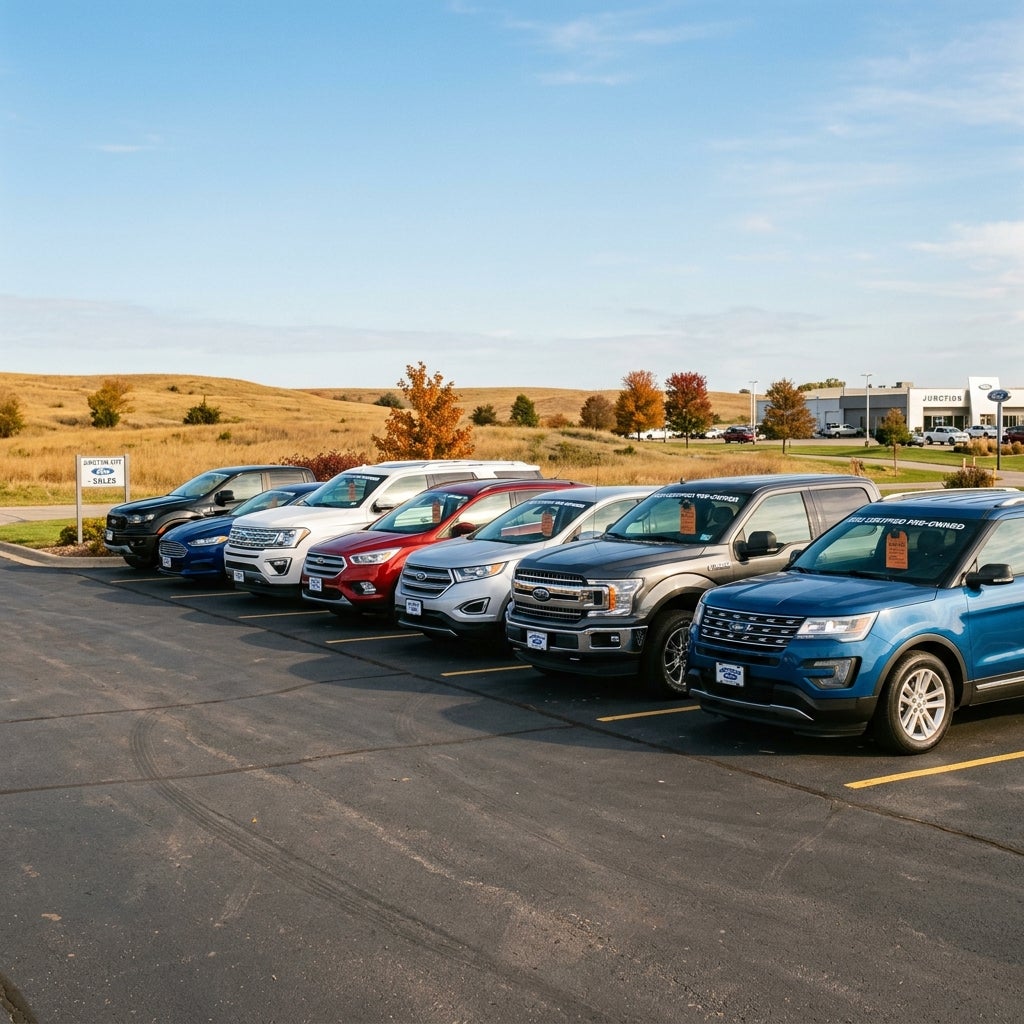
Current automotive market inventory data for Geary County and the surrounding Flint Hills region reveals significant volume trends for safety-conscious car shoppers in Fall 2026. Pre-owned vehicle turn rates have accelerated, with late-model vehicles (2021–2025) featuring standard AEB remaining on dealer lots for an average of just 28 days compared to 45 days for older vehicles lacking active driver assists.
A row of colorful Ford SUVs and trucks parked in a dealership lot against a scenic outdoor background. (Representative image for illustration purposes only. Actual vehicle may vary based on trim and configuration.)
This rapid turnover reflects high demand from local commuters and military families stationed at nearby Fort Riley who prioritize collision avoidance features for their daily drives. Inventory freshness is at an all-time high at Valor Ford, with new trade-in intake occurring weekly. Buyers seeking specific active safety features like Evasive Steering Assist or Intersection Assist are encouraged to monitor lot updates frequently to secure late-model inventory as soon as vehicles complete their safety reconditioning.

Navigating Base Gates and Flint Hills Highways: Real-World Safety for Fort Riley Personnel

Base Gate Congestion & Stop-and-Go Protection

Military personnel and civilian contractors commuting to Fort Riley contend with intense traffic density during morning physical training shifts and afternoon dismissal. Traffic approaching Trooper Gate, Henry Gate, or Ogden Gate can suddenly grinding to a halt from 55 mph highway speeds. Low-sun glare during early morning hours further impairs human visibility. In these exact high-risk scenarios, Automatic Emergency Braking and Forward Collision Warning provide critical milliseconds of reaction time, preventing severe rear-end accordion crashes at security checkpoints.

Flint Hills Rural Highways & Wildlife Alerts

Driving open stretches of I-70 or rural county roads in the Flint Hills presents unique environmental driving hazards. Deer movement peaks during fall migration months in Kansas, and sudden crosswinds can cause sudden speed reductions in surrounding traffic. Advanced radar-camera fusion systems with Nighttime Pedestrian and Large Animal Detection actively monitor dark roadways, auto-applying brakes when unpredictable hazards cross your path before human headlights even catch the reflection.

How to Test Drive and Evaluate Driver-Assist Systems Safely Before You Buy

Evaluating active safety systems requires a structured approach during your dealership test drive. You must safely confirm that all sensors, alerts, and feedback mechanisms function intuitively without causing unnecessary distraction. Follow this three-step evaluation guide:

Step 1: Menu & Static Setup

Before turning the key, navigate the instrument cluster digital driver display. Verify that Forward Collision Sensitivity can be adjusted between High, Normal, and Low. Ensure that active braking toggles are switched ON and that no driver-assist system warning messages or disabled icons are illuminated.

Step 2: Low-Speed Alert Verification

In a controlled parking lot or quiet side street, practice low-speed braking and reversing. Test the Rear Cross-Traffic Alert by backing toward an open area with cross traffic. Confirm that audible chimes sound clearly and that backup camera dynamic guidelines accurately track wheel angle.

Step 3: Highway Gap & Lane Test

Take the vehicle onto I-70 or Highway 77. Engage Adaptive Cruise Control to test how smoothly the radar adjusts vehicle speed as lead cars accelerate or slow down. Test Lane-Keeping System feedback to ensure steering wheel haptic vibrations or soft steering torque interventions feel natural.

Upgrading Your Current Vehicle: Trade-In Values and Safety Suite Upgrades

The Financial Logic of Upgrading to Active Safety

If you are currently driving an older model vehicle produced before AEB became standard industry practice, your vehicle lacks critical automated collision avoidance tech. Upgrading to a late-model pre-owned vehicle does not just improve reliability—it protects your family against catastrophic rear-end accidents. Thanks to sustained demand in the Kansas pre-owned market, current trade-in valuations remain exceptionally strong. Levering your current car's equity allows you to transition into a late-model Ford Co-Pilot360 vehicle while Helping you find a financing solution that fits your budget.

Seamless Trade Evaluation at Valor Ford

At Valor Ford, evaluating your trade-in is transparent and quick. Our appraisal team analyzes market conditions, maintenance history, and vehicle condition to offer top market value for your trade. You can start the process right now from home using our simple online tool to get an instant Trade In Evaluation. Apply that trade equity directly toward any of our certified pre-owned or standard safety-equipped used cars.

Find Vehicles Equipped with AEB and Advanced Safety Tech at Valor Ford in Junction City

When it comes to protecting yourself and your loved ones on Kansas roads, Automatic Emergency Braking stands unmatched as the most effective technology for reducing rear-end collisions. Whether you are searching for a fuel-efficient sedan, a versatile crossover, or a heavy-duty truck, Valor Ford is your trusted destination for safety-inspected pre-owned vehicles in Geary County. Visit our dealership at 1825 Goldenbelt Blvd, Junction City, KS 66441 to test drive late-model Ford Co-Pilot360 models. Need directions? Get Directions to Valor Ford or Call us at (785) 238-5114 to speak with our friendly team. Explore our online tools to Schedule Pickup and Delivery Service, Order Genuine Ford Parts, or research our latest models including Research Ford Maverick, Research Ford Mustang, Shop New Ford Bronco Inventory, and Research Ford F-250.
Valor Automotive logo featuring a silver shield with a red 'V' and white 'A' monogram above the company name.
Posted in:

Related Posts

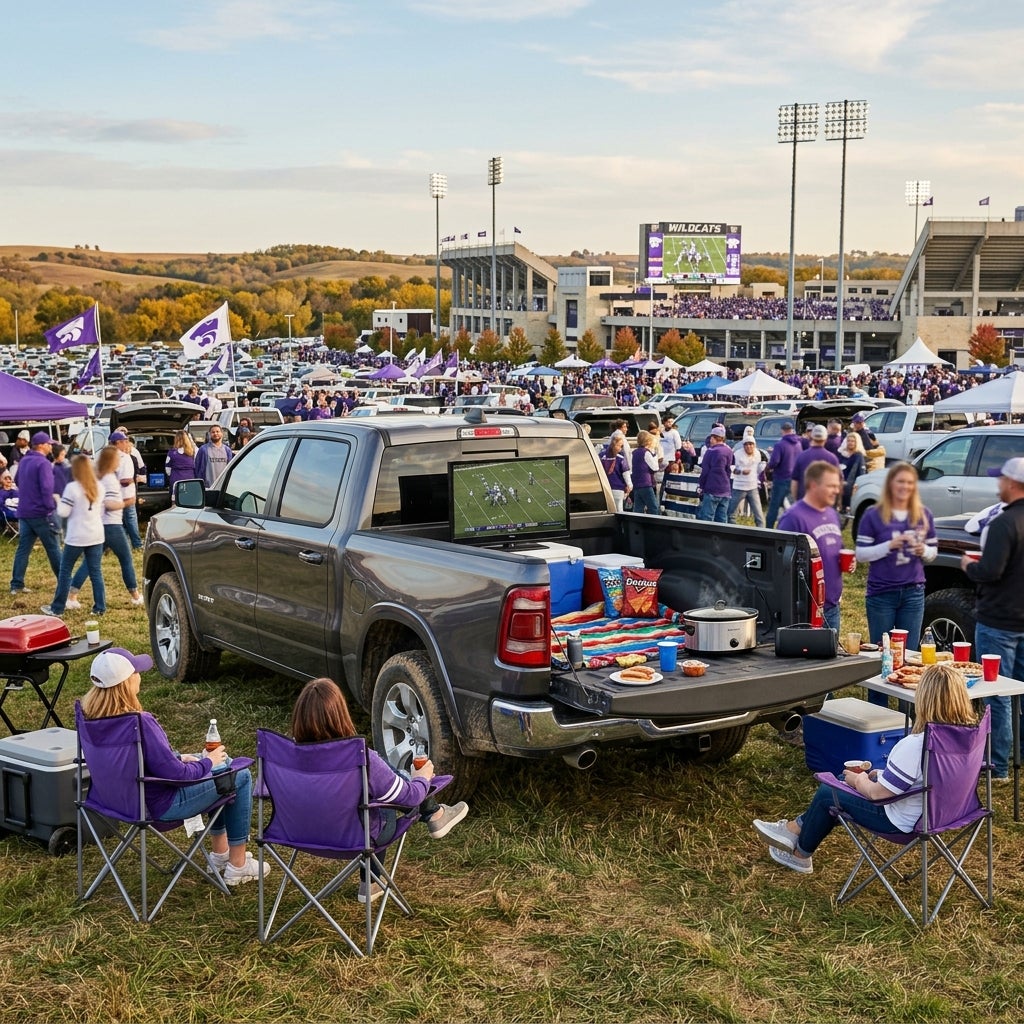
People tailgating around a grey pickup truck with a TV in the bed outside a college football stadium. (Representative image for illustration purposes only. Actual vehicle may vary based on trim and configuration.)

Can a 400-Watt Truck Outlet Power a Slow Cooker and TV Simultaneously? The Bottom-Line Answer

Can a 400-Watt Truck Outlet Power a Slow Cooker and TV Simultaneously? The Bottom-Line Answer The short answer is generally no, not if the slow cooker is actively heating on high. A standard 400-watt truck or vehicle inverter is designed to handle light-to-moderate electrical loads. A typical 6-quart slow cooker operating on its High temperature setting draws between 250 and 300 watts of continuous power, but it can spike beyond 350 watts when its heating element initially cycles on. When you pair that with a modern 43-inch to 55-inch LED television—which draws anywhere from 60 to 120 watts—the combined continuous demand quickly reaches 310 to 420 watts. Add in initial power surge requirements, and you will almost certainly trip the vehicle inverter's automatic internal circuit breaker, instantly cutting power to both appliances. However, there is a very simple workaround that makes simultaneous operation very effective If you cook your meal completely at home, bring it to the tailgate hot, and switch the slow cooker setting to 'Warm' (which consumes only 50 to 80 watts continuous), your total load with a 65-watt LED TV will remain safely under 150 watts. Alternatively, powering devices sequentially—bringing stew or dip to temperature before plugging in the big screen—allows a standard 400-watt outlet to manage game day duties without issue. For drivers seeking seamless power without wattage juggling, high-capacity onboard power systems found on modern vehicles like the Ram 1500 and Chrysler Pacifica at Valor CDJR offer robust solutions tailored for outdoor activities. Calculating Electrical Load: Slow Cooker and LED TV Power Draw Explained To understand electrical management in your truck or minivan, you must master the difference between running (continuous) watts and starting (surge) watts. Vehicle inverters convert 12V DC power from the automotive battery into 115V AC power suitable for household electronics. Standard automotive inverters are rated for peak surge capacity for fractions of a second, but their sustained output rating is what dictates real-world usability. A slow cooker uses resistive heating coils. When first turned on High, these coils demand peak amperage to reach operating temperature. Similarly, televisions feature power supply capacitors that draw a brief surge when turned on. If the total combined surge exceeds 400 watts, the inverter trips to protect your vehicle's wiring harness and battery from overheating or short-circuit damage. Tailgate Device Running Watts Peak Surge Watts Compatibility (400W Limit) 3.5-Qt Slow Cooker (Low) 120W - 150W 180W Safe Alone or with Small TV 6-Qt Slow Cooker (High) 275W - 320W 400W Single Device Only Slow Cooker (Warm Mode) 50W - 75W 90W Safe for Dual Device Use 32-inch LED Television 35W - 55W 75W Very Low Power Draw 55-inch Smart LED TV 75W - 110W 150W Moderate Power Draw HD Satellite Receiver 20W - 30W 40W Minimal Power Draw What Is the Onboard Power Inverter Capacity Available on the Ram 1500? The Ram 1500 has long set the benchmark for work site utility and game day versatility. Most Ram 1500 models equipped with the Bed Utility Group feature a 115V/400W AC outlet mounted directly into the interior sidewall of the truck bed, complemented by a secondary 115V outlet on the rear of the center console inside the cabin. These outlets are fed by a heavy-duty power inverter tied directly to the vehicle's charging network. Ram's intelligent battery protection control unit monitors the truck's 12-volt battery voltage continuously. If you are running devices with the ignition in accessory mode and voltage drops below a safe starting threshold, the system automatically cuts inverter power to preserve cranking battery reserve. Browse our latest New Vehicle Listings to explore Ram models equipped with factory inverter packages. Explore Ram 1500 Inventory How Does the Onboard Electrical Outlet System Work on the Chrysler Pacifica? 115V AC Inverter Power The Chrysler Pacifica features an available 115-volt AC auxiliary power outlet located convenient to the second-row seats or rear cargo trim panel. Providing up to 150W continuous (and up to 400W on select high-spec trims), it powers gaming consoles, laptops, and outdoor displays directly from the vehicle battery. Plug-In Hybrid Efficiency On the Chrysler Pacifica Plug-In Hybrid, the onboard electrical setup is capable. The vehicle pulls electrical power directly from its massive 16 kWh high-voltage lithium-ion traction battery, allowing you to run small electronics for hours without idling a gasoline engine continuously. Whisper-Quiet Operation Because the hybrid system only cycles the V6 gas engine occasionally to top off the battery reserve, your tailgate setup stays whisper quiet. Enjoy pristine sound quality from television broadcasts and music without noisy generator humming or exhaust odor. Is a Minivan or a Full-Size Truck Better for Family Game Day Setups at College Football Games? Choosing between a Ram 1500 and a Chrysler Pacifica for college game days in Manhattan comes down to how your family tailgates. The Ram 1500 provides strong rugged capability. High ground clearance, durable spray-in bedliners, RamBox cargo management units with built-in drain plugs for ice and drinks, and massive towing capacity make it ideal for pulling large smoker trailers or heavy equipment platforms. Conversely, the Chrysler Pacifica shines in weather protection and passenger comfort. Its rear power liftgate serves as an instant rain canopy or sun shade over rear-facing seating. Power sliding doors make loading fragile electronics effortless, while weather-sealed interior flooring handles muddy boots during rainy autumn kickoffs across Riley County. What Is the Cargo Capacity of the Chrysler Pacifica for Hauling Tailgating Equipment? 140.5 Cu. Ft. Max Space With exclusive Stow 'n Go seating folded effortlessly into the floor bins, the Chrysler Pacifica opens up a massive 140.5 cubic feet of flat cargo space. That is more enclosed cargo volume than many full-size SUV options on the market. Enclosed Protection Protect expensive 65-inch 4K screens, soundbars, satellite dishes, and digital slow cookers inside a climate-controlled, lockable cabin while traveling from Junction City to Manhattan before game kickoff. Upgrade Your Rig Ready to trade in your current vehicle for a tailgate-ready minivan or truck? Get a current valuation today with our official Trade In Evaluation tool. Value Your Trade-In K-State Game Day Setup: Using Chrysler Pacifica and Ram 1500 Onboard Power at Bill Snyder Stadium For K-State Wildcats fans driving up from Junction City or surrounding Geary County, a smooth game day experience at Bill Snyder Family Stadium requires a solid electrical timeline. Parking lots open 5 hours before kickoff, giving you plenty of time to build the ultimate tailgate station. Recommended Timeline & Power Strategy: • Hour -4.5 (Arrival & Set Up): Park vehicle, extend your pop-up tent, and position your 14-gauge heavy-duty extension cord from the Ram 1500 bed outlet or Pacifica rear plug. • Hour -4.0 (Food Preparation): Plug in your pre-heated slow cooker set strictly to 'Warm' (50W-80W). If you need to boost food heat initially, run the crockpot alone for 20 minutes before powering on video gear. • Hour -3.5 (Entertainment Power On): Connect your LED TV (65W) and satellite/streaming device (25W). Total draw will settle around 140W to 170W—well within your 400W system threshold. • Hour -1.0 (Pre-Kickoff Wind Down): Unplug non-essential devices, secure equipment, and head into the stadium with total peace of mind! What Stadium Tailgating Rules Around Power Use and Generators Should Owners Consider? Traditional Generator Restrictions K-State Athletics and Bill Snyder Family Stadium enforce specific tailgating policies regarding standalone gas generators. Loud portable generators that disrupt neighboring tailgaters or produce heavy exhaust fumes are strictly monitored. Furthermore, storing extra liquid gasoline cans near hot vehicle tailpipes poses severe fire safety hazards in crowded stadium parking lots. Onboard Power Advantage Vehicle-integrated onboard outlets give Ram 1500 and Chrysler Pacifica owners a massive advantage. Factory inverters produce zero extra noise beyond standard engine idle or operate in complete silence when powered by the Pacifica Plug-In Hybrid. You comply with all stadium rules, save space by leaving external generators at home, and eliminate gas cans entirely. How to Manage 400-Watt Outlets Safely Without Tripping Truck Inverter Breakers 1. Stagger Startup Times Never plug in and turn on the slow cooker, TV, and audio receiver simultaneously. Turn on devices one by one, allowing peak initial surge currents to settle before starting the next appliance. 2. High-Efficiency Tech Choose modern LED or OLED displays and compact soundbars rather than older plasma screens or high-wattage home theater receivers that consume excessive electricity. 3. Electrical Maintenance Ensure your battery terminals, alternator output, and fuses are in top condition before football season. Book a multi-point inspection through our Service Scheduler. Schedule Electrical Service What Is the Starting Price for a Ram 1500 Equipped with Truck Bed Power Outlets? The Ram 1500 lineup offers onboard 115V/400W outlets across multiple trim levels. On entry-level trims like the Tradesman and popular Big Horn, the 400-watt power inverter is included when equipped with the optional Bed Utility Group or Level 2 Equipment Package. Mid-to-upper trims such as the Laramie, Rebel, and Limited come standard with cabin and bed-mounted auxiliary power outlets. At Valor CDJR, our finance specialists help Junction City and Manhattan buyers with current financing information. Start your application early by visiting Get Pre-Approved. Ram 1500 Trim Outlet Configuration Inverter Rating Tailgate Package Availability Tradesman Bed & Console Outlets 400W Peak / Continuous Optional (Bed Utility Group) Big Horn Bed & Console Outlets 400W Peak / Continuous Optional (Level 2 Group) Laramie Bed, Console & Rear Seat 400W Continuous Standard Equipment Rebel Bed, Console & Rear Seat 400W Continuous Standard Equipment Limited Bed & Multi-Cabin Sockets 400W Continuous Standard Premium Feature Tailgating and Camping Power Setups Across Junction City and Riley County Milford Lake Camping Heading out for weekend camping at Milford Lake? Onboard 400W outlets easily power air mattress inflators, LED campsite lanterns, portable coffee makers, and electric insect zappers without carrying heavy power banks. Tuttle Creek Excursions At Tuttle Creek State Park, recharge 18V power tool batteries, run portable tire pumps for off-road trail riding, or keep handheld radios powered up during multi-day family outdoor adventures. Rural Work & Jobsite Power Across rural Geary and Riley counties, local agricultural and contractor teams rely on Ram truck bed power to run mobile laptops, diagnostic scanners, and battery chargers right in the field. Test Drive a Tailgate-Ready Ram 1500 or Chrysler Pacifica at Valor CDJR in Junction City Whether you are getting ready for K-State game days at Bill Snyder Family Stadium or gearing up for outdoor family camping across Riley and Geary counties, having reliable onboard AC power elevates your entire experience. A standard 400-watt outlet can seamlessly run a slow cooker on 'Warm' alongside a large LED television, making your vehicle the ultimate tailgate command center. Visit Valor CDJR in Junction City, KS today to inspect power inverter options on our New Vehicle Listings and Used Vehicle Listings. Our team is ready to assist you with everything from vehicle feature demonstrations to maintaining your electrical system at our Parts Department and Express Lane. Explore our Commercial Vehicle Inventory or Get Directions to Valor CDJR today. Have questions right now? Call us at (785) 238-5114! Schedule Your Test Drive Today

Why Was the Jeep Patriot Discontinued After 2017? The Bottom Line Strategy

Why Was the Jeep Patriot Discontinued After 2017? The Bottom Line Strategy

Why Was the Jeep Patriot Discontinued After 2017? The Bottom Line Strategy Fiat Chrysler Automobiles (FCA) officially discontinued the Jeep Patriot following the 2017 model year as part of a comprehensive global vehicle consolidation strategy. At its core, the decision was driven by three primary operational pillars: eliminating redundancy within the compact SUV segment, retiring the aging Mitsubishi-co-developed MK architecture, and aligning the Jeep lineup with increasingly stringent global crash safety standards. For a decade, the Jeep Patriot and its mechanical twin, the first-generation Jeep Compass, occupied virtually the same showroom footprint. Both compact crossovers shared identical wheelbases, engines, transmissions, and interior frameworks. While the Patriot appealed to traditionalists with its classic, boxy Cherokee-inspired profile and ultra-accessible price point, having two distinct nameplates competing for the exact same entry-level buyer split marketing dollars and engineering focus. By retiring both the Patriot and the first-generation Compass after 2017, FCA was able to launch a single, completely re-engineered global Jeep Compass built on the advanced Small Wide 4x4 platform. This move streamlined manufacturing efficiency, improved structural integrity across the board, and allowed Jeep to deliver a far more refined compact SUV to drivers throughout Junction City, Fort Riley, and Manhattan. Platform Overhaul: How FCA Streamlined the Patriot and Compass Lineup The foundation of the 2017 Jeep Patriot traced back to the mid-2000s MK platform, a joint architecture originally co-developed by Chrysler and Mitsubishi Motors. Also shared with the Dodge Caliber, the MK chassis served its purpose by delivering affordable unit-body construction, but by 2017 it had reached the absolute limits of its engineering lifespan. As crash testing protocols evolved—most notably the Insurance Institute for Highway Safety (IIHS) small overlap front crash test—the MK platform required substantial structural overhaul to maintain top tier safety ratings. Rather than pouring capital into redesigning two separate legacy platforms, FCA transitioned to the modular Small Wide 4x4 architecture (shared with the Jeep Renegade and modern Compass). The new Small Wide architecture yielded dramatic improvements in torsional rigidity, noise, vibration, and harshness (NVH) suppression, and ride comfort. Drivers stepping out of a 2017 Patriot and into a modern platform immediately notice reduced wind noise on highway stretches along I-70 and enhanced cabin acoustics. What Was the Original Starting MSRP of a 2017 Jeep Patriot? One of the main reasons the 2017 Jeep Patriot retains a passionate fanbase is its historical positioning as America's most affordable 4x4 SUV. Below is a breakdown of the original starting trim tiers that defined its market appeal. Sport Trim With an initial base MSRP starting around $18,040 for front-wheel drive, the Patriot Sport was built for value-focused buyers. Standard equipment included 16-inch steel wheels, fog lamps, roof side rails, tilt steering, and cloth bucket seats, offering functional utility without extra frills. Latitude Trim Stepping up to the Latitude trim unlocked essential everyday conveniences like power windows, power door locks, heated front seats, keyless entry, air conditioning, 17-inch aluminum wheels, and a leather-wrapped steering wheel, delivering maximum value for commuters. High Altitude Trim The High Altitude edition brought premium touches to the compact Patriot, including leather-trimmed seats, a power driver's seat, a power sunroof, bright chrome exterior fascia accents, and unique 17-inch polished aluminum wheels. Trim Level Est. Original MSRP (FWD) Standard Engine Key Standard Features Sport $18,040 2.0L World Gas I4 16-inch Steel Wheels, Fog Lamps, Cloth Seats Latitude $22,395 2.4L World Gas I4 Power Lock/Windows, Heated Front Seats, A/C High Altitude $25,740 2.4L World Gas I4 Leather Seating, Power Sunroof, Chrome Trim What 4WD System Makes the 2017 Jeep Patriot Trail Rated? Not every 2017 Jeep Patriot earned the prestigious Trail Rated badge. While standard four-wheel-drive Patriots utilized the Freedom Drive I system—a full-time active electronic system designed primarily for light snow and rain—off-road enthusiasts opted for the specialized Freedom Drive II Off-Road Package. Freedom Drive II transformed the compact crossover into a genuine trail vehicle by pairing the 2.4L engine with a Continuously Variable Transmission with Low Ratio (CVT2L). This setup provided a 19:1 crawl ratio, ideal for managing steep inclines and rocky terrain across the Flint Hills near Riley County. The Freedom Drive II package also added a one-inch factory ride height lift, full-underbody skid plates, front and rear tow hooks, engine oil cooler, all-terrain tires, and water-fording seals capable of crossing up to 19 inches of water. Finding a pre-owned Patriot with FDII is a great win for local budget trail runners. Browse Pre-Owned Inventory 2017 Jeep Patriot vs Gladiator: Comparing Engines, Transmissions, and Capability 2017 Jeep Patriot Powertrain The 2017 Patriot offered two four-cylinder World Gas Engine options: a 2.0L producing 158 horsepower and 141 lb-ft of torque, or a 2.4L delivering 172 horsepower and 165 lb-ft of torque. Transmission options included a 5-speed manual, a Hyundai 6-speed automatic, or the Jatco CVT. Max towing capacity was capped at 2,000 lbs with the Prep Package. Jeep Gladiator Powertrain By contrast, the Jeep Gladiator comes standard with a robust 3.6L Pentastar V6 generating 285 horsepower and 260 lb-ft of torque, mated to a 6-speed manual or an 8-speed TorqueFlite automatic. Built with heavy-duty solid Dana 44 axles front and rear, the Gladiator boasts a towing capacity of up to 7,700 lbs and a payload rating up to 1,725 lbs. Specification 2017 Jeep Patriot (2.4L) Jeep Gladiator (3.6L V6) Horsepower 172 hp 285 hp 盛り Torque 165 lb-ft 260 lb-ft Max Towing Up to 2,000 lbs Up to 7,700 lbs Drivetrain Type FWD / Freedom Drive I & II AWD Command-Trac / Rock-Trac 4WD Is a Jeep Gladiator Practical for Daily Commuting Around Junction City and Manhattan? Commuter Fuel & Ride Despite its mid-size truck chassis, the Gladiator utilizes a five-link coil rear suspension system adapted from the Ram 1500. This provides impressive highway composure during daily drives on I-70 between Fort Riley, Junction City, and Kansas State University. Modern sound insulation and refined top options make the cabin surprisingly quiet for a vehicle with removable doors and roof panels. Open-Air Truck Utility The 5-foot steel bed with available spray-in bedliner and 115V outlet easily handles tailgating gear for K-State football games, camping equipment, or hardware store runs, offering dual-purpose versatility that small crossovers simply cannot match. Why Would a Vehicle Buyer Choose a 2017 Jeep Patriot Over a Jeep Gladiator? Pre-Owned Value Option While a pre-owned or new Gladiator represents a serious investment in heavy-duty off-road truck capability, a used 2017 Jeep Patriot occupies an entirely different budget tier. For military personnel arriving at Fort Riley or college students needing reliable 4WD transportation contact the dealership for current pricing, a late-model Patriot offers unmatched entry value. Compact Size & Fuel Efficiency The Patriot's compact length (173.8 inches vs. Gladiator's 218 inches) makes it effortless to park in tight apartment lots, downtown Manhattan parking structures, or crowded driveways. Furthermore, its lighter curb weight translates to lower routine fuel consumption during short city trips. Is a Jeep Gladiator Significantly More Expensive to Maintain Than a 2017 Jeep Patriot? When evaluating long-term ownership costs, physical vehicle size and mechanical complexity play major roles. The 2017 Jeep Patriot is a lightweight compact crossover utilizing standard passenger vehicle components, which generally means lower costs for routine wear items like replacement tires, brake pads, and rotors. The Jeep Gladiator, being a body-on-frame truck equipped with heavy-duty solid axles, transfer cases, and optional 33-inch or 35-inch all-terrain tires, requires larger fluid capacities (e.g., differential fluid service for front and rear Dana 44 axles) and higher-capacity brake hardware. However, the Gladiator's Pentastar V6 and 8-speed transmission have proven remarkably durable over long service intervals. Regardless of which Jeep model you drive, maintaining regular oil changes, tire rotations, and fluid flushes is easy at Valor CDJR. You can quick-schedule service through our Express Lane or book an appointment online with our certified technicians at our Service Scheduler. Schedule Certified Service Winter Weather Traction in Kansas: Patriot Freedom Drive vs. Gladiator Command-Trac Freedom Drive I (AWD) The Patriot's Freedom Drive I operates as an automatic full-time system. On icy paved roads around Junction City, it continuously adjusts torque between front and rear wheels without driver intervention, providing smooth, predictable slick-road traction. Command-Trac (Part-Time 4WD) Standard on Gladiator, Command-Trac allows drivers to manually lock the front and rear axles into a 50/50 split (4H mode). This provides ultimate traction when pushing through heavy Kansas snowdrifts or unplowed backroads. Selec-Trac (Full-Time 4WD) Available on select Gladiator trims, Selec-Trac adds a full-time 4WD mode that can remain engaged constantly on mixed surfaces—offering the seamless automatic operation of a Patriot with truck-grade mechanical muscle. Trade-In Value and Used Market Demand for 2017 Jeep Patriots in Geary County Because the 2017 Patriot was the final model year of its generation, well-maintained units remain in high demand throughout Geary County and surrounding areas. Reliable 4WD vehicles priced affordably sell rapidly to military personnel at Fort Riley and local students needing dependable winter transport. If you currently own a 2017 Patriot, its sustained market popularity means you likely hold significant trade-in equity. You can evaluate your vehicle's current market value instantly using our online Trade In Evaluation tool before stepping into a newer SUV or truck. Our trade team at Valor CDJR provides competitive trade-in offers for clean pre-owned Patriots, making your upgrade to a newer Compass, Cherokee, or Gladiator smooth and affordable. Upgrading From a Discontinued Patriot: Modern Tech and Towing Alternatives Modern Tech Upgrades Drivers transitioning out of a 2017 Patriot will enjoy massive technology upgrades in newer models. Modern Jeep Compass and Cherokee options feature Uconnect touchscreens with Apple CarPlay, Android Auto, digital driver displays, and advanced safety tech like Adaptive Cruise Control and Lane Keep Assist. Explore options in our Used Vehicle Listings. Expanded Towing & Utility If your lifestyle demands hauling boats, campers, or equipment trailers across Kansas, stepping up to a Gladiator or Grand Cherokee expands your towing limits from 2,000 lbs up to 7,700 lbs. You can start your upgrade process online by visiting Get Pre-Approved. Get Pre-Approved Online Find Your Next Capable Jeep Model at Valor CDJR in Junction City, KS Whether you are seeking a quality pre-owned 2017 Jeep Patriot, a refined modern Jeep Compass, or the rugged open-air capability of a Jeep Gladiator, Valor CDJR in Junction City is your trusted local resource. Our knowledgeable team serves drivers from Fort Riley, Manhattan, Geary County, and beyond with transparent pricing and exceptional customer care. Explore our full range of inventory in our New Vehicle Listings or check out our specialized Commercial Vehicle Inventory. For authentic replacement components and accessories, visit our expert Parts Department. Visit us today at 1825 Goldenbelt Blvd, Junction City, KS 66441. Get Directions to Valor CDJR or Call us at (785) 238-5114 to speak directly with our team. Explore Available Inventory

What Car Buying Discounts Can Active Duty Service Members Claim?

What Car Buying Discounts Can Active Duty Service Members Claim?

What Car Buying Discounts Can Active Duty Service Members Claim? Active duty service members can claim a $500 Military Bonus Cash allowance on select eligible Chrysler, Dodge, Jeep, and Ram vehicles through the Stellantis US Military Program. This incentive applies to active duty personnel, active reserves, retirees, and honorably discharged veterans within 12 months of service. The bonus cash can be combined with national consumer rebates, regional factory cash allowances, lease incentives, and current financing options offered through Chrysler Capital to review current incentives on a new vehicle purchase. Eligible military personnel purchasing or leasing a qualified vehicle can also take advantage of connected-services discounts. Stellantis offers a 12-month package for the price of 10 on select annual assistance and navigation plans, enhancing on-road security during long highway travel or routine relocations. Additionally, nonresident service members stationed in Kansas may qualify for state motor-vehicle property tax exemptions, significantly lowering ownership costs over the lifecycle of the vehicle. Our team works directly with military personnel stationed near Fort Riley to ensure every available discount and incentive is applied before signing. Whether selecting a heavy-duty pickup with high payload strength or a comfortable family SUV equipped with advanced safety tech, active duty buyers receive full support navigating incentive programs. You can confirm current program compatibility or discuss vehicle options by giving our sales staff a quick call at (785) 238-5114 or visiting our Junction City showroom location. Table of Contents How Do You Verify Eligibility and Combine Military Bonus Cash Offers? Can You Buy Remotely Before Arrival and Claim Kansas Tax Exemptions? How Does Trading In a Vehicle Work Alongside Military Discount Programs? What Is the Difference in Output Between Ram 1500 Hurricane Engines? What Is the Crawl Ratio and Transfer Case Setup on the 2027 Jeep Wrangler Rubicon? Frequently Asked Questions About Military Vehicle Purchases at Valor CDJR How Do You Verify Eligibility and Combine Military Bonus Cash Offers? Military eligibility for Stellantis bonus cash is verified by presenting an active duty military ID, DD Form 214, Leave and Earnings Statement (LES), or official retirement certificate. Spouses and surviving spouses residing in the same household also qualify for the discount. Once verified, the $500 Military Bonus Cash stacks directly on top of standard retail rebates, promotional APR financing, and special lease cash. Combining offers requires proper documentation and program matching during the financing process. The incentive acts as a direct cash allowance toward the down payment or cap cost reduction, reducing the total amount financed. Buyers can combine this program with regional promotional offers, trade-in allowances, and special financing terms customized to fit individual budget requirements. Verification documents required at the time of purchase include: Active Duty Military ID or Reserve ID card DD Form 214 (Certificate of Release or Discharge from Active Duty) Recent Leave and Earnings Statement (LES) Official military retirement certificate or 100% disability documentation Our finance department reviews all documentation upfront to ensure seamless compliance with manufacturer audit standards. While the military bonus cash applies primarily to new vehicle purchases and leases, shoppers looking for pre-owned options can explore our quality pre-owned vehicle inventory to find capable cars, trucks, and SUVs that fit their budget. Can You Buy Remotely Before Arrival and Claim Kansas Tax Exemptions? Service members can complete the entire vehicle purchase remotely prior to relocating by submitting digital credit applications, completing trade-in evaluations, and signing finance paperwork online. Nonresident military personnel stationed in Kansas can apply for a motor-vehicle property tax exemption by submitting Form TR-601 along with active military orders and a current Leave and Earnings Statement. Remote buying streamlines the relocation process by allowing buyers to select a vehicle and finalize transaction terms weeks before arriving at their new duty station. Vehicles can be fully prepped, detailed, and held at the dealership, allowing service members to drive off the lot immediately upon arrival without spending valuable leave time negotiating terms. The Kansas motor-vehicle property tax exemption offers significant financial relief for active duty members who maintain legal residence in another state. To claim the exemption, service members complete Form TR-601 (Military Personnel Affidavit for Motor Vehicle Tax Exemption) and provide supporting military documentation to the county treasurer. Kansas law generally requires vehicle titling and registration within 60 days of purchase, making early paperwork coordination essential. Buyers can initiate the purchase process early by completing our secure online credit pre-approval application and assessing their current vehicle using our online trade-in valuation tool. How Does Trading In a Vehicle Work Alongside Military Discount Programs? Trading in a vehicle reduces the overall purchase price and taxable amount on a new contract without affecting eligibility for military bonus cash programs. Dealerships apply trade-in equity directly to the transaction, allowing service members to stack trade value, military discounts, and standard factory incentives into a single financing agreement. During permanent change of station moves, trading in a vehicle locally eliminates the hassle and expense of shipping or towing an extra vehicle across the country. The appraisal process accounts for current market value, vehicle condition, and existing loan balances. If a trade-in has remaining debt, the finance team contacts the lender for a payoff quote and rolls any remaining equity or balance directly into the new contract. To ensure a smooth trade-in transaction alongside military incentives, buyers should bring: Current vehicle title or lienholder account information and payoff details Valid state vehicle registration All sets of keys, key fobs, and owner manuals Proof of active auto insurance policy This combination of trade credit and military savings applies to the entire lineup, including work trucks and haulers. Service members operating small businesses or managing heavy-duty transport needs can explore our new commercial inventory to find high-capacity trucks with exceptional payload strength and best-in-class towing capabilities. What Is the Difference in Output Between Ram 1500 Hurricane Engines? The 3.0L Hurricane Standard Output engine produces 420 hp and 469 lb-ft of torque, while the 3.0L Hurricane High Output engine generates 540 hp and 521 lb-ft of torque. Both twin-turbocharged inline-six engines deliver higher horsepower and torque output than outgoing V8 powertrains while improving overall fuel efficiency and towing performance across the Ram 1500 lineup. Engine output specifications for the twin-turbo Hurricane lineup include: 3.0L Hurricane Standard Output: 420 hp at 5,200 rpm and 469 lb-ft of torque at 3,500 rpm 3.0L Hurricane High Output: 540 hp at 5,700 rpm and 521 lb-ft of torque at 3,500 rpm Both engines feature forged steel crankshafts, plasma-transferred wire arc cylinder coatings, and dual overhead camshafts with variable valve timing. The High Output variant utilizes forged aluminum pistons, higher boost pressure from dual turbochargers, and upgraded fuel injection systems to deliver relentless power for heavy towing and dynamic highway acceleration. Beyond engine output, the Ram 1500 stands out for exceptional cabin refinement. Engineered with active noise cancellation technology and acoustic laminated glass, the truck offers one of the quietest interior cabins among full-size pickups. This combination of performance power and low interior sound levels provides a smooth, relaxed ride during long highway drives across the Flint Hills corridor toward Manhattan. What Is the Crawl Ratio and Transfer Case Setup on the 2027 Jeep Wrangler Rubicon? The 2027 Jeep Wrangler Rubicon features the Rock-Trac 4x4 system equipped with a heavy-duty two-speed transfer case and a 4:1 low-range gear ratio. When paired with the six-speed manual transmission, this transfer case setup delivers an extreme 100:1 crawl ratio for precise, controlled low-speed navigation over severe off-road obstacles. The mechanical crawl ratio is calculated by multiplying the transmission first-gear ratio, transfer case low-range ratio, and axle differential ratio. On Rubicon models equipped with the eight-speed automatic transmission, the system yields a 77:1 crawl ratio, supplying massive torque multiplication directly to the wheels at crawling speeds. Key off-road drivetrain components on the Jeep Wrangler Rubicon include: Rock-Trac 4x4 system with part-time or available full-time two-speed transfer case 4:1 low-range gear ratio for ultimate low-speed wheel torque Tru-Lok electronic front and rear locking differentials Electronic front sway bar disconnect for maximum axle articulation Heavy-duty Dana 44 front and rear solid axles with a 4.10 axle ratio This setup delivers strong off-road capability, allowing all four wheels to maintain traction over loose rock, deep mud, and steep inclines. Coupled with generous ground clearance and heavy-duty skid plates, the Wrangler Rubicon provides ultimate off-road confidence for outdoor weekend adventures. Frequently Asked Questions About Military Vehicle Purchases at Valor CDJR Q: Can surviving spouses claim the military bonus cash on a new Chrysler, Dodge, Jeep, or Ram vehicle? Surviving spouses of eligible active duty or retired military personnel who reside in the same household qualify for the $500 Military Bonus Cash allowance. Verification requires presenting official military casualty documentation, dependency records, or surviving spouse identification along with proof of current household residence at the time of purchase. Q: What specific documents should service members bring to the dealership on delivery day? Service members should bring a valid driver's license, active duty military ID or DD Form 214, a recent Leave and Earnings Statement (LES), current auto insurance documentation, and military orders if applying for state tax exemptions. If trading in a vehicle, bring the title or payoff information and all vehicle keys. Q: How long does Kansas give out-of-state military members to register a newly purchased vehicle? Kansas law requires vehicle titling and registration within 60 days of purchase. Nonresident active duty service members stationed in Kansas can complete registration through the local county treasurer's office using state tax exemption forms to maintain legal residence in their home state without paying Kansas motor-vehicle property taxes. Q: Is the military bonus cash restricted to specific vehicle trims or body styles? The military cash allowance applies to most new Chrysler, Dodge, Jeep, and Ram models across various trim levels. Certain limited-production performance models may be excluded under annual program guidelines, so confirming specific model eligibility with our sales staff prior to purchase is recommended. Q: Can digital pre-approval lock in vehicle pricing before arriving at Fort Riley? Completing an online finance pre-approval allows our team to structure purchase terms, verify military program compatibility, and review current pricing before you arrive. This ensures your vehicle selection, trade credit, and financing are finalized so you can take delivery immediately upon arriving at your new station. Our sales and finance specialists are dedicated to making vehicle buying straightforward and stress-free for military service members and their families. To explore current available inventory, calculate payments, or arrange a test drive, visit directions to our dealership, contact our team directly at (785) 238-5114, or browse our latest new vehicle inventory online today. Keep Your Vehicle Running Strong Keep your vehicle performing at its best with our service team: Parts Department Service Scheduler © 2026 Valor CDJR. All rights reserved.