Does the Factory Invoice Price Include Destination and Delivery Charges? The Direct Answer
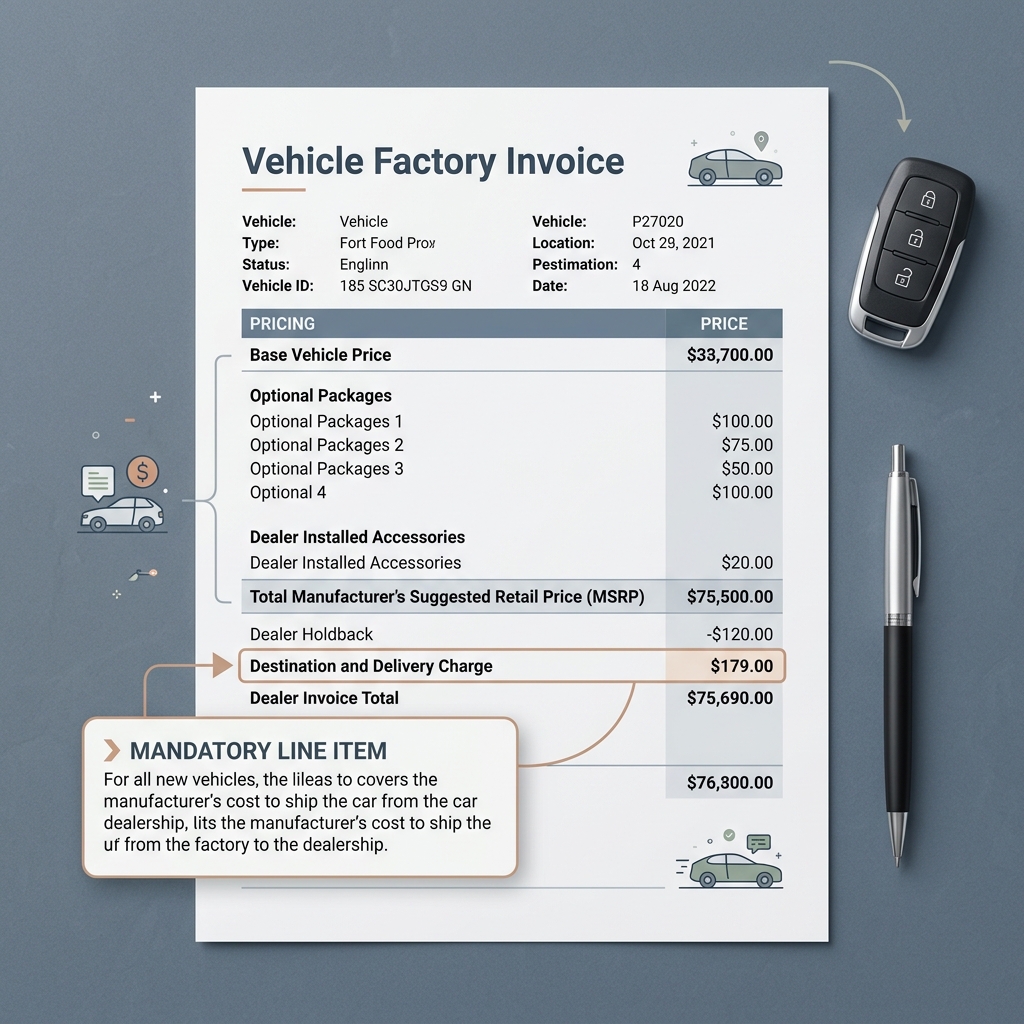
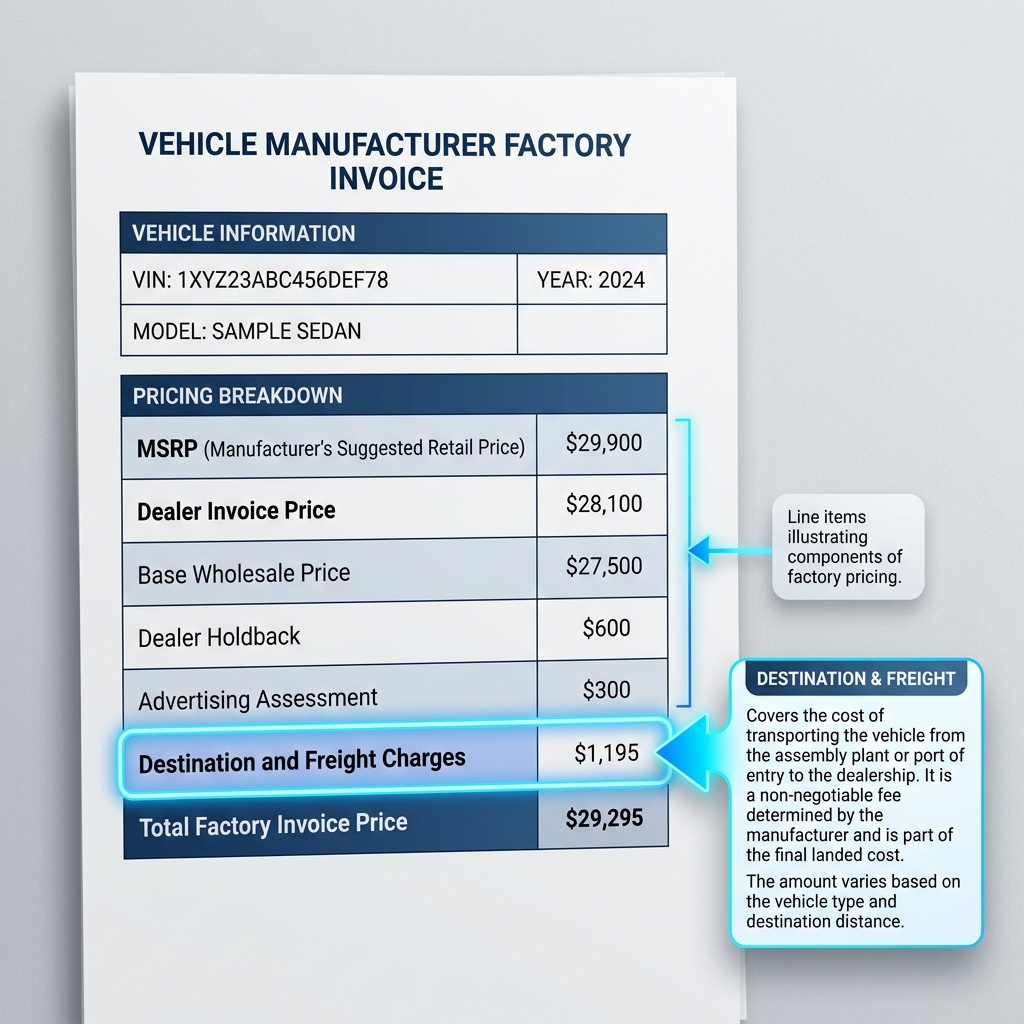
Yes, unequivocally. The factory invoice issued by vehicle manufacturers—including Stellantis for Chrysler, Dodge, Jeep, and Ram vehicles—explicitly lists the destination and delivery charge (frequently categorized as freight) as a mandatory line item. This is not a fee added arbitrarily by the dealership at retail; it is a standardized wholesale cost assessed directly by the vehicle manufacturer to transport the automobile from the assembly line to the dealership lot.
When analyzing automotive wholesale documentation, car buyers in Junction City, Manhattan, and across Geary County often assume that the “Factory Invoice Price” represents the base vehicle before shipping expenses. In reality, manufacturer invoicing structure treats freight as an integral component of the total wholesale invoice baseline. Every authorized dealer across the continental United States pays the exact same destination fee for a specific trim and model, regardless of whether the dealership is located ten miles or two thousand miles from the assembly plant.
Understanding this foundational line item is essential for evaluating vehicle quotes and dealer pricing claims. Because the factory destination charge is already baked into the total invoice figure provided by the OEM, any attempt by a seller to add a secondary “dealer destination fee” on top of an invoice-based quote represents a duplicate charge. At Valor CDJR, line-item clarity is paramount. By breaking down the exact mechanics of manufacturer freight assessment, wholesale pricing architecture, and local market dynamics, this guide provides complete transparency into what vehicle invoice numbers truly represent.
36 Years Behind the Desk: Dustin Zeck on Auto Pricing Transparency
Hello, I am Dustin Zeck, Dealer Principal at Valor CDJR. Over my 36 years in automotive retail, I have sat across the desk from thousands of car buyers—from first-time military buyers stationed at Fort Riley to generational farm families in Riley and Geary counties. During my nearly four decades managing dealership operations, I have witnessed the evolution of automotive pricing from closed-door paper catalogs to the hyper-transparent digital ecosystem we operate in today.
One constant throughout my career is that confusion surrounding wholesale terminology—such as factory invoice, destination fees, holdback, and dealer cash—causes unnecessary friction for vehicle buyers. Consumers often arrive with online printouts believing invoice price represents our absolute rock-bottom cost. Others suspect destination fees are hidden dealer profit margins. Both assumptions stem from a lack of clear industry communication.
My philosophy at Valor CDJR is simple: an informed buyer is our best customer. If you have questions about how a specific invoice is calculated or want to review line-item pricing on any truck or SUV on our lot, feel free to Call us at (785) 238-5114 directly. Let’s peel back the curtain and examine how factory pricing actually functions.
Expert Insights: Why Invoice Pricing Isn't the Whole Story
“Treating the factory invoice as the dealership’s absolute true bottom line is one of the most common misconceptions in modern car buying,” explains Dustin Zeck. “Twenty or thirty years ago, buying a car at ‘invoice price’ meant the dealer was breaking even on the wholesale transaction. Today, manufacturer financial structures involve complex backend allowances, quarterly volume targets, and floorplan assistance that shift the dealership’s true accounting baseline well below the published invoice total.”
However, the inverse is equally true: landed expenses, regional advertising levies, and pre-delivery conditioning can raise a vehicle’s wholesale operational cost above the base invoice figure. The psychological shift for consumers lies in recognizing that the factory invoice is an standardized accounting document between the manufacturer (OEM) and the franchise dealer—it is not an itemized retail receipt. Understanding where destination charges live within that wholesale calculation is the first crucial step toward mastering vehicle negotiations.
When manufacturers issue an invoice to Valor CDJR, every single option code, trim package, floor mat set, and transportation fee is coded and tallied. The bottom-line invoice figure includes the destination charge automatically. Therefore, when negotiating a deal phrased as ‘$100 below invoice’ or ‘$500 over invoice,’ both buyer and seller are operating off a baseline that ALREADY accounts for bringing the vehicle from the assembly plant to Junction City, Kansas.
How Destination and Freight Charges Appear on a Manufacturer Invoice
On a physical manufacturer invoice—whether for a Ram 1500 built in Sterling Heights, Michigan or a Jeep Wrangler assembled in Toledo, Ohio—the document is structured in two parallel columns: Wholesale Invoice (Dealer Cost) and Monroney MSRP (Suggested Retail Price). Destination charges appear prominently across both columns.
Under federal law (the Automobile Information Disclosure Act of 1958), manufacturers must list equalized freight charges. Equalization means the OEM averages logistics costs across all nationwide shipments. A dealership in Junction City, Kansas pays the exact same destination fee as a dealer located next door to the assembly plant. You can examine current model pricing directly through our New Vehicle Listings to see window sticker breakdowns.
Crucially, the destination amount listed in the Wholesale column is virtually identical to the destination amount listed on the retail window sticker. The dealership does not receive a wholesale discount on shipping charges; we pay the factory full price for logistics.
What Is the Difference Between Dealer Cost and Factory Invoice?
To understand automotive pricing, shoppers must distinguish between the published factory invoice and true net dealer cost. While the factory invoice is a fixed baseline document, several financial mechanisms alter what the dealer ultimately pays the manufacturer over time.
1. Dealer Holdback
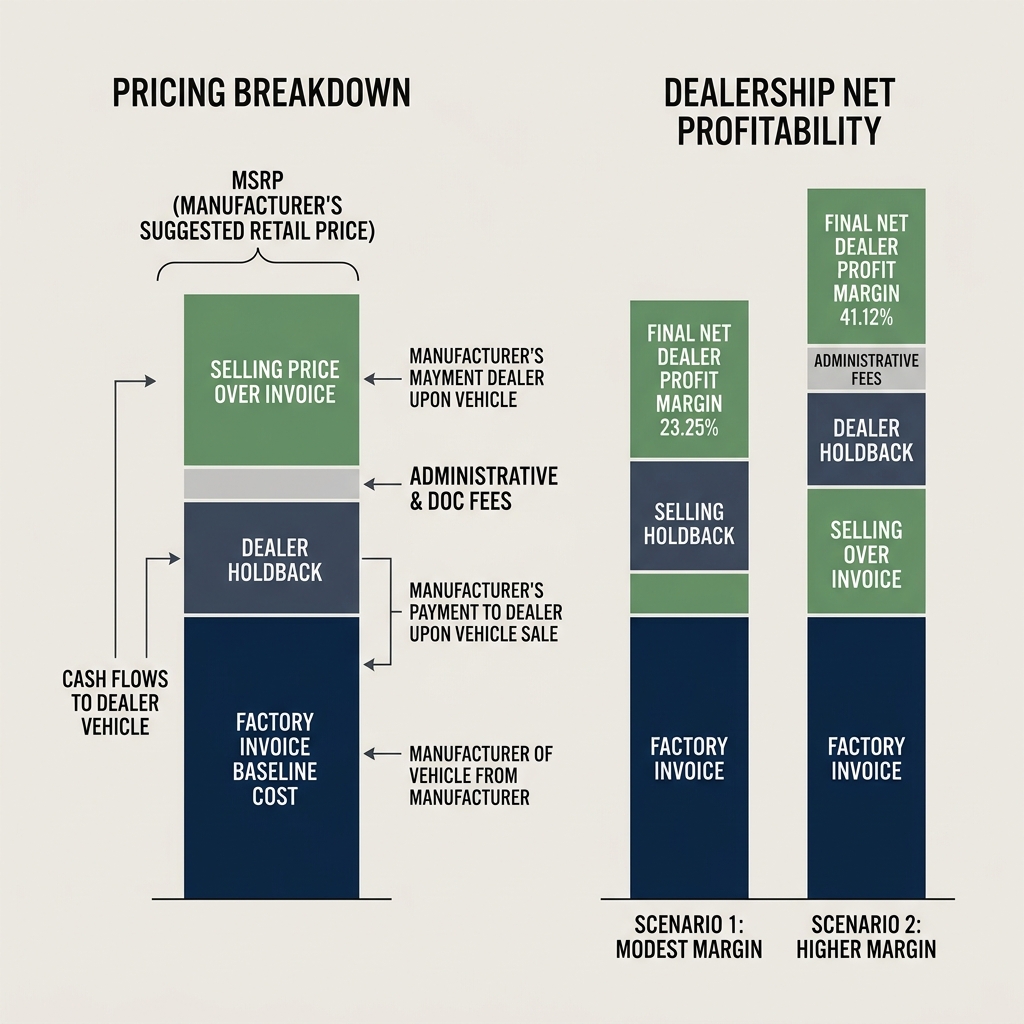
Holdback is a OEM financial credit—typically 2% to 3% of the MSRP or Base Invoice—returned to the dealership quarterly. It assists dealers in offsetting floorplan financing interest and overhead operational costs.
2. Floorplan & Allowances
Manufacturers offer wholesale assistance credits for inventory holding costs, rapid turn incentives, and volume bonuses when monthly quotas are achieved. These credits lower true net cost behind the scenes.
3. Baseline vs. Net Cost
Because holdback and volume incentives are contingent on performance and timeline, the invoice remains the standardized starting baseline. If you are trading in a vehicle toward your purchase, check your Trade In Evaluation to see how equity applies.
Why Landed Cost Is Often Significantly Higher Than the Factory Invoice Quote
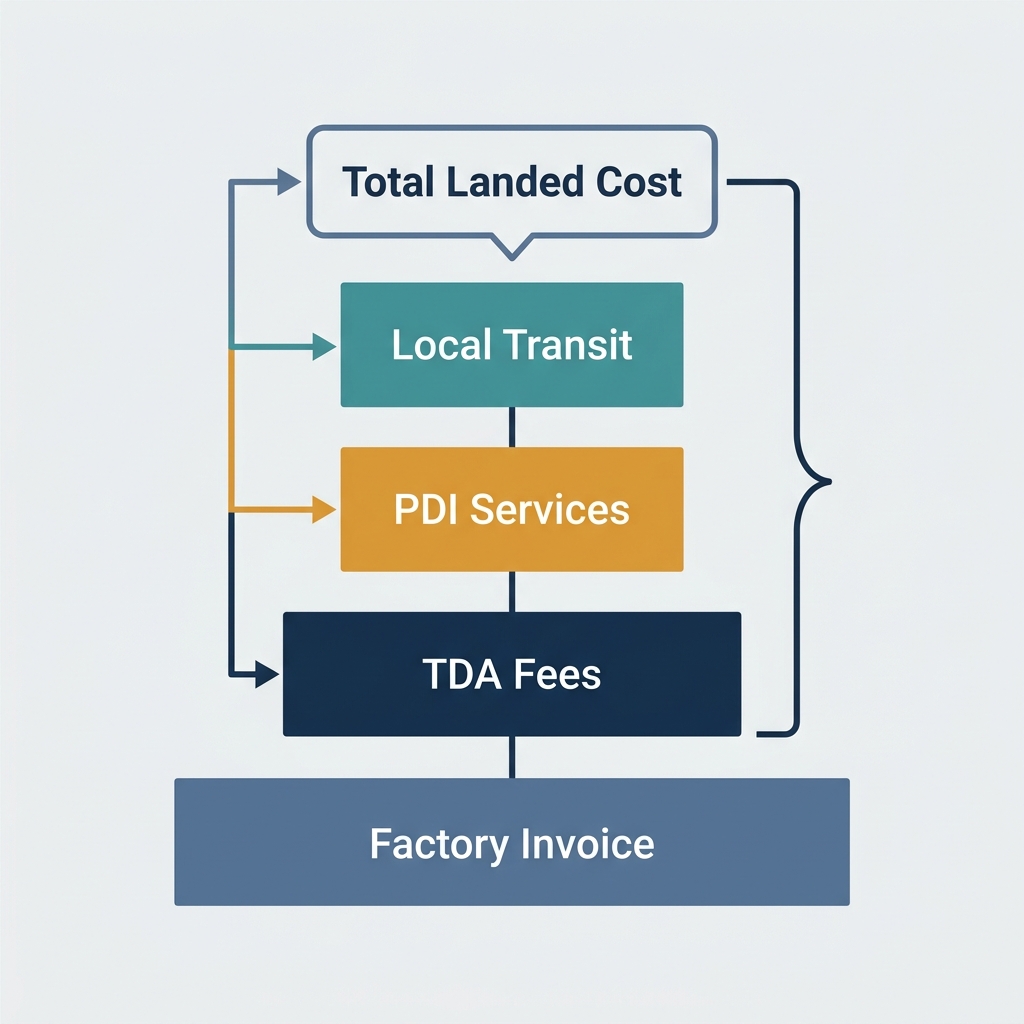
While factory incentives reduce true dealer cost below invoice, regional operational expenses increase what is known as the dealership’s Landed Cost. Landed cost represents the total capital invested in putting a specific vehicle on the showroom floor ready for delivery in Junction City.
Primary factors elevating Landed Cost above basic factory invoice include:
• Regional Advertising Association (TDA) Fees: OEM-mandated regional marketing contributions added directly to wholesale billing. • Dealer Inspection & Pre-Delivery Conditioning (PDI): Uncrating, safety inspections, fluid top-offs, software updates, and detailing. • Local Inventory Transit & Handling: Fuel charges, secondary transport from rail yards in Kansas City or Topeka, and vehicle storage protection.
Understanding landed cost prevents confusion when evaluating transparent quotes across Manhattan, Fort Riley, and Junction City dealers.
What Is the Difference Between Dealer Cash and Customer Rebates?
Dealer Cash (Incentives)
Dealer cash consists of unadvertised factory-to-dealer financial incentives. The manufacturer pays these dollars to the dealership to help move specific slow-selling models or trim levels without changing public MSRPs.
Customer Rebates
Customer rebates are public factory incentives applied directly to reduce the retail transaction price at checkout (or taken as cash back). Before structuring your deal, Get Pre-Approved to see available APR bonuses.
Stacking & Deal Structure
Dealer cash reduces the internal wholesale threshold, allowing competitive pricing. Customer rebates reduce the retail figure *after* price negotiations are complete.
What Does '$50 Over Factory Invoice Pricing' Really Mean for Buyers?
Advertisements promoting deals like “$50 Over Invoice” or “Buy at Factory Invoice Price” are compelling, but buyers must examine how the entire transaction is constructed. In reality, a deal quoted at $50 over invoice can vary significantly between dealerships based on fee structures.
When a dealer sells a vehicle for $50 over factory invoice, the immediate front-end profit on the vehicle body is exactly $50. However, the dealership retains the manufacturer holdback (typically $1,000 to $1,800 depending on total vehicle MSRP) and earns financial reserve if the buyer finances through dealership lender networks.
Beware of dealers who advertise “$50 Over Invoice” only to add mandatory administrative documentation fees of $800+, forced protection packages, or re-adding destination charges. At Valor CDJR, an invoice-based quote is straightforward—no hidden re-additions or deceptive fees.
Understanding the Difference Between Markup and Margin in Car Pricing
Wholesale Markup %
Markup is calculated as profit divided by wholesale invoice cost. If an invoice is $50,000 and selling price is $52,000, profit is $2,000. Expressed as markup on cost: $2,000 / $50,000 = 4.0%.
Retail Margin %
Margin is calculated as profit divided by final retail selling price. Using the same transaction ($2,000 profit / $52,000 retail price), profit margin equals 3.84%. Commercial buyers viewing our Commercial Vehicle Inventory rely heavily on these exact calculations.
Commercial Clarity
Automotive retail operates on slim margins—often between 2% and 5% total gross margin on new vehicles. Distinguishing markup from margin helps buyers evaluate commercial-grade fleet quotes accurately.
Does Out-the-Door Price Match the Selling Price Over Invoice?
No. The agreed selling price (e.g., $100 over factory invoice) is merely one line item in calculating the final Out-the-Door (OTD) Price. Buyers must account for statutory government taxes, mandatory state registration fees, and dealer documentation fees.
For residents in Junction City, Geary County, or nearby Manhattan, KS, the OTD calculation follows this exact formula:
• Negotiated Vehicle Selling Price (e.g. Invoice + $50)
• Kansas State Sales Tax + Local Municipal/County Taxes
• Title, Registration, and License Plate Fees
• Dealer Documentation Fee
• Minus Customer Factory Rebates and Trade-in Tax Credits.
|
Component
|
Sample Quote Basis
|
|
Factory Invoice (inc. Freight)
|
$45,200
|
|
Agreed Selling Price (+ $50)
|
$45,250
|
|
KS State & Local Sales Tax (Est.)
|
$3,393
|
|
Doc Fee & Registration
|
$495
|
|
Customer Rebate Credit
|
-$2,000
|
|
Final Out-the-Door (OTD)
|
$47,138
|
Are Near-Invoice Deals Harder to Get on Brand-New Future Model Years?
Supply & Demand Dynamics
When a brand-new model year or redesign launches, market demand outpaces factory production. During early release cycles, factory discounts and dealer cash incentives are minimal or non-existent.
Initial Production Allocation
Dealerships receive limited allocation during initial production runs. Because inventory holding times are near zero, dealers do not face floorplan interest pressure, making invoice pricing less common initially.
Military & Local Buyers
For Fort Riley military members and regional drivers, special OEM order programs or factory pre-orders can secure competitive pricing. Maintaining your current vehicle via our Service Scheduler or utilizing our Express Lane while waiting for new model allocations is a practical strategy.
How to Use Valor CDJR's Digital Tools to Calculate Your Real Cost
At Valor CDJR, we equip our customers with digital suite tools to analyze true vehicle costs from the comfort of home. You do not need to sit in a showroom for hours to get transparent figures.
Follow these practical steps on our website:
1. Browse our real-time online inventory for new or Used Vehicle Listings.
2. Click ‘View Factory Pricing’ or request the OEM invoice sheet for any in-stock model.
3. Utilize our instant trade appraisal engine to calculate net trade-in equity.
4. Apply active regional customer rebates and current finance options.
By leveraging these digital resources, shoppers across Junction City and Manhattan arrive with complete clarity regarding invoice baselines, destination charges, and final landed price.
Get Straight Answers and Transparent Vehicle Quotes at Valor CDJR
To summarize: Yes, factory invoice pricing ALWAYS includes factory destination and delivery charges. It is an OEM-mandated standardized fee that dealers pay to transport vehicles from manufacturing plants to our dealership in Junction City.
With 36 years of automotive experience, Dealer Principal Dustin Zeck and the entire team at Valor CDJR are committed to straightforward, line-item transparency. Whether you are inquiring about invoice breakdowns, holdback, factory rebates, or out-the-door pricing, we are here to provide clear answers.
Need genuine factory parts or accessories? Check out our dedicated Parts Department online or visit us today.