Which Late-Model Heavy-Duty Trucks Hold Their Resale Value strongest?
When you are investing in a 3/4-ton or 1-ton pickup, depreciation is the single largest cost of ownership over the first few years. Fortunately, late-model heavy-duty (HD) trucks retain significantly more equity than standard half-ton passenger pickups. If you want the definitive answer on which models hold their resale value strongest, late-model Ram 2500/3500 and Ford F-250 diesel 4×4 trucks are strong resale performers, regularly retaining 70% to 78% of their original vehicle value after three full years of service.
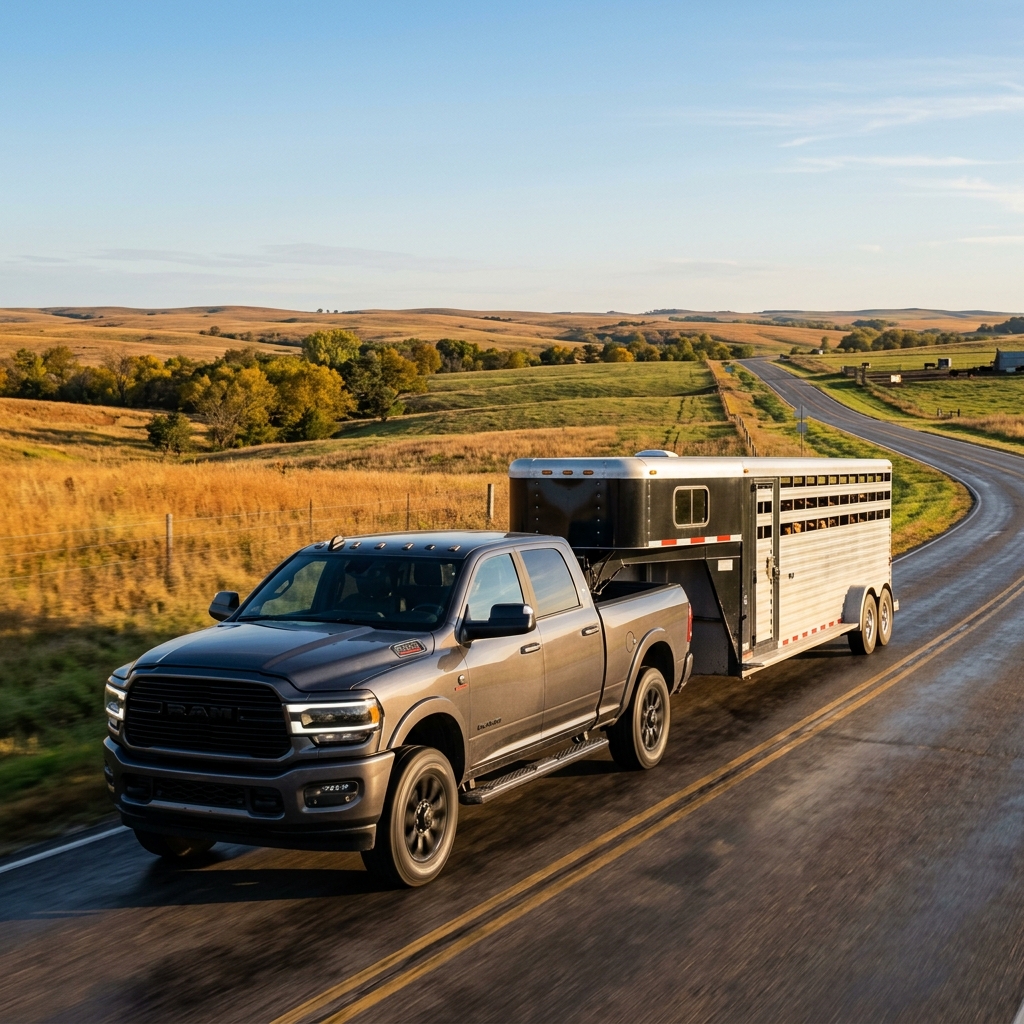
This exceptional resale stability is driven by three main factors: industrial-grade diesel engine longevity, essential 4×4 drivetrain positioning, and relentless regional demand across Junction City, Riley County, and the greater Manhattan, KS area. Whether hauling heavy agricultural equipment through the Flint Hills, pulling fifth-wheel livestock trailers, or supporting military contractors around Fort Riley, heavy-duty diesel trucks represent true workhorse utility that buyers willingly pay a premium for in the pre-owned market.
|
Truck Model & Engine
|
3-Year Residual Value Range
|
Primary Resale Driver
|
Regional Demand Index
|
|
Ram 2500 / 3500 6.7L Cummins Diesel 4×4
|
72% – 78%
|
Engine Durability & Class-Exclusive Rear Suspension
|
Extremely High
|
|
Ford F-250 / F-350 6.7L Power Stroke 4×4
|
70% – 76%
|
Aluminum Military-Grade Body & High Towing Limits
|
Extremely High
|
|
GMC Sierra / Chevy Silverado 2500HD Duramax 4×4
|
68% – 74%
|
Allison 10-Speed Transmission & Highway Comfort
|
Very High
|
|
Gas Engine 3/4-Ton Trucks (Ram 6.4L V8, Ford 6.8L/7.3L)
|
58% – 65%
|
Lower Initial Purchase Price & Fleet Utility
|
Moderate
|
How Much Value Does a Heavy-Duty Diesel Truck Lose in the First 3 Years?
Standard light-duty passenger trucks (1/2-ton models) typically suffer a steep 35% to 42% loss in equity over their first 36 months on the road. By contrast, a heavy-duty diesel truck loses only 22% to 30% of its initial value across the exact same timeframe. On a well-equipped $75,000 diesel workhorse, that difference equals nearly $10,000 to $12,000 in preserved vehicle equity.
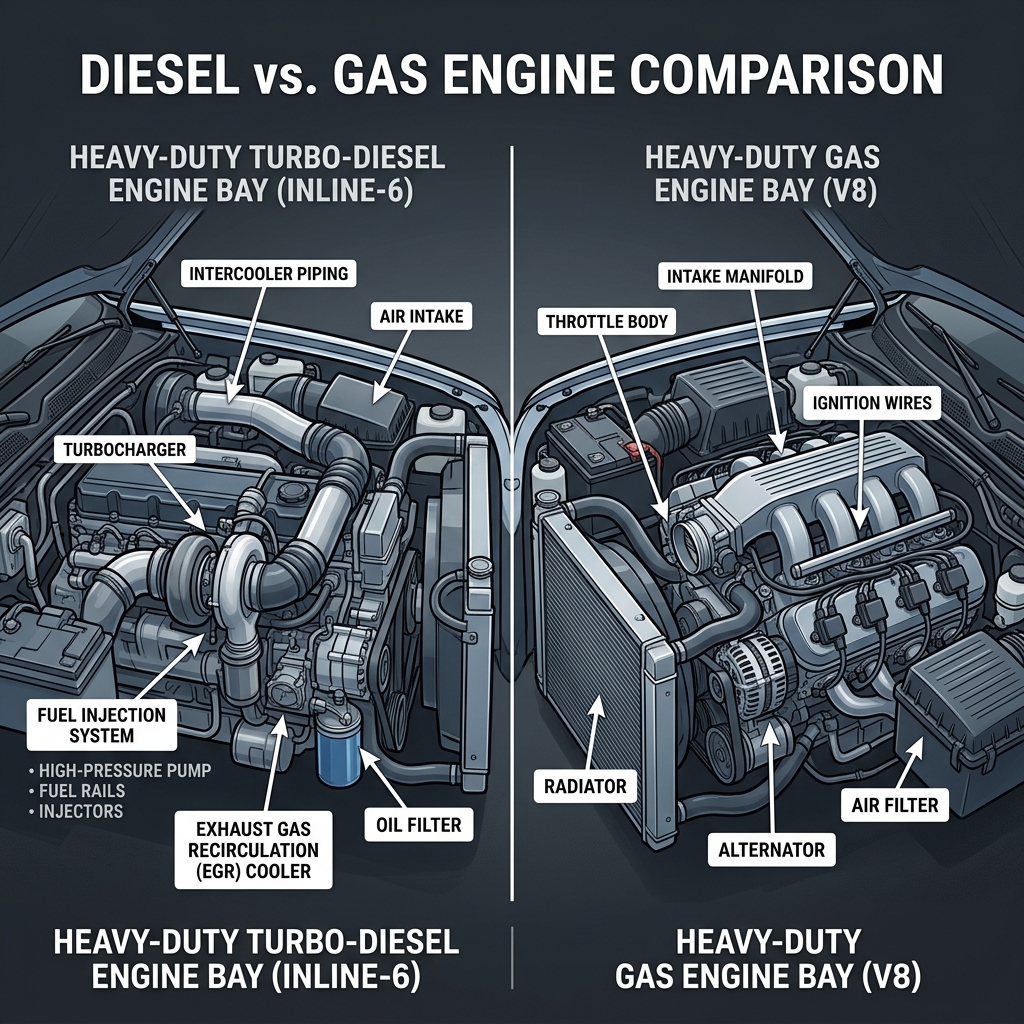
Why do heavy-duty diesel engines shield owners so effectively against initial market drops? The primary reason lies in expected lifespan. Commercial buyers and pre-owned shoppers view a 3-year-old diesel truck with 45,000 miles as barely broken in. Cummins inline-six and Power Stroke V8 engines are engineered to reach 300,000 to 500,000 miles with standard maintenance, insulating them from the steep mileage penalty that hits high-strung gasoline engines.
3-Year Depreciation Curve Breakdown:• Year 1: Gas Trucks (-20%) vs HD Diesel Trucks (-10% to -12%) • Year 2: Gas Trucks (-30%) vs HD Diesel Trucks (-16% to -20%) • Year 3: Gas Trucks (-40%) vs HD Diesel Trucks (-22% to -28%)
Because secondary market demand for pre-owned diesel power consistently exceeds regional supply in Central Kansas, late-model trade-ins retain strong floor pricing whether sold at retail or auctioned off.
When evaluating long-term value, intelligent buyers calculate the net cost to own rather than just the initial window sticker price. A diesel heavy-duty truck retains a higher proportion of its initial capital investment, protecting your net worth while providing uncompromised towing performance.
What Is the Upfront Cost Difference Between Gas and Diesel Engines in HD Trucks?
When ordering or buying a new heavy-duty truck, choosing a diesel engine requires an initial option price premium between $9,000 and $12,500 over a standard heavy-duty gas engine. For example, selecting the 6.7L Cummins Turbo Diesel in a Ram 2500 or the High-Output 6.7L Power Stroke in a Ford F-250 adds a noticeable uptick to the sticker price. However, looking strictly at initial price overlooks how effectively diesel powertrains recapture that investment.
On trade-in appraisals at Valor CDJR, 3 to 5-year-old diesel HD trucks typically hold onto 75% to 85% of that initial $10,000 engine premium. Furthermore, diesel engines deliver significantly better fuel economy while pulling heavy trailer loads (often 12-16 MPG towing vs. 7-10 MPG in equivalent gas V8s), generating ongoing operational savings for heavy users across Kansas.
Tip for Junction City & Riley County Buyers: If you plan to trade every 3 to 4 years and log heavy towing miles, the diesel powertrain pays for itself through elevated trade-in equity and reduced fuel consumption under heavy loads.
What Price Savings Can You Expect on a 2-Year-Old Low-Mileage Diesel Truck?
Upfront Upgrades Saved
Buying a 2-year-old pre-owned HD diesel allows you to bypass the steepest drop on the depreciation curve. Buyers routinely save $12,000 to $18,000 off original sticker price, while gaining expensive factory-installed upgrades like fifth-wheel prep, spray-in bedliners, heavy-duty alternators, and premium leather packages that the first owner paid for upfront.
Powertrain Warranty Safety
Most major heavy-duty manufacturers cover diesel engines under a factory 5-year / 100,000-mile powertrain warranty. Selecting a 2-year-old model with 25,000 miles leaves you with 3 full years or up to 75,000 miles of manufacturer protection, delivering peace of mind alongside significant cost savings.
Slower Secondary Depreciation
When you buy a 2-year-old truck, your future cost-per-mile decreases dramatically. Should you decide to sell or trade the vehicle 3 years later, your personal equity loss is minimal because the vehicle has already settled into its long-term, slow-depreciation curve. Check our Used Vehicle Listings for current inventory.
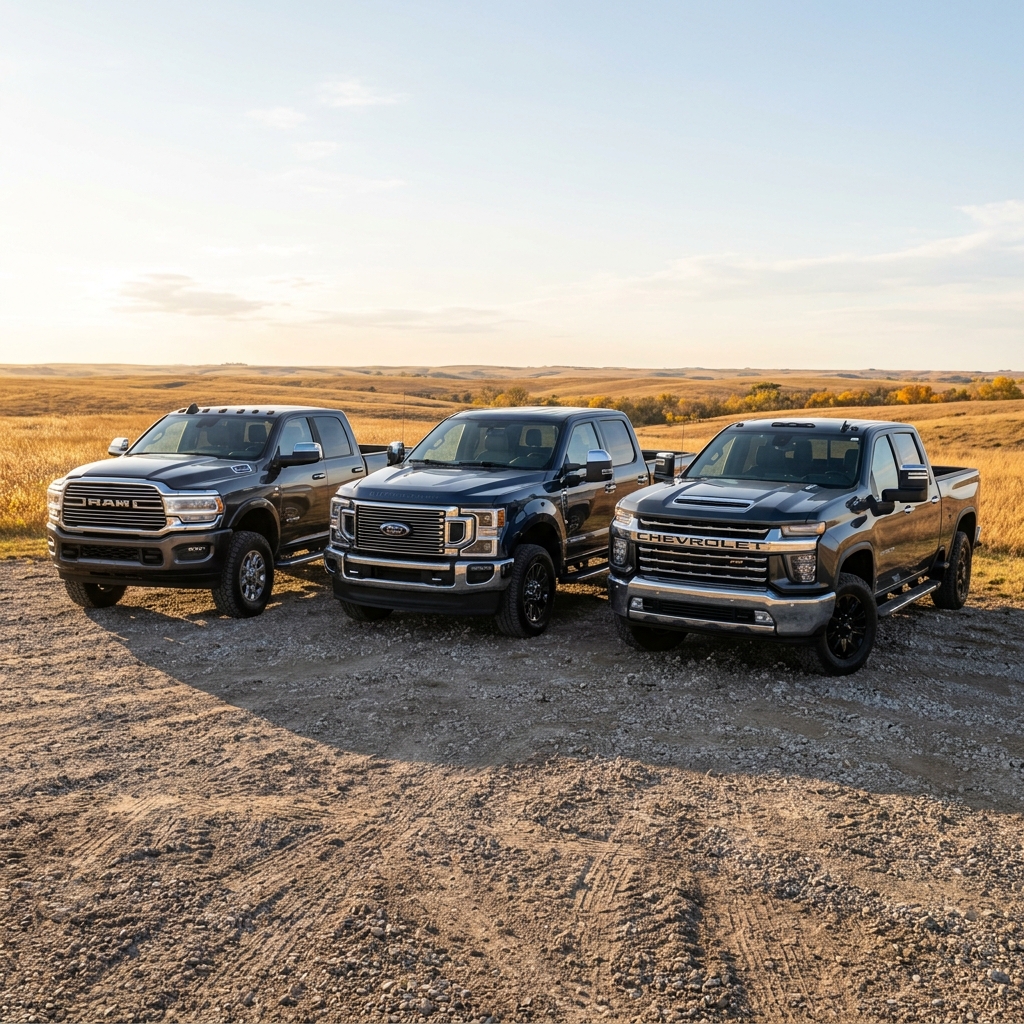
Comparing 3/4-Ton Resale Values: Ram 2500 vs. Ford F-250 vs. Chevy Silverado 2500HD
Ram 2500 Cummins
Residual Leader (74% – 78%): Powered by the legendary 6.7L Inline-6 Cummins Turbo Diesel, Ram 2500 models benefit from simple, robust engine design and a class-exclusive rear coil-spring suspension that delivers unrivaled ride quality. Pre-owned buyers actively search for late-model Ram 2500s, leading to exceptionally short turn times on trade-in lots.
Ford F-250 Power Stroke
Ford F-250 Power Stroke (70% – 76%): Ford’s military-grade aluminum alloy body eliminates panel rust concerns, while the 6.7L Power Stroke V8 paired with the 10-speed TorqShift automatic provides massive towing numbers. Tremor Off-Road packages and Lariat/King Ranch trims command top-dollar values across Kansas and the Midwest.
Chevy Silverado 2500HD
Steady Workhorse (68% – 74%): The Silverado 2500HD with the 6.6L Duramax diesel and Allison transmission boasts a devoted commercial following. While base trims see moderate depreciation, LTZ and High Country packages remain strong secondary performers across agricultural markets.
How Much Can a 2025 Ford F-250 4×4 Diesel Tow Compared to Competitors?
Towing capacity directly dictates a heavy-duty truck’s resale appeal. Commercial operators and weekend RV haulers seek high towing ratings to ensure legal compliance and effortless highway performance. The 2025 Ford F-250 4×4 with the High-Output 6.7L Power Stroke Diesel delivers up to 22,000+ lbs of conventional towing and up to 23,000 lbs fifth-wheel/gooseneck towing when properly configured with high-capacity axle packages.
Comparatively, a late-model Ram 2500 6.7L Cummins Diesel features conventional towing up to 20,000 lbs (limited primarily by rear axle gross weight ratings on 3/4-ton coil suspensions, though Ram 3500 models push maximum towing well past 37,000 lbs). The Silverado 2500HD Duramax tops out around 22,500 lbs max gooseneck capacity. Class-leading towing specs allow sellers to command premium prices, as secondary buyers look for models ready for heavy gooseneck stock trailers or tri-axle toy haulers.
|
Truck Model & Engine
|
Max Torque
|
Max Conventional Towing
|
Max 5th-Wheel / Gooseneck
|
|
2025 Ford F-250 6.7L HO Power Stroke
|
1,200 lb-ft
|
22,000 lbs
|
23,000 lbs
|
|
Late-Model Ram 2500 6.7L Cummins
|
850 – 1,075 lb-ft
|
20,000 lbs
|
20,000 lbs
|
|
Chevy Silverado 2500HD 6.6L Duramax
|
975 lb-ft
|
20,000 lbs
|
22,500 lbs
|
Can a 3/4-Ton Truck Safely Tow a Large Fifth-Wheel Trailer Around Riley County?
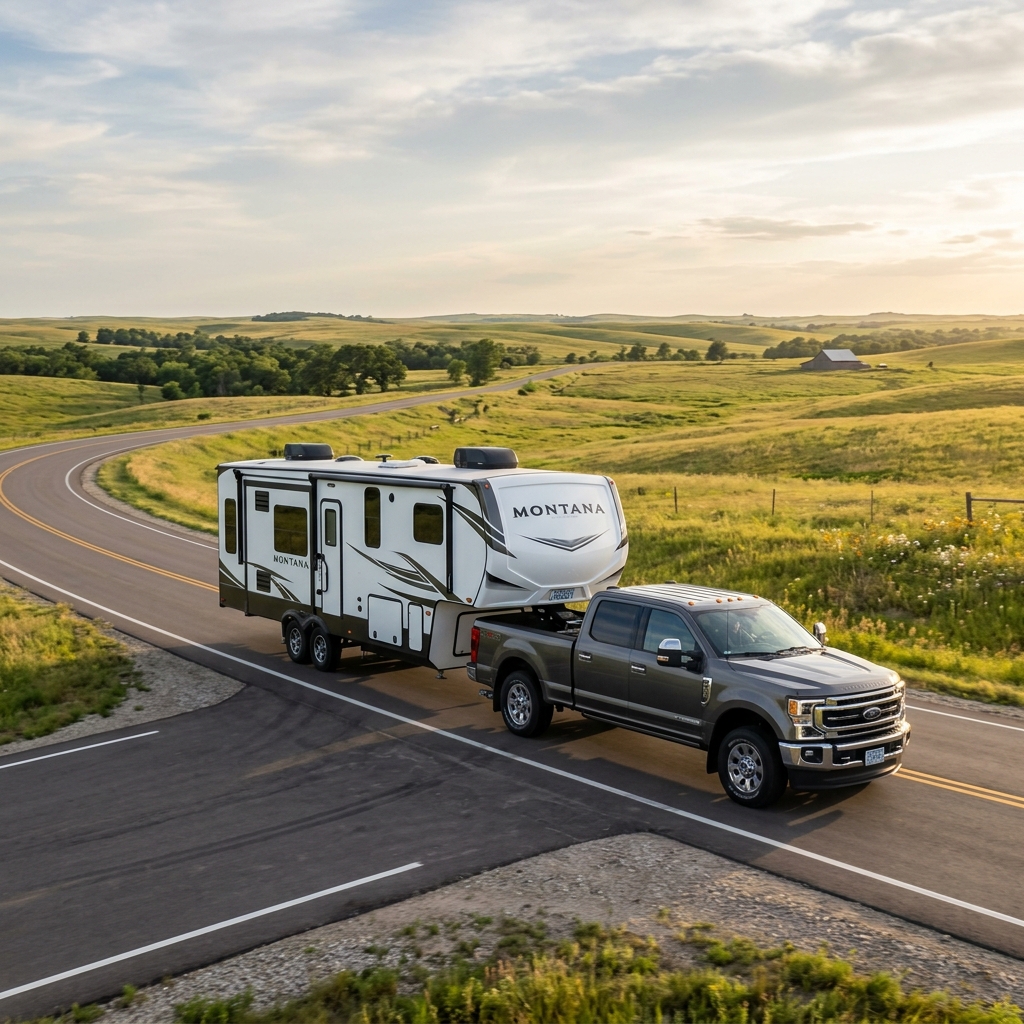
Yes, a late-model 3/4-ton heavy-duty truck (Ram 2500, Ford F-250, or Chevy 2500HD) can safely pull many medium-to-large fifth-wheel trailers, but payload capacity and pin weight calculations are critical factors. While raw towing capacity might be rated at 18,000+ lbs, a fifth-wheel trailer transfers 15% to 25% of its total weight directly onto the truck bed as ‘pin weight’.
For example, a 14,000 lb loaded fifth-wheel camper places roughly 2,800 lbs of pin weight in the bed. If your 3/4-ton diesel truck has a max payload rating of 2,500 lbs (heavy diesel engines reduce net payload compared to gas models), you could exceed Gross Axle Weight Ratings (GAWR) once passengers, fuel, and gear are loaded. In rolling agricultural terrain throughout Riley County, Manhattan, and along I-70 near Junction City, maintaining safe pin weight tolerances ensures stable handling and legal operation. For fifth-wheels exceeding 15,000 lbs, upgrading to a 1-ton Ram 3500 or Ford F-350 with dual rear wheels (dually) is often recommended and boosts overall towing comfort.
Key Factors That Maximize Heavy-Duty Truck Resale Value at Trade-In
1. Strict Maintenance Records
Diesel engines rely on immaculate maintenance. Documenting timely oil changes, fuel filter replacements (every 10,000–15,000 miles), DEF tank servicing, and transmission fluid flushed through a certified service center like the Valor CDJR Service Scheduler adds $1,500+ directly to trade appraisals.
2. Undercarriage & Body Care
Kansas winter road salt and agricultural mud accelerate underbody corrosion. Applying protective undercoating, maintaining spray-in bedliners, and keeping paint clean from chips prevents cosmetic degradation that appraisers ding heavily during vehicle trade evaluations.
3. High-Demand Equipment
Factory equipment pays dividends. Dual alternators, 5th-wheel/gooseneck prep packages, auxiliary dash switches, snow plow prep packages, and upgraded rear axle ratios (e.g., 3.73 or 4.10) retain nearly 80% of their original accessory cost when appraised.
Proven 4×4 Power Positioning: Why Four-Wheel Drive HD Trucks Retain Top Resale in Kansas
In Central Eastern Kansas, vehicle climate and terrain demand genuine off-road and towing versatility. A 4×2 heavy-duty truck suffers a massive resale penalty in our region, often sitting twice as long on dealership lots and losing $4,000 to $6,000 more value than an equivalent 4×4 configuration.
Proven 4×4 Power Positioning combines mandatory four-wheel drive capability with high-output diesel torque. Between unpredictable Midwest winter blizzards, muddy construction jobsites, unpaved farm access roads, and outdoor towing needs near Milford Lake or Fort Riley training areas, 4×4 capability is considered essential equipment. Pre-owned buyers near Junction City will rarely consider a 2WD heavy-duty model.
Ready to test drive a high-value 4×4 HD truck? Get Directions to Valor CDJR and visit our showroom at 1825 Goldenbelt Blvd in Junction City.
Gas vs. Diesel HD Maintenance Costs: Impact on Overall Ownership Value
Diesel HD Maintenance Reality
Routine service on a diesel truck costs approximately 30% to 50% more per oil change interval due to 12-to-15 quart oil capacities, specialized diesel exhaust fluid (DEF), fuel filter water separators, and heavy-duty cooling systems. Over 5 years (75,000 miles), expect to spend approximately $2,800 – $3,500 on routine diesel scheduled maintenance.
Gas HD Maintenance Comparison
Gasoline HD trucks (like Ram 6.4L HEMI or Ford 7.3L Godzilla V8) cost less in routine shop maintenance over 5 years ($1,500 – $2,000). However, the gas engine suffers significantly faster depreciation, losing roughly $8,000 to $12,000 MORE in total resale value than the diesel over the same period, completely offsetting any minor routine service savings.
Trim Levels and Value Retention: Tradesman, Laramie, Limited, and Premium Packages
Work Trims (Tradesman / XL)
Base work trims offer low initial entry costs and hold steady percentage values due to commercial fleet demand. However, vinyl seats and sparse tech options limit retail secondary buyer appeal, capping top-dollar trade-in valuations.
Mid-Luxury Sweet Spot (Laramie / Lariat)
The Resale Sweet Spot: Ram Laramie and Ford Lariat trims strike the ultimate balance. Leather seats, heated/ventilated options, and advanced towing tech attract both family buyers and commercial operators, yielding maximum trade velocity and equity retention.
Ultra-Luxury Trims (Limited / Platinum)
Top-tier trims like Ram Limited or Ford Platinum deliver unmatched luxury and air suspensions. While highly desired pre-owned, high initial MSRPs mean higher absolute dollar depreciation ($20,000+) over their first 3 years.
Buying vs. Trading a Late-Model Heavy-Duty Truck in Junction City
If you currently own a late-model heavy-duty truck, market conditions in Junction City make a good time to leverage your accumulated vehicle equity. Because late-model low-mileage HD trucks are in high demand across Central Kansas, trade-in valuations at Valor CDJR remain at historically strong levels.
Kansas State Sales Tax Advantage: Did you know that trading in your vehicle in Kansas grants significant tax benefits? When you trade in at Valor CDJR, you only pay state and local sales tax on the net price difference between your new truck and your trade allowance. Contact us for current trade-in tax information.
Have questions about your current truck’s valuation or current financing information? Call us at (785) 238-5114 to speak directly with our truck specialists, or start your online appraisal using our Trade In Evaluation tool.
Find Your High-Value Late-Model Heavy-Duty Truck at Valor CDJR
At Valor CDJR in Junction City, KS, we understand the heavy-duty truck market inside and out. Whether you need a low-mileage Ram 2500 Cummins for heavy agricultural hauling, a Ford F-250 Power Stroke for commercial contracting, or want to maximize your current trade-in equity, our team is committed to providing expert advice and transparent pricing.
Explore our extensive inventory of high-value late-model pre-owned trucks, get pre-approved for competitive financing rates, or stop by our dealership today near Fort Riley and Manhattan.