What Factory Hardware Is Included in the Ram Fifth-Wheel / Gooseneck Prep Group?
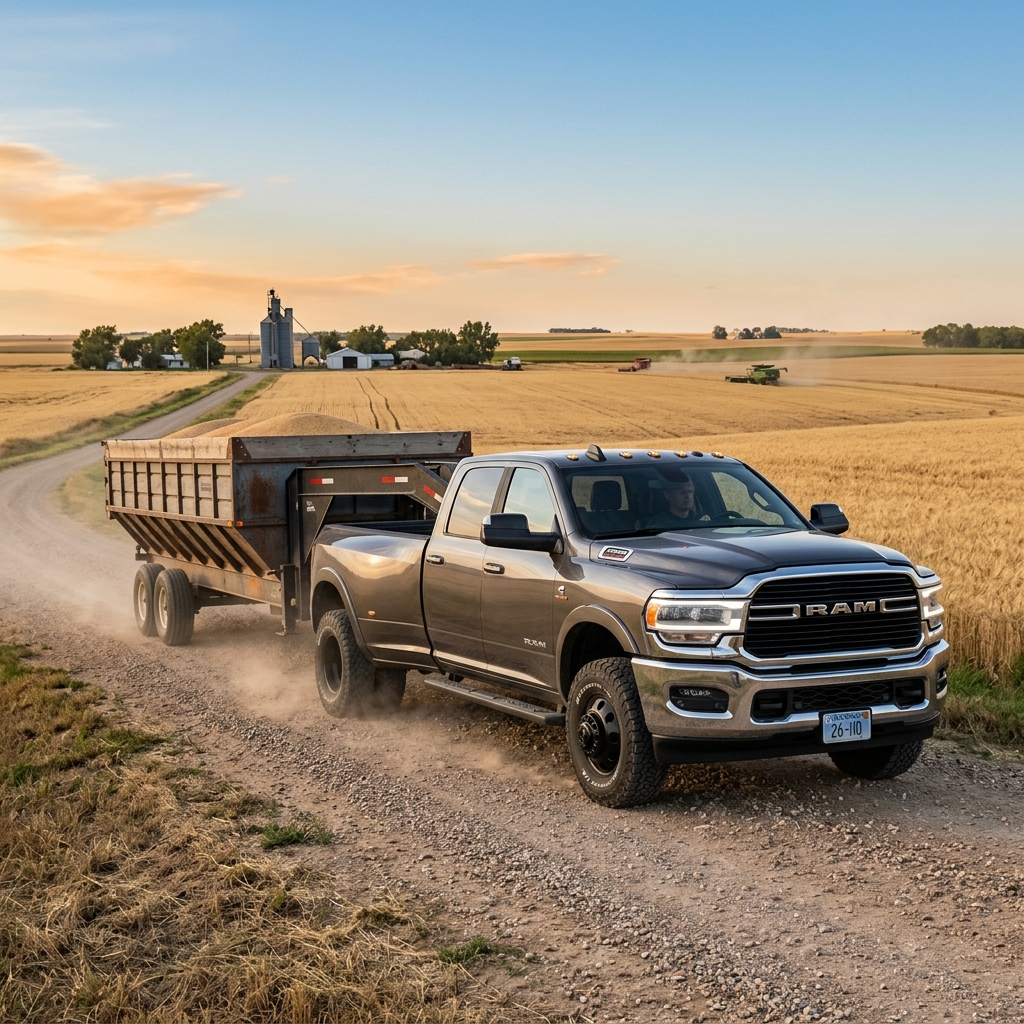
When you are preparing for heavy agricultural hauling across Riley County or hitching up a 35-foot livestock trailer in Junction City, knowing exactly what equipment comes integrated into your truck bed is critical. The Ram Heavy Duty Production Option Code AHU—officially designated as the Fifth-Wheel / Gooseneck Towing Prep Group—is a factory-engineered structural system built directly into the frame assembly during production. Rather than relying on aftermarket brackets, bed drilling, or welded subframes that compromise factory rust warranties, Option Code AHU delivers a seamless, flush-mounted towing foundation engineered specifically for extreme structural loads.
Every Ram 2500 and 3500 equipped with the factory AHU Prep Group includes five essential hardware components engineered directly into the bed floor and frame architecture:
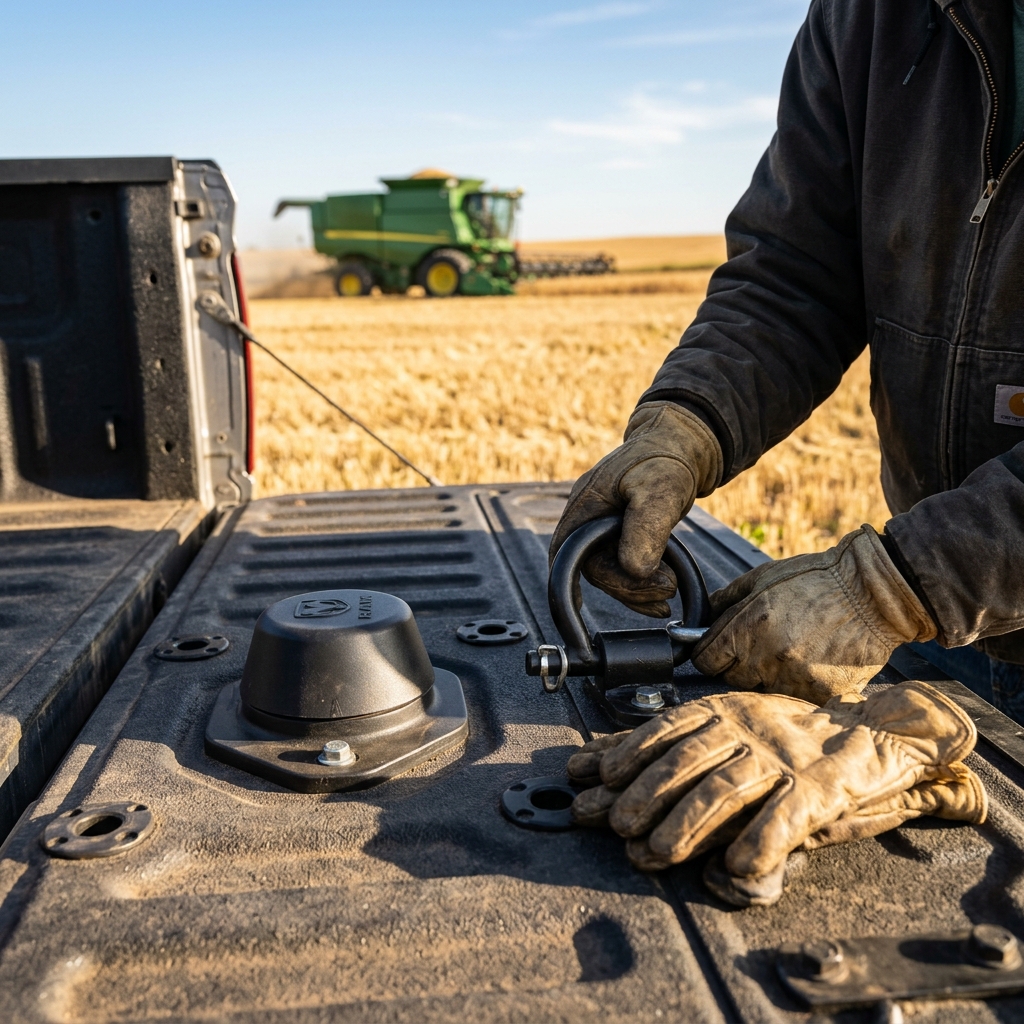
• Integrated Fully Welded Frame Crossmembers: Below the stamped steel bed floor sit massive, factory-welded structural steel crossmembers attached directly to the hydroformed box frame rails. These crossmembers distribute tongue weights and vertical pin loads directly to the chassis rather than stressing the bed sheet metal. • Five In-Bed Mounting Pucks: Four outer receiver pucks arranged in a standard footprint for quick drop-in fifth-wheel hitches, plus a centralized fifth puck specifically designed for a 2-5/16 inch gooseneck ball. • Removable Cast-Aluminum Puck Covers: Durable, flush-fitting covers that seal each receiver hole when hitches are removed, preserving a completely flat bed floor for loose grain bags, tools, or lumber. • In-Bed 7-Pin Electrical Wiring Connector: Mounted conveniently into the rear driver-side bed wall, keeping trailer wiring harnesses off the tailgate and safely isolated inside the bed. • Pre-Drilled Bed Floor Ports with Reinforced Collars: Factory-punched bed openings featuring structural collars that prevent moisture penetration, bed flexing, and metal fatigue around the mounting points. Whether you are shopping our New Vehicle Listings or upgrading your current fleet, understanding this factory architecture ensures you maximize your truck’s towing potential safely and legally.
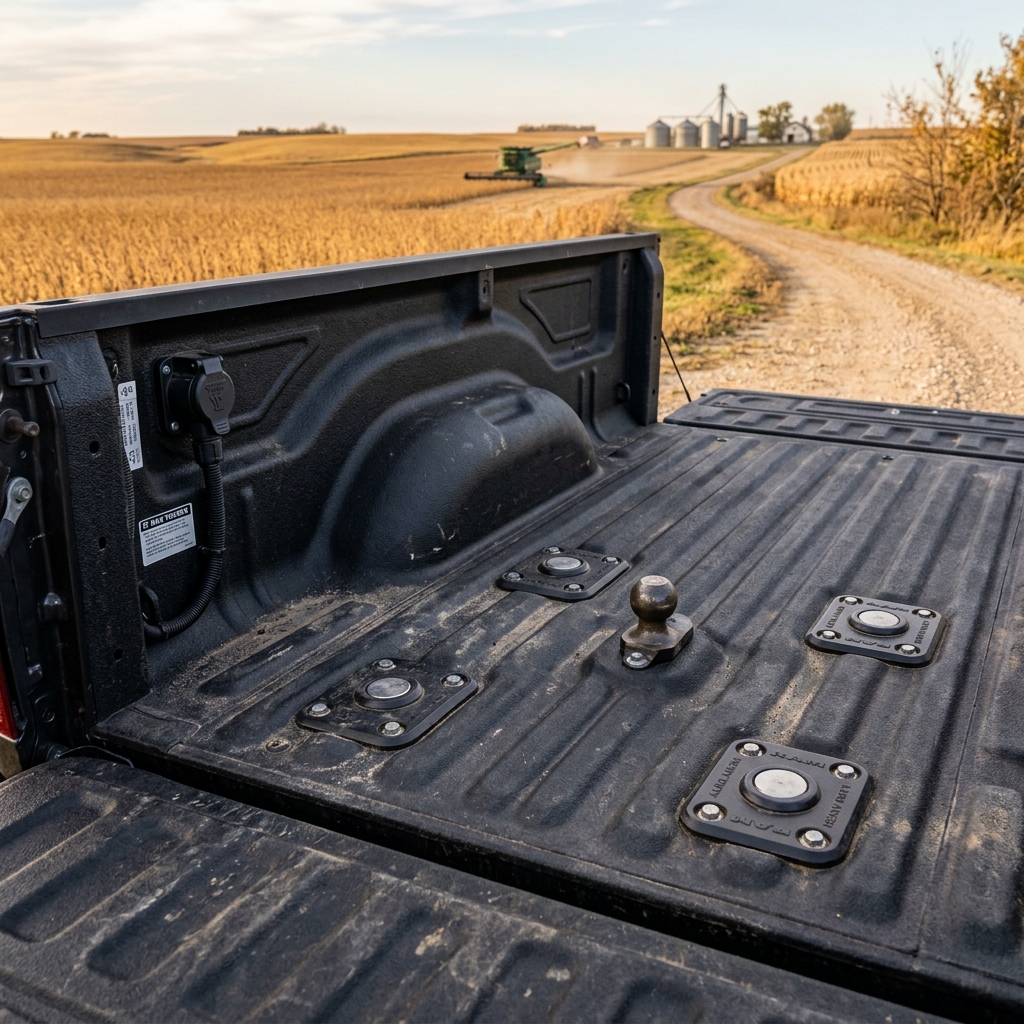
Anatomical Breakdown: Beneath the Bed Cover of Ram Production Option Code AHU
Hydroformed Frame Integration & Structural Metallurgy
To appreciate why option code AHU is superior to aftermarket hitches, you must look underneath the truck bed. Ram Heavy Duty chassis frames utilize 50,000 PSI steel hydroformed frame rails with fully boxed cross-sections. In factory AHU builds, additional structural steel crossmembers are Robotically Metal Inert Gas (MIG) welded directly between the main frame rails at the assembly plant in Saltillo.
This direct frame attachment creates an uninterrupted load path. When a heavy gooseneck trailer applies 5,000 lbs of vertical pin weight while rolling down bumpy rural roads in Geary County, that force travels directly down through the cast steel puck housings, into the factory welded crossmembers, and evenly across both frame rails. Because no aftermarket drilling is performed on the high-strength frame flanges, structural integrity and factory rust-through warranties remain 100% intact.
In-Bed Electrical Integration & Corrosion Prevention
Beyond heavy iron, Option Code AHU includes a fully integrated 7-pin electrical harness extension connected directly to the primary vehicle body harness. Unlike aftermarket installations that splice into rear bumper wiring using clip-on connectors—which frequently corrode from winter road salt or mud—the factory harness uses weatherproof Deutsch-style sealed connectors.
The bed-side outlet is inset flush into the rear driver-side inner quarter panel. This placement prevents cargo from crushing the plug while allowing full wire clearance when making sharp jackknife turns with tall gooseneck couplers. The integrated circuitry communicates seamlessly with the truck’s central Body Control Module (BCM), enabling automatic trailer light checks, trailer anti-lock brake integration, and blind-spot monitoring trailer length detection.
2026 Ram 2500 vs. 3500: Realistic Towing and Payload Capacities for Heavy Agricultural Hauling
Choosing between a 2026 Ram 2500 and Ram 3500 for high-payload fall harvest towing requires evaluating more than just horsepower. While both trucks offer the legendary 6.7L Cummins Turbo Diesel and the 6.4L HEMI V8, their rear suspension designs and Gross Vehicle Weight Ratings (GVWR) create distinctly different real-world capabilities when hooked to heavy gooseneck grain wagons or multi-axle livestock trailers.
|
Model / Engine Configuration
|
Rear Suspension Architecture
|
Max Gooseneck Towing
|
Max Payload Capacity
|
Ideal Kansas Hauling Role
|
|
2026 Ram 2500 6.4L HEMI V8
|
5-Link Coil Spring / Auto-Level Air
|
Up to 17,730 lbs
|
Up to 4,010 lbs
|
General ranch work, utility trailers, equipment shuttle
|
|
2026 Ram 2500 6.7L Cummins Diesel
|
5-Link Coil Spring / Auto-Level Air
|
Up to 19,990 lbs
|
Up to 3,150 lbs
|
Medium livestock trailers, round-bale transportation
|
|
2026 Ram 3500 SRW 6.7L Cummins
|
Hotchkiss Leaf Spring System
|
Up to 25,650 lbs
|
Up to 4,580 lbs
|
Heavy gooseneck flatbeds, heavy machinery haulers
|
|
2026 Ram 3500 DRW 6.7L HO Cummins
|
High-Capacity Leaf Springs + Air
|
Up to 37,090 lbs
|
Up to 7,680 lbs
|
Maximum commercial grain hauling, multi-head livestock
|
Ram 2500 Coil vs Air
The Ram 2500 features a proprietary 5-link rear coil spring suspension that provides unmatched unladen ride quality. For gooseneck towing, opting for the factory Rear Auto-Level Air Suspension levels the truck bed automatically under high pin weights, preserving headlight alignment and front axle steering traction.
Ram 3500 Leaf Springs
Ram 3500 models utilize heavy-duty Hotchkiss leaf spring rear suspensions. This stiff architecture supports severe vertical pin weights (up to 7,680 lbs payload on dual-rear-wheel models) without excessive suspension squat, maintaining vehicle stability on Kansas highway routes.
High-Output Cummins Power
Paired with the AISIN 6-speed heavy-duty automatic transmission, the High-Output 6.7L Cummins Turbo Diesel generates up to 1,075 lb-ft of low-end torque. This torque peak arrives as low as 1,800 RPM, allowing heavy grain loads to pull smoothly out of soft field conditions.
Understanding Gross Combined Weight Rating (GCWR) and How It Limits Ram Truck Hauling
Defining Key Weight Limits: GCWR vs. GVWR vs. GAWR
A common mistake among agricultural operators in Geary County is assuming that if a trailer hitch is rated for 30,000 lbs, the truck can legally tow 30,000 lbs under all conditions. Safety and legal compliance depend on respecting three distinct ratings specified on the driver’s door pillar label:
1. Gross Vehicle Weight Rating (GVWR): The maximum total allowable weight of the truck alone, including fuel, passengers, cargo, and trailer pin weight. 2. Gross Axle Weight Rating (GAWR): The maximum weight allowed on the individual front and rear axles. On heavy goosenecks, rear GAWR is frequently breached before hitting total towing capacity. 3. Gross Combined Weight Rating (GCWR): The total maximum allowable combined weight of the fully loaded truck AND the fully loaded trailer together.
Practical Calculation for Kansas Harvest Operations
To calculate your true legal payload capability, consider a Ram 3500 Crew Cab 4×4 with a GCWR of 43,000 lbs. If the scale weight of the truck equipped with tools, auxiliary fuel tanks, driver, and passengers totals 9,200 lbs, your maximum allowable trailer weight (including trailer tare weight plus grain cargo) cannot exceed 33,800 lbs (43,000 – 9,200 = 33,800).
Furthermore, gooseneck trailers transfer roughly 20% to 25% of their total weight onto the truck’s bed as pin weight. A 20,000 lb gooseneck trailer places 4,000 to 5,000 lbs directly onto the truck’s rear axle. If your truck has a payload capacity of only 3,200 lbs, you will exceed rear GAWR and GVWR even though you are well under maximum GCWR. To check your vehicle’s payload status or evaluate your trade, visit our Trade In Evaluation page.
Calibrating the Integrated Trailer Brake Controller: Recommended Gain Settings for Harvest Trailers
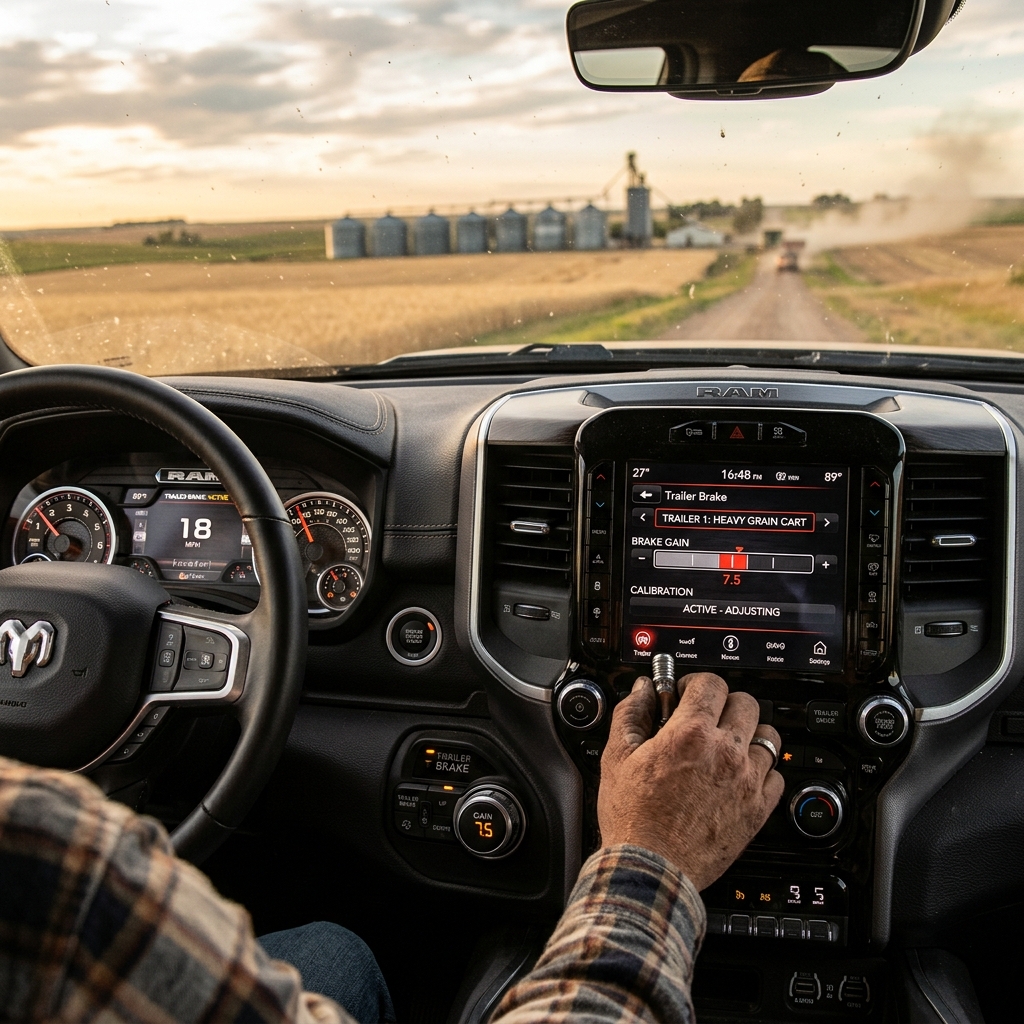
Every Ram Heavy Duty truck equipped with Option Code AHU or towing packages includes an Integrated Trailer Brake Controller (ITBC) built directly into the center stack. This unit uses electronic proportional braking, sending voltage to trailer brakes based on hydraulic brake pressure generated by the truck’s master cylinder. Calibrating gain settings correctly before hauling heavy harvest loads is crucial for preventing jackknifing or premature brake overheating.
|
Trailer Type & Braking System
|
Trailer Weight Condition
|
ITBC Setting Mode
|
Recommended Starting Gain
|
|
Dual-Axle Electric Drum Brakes
|
Unladen / Light Load
|
Light Electric
|
4.0 to 5.5
|
|
Triple-Axle Electric Drum (Livestock)
|
Fully Loaded (Harvest / Cattle)
|
Heavy Electric
|
6.5 to 8.5
|
|
Electric-Over-Hydraulic Disc Brakes
|
Loaded Commercial Flatbed
|
EOH Heavy
|
5.5 to 7.5
|
|
Heavy Grain Gooseneck (Surge/EOH)
|
Peak Harvest Weight (25k+ lbs)
|
EOH Heavy
|
7.5 to 9.5
|
Step-by-Step Brake Calibration Procedure for Rural Kansas Roads: 1. Select the Correct Brake Type: In the Ram Instrument Cluster menu, navigate to Trailer Tow -> Trailer Select -> Brake Type. Choose between ‘Light Electric’, ‘Heavy Electric’, ‘Light EOH’, or ‘Heavy EOH’. Electric-over-hydraulic (EOH) systems require specific pulse timings to prevent pump delay. 2. Set Initial Gain On Flat Ground: Accelerate truck and trailer to approximately 20 MPH on a clean, paved road (such as Goldenbelt Blvd near Junction City). 3. Manual Squeeze Test: Without touching the foot brake pedal, squeeze the manual slider switch on the dashboard brake controller completely. 4. Adjust Until Lockup Threshold: If trailer brakes lock up and slide tires, reduce gain by 0.5 increments. If trailer pushes the truck during braking, increase gain until you feel a firm, smooth drag that decelerates the rig without wheel lockup. 5. Gravel Road Verification: When operating on dirt or gravel township roads around Manhattan and Geary County, reduce gain settings by 1.0 to 1.5 points to prevent trailer tires from skidding on loose stone.
Tire Pressure Best Practices: Should Heavy Harvest Trailer Tires Be Adjusted to Max PSI?
Cold Inflation Ratings vs. Heat Expansion
During peak fall harvest, ambient temperatures across Kansas fluctuate dramatically between crisp autumn mornings and warm afternoon highway runs on I-70. A critical question for agricultural haulers is whether heavy trailer and truck tires should be inflated to maximum sidewall PSI ratings. The unequivocal technical answer is **YES: Under full payload conditions, tires must be inflated to the manufacturer cold maximum PSI rating listed on the tire sidewall and vehicle certification label.** Heavy HD truck tires (typically Load Range E or F rated at 80 PSI cold) rely on internal air pressure to support vertical loads. Under-inflating a tire by just 10 PSI reduces load capacity by nearly 12% and causes rapid sidewall flexing.
Avoiding Thermal Blowouts & Tire Degradation
Sidewall flexing generates extreme thermal heat. When hauling a 24,000 lb gooseneck trailer across the Flint Hills at 65 MPH, an under-inflated tire can quickly exceed internal temperatures of 200°F, leading to tread separation or catastrophic blowouts.
Never bleed air pressure from hot tires during mid-day stops. Tire manufacturers design tire carcasses to accommodate normal thermal pressure rises (10 to 15 PSI above cold rating) during highway operation. For fast tire inspections, routine fluid checks, and rapid maintenance, stop by our Express Lane at Valor CDJR.
Fall Harvest Towing Checklist: Preparing Heavy-Duty Ram Trucks for High-Payload Hauling
Before taking heavy gooseneck trailers into field harvest operations or embarking on multi-state livestock transports, complete this essential 8-point technical checklist engineered specifically for Ram Heavy Duty trucks equipped with the AHU Prep Group.
1. Ball & Pin Box Lubrication
Apply heavy lithium grease to the 2-5/16 inch gooseneck ball surface or install a high-density polyethylene lubricant plate on fifth-wheel kingpins to prevent metal grinding and binding.
2. Safety Chain Anchor Torque
Inspect drop-in safety chain loops in the bed pucks. Ensure the quarter-turn locking pins seat fully and retaining cotter pins are engaged without rust deformation.
3. 7-Pin Plug Voltage Testing
Test auxiliary 12V charging terminals and trailer brake signal pins inside the in-bed 7-pin socket using a digital multimeter to confirm clean 13.8V+ alternator output.
4. Tire Tread & Sidewall Inspection
Verify minimum 4/32 inch tread depth on truck drive tires and inspect inner duals for trapped stones or sidewall bulges that cause high-speed thermal failure.
5. Transmission Fluid & Cooler
Check transmission fluid levels on 68RFE and AISIN transmissions. Ensure auxiliary transmission oil cooler fins behind the front grille are clear of crop chaff and debris.
6. Emergency Breakaway Battery
Test the 12V gel-cell battery on the trailer breakaway system. Ensure the lanyard cable is correctly length-adjusted and clipped to a rigid bed anchor, never around the ball.
Factory-Installed Puck System vs. Aftermarket Gooseneck Hitches: Cost, Warranty, and Structural Integrity
When configuring a commercial or agricultural Ram Heavy Duty truck, buyers often evaluate whether ordering Option Code AHU from the factory is worth the investment compared to installing an aftermarket under-bed hitch later. A head-to-head comparison illustrates the long-term operational advantages of factory integration.
|
Evaluation Criterion
|
Ram Factory AHU Prep Group
|
Aftermarket Under-Bed Gooseneck Hitch
|
|
Installation Requirement
|
100% Robotically Welded at Factory
|
4-8 Hours Labor; Bed Removal or Cutting Required
|
|
Bed Floor Finish
|
Flush-fit puck covers; 100% flat bed when removed
|
Exposed center hole; aftermarket trim rings can catch cargo
|
|
Powertrain & Frame Warranty
|
Preserves 5-Year/100,000-Mile Factory Warranty
|
Risk of voiding frame anti-corrosion coverage due to drilling
|
|
Integrated 7-Pin Electrical
|
Factory sealed in-bed wiring harness included
|
Requires aftermarket harness splicing into rear bumper wire
|
|
Fifth-Wheel Compatibility
|
Direct drop-in for standard 5th-wheel hitches
|
Requires bulky adapter rails mounted above bed floor
|
Essential Mopar Gooseneck & Fifth-Wheel Adapter Kits Available at Valor CDJR
To turn your Ram factory prep group into a fully functional towing rig, Valor CDJR stocks authentic Mopar towing accessories engineered specifically for Option Code AHU receiver pucks. Ordering factory-approved components ensures proper metallurgy and precise lock-pin tolerances.
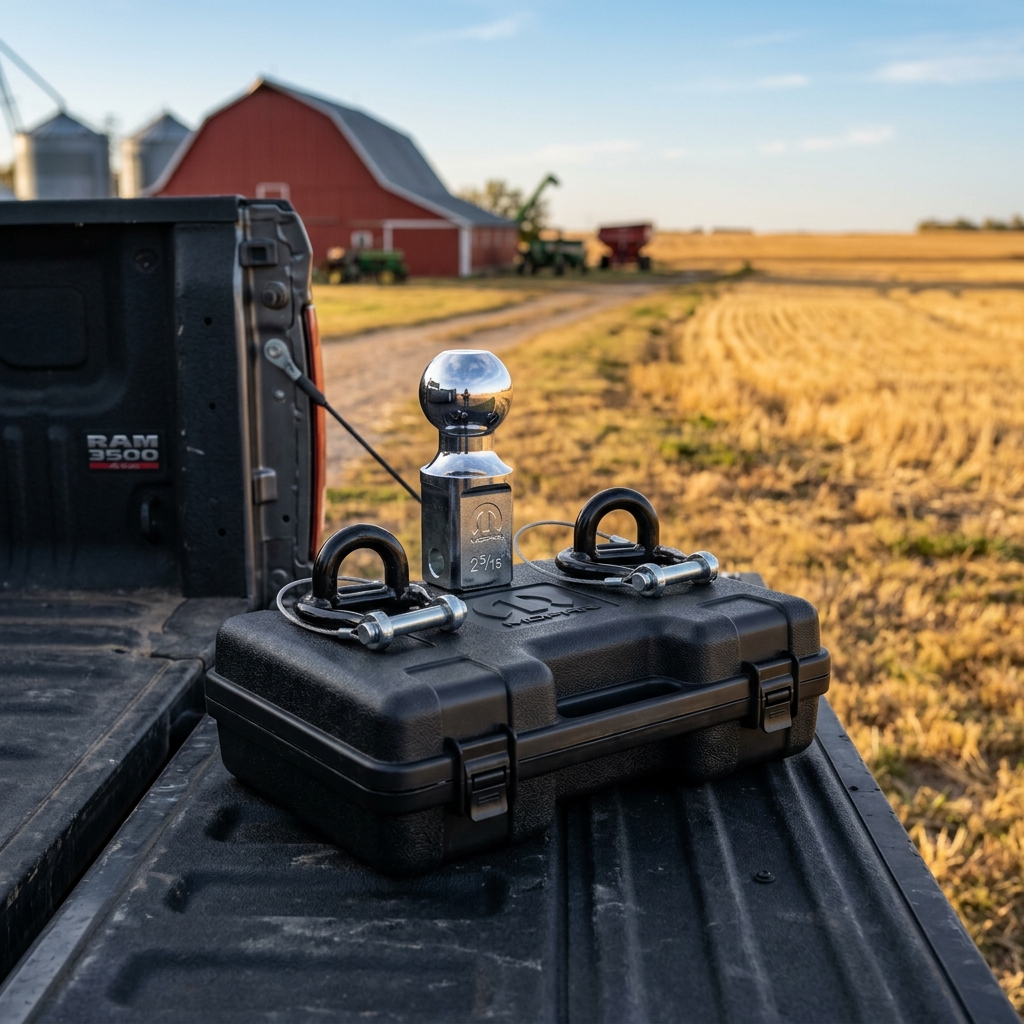
Mopar 2-5/16 Gooseneck Ball Kit
Features a patented lever-action quick-release locking mechanism that drops directly into the center bed puck. Includes two heavy-duty safety chain tie-down loops and a custom molded carrying case.
Picture-Frame Fifth-Wheel Adapter
Adapts outer bed pucks to accept traditional industry-standard fifth-wheel hitches from Curt, B&W, and Reese without installing elevated bed rails.
In-Bed Plug Replacement Caps
UV-resistant, weather-sealed replacement puck caps and 7-pin dust covers designed to withstand extreme winter weather and agricultural chemical exposure.
Navigating Flint Hills Terrain and Kansas Rural Highway Demands in Manhattan & Junction City
Managing Steep Rolling Grades on I-70 & US-77
Towing heavy agricultural loads around Fort Riley, Junction City, and Manhattan presents distinct topographic challenges. Navigating the steep, rolling grade transitions of Interstate 70 through the Flint Hills requires constant vehicle control. When descending 6% grades with a 25,000 lb gooseneck trailer, relying solely on mechanical service brakes can lead to dangerous brake fade.
Ram Heavy Duty trucks equipped with Cummins Turbo Diesel engines feature a driver-selectable **Smart Exhaust Brake**. Operating in either ‘Full’ or ‘Automatic’ mode, this system adjusts variable-geometry turbocharger vanes to generate reverse engine backpressure. Automatic mode maintains a set vehicle speed during downhill descents without requiring pedal input, dramatically extending brake pad life.
Crosswind Stability & Prairie Road Traction
Kansas prairie winds frequently blow sustained 35+ MPH gusts across north-south corridors like Highway 77. High-profile livestock or enclosed gooseneck trailers act like massive sails, creating lateral sway that tests chassis rigidity.
The Ram AHU prep group places the gooseneck ball pivot point approximately 2 inches forward of the rear axle centerline. Positioning vertical tongue weight forward of the rear axle creates natural stability, transferring downward force to both front and rear axles. Combined with Ram Electronic Stability Control (ESC) and Trailer Sway Mitigation, your rig remains firmly planted in high crosswinds. If you are exploring pre-owned heavy-duty options, browse our Used Vehicle Listings.
Step-by-Step Guide: How to Connect a Gooseneck Trailer to the Ram In-Bed Puck System
Connecting a gooseneck trailer to the Ram factory puck system is a streamlined process that takes less than five minutes when following proper mechanical safety protocols:
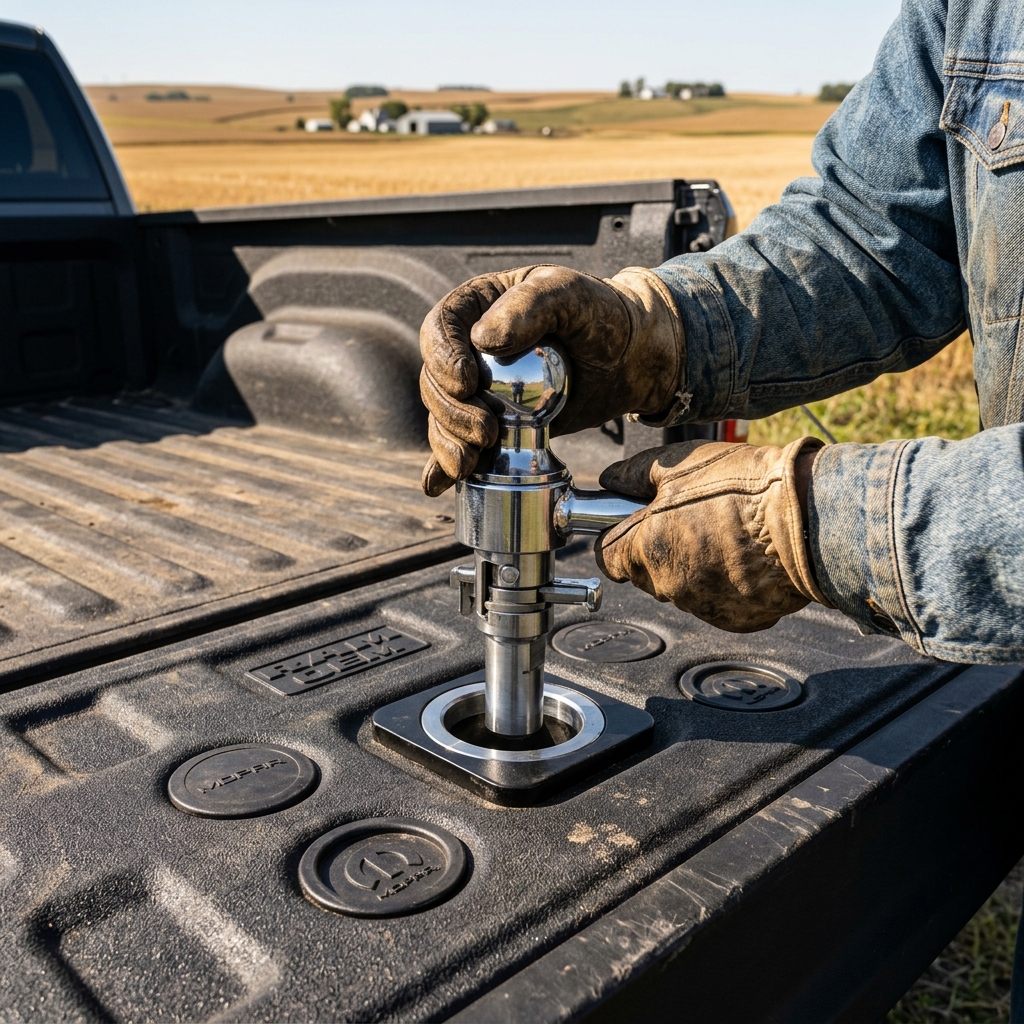
1. Remove Center Puck Cover: Rotate the central cast-aluminum bed cover counterclockwise and lift it out to expose the factory gooseneck receiver socket. 2. Insert Gooseneck Ball: Lift the center locking lever on your Mopar 2-5/16 ball, insert the shank into the socket, and drop the lever down to engage the dual locking ball bearings underneath. 3. Install Safety Chain Loops: Insert the two drop-in safety chain loops into the designated rear diagonal outer puck sockets. Rotate each loop 90 degrees until the locking tab drops securely into place. 4. Align Truck & Coupler: Lower tailgate (or open 5th-wheel cutout gate), back truck into position until the trailer coupler aligns directly over the ball, and lower the trailer jack. 5. Lock Coupler & Engage Pin: Close the trailer coupler locking handle and insert the safety pin. Verify that the coupler collar has seated fully beneath the ball shoulder. 6. Attach Safety Chains & Breakaway Lanyard: Cross safety chains beneath the drawbar and hook into bed loops. Attach the breakaway cable to a rigid bed anchor. 7. Plug in 7-Pin Harness: Insert trailer electrical plug into the bed-wall socket and latch the spring-loaded socket lid over the plug connector lock edge. 8. Verify Dashboard Display: Start truck and check instrument cluster for ‘Trailer Connected’ notification and automated exterior trailer light check cycle.
Schedule Heavy-Duty Ram Towing Service and Order Factory Parts at Valor CDJR in Junction City, KS
Whether you are equipping a brand-new 2026 Ram 3500 dually for peak harvest or maintaining a commercial fleet in Junction City, Valor CDJR is your trusted regional heavy-duty truck authority. Our dealership features factory-trained Chrysler Dodge Jeep Ram Master Technicians who understand the exacting demands of Kansas agricultural and commercial towing.
Visit our showroom at 1825 Goldenbelt Blvd to inspect our inventory of factory AHU-equipped Ram 2500 and 3500 models, order genuine Mopar gooseneck ball kits, or perform a pre-harvest towing system checkup. For current financing options for your farm or commercial business, contact our team through our Finance Center page. You can also Get Directions to Valor CDJR or Call us at (785) 238-5114 to speak directly with a truck specialist.