Demystifying Car Maintenance: Your Guide to Common Auto Services in Junction City
For many drivers in Junction City, Kansas, looking at a service menu can feel like reading a foreign language. Terms like ‘fluid flush,’ ‘alignment,’ and ‘rotation’ get thrown around constantly, leaving you wondering what is truly necessary and what can wait. The truth is, vehicle maintenance does not have to be confusing, intimidating, or stressful. Our goal today is to break down these common automotive services into plain, straightforward English, helping you understand exactly what is happening under your hood so you can make highly informed, confident decisions for your vehicle’s longevity and your family’s safety.
We believe that an educated vehicle owner is a confident vehicle owner. When you know exactly why a service is recommended, how it protects your investment, and what the warning signs of neglect look like, you save money and enjoy peace of mind on every journey. Whether you are daily commuting along Highway 77, planning a summer road trip across the Flint Hills, or operating heavy-duty machinery for local business needs, keeping your vehicle in top running condition is vital. Let us pull back the curtain on common garage services and make automotive care crystal clear.
In this comprehensive guide, we will dive deep into the differences between tire rotations and wheel alignments, explore how alignments actually protect your vehicle’s mechanical integrity, break down realistic maintenance costs, and dissect the vital systems that keep you safe—like your brakes and battery. By the time you finish reading, you will possess a master-level understanding of basic automotive care, enabling you to speak the same language as your technician and navigate your service visits with absolute confidence.
What Is the Difference Between a Tire Rotation and a Wheel Alignment?
It is incredibly common for drivers to confuse tire rotations with wheel alignments. After all, both services take place around your wheels, both directly affect how your car handles, and both are critical for maximizing the lifespan of your rubber. However, they are entirely different procedures addressing completely separate mechanical issues. Confusing them can lead to neglecting one or the other, resulting in uneven tire wear or premature steering component failure.
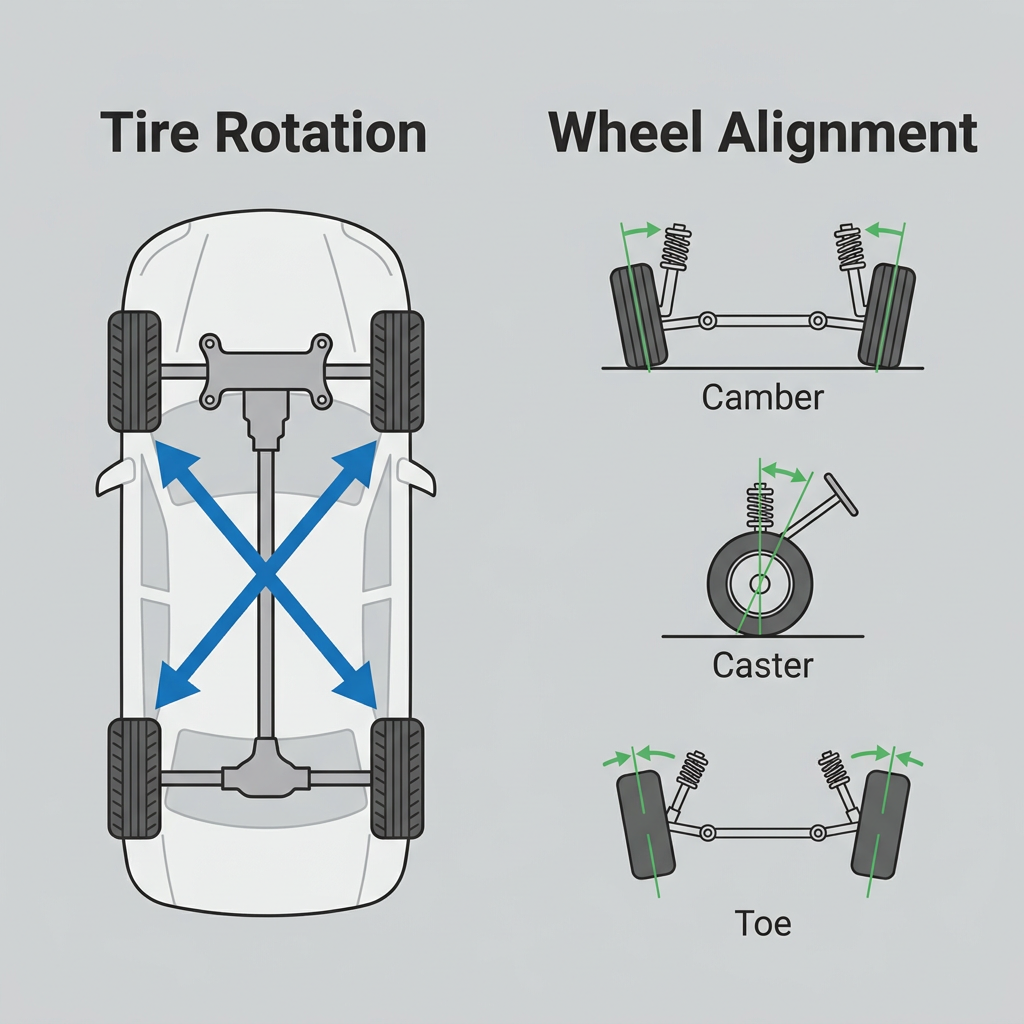
A tire rotation is a simple physical relocation of your existing wheels and tires. Because the front of your car holds the heavy engine and performs all the steering, front tires wear down much faster and in different patterns than rear tires. During a rotation, a technician will take the tires off your vehicle and move them to different positions—such as swapping the front tires to the back, or crossing them diagonally depending on your drivetrain. This ensures that all four tires wear down at an even, balanced rate over time, preventing you from having to replace two tires prematurely.
On the other hand, a wheel alignment does not involve changing the positions of your tires at all. In fact, it is not actually an adjustment of your tires; rather, it is a complex calibration of your vehicle’s suspension system. Over time, hitting potholes, bumping curbs, or driving on rough, unpaved country roads out in the Flint Hills can knock your steering and suspension out of alignment. A technician uses highly sensitive computerized sensors to measure the angles of your steering knuckles and suspension components, adjusting them back to the precise factory specifications so your tires point perfectly straight ahead.
Regularly scheduled tire rotations should typically occur every 5,000 to 7,500 miles—often conveniently matching your routine oil change schedule. Alignments, conversely, are typically performed once a year, whenever you purchase a brand-new set of tires, or immediately after you hit a major road hazard that disrupts your vehicle’s steering behavior.
What Does a Standard Wheel Alignment Do for Your Car?
To truly appreciate why a wheel alignment is so important, think of your vehicle as a runner. If a runner’s shoes are tilted outward or inward, they will quickly develop joint pain, lose speed, and wear out their shoes unevenly. Your car behaves the exact same way. A professional computerized wheel alignment fine-tunes three primary angles of your steering and suspension geometry to keep your ride smooth, safe, and efficient.
Toe Angle
Imagine looking down at your feet. If you point your toes inward toward each other, that is ‘toe-in.’ If you point them outward, that is ‘toe-out.’ In automotive terms, toe refers to whether the front of your tires point slightly toward or away from the center of the vehicle. Incorrect toe settings cause tires to scrub sideways against the asphalt of Riley County roads, rapidly shaving down your tread.
Camber Angle
Camber is the inward or outward tilt of the wheels when viewed directly from the front of your car. If the top of the wheel tilts too far inward (negative camber) or too far outward (positive camber), your tire is not maintaining flat, full contact with the road. This results in heavy wear on just one side of the tire (inside or outside edge) and can negatively impact your cornering stability.
Caster Angle
Caster is the angle of your steering axis when viewed from the side of the vehicle. If you have ever ridden a bicycle, the forward tilt of the front fork helps the bike stay stable and self-center when you let go of the handlebars. This is positive caster. Proper caster ensures stable straight-line tracking on high-speed highways and helps your steering wheel naturally return to center after a turn.
By keeping these three angles precisely matched to your manufacturer specifications, a standard alignment guarantees your vehicle drives straight without pulling to one side. It also minimizes rolling resistance, which means your engine does not have to work as hard, directly improving your fuel economy and putting hard-earned money back in your pocket. To ensure your vehicle is traveling perfectly straight down the road, consider scheduling a professional diagnostic check-up through our Service Scheduler.
How Much Does a Four-Wheel Alignment Cost on Average?
One of the most frequent questions we hear in our service department is: ‘How much is this going to cost me?’ We understand that automotive budgets are important, and transparency is one of our primary core values. Nationally, a standard computerized four-wheel alignment generally ranges between $100 and $200, depending on the complexity of your vehicle’s suspension design and the specific tools required.
While some drivers might view an alignment as an optional luxury expense, looking at the long-term math reveals it is actually a massive money-saver. Consider this: a set of high-quality, reliable modern tires can easily cost anywhere from $600 to well over $1,200 depending on your vehicle model. If your suspension is severely misaligned, it can completely destroy a brand-new set of tires in as little as a few thousand miles of driving.
By spending a modest amount on a routine annual alignment, you are directly protecting that massive tire investment, extending their usable road life by up to 10,000 or even 20,000 miles. Furthermore, bad alignments put extreme, unnatural friction on wheel bearings, ball joints, and steering linkages, eventually leading to massive mechanical failure bills. An alignment is preventative healthcare for your car.
The Value of Regular Maintenance
• Protects tire investments worth up to $1,200+
• Prevents premature wear on expensive suspension components
• Improves highway fuel efficiency by reducing rolling resistance
• Enhances critical emergency handling and steering feedback
What Is a Brake Fluid Flush and Why Is It Necessary?
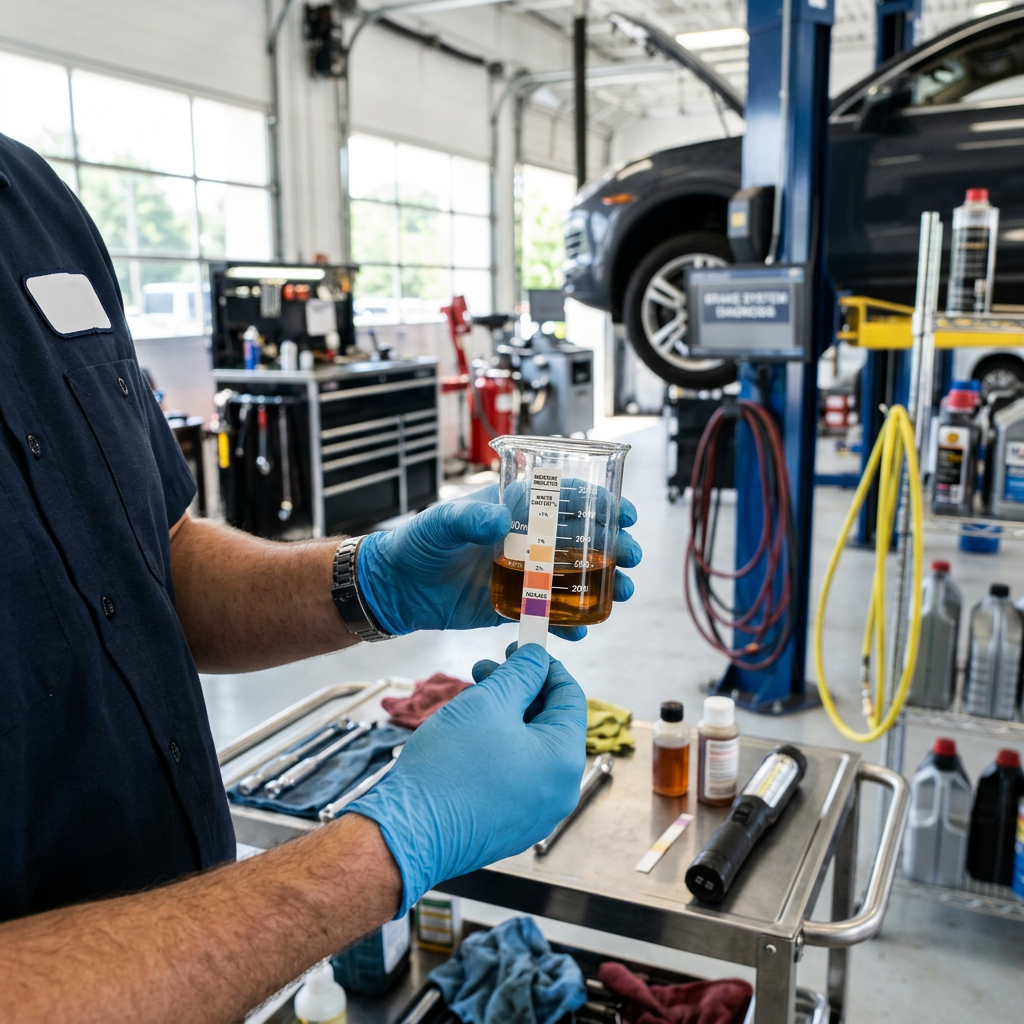
Fresh brake fluid is typically a clear, light golden color. As it absorbs moisture and contaminants over years of hard stopping, it degrades into a dark, muddy brown or black liquid that actively damages your braking system.
When you step on your brake pedal, you are not actually pushing a physical cable that clamps your brakes shut. Instead, you are pushing a piston that compresses a specialized hydraulic liquid known as brake fluid. This fluid transmits the physical force from your foot directly down to the heavy steel calipers at each wheel, clamping the brake pads against the spinning rotors to bring your multi-ton vehicle to a safe, controlled stop.
Brake fluid is ‘hygroscopic,’ which is a scientific term meaning it naturally attracts and absorbs moisture from the surrounding air. Over time, even in sealed systems, microscopic water molecules find their way past rubber seals and hoses. As moisture accumulates in your brake fluid, two critical problems emerge: first, the boiling point of the fluid drops dramatically. Under heavy braking (like descending steep hills or sudden highway stops), the fluid can actually boil, turning into highly compressible gas bubbles that result in a dangerously spongy, unresponsive pedal.
Second, moisture sitting inside your steel lines, aluminum calipers, and ABS control valves causes internal corrosion. This rust creates abrasive debris that ruins seals and can lead to expensive component leaks or failure. A brake fluid flush involves completely draining out all of this old, water-saturated fluid, cleaning the lines, and refilling the system with fresh, high-boiling-point fluid. This simple service keeps your stopping power instantaneous and prevents catastrophic internal rust.
What Is the Typical Maintenance Schedule for a Car's Braking System?
Because your brakes are your vehicle’s single most critical active safety system, staying ahead of their natural wear is paramount. You should never wait until you hear grinding noises to think about your brakes. A structured, proactive inspection routine ensures that minor pad wear is addressed before it escalates into ruined rotors, seized calipers, or unsafe stopping distances during your daily commutes to Manhattan.
Every 6 Months
Visual Inspections: Have your technician perform a quick visual check of your brake pad thickness whenever your wheels are removed for a routine tire rotation. This allows you to track the exact rate of wear and plan ahead for eventual replacements without any sudden surprises.
Every 12,000 Miles
Comprehensive Servicing: A detailed measurement of rotors, calipers, and hardware. Depending on your personal driving habits (stop-and-go city driving vs. open highway miles), front brake pads typically require replacement within the 25,000 to 50,000-mile window to keep your stopping performance flawless.
Every 2 Years
Brake Fluid Flush: Regardless of vehicle mileage, chemical degradation occurs. Flushing old fluid every 24 months protects expensive ABS valves and maintains structural hydraulic safety. If you need replacement parts, visit our trusted Parts Department.
What Are the Common Symptoms of a Failing Car Battery?
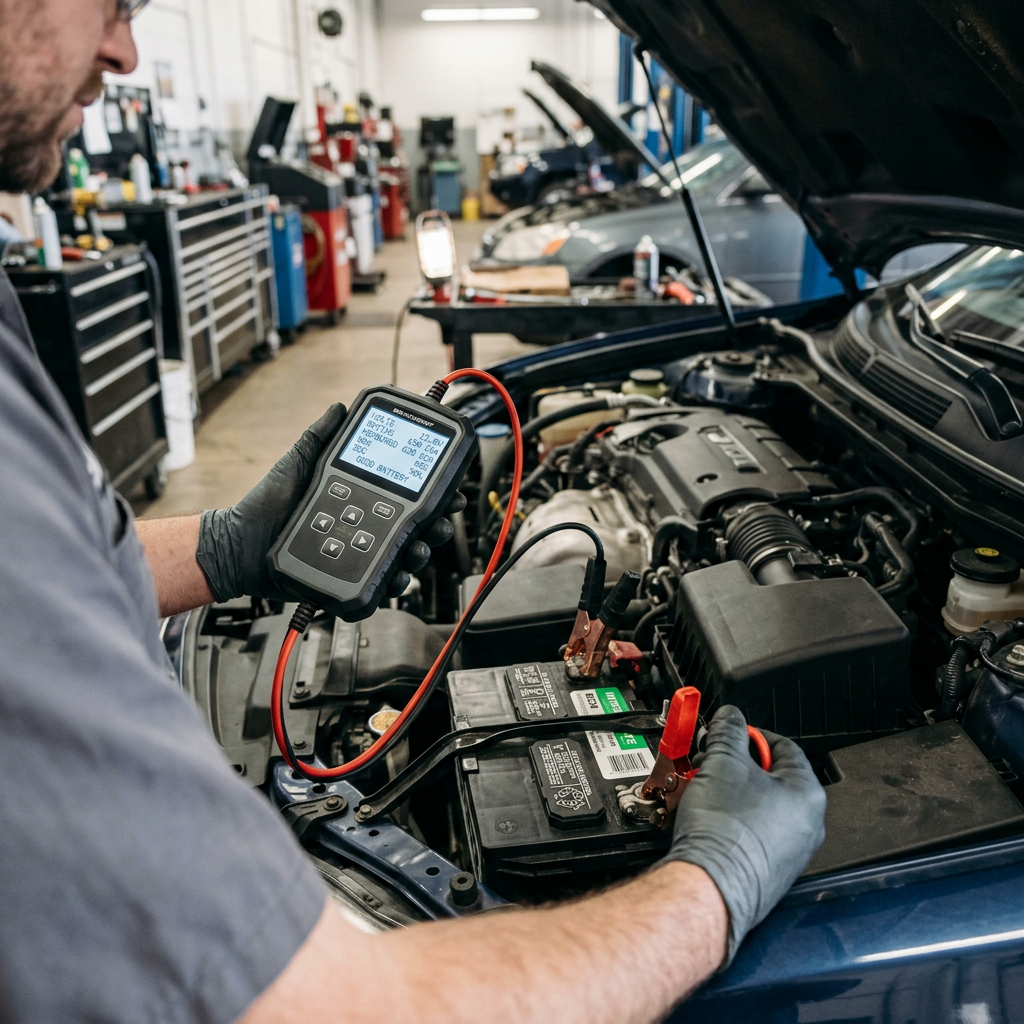
Few experiences are as universally frustrating as walking out to your car, turning the key, and hearing nothing but a hollow click. Car batteries do not live forever; in fact, the extreme temperature swings of Kansas summers and harsh winters put massive chemical strain on them, limiting their typical lifespan to between 3 and 5 years. Fortunately, your battery almost always gives warning signs before it dies completely.
The most common warning sign is a slow, sluggish engine crank. If your engine takes several seconds of struggling, groaning effort to turn over and start, your battery is struggling to deliver the massive electrical amperage needed by the starter motor. You might also notice your headlights or dashboard lights dimming significantly when the engine is idling, only brightening up once you press the gas pedal and the alternator spins faster to assist.
Keep an eye out for physical warning signs too. Pop your hood and inspect the metal battery terminals. If you see a crusty, white, blue, or green powdery buildup, that is corrosion, which blocks the flow of electricity. Additionally, if the battery case appears swollen, bloated, or cracked from heat exposure, it must be replaced immediately. If you notice any of these warning signs, avoid getting stranded in the Flint Hills by visiting our service bay today.
Do Local Shops in Junction City Offer Digital Vehicle Inspections?
Technology has completely revolutionized how we interact with our service mechanics. Gone are the days when you had to blindly trust a phone call from a garage telling you that a mystery part was broken. Today, cutting-edge service centers—like our highly advanced facility here in Junction City—utilize Digital Vehicle Inspections (DVIs) to bring 100% honesty, transparency, and clarity directly to your smartphone.
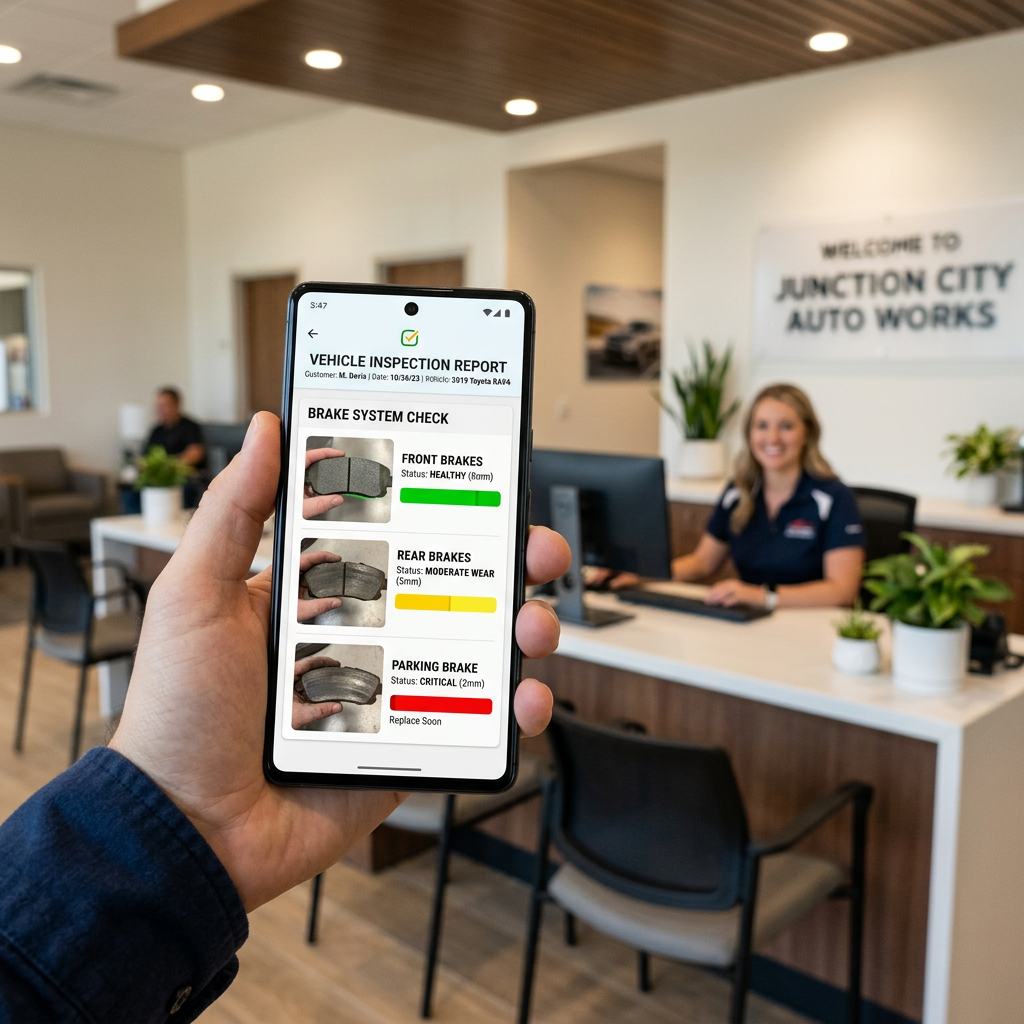
During a Digital Vehicle Inspection, our factory-trained technicians perform a comprehensive bumper-to-bumper health check of your vehicle. Instead of just writing notes on a clipboard, they carry specialized tablets to capture high-definition photographs and crystal-clear video clips of your actual vehicle components. If they find a leaking fluid line, a worn-out brake pad, or a torn suspension boot, they take a photo of the exact problem area, attach a brief explanation in plain English, and text or email the interactive report directly to you.
This modern approach eliminates all guesswork. You can physically see the wear for yourself, review color-coded health ratings (green for good, yellow for caution, red for immediate attention), and approve or decline specific service recommendations with a simple tap on your screen. It is like having a front-row seat right next to the technician in our garage, ensuring you always remain in complete control of your vehicle maintenance decisions and budget.
Do Local Junction City Shops Offer Warranty Options on Mechanical Repairs?
When investing your hard-earned money into mechanical repairs, you deserve to know that the job is done right—and that the repair will actually last. One of the biggest differences between independent, independent garages and a reputable, certified dealership is the strength, scope, and reliability of the warranty backing up the work performed.
At Valor CDJR, we do not believe in temporary fixes. All of our mechanical repairs are performed by factory-certified technicians using genuine Original Equipment Manufacturer (OEM) parts, rather than aftermarket alternatives that may not fit perfectly. Because of this dedication to quality, our repairs are backed by robust, nation-spanning parts and labor warranties. If a covered component happens to experience an issue down the road, you are fully protected.
Choosing a dealer-backed repair warranty gives you absolute peace of mind. It means your repair is supported by a large network of certified facilities, meaning you are covered even if you travel outside of Kansas on vacation. Before choosing a shop, always ask: ‘What happens if this part fails in six months?’ A reputable shop should stand proudly behind their workmanship with a written guarantee.
If you are currently evaluating your vehicle’s long-term viability and thinking about trading it in for something newer instead of pouring more cash into aging repairs, you can quickly get an accurate estimate using our online Trade In Evaluation tool to see what your vehicle is worth today.
Schedule Your Next Clear, Confident Service at Valor CDJR Today
You do not have to navigate vehicle maintenance alone or in the dark. At Valor CDJR, we pride ourselves on delivering clear, plain-language explanations, transparent digital vehicle reports, and expert mechanical care that keeps you safe on the road. Whether you need a quick tire rotation in our Express Lane, a computerized alignment, a brake system overhaul, or a fresh car battery, our friendly team is here to assist you.
If you are currently looking to upgrade your ride altogether, feel free to browse our comprehensive New Vehicle Listings or explore our reliable, affordable Used Vehicle Listings. If you need financing support, you can even Get Pre-Approved online from the comfort of your couch. We are your one-stop automotive resource in Junction City!
Tags: Auto Services, Automotive Repair, Brake Fluid Flush, Car Battery Replacement, Car Maintenance, Digital Vehicle Inspection, Fuel Efficiency, Preventative Maintenance, Suspension Repair, tire rotation, Vehicle Safety, Wheel Alignment
Posted in
Buying Guides, Financing & Insurance, Maintenance & Service, Safety Features, Technology & Innovation |
No Comments »