Blog / Vehicle Maintenance & Winter Care

Is All-Wheel Drive Worth the Extra Cost for Kansas Winters? The Bottom-Line Verdict from 20 Years in the Dealer Seat

Is All-Wheel Drive Worth the Extra Cost for Kansas Winters? The Bottom-Line Verdict from 20 Years in the Dealer Seat

Is All-Wheel Drive Worth the Extra Cost for Kansas Winters? A 20-Year Perspective from the Dealership

As the General Manager at Valor CDJR here in Junction City, I get asked the exact same question as temperatures drop each fall: "Jace, do I really need to spend the extra $2,000 to $3,000 for All-Wheel Drive, or am I just buying into clever dealership marketing?" After two decades sitting in the dealer seat, watching how vehicles perform across thousands of Kansas winter commutes, evaluating trade-ins, and analyzing real-world accident reports, my short answer is unequivocally YES. However, that affirmative comes with one critical, non-negotiable caveat: an advanced AWD system is only as effective as the mechanical grip of the rubber touching the pavement.
Kansas winter driving is notoriously deceptive. Unlike regions that receive consistent, dry powder snowfall, the weather patterns across Geary, Riley, and Dickinson counties deliver freezing rain, sudden black ice on I-70 bridges over the Smoky Hill River, unplowed rural farm routes, and deep sludgy slush on hill inclines throughout Manhattan. Rear-wheel drive vehicles—traditionally loved for their raw American muscle dynamics—can quickly transform into stressful challenges when torque breaks rear traction. Front-wheel drive offers decent pull over the front axle, but it lacks the active dynamic torque distribution required to climb frozen grades or recover from sudden lateral slippage. All-Wheel Drive changes the safety equation completely by transforming wheelspin into forward momentum within milliseconds.
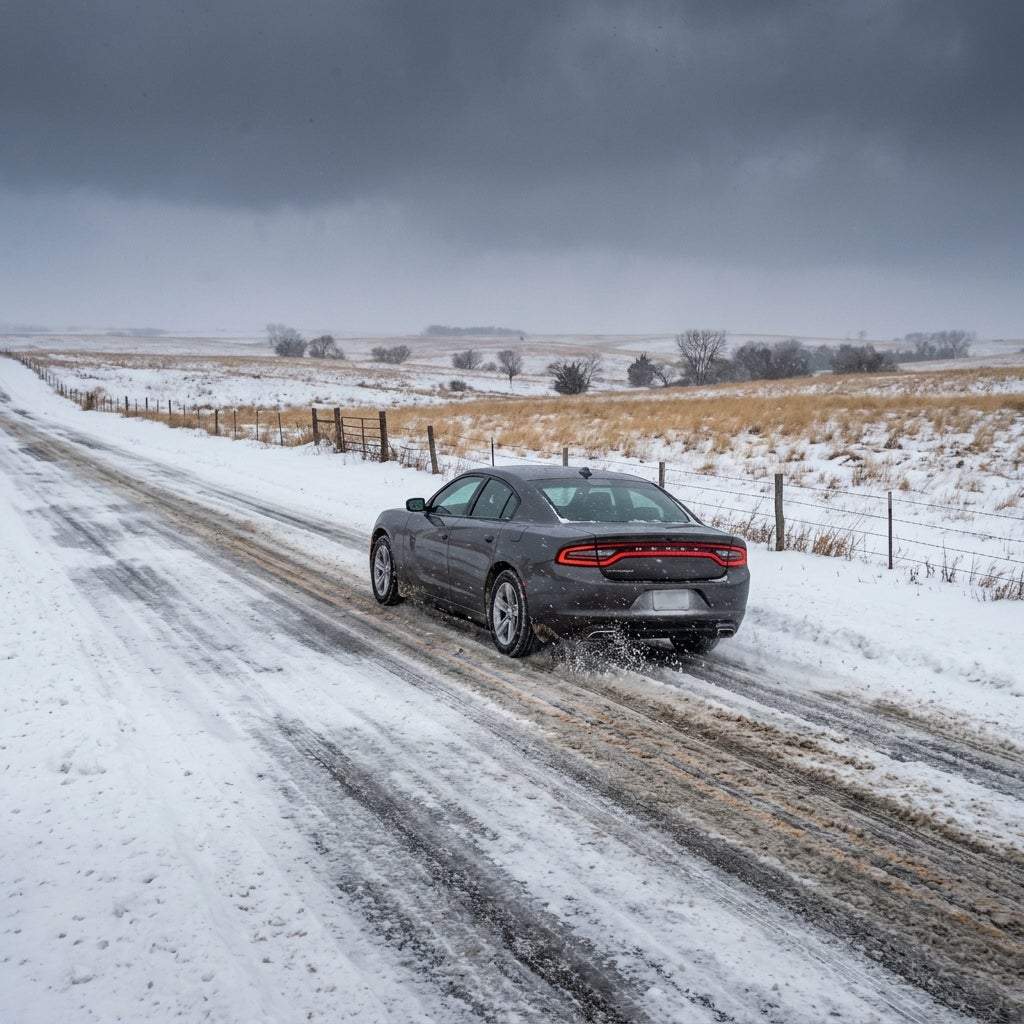
A dark grey Dodge Charger driving along a snowy rural road under a stormy sky. (Representative image for illustration purposes only. Actual vehicle may vary based on trim and configuration.)
Throughout this deep-dive report, I am going to break down the mechanical engineering behind modern Dodge all-wheel drive systems, contrast rear-wheel drive muscle against four-corner traction, evaluate winter tire physics, examine cold-weather electric vehicle range retention, and calculate the true monetary return on investment. Whether you are driving an daily commuter across Junction City or navigating backroads near Fort Riley, understanding how AWD technology operates will empower you to make an informed, safety-first automotive decision.

Meet Jace Grabouski: Two Decades Navigating Flint Hills Roads and Automotive Engineering

My perspective isn't derived from press releases or vehicle brochures; it comes from 20 continuous years on the frontlines of dealership operations right here in Junction City. Over two decades serving as General Manager at Get Directions to Valor CDJR, I have personally assisted thousands of local drivers, military service members from nearby Fort Riley, and local farm families select vehicles tailored to our rugged regional topography.
Having spent decades evaluating Chrysler, Dodge, Jeep, and Ram engineering evolutions—from early mechanical transfer cases to modern electro-hydraulic active axle disconnections—I have developed a granular appreciation for drivetrain engineering. When winter storms sweep through the Flint Hills, bringing sub-zero temperatures and packed sheet ice, knowing exactly how your car's transfer case shifts torque between axles isn't just automotive trivia—it's essential knowledge for keeping your family safe on rural state highways.

How Does the Dodge Charger All-Wheel Drive System Perform in Snow and Winter Conditions?

To understand why the Dodge Charger AWD system is uniquely qualified for Midwestern winter storms, you have to look under its sheet metal. Unlike traditional basic all-wheel drive setups that drag all four wheels continuously—sucking fuel efficiency dry—Dodge engineered an active transfer case with complete front-axle disconnect technology. Under ideal summer driving conditions or dry autumn highway cruising, the system can disengage the front driveshaft. The vehicle operates as a 100% rear-wheel drive sedan, preserving classic muscle car steering dynamics and maximizing fuel economy.
However, the moment ambient temperatures drop below approximately 40°F, or sensors detect wheel slip, windshield wiper activation, or rapid acceleration inputs, an electro-hydraulic clutch pack seamlessly engages the front axle in under 17 milliseconds. This lightning-fast engagement happens without any driver intervention. On frozen asphalt or unpaved backroads across Riley County, torque is dynamically shifted up to a 38/62 front-to-rear ratio, ensuring instant stability before micro-slips turn into major loss of control.
Furthermore, Dodge pairs this active transfer case with Electronic Stability Control (ESC) and All-Speed Traction Control tuned specifically for icy conditions. When the Charger detects one side of the vehicle resting on snow while the other sits on pavement (a common occurrence when pulls off onto shoulder gravel), the system applies micro-braking pressure to spinning wheels while re-routing torque across the open differentials to wheels with grip.
The result is a heavy, balanced four-door sedan that plants itself with total confidence into winter corners. Having driven Charger AWD test units through heavy blizzards along US-77, I can attest that the level of lateral stability and directional tracking provides peace of mind that lightweight front-wheel drive economy cars simply cannot match.

How Does Dodge Charger AWD Compare to RWD in Winter Driving Across Junction City?

Rear-Wheel Drive (RWD) Dynamics

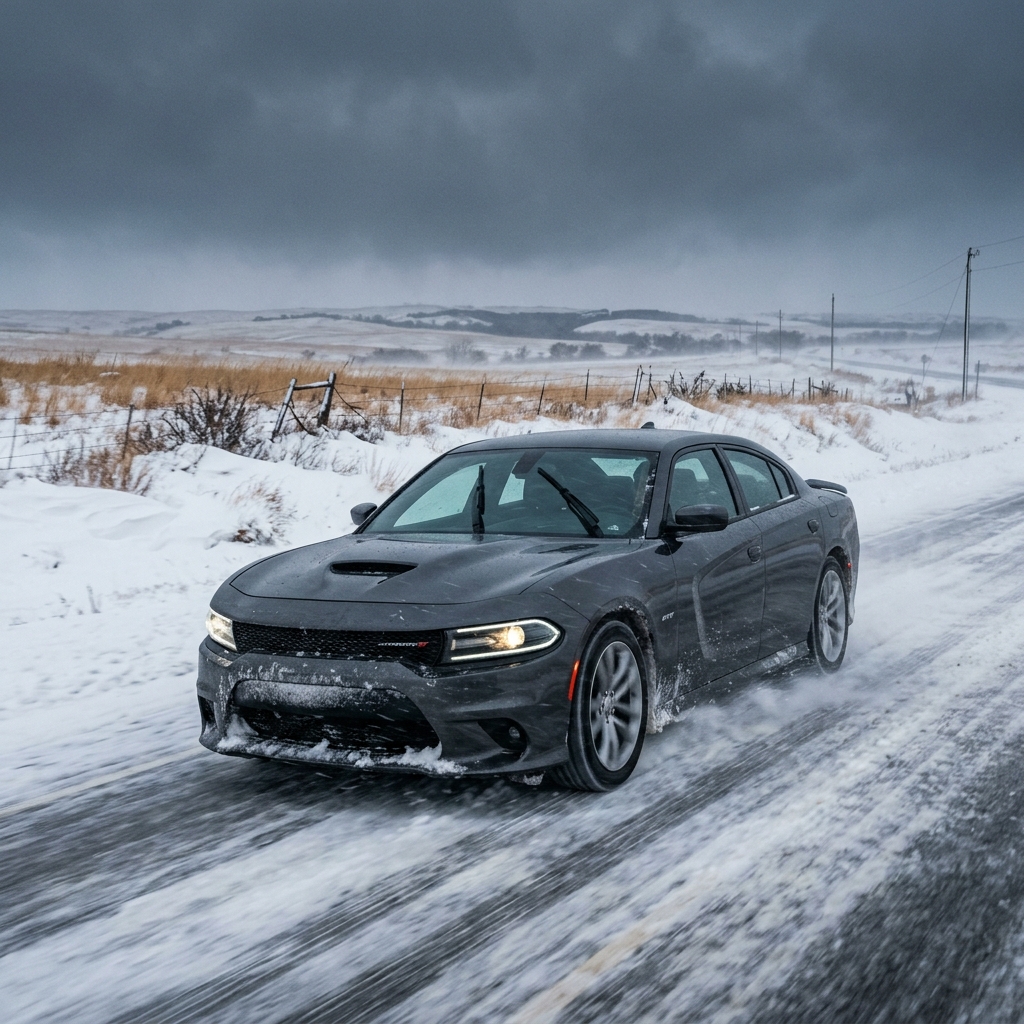
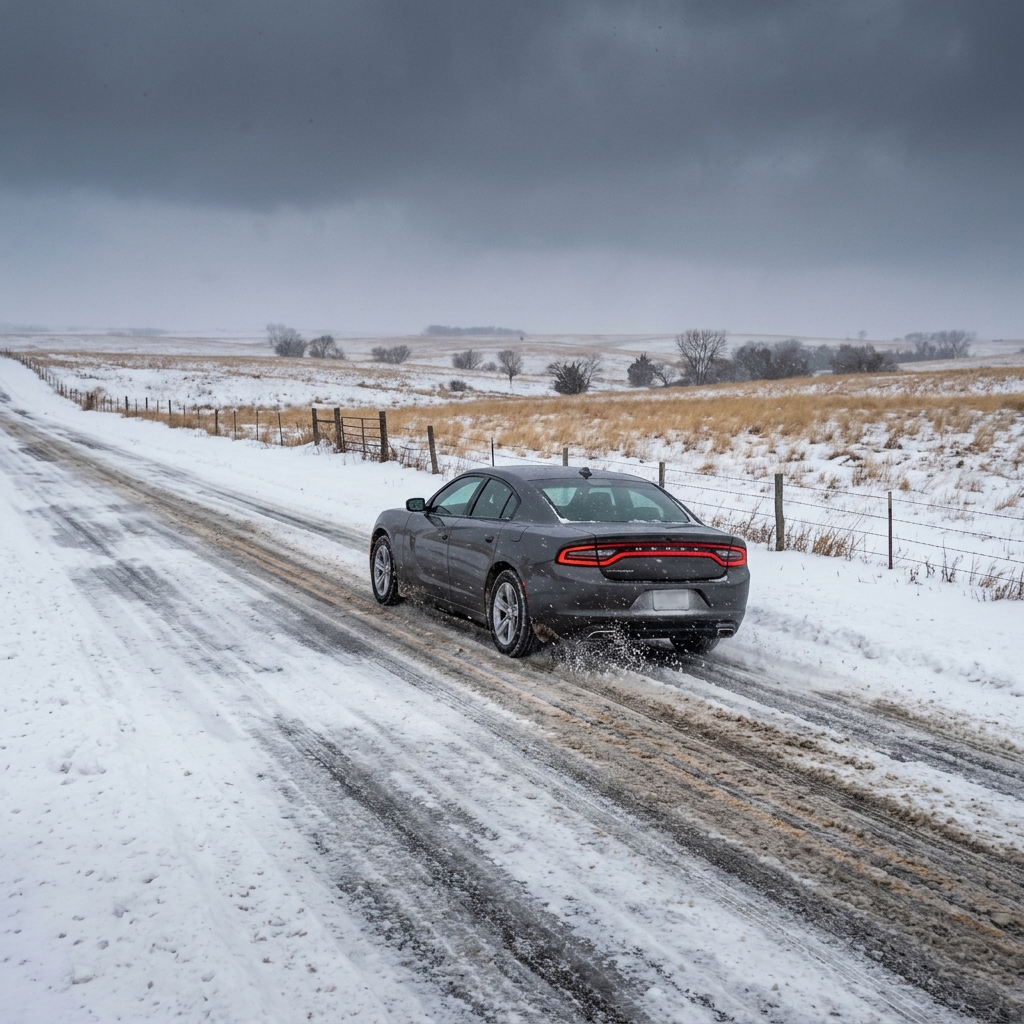
Gray sedan driving along a slushy rural road under a dark winter sky. (Representative image for illustration purposes only. Actual vehicle may vary based on trim and configuration.)
RWD delivers unmatched acceleration geometry on dry asphalt because vehicle weight transfers to the rear axle during launch. However, on freezing rain or slick ice, pushing a vehicle from behind while using front wheels solely for steering creates inherent instability. Under heavy throttle on icy Junction City streets, rear wheels easily break traction, causing oversteer ('fishtailing') that requires quick counter-steering.

All-Wheel Drive (AWD) Traction

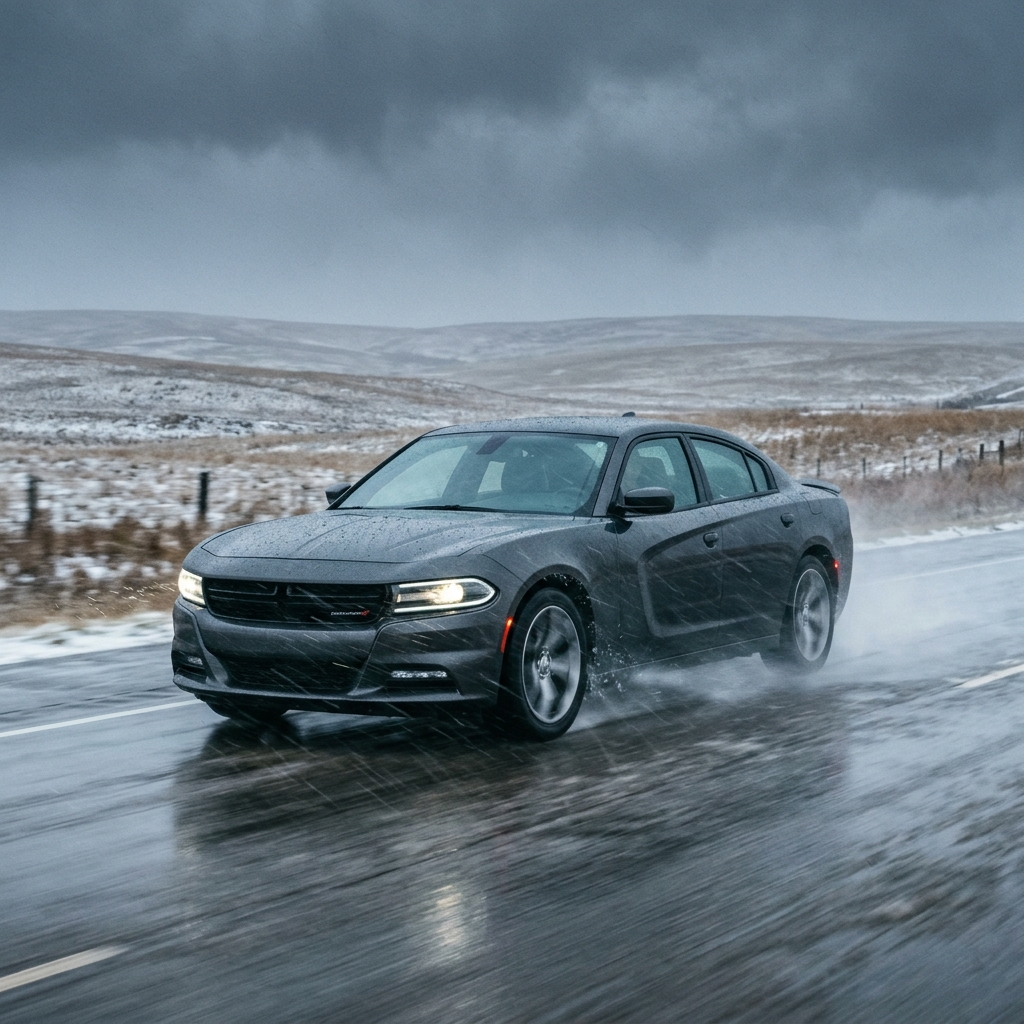
Dark gray Dodge Charger driving fast on a wet, snow-dusted road under an overcast sky. (Representative image for illustration purposes only. Actual vehicle may vary based on trim and configuration.)
AWD pulls and pushes simultaneously. By transferring engine output across four contact patches, engine torque per wheel is effectively cut in half. This drastically reduces the likelihood of exceeding any single tire's threshold of static friction. Starting from a complete stop on an icy uphill stoplight becomes effortless, eliminating panic and wheelspin completely.

Flint Hills Commuting Realities

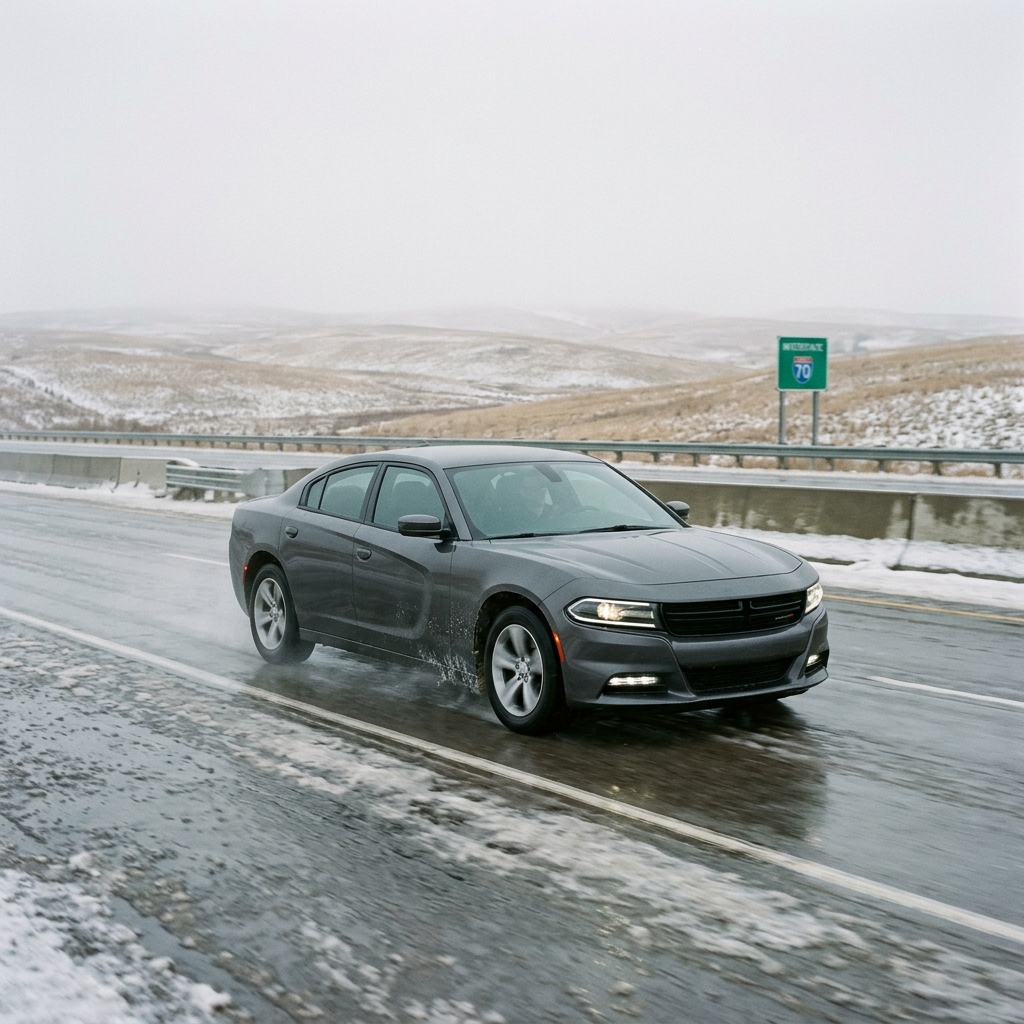
A grey Dodge Charger driving along a wet, slushy highway past an Interstate 70 sign in a winter landscape. (Representative image for illustration purposes only. Actual vehicle may vary based on trim and configuration.)
Cruising I-70 between Junction City and Manhattan during severe squalls presents high-speed crosswinds combined with slush accumulation between lanes. RWD vehicles experience severe lateral drift during lane changes. AWD provides directional stability, locking the sedan onto its intended path even when crossing frozen slush ruts at speed.

How Does the Next-Gen Dodge Charger’s Wet/Snow Mode Help in Winter Conditions?

Modern drivetrain engineering extends far beyond mechanical gears; software algorithms dictate how power reaches the cold asphalt. In next-generation Dodge Charger platforms, the selectable Wet/Snow Drive Mode fundamentally recalibrates the vehicle’s brain to prioritize stability over aggressive performance.
When engaged, Wet/Snow mode alters electronic throttle mapping. Even if a driver presses heavy on the accelerator pedal out of habit, the ECU dampens engine response, delivering smooth, progressive torque build-up rather than sudden bursts that break tire adhesion. The transmission logic shifts early to keep engine RPM low, reducing peak torque torque at the wheels.
Simultaneously, the active transfer case locks into a fixed 50/50 static torque split, ensuring both front and rear axles share initial movement duties instantly upon acceleration. The ABS and ESC systems adopt ultra-sensitive threshold settings, intervening subtly before driver-perceptible slip occurs.
For drivers facing deep snow drifts or packed ice near Milford Lake, this software integration transforms high-horsepower machinery into a predictable, compliant winter transport. It removes driver error from throttle management during slippery maneuvers.

Are Factory All-Season Tires Sufficient for Winter Driving in a Dodge Charger AWD?

The All-Season Myth

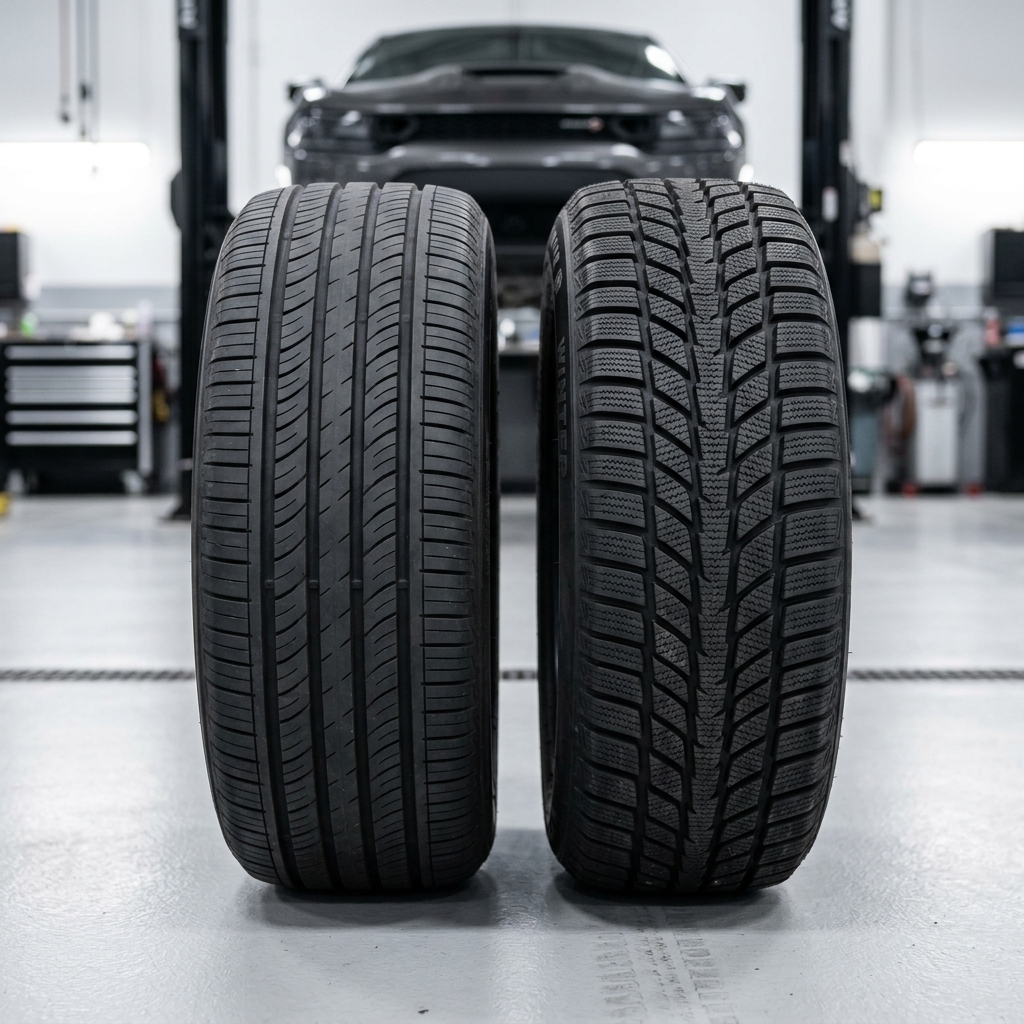
Factory all-season tires are engineered for low rolling resistance and long tread life in moderate conditions. However, once ambient temperatures drop below 45°F (7°C), standard all-season rubber compounds harden like hockey pucks. Regardless of how sophisticated your AWD system is, hard rubber cannot conform to ice micro-texture.
Side-by-side comparison of a smooth all-season car tire and a deep-treaded winter tire inside an auto garage. (Representative image for illustration purposes only. Actual vehicle may vary based on trim and configuration.)

Dedicated Winter Rubber

Dedicated winter tires utilize silica-rich soft rubber compounds that remain flexible in sub-zero Kansas deep freezes. High-density 3D siping cuts through surface water films to bite directly into hard ice. Pairing Dodge AWD with dedicated winter tires yields stopping distances up to 35% shorter than AWD with all-season rubber.
Remember: All-wheel drive helps you accelerate, but all four wheels already brake on every car. AWD does not reduce stopping distance on ice—tires do. If you plan to navigate extreme winter conditions across Kansas, combining AWD technology with proper winter tires or severe-snow-rated 3PMSF (Three-Peak Mountain Snowflake) tires at our Parts Department is the ultimate safety solution.

Jace’s Core Insight: "Traction Tech Gets You Moving, But Tread Physics Keeps You Off the Shoulder

"In my 20 years managing dealerships in Junction City, the most dangerous driver on the road during a winter storm is the one who believes an 'AWD' badge makes them immune to the laws of physics. All-Wheel Drive gives you incredible confidence getting out of snowy driveways and climbing icy Flint Hills grades. But when it comes to steering around an obstacle or emergency stopping on freezing rain, your drivetrain won't save you if your tires are bald or unsuited for sub-zero temperatures. Respect the road, maintain your vehicle, drive with sensible speed, and let technology work for you."
— Jace Grabouski, General Manager at Valor CDJR

Is the Dodge Charger AWD Platform Identical to the Chrysler 300 AWD?

A frequent technical query from pre-owned vehicle buyers visiting our showroom is whether the Dodge Charger AWD system is identical to the Chrysler 300 AWD setup. From an architecture standpoint, yes—they share core mechanical DNA. Both flagship sedans utilize Stellantis' unibody full-size platform, sharing the BorgWarner active transfer case, front axle disconnect hardware, and 3.6L Pentastar V6 powertrain pairing.
However, executive chassis tuning separates their road personalities. The Chrysler 300 AWD is calibrated for plush, luxury isolation, utilizing softer dampening rates, quieter compliance bushings, and smoother throttle mapping. It absorbs highway expansion joints effortlessly while delivering quiet winter confidence.
In contrast, the Dodge Charger AWD receives sport-calibrated steering gear ratios, firmer anti-roll bars, stiffer damper valving, and aggressive transmission shift schedules. The electronic stability control thresholds in the Charger allow slightly more dynamic rotation before intervening, providing a sportier feel on winding Kansas country roads.
Both sedans offer exceptional winter capability, but choosing between them depends on whether your preference leans toward executive comfort or muscular performance. Explore our Used Vehicle Listings to compare both models side-by-side.

How Does Cold Weather Affect the Battery Range and AWD of the Electric Dodge Charger Daytona?

As Dodge ushers in the electrified era with the all-electric Dodge Charger Daytona, winter performance dynamics undergo a radical revolution. The Daytona replaces mechanical driveshafts and transfer cases with dual Electric Drive Modules (EDMs)—one powering the front axle and one powering the rear. This dual-motor electric AWD configuration delivers instant torque vectoring across four wheels within microseconds, eliminating mechanical engagement delays entirely.
However, extreme Midwestern cold impacts high-voltage lithium-ion battery chemistry. During sub-zero Kansas cold snaps, chemical reactions slow down, and cabin heating demands energy from the traction battery. Drivers can expect a temporary range reduction of 20% to 30% during severe freezing conditions if proper thermal management protocols aren't followed.
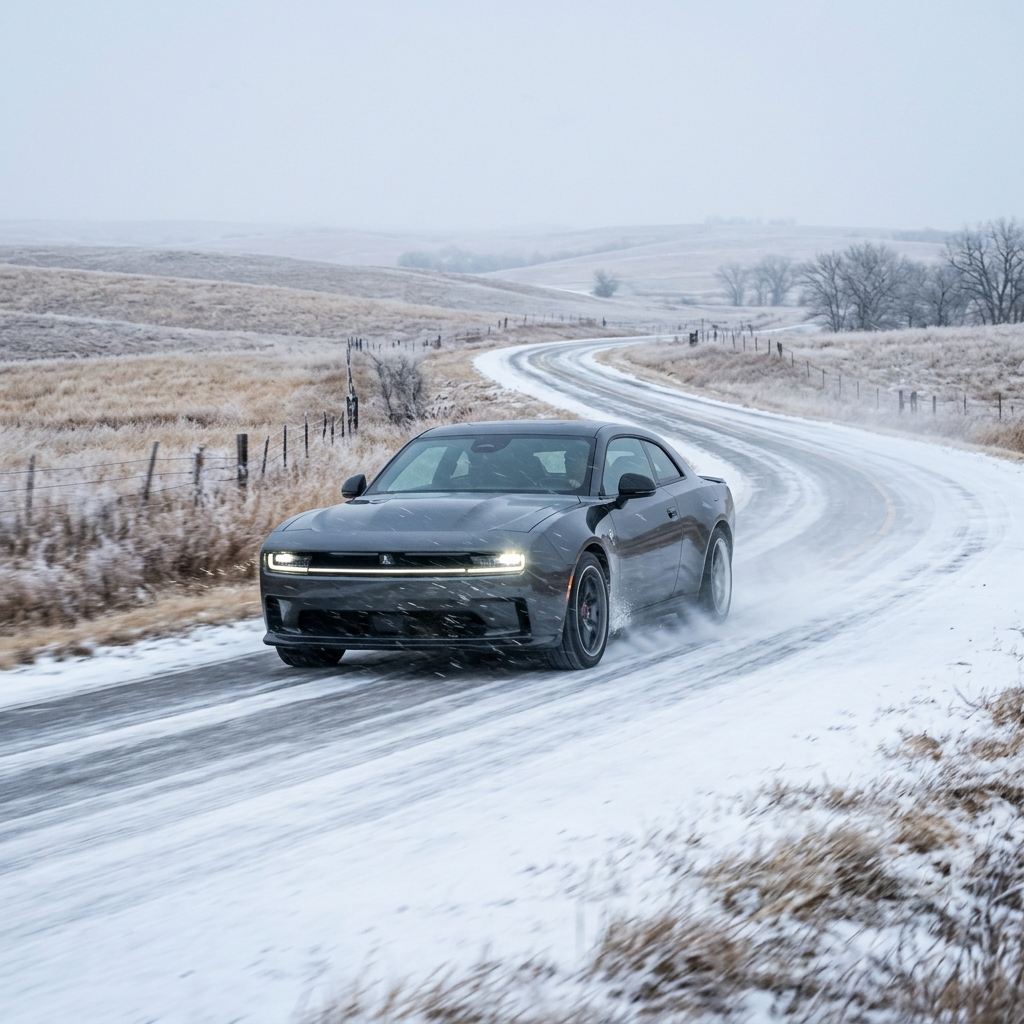
Dark grey Dodge Charger muscle car driving along a snow-covered, icy rural road. (Representative image for illustration purposes only. Actual vehicle may vary based on trim and configuration.)
To mitigate range loss, the Charger Daytona features automated battery pre-conditioning. When scheduled while plugged into your Level 2 home charger prior to morning departure in Junction City, the system warms the battery pack to its optimal electrochemical operating window (around 70°F) using grid power rather than stored battery energy. This preserves maximum driving range and ensures full dual-motor AWD power availability from the instant you back out of your driveway.

Calculating the ROI: Upfront Costs, Resale Value, and Winter Safety Peace of Mind

Initial Purchase Cost

Selecting All-Wheel Drive can affect a vehicle's MSRP. For current pricing and payment information, contact the dealership. Additionally, active front-axle disconnect technology keeps fuel economy penalties negligible (typically less than 1 MPG difference compared to RWD).

Resale & Trade Equity

In Midwestern resale markets like Kansas, AWD vehicles retain a significantly higher percentage of their initial value compared to RWD sedans. At trade-in time, AWD vehicles may retain stronger resale value compared with similar RWD models.

Accident Avoidance ROI

Insurance deductibles and related costs vary. AWD may help improve winter confidence and could reduce the risk of weather-related incidents.

Jace Grabouski’s Winter Readiness Checklist for Riley County Drivers

Before the first severe freeze hits Junction City, I recommend every driver complete this 4-step winter readiness protocol to ensure total vehicle reliability:
1. Battery Load Testing: Cold weather reduces battery capacity by up to 50%. Have your 12V battery load-tested at our Express Lane to avoid getting stranded in freezing temperatures.

2. Transfer Case Fluid Inspection: AWD transfer cases rely on clean synthetic fluid to actuate clutch packs smoothly. Check your maintenance schedule or visit service every 30,000 to 50,000 miles.

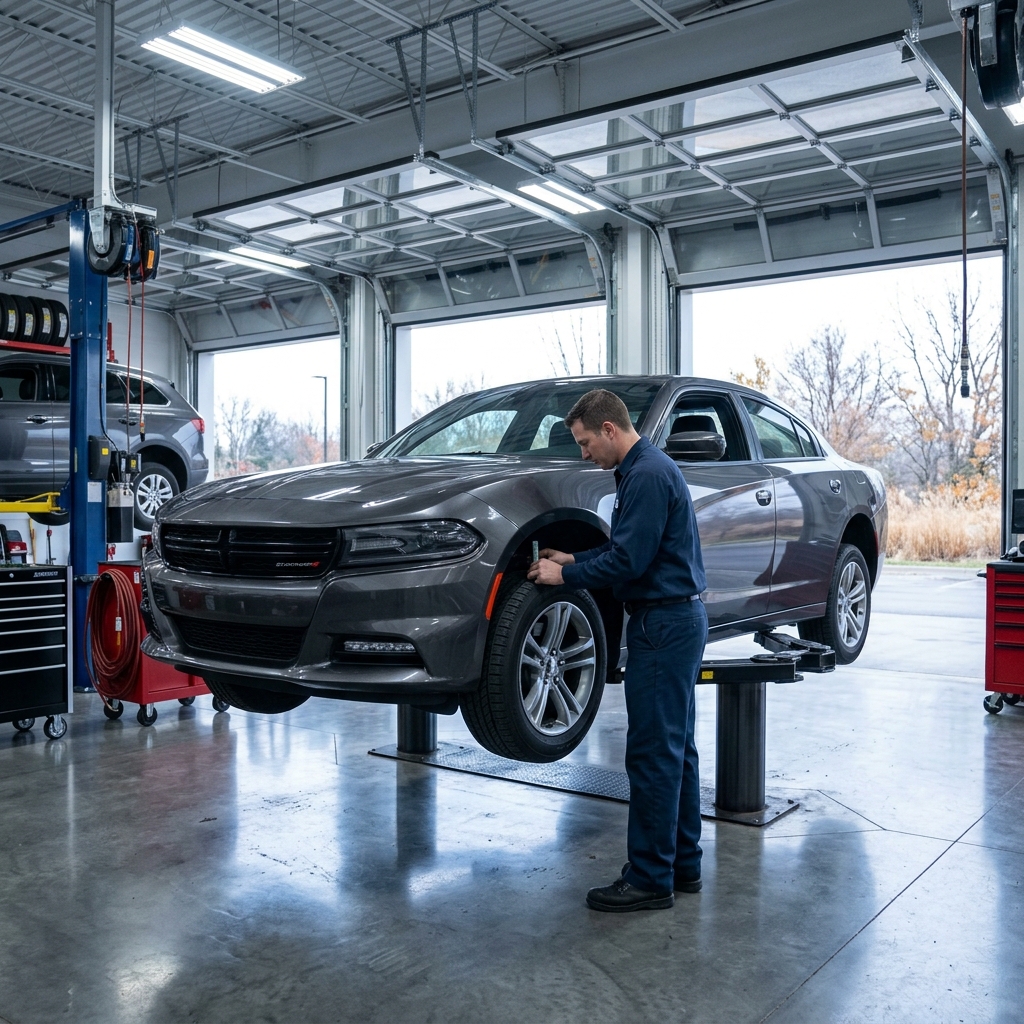
3. Tire Tread Depth & Pressure: Inspect tread depth using a depth gauge (minimum 4/32" for winter driving). Remember that tire pressure drops approximately 1 PSI for every 10°F drop in outside temperature.

4. Verify Drive Modes & Emergency Kit: Familiarize yourself with how to engage Wet/Snow drive modes in your vehicle controls, and pack a trunk kit containing jumper cables, a tow strap, blanket, flashlight, and bag of ice melt.
Mechanic using a tread depth gauge on a gray sedan's front tire while elevated on a hydraulic lift in a service bay. (Representative image for illustration purposes only. Actual vehicle may vary based on trim and configuration.)

Test Drive All-Wheel Drive Performance at Valor CDJR in Junction City

If you are considering winter readiness to find out if your vehicle is equipped for Kansas roads. My team and I at Valor CDJR are ready to help you navigate your winter vehicle search with transparent expert guidance, competitive financing offers, and world-class service support.
Visit our showroom at 1825 Goldenbelt Blvd, Junction City, KS 66441 or Call us at (785) 238-5114 to speak directly with our product specialists. Experience the security, power, and engineering precision of modern Dodge and Chrysler All-Wheel Drive firsthand.

Posted in:

Related Posts

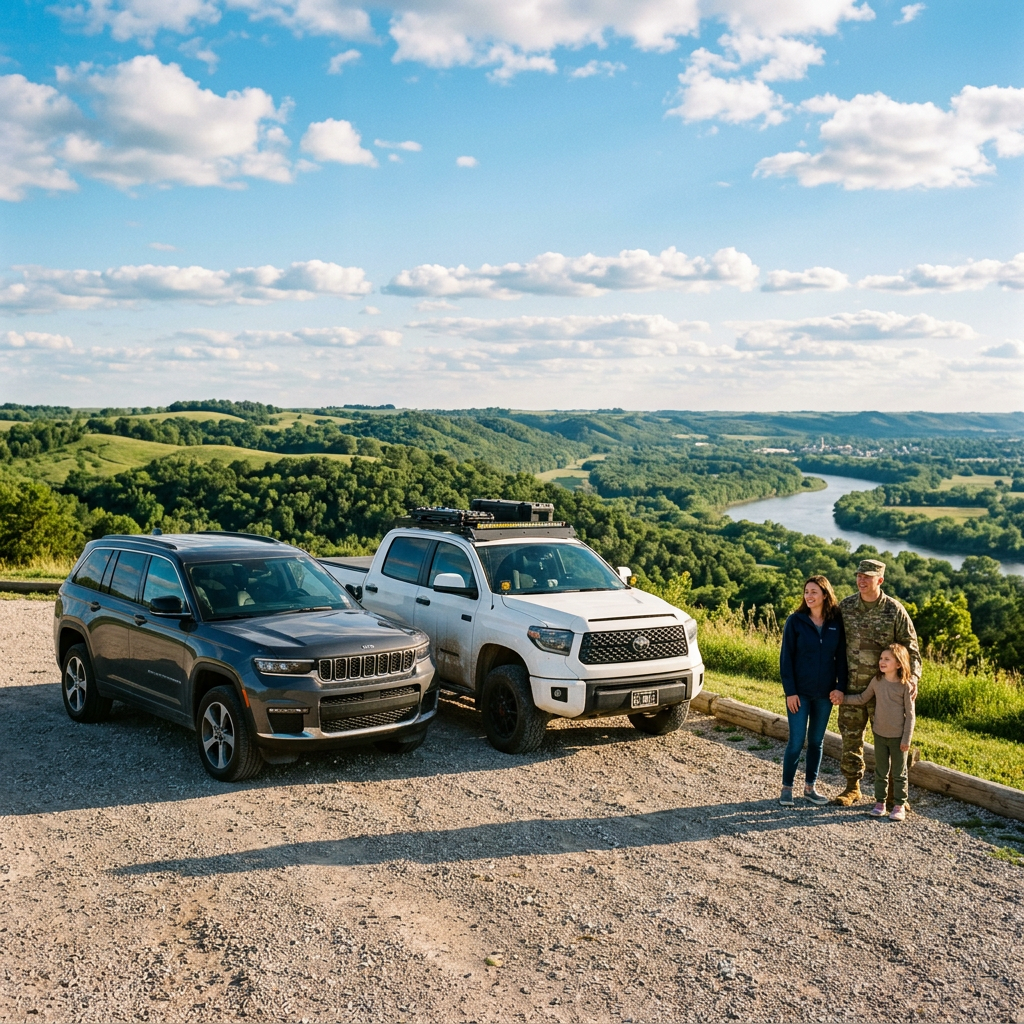
Family with two vehicles overlooking scenic river and hills under blue sky. (Representative image for illustration purposes only. Actual vehicle may vary based on trim and configuration.)

Serving Those Who Serve: Vehicle Solutions for Fort Leavenworth and Junction City Military Families

Serving Those Who Serve: Vehicle Solutions for Fort Leavenworth and Junction City Military Families To the dedicated servicemen, servicewomen, and military families stationed across the heartland of Kansas—from the historic grounds of Fort Leavenworth to the bustling community surrounding Fort Riley and Junction City—we salute you. Your lives are characterized by transitions, duty, and an unwavering commitment to our country. Amidst the complexity of Permanent Change of Station (PCS) moves, temporary duty assignments, and the unique rhythms of military life, having a reliable, capable, and comfortable vehicle isn't just a luxury. It is an absolute operational necessity for your household. Whether you are navigating the rolling hills of northeastern Kansas, commuting along Interstate 70, or preparing for a cross-country haul to your next assignment, your vehicle is the literal engine that keeps your family moving forward. At Valor CDJR, located conveniently in Junction City, KS, we don't view military transactions as mere sales. We view them as a profound partnership. Many members of our own team have deep ties to the armed forces, meaning we understand the distinct challenges of military relocations, temporary deployments, and tight timelines. We know that when a PCS order lands on your desk, you don't have weeks to waste haggling over car deals or deciphering complex out-of-state registration laws. You need straightforward answers, transparent pricing, and a team that respects your sacrifice. That is why we have designed this comprehensive guide specifically for our military neighbors at Fort Leavenworth, Junction City, Manhattan, and Fort Riley. We aim to equip you with the practical knowledge, vehicle options, and financial strategies needed to make your next vehicle purchase as seamless and stress-free as possible. As you dive into this guide, you will find expert analysis on local driving conditions, direct comparisons of the safest family haulers, and clear checklists for claiming manufacturer military discounts. We also demystify the complexities of maintaining your home-state registration while stationed in Kansas and provide critical local maintenance advice to survive the intense regional winter weather. Our goal is to serve as your trusted automotive resource, providing the same high level of dedication and integrity that you bring to your mission every single day. If you would like to speak directly with our team at any point, feel free to Call us at (785) 238-5114 or stop by our showroom for a personal consultation. What are the key vehicle specifications needed for military families moving to Fort Leavenworth or Junction City? Transitioning to northeastern Kansas brings a unique set of geographic and meteorological challenges that every military family must prepare for. The historic terrain of Fort Leavenworth sits along the high bluffs of the Missouri River, featuring steep inclines, winding roads, and dense tree cover that can make winter driving particularly hazardous. Meanwhile, the sprawling plains around Junction City, Fort Riley, and Manhattan are defined by vast, open spaces, exposed highways, and rolling hills. The climate here is notoriously variable, transitioning rapidly from sweltering summer humidity to sudden, intense winter blizzards. Because of these distinct environments, purchasing a vehicle with the right specifications is crucial for your family's safety and logistical success. First and foremost, active all-wheel drive (AWD) or robust four-wheel drive (4WD) is highly recommended. While front-wheel-drive vehicles can manage on well-salted highways, the sudden ice storms and drifting snow common to the I-70 and US-73 corridors demand the superior traction of an active 4WD system. When commuting early in the morning for physical training or duty formations before snowplows have cleared the secondary roads, having a vehicle that automatically routes power to the wheels with the most grip can make the difference between arriving safely or sliding into a ditch. Cargo capacity is another critical factor, particularly when navigating the realities of a PCS move. Military families are all too familiar with the 'partial DITY' or Personally Procured Move (PPM), where you pack precious valuables, high-priority gear, family pets, and essential suitcases into your personal vehicle. A vehicle with flexible, fold-flat seating, abundant under-floor storage, and roof rack compatibility allows you to maximize your carrying capacity. This ensures you do not have to leave behind sentimental items or crucial documentation when moving across the country. Lastly, ground clearance cannot be overlooked. The combination of heavy winter snowfall, deep spring potholes, and unpaved county roads in the surrounding training areas requires a vehicle that sits comfortably above the debris. Standard sedans often struggle with the heavy snow packed at the end of driveways or the gravel paths leading to off-post housing. Opting for an SUV or truck with at least 8 inches of ground clearance ensures you can confidently navigate whatever terrain or weather the Kansas landscape throws your way. To help you visualize these differences, we recommend checking out our extensive New Vehicle Listings to explore models with class-leading ground clearance and advanced 4WD systems, ensuring you have the exact mechanical capabilities required to master the Kansas elements. Comparing the Best SUVs and Trucks: Which of these vehicles has better safety ratings for family hauling? When transporting your most precious cargo—your family—safety and reliability take absolute priority. Long, cross-country PCS drives, weekend trips to Kansas City, and daily school drop-offs require a robust platform packed with cutting-edge driver-assist technologies. Below, we compare three of the most popular, capable, and highly rated family vehicles in our lineup: the versatile Jeep Grand Cherokee, the luxurious and cavernous Wagoneer, and the incredibly strong Ram 1500. Each offers unique advantages tailored to different military lifestyles, from elite off-road readiness to heavy-duty towing capacity. Jeep Grand Cherokee A highly decorated SUV renowned for its balance of off-road prowess and family comfort. Equipped with over 110 standard and available safety features, including Adaptive Cruise Control, Active Lane Management, and Full-Speed Forward Collision Warning with Active Braking. It provides incredible peace of mind on slick highways and gravel roads alike. The Wagoneer For maximum space, the Wagoneer features three spacious rows of seating and class-leading cargo volume behind the third row. Built with a high-strength steel safety cage, it integrates advanced driver assists like an available 360-degree Surround View Camera and Intersection Collision Assist, making tight parking spots on base easy to navigate. Ram 1500 Redefining the modern pickup, the Ram 1500 combines immense utility with a cabin that rivals luxury sedans. Its safety suite features Electronic Roll Mitigation, Blind Spot Monitoring with Rear Cross Path and Trailer Detection, and massive 14.9-inch brakes. It is the ultimate vehicle for towing heavy trailers during a DITY/PPM move. Feature / Specification Jeep Grand Cherokee Wagoneer Ram 1500 Seating Capacity 5 to 7 Passengers Up to 8 Passengers 5 to 6 Passengers Max Towing Capacity Up to 7,200 lbs Up to 10,000 lbs Up to 11,580 lbs Standard Safety Suites Active Lane Management, Adaptive Cruise Blind Spot Monitoring, Full-Speed Forward Collision Electronic Stability Control, Trailer Sway Control Available Camera Systems 360-degree Surround View, Night Vision 360-degree Surround View, Back-Up Camera 360-degree Surround View with Trailer Reverse Guidance Best Fit For Daily Commuting & Off-Road Weekend Trips Large Families & Premium Comfort Heavy Hauling & Ultimate Utility Work Explore Our Quality Used Inventory What documentation is required to secure a manufacturer military discount? We believe that those who serve our nation deserve tangible rewards. Jeep, Ram, Dodge, and Chrysler offer available military offer information to active duty personnel, active reserve members, retired military veterans, and honorably discharged veterans within 12 months of their discharge date. This offer may be available on eligible new vehicles; contact the dealership for current program details. However, to comply with federal regulations and manufacturer audit guidelines, specific documentation must be presented at the time of purchase. To ensure your transaction goes smoothly and you receive every single dollar of savings you are entitled to, please review the required documentation checklist. Gathering these documents beforehand will allow our finance team to quickly verify your status and apply the discounts directly to your paperwork, keeping your visit quick and efficient. Required Military Validation Checklist: • Active Duty & Reserve: A current, valid military identification card or your most recent Leave and Earnings Statement (LES) to verify active status. • Retired Military Personnel: A valid DD Form 2A (Blue) Active Duty Retired Identification Card or a DD Form 214 showing a minimum of 20 years of qualifying service. • Honorably Discharged Veterans: A copy of your DD-214 (Certificate of Release or Discharge from Active Duty) clearly displaying an 'Honorable Discharge' status, dated within the past 12 months. • Verification Portals: In many cases, we can assist you in utilizing digital verification networks such as ID.me directly in our showroom, which instantly validates your military affiliation securely. How do you register a vehicle in your home state while stationed in Kansas? One of the most complex aspects of buying a car while on active duty is navigating vehicle registration. If you are stationed at Fort Leavenworth or Fort Riley but maintain your legal residency in another state, you are protected by the Servicemembers Civil Relief Act (SCRA). The SCRA prevents you from being forced to register your personal vehicle in Kansas or pay Kansas property taxes on it, provided you are in the state solely in compliance with military orders. This means you have the legal right to register your newly purchased vehicle in your home state of record, potentially saving you hundreds of dollars in annual registration fees and sales taxes depending on your home state's laws. At Valor CDJR, we are highly experienced in facilitating out-of-state registrations for our military clients. The process requires careful coordination between our dealership, your lending institution, and your home state's Department of Motor Vehicles (DMV). When you purchase a vehicle from us, we will help gather the necessary manufacturer's certificate of origin or title, the bill of sale, and physical verification of the Vehicle Identification Number (VIN)—which is often required by out-of-state DMVs. We will package these documents securely and coordinate with your home state's DMV to ensure your license plates and registration stickers are mailed directly to your Kansas address or military PO Box. If you do choose to register your vehicle in Kansas, the state offers generous exemptions for active-duty military members who are non-residents stationed here. By submitting a military tax exemption form (Form TR-601) along with a copy of your active military orders and your current LES, you can be exempted from paying the state's motor vehicle property tax. Whichever path you choose, our experienced finance team will walk you through the paperwork step-by-step, ensuring total compliance and maximum savings. If you have questions about your specific state, feel free to stop by and Get Directions to Valor CDJR to speak with our registration specialists in person. Financing Your Ride: Are auto loan rates generally lower at credit unions than at franchise dealerships? A common question among military car buyers is whether they should secure financing through a dedicated military credit union, such as Navy Federal Credit Union or PenFed, or utilize dealership financing. Credit unions are member-owned, non-profit institutions, which often allows them to offer highly competitive, low baseline interest rates to their members. For many military families, getting pre-approved at a credit union is an excellent starting point that establishes a clear budget before they ever step onto a dealership lot. However, franchise dealerships like Valor CDJR possess a distinct advantage that can often beat pre-approved rates: direct relationships with dozens of national and local lending institutions, including Chrysler Capital. Because we send lenders a high volume of business, we can leverage these relationships to negotiate lower interest rates, secure promotional 0% APR financing on select new models, or find flexible terms that credit unions might not offer. We routinely work directly with Navy Federal, PenFed, and local Kansas credit unions, allowing us to compare all available options under one roof. By allowing our finance department to submit your application to our network, we can often match or beat your credit union pre-approval, or package your loan with manufacturer rebates that are only available when financing through Chrysler Capital. Our primary goal is to find the lowest total cost of ownership for your family, ensuring your monthly payments fit comfortably within your Basic Allowance for Housing (BAH) and overall budget. Get Pre-Approved Instantly Online Kansas Winter Survival: How often should underbody car washes be performed during Kansas winters? If you are relocating to Kansas from a southern or western duty station, the local winter climate can be an abrupt shock to both you and your vehicle. Kansas winters are characterized by freezing rain, heavy snowfall, and rapid temperature fluctuations. To keep roads passable, local municipalities and base maintenance crews spray highways with aggressive liquid brine and rock salt. While highly effective at melting ice, this chemical mixture forms a highly corrosive paste that clings to your vehicle's undercarriage, eating away at brake lines, exhaust systems, and suspension components. Protecting your vehicle requires a dedicated winter maintenance routine. Weekly Rinse Schedule During active snow weeks when roads are heavily treated, we recommend an underbody car wash at least once every 7 to 10 days. Do not wait for the snow to melt completely. The longer the salt paste remains in contact with bare metal components, the faster oxidation and rust will develop, permanently damaging your vehicle. Temperature Timing Always perform your underbody wash when the ambient temperature rises above 35 degrees Fahrenheit. This prevents the high-pressure wash water from instantly freezing inside your door locks, door seals, window tracks, and electronic sensors, which can lock you out of your vehicle or cause electrical faults. Preserving Trade Value A rusted frame or corroded brake system is one of the quickest ways to destroy your vehicle's trade-in or resale value. By maintaining a clean undercarriage, you protect the mechanical integrity of your vehicle, ensuring that when it is time to trade it in for your next PCS move, you receive top dollar. If you want to ensure your vehicle is mechanically sound before the winter storm season hits, you can easily book a comprehensive check-up using our online Service Scheduler to have our certified technicians inspect your undercarriage, test your battery, and top off your winter fluids. Navigating the PCS Move: Packing and Towing Tips for Your Next Duty Station A Permanent Change of Station (PCS) is a major undertaking, combining military precision with family logistics. If you have opted for a Personally Procured Move (PPM/DITY), towing a trailer or packing your SUV to its maximum weight limit requires careful planning. Overloading your vehicle or towing beyond its mechanical limits is not only dangerous; it can lead to catastrophic transmission, engine, or brake failure on the highway. Before loading up, always verify your vehicle's Gross Vehicle Weight Rating (GVWR) and Gross Combined Weight Rating (GCWR), which are located on the placard inside the driver-side door jamb. Remember that the weight of passengers, fuel, and luggage all count toward your maximum payload capacity. When towing, ensure you use a high-quality, properly rated hitch and safety chains, and distribute your trailer's cargo weight so that 10% to 15% sits directly on the tongue to prevent trailer sway. If you need to upgrade your vehicle's towing capabilities before your next move, our specialized Parts Department can help you source and install OEM-certified trailer brake controllers, heavy-duty hitch receivers, and custom wiring harnesses designed specifically for your model. Value Your Trade-In Before You Deploy or PCS Deployments and overseas assignments often require military families to make rapid decisions regarding their household assets. If you are preparing for an upcoming deployment or moving to an OCONUS (Outside the Continental United States) duty station where bringing your current vehicle is impractical or prohibited, leaving a depreciating asset sitting in a long-term storage lot is rarely the best financial decision. Storage fees, insurance costs, dead batteries, and dry-rotting tires can quickly drain your hard-earned money while you are away. At Valor CDJR, we make transitioning out of your current vehicle or downsizing incredibly straightforward. We buy clean, well-maintained vehicles of all makes and models, offering fair, market-reflective values. By selling your vehicle to us before you deploy, you can eliminate monthly insurance payments, put cash directly into your savings account, and enjoy total peace of mind while focused on your mission. Our process is entirely transparent, with no obligation to purchase a vehicle from us in return. We handle all the paperwork, lien payoffs, and title transfers, allowing you to focus on your family and your deployment preparation. Get an Instant Trade-In Evaluation Maintaining Readiness: Certified Service and Parts Near Fort Riley and Manhattan Military readiness isn't just about tactical gear and training; it also applies directly to your personal vehicles. A broken-down car can disrupt duty schedules, cause missed appointments, and create immense stress for family members left behind during deployments. Keeping your Chrysler, Dodge, Jeep, or Ram vehicle in peak operating condition requires routine maintenance handled by certified experts who understand your vehicle inside and out. Our modern service center in Junction City, KS, is fully equipped with state-of-the-art diagnostic technology and staffed by factory-trained, certified technicians. Whether you need a quick oil change and tire rotation before a road trip, a comprehensive brake overhaul, or complex engine diagnostics, we use only genuine OEM Mopar parts to ensure your vehicle performs exactly as the manufacturer intended. We also offer specialized winter preparation packages, ensuring your heating system, battery, and tires are ready for the freezing cold. For military members with tight schedules, we feature a dedicated Express Lane service that requires no appointment for routine maintenance like oil changes and multi-point inspections. This allows you to get in, get serviced, and get back to your duty station or family with zero wasted time. Why Choose Valor Service? • Factory-Trained Certified Technicians • Genuine OEM Mopar Parts & Accessories • Express Lane for Quick, No-Appointment Maintenance • Comfortable Waiting Area with Free Wi-Fi • Shuttle Service and Convenient Loaner Options Available Your Mission, Our Support: Visit Valor CDJR in Junction City Today At Valor CDJR, our mission is simple: to provide the absolute highest level of customer care, transparency, and respect to the military families who sacrifice so much for our nation. Whether you are stationed at Fort Leavenworth, living in Junction City, or commuting from Manhattan, we are here to support your automotive journey every step of the way. From matching military credit union rates to processing complex out-of-state registrations, we handle the hard work so you can stay focused on your military duties. We invite you to visit our dealership in Junction City today to meet our team, explore our extensive inventory of new and high-quality pre-owned vehicles, and experience our military-friendly culture firsthand. If you are looking to expand your business or need heavy-duty capability, we also encourage you to check out our Commercial Vehicle Inventory. No matter your automotive needs, we are honored to serve those who serve our country. Please Get Directions to Valor CDJR and let us know how we can assist you today. Browse Our New Vehicle Inventory

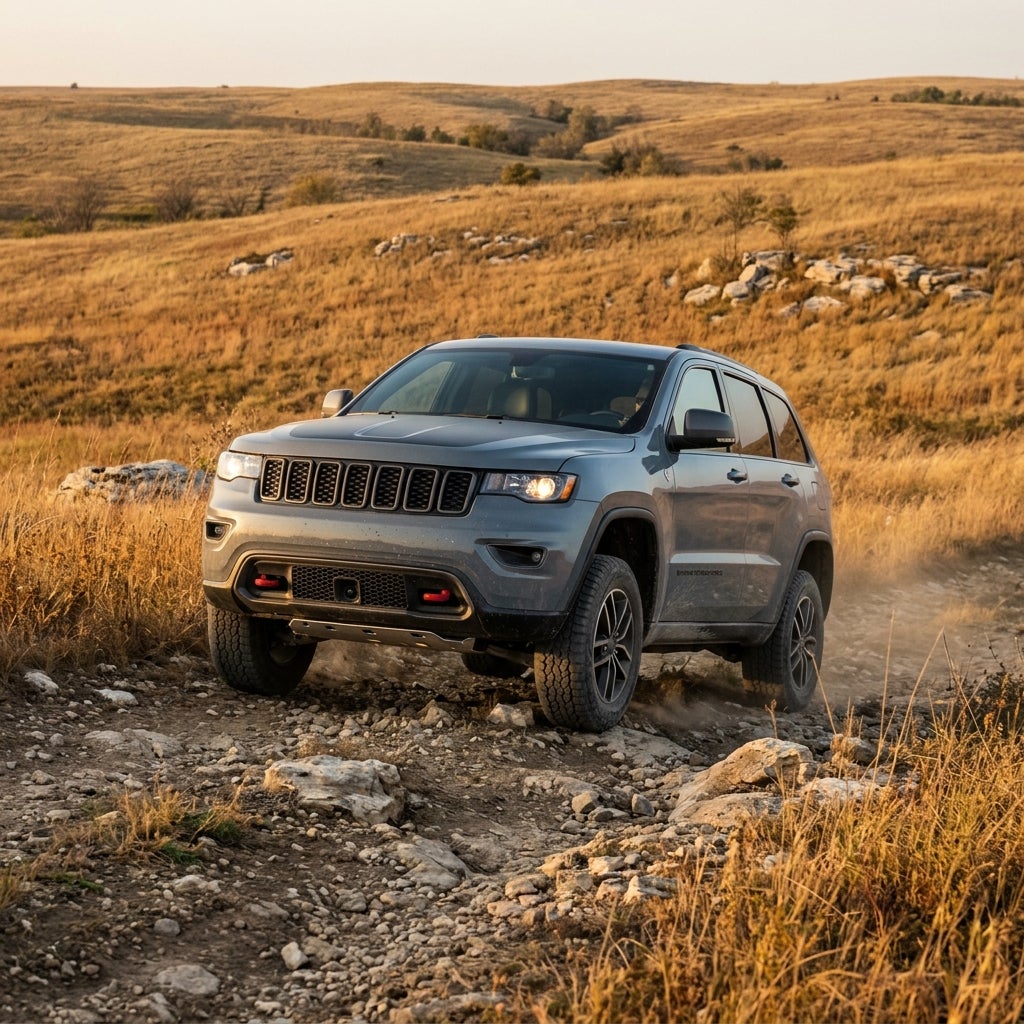
Optimizing 2021 Jeep Grand Cherokee Off-Road Capability: Expert Q&A with Valor CDJR

Optimizing 2021 Jeep Grand Cherokee Off-Road Capability: Expert Q&A with Valor CDJR

Optimizing 2021 Jeep Grand Cherokee Off-Road Capability: Expert Q&A with Valor CDJR In this exclusive interview, Dustin Zeck, Dealer Principal at Valor CDJR with 36 years of automotive leadership experience, delivers detailed technical insights on maximizing the trail performance, suspension clearance, and towing potential of the 2021 Jeep Grand Cherokee. Q: What approach and departure angles does the Trailhawk have compared to standard 2021 Jeep Grand Cherokee trims? A: The 2021 Jeep Grand Cherokee Trailhawk achieves nearly 36 degrees of approach angle, 22 degrees of breakover angle, and 27 degrees of departure angle when raised to Off-Road II height, compared to standard trims that deliver roughly 26 degrees of approach angle and 24 degrees of departure angle. That mechanical difference allows off-road drivers to clear steep rock ledges and deep trail washouts without damaging bodywork or chassis components. Zeck points out that dedicated body geometry and air suspension height adjustments account for this dramatic improvement. Standard Grand Cherokee trims utilize fixed coil spring setups or street-oriented body valances, designed primarily for highway aerodynamic efficiency. The Trailhawk combines specialized front and rear bumpers with adjustable air bladders, giving drivers elevated clearance precisely where the vehicle meets steep terrain. When drivers visit our dealership at 1825 Goldenbelt Blvd in Junction City to inspect the Trailhawk, Zeck usually points out how the front underbody skid plates shield vulnerable steering components during sharp vertical climbs. For personalized trim consultations or stock inquiries, customers are always welcome to give our sales team a quick call at (785) 238-5114. Q: What standard off-road capability features come on the 2021 Jeep Grand Cherokee? A: Standard off-road equipment begins with advanced four-wheel-drive configurations, including Quadra-Trac I, Quadra-Trac II with its two-speed transfer case, and Quadra-Drive II featuring a Rear Electronic Limited-Slip Differential. These robust mechanical systems continuously monitor wheel traction and redistribute engine torque to maintain forward momentum across low-grip surfaces. Zeck notes that Jeep builds true trail capability into the structural foundation of the lineup. Models equipped with Quadra-Trac II actively route up to 100 percent of available torque to the specific axle with the most grip when tire slip is detected. Trail-rated models add heavy-gauge steel skid plates that protect the fuel tank, transfer case, front suspension, and engine oil pan from severe trail impacts. Shoppers interested in exploring available factory four-wheel-drive options can browse our new-vehicle inventory to see current model configurations. Standard hill descent control further supports trail driving by automatically managing brake pressure on steep declines so the driver can focus entirely on steering navigation. Q: How high does Quadra-Lift Air Suspension raise the 2021 Jeep Grand Cherokee? A: The Quadra-Lift Air Suspension system features five distinct height settings that adjust ground clearance from a baseline of 8 inches up to a maximum ground clearance of nearly 11 inches in Off-Road II setting. Selecting Off-Road I elevates the vehicle by roughly 1 inch to achieve over 9 inches of total clearance for navigating rutted roads. Zeck explains that the pneumatic air springs adapt smoothly to various driving environments, automatically dropping the body into Aero Mode at cruising speeds to optimize fuel economy or Park Mode for effortless passenger loading. Raised into its highest Off-Road II setting, the Grand Cherokee can safely forge through up to 20 inches of standing water without risking water ingestion into the intake or axle breathers. "When local drivers visit our showroom to inspect a Grand Cherokee, they usually ask whether the Quadra-Lift air suspension alters highway ride quality before they ask about trail clearance." To evaluate how pre-owned models equipped with air suspension perform on local roads, customers can inspect our pre-owned vehicle lineup. Zeck emphasizes that pneumatic air springs deliver exceptional highway ride comfort while maintaining rigid support across rough terrain. Q: What drive modes are selectable with the Selec-Terrain system? A: The Selec-Terrain Traction Management System provides five driver-selectable settings: Auto, Sport, Snow, Sand/Mud, and Rock. Rotating the center console dial recalibrates up to 12 powertrain and stability sub-systems, including throttle response, transmission shift mapping, transfer case torque distribution, and traction control intervention. Zeck highlights how each setting customizes vehicle mechanicals for specific surface conditions. Auto mode continuously adapts to changing road conditions, while Sport mode lowers the ride height and holds transmission gears longer for spirited paved-road performance. The Snow setting splits drive torque evenly between front and rear axles while starting in second gear to minimize wheel spin on slick winter roads in Manhattan. In Sand/Mud and Rock settings, electronic throttle sensitivity adjusts and hill descent control readies itself to maximize tire traction over loose earth or uneven boulders. Drivers planning to trade in their current vehicle for a trail-ready SUV can easily value their trade-in online to begin the upgrade process. Q: Which SUV offers higher payload and towing capacities between the Grand Cherokee and Toyota 4Runner? A: The 2021 Jeep Grand Cherokee delivers superior towing and payload capabilities, offering a maximum towing capacity of up to 7,200 lbs when equipped with the 5.7-liter V8 engine and 6,200 lbs with the 3.6-liter V6 engine, easily outperforming the Toyota 4Runner's maximum 5,000-lb towing limit. Zeck explains that powertrain options drive this major performance advantage. The base 3.6-liter V6 engine generates 295 horsepower and 260 lb-ft of torque through an eight-speed automatic transmission, while the available 5.7-liter V8 engine pushes output to 360 horsepower and 390 lb-ft of torque. Combined with a maximum payload capacity of up to 1,380 lbs, the Grand Cherokee offers far greater utility for hauling heavy trailers and equipment. For drivers hauling utility trailers or camper rigs across Riley County, Zeck stresses the value of factory-integrated towing hardware. Prospective buyers can streamline their purchasing journey by prequalifying online prior to visiting our sales department. Q: What equipment is included in the Trailer Tow Group IV package? A: The Trailer Tow Group IV package includes a heavy-duty Class IV receiver hitch, 7-pin and 4-pin wiring harnesses, heavy-duty engine cooling, a 180-amp alternator, rear load-leveling suspension, and a full-size spare tire. This comprehensive factory equipment ensures the vehicle operates within safe thermal and structural limits while towing maximum capacity loads. Zeck emphasizes that heavy-duty cooling components and high-output electrical charging are essential for maintaining engine efficiency during long highway pulls under load. The rear load-leveling shocks use internal hydraulic valving to automatically counteract tongue weight, keeping the vehicle stance level and preserving headlamp alignment and steering control. Integrated factory wiring connections ensure reliable operation of electronic trailer brake controllers and trailer signal lights. Owners seeking replacement hardware or towing add-ons can consult our dedicated parts department for authentic factory equipment. Q: What is the largest tire size that fits on a stock 2021 Jeep Grand Cherokee? A: On an unmodified 2021 Jeep Grand Cherokee with factory suspension, the largest all-terrain tire size that fits without causing wheel well rubbing is 265/60R18, which measures approximately 30 inches in overall diameter, or 265/50R20 on 20-inch wheels. Zeck advises that mounting oversized tires without installing a suspension lift kit or modifying inner fender liners will lead to tire contact against the suspension control arms and body plastics during full lock turns or heavy suspension flex. Keeping close to factory tire dimensions also preserves proper speedometer calibration, transmission shift points, and electronic stability system tuning. For expert tire mounting, custom alignment, or general maintenance care, drivers can visit our Junction City showroom location or connect directly with our service advisors by calling (785) 238-5114. You can also reserve your next service appointment using our online service scheduler to keep your Grand Cherokee performing at its absolute best. © 2026 Valor CDJR. All rights reserved.

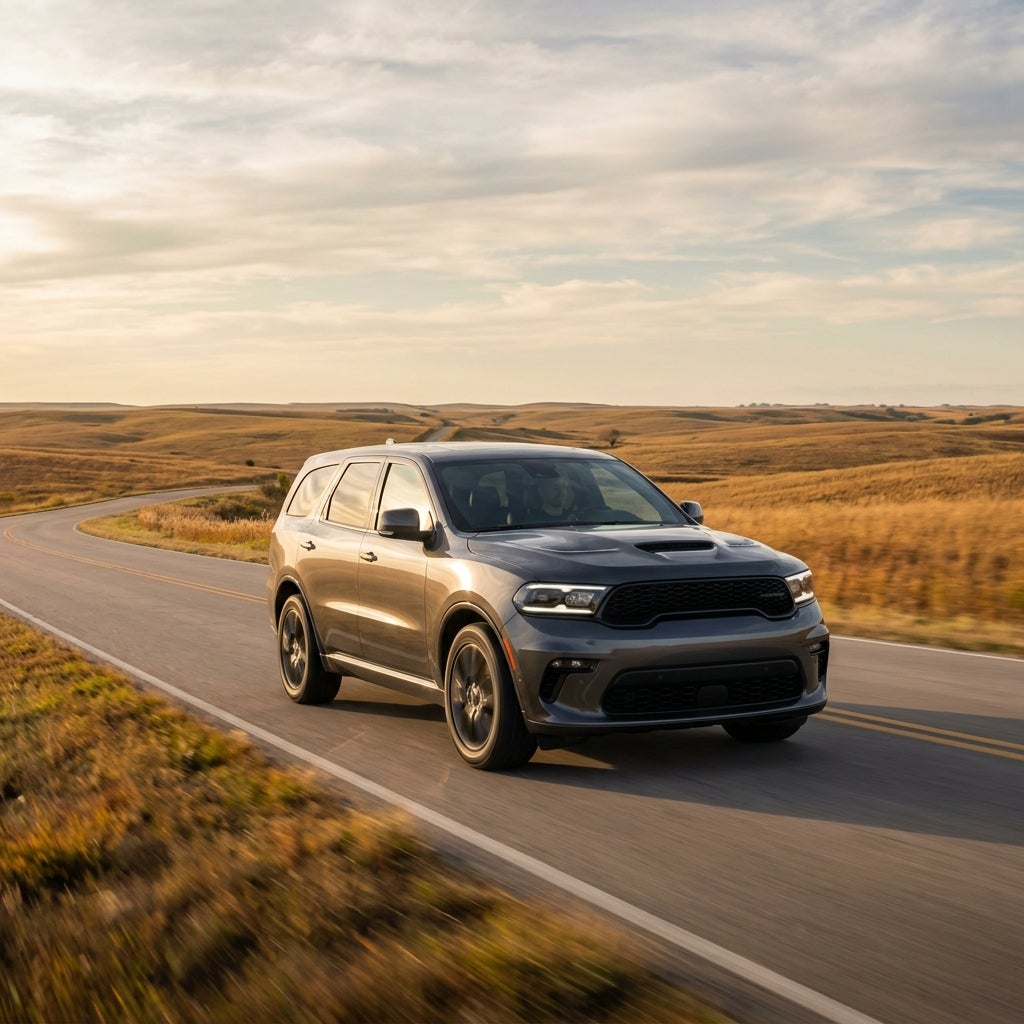
2025 Dodge Durango Local Market Evidence in Junction City, KS

2025 Dodge Durango Local Market Evidence in Junction City, KS

2025 Dodge Durango Local Market Evidence in Junction City, KS When evaluating whether there is strong local market evidence for shopping a 2025 Dodge Durango in Junction City, Kansas, the data points overwhelmingly to yes. Central Kansas buyers, particularly across Geary County and neighboring Riley County, consistently prioritize versatile three-row SUVs that blend true muscle-car performance with heavy-duty towing capability and confident all-weather control. The 2025 Dodge Durango fulfills these regional demands better than almost any alternative in the midsize SUV segment. Local market evidence is reflected in three distinct trends: steady incoming inventory allocations at local dealerships like Valor CDJR, exceptional regional resale values for all-wheel-drive three-row vehicles, and specialized lifestyle demand. Families commuting daily between Junction City and Fort Riley or driving into Manhattan require winter-ready traction during severe Kansas weather spells. Concurrently, outdoor enthusiasts pulling boats to Milford Lake require serious trailering stamina. Whether comparing the efficient SXT or the muscular R/T trim, the 2025 Durango stands out as a prime investment tailored for life in the Kansas River Valley. To explore live inventory allocations and test drive a new Durango in person, Get Directions to Valor CDJR today. Durango Metric 2025 Dodge Durango SXT 2025 Dodge Durango R/T Engine Option 3.6L Pentastar V6 5.7L HEMI V8 Horsepower & Torque 295 hp / 260 lb-ft 360 hp / 390 lb-ft Max Towing Capacity Up to 6,200 lbs Up to 8,700 lbs Drive System Available AWD Performance AWD Standard/Available Infotainment Uconnect 5 w/ 8.4-inch or 10.1-inch Uconnect 5 w/ 10.1-inch Display Browse New Durango Inventory Key Local Factors Driving 2025 Durango Demand Near Fort Riley and Riley County Living and working around Junction City involves unique geographic and demographic considerations. A major engine of local demand is the active military community at Fort Riley. Service members and military families frequently undergo Permanent Change of Station (PCS) moves, requiring versatile vehicles capable of cross-country highway travel, carrying full family loads, and towing trailers without breaking a sweat. Furthermore, winter commuting along Interstate 70 between Junction City, Ogden, and Manhattan can quickly turn hazardous during sudden plains snowstorms and freezing rain. The Dodge Durango's available all-wheel-drive system continuously monitors road conditions, automatically distributing power between front and rear axles to maintain stability on icy overpasses. Beyond winter safety, the rolling topography of the Flint Hills demands responsive power. Negotiating steep grades along Highway 77 or carrying heavy weekend cargo requires an engine and chassis tuned for endurance. The Durango delivers muscle-car heritage in a utility framework, explaining why it remains a top choice throughout Geary County. What Are the Main Performance Differences Between the 2025 Dodge Durango SXT and R/T? 2025 Dodge Durango SXT: 3.6L Pentastar V6 Engine The entry point to the Durango lineup features the proven 3.6-liter Pentastar V6 engine paired with a smooth TorqueFlite 8-speed automatic transmission. Generating 295 horsepower and 260 lb-ft of torque, the SXT provides energetic acceleration for everyday highway merging and town driving. It offers a strong maximum towing capacity of up to 6,200 pounds when properly equipped, making it ideal for lighter campers, small utility trailers, and family watercraft. 2025 Dodge Durango R/T: 5.7L HEMI V8 Engine Stepping up to the Durango R/T unleashes legendary V8 rumble. Powered by the 5.7-liter HEMI V8, the R/T delivers 360 horsepower and 390 lb-ft of torque. Featuring performance transmission calibration, sport-tuned steering, and an available active exhaust, the R/T accelerates with authority. More importantly for local towers, maximum towing capacity increases to an impressive 8,700 pounds, effortlessly handling heavy travel trailers and larger ski boats. Performance Feature Durango SXT (3.6L V6) Durango R/T (5.7L V8) Horsepower 295 hp @ 6,400 rpm 360 hp @ 5,150 rpm Torque 260 lb-ft @ 4,000 rpm 390 lb-ft @ 4,250 rpm Transmission 8-Speed Automatic 8-Speed Performance Auto Standard Towing 6,200 lbs 7,400 lbs (Up to 8,700 lbs w/ Tow N Go) Exhaust Note Quiet / Smooth Signature Performance Active Exhaust How Much More Expensive Is the 2025 Dodge Durango R/T Than the SXT? Trim MSRP Gaps The entry-level Durango SXT offers an accessible starting price point for value-focused families. Stepping up to the R/T typically represents an MSRP increment of roughly $9,000 to $12,000, depending on optional packages like the Tow N Go or Blacktop Package. Standard Equipment Value That price bump brings significant standard upgrades beyond the 5.7L V8 engine. The R/T includes standard Uconnect 5 10.1-inch navigation touchscreen, leather-trimmed sport seating, power liftgate, 20-inch aluminum wheels, and Dodge Performance Pages. Monthly Financing & Trade Offset On a standard 60-month or 72-month finance term, the monthly payment difference usually ranges between $150 and $220. However, utilizing high trade-in valuations at Valor CDJR can significantly offset this monthly gap. Get Pre-Approved Online Standard Features vs Upgrades Across 2025 Durango SXT vs R/T Configurations Uconnect 5 Infotainment The SXT comes standard with an 8.4-inch display, while higher configurations and the R/T boast the crisp 10.1-inch high-definition Uconnect 5 screen. Both systems support wireless Apple CarPlay and Android Auto, dual-phone Bluetooth connectivity, and over-the-air map updates. Seating & Interior Flex The SXT features comfortable 7-passenger seating with a 60/40 fold-flat second row. The R/T unlocks available second-row captain's chairs for effortless pass-through to the third row, combined with heated/ventilated front seats and leather seating surfaces. Safety & Exterior Style Standard driver assistance includes Blind Spot Monitoring and Rear Cross Path Detection. R/T adds Adaptive Cruise Control with Stop, Forward Collision Warning with Active Braking, performance hood scoops, and optional dark exterior accents via the Blacktop Package. Real-World Highway and Flint Hills Fuel Economy for V6 vs V8 Models 3.6L V6 Daily Efficiency For commuters traveling back and forth between Junction City, Fort Riley, and Manhattan on I-70, the 3.6L Pentastar V6 delivers great highway fuel efficiency. Achieving an EPA-estimated rating up to 26 mpg highway in rear-wheel drive or 25 mpg highway with AWD, the V6 maximizes range on long weekly drives while maintaining plenty of passing power. 5.7L V8 Fuel Saver MDS Technology While the 5.7L HEMI V8 yields around 22 mpg highway, Dodge engineers integrated clever Fuel Saver Multi-Displacement System (MDS) technology. Under light throttle conditions during steady highway cruising across flat stretches of Geary County, MDS seamlessly deactivates four cylinders to conserve fuel without sacrificing engine responsiveness when accelerating up Flint Hills grades. Trade-In Valuation and Resale Trends in Central Kansas Pre-owned three-row SUVs remain in extremely high demand throughout Central Kansas. Due to constant PCS cycles at Fort Riley and the strong preference for AWD capability among regional buyers, high-quality trade-in vehicles command premium appraisal values. Dodge Durango models historically retain strong resale equity thanks to their muscular styling, durable drivetrains, and versatile towing capacity. At Valor CDJR, our trade valuation experts leverage real-time local market data to provide top market value for your current sedan, truck, or crossover. Start your appraisal online with our quick Trade In Evaluation tool to see how much equity you can apply toward your new 2025 Dodge Durango. Value Your Trade-In Now Towing Boats, Campers, and Trailers Around Milford Lake and the Kansas River Valley Milford Lake—the largest body of water in Kansas—is located right in Junction City's backyard. Weekend outdoor recreation is a way of life for local residents, whether hauling ski boats, pontoon craft, camper trailers, or jet skis to local boat ramps. The Durango standard trailer sway control tech automatically detects trailer movement and applies targeted brake pressure to maintain rock-solid tracking. While the SXT model's 6,200-pound limit easily handles personal watercraft and midsize pop-up campers, the R/T model's 8,700-pound maximum rating with the Tow N Go package equips you to tow full-size double-axle travel trailers and heavy speedboats without strain. Total Cost of Ownership: Maintenance, Insurance, and Service Support Routine Maintenance Both V6 and V8 Durango engines feature proven Mopar engineering designed for long-term reliability. Quick oil changes, tire rotations, and multi-point inspections can be handled rapidly at our dedicated Express Lane service center in Junction City without needing an advance appointment. Insurance Considerations Insurance rates for the Durango SXT typically reflect standard midsize family SUV insurance brackets. The R/T trim may carry slightly higher premiums due to its V8 performance package, though advanced standard driver safety suites help keep policy rates competitive. Certified Service & Parts Valor CDJR maintains a comprehensive stock of OEM Mopar components via our local Parts Department. You can easily schedule scheduled maintenance through our online Service Scheduler or Call us at (785) 238-5114. How to Compare 2025 Dodge Durango Inventory in Junction City and Manhattan Shopping for a 2025 Durango across Junction City and nearby Manhattan is straightforward when working with Valor CDJR. Rather than driving between multiple dealer lots, buyers can filter online inventory by trim, engine, exterior paint color, and trailering packages. Browse our New Vehicle Listings or explore pre-owned models in our Used Vehicle Listings. If you have specific preferences for paint shades or interior seating configurations, our sales team can track incoming factory allocations or assist with a direct custom order from Dodge. Buyer Decision Framework: Choosing the Right 2025 Durango Trim for Your Needs Step 1: Determine Towing Capacity Needs If your recreational towing involves lightweight trailers or boats under 6,000 lbs, the SXT V6 is fully capable. If pulling heavy travel trailers over 7,000 lbs, select the R/T with the 5.7L V8. Step 2: Calculate Commute & Fuel Priorities High-mileage daily commuters driving I-70 between Junction City and Manhattan will appreciate the Pentastar V6's 25+ highway mpg. Weekend cruisers and performance fans will prefer the HEMI V8 sound. Step 3: Evaluate Interior Tech & Budget Compare monthly finance targets against desired tech features like the 10.1-inch Uconnect 5 display or captain's chairs. Use our online financing tools to lock in rates. Apply for Durango Financing Test Drive the 2025 Dodge Durango at Valor CDJR in Junction City Ready to experience the 2025 Dodge Durango for yourself? Visit Valor CDJR at 1825 Goldenbelt Blvd in Junction City, KS. Our knowledgeable sales staff is ready to help you compare SXT and R/T models side-by-side, answer questions about military incentive programs, and walk you through competitive financing options. Whether you are stopping by after work or visiting from nearby Manhattan or Fort Riley, we welcome you to schedule a relaxed, no-pressure test drive today. Take the wheel and discover why the Durango remains the premier 3-row SUV for Kansas drivers. Schedule Your Test Drive Today