Blog / Off-Road & Adventure Vehicles

When Should You Engage 4WD Low Range While Off-Roading? The Direct Answer

When Should You Engage 4WD Low Range While Off-Roading? The Direct Answer

When Should You Engage 4WD Low Range While Off-Roading? The Direct Answer

Direct Key Takeaway: You should engage 4WD Low (4LO) when operating your vehicle below 25 mph across demanding terrain such as steep technical inclines, deep thick mud, loose sand dunes, rocky ledge crawls, or when descending extreme gradients that require maximum engine braking. Engaging 4LO mechanically multiplies engine torque to its highest possible transfer ratio while dramatically slowing wheel rotation. This fundamental mechanical reduction gives your 4x4 precise throttle modulation and massive crawling force without overheating your automatic transmission, slipping your clutch, or spinning tires uncontrollably.
Off-roading in the Flint Hills and rugged backcountry near Junction City, KS presents diverse terrain challenges ranging from slippery riverbed clay to sharp limestone shelves. Navigating these environments successfully requires an understanding of how your transfer case manages wheel torque and momentum. When you encounter severe resistance where momentum alone cannot safely carry the vehicle, shifting into 4WD Low shifts your transfer case into an auxiliary reduction gear set—typically yielding a ratio between 2.72:1 and 4.0:1 or higher depending on your vehicle's factory trim configuration.
By utilizing 4LO early when facing technical obstacles, you protect key mechanical components against thermal stress and excess wear. Driver inputs become softer and far more manageable; a subtle nudge on the accelerator translates into smooth, controlled power rather than an abrupt spin of the tires that can break traction or damage fragile trail infrastructure. Understanding when and how to deploy this powerful mechanical tool separates casual drivers from experienced off-road enthusiasts.
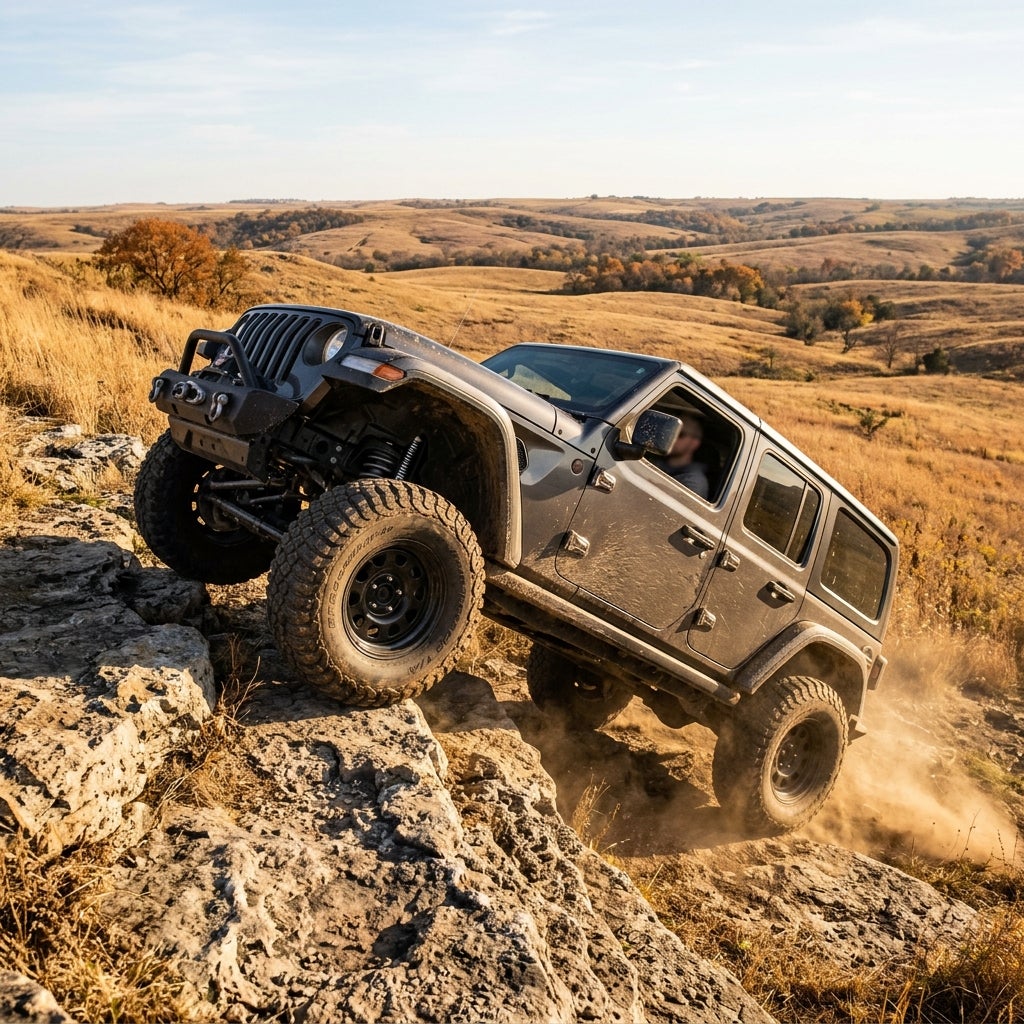
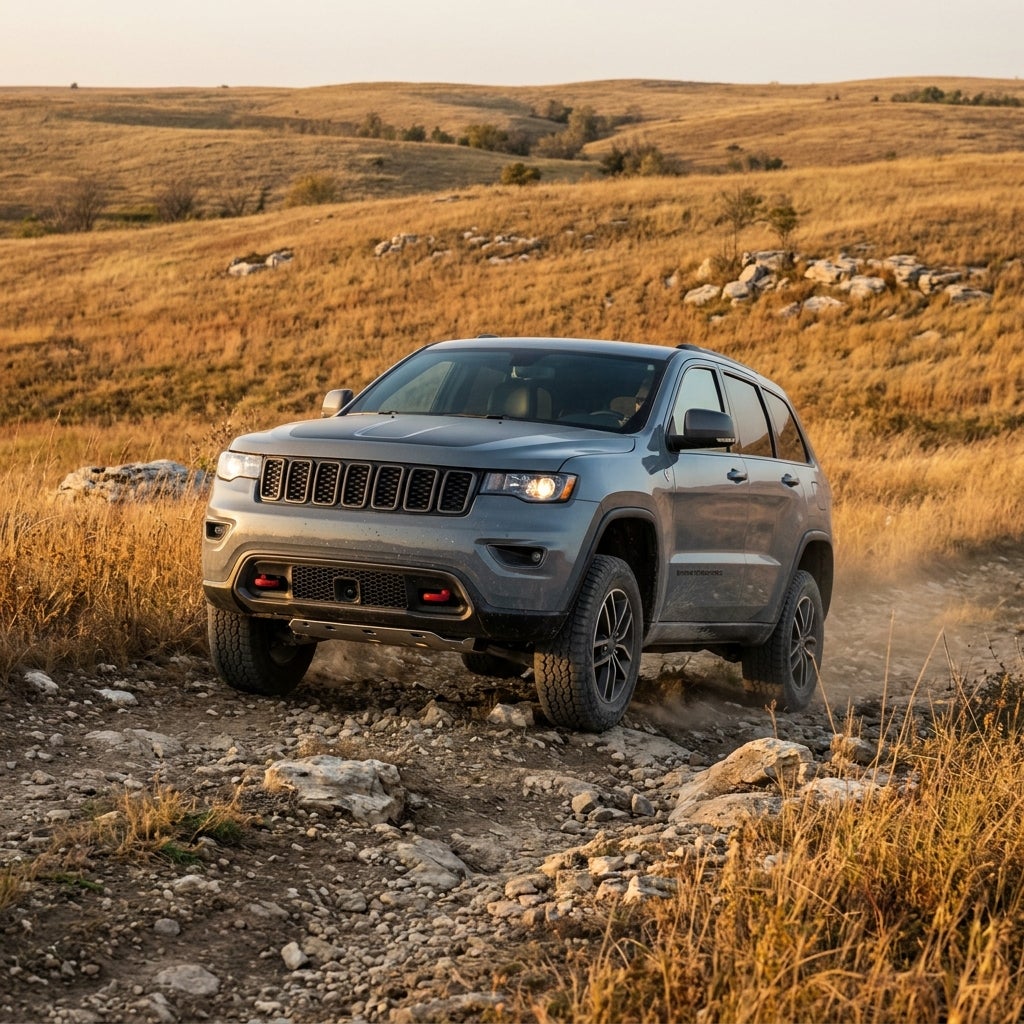
Dark grey Jeep Wrangler climbing a steep rocky ledge in a rolling prairie hill landscape. (Representative image for illustration purposes only. Actual vehicle may vary based on trim and configuration.)

Understanding 4WD High vs. 4WD Low: How Mechanical Gear Ratios Work

To master off-road driving, you must understand the mechanical difference between 4WD High (4HI) and 4WD Low (4LO). Both drive modes lock the front and rear driveshafts together inside the transfer case, ensuring equal speed distribution between the front and rear axles. However, 4HI maintains a direct 1:1 gear ratio inside the transfer case, passing the transmission's output directly to the differential ring and pinion gears.
4WD High is engineered for higher-speed traction on loose or slick surfaces such as snow-covered highways, wet gravel, fire roads, or packed dirt trails where speeds range from 25 mph up to 55 mph. Because 4HI retains street-level gearing, it allows normal highway velocities while delivering four-wheel drive stability. However, when navigating steep grades or heavy resistance at low speeds in 4HI, the transmission torque converter must slip continuously, generating immense heat that degrades automatic transmission fluid quickly.
Shifting into 4WD Low engages a secondary planetary gear set inside the transfer case, creating substantial gear reduction. For example, a standard 2.72:1 transfer case reduction multiplies torque output at the axles by 272 percent compared to 4HI in the same transmission gear. Extreme off-road vehicles like the Jeep Wrangler Rubicon feature a 4.0:1 transfer case ratio, which, when multiplied by first gear and axle ratio, produces a Crawl Ratio exceeding 70:1 or 100:1.
This mechanical leverage reduces ground speed dramatically relative to engine rpm. At 2,500 engine rpm in 4LO, your vehicle might move forward at only 2 to 4 mph. This slow velocity paired with high torque allows the tires to climb obstacles slowly without surging, hopping, or slipping. Furthermore, 4LO works in reverse: when descending steep inclines, engine compression acts through the gear reduction to brake the vehicle naturally without overheating service brakes.

Drive Mode

Transfer Case Ratio

Target Speed Range

Primary Use Case

Key Advantage

2WD (2HI)

1.00:1

Any Speed

Dry pavement, dry highway

Maximum fuel efficiency, zero driveline bind

4WD High (4HI)

1.00:1

15 mph – 55 mph

Snow, wet roads, loose gravel trails

Four-wheel traction at normal trail speeds

4WD Low (4LO)

2.72:1 – 4.00:1

0 mph – 25 mph

Rock crawling, deep mud, steep grades

Maximum torque, extreme slow speed control

Critical Trail Conditions Requiring 4WD Low Range

Steep Rock Ledges & Technical Climbs

Climbing limestone ledges across Kansas river valleys requires micro-adjustments of throttle and brake. In 4LO, the massive mechanical leverage lets you ease the tire up and over 12-inch steps without bouncing. Bouncing causes suspension loading and unloading, which frequently leads to broken axle shafts or lost traction.

Deep Rutted Mud & Riverbed Clay

Heavy Kansas gumbo clay creates extreme rolling resistance that bogs down engines in 4HI. Engaging 4LO gives the powertrain sufficient mechanical leverage to turn heavy mud-clogged tires, maintaining engine rpm inside its optimal powerband without bogging, stalling, or overheating the transmission fluid.

Steep Descents & Loose Sand

Descending steep off-road declines in 4LO uses engine compression braking to control speed naturally. Heavy foot braking on steep dirt can lock wheels, causing the vehicle to slide uncontrollably. In sand, 4LO allows steady low-rpm wheel torque that keeps momentum going without digging tires into soft pits.
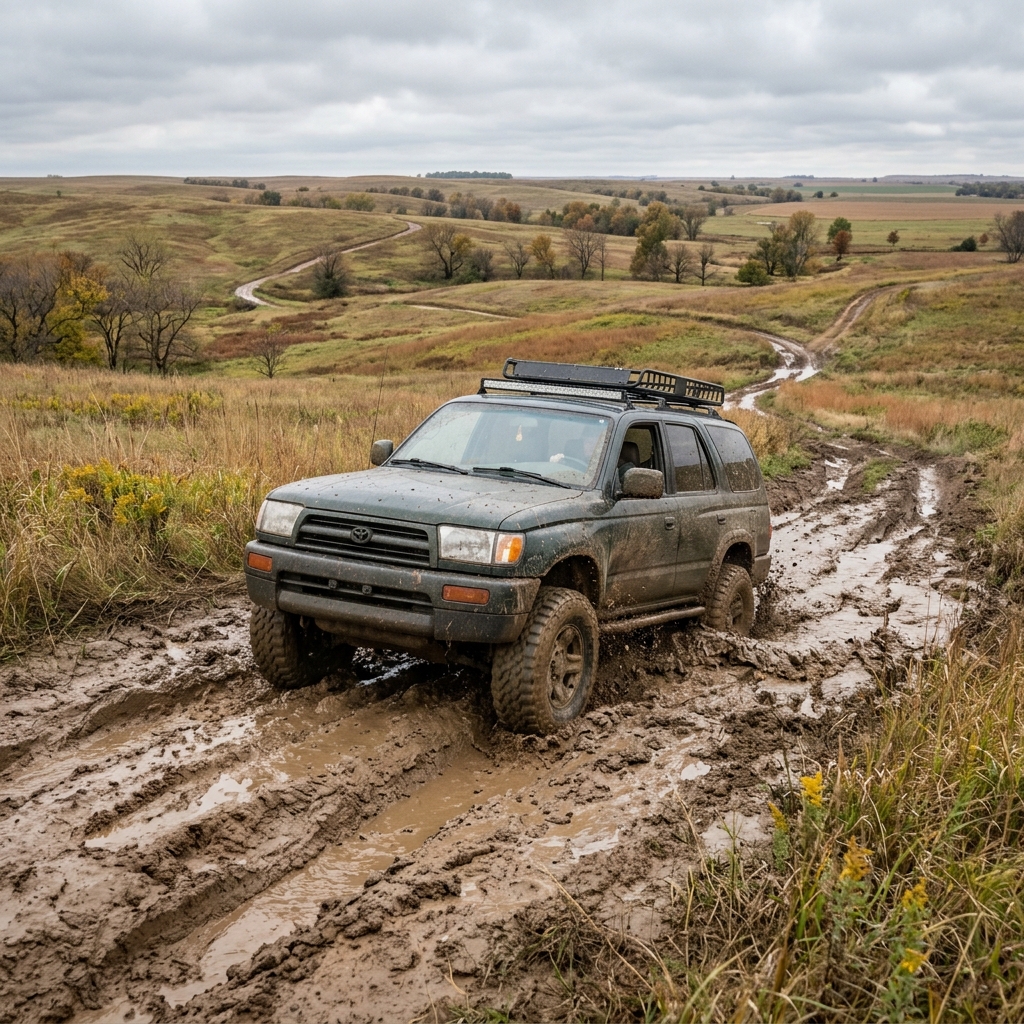
Dark green Toyota 4Runner driving through deep mud ruts on a rural dirt road through grassy hills. (Representative image for illustration purposes only. Actual vehicle may vary based on trim and configuration.)

Can You Drive a 4WD SUV on Dry Pavement in 4WD Mode?

The short answer is no. Traditional part-time 4WD systems lock the front and rear driveshafts together at an identical rotational speed when set to 4HI or 4LO. When a vehicle turns a corner, the outer front wheel travels a significantly longer path than the inner rear wheel. On loose trail surfaces like dirt, mud, or gravel, tire slippage easily absorbs this speed variance.
On high-traction dry pavement or concrete, tires cannot slip. As a result, rotational forces build up in the axle shafts, transfer case gears, and U-joints—a phenomenon known as driveline binding. You will feel the vehicle jerk, resist turning, and experience severe wheel hop during low-speed parking turns.
Continued operation on dry pavement in 4WD mode causes accelerated tire wear, sheared axle shafts, stretched transfer case chains, and cracked housings. The only exception is vehicles equipped with a full-time 4WD or Automatic 4WD (4AUTO) mode featuring a center differential that allows slip between axles on dry pavement.
If you accidentally engage 4WD on pavement and experience binding, stop immediately, straighten the steering wheel, shift back to 2WD, and back up 10 to 20 feet to relieve tension. If binding symptoms persist, schedule an inspection at our Junction City service center. You can also New Vehicle Listings to compare models featuring automatic 4WD systems.

How to Properly Shift into 4WD Low Without Grinding Gears

Step 1: Slow the Vehicle to 1 to 3 MPH
Unlike 4HI, which allows shift-on-the-fly execution at higher speeds, 4LO requires the transfer case gears to sync at near-zero velocity. Allow your 4x4 to coast slowly at 1 to 3 mph on level terrain. Do not attempt shifting while stopped completely if gears are misaligned, as teeth may butt against each other.
Step 2: Place Transmission in Neutral (N)
Shift your main automatic transmission or depress the clutch pedal fully on a manual transmission into Neutral. This removes load and engine torque from the input shaft, enabling transfer case gears to slide smoothly without gear clashing or grinding noises.
Step 3: Move Transfer Case Lever or Push 4LO Button
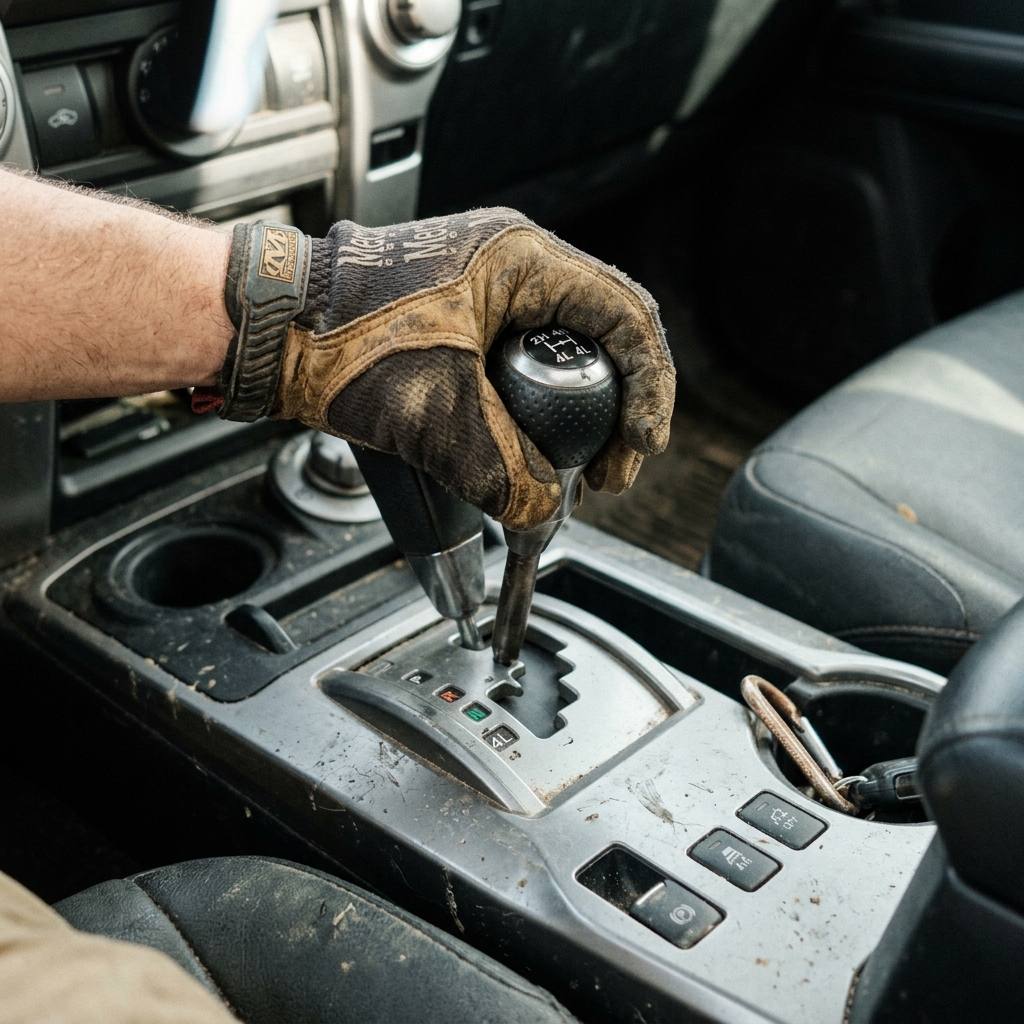
Firmly pull the manual transfer case lever through Neutral straight into 4LO in one continuous motion. For electronic push-button systems, press 4LO and hold momentarily. You may hear a solid mechanical engagement clunk as gear teeth mesh into position.
Step 4: Verify Indicator and Select Drive
Confirm the 4LO dashboard light turns solid before applying throttle. Return the transmission selector to Drive or 1st Gear. Test throttle response gently to ensure the lower gear ratio is fully engaged before driving onto steep or technical terrain.
A gloved hand shifts a 4WD lever inside a dirty off-road vehicle center console. (Representative image for illustration purposes only. Actual vehicle may vary based on trim and configuration.)

Why Are All-Terrain Tires Critical for Off-Road SUVs in Low Range?

Durable Sidewall Protection

Low-range torque forces tires against sharp rocks and trail debris. All-terrain and mud-terrain tires feature multi-ply reinforced sidewalls (such as 3-ply armor construction) that resist punctures and tears when crawling over flint rock.

Self-Cleaning Tread Voids

Standard highway tires fill up with wet Kansas clay instantly, turning smooth like slicks. Aggressive all-terrain tires feature wide shoulder voids and stone ejectors that clean mud out as the wheel rotates, maintaining bite.

Airing Down for Footprint

Lowering tire pressure (airing down to 15-20 PSI) increases the tire footprint length, spreading vehicle weight over a larger surface area. Combined with 4LO, this maximizes mechanical grip over loose sand and slick rock ledges.
Without proper tires, the impressive gear reduction of 4LO is wasted because the vehicle cannot transmit mechanical torque to the trail. Upgrading tire specs is one of the most effective enhancements you can make. Check out our Parts Department for factory-approved wheel and tire packages fitted for heavy trail duty.

What Factory Off-Road Trim Packages Offer the Best Features?

Purchasing a factory off-road trim package provides integrated capability engineered directly by OEM factory technicians. Models like the Jeep Wrangler Rubicon, Jeep Grand Cherokee Trailhawk, and Ram 2500 Power Wagon come pre-equipped with essential hardware that would cost thousands more to replicate in the aftermarket.
Key factory off-road features include electronic front and rear locking differentials (Tru-Lok), electronic sway-bar disconnects for extreme axle articulation, steel skid plates protecting transfer cases and oil pans, and specialized low-range transfer cases (such as the Rock-Trac 4:1 ratio system).
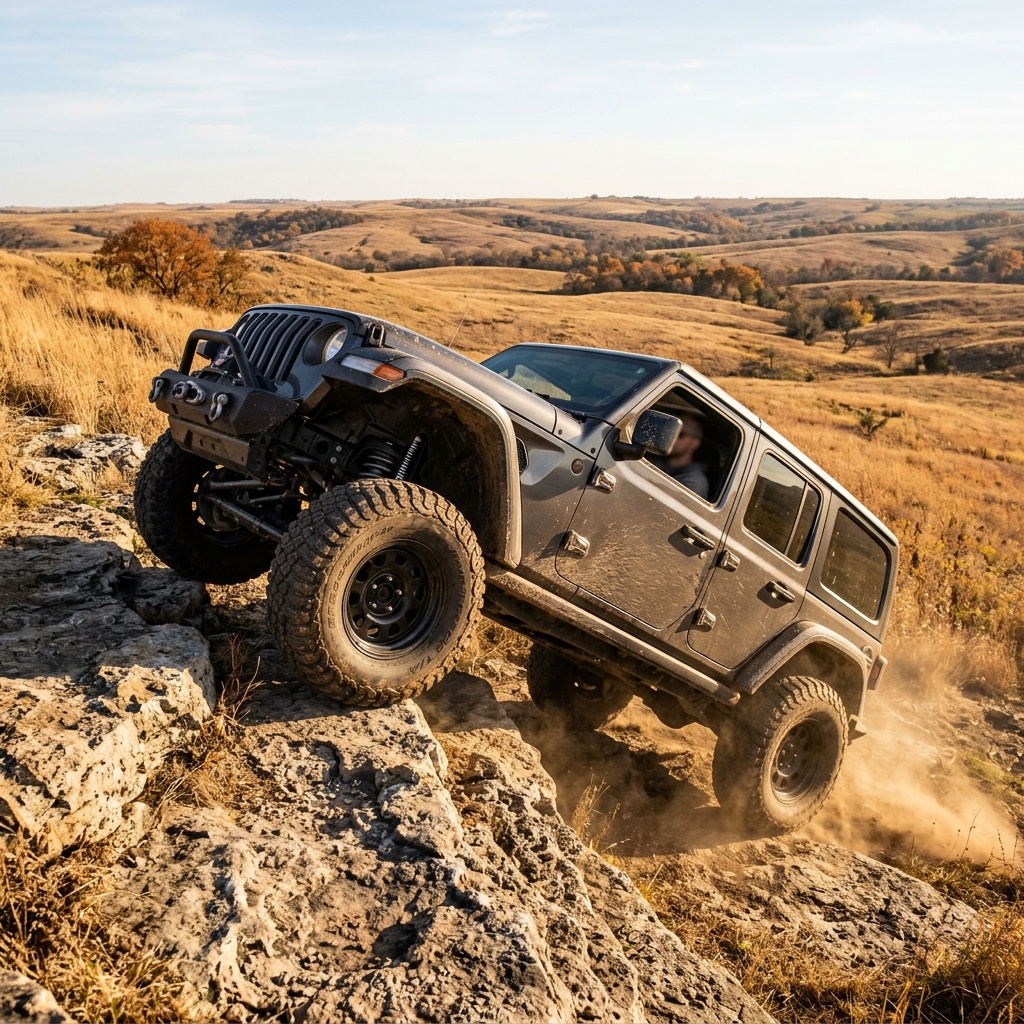
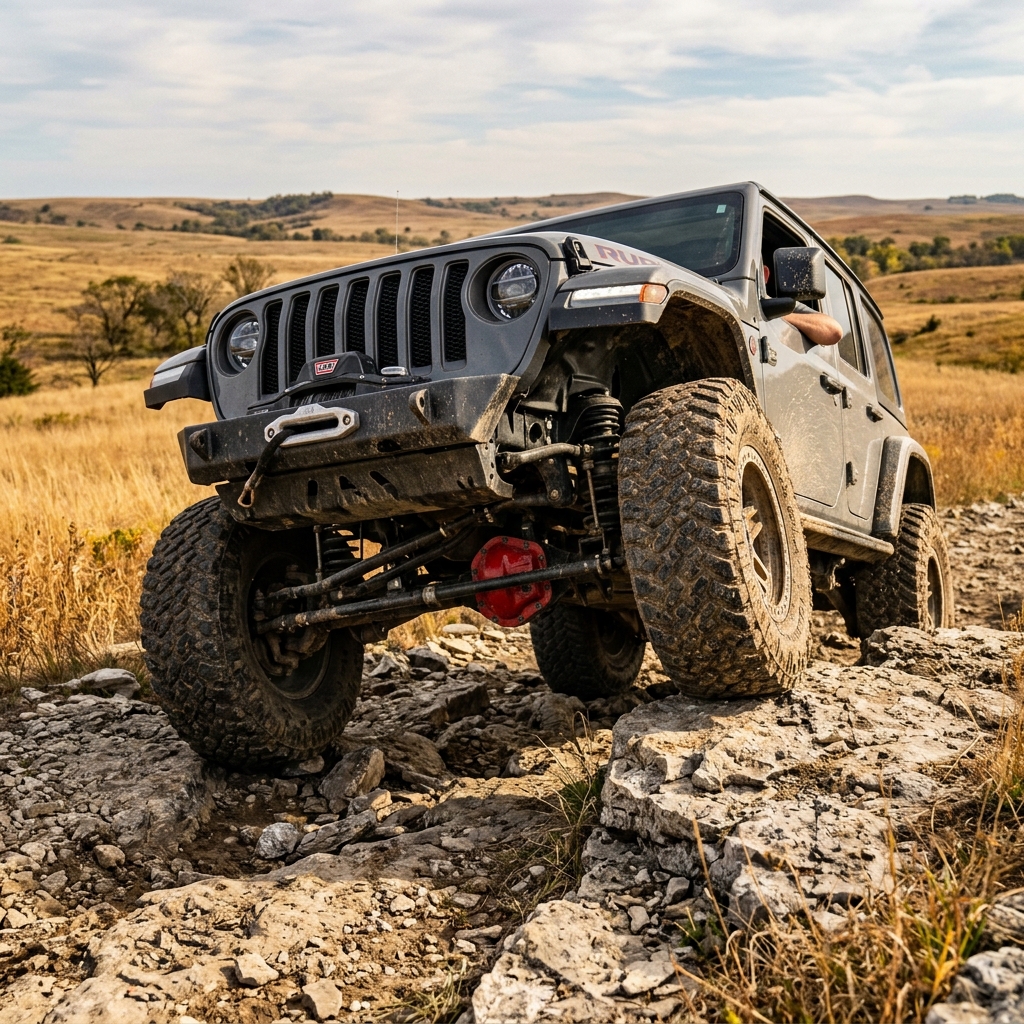
Gray off-road Jeep Wrangler traversing a rugged, rocky trail in a grassy countryside setting. (Representative image for illustration purposes only. Actual vehicle may vary based on trim and configuration.)

How Do Open-Air Features Compare Between the Jeep Wrangler and Ford Bronco?

Jeep Wrangler Open-Air Architecture

The Jeep Wrangler features removable lightweight doors, folding windshield glass, and versatile soft or hardtop options including the Sky One-Touch Power Top. Door removal on the Wrangler provides unobstructed line-of-sight directly down to the front tires—a crucial advantage when picking precise tire placement on narrow rock ledges in 4LO.

Ford Bronco Open-Air Architecture

The Ford Bronco utilizes frameless door glass and cowl-mounted side mirrors, meaning mirrors remain functional even when doors are removed. While both vehicles offer exceptional trail visibility and open-air Freedom, the Wrangler's solid front axle architecture provides superior suspension flex and wheel travel during low-range technical crawls.

Essential Trail Equipment and Safety Rules for 4x4 and Off-Road SUVs

Recovery Hardware & Straps

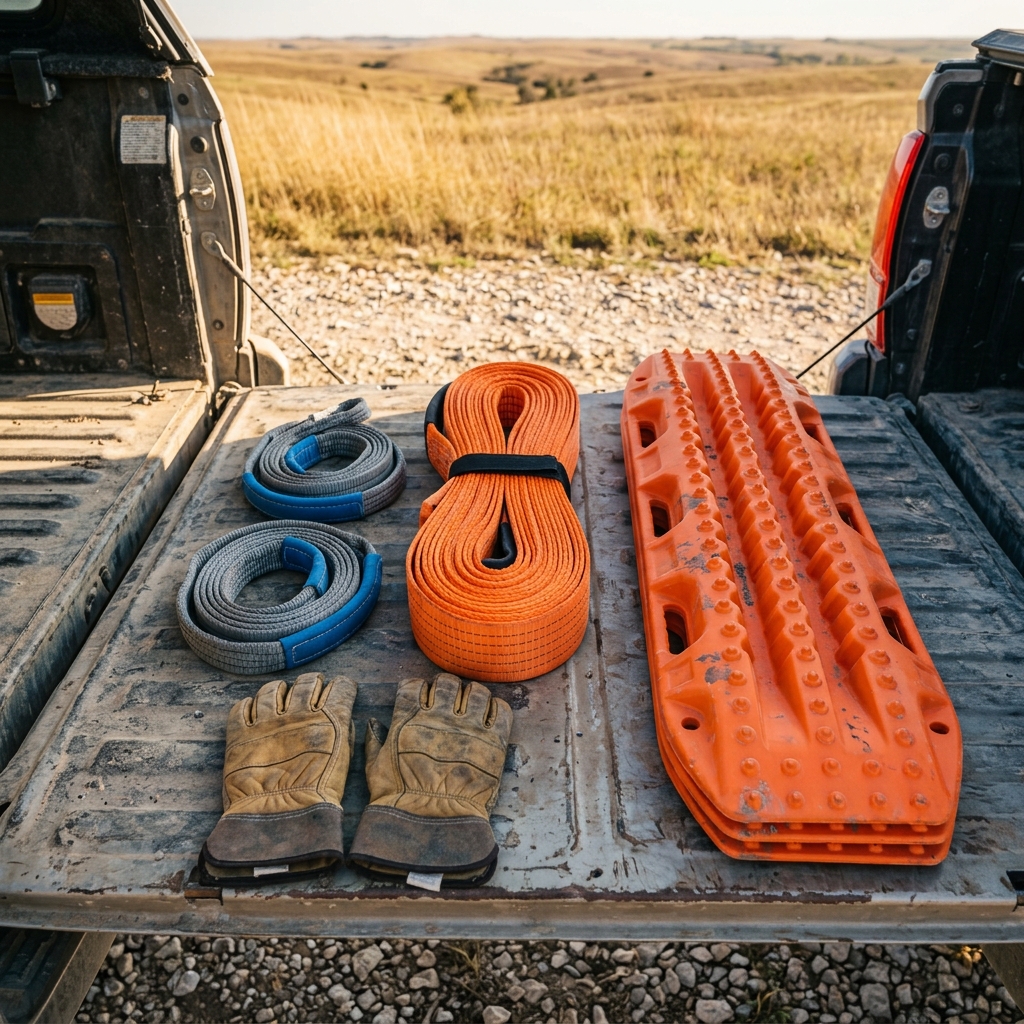
Never head onto Kansas trails alone. Essential gear includes kinetic snatch ropes, soft shackles, traction boards, and a high-capacity electric winch. Rated recovery points attached directly to the vehicle frame are mandatory before pulling stuck vehicles.

Spotter Hand Signals

When crawling steep drop-offs or limestone ledges in 4LO, rely on a trained spotter outside the vehicle. Establish clear hand signals before starting the obstacle: driver side turn, passenger side turn, slow forward, and immediate emergency stop.

Trail Control Electronics

Modern Jeep models offer Select-Speed Control and Hill Descent Control. These systems act as off-road cruise control in 4LO, automatically modulating individual wheel brakes to maintain set speeds between 0.6 mph and 5 mph down steep grades.
Off-road recovery gear including orange traction boards, a tow strap, ropes, and gloves neatly laid out on a truck tailgate. (Representative image for illustration purposes only. Actual vehicle may vary based on trim and configuration.)

Do Off-Road 4x4 SUVs Hold Their Resale Value Better Than Regular SUVs?

Market Data Shows Strong Depreciation Resistance: True body-on-frame 4x4 SUVs with two-speed transfer cases consistently outperform front-wheel-drive-based crossovers in long-term residual value retaining. Models like the Jeep Wrangler regularly top automotive residual value awards, retaining up to 65% to 70% of initial MSRP after five years.
Strong demand in the pre-owned market drives this value retention. Enthusiasts, outdoor adventurers, and rural drivers specifically seek out secondary market vehicles with proven 4LO capability and heavy-duty mechanical components.
Factory off-road options—such as front/rear differential lockers, electronic disconnects, and factory lift packages—yield exceptional return on investment at trade-in time compared to non-functional appearance upgrades.
If you currently own a capable 4x4 and are considering an upgrade, evaluate your current vehicle's market value today. Browse our Used Vehicle Listings or request an appraisal directly from our team.

Preparing Your 4x4 for Flint Hills and Riley County Off-Road Trails

The geography surrounding Junction City, Manhattan, and Riley County presents unique trail demands. The Flint Hills region is famous for its rocky soil structure containing sharp embedded limestone and chert rock layers. These sharp edges test tire sidewalls and underbody components during low-range technical ascents.
Furthermore, seasonal rains transform local agricultural access roads and reservoir floodplains into sticky clay mud. Navigating water crossings along local creeks requires checking water depth and verifying axle breather tube extensions before crossing to prevent water contamination in front and rear differentials.
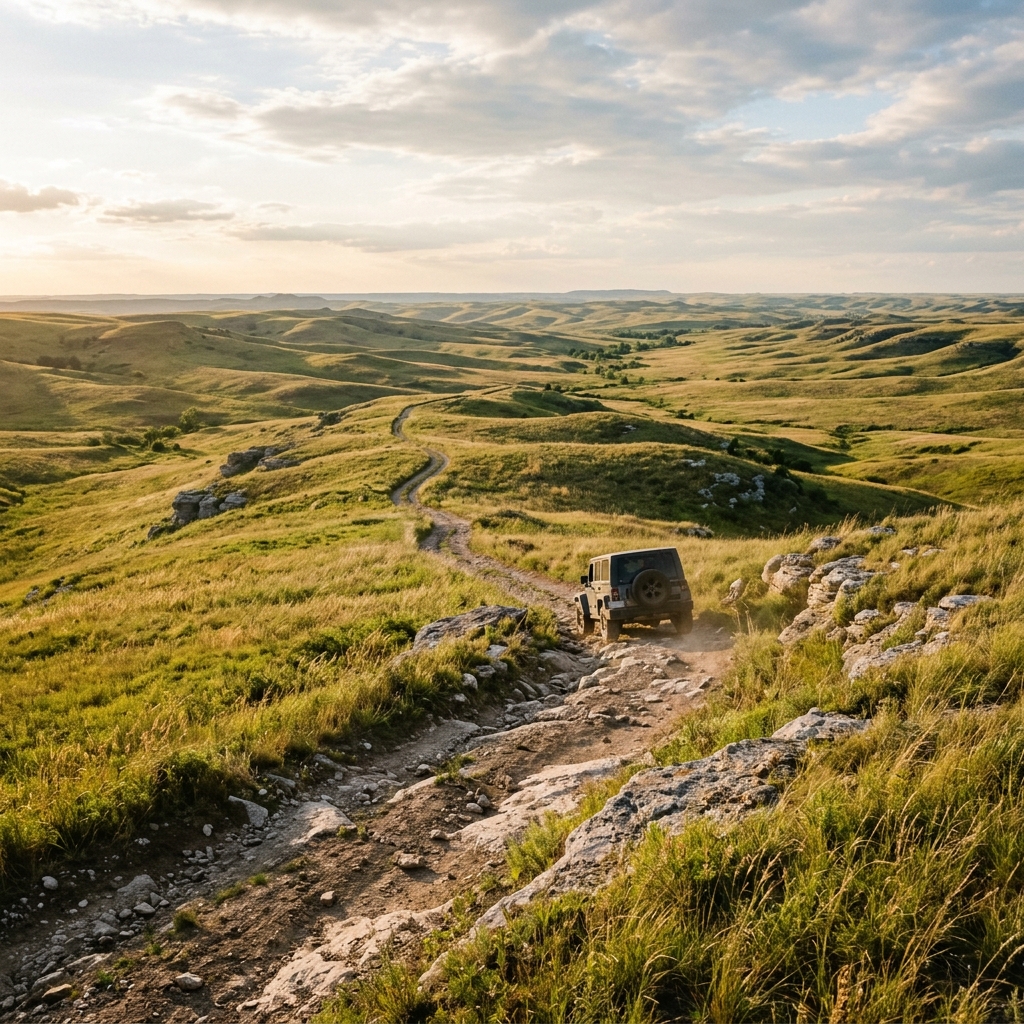
An SUV driving along a winding, rocky dirt trail through vast rolling green and yellow grassy hills at sunset. (Representative image for illustration purposes only. Actual vehicle may vary based on trim and configuration.)

Post-Trail Maintenance Checklist to Protect Your 4WD Drivetrain

1. Fluid Inspection

Check front and rear differential oil as well as transfer case fluid level after deep water crossings. Milky or discolored fluid indicates water intrusion through breathers requiring immediate fluid flush.

2. High-Pressure Wash

Thoroughly wash packed mud from brake calipers, steering tie rods, driveshaft U-joints, and radiator cooling fins. Dried mud creates severe wheel imbalance and traps moisture against steel frame rails.

3. Pressure & Steering Check

Re-inflate tires back to recommended street pressure before hitting paved highways. Inspect CV boots, steering stabilizer shocks, and track bar bolts for damage or loosened hardware. Quick service is available at our Express Lane.

Explore Capable 4x4 SUVs and Expert Off-Road Service at Valor CDJR

At Valor CDJR in Junction City, KS, we are passionate about four-wheel drive capability and local trail adventures. Whether you are looking for a brand new Jeep Wrangler Rubicon, a Ram 1500 Rebel, or professional service for your current 4x4 drivetrain, our team is ready to serve drivers throughout Manhattan, Riley County, and the surrounding Flint Hills community.
Visit us today at 1825 Goldenbelt Blvd, Junction City, KS 66441 or reach our team directly. Get Directions to Valor CDJR|Call us at (785) 238-5114
Valor Automotive logo featuring a blue shield with a red V and white A monogram above company text.

Posted in:

Related Posts

Optimizing 2021 Jeep Grand Cherokee Off-Road Capability: Expert Q&A with Valor CDJR

Optimizing 2021 Jeep Grand Cherokee Off-Road Capability: Expert Q&A with Valor CDJR

Optimizing 2021 Jeep Grand Cherokee Off-Road Capability: Expert Q&A with Valor CDJR In this exclusive interview, Dustin Zeck, Dealer Principal at Valor CDJR with 36 years of automotive leadership experience, delivers detailed technical insights on maximizing the trail performance, suspension clearance, and towing potential of the 2021 Jeep Grand Cherokee. Q: What approach and departure angles does the Trailhawk have compared to standard 2021 Jeep Grand Cherokee trims? A: The 2021 Jeep Grand Cherokee Trailhawk achieves nearly 36 degrees of approach angle, 22 degrees of breakover angle, and 27 degrees of departure angle when raised to Off-Road II height, compared to standard trims that deliver roughly 26 degrees of approach angle and 24 degrees of departure angle. That mechanical difference allows off-road drivers to clear steep rock ledges and deep trail washouts without damaging bodywork or chassis components. Zeck points out that dedicated body geometry and air suspension height adjustments account for this dramatic improvement. Standard Grand Cherokee trims utilize fixed coil spring setups or street-oriented body valances, designed primarily for highway aerodynamic efficiency. The Trailhawk combines specialized front and rear bumpers with adjustable air bladders, giving drivers elevated clearance precisely where the vehicle meets steep terrain. When drivers visit our dealership at 1825 Goldenbelt Blvd in Junction City to inspect the Trailhawk, Zeck usually points out how the front underbody skid plates shield vulnerable steering components during sharp vertical climbs. For personalized trim consultations or stock inquiries, customers are always welcome to give our sales team a quick call at (785) 238-5114. Q: What standard off-road capability features come on the 2021 Jeep Grand Cherokee? A: Standard off-road equipment begins with advanced four-wheel-drive configurations, including Quadra-Trac I, Quadra-Trac II with its two-speed transfer case, and Quadra-Drive II featuring a Rear Electronic Limited-Slip Differential. These robust mechanical systems continuously monitor wheel traction and redistribute engine torque to maintain forward momentum across low-grip surfaces. Zeck notes that Jeep builds true trail capability into the structural foundation of the lineup. Models equipped with Quadra-Trac II actively route up to 100 percent of available torque to the specific axle with the most grip when tire slip is detected. Trail-rated models add heavy-gauge steel skid plates that protect the fuel tank, transfer case, front suspension, and engine oil pan from severe trail impacts. Shoppers interested in exploring available factory four-wheel-drive options can browse our new-vehicle inventory to see current model configurations. Standard hill descent control further supports trail driving by automatically managing brake pressure on steep declines so the driver can focus entirely on steering navigation. Q: How high does Quadra-Lift Air Suspension raise the 2021 Jeep Grand Cherokee? A: The Quadra-Lift Air Suspension system features five distinct height settings that adjust ground clearance from a baseline of 8 inches up to a maximum ground clearance of nearly 11 inches in Off-Road II setting. Selecting Off-Road I elevates the vehicle by roughly 1 inch to achieve over 9 inches of total clearance for navigating rutted roads. Zeck explains that the pneumatic air springs adapt smoothly to various driving environments, automatically dropping the body into Aero Mode at cruising speeds to optimize fuel economy or Park Mode for effortless passenger loading. Raised into its highest Off-Road II setting, the Grand Cherokee can safely forge through up to 20 inches of standing water without risking water ingestion into the intake or axle breathers. "When local drivers visit our showroom to inspect a Grand Cherokee, they usually ask whether the Quadra-Lift air suspension alters highway ride quality before they ask about trail clearance." To evaluate how pre-owned models equipped with air suspension perform on local roads, customers can inspect our pre-owned vehicle lineup. Zeck emphasizes that pneumatic air springs deliver exceptional highway ride comfort while maintaining rigid support across rough terrain. Q: What drive modes are selectable with the Selec-Terrain system? A: The Selec-Terrain Traction Management System provides five driver-selectable settings: Auto, Sport, Snow, Sand/Mud, and Rock. Rotating the center console dial recalibrates up to 12 powertrain and stability sub-systems, including throttle response, transmission shift mapping, transfer case torque distribution, and traction control intervention. Zeck highlights how each setting customizes vehicle mechanicals for specific surface conditions. Auto mode continuously adapts to changing road conditions, while Sport mode lowers the ride height and holds transmission gears longer for spirited paved-road performance. The Snow setting splits drive torque evenly between front and rear axles while starting in second gear to minimize wheel spin on slick winter roads in Manhattan. In Sand/Mud and Rock settings, electronic throttle sensitivity adjusts and hill descent control readies itself to maximize tire traction over loose earth or uneven boulders. Drivers planning to trade in their current vehicle for a trail-ready SUV can easily value their trade-in online to begin the upgrade process. Q: Which SUV offers higher payload and towing capacities between the Grand Cherokee and Toyota 4Runner? A: The 2021 Jeep Grand Cherokee delivers superior towing and payload capabilities, offering a maximum towing capacity of up to 7,200 lbs when equipped with the 5.7-liter V8 engine and 6,200 lbs with the 3.6-liter V6 engine, easily outperforming the Toyota 4Runner's maximum 5,000-lb towing limit. Zeck explains that powertrain options drive this major performance advantage. The base 3.6-liter V6 engine generates 295 horsepower and 260 lb-ft of torque through an eight-speed automatic transmission, while the available 5.7-liter V8 engine pushes output to 360 horsepower and 390 lb-ft of torque. Combined with a maximum payload capacity of up to 1,380 lbs, the Grand Cherokee offers far greater utility for hauling heavy trailers and equipment. For drivers hauling utility trailers or camper rigs across Riley County, Zeck stresses the value of factory-integrated towing hardware. Prospective buyers can streamline their purchasing journey by prequalifying online prior to visiting our sales department. Q: What equipment is included in the Trailer Tow Group IV package? A: The Trailer Tow Group IV package includes a heavy-duty Class IV receiver hitch, 7-pin and 4-pin wiring harnesses, heavy-duty engine cooling, a 180-amp alternator, rear load-leveling suspension, and a full-size spare tire. This comprehensive factory equipment ensures the vehicle operates within safe thermal and structural limits while towing maximum capacity loads. Zeck emphasizes that heavy-duty cooling components and high-output electrical charging are essential for maintaining engine efficiency during long highway pulls under load. The rear load-leveling shocks use internal hydraulic valving to automatically counteract tongue weight, keeping the vehicle stance level and preserving headlamp alignment and steering control. Integrated factory wiring connections ensure reliable operation of electronic trailer brake controllers and trailer signal lights. Owners seeking replacement hardware or towing add-ons can consult our dedicated parts department for authentic factory equipment. Q: What is the largest tire size that fits on a stock 2021 Jeep Grand Cherokee? A: On an unmodified 2021 Jeep Grand Cherokee with factory suspension, the largest all-terrain tire size that fits without causing wheel well rubbing is 265/60R18, which measures approximately 30 inches in overall diameter, or 265/50R20 on 20-inch wheels. Zeck advises that mounting oversized tires without installing a suspension lift kit or modifying inner fender liners will lead to tire contact against the suspension control arms and body plastics during full lock turns or heavy suspension flex. Keeping close to factory tire dimensions also preserves proper speedometer calibration, transmission shift points, and electronic stability system tuning. For expert tire mounting, custom alignment, or general maintenance care, drivers can visit our Junction City showroom location or connect directly with our service advisors by calling (785) 238-5114. You can also reserve your next service appointment using our online service scheduler to keep your Grand Cherokee performing at its absolute best. © 2026 Valor CDJR. All rights reserved.

2026 RAM 1500: Off-Road and Winter Capability for Kansas Terrain

2026 RAM 1500: Off-Road and Winter Capability for Kansas Terrain

2026 RAM 1500: Off-Road and Winter Capability for Kansas Terrain What Is the Difference Between 4WD Auto and 4WD High in the 2026 Ram 1500? In the 2026 Ram 1500, 4WD Auto uses an electronically controlled clutch pack to automatically route power to the front wheels only when rear wheel slip is detected, making it safe for mixed dry and slick pavement. In contrast, 4WD High mechanically locks the front and rear drivelines in a continuous 50/50 torque split, providing maximum traction for deep snow, ice, or loose mud, but it should never be engaged on dry pavement to prevent driveline binding. As General Manager at Valor CDJR, with 20 years in the automotive business, I see truck owners face this transfer case choice every time temperature drops. In 4WD Auto, the active transfer case maintains a light clutch engagement that constantly monitors throttle position, steering angle, and individual wheel speeds. When you hit a patch of slush or black ice, the clutch pack tightens within milliseconds to send power forward. Because the clutches can slip slightly during tight turning maneuvers, you can leave the truck in 4WD Auto on patchy winter highways without experiencing wheel hop or driveline stress. When you switch to 4WD High, those internal clutches lock completely. Both axles turn at identical speeds, which delivers strong forward traction through heavy snowdrifts or rutted mud lanes along river valley farms. However, because the front and rear tires must rotate at different speeds when negotiating sharp corners, driving in 4WD High on dry concrete forces tires to scrub, putting severe binding stress on the transfer case and front axle shafts. When truck buyers come into our showroom to compare 4WD settings before winter, they almost always ask whether leaving 4WD Auto engaged on dry highway stretches causes extra wear. I reassure them that Ram engineered this active clutch system specifically for seamless variable-traction driving. If you want to walk through these four-wheel-drive modes in person or test drive a pickup equipped with the active transfer case, stop by our showroom on Goldenbelt Boulevard or give our team (785) 238-5114 a quick call. For commuters navigating mixed pavement around Junction City, keeping the system in 4WD Auto during winter storms provides complete peace of mind without needing to manually toggle buttons as road conditions change. Table of Contents Which Truck Has a Better 4WD System for Icy Kansas Highways: Ram 1500 or Ford F-150? What Off-Road Features Does the 2026 Ram 1500 Rebel Offer for Rugged Terrain? How Does the 2026 Ram 1500 Active 4WD System Handle Winter Snow and Ice? Are All-Weather Floor Liners and the Cold Weather Group Worth the Cost on a Ram 1500? How Much Extra Does Four-Wheel Drive Cost and How Do You Choose the Right Setup? Which Truck Has a Better 4WD System for Icy Kansas Highways: Ram 1500 or Ford F-150? The 2026 Ram 1500 features an active transfer case that provides a smoother, faster-reacting 4WD Auto torque transfer than the Ford F-150 across variable icy highway surfaces, delivering superior directional stability without driveline chatter or binding when transitions between ice patches and bare asphalt occur. While the Ford F-150 offers an automatic four-wheel-drive setting on its upper-tier trims, Ram makes its sophisticated active 4WD transfer case widely available across mid-level configurations. On icy highway corridors, the Ram system continuously evaluates wheel slip ratios and steering input. When rear tire friction drops on an icy overpass, torque shifts forward instantaneously and smoothly. The F-150's system is effective, but drivers often notice a firmer driveline engagement when its transfer case locks in under throttle. Another significant advantage in the Ram 1500 is its rear suspension architecture. Ram utilizes a multi-link rear coil-spring suspension—or available Active-Level Four-Corner Air Suspension —instead of traditional leaf springs. On corrugated, ice-rutted highways, traditional leaf-sprung trucks like the F-150 tend to skip or chatter sideways when hitting sudden bumps. The Ram 1500's independent coil damping keeps the rear tires planted firmly against the pavement, allowing the active 4WD system to apply engine torque directly to the road surface without losing vehicle balance. For drivers making daily highway commutes near Manhattan, where icy bridge decks on Highway 177 give way to clear pavement in the Flint Hills, the Ram active transfer case keeps the truck settled and tracking straight. You can explore our new Ram 1500 inventory to see which models feature this active transfer case, or contact our factory parts accessories department to learn about cold-weather equipment upgrades. What Off-Road Features Does the 2026 Ram 1500 Rebel Offer for Rugged Terrain? The 2026 Ram 1500 Rebel comes equipped with a factory 1-inch suspension lift delivering 9.7 inches of ground clearance, Bilstein front and rear performance shocks, an electronic locking rear differential, heavy-duty underbody skid plates, front recovery tow hooks, and 33-inch Goodyear Wrangler DuraTrac all-terrain tires on 18-inch wheels. Engineered specifically for terrain that stops standard light-duty pickups, the Rebel balances trail capability with daily driving refinement. Under the hood, the standard 3.0L Hurricane twin-turbo inline-six engine puts out 420 hp and 469 lb-ft of torque, giving you massive low-end torque for crawling over steep inclines or pushing through deep mud. For drivers who prefer classic V8 exhaust notes, the 5.7L HEMI V8 returns as an available option with 395 hp and 410 lb-ft of torque. Both powertrains pair with a robust eight-speed automatic transmission and standard 4WD. The Rebel's hardware is purpose-built for harsh environments: Bilstein monotube shocks tuned to absorb high-frequency washboard ruts while controlling body roll over large dips. An electronic locking rear differential that locks both rear axle shafts together at the press of a button, forcing both rear tires to turn at identical speeds when one side loses traction completely. Heavy-gauge steel underbody skid plates protecting the transfer case, front suspension, power steering gear, and fuel tank from rock impacts. Selec-Speed Control, which acts as an off-road cruise control to manage throttle and braking during steep downhill descents or technical trail climbs. If you opt for the available four-corner air suspension on the Rebel, maximum ground clearance increases to 10.7 inches, allowing the truck to clear deep snowdrifts and high-centered trail obstacles with ease. If you want to examine these trail components under the chassis, check out our selection of pre-owned trucks or stop by to inspect our latest off-road builds in person. How Does the 2026 Ram 1500 Active 4WD System Handle Winter Snow and Ice? On packed snow and frozen black ice, the 2026 Ram 1500’s active 4WD system reacts instantly using sensor data to maintain traction and steering control. Winter driving demands predictability. When you accelerate from a stop light on a snow-covered incline, the active system senses the initial micro-slip in the rear wheels and immediately tightens the transfer case clutch pack. Torque flows to the front wheels in under a tenth of a second, preventing the rear end from stepping out or fishtailing. In addition, the selectable drive modes adjust throttle response and transmission shift points. Selecting Snow Mode softens initial throttle sensitivity, preventing sudden torque spikes that break tire friction on slippery surfaces. Beyond the transfer case, the electronic stability control system works in tandem with the anti-lock braking system to brake individual spinning wheels, directing power across the axle to the tire with the most grip. When equipped with the available anti-spin rear differential or electronic rear locker, the Ram 1500 maintains forward traction even if both passenger-side tires land on solid ice while driver-side tires sit on clear pavement. To ensure your pickup remains fully prepared for cold-weather driving, our certified technicians can inspect your transfer case fluid, battery health, and tire tread depth. You can easily schedule a winter service appointment with our team to keep your 4WD system operating at peak performance all season long. Are All-Weather Floor Liners and the Cold Weather Group Worth the Cost on a Ram 1500? The optional Cold Weather Group package and standard or available rubber all-weather floor liners deliver exceptional long-term interior protection and cabin comfort for cold-weather driving, making them useful additions for helping protect the interior from mud, snow, and road salt. The Cold Weather Group typically adds between $235 and $300 to the manufacturer suggested retail price, making it one of the highest-value option packages in the full-size truck market. This equipment group includes: An engine block heater that warms engine oil and coolant overnight, reducing engine start-up wear and providing warm cabin heat much faster during sub-zero mornings. High-output heated front seats and a heated leather-wrapped steering wheel that reach full operating temperature within two minutes of starting the truck. Factory remote engine start integrated directly into the key fob, allowing you to pre-condition the cabin and defrost windshield ice from inside your home. Heavy-duty rubber all-weather floor liners come standard on off-road models like the Rebel and Warlock, and are available across Tradesman, Big Horn, and Laramie trims. These liners feature deep perimeter channels designed to trap melted slush, mud, and corrosive de-icing chemicals. Standard cloth carpeting quickly absorbs salt-laden water, leading to sub-floor rust and lingering cabin odors that degrade trade-in value over time. Investing in factory cold-weather options protects your vehicle's structural and aesthetic condition. When you are ready to upgrade your current pickup, you can value your trade-in online to see how well-maintained equipment boosts your overall vehicle equity. How Much Extra Does Four-Wheel Drive Cost and How Do You Choose the Right Setup? Adding four-wheel drive to a 2026 Ram 1500 adds approximately $3,500 to $3,850 over equivalent two-wheel drive configurations, a cost that is largely recovered at resale while providing critical traction and safety for regional driving conditions. Choosing the right Ram 1500 configuration comes down to matching your primary usage requirements against the trim lineup: Tradesman (starting MSRP): Built for pure utility and work durability, featuring the standard 3.6L Pentastar V6 with eTorque or available 5.7L HEMI V8. Big Horn ($47,575 starting MSRP): Offers the ideal balance of daily comfort, optional Level 2 tech equipment, and optional 3.0L Hurricane twin-turbo inline-six power. Rebel ($65,345 starting MSRP): Dedicated factory off-roader with standard 4WD, lifted suspension, Bilstein shocks, and 420 hp. Limited ($76,700 starting MSRP): Top-tier luxury with standard 4WD, air suspension, and the high-output Hurricane engine producing 540 hp and 521 lb-ft of torque. Because 4x4 trucks command significantly higher resale values in Midwestern pre-owned markets, much of the initial drivetrain investment returns to your pocket when it comes time to trade. Furthermore, the standard 10-year/100,000-mile powertrain limited warranty on 2026 Ram models ensures long-term confidence in transfer case and axle durability. My team and I are here to help you select the exact drivetrain, engine, and cab configuration for your lifestyle. You can contact us for current financing options through our secure online application, or visit us directly to test drive a 4x4 Ram 1500 today. Stop by our dealership or call our team at (785) 238-5114 to explore our current inventory and experience 2026 Ram capability firsthand. © 2026 Valor CDJR. All rights reserved.

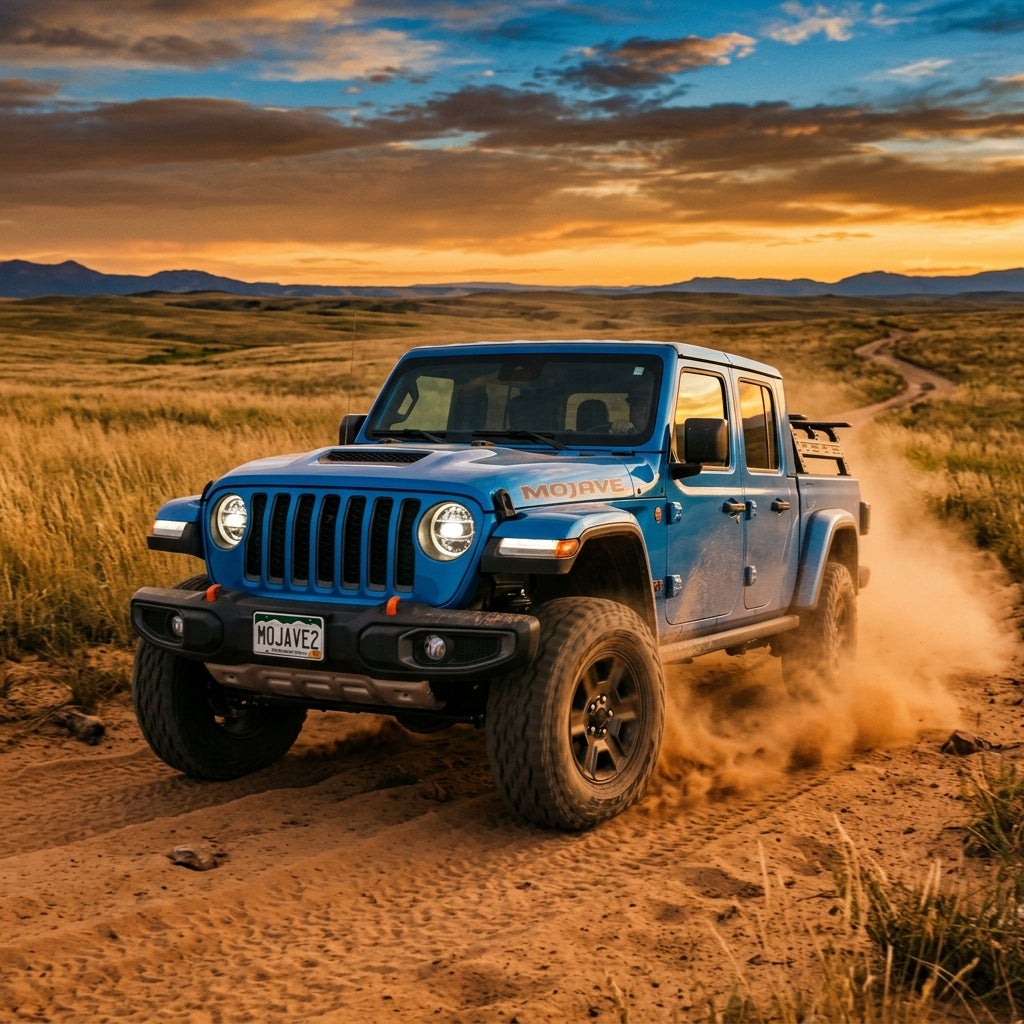
A blue Jeep Gladiator Mojave driving on a dusty dirt road at sunset. (Representative image for illustration purposes only. Actual vehicle may vary based on trim and configuration.)

2022 Jeep Gladiator Mojave: Desert-Rated Pickup for Kansas Adventurers

The 2022 Jeep Gladiator Mojave is Jeep's first Desert Rated pickup, purpose-built for high-speed open terrain rather than slow-speed rock crawling. Starting at $49,110, it pairs a 285 hp Pentastar 3.6L V6 with 4,500 lbs of towing capacity and genuine 4WD capability — making it the right truck for Junction City families who tow to Milford Lake on weekends and commute across rolling Kansas plains during the week. No other midsize pickup offers a removable roof alongside this level of desert-validated performance. View Inventory How Well Does the 2022 Jeep Gladiator Mojave Handle Off-Road and Daily Driving in Junction City? The Mojave earns its Desert Rated badge with a suspension tuned specifically for high-speed open terrain, which also translates to a noticeably more compliant and comfortable ride on paved roads compared to stiffer off-road setups — a genuine advantage for daily driving around Junction City's mix of highway stretches and gravel back roads. Edmunds notes that the Mojave is tailored for higher-speed off-road driving with reinforced chassis components and a desert-focused suspension tune, making it equally capable on washboard runs and smooth on the commute to Fort Riley. The standard Command-Trac part-time 4WD system with low and high gear ranges gives drivers the confidence to handle the gently rolling plains and river valley terrain surrounding Junction City without hesitation. Whether the road turns to gravel near the Kansas River or you're navigating a muddy trail after a spring rain, the Mojave's 4WD capability and 11.1 inches of ground clearance keep you moving. Fuel economy for a truck of this capability and curb weight is reasonable. The EPA-rated figures for the Mojave are: Feature Mojave MPG 16 city / 23 hwy / 19 combined At 19 combined MPG, the Mojave delivers a calculated range of 418 miles on its 22-gallon fuel tank — enough for a round trip from Junction City to Milford Lake and back several times before a fill-up is needed. Shoppers interested in exploring available Mojave configurations can browse our current new-vehicle inventory to see what's in stock at Valor CDJR. Schedule Test Drive Exterior Styling and Rugged Design Features Tailored for Adventures The Gladiator Mojave carries a design language that is unmistakably Jeep — seven-slot grille, boxy fenders, and a purposeful stance that communicates capability before the engine even starts. On the Mojave specifically, painted front and rear bumpers, black electrically adjustable mirrors, and standard front fog lights give it a polished yet aggressive appearance that fits naturally alongside the historic character of downtown Junction City and the energetic vibe of a college town. The exterior color palette gives buyers meaningful choices. Options include Black Clear Coat, Bright White Clear Coat, Firecracker Red Clear Coat, Snazzberry Pearl Coat, Sting-Gray Clear Coat, Hydro Blue Pearl Coat, Granite Crystal Metallic Clear Coat, Sarge Green Clear Coat, Silver Zynith Clear Coat, and the exclusive Limited Edition Gobi Clear Coat — a desert-inspired sand tone that directly references the Mojave's heritage. The in-stock unit at Valor CDJR wears Silver Zynith Clear Coat, a sharp choice that catches light well on both highway and trail. Standard 17-inch alloy wheels with 7.5-inch-wide rims mount all-terrain tires measuring 11.2 inches wide, giving the Mojave the stance and grip to handle Kansas terrain with authority. Optional LT285/70R17C mud-terrain tires and 17x7.5 Low Gloss Black Polished Aluminum Wheels are available for buyers who want to push deeper into the dirt. The Mojave also supports a range of roof configurations — from a Black 3-Piece Hard Top to a Premium Black Sunrider Soft Top — so open-air driving on a warm Kansas evening is always an option. Shoppers looking at pre-owned options can browse our pre-owned Gladiator listings to find the right color and configuration. 2022 Jeep Gladiator Mojave Powertrain Performance and Towing Capacity for Kansas Terrain A stat that matters most to Junction City families: the Mojave pulls 4,500 lbs — enough to haul a loaded boat trailer to Milford Lake, tow a utility trailer for a weekend project, or transport a pair of ATVs for a Flint Hills trail run. That number comes from a well-sorted powertrain, not an overworked one. Feature Mojave Engine 3.6L Horsepower 285 hp Torque 260 lb-ft Transmission manual 6-speed Drivetrain All-wheel drive The Pentastar 3.6L V6 produces 285 hp at 6,400 rpm and 260 lb-ft of torque at 4,400 rpm, paired standard with a manual 6-speed transmission. For drivers who prefer an automatic, the optional 8-Speed Automatic 850RE Transmission is available — a smooth, wide-ratio unit with gear ratios spanning 4.71:1 in first down to 0.67:1 in eighth, providing both strong off-the-line pull and relaxed highway cruising. The in-stock Silver Zynith unit at Valor CDJR is equipped with this 8-speed automatic. Feature Mojave Seating 5 Curb weight 4,952 lbs Towing 4,500 lbs Payload 1,298 lbs The 1,298 lbs of payload capacity means the Mojave's bed handles real work — camping gear, tools, or equipment for a weekend project. The 4,952 lb curb weight reflects the Mojave's reinforced desert-duty chassis, which includes heavy-duty suspension with gas shocks as standard equipment. The Command-Trac 4WD system with low/high gear ranges adds confident traction on the gravel and rolling terrain surrounding Riley County. If you're ready to move from your current vehicle into a Mojave, Valor CDJR makes it easy to get an estimate on your trade-in before you visit the lot. Interior Comfort and Space in the 2022 Jeep Gladiator Mojave for Families and Outdoor Enthusiasts Five adults fit comfortably in the Gladiator Mojave's crew cab — and the interior dimensions back that claim with real numbers. Front passengers enjoy 41.2 inches of leg room and 42.8 inches of headroom, while rear passengers get 38.3 inches of leg room and a matching 42.8 inches of headroom. Shoulder room measures 55.7 inches front and rear, so three adults across the back seat is a genuine option rather than a compromise. For a family loading up for a day at Tuttle Creek State Park, the split-folding rear bench opens up under-seat storage space in the rear, giving you a place to stow gear you want secured rather than exposed in the bed. Front bucket seats come standard in an upgraded cloth, with leather-trimmed bucket seats and specific leather combinations — including Global Black/Steel Grey Leather and Black/Green Leather — available as options for buyers who want a more refined cabin feel. The in-stock Mojave at Valor CDJR features black leather front seat upholstery, a clean and durable choice for active families. Climate control is handled by a single-zone automatic air conditioning system with touch screen controls and a cabin micro-filter, keeping the interior comfortable regardless of Kansas summer heat. A full-length floor console with front and rear cup holders, illuminated vanity mirrors, and ambient lighting round out the daily-driver comfort picture. Storage under the rear seat adds another practical layer for stowing valuables out of sight. Buyers considering financing their Mojave purchase can get a pre-approval decision online before visiting Valor CDJR, which simplifies the process considerably. Infotainment and Connectivity Features That Enhance the Driving Experience The Mojave's standard Uconnect 4C system centers on an 8.4-inch touchscreen — large enough to navigate clearly while wearing work gloves and responsive enough for quick inputs at a stoplight. The system includes built-in navigation with a 3D display, voice guidance, traffic information, and a traffic subscription, so you always have current routing whether you're heading through downtown Junction City or finding your way across the Flint Hills. Smartphone integration is comprehensive and effectively permanent. Both Apple CarPlay and Android Auto are standard, each included — meaning they function for the life of the vehicle without additional fees. Bluetooth connectivity, a voice activation system, and steering wheel-mounted audio controls keep hands on the wheel and eyes on the road. The audio system is a genuine highlight for a truck in this class. A 9-speaker Alpine system with a subwoofer delivers clear, full-range sound whether you're on a quiet highway stretch or parked at a campsite. AM/FM radio, satellite radio with a 6-month trial subscription, and digital radio round out the audio options. Two front USB charging ports and four rear USB charging ports — six total — mean every passenger stays charged on a long drive. A 7-inch digital instrument cluster display sits in the gauge pod, delivering trip computer data including average fuel economy. Keyless entry, push-button start, and a programmable garage door opener add everyday convenience. For drivers who want to expand the Mojave's capabilities further, Valor CDJR's Mopar parts and accessories department stocks genuine Jeep add-ons including the optional TrailCam integrated off-road camera, wireless Bluetooth speaker, and auxiliary switch group for powering aftermarket accessories. Safety and Driver Assistance Technologies Designed for Kansas Drivers in the 2022 Jeep Gladiator Mojave The Mojave's standard safety foundation is solid for a truck designed to go well beyond paved roads. Four airbags are fitted as standard — dual intelligent front airbags for driver and passenger, plus front side airbags — with pre-tensioning front seatbelts (both height-adjustable) and a 3-point center rear belt covering all three rear seating positions. Height-adjustable head restraints are fitted front (2) and rear (3), and LATCH child seat anchors come standard for families with younger passengers. The braking system runs four-wheel ventilated disc brakes with ABS and a brake assist system that applies additional braking force when the system detects an emergency stop — a meaningful advantage on the flat-to-rolling terrain around Junction City where reaction time matters. Hill holder prevents rollback on inclines, which is useful when stopped on an overpass or a gravel rise. Electronic traction control, roll stability control, and a full stability control system work together to keep the Mojave composed on both paved roads and loose surfaces. The optional Safety Group package adds a rear camera, rear parking sensors, LED brake lights, and Blind-Spot/Rear Cross-Path Detection — a system that monitors the lanes beside and behind the truck and warns the driver of vehicles approaching from the rear quarters. This is particularly useful when towing, where rear visibility is naturally limited. For drivers who want the most comprehensive electronic safety net, the optional Advanced Safety Group adds Full Speed Forward Collision Warning Plus with automatic emergency braking that activates from as low as 3 mph, a brake assist link to the collision system, and automatic high-beam headlight control. The trailer stability program is standard, actively managing sway when towing — a reassuring feature for anyone pulling a loaded boat trailer on a windy Kansas highway. Pricing Breakdown of All 2022 Jeep Gladiator Mojave Trims The 2022 Jeep Gladiator Mojave carries a starting MSRP of $49,110 — positioning it as Jeep's co-flagship off-road trim alongside the Rubicon, and reflecting the desert-specific engineering, standard 9-speaker Alpine audio, Uconnect 4C navigation, and heavy-duty suspension that come as part of the base configuration. Feature Mojave Base MSRP $49,110 Destination charge $1,595 The destination charge of $1,595 brings the as-delivered starting price to $50,705 before any options are selected. From there, buyers can meaningfully customize the Mojave through a well-stocked options list. Notable additions include the Cold Weather Group (heated front seats for both driver and passenger, plus a heated steering wheel), the LED Lighting Group (projector-beam LED headlights, LED daytime running lights, LED fog lights, and LED rear and brake lights), the Safety Group (rear camera, rear sensors, blind-spot monitoring), and the Advanced Safety Group (forward collision warning with automatic emergency braking and auto high beams). Roof configuration is another key personalization point. The Black 3-Piece Hard Top with a sliding rear window and rear defogger, the Body Color 3-Piece Hard Top, and the Premium Black Sunrider Soft Top each change the character of the truck significantly. The Dual Top Group adds a manual soft top alongside the hard top panels, giving owners maximum flexibility across seasons. Interior upgrades include Global Black/Steel Grey Leather and Black/Green Leather seating options, while the optional 8-Speed Automatic 850RE Transmission is a popular option for buyers who prefer not to row their own gears. The in-stock used Mojave at Valor CDJR — a Silver Zynith Clearcoat crew cab with 49,373 miles, leather seating, the 8-speed automatic, LED Lighting Group, Cold Weather Group, hard top, and Uconnect 4C navigation — is currently priced at $33,763, representing a strong value entry point for buyers who want the full Mojave experience at a lower price than new. In the competitive midsize pickup segment, the Mojave competes with trucks like the Toyota Tacoma, Ford Ranger, and Chevrolet Colorado — and the Gladiator Mojave offers a removable roof, open-air driving, and a desert-validated suspension tune. Get a Quote Warranty Coverage, Maintenance, and Service Options for 2022 Jeep Gladiator Mojave Owners Jeep backs the 2022 Gladiator Mojave with a warranty structure that gives owners genuine peace of mind across the vehicle's early years of ownership. The basic vehicle warranty covers 36 months or 36,000 miles, whichever comes first. The powertrain warranty — covering the Pentastar engine, transmission, and drivetrain components — extends to 60 months or 60,000 miles. Anti-corrosion protection runs 60 months, and roadside assistance is included for 60 months or 60,000 miles, meaning Jeep's manufacturer-backed roadside coverage travels with you on every trail run and long-distance haul. Coverage Duration Distance Basic vehicle 36 months 36,000 mi Powertrain 60 months 60,000 mi Anti-corrosion 60 months Unlimited mi Paint 36 months 36,000 mi Roadside assistance 60 months 60,000 mi For Valor CDJR customers in Junction City and the surrounding area, keeping your Gladiator Mojave properly maintained is straightforward. Our service team is familiar with the Pentastar V6, the Command-Trac 4WD system, and the specific maintenance intervals these trucks require — from oil changes and tire rotations to transfer case fluid and differential service after heavy off-road use. Military families and local professionals with busy schedules can book a service appointment online at a time that works around their week, with transparent pricing and no surprises. Awards, Expert Reviews, and Recognition Highlighting the 2022 Jeep Gladiator Mojave's Strengths Third-party recognition for the 2022 Gladiator is consistent and credible. Kelley Blue Book named the Gladiator to its Best Resale Value: Top 10 list for 2022 — a meaningful signal for buyers who care about long-term ownership costs. Vincentric awarded it Best Value in America: Small/Mid-Size Pickup for 2022, and the Specialty Equipment Market Association recognized it as SEMA Mid-Size Truck of the Year for 2022. Expert reviewers have been equally direct. MotorTrend observed that the Gladiator Mojave's desert racing-inspired suspension allows it to go almost anywhere and get there faster than any other Gladiator and most other trucks — high praise that reflects the engineering investment Jeep made in the desert-specific tune. A follow-up MotorTrend evaluation noted that Jeep gives the Gladiator more of what buyers want with the Mojave while taking essentially nothing away in return. Car and Driver described the Gladiator as a legitimate pickup truck and a trail-ready tool simultaneously, while Edmunds noted the Mojave's specialized suspension setup positions it as the ideal choice for buyers who prioritize high-impact desert endurance and open-trail composure. Kelley Blue Book reinforced the Gladiator's unique market position as a pickup with a detachable roof and doors — a distinction that remains true in the midsize segment today. Frequently Asked Questions About Owning a 2022 Jeep Gladiator Mojave The 2022 Jeep Gladiator Mojave has a towing capacity of 4,500 lbs. That is enough to haul a mid-size boat, a loaded utility trailer, or a pair of ATVs on a tandem trailer. The standard trailer stability program actively manages sway while towing, and the optional Trailer Tow Package adds dedicated trailer towing preparation for buyers who tow regularly. For families heading to Milford Lake or Tuttle Creek State Park on weekends, this capacity comfortably covers most recreational towing needs. Yes. The Mojave comes standard with the Command-Trac part-time 4WD system, which includes both high and low gear ranges. An optional Selec-Trac Full Time 4WD System is also available for buyers who want a system that can remain engaged on mixed surfaces. The standard 4WD system is well-suited to the gravel roads, rolling plains, and occasional muddy conditions found across Riley County and the Flint Hills region. The EPA rates the Mojave at 16 mpg city, 23 mpg highway, and 19 mpg combined. With a 22-gallon fuel tank, that works out to a calculated range of 418 miles per fill-up. The engine runs on regular 87-octane unleaded fuel, keeping day-to-day operating costs reasonable for a truck with this level of capability. The Mojave is rated to carry 1,298 lbs of payload in its bed and cabin combined. The bed measures 60.3 inches long, 56.8 inches wide at the rails, and 44.8 inches between the wheelhouses — a short-box configuration that fits in standard parking spaces while still handling full-size gear loads, camping equipment, or materials for a weekend project. Valor CDJR currently has a 2022 Jeep Gladiator Mojave in Silver Zynith Clearcoat with leather seating, the 8-speed automatic, LED Lighting Group, Cold Weather Group, and Uconnect 4C navigation available on the lot at 1825 Goldenbelt Blvd, Junction City. To ask about availability, schedule a test drive, or get answers about specific options, give our team a call at (785) 238-5114 — we are happy to walk you through everything the Mojave offers before you make the drive in. The Mojave is Jeep's Desert Rated trim — the only Gladiator specifically engineered for high-speed open terrain and sand running rather than slow-speed technical rock crawling. Its suspension is tuned for compliance and composure at speed across washboard and whoops, which also makes it more comfortable on paved roads than the stiffer Rubicon setup. Standard equipment includes heavy-duty suspension with gas shocks, a 9-speaker Alpine audio system, Uconnect 4C with an 8.4-inch touchscreen, and the full suite of Jeep open-air roof and door options that make it one of the few pickups that can be driven with the top and doors removed. Contact Us Vehicle specification data © JATO Dynamics Limited.