




Blog / Vehicle Ownership Care

Jeep Grand Cherokee Maintenance Costs Explained: Q&A with Valor CDJR

Jeep Grand Cherokee Maintenance Costs Explained: Q&A with Valor CDJR

Jeep Grand Cherokee Maintenance Costs Explained: Q&A with Valor CDJR

The Jeep Grand Cherokee is not significantly more expensive to maintain than other midsize SUVs, averaging roughly $666 annually in routine care and minor repairs compared to the midsize SUV segment average of $615 per year. To examine how component design, four-wheel-drive transfer cases, and recurring service schedules impact total ownership expenses over time, we spoke with Mike Hogg, Service Director at Valor CDJR, who brings 20 years of hands-on automotive expertise to explain what owners can expect.

Q: Is a Jeep Grand Cherokee expensive to maintain compared to other midsize SUVs?

A: Maintenance costs for the Jeep Grand Cherokee align closely with the broader midsize SUV segment, with annual upkeep averaging about $666 compared to $615 for the average crossover. Standard service procedures like synthetic engine oil changes, tire rotations, and cabin air filter replacements carry straightforward pricing similar to rival two-row family vehicles. What sets the Grand Cherokee apart mechanically is its true truck-based heritage and available 4WD systems, which provide a maximum towing capacity of 6,200 lbs alongside genuine off-road capability.

While routine engine and brake servicing remain very manageable, models equipped with advanced transfer cases or height-adjustable air suspensions require periodic driveline fluid changes and multi-point inspections to ensure long-term durability. For service customers balancing daily travel near Fort Riley, staying proactive with scheduled maintenance prevents unexpected mechanical issues down the road. If you ever have questions regarding your vehicle's maintenance history or upcoming service needs, you can give our dealership team a quick call or stop by our Junction City service department to speak directly with an advisor.

Q: How much does annual maintenance cost for a Jeep Grand Cherokee?

A: Owners typically budget around $666 annually for routine upkeep and unscheduled repairs, while long-term industry estimates from Kelley Blue Book project five-year maintenance expenses of $5,132 and repair expenses of $1,918 for mid-level configurations like the Limited trim. Out-of-pocket costs during the initial years of ownership remain relatively low because new vehicles are backed by factory warranty protection, including 3 years or 36,000 miles of basic coverage and 5 years or 60,000 miles of powertrain coverage.

Annual service expenses vary based on vehicle age, total mileage, and whether your SUV features the standard 3.6L Pentastar V6 engine or the available turbocharged 2.0L engine. Early service visits center on synthetic motor oil adjustments, tire rotations, and battery health checks. As your vehicle passes 60,000 miles, maintenance budgets step up slightly to accommodate wear-and-tear items like brake pads, brake rotors, spark plugs, and fluid changes for the TorqueFlite® eight-speed automatic transmission.

Q: What recurring maintenance intervals should a Grand Cherokee owner budget for?

A: Grand Cherokee owners should plan maintenance around the onboard oil-change indicator, which caps service intervals at a maximum of 10,000 miles, 12 months, or 350 engine hours. Key maintenance milestones include rotating tires every 5,000 to 7,500 miles to promote even tread wear, replacing the cabin air filter every 12,000 miles, inspecting suspension components and brake systems every 20,000 miles, and renewing the engine air filter at 30,000 miles.

For turbocharged models, spark plug replacement is scheduled at 60,000 miles, while a complete engine coolant flush is recommended at 150,000 miles. Drivers navigating the rolling Flint Hills terrain in Manhattan frequently encounter unpaved roads and seasonal dust, which can accelerate filter clogging and suspension wear. Adhering to these published intervals keeps your factory warranty valid and extends the operational life of key drivetrain components.

"Following your dashboard oil-change indicator and replacing transfer case fluids on schedule is the single best way to avoid major repair bills over 100,000 miles."

Q: What are the most common maintenance repairs for a Jeep Grand Cherokee?

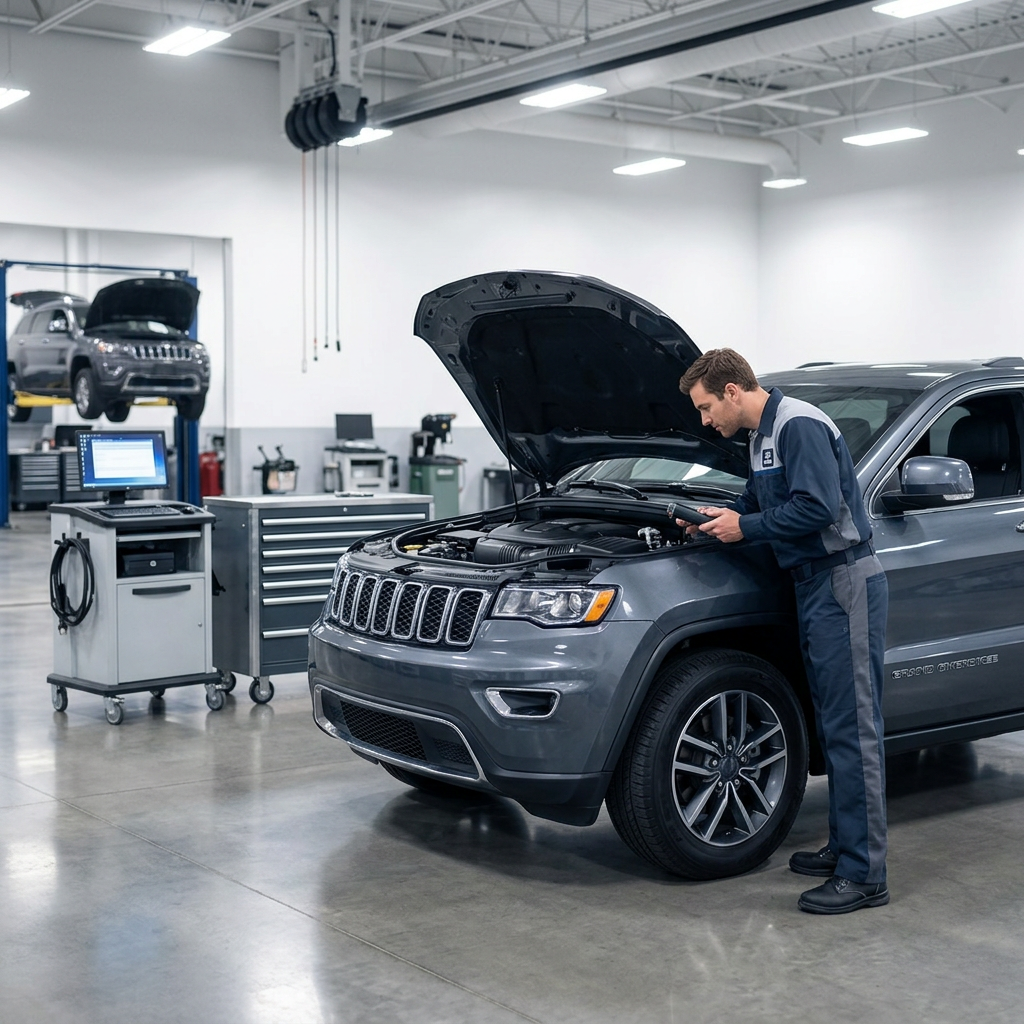
A: The most frequent maintenance repairs on higher-mileage Grand Cherokee models involve standard wear items such as brake pad and rotor replacements, suspension strut servicing, ignition coil renewals, and occasional water pump or alternator replacements. Over time, complex electronic modules and 4WD transfer case shift actuators may also require diagnostic scans or software updates to maintain smooth gear engagement.

Performing these services with authentic Mopar fluids and original equipment parts ensures proper fitment and protects engineered mechanical tolerances across every system. Drivers looking to order authentic factory components can connect directly with our parts center, while those needing diagnostic support can reserve a convenient time slot through our online service scheduler.

Q: Is there a local Junction City service discount that could reduce maintenance bills?

A: Valor CDJR hosts a dedicated service offer on maintenance procedures and repairs for active duty service members, veterans, and military families. This offer applies directly to essential vehicle upkeep, including synthetic oil changes, brake system flushes, tire rotations, battery replacements, and multi-point vehicle safety audits.

Service customers can take advantage of these savings simply by presenting a valid active-duty military identification card, retiree credential, or veteran designation during appointment check-in. Providing discounted maintenance care supports local military families and helps keep their primary family transportation operating safely and efficiently.

Q: How do ongoing factors like insurance costs and trim levels impact overall ownership expenses?

A: Total ownership costs depend significantly on trim level selection and annual vehicle insurance, with typical auto insurance for a Grand Cherokee ranging between $1,600 and $1,900 annually based on driver history and coverage selections. Entry-level models like the Laredo, which starts at $39,520 MSRP, feature straightforward coil-spring suspensions and standard exterior hardware that keep routine replacement costs lower over time.

By contrast, luxury trims like the Summit, starting at $60,900 MSRP, incorporate premium features such as height-adjustable air suspensions and active driving assistance tech that require specialized diagnostic tools when servicing. To learn more about maintaining your specific vehicle trim or to schedule your next inspection, reach out to our service staff at (785) 238-5114 or stop by our Junction City dealership location to speak with an expert technician.
© 2026 Valor CDJR. All rights reserved.

Vehicle specification data © JATO Dynamics Limited.


Posted in:

Related Posts

jeep

What I Tell Customers About 2021 Jeep Grand Cherokee Upgrades and Quick Wins

What I Tell Customers About 2021 Jeep Grand Cherokee Upgrades and Quick Wins What I Tell Customers About 2021 Jeep Grand Cherokee Upgrades and Simple Upgrades What Are the Simple Aesthetic Upgrades for a 2021 Jeep Grand Cherokee? The simplest aesthetic upgrades for a 2021 Jeep Grand Cherokee include installing matte blackout emblem overlays, upgrading dim factory halogen headlights to error-free LED bulb kits, adding custom all-weather floor liners, and applying pre-cut window tint or chrome delete vinyl trim kits. These non-invasive cosmetic changes take less than two hours to complete with basic hand tools and deliver an immediate personalized appearance. Beyond quick visual tweaks, adding illuminated front door sill plates and dark-tinted window rain guards gives the classic two-row unibody profile a sharper, custom look. For vehicle owners heading out on weekend trips near Milford Lake around Junction City [1], custom all-weather rubber mats and molded cargo liners protect interior floor carpeting from mud, sand, and water while maintaining a clean factory fit. Upgrading the front grille insert to a dark mesh pattern or changing stock mirror covers to gloss-black housings cleans up the side profile. If you want to check out genuine trim accessories or discuss custom options with our team in person, stop by our showroom on Goldenbelt Blvd or give us a quick call at (785) 238-5114. Table of Contents What Is the Difference Between the Standard 2021 Jeep Grand Cherokee and the Grand Cherokee L? Can You Add an OEM Trailer Hitch Receiver to a 2021 Jeep Grand Cherokee After Purchase? How Do You Install LED Bulb Upgrades on a 2021 Jeep Grand Cherokee? What Are the Easiest Performance Modifications for a 2021 Jeep Grand Cherokee? Which SUV Has Better Consumer Reliability Scores: 2021 Grand Cherokee or 2021 Ford Explorer? What Are the Average Annual Maintenance Costs for a 2021 Jeep Grand Cherokee? What Is the Difference Between the Standard 2021 Jeep Grand Cherokee and the Grand Cherokee L? The primary difference between the standard 2021 Jeep Grand Cherokee and the 2021 Grand Cherokee L is seating capacity and vehicle architecture. The standard 2021 model uses the established two-row WK2 platform seating up to five passengers, while the Grand Cherokee L debuts the redesigned three-row WL platform, offering six or seven seats across a 6.9-inch longer wheelbase. In terms of interior cargo room, the Grand Cherokee L delivers 85 cubic feet of maximum cargo capacity with the second and third rows folded flat, compared to 68 cubic feet in the standard two-row SUV. Up front, the Grand Cherokee L features the updated Uconnect 5 infotainment system with an available 10.1-inch touchscreen, whereas the two-row 2021 model runs Uconnect 4 on an 8.4-inch display. Both models share reliable powertrain options, including the standard 3.6L Pentastar V6 engine and available 5.7L V8. To compare cabin dimensions and seating configurations side by side, feel free to browse our pre-owned vehicle lineup to see which body layout fits your daily driving needs. Can You Add an OEM Trailer Hitch Receiver to a 2021 Jeep Grand Cherokee After Purchase? An OEM Mopar trailer hitch receiver and factory wiring harness can be retrofitted onto a 2021 Jeep Grand Cherokee after purchase if the vehicle was not equipped with the factory tow package. Installing the genuine Class IV receiver maintains factory ground clearance and supports a maximum towing capacity of 3,500 lbs on models with the 3.6L Pentastar V6 or up to 7,200 lbs when paired with the 5.7L V8 engine. The retrofit installation requires mounting the heavy-duty receiver beam directly to the rear unibody frame rail structure and installing a factory bumper bezel trim kit around the hitch cutout. Wiring the factory 7-pin and 4-pin trailer harness into the onboard electrical system ensures full compatibility with electronic trailer sway control without triggering dashboard warning lights. If you are shopping for a pre-owned SUV or planning a vehicle upgrade, you can check our selection of new inventory, take a moment to get pre-approved online, or order genuine towing components directly through our genuine parts department. 2021 Jeep Grand Cherokee Pricing Pricing by trim Trim Base MSRP Destination charge 80th Edition $42,355 $1,495 80th Edition 4WD $44,355 $1,495 Freedom $37,930 $1,595 Freedom 4WD $39,955 $1,595 High Altitude $49,660 $1,495 High Altitude 4WD $52,660 $1,495 Laredo E $34,220 $1,495 Laredo E 4WD $36,220 $1,495 Laredo X $37,520 $1,495 Laredo X 4WD $39,520 $1,495 Laredo X SE $37,880 $1,595 Laredo X SE 4WD $40,205 $1,595 Limited $40,175 $1,495 Limited 4WD $42,175 $1,495 Limited X $46,930 $1,595 Limited X 4WD $48,950 $1,595 Overland $46,715 $1,495 Overland 4WD $49,715 $1,495 SRT $69,165 $1,495 Summit $52,715 $1,495 Summit 4WD $55,715 $1,495 Trackhawk $87,670 $1,495 Trailhawk 4WD $45,375 $1,495 How Do You Install LED Bulb Upgrades on a 2021 Jeep Grand Cherokee? Installing LED bulb upgrades on a 2021 Jeep Grand Cherokee requires accessing the headlight dust covers behind the wheel well liner access doors, unclipping the stock halogen bulbs, and plugging in CAN-bus error-free LED replacement units. The entire installation takes roughly 30 to 45 minutes for both headlights without cutting or splicing factory wiring. Because the Jeep electrical architecture actively monitors circuit resistance, installing basic aftermarket LED bulbs often causes hyper-flashing or "light out" notifications on the digital gauge cluster. Selecting CAN-bus compliant bulbs equipped with integrated load resistors or plug-and-play anti-flicker decoders eliminates voltage errors while upgrading output to bright, clean white light. When customers stop by to ask about quick interior or exterior improvements, swapping out dim interior halogen cabin lights and lower fog lamps for crisp LEDs is one of the easiest modifications our team recommends. If you are considering trading in your current vehicle for a model with premium LED lighting packages, you can evaluate your trade-in online in just a few clicks. What Are the Easiest Performance Modifications for a 2021 Jeep Grand Cherokee? The easiest performance modifications for a 2021 Jeep Grand Cherokee are installing a cold air intake kit, connecting a plug-and-play electronic throttle response controller, and adding a cat-back performance exhaust system. These simple bolt-on upgrades sharpen accelerator pedal response, improve engine airflow, and produce a deeper exhaust tone without opening the engine case. A high-flow cold air intake replaces the restrictive airbox on the standard 3.6L Pentastar V6, which makes 295 hp and 260 lb-ft of torque, giving the engine smoother airflow under load. On models equipped with the 5.7L V8 engine pushing 360 hp and 390 lb-ft of torque, plugging an electronic throttle controller into the pedal harness under the dash takes 15 minutes and removes drive-by-wire lag when accelerating up rolling highway climbs around Manhattan. High-output factory variants like the SRT with its 6.4L V8 putting out 475 hp and 470 lb-ft of torque, or the supercharged Trackhawk delivering 707 hp and 645 lb-ft of torque, already feature high-flow induction systems. Under the Magnuson-Moss Warranty Act, quality bolt-on aftermarket parts do not void factory vehicle warranties unless the modification directly causes a mechanical failure. 2021 Jeep Grand Cherokee Engine & Performance Powertrain specs by trim Feature 80th Edition 80th Edition 4WD Freedom Freedom 4WD High Altitude High Altitude 4WD Engine 3.6L 3.6L 3.6L 3.6L 3.6L 3.6L Horsepower 295 hp 295 hp 295 hp 295 hp 295 hp 295 hp Torque 260 lb-ft 260 lb-ft 260 lb-ft 260 lb-ft 260 lb-ft 260 lb-ft Transmission automatic 8-speed automatic 8-speed automatic 8-speed automatic 8-speed automatic 8-speed automatic 8-speed Drivetrain Rear-wheel drive Four-wheel drive Rear-wheel drive Four-wheel drive Rear-wheel drive Four-wheel drive Engine & Performance (continued) Feature Laredo E Laredo E 4WD Laredo X Laredo X 4WD Laredo X SE Laredo X SE 4WD Engine 3.6L 3.6L 3.6L 3.6L 3.6L 3.6L Horsepower 295 hp 295 hp 295 hp 295 hp 295 hp 295 hp Torque 260 lb-ft 260 lb-ft 260 lb-ft 260 lb-ft 260 lb-ft 260 lb-ft Transmission automatic 8-speed automatic 8-speed automatic 8-speed automatic 8-speed automatic 8-speed automatic 8-speed Drivetrain Rear-wheel drive Four-wheel drive Rear-wheel drive Four-wheel drive Rear-wheel drive Four-wheel drive Engine & Performance (continued) Feature Limited Limited 4WD Limited X Limited X 4WD Overland Overland 4WD Engine 3.6L 3.6L 3.6L 3.6L 3.6L 3.6L Horsepower 295 hp 295 hp 295 hp 295 hp 295 hp 295 hp Torque 260 lb-ft 260 lb-ft 260 lb-ft 260 lb-ft 260 lb-ft 260 lb-ft Transmission automatic 8-speed automatic 8-speed automatic 8-speed automatic 8-speed automatic 8-speed automatic 8-speed Drivetrain Rear-wheel drive Four-wheel drive Rear-wheel drive Four-wheel drive Rear-wheel drive Four-wheel drive Engine & Performance (continued) Feature SRT Summit Summit 4WD Trackhawk Trailhawk 4WD Engine 6.4L 3.6L 3.6L 6.2L 3.6L Horsepower 475 hp 295 hp 295 hp 707 hp 295 hp Torque 470 lb-ft 260 lb-ft 260 lb-ft 645 lb-ft 260 lb-ft Transmission automatic 8-speed automatic 8-speed automatic 8-speed automatic 8-speed automatic 8-speed Drivetrain All-wheel drive Rear-wheel drive Four-wheel drive All-wheel drive Four-wheel drive Which SUV Has Better Consumer Reliability Scores: 2021 Grand Cherokee or 2021 Ford Explorer? The 2021 Jeep Grand Cherokee earns higher consumer quality and dependability ratings than the 2021 Ford Explorer, scoring 83 out of 100 in J.D. Power Quality & Reliability rankings. By comparison, the Ford Explorer scored lower due to initial owner complaints surrounding interior electronics, transmission shifting, and trim fitment following its generation redesign. Mechanically, the 2021 Grand Cherokee benefits from a refined powertrain setup utilizing the 3.6L Pentastar V6 engine mated to a standard TorqueFlite 8-speed automatic transmission. This mechanical combination demonstrates long-term durability and lower severe repair frequencies, making the Grand Cherokee a reliable choice for long-term SUV ownership. What Are the Average Annual Maintenance Costs for a 2021 Jeep Grand Cherokee? Average annual routine maintenance costs for a 2021 Jeep Grand Cherokee range between $650 and $850 per year for standard service, with RepairPal citing an average annual repair cost of $666. Routine expenses include synthetic engine oil changes, tire rotations, cabin air filter swaps, and periodic brake pad replacements. Across the lineup, from the entry-level Laredo E starting at a base MSRP of $34,220 up to the premium Summit trim at $52,715, recommended factory service intervals occur every 7,500 to 10,000 miles. Sticking to these service intervals protects core drivetrain components and maintains strong resale value over time. When you are ready to complete routine maintenance or install genuine Mopar accessories, feel free to visit our dealership, give our service department a call at (785) 238-5114, or conveniently schedule a service appointment online. © 2026 Valor CDJR. All rights reserved. Vehicle specification data © JATO Dynamics Limited.

What I've Learned About RAM 1500 Reliability Over the Years

What I've Learned About RAM 1500 Reliability Over the Years

What I've Learned About RAM 1500 Reliability Over the Years How Reliable Is the Ram 1500 for Long-Term Ownership Past 100,000 Miles? The Ram 1500 exhibits impressive long-term mechanical durability, routinely surpassing 150,000 to 200,000 miles when properly maintained. In J.D. Power’s 2026 Vehicle Dependability Study, which evaluates owner-reported issues after three years, the Ram 1500 earned the top ranking in the Large Light Duty Pickup category [1], supported by a factory 10-year/100,000-mile powertrain warranty. While initial quality ratings from J.D. Power and predicted reliability scores from Consumer Reports show some early electrical or infotainment quirks [1], the core mechanical components—including the frame, transmission, and engine blocks—are built for heavy work. When truck owners ask me about high-mileage dependability, I point out that routine fluid changes and servicing the transmission around 60,000 miles are what push these trucks past 150,000 miles without major mechanical drama. According to RepairPal data, average annual repair costs for the Ram 1500 sit around $652 to $691 [1], which is lower than the $752 average for full-size trucks. Regular maintenance at recommended intervals keeps major repairs rare. If you ever want to discuss long-term service schedules or inspect a truck in person at our Goldenbelt Boulevard showroom, you can also reach us directly at (785) 238-5114. Table of Contents What Are the Performance Specs and Durability of the 3.0L Hurricane Twin-Turbo Inline-Six? What Real-World Fuel Economy Does the Ram 1500 Deliver Over Time? Which Ram 1500 Configuration Yields the Highest Towing Capacity? How Do You Fix Broken Exhaust Manifold Bolts on a Ram 1500? Which Component Makes Up the Largest Portion of 5-Year Ownership Costs? Which Ram 1500 Trim Levels Hold Their Resale Value Best in Junction City? What Are the Performance Specs and Durability of the 3.0L Hurricane Twin-Turbo Inline-Six? The 3.0L Hurricane twin-turbo inline-six delivers up to 540 hp and 521 lb-ft of torque in its High Output configuration [2], outperforming traditional naturally aspirated V8s in both acceleration and towing strength. The Standard Output version generates 420 hp and 469 lb-ft of torque [2], providing rapid throttle response and sustained power for heavy trailering. Designed with a rigid cast-aluminum block, cross-bolted main bearing caps, and plasma transfer wire arc cylinder coatings, the Hurricane engine is engineered for severe duty cycles. In real-world evaluations, standard-output models sprint from 0 to 60 mph in 5.2 seconds, while high-output variants hit 60 mph in 4.7 seconds. Long-term engine durability depends on maintaining clean synthetic oil to protect the dual turbochargers and replacing spark plugs around 100,000 miles. Drivers looking to compare powertrain responsiveness can explore our latest new vehicle inventory to test the twin-turbo inline-six setup firsthand. What Real-World Fuel Economy Does the Ram 1500 Deliver Over Time? Over multi-year ownership, the Ram 1500 delivers EPA-estimated fuel economy ranging from 20 mpg city / 25 mpg highway with the 3.6L Pentastar V6 eTorque mild-hybrid system to 18 mpg city / 25 mpg highway with the standard-output Hurricane inline-six. Four-wheel-drive Hurricane models average around 17 mpg combined to 20 mpg combined depending on output and driving habits. Real-world highway driving often yields competitive efficiency because the mild-hybrid eTorque system assists with stop-and-start torque demands, while the twin-turbo setup optimizes air-fuel ratios during cruise conditions. On long highway stretches, such as commuting between work sites around Manhattan, steady throttle control keeps fuel consumption near top EPA estimates. Over 100,000 miles, driving style, tire pressure, and payload weight influence overall fuel consumption more than minor factory variances. For value-minded truck buyers, exploring our pre-owned vehicle selection offers well-maintained options with documented mileage histories. Which Ram 1500 Configuration Yields the Highest Towing Capacity? The Ram 1500 achieves its maximum towing capacity of 11,530 lbs when configured as a Quad Cab 4x2 equipped with the 3.0L Hurricane twin-turbo inline-six and the highest numerical rear axle ratio available. Properly equipped models also offer a maximum payload capacity of up to 2,410 lbs in the bed. Achieving top towing numbers requires matching the cab style, bed length, rear axle ratio, and factory towing package. Features like available Active-Level Four-Corner Air Suspension [1, 2], integrated trailer brake controls, and digital trailer monitoring systems stabilize heavy loads across uneven terrain. Routine inspection of cooling systems, brake pads, and transmission fluid keeps trailering systems performing reliably under heavy strain. Owners needing pre-season safety checks or fluid flushes can schedule a service appointment online with our technician team. How Do You Fix Broken Exhaust Manifold Bolts on a Ram 1500? Fixing broken exhaust manifold bolts on a Ram 1500 involves removing the heat shield, extracting broken studs from the cylinder head, and replacing the warped exhaust manifold with upgraded hardware or thick aftermarket headers. Repair costs can vary, so contact our service department for current pricing. Repeated thermal expansion and contraction cause the cast-iron factory exhaust manifolds on 5.7L Hemi V8 models to warp [1, 2], snapping the rear manifold bolts over time. Drivers usually detect this issue by a prominent ticking sound from the engine bay upon cold start, which temporarily fades as the engine warms and metal expands. Installing grade-8 stainless steel bolts along with premium manifold gaskets prevents recurrence and restores quiet exhaust flow. Shoppers planning maintenance or upgrading their truck can contact our team for current financing options for major repairs or vehicle upgrades. Which Component Makes Up the Largest Portion of 5-Year Ownership Costs? Depreciation represents the single largest expense during the first five years of Ram 1500 ownership, accounting for more than forty percent of total ownership costs, followed by fuel expenses, insurance premiums, and routine maintenance. Scheduled maintenance and minor repairs average between $650 and $850 per year over that period. Total cost of ownership calculations include routine wear items like tires, brake pads, filters, and fluid flushes alongside fuel consumption. Adhering to factory service intervals—such as changing engine oil every 5,000 to 7,500 miles and servicing transmission fluid at 60,000 miles—helps minimize unexpected repair bills. Utilizing genuine factory components ensures precise fitment and long component lifespan during scheduled servicing. Drivers handling home maintenance or ordering replacement filters can consult our dedicated parts center for original equipment components. Which Ram 1500 Trim Levels Hold Their Resale Value Best in Junction City? Off-road focused trims like the Rebel and well-appointed mid-tier trims like the Laramie retain the highest percentage of their resale value over five years, significantly outperforming entry-level work configurations like the Tradesman. Higher demand for leather seating, advanced safety technology, and 4WD capability keeps used values strong. In regional markets around Junction City, four-wheel-drive trucks equipped with popular options like the Big Horn Level 2 equipment group or Laramie luxury packages attract strong buyer demand on the pre-owned market. Regional work conditions and outdoor recreation make 4WD capability a primary factor in residual value preservation. Protecting your investment starts with regular maintenance records and keeping interior cabin materials in top condition. If you want to discuss vehicle valuations or visit our dealership address, you can evaluate your trade-in value online or give our team a call at (785) 238-5114. © 2026 Valor CDJR. All rights reserved.

RAM 1500 Reliability & Longevity: Q&A With Valor CDJR General Manager Jace Grabouski

RAM 1500 Long-Term Reliability Insights: What 20 Years in Service Taught Me

RAM 1500 Long-Term Reliability Insights: What 20 Years in Service Taught Me How Many Miles Can a Ram 1500 Last With Proper Maintenance? A well-maintained Ram 1500 can comfortably exceed 200,000 to 250,000 miles over its service life when owners stay disciplined with routine fluid renewals and preventative mechanical care. Reaching this high-mileage milestone requires adhering to strict engine oil change intervals every 5,000 to 7,500 miles, servicing transmission fluid every 60,000 miles, and replacing differential lubricants around 50,000 to 60,000 miles. In my 20 years as a Service Director, I have watched hundreds of half-ton trucks cross the 200,000-mile mark without major engine overhauls. Crossing that threshold in a full-size pickup comes down to mechanical consistency rather than luck. For any powertrain, the single most important task is running high-grade full synthetic oil. While onboard oil life monitoring systems allow extended intervals during light highway cruising, trucks used for frequent towing, short trips, or heavy hauling need that 5,000-to-7,500-mile schedule to prevent internal sludge formation and protect sensitive valve train components. Beyond the engine bay, critical drivetrain components demand scheduled attention to sustain long-term durability. The eight-speed automatic transmission performs at its best when fresh fluid and a new pan filter are installed every 60,000 miles. Front and rear differentials, along with four-wheel-drive transfer cases, experience substantial thermal breakdown during routine operation, making gear lubricant exchanges essential at 50,000 to 60,000 miles. Replacing spark plugs at 100,000 miles, executing cooling system flushes every 60,000 miles, and periodically inspecting front suspension ball joints will keep the chassis tight and responsive. If you want to review your truck's maintenance history or map out a preventative maintenance plan, you can easily stop by our Goldenbelt Boulevard service center or give our team a quick call to speak with a factory-trained technician. Table of Contents Why Did Ram Transition from the 5.7L HEMI V8 to the 3.0L Hurricane Engine? What Are the Primary Service Focus Areas and Known Issues on the Hurricane Twin-Turbo? What Cooling Upgrades Protect the Ram 1500 During Heavy Towing around Junction City? How Do Ram 1500 Long-Term Maintenance Costs and 5-Year Value Retention Compare? How Do High-Mileage 5.7L HEMI Models Compare to Newer Powertrains over Time? Why Did Ram Transition from the 5.7L HEMI V8 to the 3.0L Hurricane Engine? Ram replaced the legendary 5.7L HEMI V8 with the 3.0L Hurricane twin-turbo inline-six engine to deliver significantly higher horsepower and torque while simultaneously reducing overall tailpipe emissions and improving fuel efficiency. The forced-induction inline-six design delivers broader torque curves that peak much lower in the RPM range, giving truck owners superior towing pull and acceleration compared to naturally aspirated V8 architectures. When reviewing output figures in our service bay, the mechanical advantages of the new engine family become obvious. The outgoing 5.7L HEMI V8 produced 395 hp and 410 lb-ft of torque. By comparison, the Standard Output 3.0L Hurricane twin-turbo inline-six generates 420 hp and 469 lb-ft of torque, while the High Output variant produces a massive 540 hp and 521 lb-ft of torque. Even the baseline 3.6L Pentastar V6 engine remains a reliable entry point at 305 hp, but the Hurricane inline-six represents a technological leap forward for heavy-duty work needs. Every engine variant pairs with a durable eight-speed automatic transmission calibrated to manage high torque loads cleanly. From an engineering perspective, modern forced-induction inline engines offer exceptional structural integrity. The Hurricane utilizes a deep-skirt cast-aluminum block, plasma transfer wire arc cylinder coatings to minimize friction, and forged steel crankshafts and connecting rods engineered to handle high cylinder pressures. These heavy-duty internal components ensure the engine withstands sustained thermal stress without sacrificing long-term durability. For truck owners looking to source genuine oil filters, spark plugs, or specialized fluids for these modern powertrains, our Mopar parts department stocks factory-approved components designed specifically for your vehicle's engine. What Are the Primary Service Focus Areas and Known Issues on the Hurricane Twin-Turbo? Primary service focus areas for the 3.0L Hurricane twin-turbo inline-six engine involve minor electronic calibrations, wastegate actuator sensor adjustments, and monitoring oil cooler line fittings rather than structural internal engine wear. Early field notices center largely on software recalibrations for the powertrain control module to optimize boost management and throttle response. When truck owners ask me about long-term forced-induction reliability, I explain that twin-turbo engines require a slightly different maintenance mindset than naturally aspirated engines. Auxiliary components such as turbochargers, intercoolers, and wastegate bypass valves experience elevated operating temperatures, making clean oil essential. Factory service intervals recommend full synthetic oil and filter changes every 7,500 to 10,000 miles, engine air filter replacements at 30,000 miles, spark plug updates at 100,000 miles, and engine coolant exchanges at 10 years or 150,000 miles. Keeping air filters clean is critical because debris entering the intake tract can score compressor wheel blades over time. Practicing smart operational habits also extends turbocharger lifespan significantly. After pulling heavy trailers up steep grades or running at highway speeds for extended periods, letting the engine idle for one to two minutes before shutdown allows engine oil to circulate through the turbo bearings, carrying away residual heat. This prevents oil coking inside the center cartridge bearings. Staying proactive with routine checks helps avoid unscheduled downtime, and drivers can easily set up their next vehicle inspection through our online service scheduler. What Cooling Upgrades Protect the Ram 1500 During Heavy Towing around Junction City? Factory trailer tow packages protect the Ram 1500 drivetrain during frequent heavy hauling by combining heavy-duty engine cooling radiators, auxiliary transmission fluid coolers, integrated trailer brake controllers, and specialized tow drive modes. These integrated systems manage thermal loads under heavy engine stress, preventing fluid breakdown and keeping operating temperatures within safe mechanical thresholds. The surrounding agricultural terrain and livestock operations around Junction City demand maximum effort from half-ton trucks year-round. Whether you are pulling a heavy equipment trailer along highway corridors or hauling recreational boats out to Milford Lake, heat is the ultimate enemy of automatic transmissions and engine bearings. With a maximum rated towing capacity of 11,610 pounds when properly equipped, keeping the truck's thermal management systems in peak condition is vital for long-term survival. Auxiliary transmission coolers play a central role in protecting the eight-speed automatic transmission. When pulling heavy loads, torque converter slippage generates substantial heat; the auxiliary cooler routes fluid through dedicated heat exchangers before returning it to the transmission case. Engaging the truck's Tow/Haul drive mode alters transmission shift logic, delaying upshifts to keep the engine in its optimal power band and applying engine braking on downhill grades. This reduces strain on the mechanical service brakes while maintaining cooler overall running temperatures across the entire power assembly. How Do Ram 1500 Long-Term Maintenance Costs and 5-Year Value Retention Compare? The Ram 1500 delivers highly competitive long-term ownership value, averaging $650 to $850 annually in routine maintenance expenses while retaining roughly 52% to 57% of its initial retail value after five years of ownership. Industry evaluation data from RepairPal gives the Ram 1500 a reliability score of 3.5 out of 5, ranking it #3 out of 19 full-size trucks, with an average annual repair cost of $652 compared to the $752 segment average. In J.D. Power's 2026 Vehicle Dependability Study, the Ram 1500 achieved the lowest rate of reported problems among large light-duty pickup trucks. Over a typical 5-year ownership cycle, total scheduled maintenance and repair costs generally accumulate between $3,500 and $4,500. This places the truck on equal footing with major half-ton competitors while offering superior cabin comfort and ride refinement. Initial factory coverage includes a 3-year/36,000-mile basic warranty alongside a 5-year/60,000-mile powertrain warranty, offering comprehensive protection during early ownership years. Commuters driving through the rolling Flint Hills terrain into Manhattan benefit directly from keeping their maintenance records up to date. Documented dealership service histories consistently boost trade-in values when it comes time to upgrade. Buyers in the pre-owned market place a strong premium on verified fluid services, completed safety recalls, and clean mechanical inspections, allowing well-maintained trucks to command top dollar on appraisal day. How Do High-Mileage 5.7L HEMI Models Compare to Newer Powertrains over Time? The most common high-mileage mechanical issue associated with older 5.7L HEMI V8 models is cracked or broken exhaust manifold bolts, which create a distinct ticking noise during cold starts. Over thousands of heating and cooling cycles, thermal expansion strains the rear exhaust manifold hardware, eventually causing the factory bolts to snap. In addition to exhaust manifold bolt fatigue, earlier V8 engines equipped with the Multi-Displacement System require strict adherence to recommended 5W-20 oil viscosity. Using incorrect oil weights or allowing excessive engine idling can restrict oil flow to the hydraulic lifters and camshaft rollers, leading to premature valvetrain wear. Resolving broken manifold bolts involves removing the heat shields, extracting the broken studs, and installing upgraded hardware with fresh exhaust gaskets to eliminate the noise permanently. By comparison, baseline powertrains like the 3.6L Pentastar V6 with the eTorque mild-hybrid system replace traditional alternators with a belt-driven motor generator unit connected to a compact 48-volt battery pack. This setup supplies electric torque assistance during initial acceleration, reducing low-end mechanical strain on the internal combustion engine without adding complex high-voltage maintenance requirements. Whether you drive a classic V8 or a newer inline-six, routine care keeps your pickup running smoothly for years to come. To speak with our service team about maintaining your truck, visit our Junction City dealership address or call us at (785) 238-5114 today. © 2026 Valor CDJR. All rights reserved.