Blog / Maintenance & Service

Direct Answer: What Mopar Accessories Best Protect Jeep Seats and Cargo Areas for Kansas Winters?

Direct Answer: What Mopar Accessories Best Protect Jeep Seats and Cargo Areas for Kansas Winters?

Direct Answer: What Mopar Accessories Best Protect Jeep Seats and Cargo Areas for Kansas Winters?

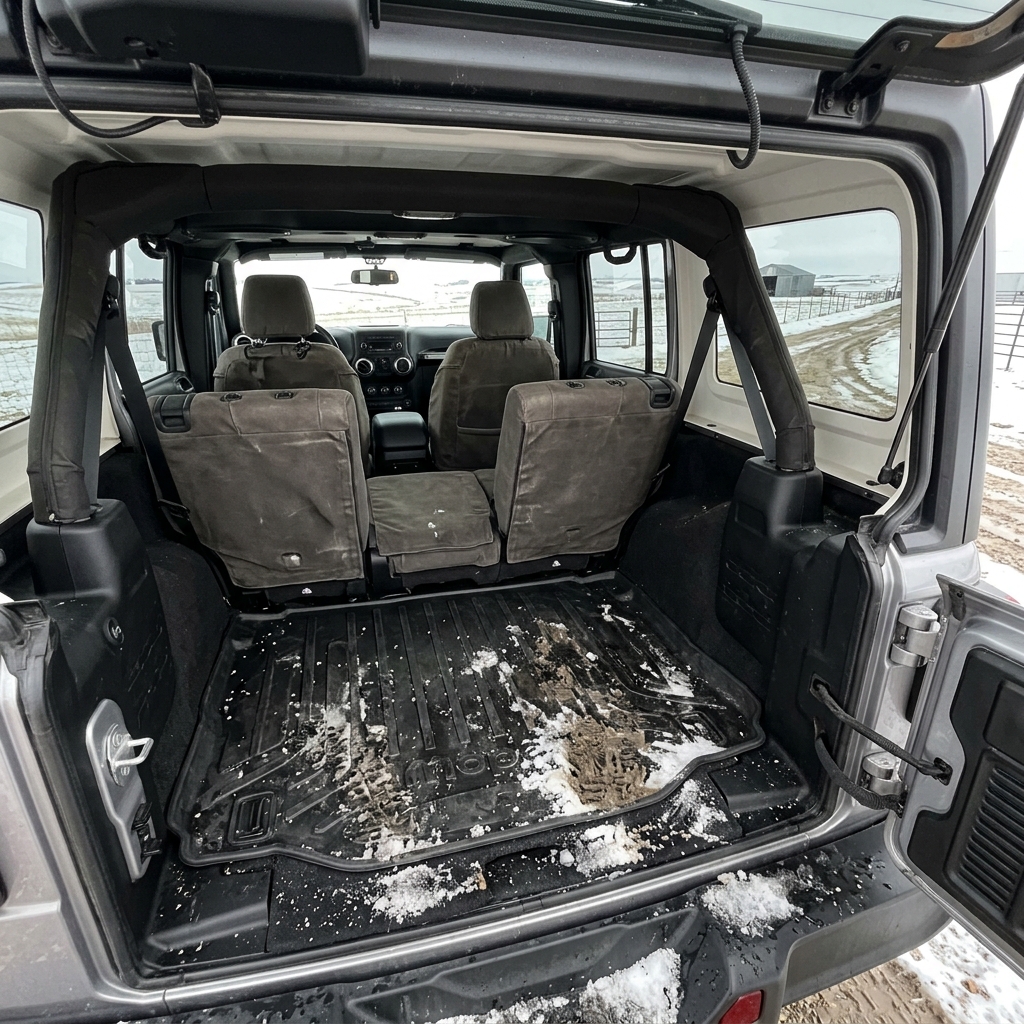
Open tailgate view into the cargo space of a Jeep Wrangler with folded rear seats and a snowy rubber floor mat. (Representative image for illustration purposes only. Actual vehicle may vary based on trim and configuration.)
When late autumn transitions into full-fledged winter across the Flint Hills, Kansas drivers face a brutal combination of freezing rain, thick mud, wet slush, and corrosive road salt. Protecting the cabin and cargo bay of your Jeep Wrangler, Gladiator, Grand Cherokee, or Compass requires purpose-built interior armor. The absolute best original equipment manufacturer (OEM) solution comes directly from Mopar—Jeep's official service, parts, and customer care division. Authentic Mopar winterization accessories are specifically engineered to fit the exact contours of your vehicle's floor pans, seating frames, and trunk bays, providing an unyielding shield against the worst elements Kansas winters can throw at your cabin.
The essential lineup for complete Jeep interior winter defense includes four cornerstone Mopar components: 1. Custom-Fit All-Weather Slush Mats: Built with deep reservoir channels, high retention walls, and specialized drain-plug compatibility (on Wrangler and Gladiator models) that allow melted snow to drain directly through the vehicle floor. 2. Heavy-Duty Molded Cargo Trays: Constructed from flexible, cold-resilient thermoplastic elastomer (TPE) that flexes under heavy loads without cracking in sub-zero temperatures. 3. Waterproof Neoprene and Heavy Canvas Seat Covers: Custom tailored to seal out wet hunting gear, mud-slicked coveralls, and spilled hot coffee while remaining fully side-airbag compliant. 4. Cargo Area Seatback Protectors: Molded rubberized barriers that attach directly to the rear of second-row seats, ensuring seamless protection whether seats are raised upright or folded flat for bulky cargo. To explore these fitted upgrades in person, stop by our Parts Department at Valor CDJR in Junction City.

Why Factory Mopar All-Weather Floor Mats and Cargo Liners Outperform Universal Options

Universal off-the-shelf floor mats bought at general retail stores may seem convenient initially, but they fall drastically short when exposed to genuine Kansas winter conditions. Generic mats rely on flat trim-to-fit designs that shift constantly underfoot, curl up at the edges when temperatures plunge below freezing, and fail to block liquid runoff from soaking into under-carpet acoustic insulation. Once salt-laden slush penetrates carpet padding, it breeds stubborn mildew odors, causes sub-floor rust, and degrades vehicle trade-in values over time.
Factory Mopar all-weather mats are engineered using precise 3D digital CAD data straight from the Jeep vehicle design teams. This guarantees millimeter-perfect fitment against every swell, pedal mount, and seat rail anchored to your floor pan. On Jeep Wrangler and Gladiator models, Mopar mats feature patented integrated drain-plug grommets. When snow melts inside your cabin, you can unplug the floor drains directly through the mat, letting water escape without removing the liner. Furthermore, Mopar's proprietary rubber compound remains pliable in extreme freeze conditions down to sub-zero temperatures, ensuring the high retention walls never distort or leak onto your carpet.
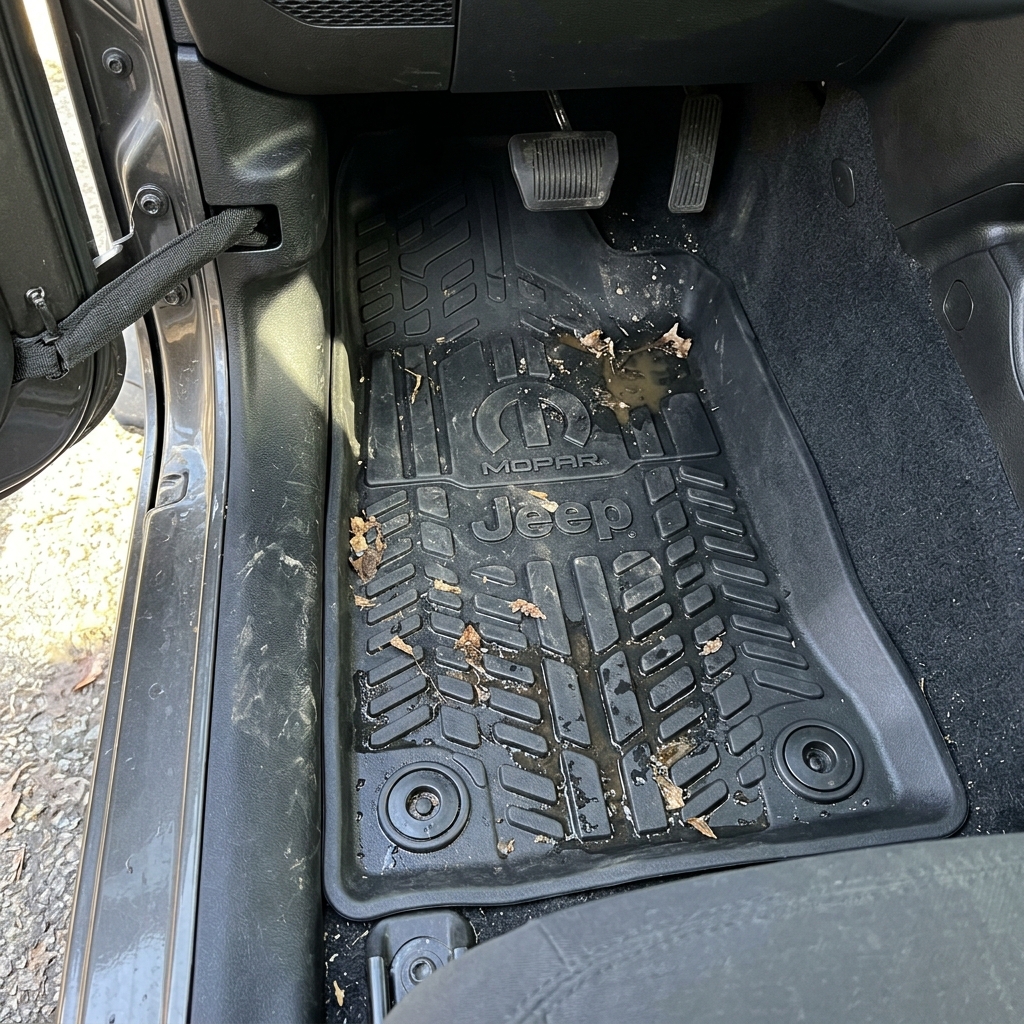
Dirty black rubber Mopar Jeep floor mat covered in mud, standing water, and dried leaves in a driver's footwell. (Representative image for illustration purposes only. Actual vehicle may vary based on trim and configuration.)

Key Mopar Seat Accessories: Heavy-Duty Covers, Waterproof Barriers, and Heated Comfort Upgrades

Canvas & Neoprene Covers

Mopar heavy-gauge canvas and neoprene seat covers offer an impenetrable barrier against damp winter coats, mud, and active lifestyle wear. Tailor-fit to specific seat configurations, these covers preserve factory leather and cloth upholstery while incorporating engineered side seams that ensure full deployment of seat-mounted side airbags in an emergency.

Seatback Storage Systems

Keep winter emergency gear organized and off the wet floorboards with Mopar MOLLE-style seatback storage panels. Engineered for heavy utility, these tactical grid panels accept modular pouches for ice scrapers, thermal gloves, flashlights, tow straps, and first-aid kits, keeping essential equipment secure and rapidly accessible.

Heated Seat Accessory Kits

If your Jeep came from the factory with standard cloth seats, Mopar offers heated seat accessory kits. These systems integrate seamlessly with your vehicle's electrical harness and dashboard controls, delivering rapid warming comfort to front seats during freezing morning commutes across Geary and Riley Counties.

Preparing Your Jeep or Ram 1500 for Late-Autumn Tailgating and Farm Work in Riley and Geary Counties

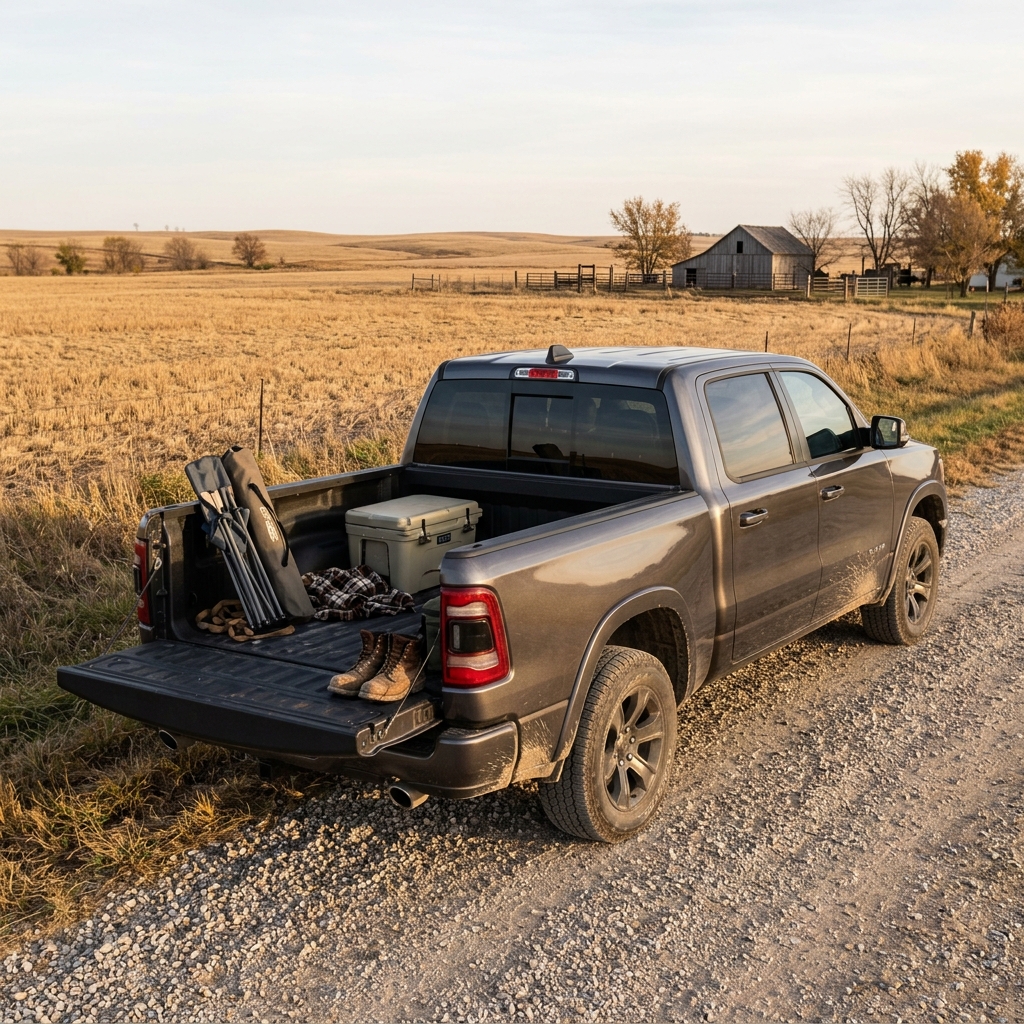
Dark grey pickup truck parked on a dirt road with tailgate open showing camping gear, a cooler, and boots. (Representative image for illustration purposes only. Actual vehicle may vary based on trim and configuration.)
Life in Junction City, Manhattan, and surrounding rural Riley and Geary counties demands exceptional versatility from your vehicle. On Saturday afternoon, your truck or SUV might be parked outside Bill Snyder Family Stadium supporting K-State game day tailgating; by Monday morning, it is navigating muddy pastures, towing livestock trailers, or hauling heavy equipment across unpaved county roads. Transitioning seamlessly between agricultural labor, outdoor recreation, and family transport requires a multi-layered interior protection strategy.
For dual-purpose duty, local drivers frequently combine heavy-duty Mopar floor slush mats with Mopar bed liners and tonneau covers on Ram 1500 trucks, or rear cargo trays and seatback covers on Jeep Grand Cherokee models. This setup ensures that clay-heavy Kansas soil, agricultural chemicals, and wet hunting gear stay completely contained. Whether you are transporting livestock feed in the morning or loading tailgate coolers in the afternoon, Mopar accessories let you hose down your protective liners in minutes, keeping the underlying vehicle spotless. If you need expanded utility for your operations, browse our current Commercial Vehicle Inventory to find heavy-duty work trucks built for tough Kansas workloads.

How Cargo Volume Capacities Compare Between the Ram 1500 Bed and Grand Cherokee Interior Space

Understanding the distinction between open bed volume and climate-controlled interior cargo space is critical when planning winter farm work or outdoor excursions. The Ram 1500 offers substantial exterior cargo space designed for rugged, weather-resistant equipment, while the Jeep Grand Cherokee provides locked, heated interior storage optimal for sensitive tools, luggage, and perishable supplies.
A Ram 1500 equipped with a 5-foot-7-inch short box delivers approximately 54 cubic feet of cargo space, expanding to 61.5 cubic feet with a 6-foot-4-inch bed box. In contrast, the Jeep Grand Cherokee provides up to 38 cubic feet behind the second-row seats, expanding to 71 cubic feet when the rear seats are folded flat. Pairing a Ram 1500 with a Mopar spray-in bedliner and tri-fold tonneau cover creates weather-protected exterior storage, while equipping a Grand Cherokee with Mopar molded cargo liners keeps high-capacity interior space protected against snow and mud.

Vehicle & Configuration

Primary Storage Type

Max Usable Volume

Recommended Winter Liner

Ram 1500 5'7" Bed

Open / Covered Bed

53.9 cu ft

Mopar Spray-In Liner + Tonneau

Ram 1500 6'4" Bed

Open / Covered Bed

61.5 cu ft

Mopar Bed Mat + Lockable Box

Jeep Grand Cherokee (Seats Up)

Enclosed Climate-Controlled

37.7 cu ft

Mopar Molded Rubber Cargo Tray

Jeep Grand Cherokee (Seats Folded)

Enclosed Climate-Controlled

70.8 cu ft

Mopar Cargo Tray + Seatback Shield

Can the Ram 1500 Bed Power Outlet Run Electric Heaters or Tailgating Appliances Simultaneously?

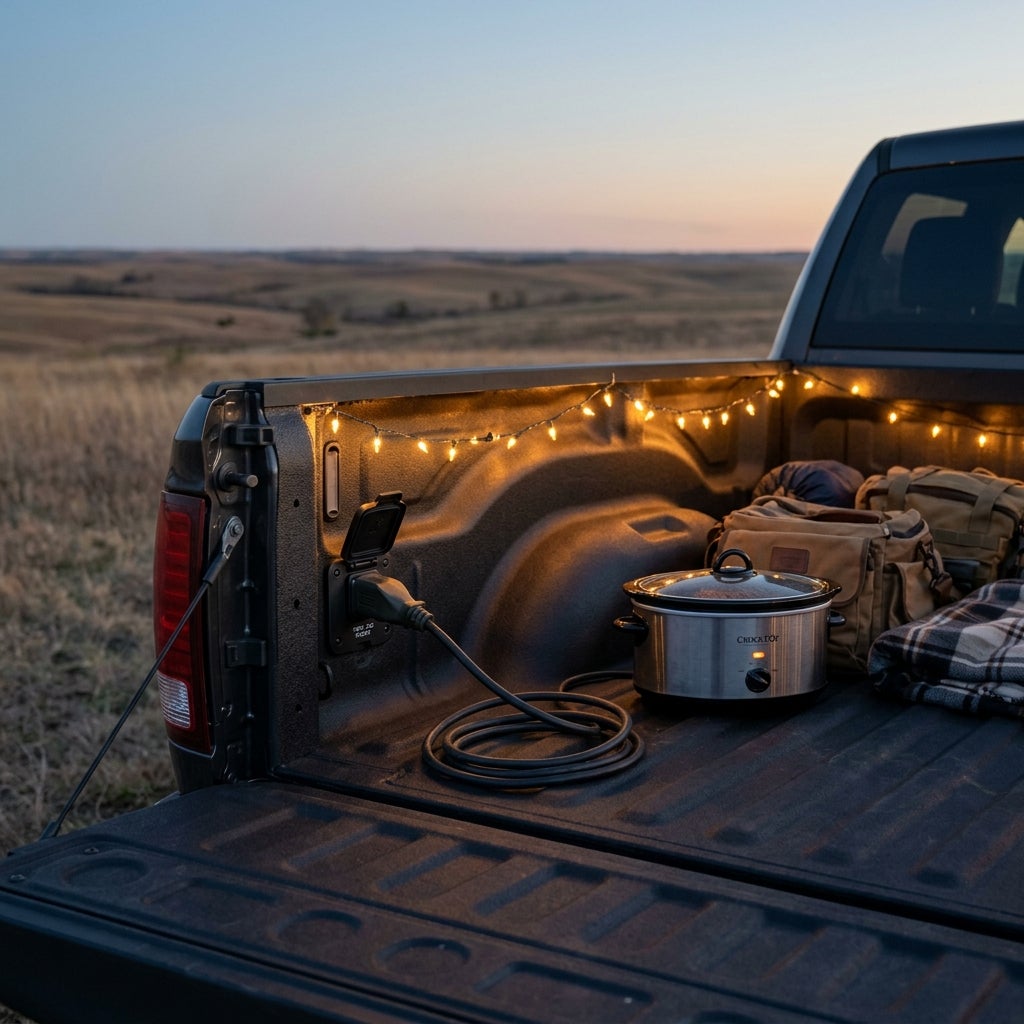
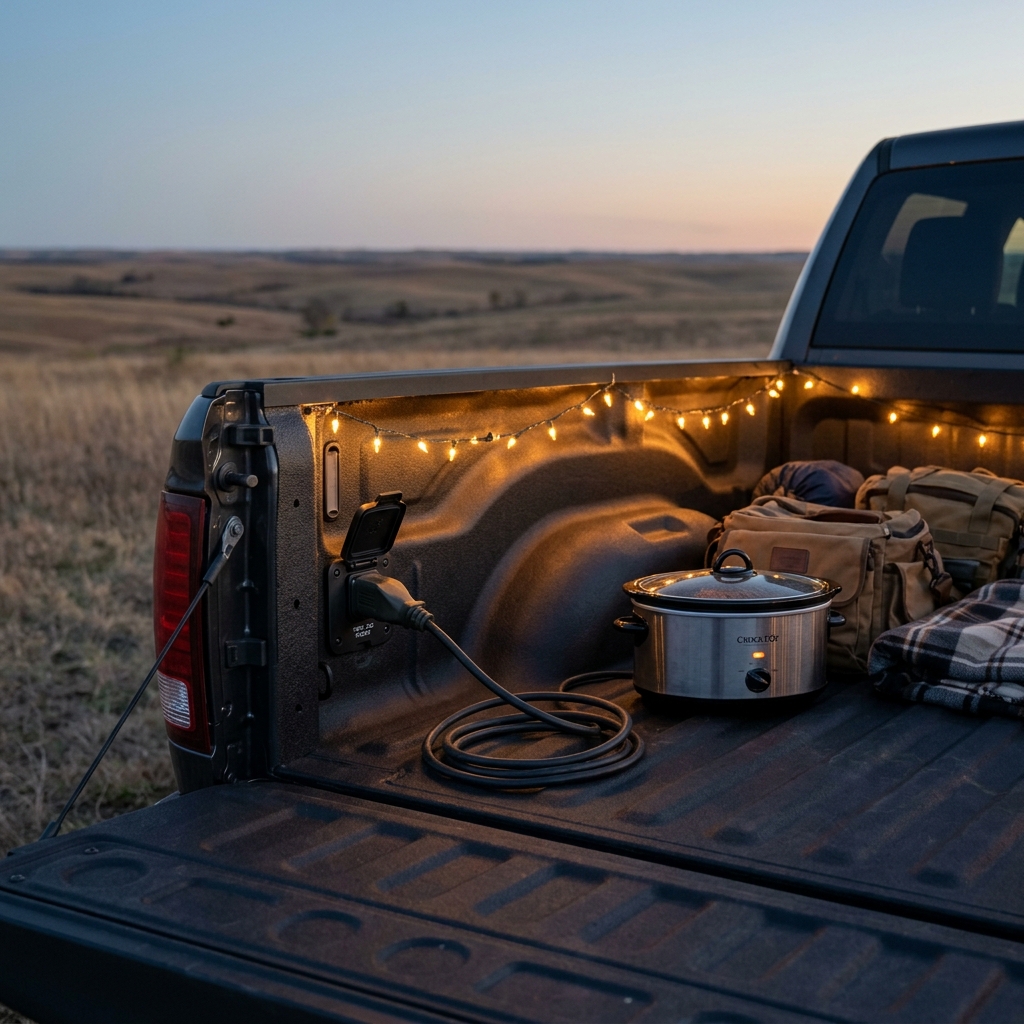
A slow cooker plugged into a pickup truck bed outlet surrounded by string lights, bags, and a blanket at sunset. (Representative image for illustration purposes only. Actual vehicle may vary based on trim and configuration.)

Wattage Limits & Ratings

The Ram 1500 optional truck bed outlet delivers 115-volt AC power rated up to 400 watts. While 400 watts easily powers LED stadium lights, slow cookers (which draw 150–250W), and battery chargers, high-draw ceramic space heaters typically demand 1,200 to 1,500 watts and will trip the inverter's internal breaker.

Tailgating Appliance Load

You can safely run low-wattage tailgating appliances simultaneously, such as a 180W crockpot alongside a 50W television or LED lighting array (totaling ~230W). Managing cumulative draw ensures stable operation without interrupting power to your tailgate setup.

Battery & Engine Idle Rules

To prevent draining your starter battery during cold weather, run the engine while operating high-demand accessories. The system automatically regulates voltage to ensure your truck starts reliably, even when running auxiliary devices in freezing temperatures.

How the Ram 1500 Onboard Power Inverter Supports Farm Electrical Equipment and Tailgate Accessories

For farmers and landowners in Geary and Riley counties, the Ram 1500 onboard power inverter acts as a mobile electrical hub out in remote pastures. Powering 18-volt cordless tool battery chargers, electric fence chargers, portable soldering irons, and emergency work lights directly from the truck bed eliminates the need to haul heavy, noisy gas generators for minor fence repairs or equipment maintenance.
When non-working weekend hours roll around, that same inverter seamlessly transitions to power outdoor entertainment gear. Combined with Mopar heavy-duty truck bed outlet protective weather caps, the system keeps electrical contacts clean and dry regardless of rain, mud, or snow, providing reliable mobile power year-round.

What Should Junction City-Area Jeep and Ram Owners Check Before Late-Autumn Farm Work and Tailgating?

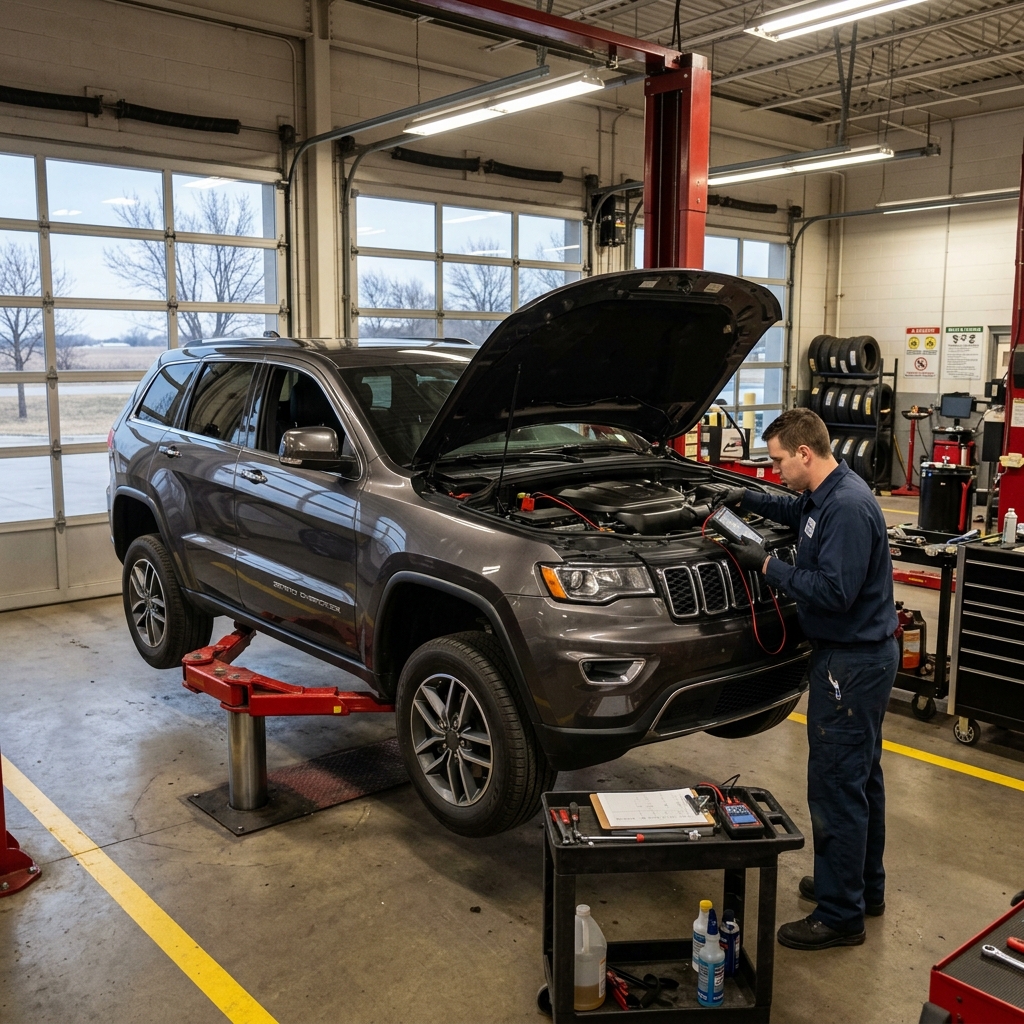
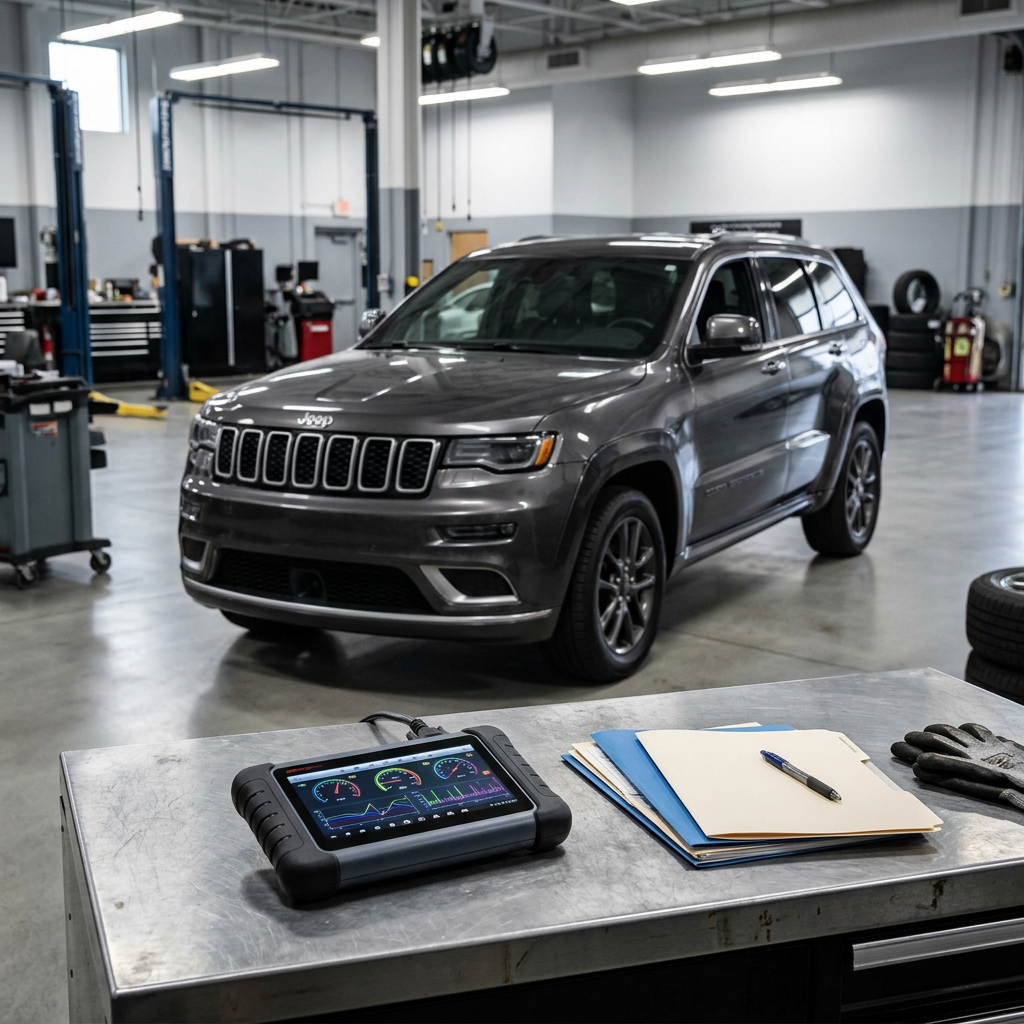
Mechanic using a diagnostic tool on a grey SUV raised on a hydraulic lift in an auto repair shop. (Representative image for illustration purposes only. Actual vehicle may vary based on trim and configuration.)
Before winter frost settles over central Kansas, completing a comprehensive seasonal inspection ensures your vehicle stays dependable when navigating remote county roads or cold morning starts. Key maintenance items include:
1. Battery Cold-Cranking Amps (CCA): Sub-freezing temperatures reduce battery output by up to 50%. Have your battery load-tested to confirm adequate starting power. 2. Tire Pressure & Tread Depth: Cold air lowers tire pressure by approximately 1 PSI per 10°F drop. Ensure tread depth is above 4/32" for effective snow traction. 3. Engine Coolant / Antifreeze Mix: Test your coolant mixture to ensure freeze protection down to -25°F. 4. Mopar Beam Wiper Blades & Winter Fluid: Replace worn blades with heavy-duty Mopar synthetic beam blades that resist ice buildup. 5. Cabin Air Filter: Replace clogged filters to maintain maximum defroster airflow and cabin heating efficiency. 6. Interior Mopar Slush Mat Fitment: Snap all floor mats securely onto factory floor retainers to prevent interference with pedals. You can quickly schedule an inspection through our online Service Scheduler or visit our Express Lane for maintenance without an appointment.

How Does Quadra-Lift Air Suspension Improve Ground Clearance on Jeep Vehicles During Winter Snow?

Jeep's available Quadra-Lift® Air Suspension system is a useful feature for severe Kansas winter driving. By utilizing closed-loop air springs at all four wheels, Quadra-Lift allows drivers to electronically adjust ride height depending on terrain requirements, offering up to 10.9 inches of maximum ground clearance in Off-Road 2 setting.
When drifting snow buries rural county roads or unpaved farm lanes around Junction City, raising the vehicle prevents the undercarriage from snow-plugging or high-centering. Combined with Jeep's Selec-Terrain® traction control set to 'Snow' mode, the system optimizes torque distribution, throttle response, and suspension height to maintain steady forward momentum through deep slush and ice. To explore new models featuring Quadra-Lift, browse our latest New Vehicle Listings or explore pre-owned models in our Used Vehicle Listings.

Selecting Mopar Cargo Management Accessories for Snowboards, Hunting Gear, and Emergency Kits

Under-Seat Lockable Bins

Secure valuable hunting gear, tools, and electronics in lockable Mopar heavy-gauge steel under-seat storage bins. These lockboxes integrate directly under second-row seating in Ram trucks and Jeep Wranglers, keeping contents concealed and safe.

Roof-Mounted Gear Carriers

Free up interior cabin space by installing Mopar crossbars paired with lockable ski and snowboard carriers or hard-shell cargo boxes. Built with corrosion-resistant aluminum, these carriers handle wet sports gear without cluttering your interior.

Mopar Roadside Winter Kits

Official Mopar roadside safety kits come packed with essential winter recovery tools: heavy-duty jumper cables, thermal blankets, work gloves, a folding shovel, flashlight, and reflective warning triangles packaged in a durable canvas bag.

Where Can Riley and Geary County Drivers Arrange Local Jeep or Ram Seasonal Service?

Finding reliable, factory-certified service and genuine Mopar accessory installation is convenient for drivers throughout Junction City, Fort Riley, Manhattan, and the surrounding Flint Hills region. Valor CDJR is your dedicated local hub for authentic Mopar parts, seasonal vehicle maintenance, and professional accessory installation.
Located at 1825 Goldenbelt Blvd in Junction City, KS 66441, our team of factory-trained technicians ensures your floor mats, seat covers, cargo trays, and power accessories are installed precisely according to manufacturer specifications. You can Get Directions to Valor CDJR or Call us at (785) 238-5114 to consult directly with our parts and service specialists. If you are considering upgrading your vehicle before winter arrives, check your current vehicle value with our Trade In Evaluation tool or Get Pre-Approved online.
Valor Automotive logo featuring a blue shield with a red V and white A monogram above company text.

Winterize Your Jeep Cargo and Seating Areas at Valor CDJR in Junction City

Don't let freezing weather, slush, and salt damage your Jeep or Ram interior this season. Equip your vehicle with authentic Mopar slush mats, molded cargo trays, waterproof seat covers, and cargo organization systems designed specifically for your model. Visit Valor CDJR today at 1825 Goldenbelt Blvd in Junction City, KS, or contact our team online to order accessories, schedule maintenance, or explore our complete line of new and pre-owned vehicles.

Posted in:

Related Posts

2021 Jeep Grand Cherokee Laredo Maintenance Guide: Q&A Expert Insights

2021 Jeep Grand Cherokee Laredo Maintenance Guide: Q&A Expert Insights

2021 Jeep Grand Cherokee Laredo Maintenance Guide: Q&A Expert Insights The factory maintenance schedule for a 2021 Jeep Grand Cherokee Laredo mandates engine oil and filter changes along with tire rotations at intervals not to exceed 10,000 miles or 12 months, managed by the onboard automatic oil change indicator system. Standard maintenance checkpoints include replacing the cabin air filter and engine air filter every 12,000 to 20,000 miles, exchanging brake fluid every 24 months, and completing a full fluid service and spark plug replacement at 100,000 miles. To explain these maintenance milestones and long-term care practices, we sat down with Dustin Zeck, Dealer Principal at Valor CDJR, who brings 36 years of automotive experience to SUV owners across the region. Q: Dustin, what is the official recommended maintenance schedule for a 2021 Jeep Grand Cherokee Laredo? A: Standard routine maintenance on the 2021 Jeep Grand Cherokee Laredo follows a 10,000-mile or 12-month maximum interval, driven primarily by the automatic oil change indicator. Whenever the message center displays an oil change prompt, service should be completed within 500 miles, comprising a fresh engine oil and filter replacement, a tire rotation, and a comprehensive multi-point inspection. Operating under severe conditions, such as frequent short trips, extensive idling, or regular trailering across the flat to gently rolling plains of Junction City, often prompts the system to request service closer to the 6,000-mile mark. As mileage accumulates, specific inspection and replacement services become necessary to maintain vehicle safety and drivability. At every 12,000 to 15,000 miles, technicians inspect the brake pads, rotors, cooling system, and suspension joint boots while replacing both the engine air filter and the cabin air filter. At 30,000-mile steps, inspection expands to the transfer case, axle differentials, and transmission fluid conditions. Once the vehicle reaches 100,000 miles, the factory schedule calls for installing new spark plugs, refreshing the engine coolant, and servicing gear fluids to protect critical drivetrains. Drivers seeking tailored maintenance tracking can visit our dealership service facility or contact our team directly at (785) 238-5114 to review their vehicle's service history. Q: What engine specifications and mechanical components drive the maintenance needs on this 2021 Grand Cherokee Laredo? A: The standard powertrain under the hood of the 2021 Jeep Grand Cherokee Laredo is the proven 3.6-liter Pentastar V6 engine paired with an 8-speed automatic transmission, producing 293 hp and 260 lb-ft of torque. This engine utilizes an internal oil cooler housing and double overhead camshafts that rely heavily on clean, properly specified lubricants. The factory specification calls for synthetic SAE 0W-20 engine oil meeting Chrysler Material Standard MS-6395. Using oil that meets this precise standard prevents sludge build-up in the variable valve timing system and protects internal bearings during cold starts. Transmitting power to the ground requires specialized maintenance depending on whether the vehicle is equipped with rear-wheel drive or the available Quadra-Trac I single-speed four-wheel-drive system. Vehicles equipped with four-wheel drive use front and rear differentials that require routine fluid checks for contamination, particularly after driving through standing water or mud. Brake components on this midsize SUV handle a curb weight of roughly 4,500 lb, making regular brake pad thickness measurements and rotor checks essential to offset thermal wear. When replacement components are required, sourcing factory-certified parts through our Mopar parts department guarantees proper fitment and restores original engineering tolerances. Q: How much should owners budget for estimated annual maintenance costs on a 2021 Grand Cherokee Laredo? A: Average annual maintenance and repair costs for a 2021 Jeep Grand Cherokee Laredo range between $600 and $700 under normal driving conditions. During the initial three years or 36,000 miles, primary expenses remain minimal, consisting mostly of scheduled synthetic oil services, air filter replacements, and tire rotations. Because the vehicle came standard with a 3-year/36,000-mile limited warranty and a 5-year/60,000-mile powertrain warranty, warrantable mechanical repairs during the early ownership period carry zero out-of-pocket expense for parts or labor. Budget requirements increase moderately as the vehicle approaches higher mileage milestones where wearable mechanical items need replacement. Between 40,000 and 60,000 miles, items such as brake pads, brake rotors, and tires naturally reach the end of their first service lifecycle. Budgeting for these wear-and-tear components alongside scheduled fluid services prevents unexpected repair bills and maintains optimal mechanical reliability over time. Q: What are the most common mechanical repairs that show up on a 2021 Jeep Grand Cherokee as mileage increases? A: High-mileage service trends on the 2021 Grand Cherokee point to specific wear items, including engine coolant thermostats, engine oil cooler housing gaskets, control arm suspension bushings, and front brake components. The thermostat and oil cooler housing assemblies reside in the valley of the V engine block, where heat cycles over time can degrade plastic housings or rubber seals, leading to minor coolant or oil seepage. Identifying these minor leaks during routine oil change inspections allows technicians to resolve them before fluid levels drop enough to cause thermal distress. "Adhering to the 10,000-mile cap on synthetic oil changes and catching minor fluid leaks early is what keeps a Grand Cherokee running smoothly past 100,000 miles." Commuters who bring in a 2021 model for routine service often ask if their engine oil cooler housing needs attention when they notice minor fluid drips during garage parking. Addressing suspension arm bushings and sway bar links is another common maintenance item past 60,000 miles, as worn rubber bushings can lead to uneven tire wear or front-end clunks over road undulations. Promptly replacing worn suspension joints preserves steering feel and protects the vehicle's alignment geometry. Q: How does the 2021 Grand Cherokee Laredo compare to rivals like the Toyota 4Runner and Ford Explorer in terms of reliability and capability? A: Comparing capability and upkeep between the Grand Cherokee Laredo, Toyota 4Runner, and Ford Explorer highlights clear mechanical differences across the midsize SUV segment. The Toyota 4Runner utilizes a body-on-frame platform powered by a 270-hp V6 and a 5-speed automatic transmission, which offers strong predicted durability but sacrifices fuel efficiency at an EPA-rated 17 mpg combined and requires higher steering effort on paved roads. In contrast, the unibody Grand Cherokee Laredo delivers refined road manners with an EPA rating of 18 mpg city / 25 mpg highway in four-wheel-drive configuration while maintaining a strong 6,200 lb maximum towing capacity. When measured against the Ford Explorer on off-road readiness, the Grand Cherokee Laredo holds a distinct chassis advantage with 8.6 inches of standard ground clearance compared to the Explorer's 7.9 inches. Jeep's four-wheel-drive system delivers continuous traction control without requiring manual driver inputs, making it exceptionally reliable for drivers navigating the rolling hills of Manhattan during winter weather conditions. While rivals offer varied strengths, the Grand Cherokee balances daily ride comfort, towing muscle, and true all-terrain capability with reasonable long-term upkeep expenses. Q: Can owners handle basic maintenance like oil changes and air filter swaps on a 2021 Grand Cherokee Laredo themselves, or should they visit your service center? A: Do-it-yourself enthusiasts can comfortably perform simple maintenance tasks like changing the engine air filter, replacing the cabin air filter, and checking under-hood fluid levels using standard hand tools. Swapping air filters requires no specialized diagnostic equipment and takes only a few minutes, making it an accessible weekend task. However, changing the engine oil on the 3.6-liter Pentastar V6 requires careful attention to the top-mounted oil filter cap, which must be torqued precisely to avoid cracking the plastic filter housing. Complex tasks, routine brake service, diagnostic resets, and multi-point inspections are best handled by factory-trained technicians equipped with professional diagnostic tools. Our certified mechanics inspect safety systems like blind-spot monitoring, check for factory recall updates, and ensure all electronic control modules are running current software calibrations. To maintain your vehicle's factory maintenance record, visit our service department at 1825 Goldenbelt Blvd, Junction City, KS 66441, give our service team a call, or convenient schedule a service appointment online today. © 2026 Valor CDJR. All rights reserved.

What 20 Years in the Service Bay Taught Me About RAM 1500 Reliability

What 20 Years in the Service Bay Taught Me About RAM 1500 Reliability

What 20 Years in the Service Bay Taught Me About RAM 1500 Reliability Does the Ram 1500 Hold Its Resale Value and Long-Term Reliability Over Time? The Ram 1500 retains roughly 50% to 55% of its original value after five years of ownership, placing it right in the competitive core of the full-size pickup segment. Long-term mechanical reliability remains strong when owners adhere to scheduled maintenance, with J.D. Power ranking three-year-old Ram 1500 models highest in segment dependability. Retaining maximum resale value and long-term durability depends directly on consistent fluid services, preventative powertrain care, and complete maintenance documentation. In my two decades overseeing truck service, I have seen how preventive maintenance directly protects a pickup truck's market value. A well-maintained Ram 1500 with documented oil changes and differential services routinely commands top dollar because buyers recognize the solid engineering underneath. The coil-spring rear suspension and stiff box-section frame keep the chassis quiet and tight even after 100,000 miles of hard work. When components like bushings, ball joints, and shock absorbers are inspected and serviced on schedule, the truck retains its smooth, car-like ride quality long after lesser pickups develop cabin rattles and loose steering. Powertrain upkeep plays an equally critical role in long-term value retention. Modern engine designs utilize advanced valvetrain technologies and precise fuel delivery systems that depend on clean, un-degraded lubricants to prevent mechanical wear. If you want to review maintenance history or inspect a truck on a lift, you can reach out to our service team at (785) 238-5114 or drop by our Junction City service department. Keeping your truck on factory-recommended maintenance intervals ensures that critical components—from the transfer case to the rear axle—continue operating within factory tolerances. Table of Contents How Does Ram 1500 Reliability Compare to the Ford F-150 and Chevrolet Silverado? Are Hurricane Twin-Turbochargers Engineered for Engine-Life Durability? How Often Should You Change Oil and Is Premium Fuel Required for the Hurricane Engine? Does Frequent Heavy Towing Accelerate Transmission Wear on the Ram 1500? What Recurring Electrical and Mechanical Issues Should Ram 1500 Buyers Watch For? What Factory Warranty Coverage and Maintenance Support Keep Your Ram 1500 on the Road? How Does Ram 1500 Reliability Compare to the Ford F-150 and Chevrolet Silverado? The Ram 1500 stands out against the Ford F-150 and Chevrolet Silverado 1500 by pairing competitive powertrain durability with superior ride refinement and higher cabin assembly standards. While all three domestic half-ton trucks feature robust powertrains, the Ram 1500 utilizes a standard multi-link coil rear suspension that significantly reduces chassis vibration and harshness over rough surfaces. This design protects interior components and electrical connectors from prolonged road impact, reducing long-term rattles and squeaks. From a mechanical hardware perspective, the Ram 1500 balances proven components with modern engineering. The long-standing 3.6L Pentastar V6 with eTorque mild-hybrid technology delivers 305 hp and 269 lb-ft of torque, offering exceptional baseline durability with years of proven service history. The available 3.0L Hurricane twin-turbo inline-six engine produces 420 hp and 469 lb-ft of torque in standard output, or 540 hp and 521 lb-ft of torque in high output, surpassing the power density of rival V8 and V6 turbocharged offerings. Power is transferred through a robust TorqueFlite eight-speed automatic transmission, which has built a solid reputation for smooth shifting and structural longevity across millions of heavy-duty duty cycles. In terms of independent safety testing, the Ram 1500 Crew Cab earns a five-star overall safety rating from NHTSA, along with Good ratings in IIHS small-overlap front and updated side crashworthiness evaluations. Maintaining this level of structural integrity and vehicle performance requires genuine factory hardware. When replacing wearable chassis or braking parts, using components from our certified OEM parts center guarantees exact fitment and original factory safety specs. Are Hurricane Twin-Turbochargers Engineered for Engine-Life Durability? Factory twin-turbochargers on the 3.0L Hurricane inline-six engine are engineered to last the full design life of the engine when properly lubricated and cooled. Ram engineers designed these turbochargers with water-cooled center bearing housings, direct oil-feed galleries, and high-temperature alloy turbine wheels built to withstand severe thermal expansion cycles. Synthetic engine oil circulates through the turbocharger bearing cavities during operation and continues thermal siphoning after engine shutdown to prevent oil coking and shaft wear. The structural design of the Hurricane engine supports this high thermal load through severe-duty internal components. A deep-skirt cast-aluminum block houses a forged steel crankshaft and forged steel connecting rods, ensuring rigid alignment of rotating parts under high boost pressures. Dual overhead camshafts feature independent variable valve timing, allowing precise combustion management that keeps exhaust gas temperatures within target limits during sustained heavy loads. Plasma transfer wire arc coating on the cylinder bores reduces friction and improves heat transfer into the cooling jacket. When drivers ask me in the service drive whether twin turbos will match the durability of traditional engines, I explain that modern thermal management makes all the difference. Previous generations of turbochargers suffered from heat soak after heavy pulls, but the Hurricane engine uses dual electric water pumps and dedicated cooling circuits to maintain stable temperatures. Adhering to strict oil change schedules and allowing the cooling system to function as designed prevents premature bearing play, preserving boost efficiency and throttle response over hundreds of thousands of miles. How Often Should You Change Oil and Is Premium Fuel Required for the Hurricane Engine? Oil changes on the Ram 1500 Hurricane turbo engine should be performed every 7,500 to 10,000 miles, or at least once per year, using full synthetic oil formulations. Premium unleaded fuel may be recommended to achieve the full 540 hp rating on High-Output Hurricane variants, whereas Standard-Output versions can run on regular unleaded fuel depending on manufacturer guidance. Turbocharged engines subject engine oil to extreme thermal stress and shear forces near the turbocharger shaft bearings. Using full synthetic 0W-20 engine oil meeting factory material standards ensures proper oil film strength at high temperatures while maintaining fluid flow during cold starts. For drivers navigating the rolling Flint Hills terrain around Manhattan, frequent elevation changes and engine load spikes make timely oil service essential to prevent breakdown of the oil's additive package. Fuel selection directly influences combustion stability and knock prevention in high-compression, turbocharged engines. The High-Output Hurricane engine utilizes higher boost pressures and fuel injection pressures up to 5,075 psi, making 91 octane or higher fuel necessary to prevent pre-ignition and allow maximum ignition timing advance. Running lower octane fuel in High-Output models causes engine control modules to retard ignition timing, which reduces horsepower and fuel economy. Standard-Output models include adaptive knock monitoring that safely adjusts combustion parameters for regular gasoline without endangering internal engine components. You can easily schedule a routine synthetic oil service online to keep your fuel and lubrication systems operating at peak capability. Does Frequent Heavy Towing Accelerate Transmission Wear on the Ram 1500? Frequent heavy towing generates substantial heat within the automatic transmission, which accelerates fluid degradation and friction plate wear if the vehicle is not maintained on a severe-duty service schedule. Under standard driving conditions, transmission fluid retains its viscosity and hydraulic properties for extended intervals, but hauling trailers near the truck's maximum towing capacity elevates fluid temperatures past optimal operational thresholds. The Ram 1500 utilizes the TorqueFlite eight-speed automatic transmission, which incorporates an integrated thermal management unit designed to warm fluid quickly for efficiency and cool it during high-load demands. However, pulling heavy loads up steep grades or through stopping and starting traffic subjects the hydraulic fluid to extreme thermal shear. Over time, oxidized transmission fluid loses its ability to protect planetary gear sets, valve body actuators, and clutch packs, leading to delayed shifts or rough engagement. To prevent premature transmission wear under heavy trailering demands, owners should follow a severe-duty maintenance regimen: Change transmission fluid and filter assemblies every 45,000 to 60,000 miles when towing regularly. Inspect transfer case fluid and front/rear differential gear oils every 30,000 miles for thermal discoloration or debris. Monitor real-time transmission fluid temperatures on the instrument cluster display, keeping operating temperatures below 220 degrees Fahrenheit. Utilize tow/haul mode to adjust shift patterns, reducing gear hunting and clutch slippage under load. Ensure the auxiliary transmission fluid cooler remains clear of road debris, bugs, and mud accumulation. What Recurring Electrical and Mechanical Issues Should Ram 1500 Buyers Watch For? Potential Ram 1500 owners and long-term operators should monitor full-vehicle diagnostic scans for electronic module software updates, touchscreen responsiveness, and steering system calibration. While core mechanical assemblies demonstrate high durability, complex modern pickups rely heavily on interconnected computer networks that require periodic software alignment and voltage stability checks. In the electronic system, central touchscreen displays running the Uconnect multimedia platform may occasionally experience delayed boot times, frozen displays, or bluetooth pairing drops. These conditions are typically resolved through flash updates released by factory engineers to patch software bugs. Low battery voltage is a common root cause for intermittent electrical glitches across body control modules; a weak 12-volt battery can trigger false fault codes for power steering sensors, blind-spot monitoring systems, or electronic park brakes. Mechanically, older high-mileage trucks equipped with air suspension systems require periodic inspection of air lines, compressor relays, and rubber air bladders to prevent height leveling leaks in freezing weather. On conventional coil-spring setups, front suspension ball joints and tie-rod ends should be checked during tire rotations for boot tears or play. Catching minor electrical voltage drops or early suspension wear before components fail keeps repair costs low and prevents unexpected downtime. What Factory Warranty Coverage and Maintenance Support Keep Your Ram 1500 on the Road? Every new Ram 1500 comes backed by a 5-year/60,000-mile powertrain limited warranty and a 3-year/36,000-mile basic limited warranty. The powertrain warranty covers vital internal engine components, the transmission assembly, drive shafts, axles, and transfer case systems against manufacturing defects. The basic bumper-to-bumper warranty covers electrical systems, air conditioning components, trim, and body control units. Emergency roadside coverage is integrated directly into the factory warranty period, giving owners access to 24/7 assistance for towing, flat tire changes, jump-starts, and fuel delivery. For roadside assistance support or towing coordination directly to an authorized service facility, drivers can dial Ram Roadside Assistance at (800) 521-2779. Utilizing factory-backed roadside programs ensures that your truck is handled exclusively by trained transportation professionals who understand four-wheel-drive flatbed loading procedures. Maintaining factory warranty protection requires documented service adhering to OEM interval guidelines. Using genuine mopar filters, fluids, and mechanical parts maintains the precise operating standards set by factory engineers. For professional diagnostic evaluations, routine maintenance, or specialized powertrain care, feel free to give our team a quick call or visit our service center location to keep your pickup performing reliably for years to come. © 2026 Valor CDJR. All rights reserved.

Are There Any Safety Recalls for the 2021 Jeep Grand Cherokee? Bottom Line Answer & NHTSA Overview

Are There Any Safety Recalls for the 2021 Jeep Grand Cherokee? Bottom Line Answer & NHTSA Overview

Are There Any Safety Recalls for the 2021 Jeep Grand Cherokee? Bottom Line Answer & NHTSA Overview Yes, there are active safety recall notices for select 2021 Jeep Grand Cherokee models. According to official records from the National Highway Traffic Safety Administration (NHTSA), safety recalls have been issued for specific production batches of the 2021 Grand Cherokee and early 2021 Grand Cherokee L models. These safety campaigns address potential issues including steering column shaft separation, rearview camera software display glitches, rear seat belt retractor lockups, and radio/telematics software bugs. If you own or are considering buying a 2021 Grand Cherokee, knowing these details is essential for your peace of mind and family safety. The crucial takeaway for every driver in Junction City, Fort Riley, and Manhattan is that all safety recall repairs are required by federal law to be performed completely free of charge by an authorized Chrysler Dodge Jeep Ram dealership. Whether your vehicle needs a quick software reflash or mechanical component replacement, authorized service centers like Valor CDJR will inspect, repair, and sign off on your recall notice at zero cost for parts or labor. Having recall work completed ensures your vehicle continues to meet rigorous federal safety standards and maintains its maximum resale value. Most Common 2021 Jeep Grand Cherokee Recall Notices and What They Mean for Owners To understand 2021 Jeep Grand Cherokee safety recalls, it helps to distinguish between the classic two-row WK body style and the newly introduced three-row WL Grand Cherokee L architecture. Because 2021 was a crossover year featuring both platforms, specific recall notices apply to specific VIN ranges. Key NHTSA safety campaigns for the 2021 model year include: • Steering Column Intermediate Shaft (NHTSA Campaign 23V352000): Affecting select 2021–2023 WL models, an improperly assembled intermediate shaft may disconnect from the joint, resulting in a loss of steering control. Dealership technicians inspect and replace the steering shaft free of charge. • Rearview Camera Display Reflash (NHTSA Campaign 21V201000 / 22V141000): Radio software issues may prevent the backup camera image from displaying when reversing. A simple, zero-cost Uconnect software update corrects the display logic. • Rear Seat Belt Retractor Assemblies (NHTSA Campaign 21V810000): Automatic locking retractors on select second-row seats may lock prematurely or fail to lock properly, potentially reducing restraint effectiveness for child car seats. Below is a summary of major safety recall campaigns associated with the 2021 Jeep Grand Cherokee platform: NHTSA Campaign Affected Component Platform / Trim Potential Safety Risk Dealer Remedy 23V352000 Steering Shaft 2021 Grand Cherokee L (WL) Loss of steering control Inspect & replace shaft (Free) 21V201000 Rearview Camera 2021 WK & WL Models Blank backup screen on reverse Uconnect software update (Free) 21V810000 Rear Seat Belt Retractor 2021 Grand Cherokee L Improper child seat locking Inspect & replace retractor (Free) 21V663000 High Beam Headlamp Software 2021 Grand Cherokee L High beams fail to activate Smartbeam module reflash (Free) How to Check Your VIN and Schedule Free Recall Repairs at Valor CDJR in Junction City Checking whether your 2021 Jeep Grand Cherokee has open recalls takes less than two minutes. Every vehicle is assigned a unique 17-character Vehicle Identification Number (VIN). You can locate your VIN in three easy places: 1. Lower Corner of Windshield: Look through the bottom driver-side corner of the windshield from outside the vehicle. 2. Driver's Door Safety Label: Located on the pillar inside the driver's door frame. 3. Registration & Insurance Card: Printed directly on your Kansas vehicle registration or vehicle insurance policy. Once you have your VIN, visit the official Mopar recall lookup page or NHTSA.gov/recalls to enter your 17-digit code. Alternatively, you can call the service desk at Valor CDJR directly at Call (785) 238-5114, and our service advisors will run your VIN through the factory database instantly. Why Choose Valor CDJR for Recall Repairs Near Fort Riley? When you bring your Grand Cherokee to Valor CDJR in Junction City, KS, you receive top-tier treatment from certified Mopar master technicians who specialize in Jeep vehicles. • 100% Free Service: All recall parts and labor are completely covered under factory warranty. • Genuine Mopar Parts: We use only OEM factory-certified parts designed specifically for your 2021 Grand Cherokee. • Complimentary Multi-Point Inspection: While your vehicle is in our service bay, we perform a thorough check of tire wear, brake pads, battery health, and fluid levels to keep you safe on Kansas highways. • Convenient Service Scheduling: Book online or stop by our dealership located at 1825 Goldenbelt Blvd, Junction City, KS 66441. Schedule Your Free Recall Service Is the 2021 Jeep Grand Cherokee a Reliable Vehicle for Kansas Drivers? Mechanical Durability The mechanical foundation of the 2021 Jeep Grand Cherokee is exceptionally stout. Utilizing time-tested powertrain combinations like the 3.6L Pentastar V6 and TorqueFlite 8-speed automatic transmission, these midsize SUVs routinely pass 150,000 to 200,000 miles with routine fluid changes. Strong unibody construction provides excellent rigidity for navigating rough Flint Hills gravel roads and pothole-laden winter highways. Electrical & Tech Modern vehicles rely heavily on complex electrical architectures. While early software revisions on the Uconnect 5 system generated initial complaints regarding screen freezes, subsequent over-the-air (OTA) updates and factory reflashes have stabilized system performance. Maintaining a strong 12V battery is critical during harsh Kansas winter freezes to ensure all sensor modules perform properly. Owner Ratings Independent research agencies like J.D. Power score the 2021 Jeep Grand Cherokee in the 'Great' category for Quality & Reliability, holding an overall score of 84 out of 100. Owners consistently praise its quiet cabin, confident towing stance along Interstate 70, smooth highway ride quality, and refined interior layout across both daily commutes and long family road trips. Which 2021 Jeep Grand Cherokee Engine Option Is the Most Reliable? The 2021 Jeep Grand Cherokee offers two primary gasoline engine choices, each catering to different driving habits and maintenance profiles: • 3.6L Pentastar V6: Standard across most trims, this dual-overhead-cam engine produces 293 horsepower and 260 lb-ft of torque. With over 10 million units produced across Stellantis brands, the Pentastar V6 is widely regarded as one of the most dependable V6 engines on the market. It features a durable timing chain rather than a belt, uses regular unleaded fuel, and offers lower maintenance expenses over time. • 5.7L HEMI V8: Available on higher trims like Overland, Summit, and Trailhawk, the legendary HEMI V8 pushes out 357 horsepower and 390 lb-ft of torque. It incorporates Variable Valve Timing (VVT) and a Multi-Displacement System (MDS) that deactivates four cylinders during steady highway cruising. While exceptionally durable for heavy-duty towing, it requires strict adherence to full-synthetic oil change schedules to protect hydraulic lifters. Engine Spec 3.6L Pentastar V6 5.7L HEMI V8 Horsepower 293 hp @ 6,400 RPM 357 hp @ 5,150 RPM Torque 260 lb-ft @ 4,000 RPM 390 lb-ft @ 4,250 RPM Max Towing Capacity 6,200 lbs 7,200 lbs Recommended Oil 5W-20 Synthetic 5W-20 Synthetic (MDS compliant) Long-Term Durability Exceptional / Low Maintenance Excellent / High Torque Output What Is the Average Annual Maintenance Cost for a 2021 Jeep Grand Cherokee? According to automotive industry repair data, the average annual routine maintenance cost for a 2021 Jeep Grand Cherokee can vary based on service needs, placing it on par with other popular midsize American SUVs. Factors influencing annual costs include driving frequency across Geary and Riley counties, whether you choose the V6 or V8 engine option, and staying disciplined with scheduled preventative care. Utilizing quick service services like our Express Lane service ensures routine oil changes and multi-point checks are handled fast without disruption to your workday. Key scheduled service milestones include: • Every 7,500–10,000 Miles: Full synthetic oil change, tire rotation, brake lining check. • At 30,000 Miles: Engine air filter and cabin air filter replacement. • At 60,000 Miles: Transfer case fluid, front/rear axle fluid, and spark plug inspection. • At 100,000 Miles: Spark plug replacement, engine coolant flush, and drive belt check. Service Milestone Primary Maintenance Tasks Est. Routine Cost 10k / 20k / 30k Synthetic Oil, Filter, Tire Rotation $85 – $120 30,000 Miles Air Filters, Cabin Filters, Brake Inspection $150 – $220 60,000 Miles 4WD Fluid Service, Brake Flush, Spark Plugs $400 – $650 100,000 Miles Coolant Flush, Transmission Inspection, Belts $500 – $800 Order OEM Mopar Parts & Accessories Does Towing 7,200 lbs Require a Special Equipment Package on the 2021 Grand Cherokee? Yes, unlocking the maximum 7,200 lb towing capacity requires specific factory hardware. While the standard 3.6L Pentastar V6 equipped with a factory receiver hitch delivers an impressive 6,200 lbs towing threshold, reaching the full 7,200 lbs maximum capability requires selecting the 5.7L HEMI V8 engine paired with the factory Trailer Tow Group IV package. The Trailer Tow Group IV package provides essential heavy-duty mechanical cooling and electronics needed to haul heavy boats to Milford Lake or camper trailers through hilly Flint Hills terrain: • Class IV Hitch Receiver & Wiring: Heavy-duty 7-pin and 4-pin trailer wiring harness connectors. • Heavy-Duty Engine Cooling: High-capacity engine cooling fan and enlarged oil cooler to prevent overheating under sustained load. • 220-Amp Alternator: Ensures stable electrical power for trailer lights and onboard brake controllers. • Rear Load-Leveling Suspension: Automatically adjusts rear air springs or shock dampening to prevent sagging when hitched. • Full-Size Spare Tire: Keeps you prepared for highway tire issues when hauling a loaded trailer. Which 2021 Jeep Grand Cherokee Trim Retains the Highest Resale Value? Trailhawk Trim Highest Value Retention. Outfitted with Quadra-Drive II 4WD, rear electronic limited-slip differential, red tow hooks, skid plates, and Goodyear Wrangler off-road tires, the Trailhawk holds exceptional demand among outdoor enthusiasts in central Kansas, resulting in lowest 5-year depreciation. Limited Trim Best Volume Resale. The Limited trim strikes the sweet spot between luxury feature set (leather seating, heated seats, remote start, power liftgate) and purchase price. Highly desired on pre-owned lots for Fort Riley military buyers seeking balance. Overland & Summit Premium Comfort Retention. Offering Palermo leather seats, McIntosh audio, and Quadra-Lift suspension. While initial retail depreciation is slightly higher in percentage terms, these luxury trims retain substantial total trade-in dollar value when properly maintained. Is Buying a Certified Pre-Owned 2021 Jeep Grand Cherokee Worth the Added Cost? For SUV buyers evaluating pre-owned vehicles, choosing a Certified Pre-Owned (CPO) 2021 Jeep Grand Cherokee offers immense long-term protection and value. Every CPO vehicle at Valor CDJR must meet strict eligibility requirements: • Mandatory 125-Point Quality Inspection: Our factory-certified technicians inspect all mechanical components, brakes, tires, electrical systems, and cabin electronics. • Complete Recall Clearance: By rule, a vehicle cannot be sold as CPO until every open NHTSA safety recall has been 100% repaired and certified in the factory system. • 7-Year / 100,000-Mile Powertrain Warranty: Extends factory powertrain protection covering the engine, transmission, and drive system. • 3-Month / 3,000-Mile Maximum Care Coverage: Comprehensive bumper-to-bumper protection starting from the vehicle purchase date. • 24/7 Roadside Assistance & Car Rental Allowance: Includes flat-tire changes, battery jumpstarts, towing, and lockout support across Kansas and nationwide. Browse Certified Pre-Owned SUV Listings Navigating Flint Hills Terrain: Winter Driving and Off-Road Safety in Riley County Driving in north-central Kansas demands a versatile vehicle that handles freezing rain, unpaved rural routes, and high-speed highway traffic on Interstate 70 with ease. The 2021 Jeep Grand Cherokee features legendary four-wheel-drive technology designed specifically to conquer harsh weather conditions. Selec-Terrain Traction Management & Quadra-Lift System: Jeep's Selec-Terrain dial allows drivers to select modes tailored to current track conditions: Auto, Snow, Sand, Mud, or Rock. In 'Snow' mode, the vehicle automatically adjusts torque distribution between front and rear axles, engages second-gear launch control to limit wheel spin, and recalibrates anti-lock brake thresholds. Combined with optional Quadra-Lift air suspension providing up to 10.8 inches of ground clearance, the Grand Cherokee easily clears snowdrifts and rutted country lanes. To ensure your 4WD system operates flawlessly before winter arrives, schedule a seasonal multi-point inspection at Valor CDJR. Evaluating Your Trade-In and Upgrading Your SUV at Valor CDJR If you currently own a 2021 Jeep Grand Cherokee or another pre-owned vehicle, now is an excellent time to evaluate its current trade-in value. Used SUV values remain high across Geary and Riley counties, and completing open safety recall repairs significantly boosts your vehicle's trade appraisal. At Valor CDJR, we make upgrading effortless: • Instant Trade Appraisal: Receive a top-market cash or trade offer based on real-time Kansas market data. • Military Vehicle Purchase Discounts: Proudly supporting military service members at nearby Fort Riley with specialized incentives and preferred financing rates. • Flexible Financing: Apply easily online to get pre-approved for competitive auto loan rates. Whether you are interested in upgrading to a new vehicle lineup model or exploring quality pre-owned options, our experienced sales and finance teams are dedicated to delivering a zero-pressure, customer-first experience. We also offer specialized solutions for regional business owners through our commercial vehicle options program, helping you find the right fleet vehicles for your business requirements. Schedule Your 2021 Jeep Grand Cherokee Inspection and Service at Valor CDJR Today Don't leave your driver safety to chance. If you own a 2021 Jeep Grand Cherokee, verify your VIN status and schedule your zero-cost recall repairs or routine service with the trusted Mopar experts at Valor CDJR. Conveniently located serving Junction City, Fort Riley, Manhattan, and Salina. Visit us today at 1825 Goldenbelt Blvd, Junction City, KS 66441 or reach our friendly team by calling Call (785) 238-5114. You can also Get Directions to Valor CDJR online. Evaluate Your Vehicle Trade-In Value