Blog / Safety Features

Standard and Available Safety Features on the 2021 Jeep Compass Sport: Direct Breakdown

Standard and Available Safety Features on the 2021 Jeep Compass Sport: Direct Breakdown

Standard and Available Safety Features on the 2021 Jeep Compass Sport: Direct Breakdown

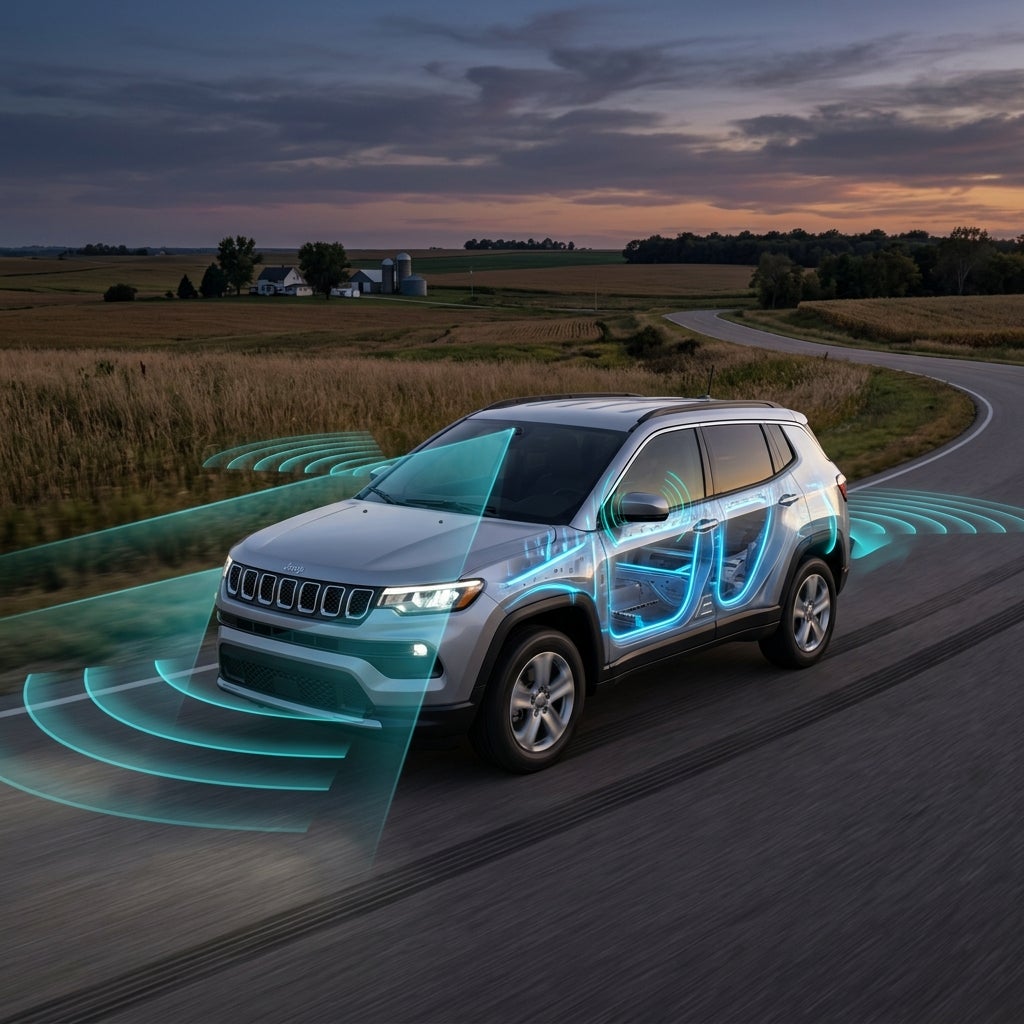
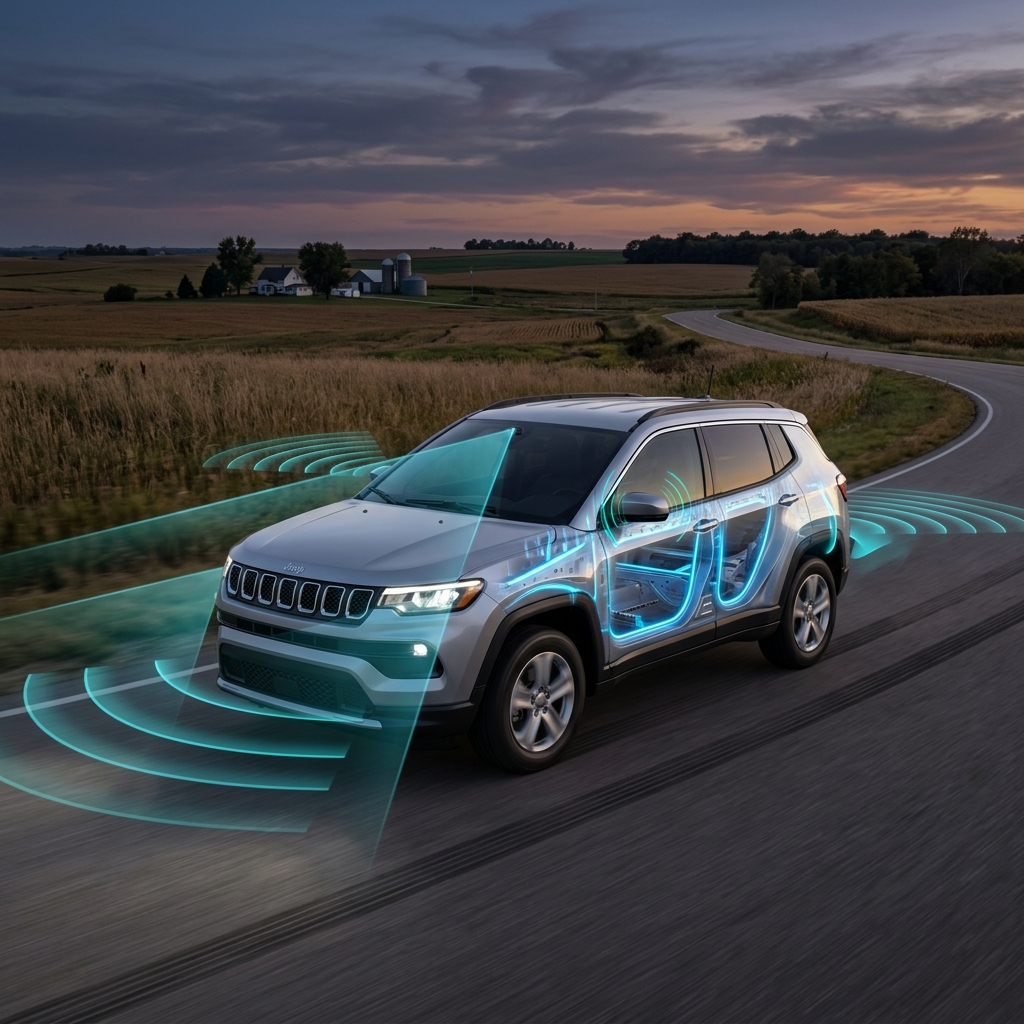
When evaluating a compact SUV for daily commutes through Junction City, long highway drives along Interstate 70, or gravel country roads across Riley and Geary counties, active safety and driver-assist capabilities are paramount. The 2021 Jeep Compass Sport serves as an accessible entry point to the Jeep SUV lineup, combining signature off-road capability with a protective shield of engineered safety features. Out of the box, every 2021 Compass Sport base trim delivers fundamental protection including a high-strength steel unibody chassis, comprehensive multistage airbag coverage, Electronic Stability Control, and the ParkView Rear Back-Up Camera. For drivers seeking modern automated driver assistance, Jeep offered powerful optional packages on the Sport trim—including Full-Speed Forward Collision Warning Plus with Active Braking, LaneSense Lane Departure Warning Plus, Blind-Spot Monitoring with Rear Cross Path Detection, and Adaptive Cruise Control with Stop and Go.
Silver Jeep SUV driving at dusk with glowing cyan graphics illustrating driver-assist radar and camera sensors. (Representative image for illustration purposes only. Actual vehicle may vary based on trim and configuration.)

Standard Safety Equipment Built into Every 2021 Compass Sport Base Trim

Structural Architecture & Passive Restraint

Safety on the 2021 Jeep Compass Sport starts with its physical core. Built on a rigid safety cage architecture engineered with over 65% high-strength steel, the chassis is designed to absorb and redirect impact energy away from cabin occupants in the event of a collision. Passive occupant protection is comprehensive, featuring advanced multistage driver and front passenger airbags, supplemental front-seat side airbags, and full-length side-curtain airbags extending across both rows. Additionally, a driver inflatable knee-bolster airbag comes standard, providing tailored lower-body collision support that is often omitted in competing base trims.

Active Vehicle Control & Back-Up Assistance

To prevent accidents before they happen, the standard 2021 Compass Sport incorporates dynamic active chassis control systems. Electronic Stability Control (ESC) works alongside Electronic Roll Mitigation and All-Speed Traction Control to continuously monitor steering input and vehicle trajectory, intervening instantly if wheel slippage or destabilization occurs. Hill Start Assist holds brake pressure on steep inclines in Manhattan or Fort Riley terrain to prevent unwanted roll-back. For tight parking maneuvering, the standard ParkView Rear Back-Up Camera displays high-resolution rear video with dynamic gridlines directly on the Uconnect display, helping you spot obstacles, curbs, and pedestrians effortlessly.

Which Advanced Driver-Assist Packages Can You Add to the 2021 Compass Sport?

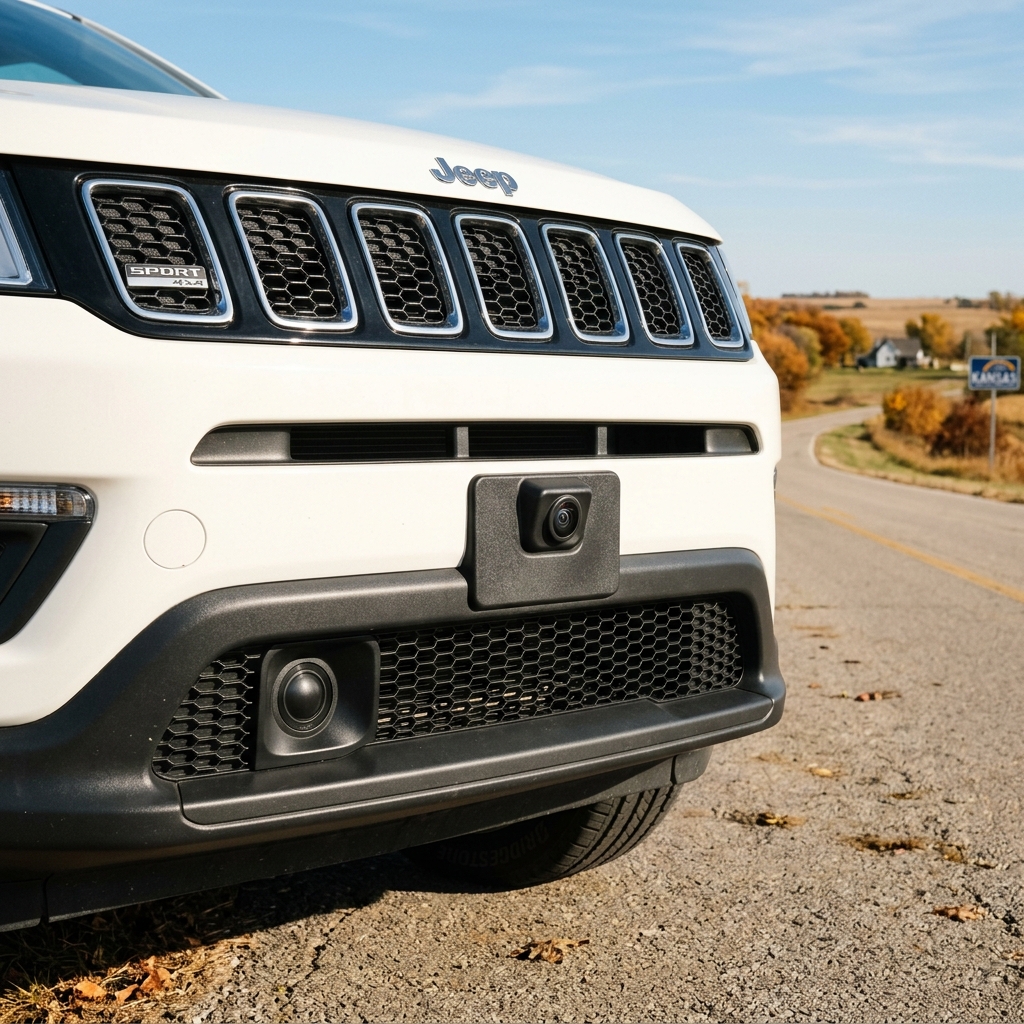
Front bumper of a white Jeep showing a forward-facing camera and radar sensor parked on a rural road. (Representative image for illustration purposes only. Actual vehicle may vary based on trim and configuration.)

Forward Collision Mitigation

Full-Speed Forward Collision Warning Plus: Utilizes radar and optical sensors to detect stopped or slow-moving traffic ahead. If a potential frontal impact is detected, it alerts the driver with visual and audible prompts. If the driver hesitates, Active Braking automatically engages the brakes to mitigate or eliminate impact velocity.

Lane Keeping & Blind-Spot Protection

LaneSense & Blind-Spot Monitoring: LaneSense Lane Departure Warning Plus monitors highway lane lines, gently nudging the steering wheel and sounding alerts if unintentional lane drift occurs. Blind-Spot Monitoring scans hard-to-see side zones, while Rear Cross Path Detection alerts you to approaching vehicles when reversing out of driveway or parking spaces.

Adaptive Cruise & Park Assist

Adaptive Cruise Control with Stop & Go: Automatically maintains a set distance behind traffic in front of you on multi-lane highways. It can bring the vehicle to a full stop in stop-and-go highway traffic and resume speed seamlessly. Available ParkSense Rear Park Assist adds distance sensors that chime when backing into tight spots.

Explore Safety Features and Pre-Owned Inventory at Valor CDJR

Whether you are looking for a fuel-efficient daily driver equipped with core safety technology or a pre-owned 2021 Jeep Compass Sport outfitted with full active safety packages, Valor CDJR in Junction City carries a curated inventory of reliable pre-owned SUVs. Our vehicle specialists are happy to walk you through option packages, show you how active safety sensors operate during a road test, and help you inspect our clean vehicle history reports. Explore our Used Vehicle Listings today to find a quality pre-owned Compass that matches your safety requirements and budget.

What Engine and Drivetrain Specs Does the 2021 Jeep Compass Sport Feature?

2.4L Tigershark Engine & Transmissions

Under the hood, the 2021 Jeep Compass Sport comes equipped with a dependable 2.4-liter Tigershark MultiAir 2 inline 4-cylinder engine generating 180 horsepower and 175 lb-ft of torque. Power delivery depends on the drivetrain selection. Front-wheel-drive (FWD) models utilize a smooth-shifting 6-speed automatic transmission designed for optimized highway fuel economy. If you choose the 4x4 configuration, the engine couples with an advanced 9-speed automatic transmission, providing shorter low-end gear ratios for confident acceleration and off-road traction alongside tall overdrive gears for quiet, efficient cruising.

Jeep Active Drive 4x4 & Selec-Terrain System

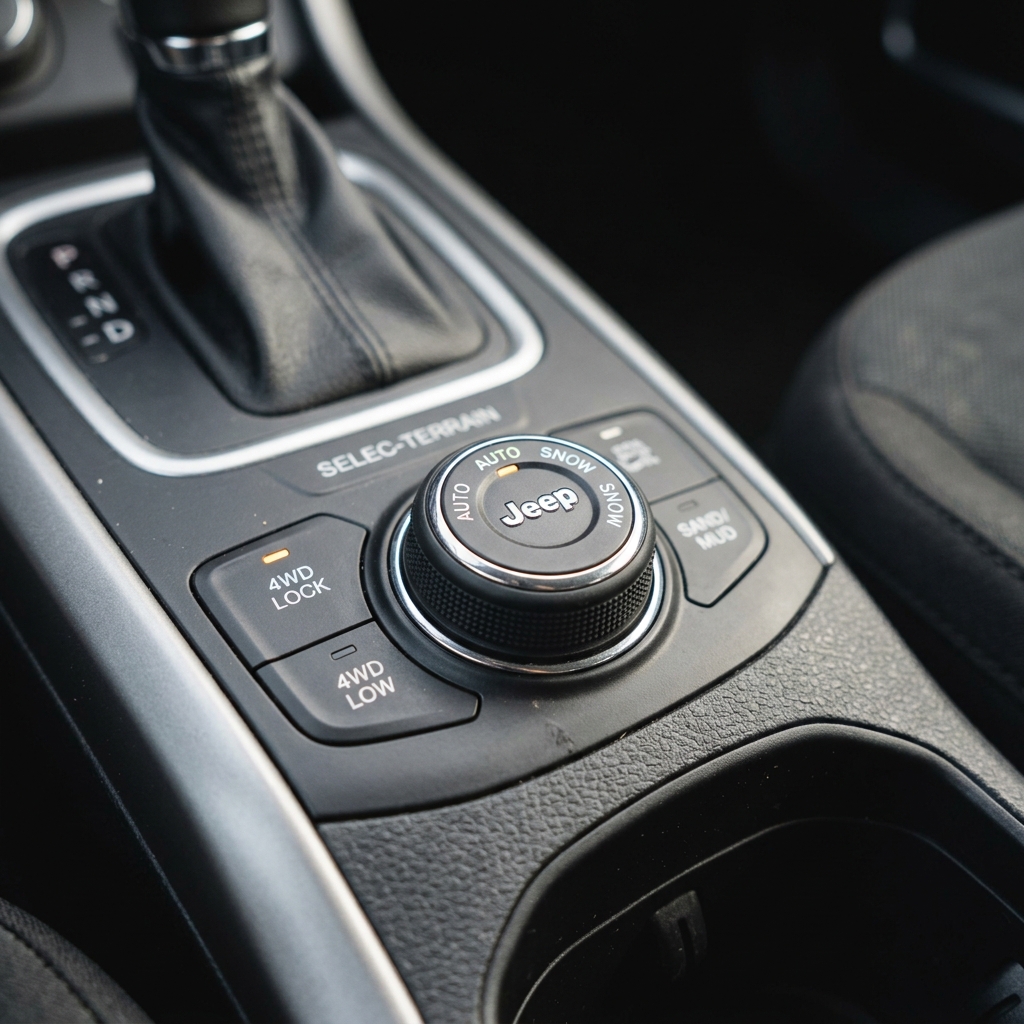
For Kansas drivers confronting variable Midwest weather, the available Jeep Active Drive 4x4 system is a major advantage. Operating seamlessly behind the scenes, it features a rear-axle disconnect that runs in 2WD mode during steady cruising to save fuel, instantly engaging 4WD when slip is detected. The included Selec-Terrain Traction Management System allows drivers to select custom drive modes (Auto, Snow, Sand, Mud) via a console dial, adjusting throttle response, transmission shifting, and torque distribution to conquer icy morning roads or muddy rural lanes.
Close-up of a Jeep Selec-Terrain drive mode dial and 4WD control buttons on a car center console. (Representative image for illustration purposes only. Actual vehicle may vary based on trim and configuration.)

Is the 2021 Jeep Compass Sport Considered a Reliable Vehicle?

IIHS Crash Test Performance

The Insurance Institute for Highway Safety (IIHS) gave the 2021 Jeep Compass high marks across primary crashworthiness evaluations, earning top 'Good' ratings in moderate overlap front, driver-side small overlap front, passenger-side small overlap front, side impact, and roof strength tests. Its occupant cell structure provides impressive resilience during high-energy collisions.

NHTSA Star Ratings

The National Highway Traffic Safety Administration (NHTSA) awarded the 2021 Jeep Compass a 4-Star Overall Safety Rating, featuring strong 5-star performance in side crash testing. Standard electronic stability control and advanced multistage restraint systems contribute to predictable vehicle dynamics and high occupant protection levels.

Midwestern Climate Durability

Owners in Kansas report long-term satisfaction with the Compass Sport's physical durability. High ground clearance, zinc-coated steel rust protection, and robust suspension components allow the vehicle to handle unpaved county roads, winter road salt, and summer heat cycles reliably when routinely maintained according to factory specifications.

How Does the 2021 Jeep Compass Sport Compare to the 2021 Ford Escape?

Jeep Compass Sport vs. Ford Escape S

When comparing entry-level compact crossovers, the 2021 Jeep Compass Sport and 2021 Ford Escape S are common cross-shoppers. While the Ford Escape relies on a 1.5L 3-cylinder base engine, the Compass Sport features a proven 2.4L 4-cylinder Tigershark engine delivering standard 180 horsepower. On the road, the Compass Sport provides superior off-road geometry with higher ground clearance (up to 8.2 inches on 4x4 models) and a dedicated Selec-Terrain system, making it more capable on unpaved trails or unplowed Kansas snow.

Feature Spec

2021 Jeep Compass Sport

2021 Ford Escape S

Base Engine

2.4L 4-Cylinder (180 hp)

1.5L 3-Cylinder (181 hp)

Standard Touchscreen

7.0-inch Uconnect 4

4.2-inch Non-Touch LCD

Apple CarPlay / Android Auto

Standard

Not Standard on Base

Traction Modes

Selec-Terrain (Auto, Snow, Sand, Mud)

Basic Drive Modes

Ground Clearance (4x4)

8.2 Inches

7.3 Inches

Interior Tech & All-Weather Value

In terms of standard cabin tech, the 2021 Compass Sport outperforms the base Escape S. Jeep equips the Sport with a vibrant 7-inch Uconnect touchscreen including standard Apple CarPlay and Android Auto integration. In contrast, the base Ford Escape S offers a basic 4.2-inch non-touch radio display, requiring paid trim upgrades to get smartphone projection. For pre-owned shoppers, the Compass Sport delivers a more modern infotainment interface and robust 4x4 options at a competitive market position.
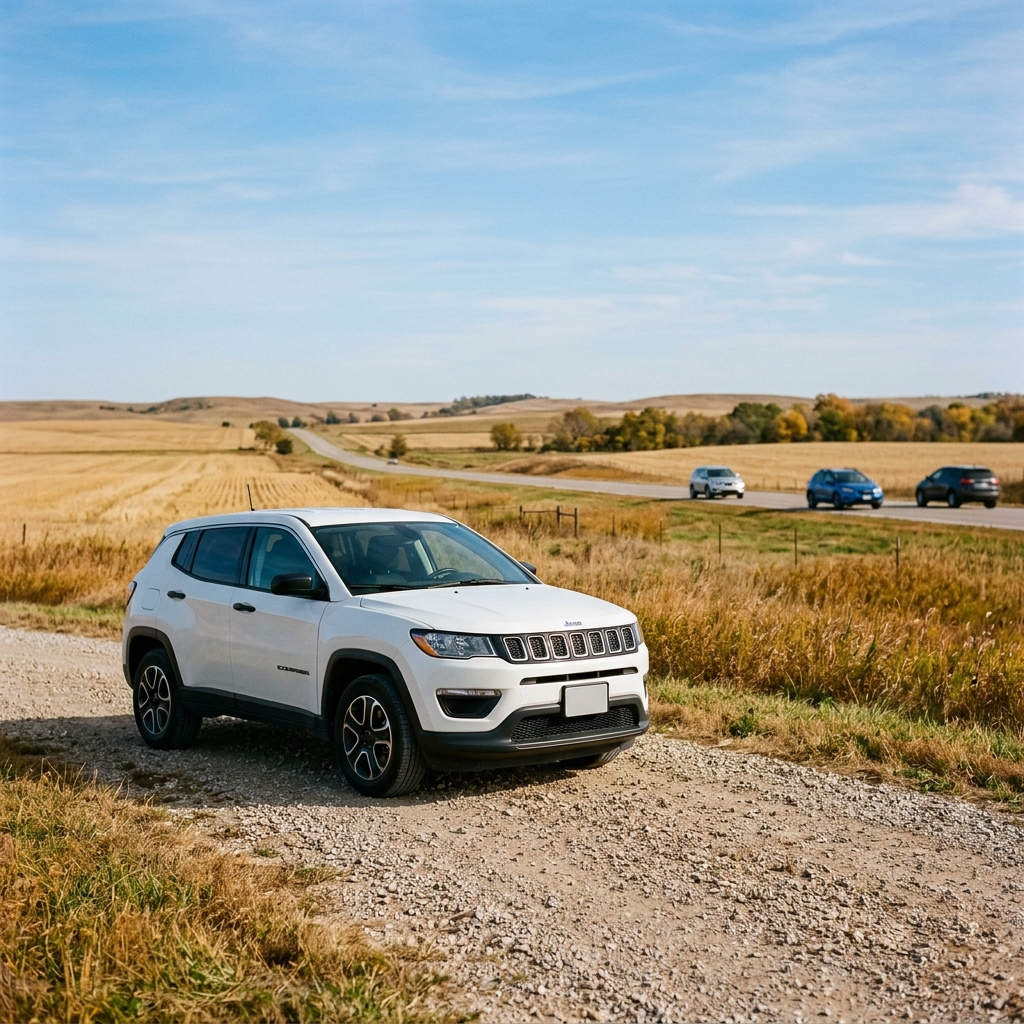
A white Jeep Compass SUV parked on a gravel country road with rolling golden hills and distant cars in the background. (Representative image for illustration purposes only. Actual vehicle may vary based on trim and configuration.)

Looking to Upgrade Your Drive? Estimate Trade-In Value or Apply for Financing

Upgrading to a safety-packed 2021 Jeep Compass Sport is straightforward at Valor CDJR. If you have a current trade-in vehicle, use our quick online Trade In Evaluation tool to receive a competitive market valuation in minutes. Ready to discuss financing options that fit your budget? Complete our secure online Get Pre-Approved form to lock in rates before visiting our Junction City dealership.

2021 Jeep Compass Sport: Ownership Maintenance Guide for Kansas Drivers

Local Driving Conditions in Junction City & Riley County

Driving in central Kansas presents unique environmental demands. From hot Flint Hills summers to freezing winter snowstorms and fine agricultural dust on unpaved roads, your Jeep Compass Sport requires proactive maintenance to retain optimal safety performance. Dust and debris can settle on exterior camera lenses and front bumper radar sensors, potentially causing false warnings or temporary disabling of LaneSense and Forward Collision Warning systems. Regularly wiping clean camera housings and radar cutouts ensures active driver assistance functions reliably.

Seasonal Inspection Checklist

As autumn transitions into winter, Kansas drivers should inspect wiper blades, washer fluid levels, and tire tread depth. Proper tire pressure is critical for radar-calibrated braking systems and Electronic Stability Control to execute emergency stops accurately. In addition, routine underbody washing removes road salt accumulation, preserving frame integrity and preventing sensor connector corrosion.

What Is the Recommended Maintenance Schedule for a 2021 Jeep Compass Sport?

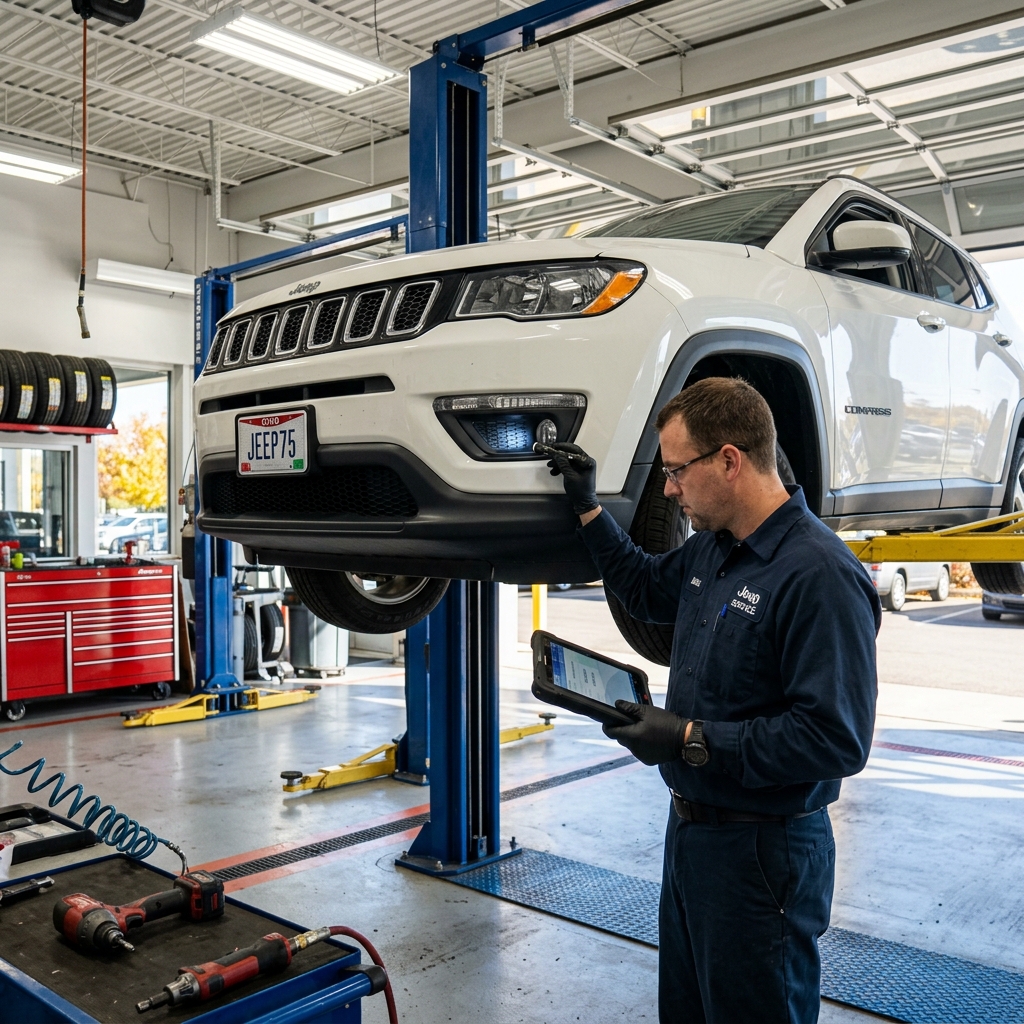
Mechanic inspecting a white Jeep Compass on a vehicle lift using a diagnostic tablet in a service bay. (Representative image for illustration purposes only. Actual vehicle may vary based on trim and configuration.)

10,000 - 20,000 Miles

• Change engine oil & Mopar filter
• Rotate tires & inspect tread wear
• Inspect brake pads, rotors & hoses
• Replace cabin air filter
• Clean camera & radar housings

30,000 - 60,000 Miles

• Replace engine air cleaner element
• Inspect CV joints, boots & steering link
• Test battery performance & terminals
• Replace spark plugs (at 60k miles)
• Inspect 4x4 transfer case & rear axle

100,000 Miles & Beyond

• Flush & replace engine coolant
• Inspect serpentine accessory drive belt
• Perform full safety sensor calibration
• Inspect suspension shocks & struts
• Service automatic transmission fluid

How Often Does a 2021 Jeep Compass Sport Need an Oil Change?

Automatic Oil Life Monitoring System

The 2021 Jeep Compass Sport features an intelligent Automatic Oil Life Monitoring System (OLMS) that calculates oil degradation based on engine operating temperatures, towing loads, idle time, and vehicle speed. Under normal highway driving conditions using recommended synthetic 0W-20 engine oil, service intervals typically range between 7,500 and 10,000 miles (or 1 year, whichever comes first). You should never exceed 10,000 miles or 12 months between oil changes.

Severe Duty Adjustments & Mopar Filters

If your daily routine involves severe driving conditions—such as frequent short trips in sub-zero winter weather, extensive idling, off-road driving, or traveling on dusty gravel roads around Manhattan and Geary County—oil changes should be scheduled sooner, typically every 4,000 to 5,000 miles. Always insist on genuine Mopar oil filters and OEM-approved full synthetic oil to protect internal MultiAir valve actuation hardware.

Where Can a 2021 Jeep Compass Sport Owner in Junction City Arrange Local Dealer Service?

Valor CDJR Mopar Certified Service Center

For specialized maintenance and safety sensor calibration, trust the certified Mopar service team at Valor CDJR. Conveniently located at 1825 Goldenbelt Blvd in Junction City, KS 66441, our state-of-the-art facility features factory-trained technicians, specialized diagnostic equipment, and genuine Mopar parts. Need directions? Get Directions to Valor CDJR or Call us at (785) 238-5114 to speak with a service advisor directly.

Express Maintenance & Online Scheduling

We respect your busy schedule. For routine oil changes, tire rotations, and multi-point safety checks without an appointment, take advantage of our Express Lane service. If your vehicle requires comprehensive maintenance or safety sensor realignment, booking an appointment takes less than two minutes through our online portal.

Schedule Service or Test Drive Your Next Jeep Compass at Valor CDJR

Valor Automotive logo featuring a blue shield with a red V and white A monogram above company text.
The 2021 Jeep Compass Sport combines foundational high-strength steel protection with optional cutting-edge active driver assistance, robust 2.4L Tigershark performance, and legendary Jeep 4x4 capability. Whether you are maintaining your current Compass Sport or searching for a pre-owned pre-owned SUV for your family, Valor CDJR is your trusted local automotive partner in central Kansas. Visit our showroom in Junction City, explore our Parts Department, or schedule your next test drive today!

Posted in:

Related Posts

Is All-Wheel Drive Worth the Extra Cost for Kansas Winters? The Bottom-Line Verdict from 20 Years in the Dealer Seat

Is All-Wheel Drive Worth the Extra Cost for Kansas Winters? The Bottom-Line Verdict from 20 Years in the Dealer Seat

Is All-Wheel Drive Worth the Extra Cost for Kansas Winters? A 20-Year Perspective from the Dealership As the General Manager at Valor CDJR here in Junction City, I get asked the exact same question as temperatures drop each fall: "Jace, do I really need to spend the extra $2,000 to $3,000 for All-Wheel Drive, or am I just buying into clever dealership marketing?" After two decades sitting in the dealer seat, watching how vehicles perform across thousands of Kansas winter commutes, evaluating trade-ins, and analyzing real-world accident reports, my short answer is unequivocally YES. However, that affirmative comes with one critical, non-negotiable caveat: an advanced AWD system is only as effective as the mechanical grip of the rubber touching the pavement. Kansas winter driving is notoriously deceptive. Unlike regions that receive consistent, dry powder snowfall, the weather patterns across Geary, Riley, and Dickinson counties deliver freezing rain, sudden black ice on I-70 bridges over the Smoky Hill River, unplowed rural farm routes, and deep sludgy slush on hill inclines throughout Manhattan. Rear-wheel drive vehicles—traditionally loved for their raw American muscle dynamics—can quickly transform into stressful challenges when torque breaks rear traction. Front-wheel drive offers decent pull over the front axle, but it lacks the active dynamic torque distribution required to climb frozen grades or recover from sudden lateral slippage. All-Wheel Drive changes the safety equation completely by transforming wheelspin into forward momentum within milliseconds. Throughout this deep-dive report, I am going to break down the mechanical engineering behind modern Dodge all-wheel drive systems, contrast rear-wheel drive muscle against four-corner traction, evaluate winter tire physics, examine cold-weather electric vehicle range retention, and calculate the true monetary return on investment. Whether you are driving an daily commuter across Junction City or navigating backroads near Fort Riley, understanding how AWD technology operates will empower you to make an informed, safety-first automotive decision. Meet Jace Grabouski: Two Decades Navigating Flint Hills Roads and Automotive Engineering My perspective isn't derived from press releases or vehicle brochures; it comes from 20 continuous years on the frontlines of dealership operations right here in Junction City. Over two decades serving as General Manager at Get Directions to Valor CDJR, I have personally assisted thousands of local drivers, military service members from nearby Fort Riley, and local farm families select vehicles tailored to our rugged regional topography. Having spent decades evaluating Chrysler, Dodge, Jeep, and Ram engineering evolutions—from early mechanical transfer cases to modern electro-hydraulic active axle disconnections—I have developed a granular appreciation for drivetrain engineering. When winter storms sweep through the Flint Hills, bringing sub-zero temperatures and packed sheet ice, knowing exactly how your car's transfer case shifts torque between axles isn't just automotive trivia—it's essential knowledge for keeping your family safe on rural state highways. How Does the Dodge Charger All-Wheel Drive System Perform in Snow and Winter Conditions? To understand why the Dodge Charger AWD system is uniquely qualified for Midwestern winter storms, you have to look under its sheet metal. Unlike traditional basic all-wheel drive setups that drag all four wheels continuously—sucking fuel efficiency dry—Dodge engineered an active transfer case with complete front-axle disconnect technology. Under ideal summer driving conditions or dry autumn highway cruising, the system can disengage the front driveshaft. The vehicle operates as a 100% rear-wheel drive sedan, preserving classic muscle car steering dynamics and maximizing fuel economy. However, the moment ambient temperatures drop below approximately 40°F, or sensors detect wheel slip, windshield wiper activation, or rapid acceleration inputs, an electro-hydraulic clutch pack seamlessly engages the front axle in under 17 milliseconds. This lightning-fast engagement happens without any driver intervention. On frozen asphalt or unpaved backroads across Riley County, torque is dynamically shifted up to a 38/62 front-to-rear ratio, ensuring instant stability before micro-slips turn into major loss of control. Furthermore, Dodge pairs this active transfer case with Electronic Stability Control (ESC) and All-Speed Traction Control tuned specifically for icy conditions. When the Charger detects one side of the vehicle resting on snow while the other sits on pavement (a common occurrence when pulls off onto shoulder gravel), the system applies micro-braking pressure to spinning wheels while re-routing torque across the open differentials to wheels with grip. The result is a heavy, balanced four-door sedan that plants itself with total confidence into winter corners. Having driven Charger AWD test units through heavy blizzards along US-77, I can attest that the level of lateral stability and directional tracking provides peace of mind that lightweight front-wheel drive economy cars simply cannot match. How Does Dodge Charger AWD Compare to RWD in Winter Driving Across Junction City? Rear-Wheel Drive (RWD) Dynamics RWD delivers unmatched acceleration geometry on dry asphalt because vehicle weight transfers to the rear axle during launch. However, on freezing rain or slick ice, pushing a vehicle from behind while using front wheels solely for steering creates inherent instability. Under heavy throttle on icy Junction City streets, rear wheels easily break traction, causing oversteer ('fishtailing') that requires quick counter-steering. All-Wheel Drive (AWD) Traction AWD pulls and pushes simultaneously. By transferring engine output across four contact patches, engine torque per wheel is effectively cut in half. This drastically reduces the likelihood of exceeding any single tire's threshold of static friction. Starting from a complete stop on an icy uphill stoplight becomes effortless, eliminating panic and wheelspin completely. Flint Hills Commuting Realities Cruising I-70 between Junction City and Manhattan during severe squalls presents high-speed crosswinds combined with slush accumulation between lanes. RWD vehicles experience severe lateral drift during lane changes. AWD provides directional stability, locking the sedan onto its intended path even when crossing frozen slush ruts at speed. Browse New AWD Inventory How Does the Next-Gen Dodge Charger’s Wet/Snow Mode Help in Winter Conditions? Modern drivetrain engineering extends far beyond mechanical gears; software algorithms dictate how power reaches the cold asphalt. In next-generation Dodge Charger platforms, the selectable Wet/Snow Drive Mode fundamentally recalibrates the vehicle’s brain to prioritize stability over aggressive performance. When engaged, Wet/Snow mode alters electronic throttle mapping. Even if a driver presses heavy on the accelerator pedal out of habit, the ECU dampens engine response, delivering smooth, progressive torque build-up rather than sudden bursts that break tire adhesion. The transmission logic shifts early to keep engine RPM low, reducing peak torque torque at the wheels. Simultaneously, the active transfer case locks into a fixed 50/50 static torque split, ensuring both front and rear axles share initial movement duties instantly upon acceleration. The ABS and ESC systems adopt ultra-sensitive threshold settings, intervening subtly before driver-perceptible slip occurs. For drivers facing deep snow drifts or packed ice near Milford Lake, this software integration transforms high-horsepower machinery into a predictable, compliant winter transport. It removes driver error from throttle management during slippery maneuvers. Are Factory All-Season Tires Sufficient for Winter Driving in a Dodge Charger AWD? The All-Season Myth Factory all-season tires are engineered for low rolling resistance and long tread life in moderate conditions. However, once ambient temperatures drop below 45°F (7°C), standard all-season rubber compounds harden like hockey pucks. Regardless of how sophisticated your AWD system is, hard rubber cannot conform to ice micro-texture. Dedicated Winter Rubber Dedicated winter tires utilize silica-rich soft rubber compounds that remain flexible in sub-zero Kansas deep freezes. High-density 3D siping cuts through surface water films to bite directly into hard ice. Pairing Dodge AWD with dedicated winter tires yields stopping distances up to 35% shorter than AWD with all-season rubber. Remember: All-wheel drive helps you accelerate, but all four wheels already brake on every car. AWD does not reduce stopping distance on ice—tires do. If you plan to navigate extreme winter conditions across Kansas, combining AWD technology with proper winter tires or severe-snow-rated 3PMSF (Three-Peak Mountain Snowflake) tires at our Parts Department is the ultimate safety solution. Jace’s Core Insight: "Traction Tech Gets You Moving, But Tread Physics Keeps You Off the Shoulder "In my 20 years managing dealerships in Junction City, the most dangerous driver on the road during a winter storm is the one who believes an 'AWD' badge makes them immune to the laws of physics. All-Wheel Drive gives you incredible confidence getting out of snowy driveways and climbing icy Flint Hills grades. But when it comes to steering around an obstacle or emergency stopping on freezing rain, your drivetrain won't save you if your tires are bald or unsuited for sub-zero temperatures. Respect the road, maintain your vehicle, drive with sensible speed, and let technology work for you." — Jace Grabouski, General Manager at Valor CDJR Schedule Winter Service Checkup Is the Dodge Charger AWD Platform Identical to the Chrysler 300 AWD? A frequent technical query from pre-owned vehicle buyers visiting our showroom is whether the Dodge Charger AWD system is identical to the Chrysler 300 AWD setup. From an architecture standpoint, yes—they share core mechanical DNA. Both flagship sedans utilize Stellantis' unibody full-size platform, sharing the BorgWarner active transfer case, front axle disconnect hardware, and 3.6L Pentastar V6 powertrain pairing. However, executive chassis tuning separates their road personalities. The Chrysler 300 AWD is calibrated for plush, luxury isolation, utilizing softer dampening rates, quieter compliance bushings, and smoother throttle mapping. It absorbs highway expansion joints effortlessly while delivering quiet winter confidence. In contrast, the Dodge Charger AWD receives sport-calibrated steering gear ratios, firmer anti-roll bars, stiffer damper valving, and aggressive transmission shift schedules. The electronic stability control thresholds in the Charger allow slightly more dynamic rotation before intervening, providing a sportier feel on winding Kansas country roads. Both sedans offer exceptional winter capability, but choosing between them depends on whether your preference leans toward executive comfort or muscular performance. Explore our Used Vehicle Listings to compare both models side-by-side. How Does Cold Weather Affect the Battery Range and AWD of the Electric Dodge Charger Daytona? As Dodge ushers in the electrified era with the all-electric Dodge Charger Daytona, winter performance dynamics undergo a radical revolution. The Daytona replaces mechanical driveshafts and transfer cases with dual Electric Drive Modules (EDMs)—one powering the front axle and one powering the rear. This dual-motor electric AWD configuration delivers instant torque vectoring across four wheels within microseconds, eliminating mechanical engagement delays entirely. However, extreme Midwestern cold impacts high-voltage lithium-ion battery chemistry. During sub-zero Kansas cold snaps, chemical reactions slow down, and cabin heating demands energy from the traction battery. Drivers can expect a temporary range reduction of 20% to 30% during severe freezing conditions if proper thermal management protocols aren't followed. To mitigate range loss, the Charger Daytona features automated battery pre-conditioning. When scheduled while plugged into your Level 2 home charger prior to morning departure in Junction City, the system warms the battery pack to its optimal electrochemical operating window (around 70°F) using grid power rather than stored battery energy. This preserves maximum driving range and ensures full dual-motor AWD power availability from the instant you back out of your driveway. Calculating the ROI: Upfront Costs, Resale Value, and Winter Safety Peace of Mind Initial Purchase Cost Selecting All-Wheel Drive can affect a vehicle's MSRP. For current pricing and payment information, contact the dealership. Additionally, active front-axle disconnect technology keeps fuel economy penalties negligible (typically less than 1 MPG difference compared to RWD). Resale & Trade Equity In Midwestern resale markets like Kansas, AWD vehicles retain a significantly higher percentage of their initial value compared to RWD sedans. At trade-in time, AWD vehicles may retain stronger resale value compared with similar RWD models. Accident Avoidance ROI Insurance deductibles and related costs vary. AWD may help improve winter confidence and could reduce the risk of weather-related incidents. Evaluate Your Trade-In Equity Jace Grabouski’s Winter Readiness Checklist for Riley County Drivers Before the first severe freeze hits Junction City, I recommend every driver complete this 4-step winter readiness protocol to ensure total vehicle reliability: 1. Battery Load Testing: Cold weather reduces battery capacity by up to 50%. Have your 12V battery load-tested at our Express Lane to avoid getting stranded in freezing temperatures. 2. Transfer Case Fluid Inspection: AWD transfer cases rely on clean synthetic fluid to actuate clutch packs smoothly. Check your maintenance schedule or visit service every 30,000 to 50,000 miles. 3. Tire Tread Depth & Pressure: Inspect tread depth using a depth gauge (minimum 4/32" for winter driving). Remember that tire pressure drops approximately 1 PSI for every 10°F drop in outside temperature. 4. Verify Drive Modes & Emergency Kit: Familiarize yourself with how to engage Wet/Snow drive modes in your vehicle controls, and pack a trunk kit containing jumper cables, a tow strap, blanket, flashlight, and bag of ice melt. Test Drive All-Wheel Drive Performance at Valor CDJR in Junction City If you are considering winter readiness to find out if your vehicle is equipped for Kansas roads. My team and I at Valor CDJR are ready to help you navigate your winter vehicle search with transparent expert guidance, competitive financing offers, and world-class service support. Visit our showroom at 1825 Goldenbelt Blvd, Junction City, KS 66441 or Call us at (785) 238-5114 to speak directly with our product specialists. Experience the security, power, and engineering precision of modern Dodge and Chrysler All-Wheel Drive firsthand. Get Pre-Approved Online

Preparing Your RAM and Jeep for Kansas Winter Roads: Expert Q&A Pre-Season Service Checklist

Preparing Your RAM and Jeep for Kansas Winter Roads: Expert Q&A Pre-Season Service Checklist

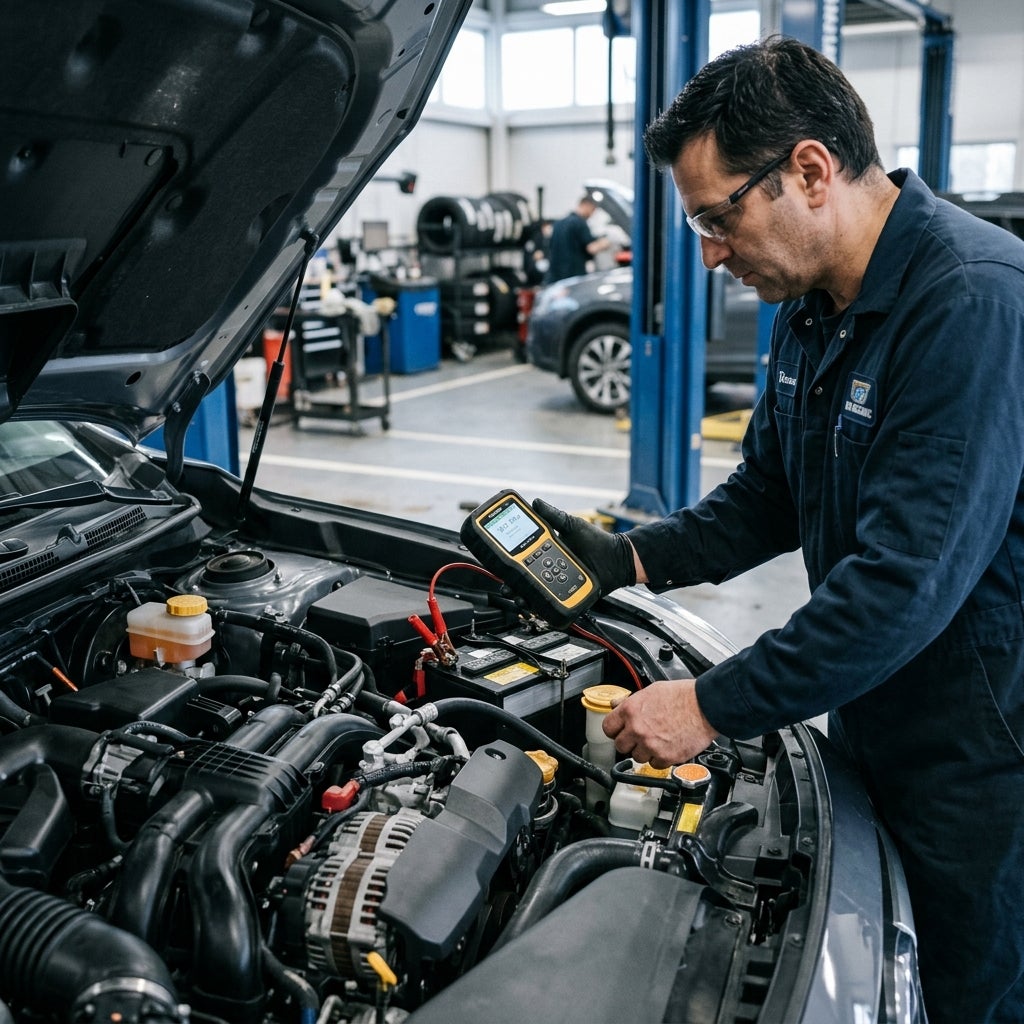
Preparing Your RAM and Jeep for Kansas Winter Roads: Expert Q&A Pre-Season Service Checklist A comprehensive winter service inspection focusing on battery cold-cranking health, coolant freeze protection, brake integrity, and transfer case fluid condition is the essential maintenance service for preparing a Ram truck or Jeep for winter in Junction City. Testing battery reserve capacity and ensuring fresh antifreeze prevents frozen engine blocks and unexpected breakdowns during severe Midwestern freezing spells. Today, we spoke with Mike Hogg, Service Director at Valor CDJR, who brings 20 years of hands-on automotive service experience to share his expert insights on seasonal vehicle preparation. Q: What maintenance service is essential for preparing a Ram truck or Jeep for winter in Junction City, Kansas? A: A full multi-point winter preparation service is vital before freezing weather arrives. Our priority during this inspection is testing the battery's cold-cranking capacity, verifying that engine coolant provides freeze protection down to sub-zero temperatures, inspecting brake pads and rotors, and checking transfer case and axle fluids in 4x4 systems. In Junction City, winter conditions bring sudden freezing temperatures and icy road surfaces across flat agricultural plains and river valleys, making uncompromised mechanical reliability essential for daily commutes and work duties. During a pre-season inspection, technicians also examine heating and defrosting performance, check wiper blade flexibility, and top off windshield washer fluid with a low-temperature winter blend that will not freeze on contact with cold glass. Driving a 2026 Jeep Grand Cherokee 4xe or a heavy-duty pickup through freezing slush requires full visibility and immediate heater response. Owners can easily prepare their vehicles by scheduling a winter maintenance inspection online before the first hard freeze hits the region. Addressing fluid health early preserves heavy-duty driveline components and guarantees that automatic four-wheel-drive systems engage without hesitation. If you have questions about specific service intervals or want to bring your truck in for a quick fluid check, you can visit our service facility at 1825 Goldenbelt Blvd or give our service desk a call at (785) 238-5114 to speak directly with an advisor. Q: What cold cranking amps rating is recommended for winter driving in Kansas? A: We recommend a battery rating of at least 600 CCA to 800 CCA for Ram pickups and Jeep SUVs operating through Kansas winters. Cold Cranking Amps measure the number of amperes a 12-volt battery can deliver at 0 degrees Fahrenheit for 30 seconds while maintaining a voltage of at least 7.2 volts. Because cold ambient air thickens engine oil and slows down internal chemical reactions within the battery, having high cranking power ensures your starter motor turns over efficiently on freezing mornings. When vehicle owners bring in a Ram 1500 or Jeep Wrangler for seasonal care, measuring the battery's reserve capacity and CCA output is one of the initial physical tests our technicians perform. A battery might start an engine easily in mild fall weather, but once temperatures plunge, a weak cell quickly fails under the increased load. If a test reveals that your battery is delivering below its factory specification, replacing it before winter prevents unexpected dead battery scenarios in your driveway or job site. For owners performing maintenance themselves or looking for factory-certified equipment, sourcing an OEM Mopar battery engineered specifically for your vehicle's electrical load is always the safest route. You can order replacement batteries, winter wiper blades, and heavy-duty floor liners directly through our genuine Mopar parts department. Q: What do the 3-Peak Mountain Snowflake symbol and M+S ratings mean for winter traction? A: The M+S rating stands for Mud and Snow, which indicates that a tire features a tread pattern designed with wider grooves and geometric angles to channel slush and soft mud away from the contact patch. However, the M+S designation is based purely on tread geometry rather than standardized performance testing in freezing conditions. It represents a baseline capability commonly found on standard all-season tires, but it does not guarantee soft rubber compounding in sub-freezing temperatures. By contrast, the 3PMSF symbol certified by tire industry standards indicates that a tire has undergone rigorous, standardized acceleration testing on packed snow and demonstrated traction exceeding baseline requirements. Tires bearing this mountain-and-snowflake emblem maintain flexibility in freezing weather thanks to specialized silica compound formulations. Equipping your vehicle with tires carrying the 3PMSF emblem gives you significantly improved stopping power and lateral stability on packed snow and icy surfaces compared to standard all-season rubber. Maintaining correct tire inflation is equally critical during winter months because ambient temperatures directly alter tire pressure. Tire pressure drops by approximately 1 to 2 PSI for every 10-degree drop in outside temperature. Checking your tire pressures monthly and ensuring your tread depth meets winter safety thresholds ensures your vehicle maintains maximum grip when navigating slick highway stretches or rural gravel roads. Q: What is the difference between 4Auto, 4High, and 4Low on a Ram 1500 in winter conditions? A: Understanding transfer case settings allows you to maximize traction without causing mechanical stress to your vehicle's four-wheel-drive system. 4Auto is designed for variable or patchy road conditions where pavement alternates between dry asphalt and slick ice patches. In 4Auto, the transfer case continuously monitors wheel slip and automatically sends power to the front axle only when rear traction loss occurs, allowing you to drive at normal speeds without binding your driveline on dry pavement. "A battery that starts fine in October can completely drop dead during the first 15-degree morning in Kansas if the internal reserve capacity is compromised." When roads are completely covered in snow, slush, or ice, switching to 4High locks the front and rear driveshafts together in a continuous 50/50 power split. This provides consistent, predictable traction for normal winter driving speeds, but it should only be used on slippery surfaces to prevent mechanical driveline binding during sharp turns. For drivers navigating steep grades or rolling hills around Manhattan after a heavy snowstorm, 4High keeps momentum steady and predictable across unplowed secondary routes. Setting the system to 4Low engages lower gear ratios to deliver maximum torque at very slow speeds, typically under 25 mph. This mode is reserved for extreme recovery situations, such as pulling out of deep snowdrifts or maneuvering through heavy mud. Knowing when to engage each setting protects internal transfer case gears while giving you complete control in challenging winter terrain. Q: Which vehicle offers higher ground clearance, Ram 1500 Rebel or Jeep Wrangler Rubicon? A: The Jeep Wrangler Rubicon offers higher ground clearance overall, providing between 10.8 inches and 12.9 inches of factory clearance depending on tire options and trim configurations. By comparison, the Ram 1500 Rebel provides approximately 9.8 inches to 10.8 inches of ground clearance, which is exceptional for a light-duty pickup but slightly lower than the dedicated off-road architecture of the Wrangler Rubicon. Ground clearance is a critical factor when driving through unplowed snow drifts, as extra height prevents the underbody from high-centering on packed snow. Both vehicles excel in winter conditions through specialized suspension tuning and protective underbody skid plates. The Ram 1500 Rebel utilizes aggressive off-road shocks and electronic locking differentials that make it a winter workhorse for hauling equipment or towing heavy loads. The Jeep Wrangler Rubicon uses heavy-duty solid axles, Tru-Lok front and rear electronic lockers, and massive tire options to crawl over severe winter obstacles and deep snowdrifts effortlessly. For business owners and fleet operators who rely on rugged vehicles for winter work, choosing between a full-size pickup and a specialized 4x4 SUV comes down to payload and bed capacity needs versus absolute trail clearance. You can explore heavy-duty work trucks and outfitted utility vehicles by viewing our commercial vehicle inventory to find the right mechanical setup for your winter operations. Q: How much does a complete pre-packaged automotive winter safety kit cost? A: Pricing for a complete pre-packaged automotive winter emergency kit can vary; contact the dealership for current pricing., depending on the quality of tools, tow strap ratings, and emergency gear included. Basic kits on the lower end of that price spectrum usually contain jumper cables, a compact snow brush, a flashlight, reflective safety markers, and a basic first-aid kit. Higher-end kits include heavy-duty tow straps, collapsible shovels, thermal blankets, tire pressure gauges, and portable jump-starter power banks. Carrying a dedicated winter safety kit in your cargo area or truck bed is essential preparation for cold-weather driving. In addition to commercial safety kits, keeping a bag of sand or kitty litter in your trunk helps provide instant traction if a tire gets stuck on polished ice. Having emergency supplies readily accessible ensures that you remain warm, visible, and equipped if you ever experience a roadside delay during severe weather. Q: How do you schedule a pre-season winter inspection for your Ram or Jeep? A: Booking a pre-season winter inspection is straightforward and can be completed online or over the phone. Our service facility is fully equipped with advanced diagnostic tools, factory-trained technicians, and specialized equipment tailored specifically for Chrysler, Dodge, Ram, and Jeep vehicles. During your appointment, our technicians perform a complete system check covering battery health, cooling system pressure, brake line integrity, suspension wear, and lighting functionality. Taking care of routine maintenance before winter arrives saves money by preventing premature component wear and avoiding emergency service calls during severe storms. Whether you drive a Ram 1500, a Jeep Wrangler, or a Chrysler Pacifica, routine seasonal care keeps your vehicle operating at peak efficiency. To set up your service appointment, reach out to our service team by calling (785) 238-5114 or stop by in person at our dealership address at 1825 Goldenbelt Blvd to ensure your vehicle is completely ready for Kansas winter roads. © 2026 Valor CDJR. All rights reserved. Vehicle specification data © JATO Dynamics Limited.

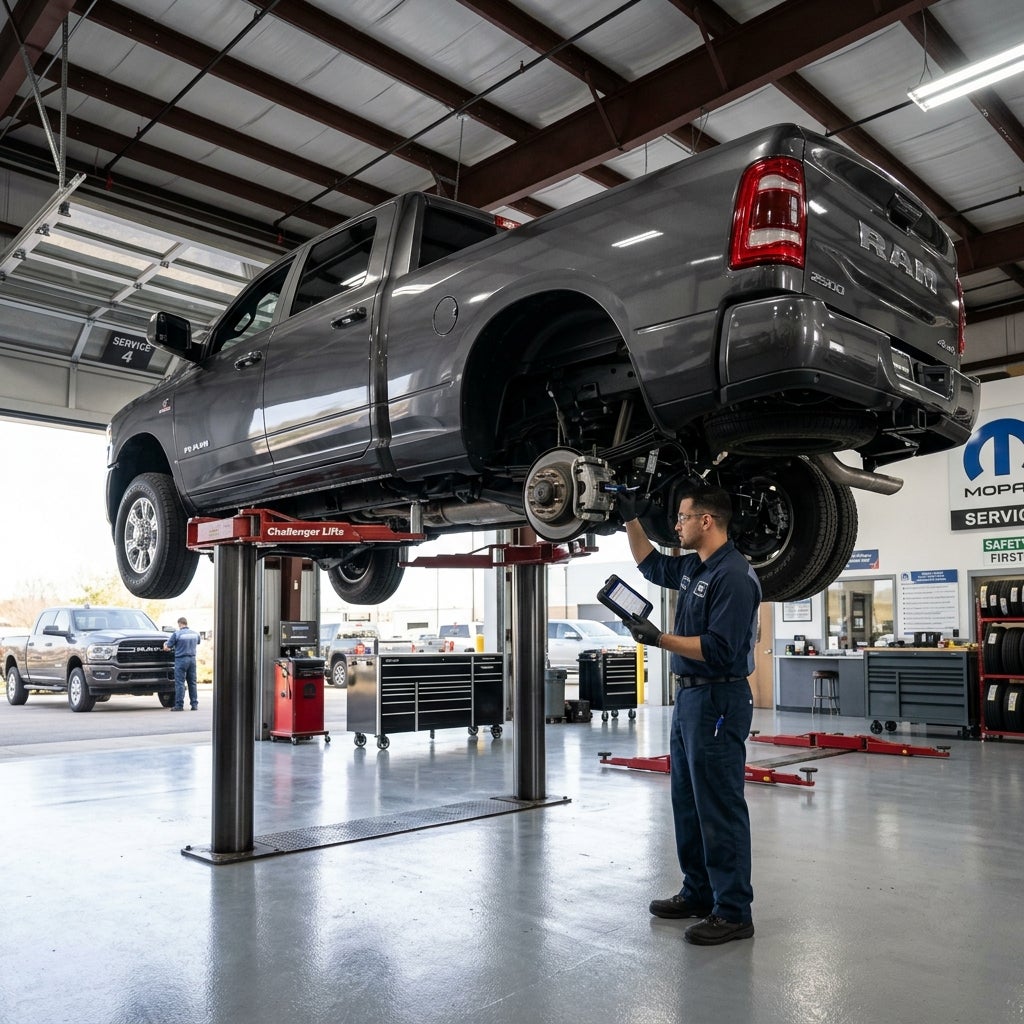
A mechanic in blue workwear uses a tablet to inspect the brake system of a dark grey pickup truck raised on a lift. (Representative image for illustration purposes only. Actual vehicle may vary based on trim and configuration.)

Does RAM Factory Warranty Cover Brake Pad Wear or Trailer Safety Checks? Direct Answer & Coverage Breakdown

Does Ram Factory Warranty Cover Brake Pad Wear or Trailer Safety Checks? Direct Answer & Coverage Breakdown When heavy-duty truck owners pull into Valor CDJR in Junction City, KS with severe brake squeal or a trailer brake warning light on the dashboard, the first question they usually ask is simple: “Is this covered under my Ram factory warranty?” The concise, definitive answer is both nuanced and critical for anyone hauling heavy gooseneck livestock trailers, farm machinery, or commercial equipment across Central Kansas. Under the standard Ram 3-Year / 36,000-Mile Basic Limited Warranty, normal wear-and-tear items—specifically brake pads, linings, shoes, and rotor surface friction wear—are covered against defects in material and workmanship for a strictly limited period of 12 months or 12,000 miles (whichever occurs first). Once your truck passes 12,000 miles or one year from its original in-service date, friction material consumption is classified as routine owner maintenance. If your brake pads wear down to the backing plate due to heavy towing across Riley County or high-mileage highway driving along I-70, replacement costs fall outside factory warranty coverage. Regarding trailer safety checks, trailer hitch mechanical integrity, trailer brake shoe adjustment, and 7-pin trailer wiring diagnostics: these procedures are strictly classified as non-warranty maintenance services. Factory warranty coverage protects solely against manufacturing defects in parts manufactured or installed by Stellantis/Ram. Standard trailer maintenance, trailer side wiring faults, damaged trailer breakaway switches, and pre-trip hitch safety checks are the operational responsibility of the truck owner. However, there is a crucial exception regarding truck-side electronic towing controls. If your 2024 or 2025 Ram 2500 or 3500 experiences a failure within the truck's Integrated Trailer Brake Module (ITBM), the factory trailer tow wiring harness, the 7-pin bumper receptacle, or the trailer light control module due to a factory material or assembly defect, those components are fully covered under the 3/36 Basic Warranty. If you are preparing for agricultural hauling season, stop by our service center or schedule an appointment online using our Service Scheduler to verify your truck's electronic trailer controller performance. Meet Mike Hogg: 20 Years of Heavy-Duty Ram Service Experience in Central Kansas As Service Director at Valor CDJR in Junction City, KS, Mike Hogg brings over 20 years of hands-on technical expertise in diagnosing and maintaining Ram Heavy-Duty powertrain, braking, and towing systems. Throughout his two decades in Central Kansas, Mike has worked directly with local farmers, cattle ranchers, construction contractors, and military families from Fort Riley who rely on their Ram 2500 and 3500 trucks for severe-duty hauling. “In Kansas agriculture and heavy commercial transport, your truck’s braking capacity isn’t just a convenience—it’s your primary safety lifeline,” says Mike. “I’ve seen drivers haul 20,000-pound livestock trailers down steep grades along Highway 18 and K-177 in blistering summer heat and sudden autumn downpours. Understanding where factory warranty ends and proactive maintenance begins is what prevents cataclysmic brake fade and costly roadside breakdowns.” Under Mike’s leadership, Valor CDJR has developed specialized, heavy-duty towing inspection protocols that go far beyond standard quick-lube checklists. His team of factory-certified Chrysler, Dodge, Jeep, and Ram master technicians evaluates friction shear points, rotor thermal checking, electronic gain signaling, and breakaway voltage systems to keep Kansas drivers safe on every mile of road. Mike Hogg, Service Director at Valor CDJR in Junction City, KS, supervising heavy-duty brake diagnostics. Understanding Ram Factory Warranty Limits on Wear Items vs. Defect Coverage Navigating manufacturer warranty documentation can be frustrating when unexpected repair bills arise. Stellantis establishes distinct boundaries between defect coverage and wear-and-tear maintenance. Understanding these parameters ensures Ram owners are never caught off guard when servicing their vehicles at our Junction City dealership. The 3-Year / 36,000-Mile Basic Limited Warranty protects almost every factory-installed component against material defects or factory assembly mistakes. However, high-friction and high-wear items have shortened coverage windows: • Brake Pads & Linings: Covered for 12 months or 12,000 miles against premature debonding, uneven backing plate cracking, or manufacturing defects. • Brake Rotors & Drums: Covered for 12 months / 12,000 miles for defect-related warpage or casting stress cracks. Wear caused by metal-to-metal pad contact due to neglected pad friction is non-warrantable. • Powertrain Warranty (5-Year / 60,000-Mile or 5-Year / 100,000-Mile Diesel): Covers internal engine, transmission, drivelines, and axle assemblies. It does not cover wheel brake hardware, calipers, rotors, or trailer braking interfaces. Component / Service Warranty Coverage Window Classification Brake Pads & Shoes 12 Months / 12,000 Miles Wear Item (Defect Only) Brake Rotors (Surface Wear) 12 Months / 12,000 Miles Wear Item (Defect Only) Brake Calipers & Master Cylinder 3 Years / 36,000 Miles Bumper-to-Bumper Warranty Integrated Trailer Brake Module (ITBM) 3 Years / 36,000 Miles Bumper-to-Bumper Electrical 7-Pin Trailer Wiring Socket (Truck Side) 3 Years / 36,000 Miles Bumper-to-Bumper Electrical Brake Fluid Flushing & Moisture Check None (Owner Maintenance) Scheduled Maintenance Trailer Safety Checks & Hitch Inspection None (Owner Maintenance) Owner Operational Check Schedule Factory Warranty Inspection Expert Commentary: Mike Hogg on Heavy-Duty Towing Realities and Stopping Safety “One of the most dangerous assumptions a truck owner can make is assuming that because their 2024 or 2025 Ram 3500 is under factory warranty, the braking system on their loaded rig is fully protected against failure during heavy towing,” notes Mike Hogg. “When you pull a 16,000-pound dual-axle stock trailer through the Flint Hills, kinetic energy converts into immense thermal energy at the wheel ends. Factory ceramic and semi-metallic friction pads can withstand incredible temperatures, but friction material wears away proportionately to load mass and stopping frequency. If you rely on warranty coverage to catch worn pads, you will likely end up with ruined rotors, severe brake fade, or complete friction glazing halfway down a 6% highway grade.” “Proactive brake maintenance and trailer safety checks aren't arbitrary dealership recommendations—they are essential protocols for anyone pulling serious payload. At Valor CDJR, we treat every towing rig as if our own families were sitting in the cab. If you ever need advice on brake wear rates or upgrading your friction pads, Call us at (785) 238-5114 to talk directly with our service advisory team.” What Trailer Brake Control Features Are Integrated into 2025 Ram Heavy-Duty Trucks? Integrated Trailer Brake Module (ITBM) The factory-installed ITBM allows seamless proportional electric or electric-over-hydraulic trailer brake engagement. Drivers can store unique trailer profiles, adjust gain output from +0.5 to +10.0 directly from the dash, and activate manual squeeze lever override in emergency sway conditions. Defect coverage: Covered 3 Yrs / 36,000 Miles. Trailer Light Check & Diagnostics 2025 Ram HD trucks feature an automated Trailer Light Check routine accessible via the Uconnect 5 touchscreen or key fob. It cycles turn signals, brake lights, and running lamps so a solo driver can verify light function before pulling onto public roads. Reverse Guidance & Trailer Cameras Equipped with Digital Rearview Mirrors, 360-degree Surround View, and dual trailer camera inputs, 2025 Ram HD models feed real-time visual streams directly into the central display. Bumper trailer wiring connectors integrate auxiliary camera links and trailer reverse guidance gridlines. If you are interested in exploring new high-capability haulers equipped with factory ITBM technology, browse our latest New Vehicle Listings or explore our heavy-duty inventory in person at Valor CDJR. How the Ram Heavy-Duty Diesel Exhaust Brake Works During Trailer Deceleration One of the greatest engineering achievements on Cummins 6.7L Turbo Diesel-powered Ram 2500 and 3500 trucks is the driver-selectable Smart Diesel Exhaust Brake. Operating via the Variable Geometry Turbocharger (VGT), this system dynamically restricts exhaust gas flow when the accelerator pedal is released, creating negative backpressure inside the engine cylinders. The exhaust brake features two distinct operating modes: • Full Exhaust Braking Mode: Delivers maximum engine retardant force immediately upon lifting off the accelerator. This mode is ideal for steep downhill grades with heavy payload gross combination weights (GCWR). • Smart (Auto) Mode: Automatically modulates exhaust backpressure to maintain the speed set by the driver. If you tap the wheel brakes while descending a hill, the Smart Exhaust Brake locks in that speed and continuously modulates exhaust pressure to hold velocity without driver pedal input. By utilizing engine compression to absorb vehicle momentum during downhill descent, the Smart Exhaust Brake dramatically reduces the thermal friction load placed on wheel brake pads and rotors. In real-world testing across hilly terrain in Central Kansas, consistent use of the diesel exhaust brake can double or triple the service life of service brake pads. If you are upgrading your agricultural fleet or commercial towing rig, check out our current Commercial Vehicle Inventory to inspect Cummins-powered trucks with factory exhaust brake technology. Schedule Your Pre-Tow Brake Inspection at Valor CDJR in Junction City, KS If you notice a brake squeal or a trailer signal error message, consider having your towing system checked. Whether you are hauling grain, livestock, or heavy equipment across Junction City, Manhattan, or Fort Riley, our certified Ram master technicians are ready to perform a comprehensive friction and electrical diagnostic. Book Towing Safety Inspection Online Recommended Brake Component Inspection Intervals for Severe-Duty and Rural Driving Conditions Severe-Duty & Agricultural Schedule (5,000-Mile Interval) Ram owner manuals specify severe-duty maintenance schedules for trucks operating under any of the following conditions: frequent trailer towing over 10,000 lbs, operation on gravel or unpaved farm roads, dusty trail driving, continuous stop-and-go idling, or off-road mud exposure. • Every 5,000 Miles / 6 Months: Inspect brake pad thickness, caliper slide pin movement, and rotor friction surfaces. Perform visual inspection of 7-pin plug pins for corrosion. • Every 15,000 Miles: Check trailer breakaway battery voltage, inspect trailer brake wire harnesses, test brake fluid moisture content (flush if boiling point is reduced). Standard Highway Towing Schedule (10,000-Mile Interval) For Ram trucks driven primarily on paved interstate highways with light to moderate towing frequency: • Every 10,000 Miles / 12 Months: Measure inner and outer pad friction depth with a digital gauge. Inspect rotor thickness against minimum throwaway specifications stamped on the rotor hat. • Every 20,000 Miles: Inspect emergency parking brake shoe linings, lubricate parking brake cables, and verify ITBM voltage output curves under simulated trailer resistance. For fast routine checks without an appointment, visit our Express Lane service bay at Valor CDJR. What Are the Common Signs of Warped Brake Rotors on a Ram 3500 Dually? 1. Brake Pedal Pulsation & Steering Vibration When applying brakes under load on a Ram 3500 Dual Rear Wheel (DRW) truck, a rhythmic pulsation felt through the brake pedal or rapid steering wheel flutter usually indicates Disc Thickness Variation (DTV) caused by localized overheating and friction material transfer. 2. Heat Checking & Surface Micro-Cracking Severe thermal cycles generate thin hairline stress cracks on rotor friction faces known as heat checking. If rotor temperatures exceed 1,200°F during hard mountain braking, the iron matrix alters, causing permanent structural hard spots (cementite formation). 3. Squealing, Groaning, or Extended Distance Glazed rotor surfaces and hardened pad friction compounds produce high-frequency squealing or low-frequency groaning under brake application. Stopping distances increase significantly as the coefficient of friction drops under extreme heat. What Practical Trailer Safety Inspection Steps Should Ram Owners Follow Before Towing Farm or Utility Trailers? Electrical & Electronic Pre-Tow Checklist 1. 7-Pin Socket Contact Tension: Clean terminal blade contacts with electrical contact cleaner and apply dielectric grease to prevent green copper oxidation. 2. Breakaway Battery Test: Verify the trailer emergency breakaway battery voltage reads at least 12.6 volts using a multimeter. Pull breakaway pin to confirm magnets lock trailer hubs. 3. ITBM Gain Calibration: Test manual squeeze lever at 5 mph on dry pavement. Adjust gain until trailer brakes lock slightly, then dial back gain 0.5 units. Mechanical & Hardware Pre-Tow Checklist 1. Coupler & Safety Chains: Ensure hitch ball matches coupler size (e.g., 2-5/16" vs 2"). Cross safety chains under coupler to form a support basket and verify chain class rating. 2. Trailer Brake Shoe Adjustment: Manually adjust star wheels on drum brake assemblies so shoes drag lightly against drum before backing off one notch. 3. Cold Tire Inflation: Set trailer tire pressures to maximum PSI stamped on sidewall to minimize sidewall flex and heat buildup along highway speeds. Order OEM Mopar Towing Accessories Ram Heavy-Duty Towing Brake and Trailer Safety Service Protocol at Valor CDJR Step 1: Mechanical Friction Diagnostic • Micrometer rotor thickness measurement at 8 points. • Digital caliper pad remaining friction depth check. • Caliper slide pin removal, cleaning, and high-temp synthetic lubrication. • Parking brake shoe lining and cable tension inspection. Step 2: Electronic ITBM & Towing Scan • WiTECH 2.0 factory diagnostic scan of Integrated Trailer Brake Controller. • Oscilloscope signal output testing at 7-pin bumper receptacle. • Voltage drop testing across factory tow wiring harness harness connections. Step 3: Fluid & Hydraulic Integrity • Digital copper/water moisture test of DOT 4 brake fluid. • Master cylinder pressure decay holding check. • Hydraulic flexible rubber brake hose expansion inspection under pedal pressure. Choosing Genuine Mopar OEM Heavy-Duty Brake Pads and Towing Accessories When replacing worn friction components on your Ram truck, choosing Genuine Mopar OEM Heavy-Duty Brake Pads and Rotors ensures optimal stopping performance and factory fitment. Mopar severe-duty friction formulations are engineered specifically for Ram caliper piston hydraulic pressures and anti-lock brake control algorithms. Key benefits of Mopar OEM Brake Friction Parts: • Engineered Thermal Capacity: High-density semi-metallic or ceramic matrix withstands operating temperatures up to 1,400°F without friction shear or pad debonding. • Multi-Layer Constrained Dampening Shims: Eliminates low-speed squeal and high-frequency brake noise. • 2-Year / Unlimited Mile Mopar Replacement Warranty: All genuine Mopar parts installed by our dealership carry full nationwide warranty protection. Generic aftermarket brake pads may vary in materials and performance under heavy towing loads. Overheating low-grade pads creates a slippery glazed film on rotors, dramatically increasing stopping distances when hauling trailers across Kansas highways. Order factory-certified parts directly through our specialized Parts Department or consult with our service advisors today. Book Your Ram Towing Safety Check & Friction Service at Valor CDJR Today Whether you need a quick brake pad wear check, trailer light diagnostics, or are thinking about upgrading to a brand new 2025 Ram 2500 or 3500 Heavy-Duty truck, the team at Valor CDJR in Junction City, KS is here to assist you every step of the way. Visit us at 1825 Goldenbelt Blvd, Junction City, KS 66441 or Get Directions to Valor CDJR. Looking to upgrade your current truck? Check your trade value using our Trade In Evaluation tool, Contact us for financing information for financing online, or explore our Used Vehicle Listings today. Schedule Service at Valor CDJR