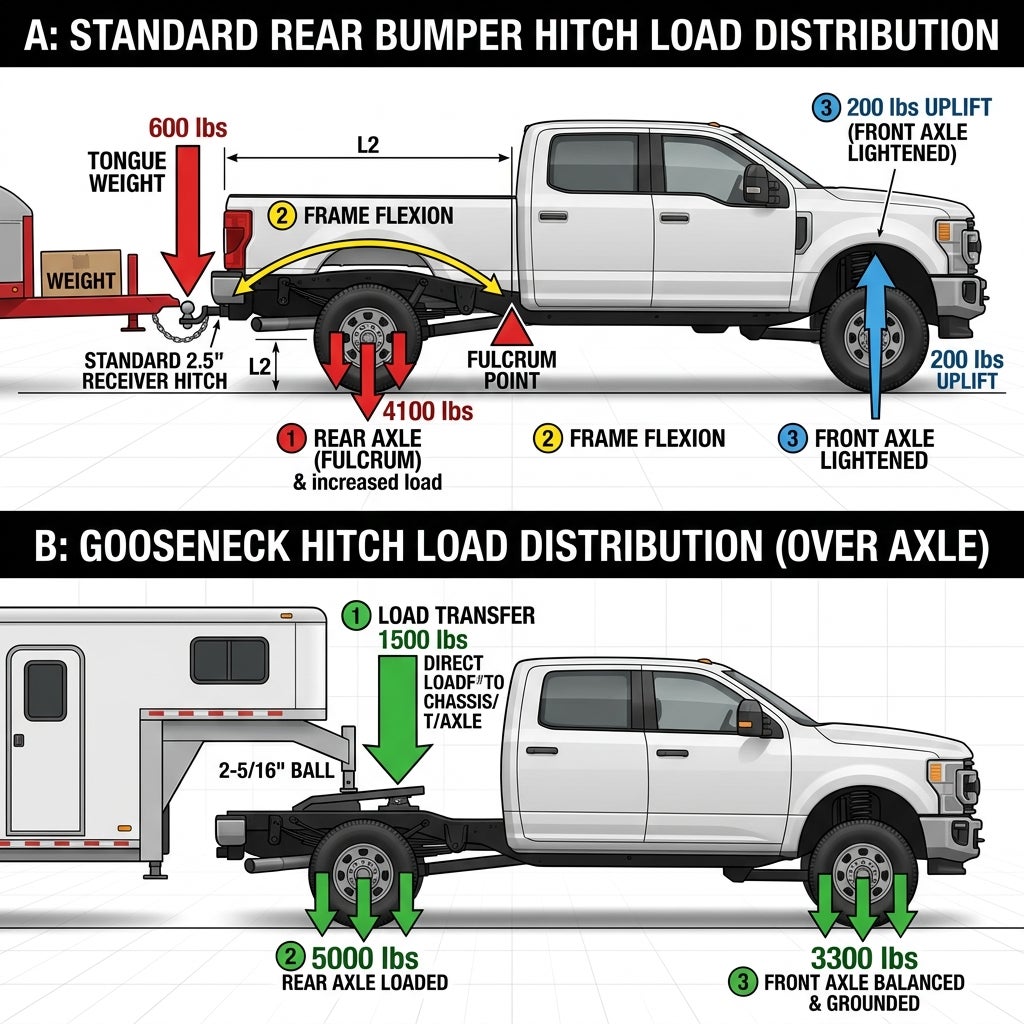





How Do Gooseneck Hitch Ratings Differ From Standard Receiver Hitches for Heavy Farm Loads? When transporting heavy agricultural loads across Kansas pastures and highways, understanding the mechanical and rated differences between gooseneck hitches and traditional rear receiver hitches is essential for safety, vehicle longevity, and legal compliance. Gooseneck hitches mount directly inside the truck bed over or slightly in front of the rear axle, transferring the trailer's tongue weight straight into the vehicle frame and rear suspension chassis. This structural configuration enables massive towing capabilities—routinely between 30,000 to 38,000+ lbs Gross Trailer Weight Rating (GTWR) and vertical tongue weight capacities exceeding 7,500 lbs on heavy-duty pickups like the Ram 3500. In contrast, traditional bumper-mounted receiver hitches (Class 3 through Class 5) extend behind the rear bumper, creating a leverage arm that exerts upward force on the front axle while pushing down on the rear overhang. Class 5 commercial receivers max out at approximately 20,000 lbs GTWR and 2,000 to 2,400 lbs of tongue weight. For Flint Hills producers hauling cattle trailers, heavy seed tenders, round bales, or combines, switching to a gooseneck setup drastically reduces trailer sway, restores front axle steering authority, and unlocks full heavy-duty payload potential. Gooseneck vs. Standard Receiver Hitches: Weight Ratings and Distribution Mechanics The Physics of Receiver Hitches: A rear receiver hitch connects 3 to 4 feet behind the truck's rear axle centerline. When you place 2,000 lbs of tongue weight on that ball, physics turns the rear axle into a fulcrum. This leverages weight away from your front tires, lifting the front end, lifting headlight beams into oncoming traffic, and degrading steering precision and front braking efficacy. Even with weight distribution bars, mechanical transfer remains constrained by bumper frame flex. The Gooseneck Advantage: By anchoring a 2-5/16-inch hitch ball directly to cross-members integrated into the truck frame over the rear axle, vertical forces compress the rear leaf or air suspension directly down into the tires. The front axle retains full pavement contact, preserving emergency braking, steering dynamics, and wheel alignment integrity when navigating muddy farm lanes or unpaved rural roads. For agricultural operators in Clay, Ottawa, and Geary counties, this fundamental physics distinction determines whether a loaded livestock or grain trailer feels balanced and predictable at highway speeds or unstable in crosswinds. Comparing Tongue Weight, Max GTWR, and Axle Load Dynamics on Farm Trucks To visualize how tow ratings scale across hitch classes and mounting configurations, review the key structural metrics below before selecting equipment for your agricultural operations: Hitch Category / System Mounting Location Max GTWR Range Max Tongue Weight Primary Ag Applications Class 3 Receiver Rear Frame / Bumper 5,000 – 8,000 lbs 500 – 800 lbs Utility trailers, small ag sprayers Class 4 Receiver Rear Frame Rail 10,000 – 12,000 lbs 1,000 – 1,200 lbs Medium equipment, small livestock tandem Class 5 Heavy Duty Receiver Rear Chassis Frame 18,000 – 20,000 lbs 1,800 – 2,400 lbs Large bumper-pull grain trailers, skid steers Gooseneck Hitch System In-Bed Over Rear Axle 30,000 – 38,500+ lbs 7,500 – 9,500 lbs Heavy livestock, multi-bale trailers, combines Class 3 to 5 Limits: Standard receiver hitches excel for general farm maintenance, moving diesel fuel tanks, or pulling light implement trailers. However, once combined trailer and load weights cross 15,000 lbs, vertical leverage causes excessive frame twist and severe rear squat. Gooseneck Authority: Anchoring the hitch directly to the vehicle chassis frame rails permits tongue weight ratios up to 20-25% of total trailer weight without exceeding rear Gross Axle Weight Ratings (GAWR), providing unmatched stability for shiftable livestock or grain loads. Sway Elimination: Because the trailer pivot point aligns with the rear axle centerline, lateral side-winds and shifting live cargo produce minimal torque on the truck chassis, eliminating the dangerous fishtailing common with heavy bumper-pull trailers. What Are the Payload Limit Differences Between Fifth-Wheel and Gooseneck Hitches? While both fifth-wheel and gooseneck hitches mount inside the truck bed over the rear axle, their mechanical designs serve distinct purposes on Kansas farms. Fifth-wheel hitches utilize a large plate mechanism and pin box primary to large recreational vehicles and specialized semi-style haulers. Gooseneck hitches utilize a compact 2-5/16-inch ball coupler that occupies minimal bed footprint. When unhitched or equipped with a flip-ball design, the gooseneck system leaves an entirely flat truck bed for hauling feed sacks, toolboxes, hay bales, or fencing materials. Furthermore, gooseneck ball hitches provide superior multi-axis articulation when traversing rutted pasture trails, steep terrace dips, and uneven field entrances. While fifth-wheel heads have limited side-to-side tilt angles, a gooseneck coupler rotates smoothly over a spherical ball, preventing binding and frame stress under extreme off-road terrain angles. Factory-installed Mopar gooseneck prep packages on Ram 2500 and Ram 3500 trucks include heavy-duty frame cross-members, integrated bed pucks, and chassis electrical connectors engineered specifically for maximum agricultural durability. Explore Commercial Work Trucks What Gross Vehicle Weight Rating (GVWR) Determines If a Harvest Truck Needs a CDL in Kansas? Federal & Kansas GCWR Thresholds: In Kansas, a Commercial Driver's License (CDL) is required when the Gross Combination Weight Rating (GCWR)—the manufacturer's assigned weight rating of the truck plus trailer—exceeds 26,001 lbs, provided the trailer's GVWR exceeds 10,000 lbs. Because gooseneck trailers routinely carry GVWRs of 14,000 to 24,000 lbs, pairing one with a Ram 3500 (GVWR 14,000 lbs) easily surpasses the 26,001 lb threshold on paper. Kansas Agricultural Exemptions: Kansas law provides critical exemptions for farmers, farm employees, and family operators. Under Kansas Statute, covered farm vehicles operated by a farmer, carrying ag products, machinery, or supplies within 150 air miles of the farm are exempt from CDL requirements when registered under farm plates, even if the GCWR exceeds 26,001 lbs. Note: Custom harvest operators, commercial custom haulers, or trips crossing state lines outside reciprocal ag boundaries must strictly maintain CDL compliance and DOT health cards. What Are the Registration and Insurance Fee Differences Between Class 3 and Class 5 Trucks in Kansas? Class 3 Heavy-Duty (e.g., Ram 3500): GVWR: 10,001 to 14,000 lbs. • Annual Kansas Tag Fee: $150 – $350 depending on farm vs. commercial designation. • Personal Property Tax: Assessed locally in Geary, Clay, or Ottawa county based on vehicle value. • Commercial Insurance: Lower baseline rates for personal/farm utilization. Class 5 Medium-Duty (e.g., Ram 5500 Chassis Cab): GVWR: 16,001 to 19,500 lbs. • Annual Tag Fee: $450 – $800+ under registered gross weight schedules. • Commercial Fleet Policies: Requires commercial liability coverage brackets. • Property Tax: Classified under commercial or agricultural equipment schedules. Financial Strategy for Ag Operators: Choosing between a Class 3 pickup and a Class 5 chassis cab involves weighing higher registration and policy premiums against massive frame payload upgrades, larger braking packages, and prolonged service life when pulling maximum 30,000+ lb harvest loads daily. How Should Heavy-Duty Truck Tire Pressure Be Adjusted When Towing Maximum Harvest Payloads? Cold Inflation for Full Payloads: Tire pressure management is critical when subjecting heavy-duty trucks to gooseneck pin weights exceeding 6,000 lbs. When operating unloaded around town, running maximum cold pressure (e.g., 80 PSI rear) causes severe center tread wear and harsh ride quality. However, when hitching to maximum harvest loads, tires MUST be inflated to their full sidewall cold rating (typically 80 PSI for Load Range E/F) to prevent excessive sidewall flexing. Dual Rear Wheel (DRW) Considerations: On dual-rear-wheel Ram 3500 trucks, equal inflation between inner and outer duals is vital. Unequal pressure causes the tighter tire to carry disproportionate weight, leading to thermal buildup, ply separation, or sudden blowout under heavy field loads. Under-inflated sidewalls generate rapid internal thermal friction at highway speeds. Always check tire pressures in the cold morning before heading out into the Flint Hills fields. Explore Heavy-Duty Ag-Ready Trucks and Towing Accessories at Valor CDJR At Valor CDJR in Junction City, KS, we specialize in equipping Central Kansas agriculture producers with heavy-duty vehicles built for serious work. Our inventory includes factory-prepped Ram 2500, Ram 3500, and Ram Chassis Cab models equipped with the legendary 6.7L Cummins® Turbo Diesel engine, factory fifth-wheel/gooseneck prep packages, integrated trailer brake controllers, power-folding trailer tow mirrors, and auto-level rear air suspension. View our New Vehicle Listings today to find your harvest-ready pickup. Browse New Ram Truck Inventory How Often Should Transmission Fluid Be Changed on Heavy-Duty Trucks Towing Heavy Loads? Severe-Duty Schedule: While owner manuals quote normal fluid intervals up to 60,000+ miles, agricultural towing falls strictly under severe-duty operation. Continuous heavy gooseneck hauling breaks down fluid friction modifiers rapidly. We recommend transmission fluid and filter changes every 30,000 to 45,000 miles for Aisin and 68RFE automatic transmissions. Thermal Friction Control: Fluid temperatures spiking above 220°F cause oxidation and varnish accumulation on valve bodies and clutch plates. Timely fluid flushes remove particulate wear debris generated during heavy low-speed maneuvering in field entrances. Cooler System Checks: During every service, ensure transmission cooler fins are cleared of chaff, dirt, and road debris. Proper airflow through auxiliary coolers is your primary defense against transmission overheating during hot September harvest runs. Fall Harvest Towing Checklist: Preparing Heavy-Duty Trucks in Clay and Ottawa Counties Before hauling grain or heavy machinery across Clay, Ottawa, and Geary county routes this fall, perform this critical pre-harvest safety check: • Gooseneck Ball & Latch: Inspect hitch ball for pitting or excessive wear; grease hitch ball and verify safety latch spring mechanism moves freely. • Trailer Wiring Harness: Test 7-way blade connector pins for corrosion; verify electric brake power and turn signals. • Emergency Breakaway System: Test breakaway switch cable and verify 12V breakaway battery holds full charge. • Brake Pad Thickness: Inspect front and rear truck brake pads; ensure at least 5mm friction material remains. • Differential Fluid: Check rear axle differential fluid level and change if contaminated after river crossings or heavy mileage. Need quick maintenance before harvest peaks? Stop by our Express Lane for quick oil changes, tire pressure checks, and fluid inspections without an appointment. How Much Does a Pre-Harvest Heavy-Duty Truck Inspection and Service Cost? Multipoint Inspection & Safety Check: Estimated Cost: $120 – $220 Includes complete chassis, brake pad depth, suspension linkage, gooseneck hardware, and 7-way lighting diagnostic. Fluid Flush & Filter Service: Estimated Cost: $350 – $650 Severe-duty transmission fluid swap, heavy-duty fuel filter dual replacements (Cummins® diesel), and rear differential gear lube service. Hitch & Brake Maintenance: Estimated Cost: $150 – $300 Integrated brake controller output calibration, gooseneck puck torque verification, and electric brake system testing via our certified Service Scheduler. Maximize Trade-In Value and Secure Ag Financing in Junction City, KS Upgrading your harvest fleet is a strategic business decision. At Valor CDJR, we work directly with local producers across Junction City, Manhattan, and rural Kansas to maximize trade-in allowances on older farm trucks and commercial haulers. Submit your vehicle details via our Trade In Evaluation tool to receive a competitive valuation. We offer flexible agricultural finance programs, seasonal payment schedules aligned with crop harvest cycles, and guidance on Section 179 tax deductions for qualifying commercial farm equipment. Fill out our online application to Get Pre-Approved in minutes. Visit us in person or Get Directions to Valor CDJR located conveniently at 1825 Goldenbelt Blvd. Value Your Farm Trade-In Schedule Your Pre-Harvest Truck Service or Heavy-Duty Test Drive at Valor CDJR Avoid downtime when grain bins are filling and harvest deadlines approach. Whether you need gooseneck hitch installation support, severe-duty transmission servicing, or a powerful new Ram 3500 dually with factory prep, Valor CDJR is your trusted heavy-duty truck partner in Geary, Riley, Clay, and Ottawa counties. Call us at (785) 238-5114 or book your service appointment online today. Schedule Pre-Harvest Service Now