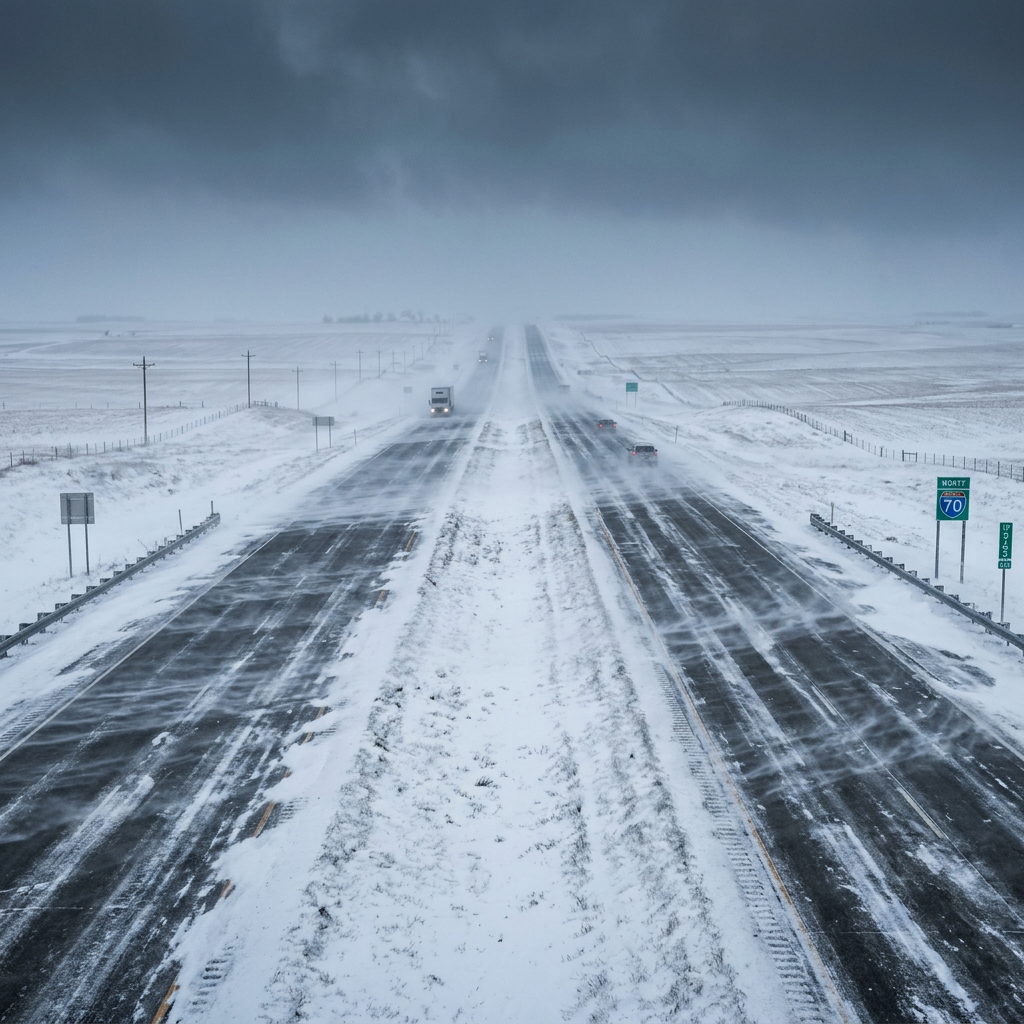





4WD High vs 4WD Low on I-70: The Direct Answer for Driving on Icy Kansas Highways When winter storms hit Central Kansas and transform Interstate 70 into a sheet of packed ice and slush between Junction City, Manhattan, and Salina, clear mechanical decision-making is essential. The practical recommendation for driving on icy highways like I-70 is to use 4WD High (or Auto / Snow Mode) when traveling at highway speeds, and to avoid using 4WD Low on an open interstate. Understanding the mechanical difference between 4WD High and 4WD Low can save your vehicle's drivetrain and prevent catastrophic accidents. Four-Wheel Drive High (4WD High) provides continuous four-wheel traction while maintaining full engine speed range, active vehicle electronic stability control (ESC), and wheel anti-lock braking systems (ABS). It is specifically engineered for slippery surfaces encountered at normal driving speeds, such as snow-covered interstates, slushy highways, and wet gravel roads. In contrast, Four-Wheel Drive Low (4WD Low) engages a secondary set of planetary gears within your vehicle's transfer case, dramatically multiplying gear reduction (typically 2.72:1 or up to 4.0:1 in Rubicon models). This massive torque multiplication is designed exclusively for extreme low-speed power under 25 mph—such as pulling a stranded vehicle out of a ditch or crawling out of deep snowdrifts. Attempting to drive in 4WD Low on open highways forces high engine RPMs at low speeds, mechanically locks front and rear driveshafts together, disables vital stability assistance systems, and risks severe driveline binding, mechanical failure, or sudden lock-up of wheels causing immediate loss of vehicle control. What Is the Maximum Safe Speed When Driving in 4WD Low versus 4WD High? 4WD Low Speed Operating Envelope: The absolute maximum mechanical safe speed when operating in 4WD Low is 25 mph. However, automotive engineers strongly recommend keeping speeds strictly below 15 mph when 4WD Low is active. Because 4WD Low uses maximum gear reduction to deliver extreme wheel torque, high engine speeds are generated at very low road speeds. Driving over 25 mph in 4WD Low causes internal transfer case overheating, extreme engine wear, and severe mechanical stress on front and rear differentials. Furthermore, turning on dry or partially clear pavement in 4WD Low can create driveline bind, where front and rear axles may rotate at different speeds during a turn and may lead to axle hopping or other drivetrain damage. 4WD High Speed Operating Envelope: 4WD High is designed for normal highway travel speeds adjusted for road conditions (typically up to 55–65 mph depending on icy surfaces). In 4WD High, full vehicle speed range is preserved, engine RPM remains in normal bands, and sophisticated vehicle electronics like Electronic Stability Control (ESC) and Anti-lock Braking Systems (ABS) remain fully operational to prevent spinouts on I-70. 4x4 Mode Feature 4WD High (4H / Auto) 4WD Low (4L) Max Safe Operating Speed Standard Highway Speeds (Adjusted for weather) Strictly Under 25 mph (Ideal < 15 mph) Transfer Case Reduction 1.0:1 (Direct Drive) 2.72:1 up to 4.0:1 (High Reduction) Active Stability Control (ESC) Fully Active Deactivated / Calibrated Off Anti-Lock Braking (ABS) Fully Active Modified Low-Speed Off-Road Mode Primary Use Case Icy interstates (I-70), packed snow, slush Deep snow drift extraction, severe mud, rock crawling How Jeep Selec-Terrain Management System Works in Snow and Ice Snow Mode Calibration When you rotate the console dial to Snow Mode in a Jeep Grand Cherokee, the system maintains the transfer case in 4WD High while altering vehicle behavior. It splits front-to-rear drive torque at a 60/40 ratio to maximize directional control. The transmission automatically launches in second gear rather than first to minimize initial wheelspin on frozen pavement. Auto Mode Intelligence In Auto Mode, the Selec-Terrain system continuously monitors wheel speed sensors, throttle position, and steering angle. If slip is detected along I-70, torque is instantly redirected to the axle with traction. However, selecting Snow Mode pre-emptively tunes throttle response to be smooth and progressive, preventing sudden wheel spin when accelerating on black ice. Mode Distinctions Unlike Sand/Mud Mode or Rock Mode (which engage 4WD Low and allow aggressive wheelspin to clear mud or climb obstacles), Snow Mode is specifically tailored to keep wheels glued to slick road surfaces by coordinating engine, transmission, braking, and transfer case controllers into full high-speed stability unison. How Quadra-Trac II Differs from Quadra-Drive II on Winter Roads Quadra-Trac II® System: Quadra-Trac II utilizes a two-speed active transfer case equipped with a center clutch pack. When wheel slip is detected by vehicle sensors, the system can route up to 100% of available engine torque to the axle with the most grip. On cross-axle slip, Quadra-Trac II utilizes Brake Lock Differential (BLD) technology—applying individual brakes to a spinning wheel so torque naturally flows across the open differential to the wheel on solid surface. Quadra-Drive II® with Rear ELSD: Quadra-Drive II builds upon Quadra-Trac II by incorporating a rear Electronic Limited-Slip Differential (ELSD). Instead of waiting for a wheel to spin and applying the brake, the rear ELSD uses electronic clutch packs to anticipate slip. On patch-ice highways like I-70 or packed gravel roads in Riley County, Quadra-Drive II can transfer up to 100% of available rear engine torque to a single rear wheel, providing unrivaled winter acceleration and cornering stability. Browse New 4x4 Inventory Is a Jeep Grand Cherokee 4x4 Worth the Extra Cost over a 2WD Model for Kansas Winter Driving? Severe Flint Hills Weather Kansas winter weather is infamous for rapid thermal drops. A morning rain can freeze into black ice on I-70 within an hour. While 2WD vehicles rely solely on front or rear traction, a 4x4 Jeep Grand Cherokee distributes motive force across all four tire contact patches, drastically reducing initial wheelspin and enabling confident hill climbing throughout the rolling Flint Hills terrain. Superior Resale Value Retention In Geary, Riley, and Saline counties, pre-owned vehicle buyers prioritize four-wheel-drive capabilities. 4x4 SUVs may retain value well on the Midwest pre-owned market compared with some 2WD variants, which can make them a practical choice for winter driving. Uncompromising Emergency Safety Whether navigating unplowed backroads near Fort Riley or coping with sudden ground blizzards between Junction City and Salina, 4x4 provides safety margins that 2WD simply cannot match. With 4WD High and Selec-Terrain, drivers gain emergency maneuverability when avoiding road hazards on ice. Navigating I-70 Winter Hazards Between Junction City, Manhattan, and Salina Driving Interstate 70 in Central Kansas presents unique geographical and atmospheric challenges during winter. The corridor between Junction City (Exit 296), Manhattan (via K-18 / K-177), and Salina is prone to intense crosswinds sweeping across open prairie ridges. High lateral wind gusts combined with slick highway surfaces can easily push high-profile vehicles out of their lane. Operating in 4WD High increases vehicle directional tracking stability, giving the driver better steering control against crosswind buffeting. Elevated bridge decks—such as the bridges over the Republican River near Junction City and the Smoky Hill River near Salina—freeze long before adjacent roadbeds due to air circulating beneath the bridge structure. Drivers transitioning from wet pavement to invisible black ice on bridges require smooth throttle management. Avoid sudden braking or hard steering inputs; let your vehicle's 4WD High system and anti-lock systems assist stability without jarring gear shifts. If you need local route guidance or emergency assistance, you can Get Directions to Valor CDJR for expert vehicle support. When Dedicated Winter Tires Beat Factory All-Seasons on Rural Gravel and Early-Morning Commutes Rubber Thermodynamics Below 45°F Factory all-season tire rubber compounds begin to harden and lose elasticity when ambient temperatures drop below 45°F (7°C). Once hardened, all-season tires cannot flex into road micro-textures, significantly lengthening stopping distances on icy pavement regardless of whether your vehicle is 2WD or 4x4. Dedicated winter tires feature specialized hydrophilic rubber compounds that remain soft in sub-zero weather, combined with thousands of microscopic sipes that create biting edges on glare ice. Rural Gravel & 3PMSF Performance For early morning commuters near Junction City, Fort Riley, and rural Geary/Riley counties, unpaved gravel roads present a mixture of frozen mud, rutted gravel, and drifting snow. Tires carrying the 3-Peak Mountain Snowflake (3PMSF) rating offer up to 30% shorter stopping distances on packed snow than standard M+S rated all-seasons. While 4WD accelerates your vehicle, only tire tread grip stops it. Order Winter Tires & Accessories Step-by-Step Guide: How to Shift into 4WD Low to Get Unstuck from Deep Snow Drifts Step 1: Complete Stop & Neutral Shift Bring your vehicle to a complete stop. Press the brake pedal firmly and shift the main automatic transmission lever into NEUTRAL (N). Shifting into 4WD Low while in Drive or Reverse will cause gear clash or transfer case lock-out rejection. Step 2: Engage 4WD LOW Button Press and hold the 4WD LOW switch (or rotate the dial to 4L / Rock mode). Wait until the instrument cluster display turns solid with the 4WD LOW indicator light before shifting transmission back into Drive or Reverse. Step 3: Gentle Rocking & Return to 4H Disable Traction Control to allow wheel spin if rocking out of deep drifts. Apply gentle throttle (do not exceed 15 mph). Once freed onto paved or cleared road surfaces, stop, shift to NEUTRAL, and switch back to 4WD HIGH immediately. Essential Pre-Winter Maintenance Checklist for 4x4 Transfer Cases and Differentials 4x4 Fluid Inspection & Service: Before severe freeze cycles arrive in Geary County, inspecting your 4x4 drivetrain fluid condition is vital: Transfer Case Fluid: Fresh synthetic transfer case fluid ensures rapid clutch engagement and internal cooling when shifting between 4WD High and 4WD Low. Front & Rear Differential Gear Oils: Inspect gear oil for water contamination or metal shavings. Cold temperatures increase fluid viscosity; fresh fluid prevents cold-start wear. Brake Lock Differential Sensor Checks: Verify wheel speed sensor harnesses are free of debris and corrosion. Battery & Electrical System Health: Extreme cold places severe loads on your vehicle's 12-volt battery. 4x4 electronic transfer case actuators, ELSD solenoids, and Selec-Terrain modules require steady electrical voltage. A battery with degraded Cold Cranking Amps (CCA) can fail to shift your transfer case when freezing temp drops occur overnight. Component Inspection Interval Recommended Winter Action Transfer Case Fluid Every 30,000 - 60,000 Miles Check level & fluid clarity before November freezes Front & Rear Differentials Every 20,000 - 40,000 Miles Replace fluid if exposed to deep mud/water Tread Depth (Winter) Monthly Ensure minimum 4/32" tread (6/32" preferred) Battery Health (CCA) Bi-Annually Load-test battery for sub-zero performance Demystifying 4x4 Low-Range and Selec-Terrain: Safe Driving on I-70 and Rural Kansas Gravel Synthesizing safe 4x4 operational rules comes down to matching transfer case range with speed and surface traction. On open interstates like I-70 where speeds exceed 25 mph, keep your transfer case in 4WD High or Selec-Terrain Snow Mode. This maintains full vehicle control, engine cooling, ABS, and stability control systems without putting strain on driveline hardware. When venturing onto rutted gravel roads or unpaved farm lanes in Riley or Dickinson counties, loose gravel allows tire slippage that relieves driveline tension. However, reserve 4WD Low strictly for low-speed recovery scenarios under 15–25 mph where maximum gear reduction is needed to crawl out of heavy snowdrifts. If considering upgrading your current vehicle before peak winter, you can explore your vehicle's value with a Trade In Evaluation. Value Your Trade-In Winter Highway Survival Gear to Keep in Your Jeep for Central Kansas Travel Recovery Hardware 20 ft / 20,000 lb Heavy-Duty Tow Strap Collapsible Metal Snow Shovel Traction Boards / Escaper Mats Heavy Work Gloves & Ice Cleats Emergency Power & Warmth Portable Lithium Battery Jump Starter Mylar Thermal Blankets & Wool Throw LED Flashlight with Extra Batteries Non-Perishable Energy Bars & Water Visibility & Fluids Brass-Blade Ice Scraper & Snow Brush 2 Gallons Sub-Zero (-30°F) Washer Fluid LED Road Flares / Reflective Triangles First Aid Kit & Multi-Tool Prepare Your Vehicle for Winter Driving at Valor CDJR in Junction City If you want to prepare before the first severe blizzard, have your vehicle's 4x4 system inspected. At Valor CDJR in Junction City, our factory-certified Chrysler, Dodge, Jeep, and Ram technicians are ready to inspect your transfer case, test battery cold-cranking output, check differential fluids, and mount 3PMSF winter tires tailored for Central Kansas highways. Serving Junction City, Manhattan, Fort Riley, and Salina, Valor CDJR is your trusted regional authority for winter safety and 4x4 excellence. Call (785) 238-5114 or stop by our dealership located at 1825 Goldenbelt Blvd, Junction City, KS 66441 today. Schedule Winter Service