




Blog / Towing & Hauling Safety

Blog

All Towing & Hauling Safety Buying Guides New Vehicle Reviews Maintenance & Service Technology & Innovation Financing & Insurance Model Comparisons Safety Features New Vehicle Inventory Used Vehicle Guides Valor CDJR Trade in Advice Family & Lifestyle Vehicles Vehicle Financing & Trade-In Tips Dealership Sales Strategies KS Community Parts & Accessories Seasonal Vehicle Care Junction City Military & Veteran Benefits Automotive Repair Buying Guides & Dealership Services Financing & Trade-In Options Heavy-Duty Truck Features Off-Road & Adventure Vehicles Service Vehicle Ownership Care Hybrid & Electric Vehicles Military Vehicle Buying Guides Commercial Truck Reviews Parts Performance & Powertrain Vehicle Features & Accessories Automotive Recalls Dealership Inventory Highlights Dealership Visit Preparation Inventory & Pricing Insights Jeep Lifestyle & Accessories Military & Community Car Buying Programs Repair & Diagnostics Vehicle Maintenance & Preparation Vehicle Pricing Strategies Vehicle Safety & Compliance Vehicle Trade-In Tips Warranty & Coverage Automotive News Car Buying Tips Car Purchase Tips Commercial Fleet Management Commercial Vehicle Comparisons Dealer Profiles & Interviews Dealership Offers & Promotions Dealership Service Experience Financing & Insurance for Military Families Genuine Parts & Accessories Local Automotive Events OEM Parts & Warranty Coverage Pre-Owned Vehicle Sales Road Trip & Travel Tips Special Offers & Promotions Tailgating & Outdoor Adventures Tailgating & Outdoor Recreation Towing & Hauling Towing & Roadside Assistance Vehicle Registration & Legal Advice for Military Personnel Vehicle Repair & Diagnostics Vehicle Sales Experience Warranty & Protection Plans Agricultural Vehicles & Equipment Brake System Care Certified Pre-Owned Programs Commercial Vehicles Community & Military Support Initiatives Dealership Events Diesel Engine Technology Engine & Performance Insights Fleet & Upfit Buying Guides Luxury SUVs Out-of-State Purchasing Guides Part & Warranty Services Parts & Repair Reimbursement Recall & Warranty Repairs Seasonal Sales Events Technology & Innovation in Vehicle Service Vehicle Incentives & Promotions Vehicle Maintenance & Winter Care Vehicle Technology & Features Weekend Dealership Events and Services
How Do Gooseneck Hitch Ratings Differ From Standard Receiver Hitches for Heavy Farm Loads?

How Do Gooseneck Hitch Ratings Differ From Standard Receiver Hitches for Heavy Farm Loads?

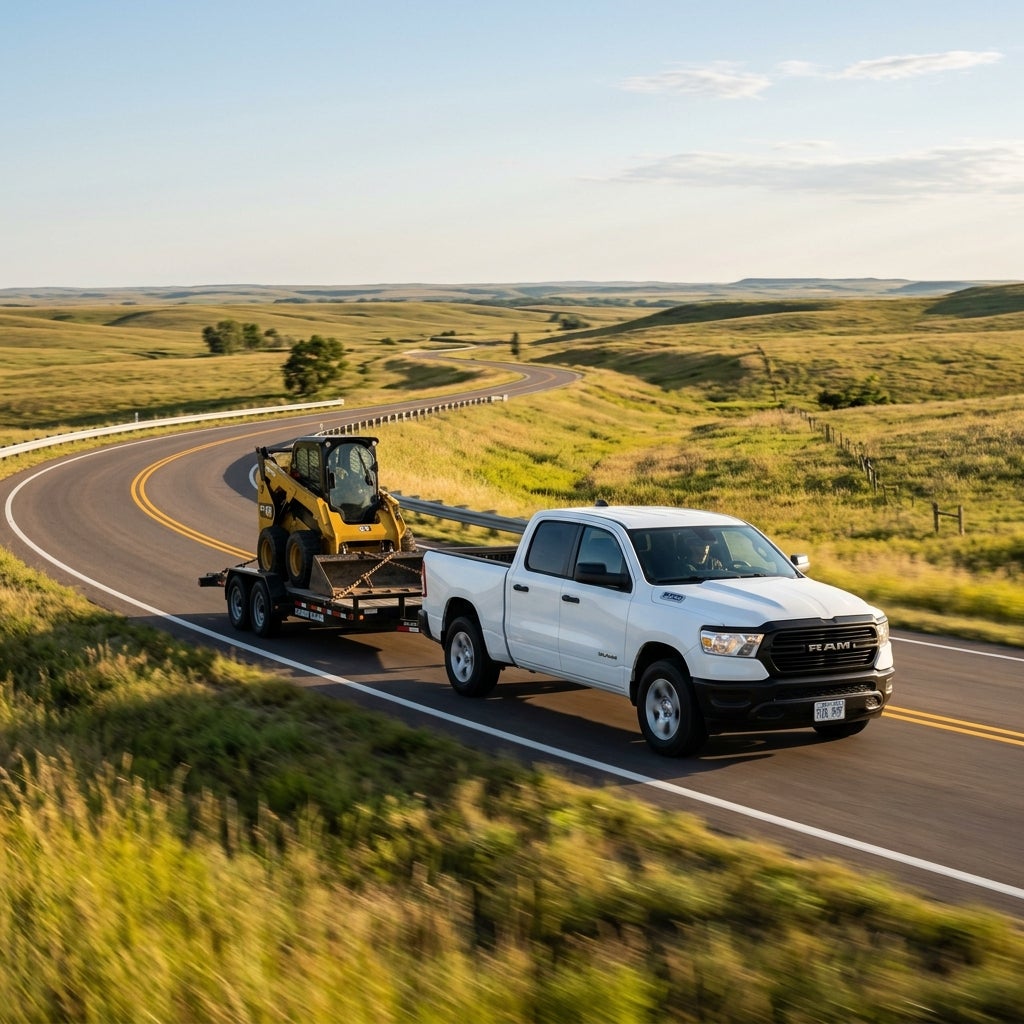
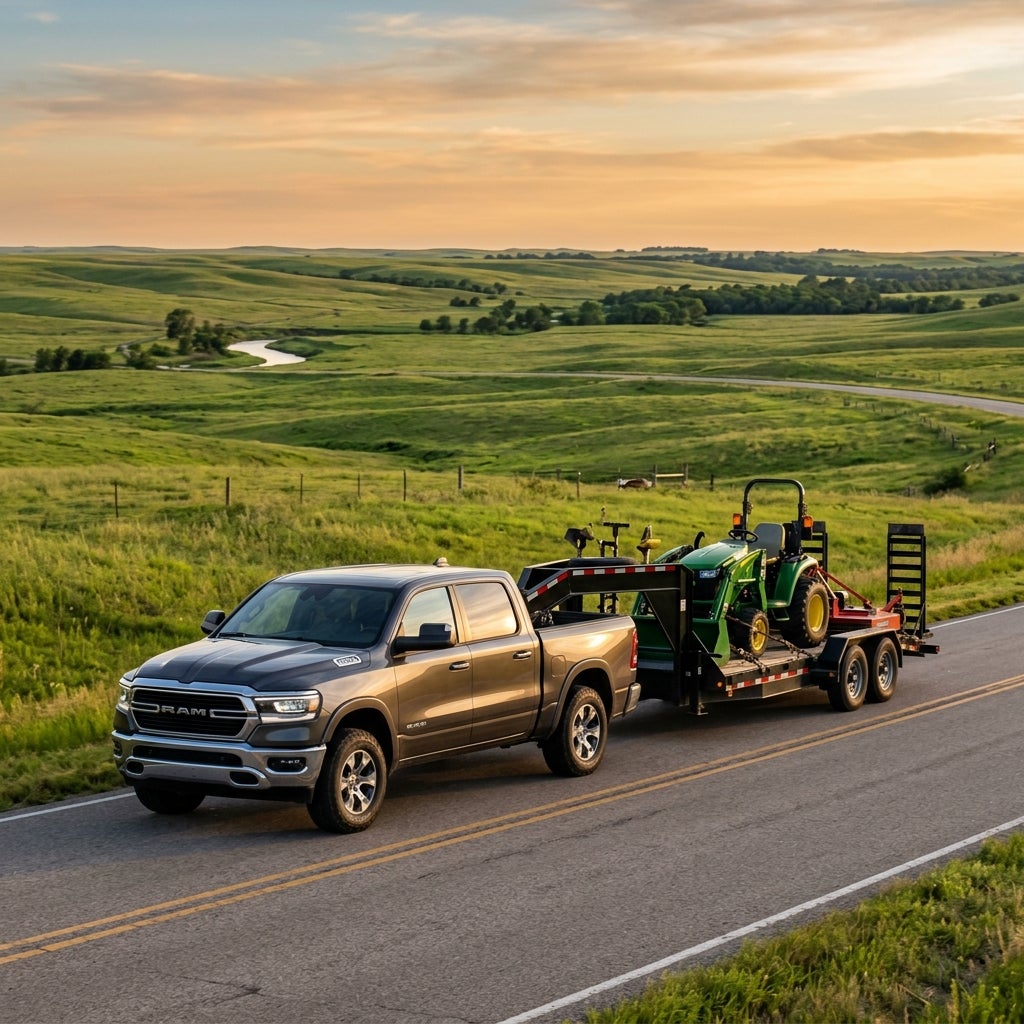
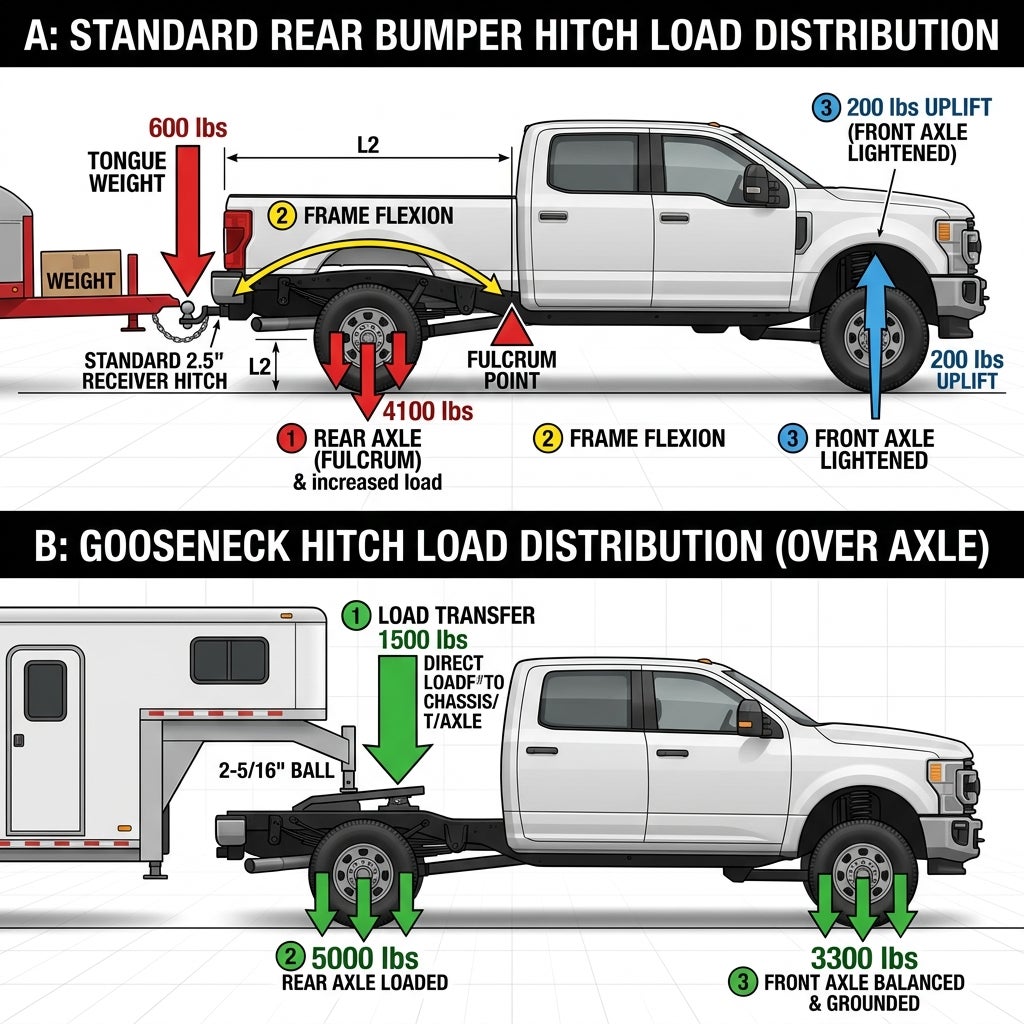
How Do Gooseneck Hitch Ratings Differ From Standard Receiver Hitches for Heavy Farm Loads? When transporting heavy agricultural loads across Kansas pastures and highways, understanding the mechanical and rated differences between gooseneck hitches and traditional rear receiver hitches is essential for safety, vehicle longevity, and legal compliance. Gooseneck hitches mount directly inside the truck bed over or slightly in front of the rear axle, transferring the trailer's tongue weight straight into the vehicle frame and rear suspension chassis. This structural configuration enables massive towing capabilities—routinely between 30,000 to 38,000+ lbs Gross Trailer Weight Rating (GTWR) and vertical tongue weight capacities exceeding 7,500 lbs on heavy-duty pickups like the Ram 3500. In contrast, traditional bumper-mounted receiver hitches (Class 3 through Class 5) extend behind the rear bumper, creating a leverage arm that exerts upward force on the front axle while pushing down on the rear overhang. Class 5 commercial receivers max out at approximately 20,000 lbs GTWR and 2,000 to 2,400 lbs of tongue weight. For Flint Hills producers hauling cattle trailers, heavy seed tenders, round bales, or combines, switching to a gooseneck setup drastically reduces trailer sway, restores front axle steering authority, and unlocks full heavy-duty payload potential. Gooseneck vs. Standard Receiver Hitches: Weight Ratings and Distribution Mechanics The Physics of Receiver Hitches: A rear receiver hitch connects 3 to 4 feet behind the truck's rear axle centerline. When you place 2,000 lbs of tongue weight on that ball, physics turns the rear axle into a fulcrum. This leverages weight away from your front tires, lifting the front end, lifting headlight beams into oncoming traffic, and degrading steering precision and front braking efficacy. Even with weight distribution bars, mechanical transfer remains constrained by bumper frame flex. The Gooseneck Advantage: By anchoring a 2-5/16-inch hitch ball directly to cross-members integrated into the truck frame over the rear axle, vertical forces compress the rear leaf or air suspension directly down into the tires. The front axle retains full pavement contact, preserving emergency braking, steering dynamics, and wheel alignment integrity when navigating muddy farm lanes or unpaved rural roads. For agricultural operators in Clay, Ottawa, and Geary counties, this fundamental physics distinction determines whether a loaded livestock or grain trailer feels balanced and predictable at highway speeds or unstable in crosswinds. Comparing Tongue Weight, Max GTWR, and Axle Load Dynamics on Farm Trucks To visualize how tow ratings scale across hitch classes and mounting configurations, review the key structural metrics below before selecting equipment for your agricultural operations: Hitch Category / System Mounting Location Max GTWR Range Max Tongue Weight Primary Ag Applications Class 3 Receiver Rear Frame / Bumper 5,000 – 8,000 lbs 500 – 800 lbs Utility trailers, small ag sprayers Class 4 Receiver Rear Frame Rail 10,000 – 12,000 lbs 1,000 – 1,200 lbs Medium equipment, small livestock tandem Class 5 Heavy Duty Receiver Rear Chassis Frame 18,000 – 20,000 lbs 1,800 – 2,400 lbs Large bumper-pull grain trailers, skid steers Gooseneck Hitch System In-Bed Over Rear Axle 30,000 – 38,500+ lbs 7,500 – 9,500 lbs Heavy livestock, multi-bale trailers, combines Class 3 to 5 Limits: Standard receiver hitches excel for general farm maintenance, moving diesel fuel tanks, or pulling light implement trailers. However, once combined trailer and load weights cross 15,000 lbs, vertical leverage causes excessive frame twist and severe rear squat. Gooseneck Authority: Anchoring the hitch directly to the vehicle chassis frame rails permits tongue weight ratios up to 20-25% of total trailer weight without exceeding rear Gross Axle Weight Ratings (GAWR), providing unmatched stability for shiftable livestock or grain loads. Sway Elimination: Because the trailer pivot point aligns with the rear axle centerline, lateral side-winds and shifting live cargo produce minimal torque on the truck chassis, eliminating the dangerous fishtailing common with heavy bumper-pull trailers. What Are the Payload Limit Differences Between Fifth-Wheel and Gooseneck Hitches? While both fifth-wheel and gooseneck hitches mount inside the truck bed over the rear axle, their mechanical designs serve distinct purposes on Kansas farms. Fifth-wheel hitches utilize a large plate mechanism and pin box primary to large recreational vehicles and specialized semi-style haulers. Gooseneck hitches utilize a compact 2-5/16-inch ball coupler that occupies minimal bed footprint. When unhitched or equipped with a flip-ball design, the gooseneck system leaves an entirely flat truck bed for hauling feed sacks, toolboxes, hay bales, or fencing materials. Furthermore, gooseneck ball hitches provide superior multi-axis articulation when traversing rutted pasture trails, steep terrace dips, and uneven field entrances. While fifth-wheel heads have limited side-to-side tilt angles, a gooseneck coupler rotates smoothly over a spherical ball, preventing binding and frame stress under extreme off-road terrain angles. Factory-installed Mopar gooseneck prep packages on Ram 2500 and Ram 3500 trucks include heavy-duty frame cross-members, integrated bed pucks, and chassis electrical connectors engineered specifically for maximum agricultural durability. Explore Commercial Work Trucks What Gross Vehicle Weight Rating (GVWR) Determines If a Harvest Truck Needs a CDL in Kansas? Federal & Kansas GCWR Thresholds: In Kansas, a Commercial Driver's License (CDL) is required when the Gross Combination Weight Rating (GCWR)—the manufacturer's assigned weight rating of the truck plus trailer—exceeds 26,001 lbs, provided the trailer's GVWR exceeds 10,000 lbs. Because gooseneck trailers routinely carry GVWRs of 14,000 to 24,000 lbs, pairing one with a Ram 3500 (GVWR 14,000 lbs) easily surpasses the 26,001 lb threshold on paper. Kansas Agricultural Exemptions: Kansas law provides critical exemptions for farmers, farm employees, and family operators. Under Kansas Statute, covered farm vehicles operated by a farmer, carrying ag products, machinery, or supplies within 150 air miles of the farm are exempt from CDL requirements when registered under farm plates, even if the GCWR exceeds 26,001 lbs. Note: Custom harvest operators, commercial custom haulers, or trips crossing state lines outside reciprocal ag boundaries must strictly maintain CDL compliance and DOT health cards. What Are the Registration and Insurance Fee Differences Between Class 3 and Class 5 Trucks in Kansas? Class 3 Heavy-Duty (e.g., Ram 3500): GVWR: 10,001 to 14,000 lbs. • Annual Kansas Tag Fee: $150 – $350 depending on farm vs. commercial designation. • Personal Property Tax: Assessed locally in Geary, Clay, or Ottawa county based on vehicle value. • Commercial Insurance: Lower baseline rates for personal/farm utilization. Class 5 Medium-Duty (e.g., Ram 5500 Chassis Cab): GVWR: 16,001 to 19,500 lbs. • Annual Tag Fee: $450 – $800+ under registered gross weight schedules. • Commercial Fleet Policies: Requires commercial liability coverage brackets. • Property Tax: Classified under commercial or agricultural equipment schedules. Financial Strategy for Ag Operators: Choosing between a Class 3 pickup and a Class 5 chassis cab involves weighing higher registration and policy premiums against massive frame payload upgrades, larger braking packages, and prolonged service life when pulling maximum 30,000+ lb harvest loads daily. How Should Heavy-Duty Truck Tire Pressure Be Adjusted When Towing Maximum Harvest Payloads? Cold Inflation for Full Payloads: Tire pressure management is critical when subjecting heavy-duty trucks to gooseneck pin weights exceeding 6,000 lbs. When operating unloaded around town, running maximum cold pressure (e.g., 80 PSI rear) causes severe center tread wear and harsh ride quality. However, when hitching to maximum harvest loads, tires MUST be inflated to their full sidewall cold rating (typically 80 PSI for Load Range E/F) to prevent excessive sidewall flexing. Dual Rear Wheel (DRW) Considerations: On dual-rear-wheel Ram 3500 trucks, equal inflation between inner and outer duals is vital. Unequal pressure causes the tighter tire to carry disproportionate weight, leading to thermal buildup, ply separation, or sudden blowout under heavy field loads. Under-inflated sidewalls generate rapid internal thermal friction at highway speeds. Always check tire pressures in the cold morning before heading out into the Flint Hills fields. Explore Heavy-Duty Ag-Ready Trucks and Towing Accessories at Valor CDJR At Valor CDJR in Junction City, KS, we specialize in equipping Central Kansas agriculture producers with heavy-duty vehicles built for serious work. Our inventory includes factory-prepped Ram 2500, Ram 3500, and Ram Chassis Cab models equipped with the legendary 6.7L Cummins® Turbo Diesel engine, factory fifth-wheel/gooseneck prep packages, integrated trailer brake controllers, power-folding trailer tow mirrors, and auto-level rear air suspension. View our New Vehicle Listings today to find your harvest-ready pickup. Browse New Ram Truck Inventory How Often Should Transmission Fluid Be Changed on Heavy-Duty Trucks Towing Heavy Loads? Severe-Duty Schedule: While owner manuals quote normal fluid intervals up to 60,000+ miles, agricultural towing falls strictly under severe-duty operation. Continuous heavy gooseneck hauling breaks down fluid friction modifiers rapidly. We recommend transmission fluid and filter changes every 30,000 to 45,000 miles for Aisin and 68RFE automatic transmissions. Thermal Friction Control: Fluid temperatures spiking above 220°F cause oxidation and varnish accumulation on valve bodies and clutch plates. Timely fluid flushes remove particulate wear debris generated during heavy low-speed maneuvering in field entrances. Cooler System Checks: During every service, ensure transmission cooler fins are cleared of chaff, dirt, and road debris. Proper airflow through auxiliary coolers is your primary defense against transmission overheating during hot September harvest runs. Fall Harvest Towing Checklist: Preparing Heavy-Duty Trucks in Clay and Ottawa Counties Before hauling grain or heavy machinery across Clay, Ottawa, and Geary county routes this fall, perform this critical pre-harvest safety check: • Gooseneck Ball & Latch: Inspect hitch ball for pitting or excessive wear; grease hitch ball and verify safety latch spring mechanism moves freely. • Trailer Wiring Harness: Test 7-way blade connector pins for corrosion; verify electric brake power and turn signals. • Emergency Breakaway System: Test breakaway switch cable and verify 12V breakaway battery holds full charge. • Brake Pad Thickness: Inspect front and rear truck brake pads; ensure at least 5mm friction material remains. • Differential Fluid: Check rear axle differential fluid level and change if contaminated after river crossings or heavy mileage. Need quick maintenance before harvest peaks? Stop by our Express Lane for quick oil changes, tire pressure checks, and fluid inspections without an appointment. How Much Does a Pre-Harvest Heavy-Duty Truck Inspection and Service Cost? Multipoint Inspection & Safety Check: Estimated Cost: $120 – $220 Includes complete chassis, brake pad depth, suspension linkage, gooseneck hardware, and 7-way lighting diagnostic. Fluid Flush & Filter Service: Estimated Cost: $350 – $650 Severe-duty transmission fluid swap, heavy-duty fuel filter dual replacements (Cummins® diesel), and rear differential gear lube service. Hitch & Brake Maintenance: Estimated Cost: $150 – $300 Integrated brake controller output calibration, gooseneck puck torque verification, and electric brake system testing via our certified Service Scheduler. Maximize Trade-In Value and Secure Ag Financing in Junction City, KS Upgrading your harvest fleet is a strategic business decision. At Valor CDJR, we work directly with local producers across Junction City, Manhattan, and rural Kansas to maximize trade-in allowances on older farm trucks and commercial haulers. Submit your vehicle details via our Trade In Evaluation tool to receive a competitive valuation. We offer flexible agricultural finance programs, seasonal payment schedules aligned with crop harvest cycles, and guidance on Section 179 tax deductions for qualifying commercial farm equipment. Fill out our online application to Get Pre-Approved in minutes. Visit us in person or Get Directions to Valor CDJR located conveniently at 1825 Goldenbelt Blvd. Value Your Farm Trade-In Schedule Your Pre-Harvest Truck Service or Heavy-Duty Test Drive at Valor CDJR Avoid downtime when grain bins are filling and harvest deadlines approach. Whether you need gooseneck hitch installation support, severe-duty transmission servicing, or a powerful new Ram 3500 dually with factory prep, Valor CDJR is your trusted heavy-duty truck partner in Geary, Riley, Clay, and Ottawa counties. Call us at (785) 238-5114 or book your service appointment online today. Schedule Pre-Harvest Service Now
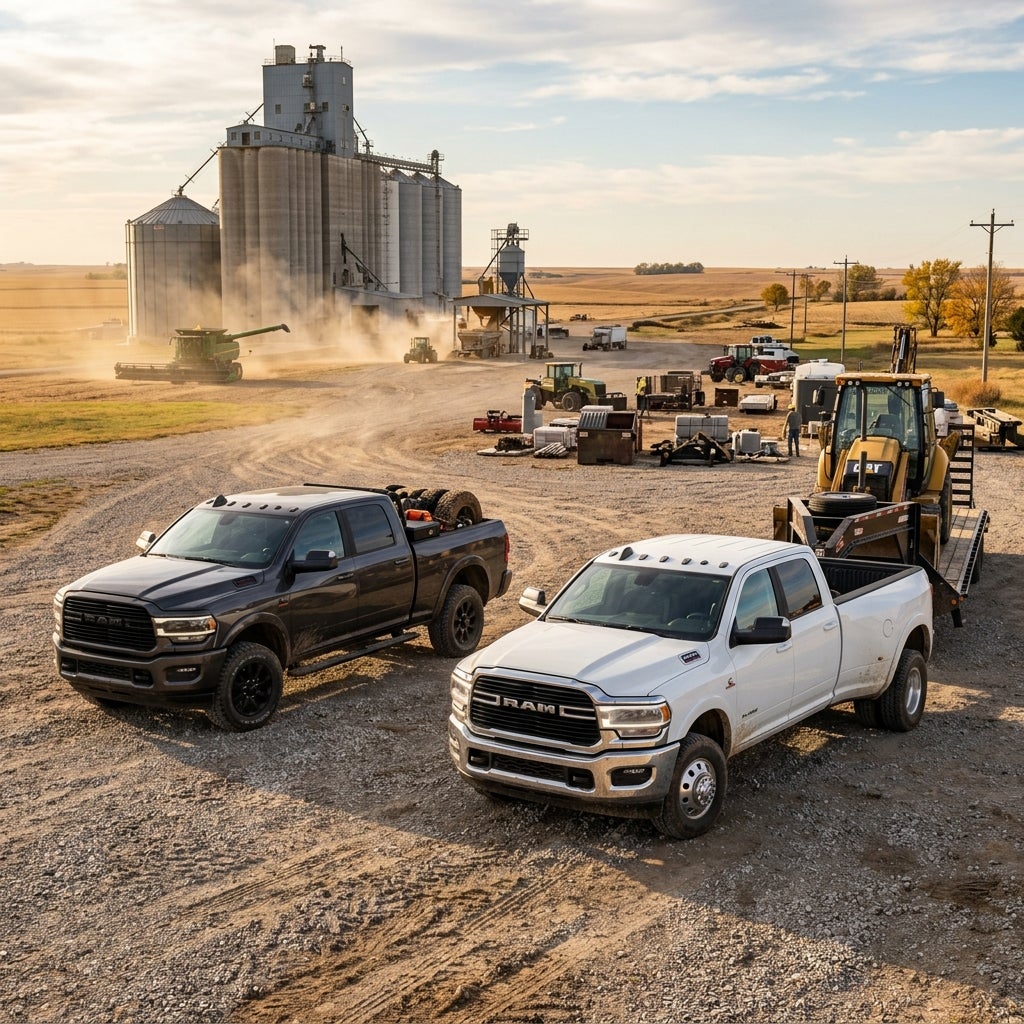
Ram 2500 vs. 3500 Cummins Heavy Duty Workhorses: Key Performance Capabilities

Ram 2500 vs. 3500 Cummins Heavy Duty Workhorses: Key Performance Capabilities

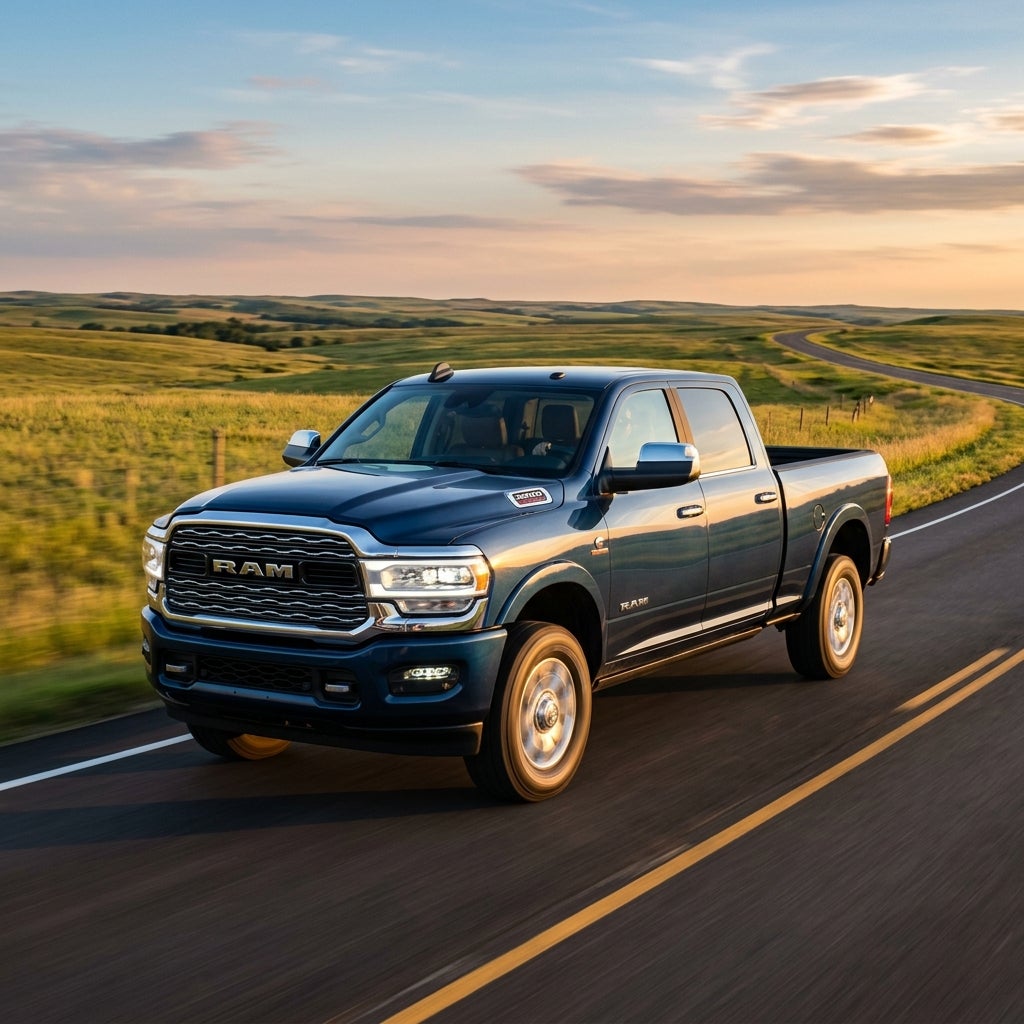
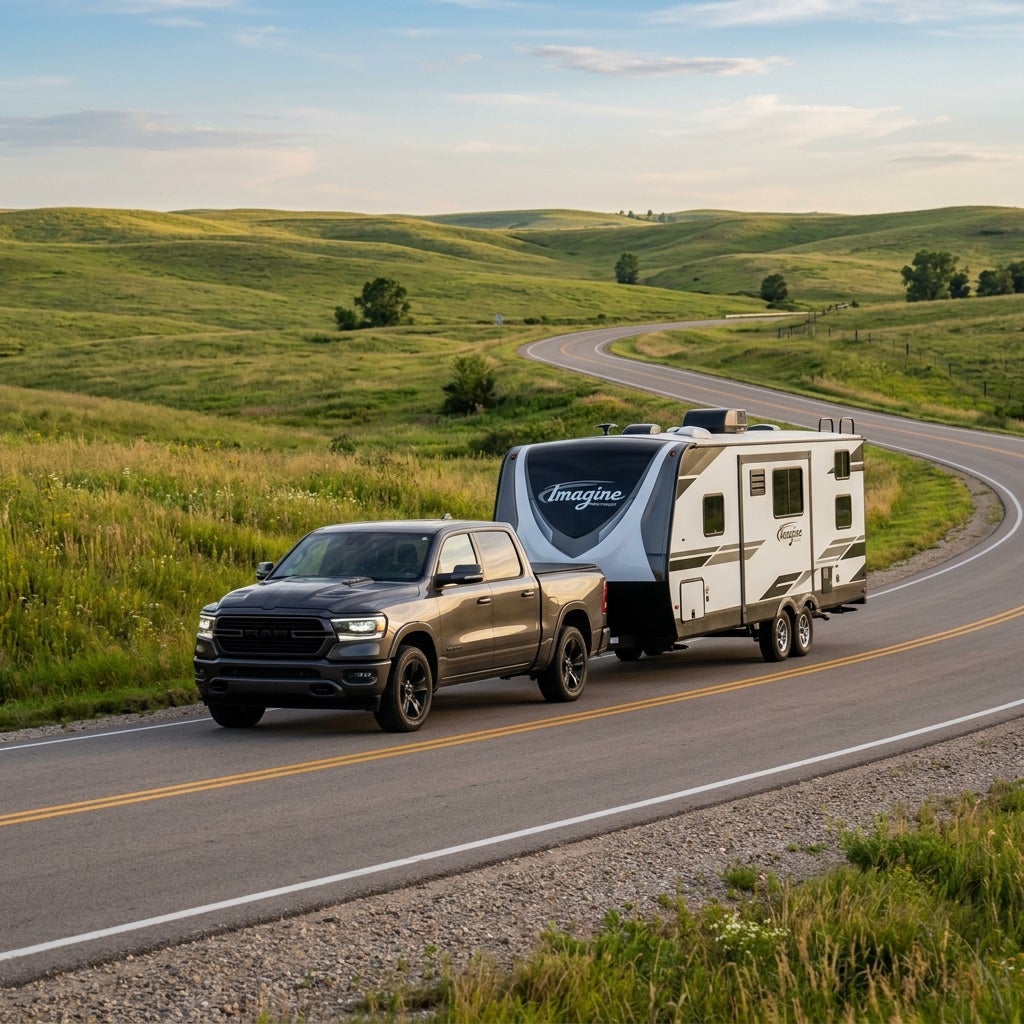
Ram 2500 vs. 3500 Cummins Heavy Duty Workhorses: Key Performance Capabilities When heavy machinery, multi-car trailers, or massive agricultural loads need to move across Kansas, commercial operators and serious truck enthusiasts turn to a legendary moniker: the Cummins Turbo Diesel. Embedded in the Ram Heavy Duty line, the 6.7L inline-six turbo diesel engine has established itself as a benchmark in industrial-grade pulling power. However, deciding between the Ram 2500 and the Ram 3500 requires a thorough understanding of how these twin heavy-duty titans deploy their powertrain options, chassis engineering, and rear suspension systems to serve different work profiles. The Ram 2500 comes equipped with the Standard Output 6.7L Cummins Turbo Diesel engine, pushing out a formidable 370 horsepower and 850 lb-ft of low-end torque. Designed with an industry-exclusive five-link rear coil suspension system (or optional rear air suspension), the Ram 2500 delivers maximum trailering capability up to 19,980 pounds while providing an extraordinarily smooth highway ride. In contrast, the Ram 3500 unlocks the optional High Output 6.7L Cummins Turbo Diesel, unleashing an incredible 420 horsepower and a earth-moving 1,075 lb-ft of torque. Paired with traditional heavy-duty rear leaf springs and available dual rear wheels (dually), the Ram 3500 elevates maximum towing capacities to an astonishing 37,090 pounds. Capability Metric Ram 2500 6.7L Cummins Ram 3500 6.7L High Output Cummins Horsepower 370 hp @ 2,800 rpm 420 hp @ 2,800 rpm Torque 850 lb-ft @ 1,700 rpm 1,075 lb-ft @ 1,800 rpm Transmission 68RFE 6-Speed Automatic Aisin AS69RC Heavy-Duty 6-Speed Maximum Towing Capacity Up to 19,980 lbs Up to 37,090 lbs Maximum Payload Capacity Up to 3,150 lbs Up to 6,840 lbs Rear Suspension Architecture Five-Link Coil Springs (Air Optional) Multi-Leaf Springs (Air Optional) What Are the Horsepower and Torque Specifications for the 6.7L Cummins Diesel in the Ram 2500 vs 3500? Standard Output 6.7L Cummins (Ram 2500 & 3500) The Standard Output (SO) 6.7L Cummins Turbo Diesel inline-six engine produces 370 horsepower and 850 lb-ft of torque. Built around a high-strength Compacted Graphite Iron (CGI) block, this engine architecture increases cylinder wall rigidity and thermal efficiency while reducing overall mass compared to traditional cast iron. Equipped with a Holset variable-geometry turbocharger (VGT), the Standard Output engine provides immediate boost at low crankshaft speeds. Maximum torque is achieved at a low 1,700 RPM, delivering immediate throttle response when starting up steep inclines with heavily loaded gooseneck trailers. Power is routed through the proven Ram 68RFE six-speed automatic transmission, optimized for smooth shifts and long-term durability under commercial duty cycles. High Output 6.7L Cummins (Ram 3500 Exclusive) For extreme heavy-haul applications, the High Output (HO) 6.7L Cummins variant elevates output to 420 horsepower and a staggering 1,075 lb-ft of torque. To withstand this extreme force, the High Output engine incorporates lightweight forged pistons, upgraded connecting rods, high-flow fuel injectors operating at over 29,000 PSI, and a higher-boost Holset VGT turbocharger setup. Generating 1,075 lb-ft of torque creates significant thermal and mechanical stresses. Consequently, Ram pairs the HO engine exclusively with the heavy-duty Aisin AS69RC six-speed automatic transmission. Featuring steel clutch plates, a heavy-duty torque converter, and advanced transmission cooling circuits, the HO Cummins configuration allows the Ram 3500 to pull severe loads up mountain passes without thermal degradation. Can You Get the High Output Cummins Turbo Diesel in a Ram 2500? A frequent question among heavy-duty truck buyers is whether the High Output 6.7L Cummins engine can be ordered on a Ram 2500. The definitive answer is **no**—the High Output Cummins Turbo Diesel is reserved exclusively for the Ram 3500 model line. This structural decision comes down to engineering constraints regarding chassis classification, cooling dynamics, and transmission size. The High Output Cummins requires the commercial-grade Aisin AS69RC six-speed automatic transmission to handle 1,075 lb-ft of torque reliably. The Aisin transmission features a substantially larger case, larger bellhousing, and beefed-up clutch packs that physical dimensions cannot fit without sacrificing ground clearance and packaging limits on the Ram 2500 chassis. Furthermore, class 2b trucks like the Ram 2500 are limited to a 10,000-lb Gross Vehicle Weight Rating (GVWR) to maintain driver license accessibility and vehicle classification standards. Adding the physical weight of the HO engine, the heavier Aisin transmission, and larger cooling modules would significantly decrease the Ram 2500's net payload capacity. Buyers needing maximum torque and extreme gooseneck capacities naturally migrate to the Ram 3500 line. What Is the Difference Between Ram 2500 and Ram 3500 Towing Capacity with the Cummins Diesel Engine? Ram 2500 Towing Characteristics The Ram 2500 Cummins tops out at **19,980 lbs** max tow rating. Its signature engineering feature is the proprietary five-link rear coil suspension. Unlike rigid leaf spring setups, multi-link coil springs dramatically reduce unladen rear chassis harshness, making the Ram 2500 the most comfortable daily-driver heavy-duty truck on the market. Ram 3500 SRW Towing Setup In Single Rear Wheel (SRW) configuration, the Ram 3500 replaces coil springs with heavy-duty multi-leaf rear springs. This increases max towing capacity up to approximately **22,670 lbs**. It offers a middle ground for drivers pulling heavy 5th-wheel RVs or mid-sized livestock trailers without requiring the wider track of a dually. Ram 3500 DRW (Dually) Towing When equipped with Dual Rear Wheels (DRW), 4.10 axle ratios, and the High Output Cummins diesel engine, the Ram 3500 becomes an unstoppable pulling platform rated up to **37,090 lbs** gooseneck towing. Dual rear tires spread heavy pin weight over four contact patches for maximum lateral stability. Browse Commercial Vehicle Inventory Does the Ram 2500 or Ram 3500 Cummins Have a Higher Payload Capacity? The **Ram 3500 Cummins** possesses a far higher payload capacity than the Ram 2500 Cummins. Payload represents the total weight a vehicle can carry in its bed and cabin, calculated by subtracting the curb weight from the Gross Vehicle Weight Rating (GVWR). Because the 6.7L Cummins cast-iron engine block weighs roughly 1,100 lbs (over 500 lbs heavier than a standard gas engine), it consumes a sizable portion of the Ram 2500’s fixed 10,000-lb GVWR limit. As a result, payload capacity for a diesel Ram 2500 typically ranges between **1,800 lbs and 3,150 lbs** depending on cab layout and trim level. The Ram 3500 operates under higher GVWR thresholds—up to 12,300 lbs for SRW models and up to 14,000 lbs for DRW dually models. This expanded structural rating allows the Ram 3500 Cummins to deliver net payload capabilities up to **6,840 lbs**. For commercial operators hauling heavy slide-in campers, bed-mounted auxiliary fuel tanks, or dense gravel, the Ram 3500 is necessary to stay legal and safe. How Does the Ram 2500/3500 Cummins Compare to the Ford F-250/F-350 Super Duty Power Stroke Diesel? Engine Architecture & Layout The fundamental difference lies in cylinder orientation: Ram utilizes an **Inline-6 (I-6)** engine design, whereas Ford utilizes a 6.7L Power Stroke V8. The inline layout features fewer moving parts (6 pistons vs 8, 1 cylinder head vs 2), providing unmatched mechanical simplicity and under-hood maintenance clearance. Torque Delivery & Exhaust Braking While Ford’s Power Stroke produces higher peak horsepower numbers on paper, the inline-six Cummins delivers its massive torque much earlier in the RPM band. Furthermore, Ram's smart variable-geometry exhaust brake provides superior hold-back control when descending steep grade hills without riding friction brakes. Cab Refinement & Longevity Ram Heavy Duty trucks are famous for class-leading interior quietness and premium cabin material options (such as Laramie, Limited Longhorn, and Limited trims). Combined with the long-term commercial heritage of Cummins industrial power plants, Ram offers superior overall cabin luxury and long-distance comfort. How Does Maximum Towing Compare Between Ram 3500 and Ford F-350 Super Duty? At the highest competitive levels of heavy-duty towing, both the Ram 3500 Cummins HO and Ford F-350 High Output Power Stroke push trailering metrics beyond 37,000 pounds. While raw paper figures trade back and forth across model years, real-world towing dynamics involve much more than just peak numbers. The Ram 3500 features a fully boxed hydroformed steel frame built with 98% high-strength steel and ten crossmembers. This ultra-rigid structural backbone minimizes frame flex when maneuvering tight gooseneck trailers into construction sites or barn yards. Factory gooseneck/5th-wheel prep packages integrate hitch mounting points directly into the frame crossmembers, complete with in-bed 7-pin electrical connectors. Additionally, Ram’s Trailer Reverse Steering Control and integrated digital rearview mirror system allow drivers to navigate long commercial trailers with heightened precision and reduced driver stress compared to Ford’s system. Browse New Vehicle Listings Does the Cummins Diesel Engine Option Hold Better Resale Value Than the Gas Engine? Historically and consistently in the pre-owned truck market, the **6.7L Cummins Turbo Diesel retains significantly higher resale value** over time compared to the 6.4L HEMI V8 gas engine. While the diesel engine carries a higher upfront option cost, buyers regularly recover a substantial percentage of that investment when trading in or selling their truck years down the line. The reason for this residual value gap comes down to operational lifespan and market demand. While a heavy-duty gas engine typically approaches overhaul considerations between 150,000 and 200,000 miles, a properly maintained 6.7L Cummins diesel engine is engineered for B10/B50 life durability extending well beyond 300,000 to 500,000 miles. In agricultural hubs and commercial hubs across Kansas, demand for clean, used Cummins-powered trucks remains exceptionally strong. Whether you plan to keep your truck for three years or ten, choosing the Cummins diesel platform shields you from rapid depreciation curves. Ready to see what your current truck is worth on trade toward a new Ram Cummins? Get an exact market estimate today with our fast Trade In Evaluation tool. Hauling Heavy Loads across Junction City and the Flint Hills Agricultural Corridor Flint Hills Agriculture & Ranching Ranchers moving cattle stock trailers through rolling hills around Geary, Riley, and Morris counties depend on the low-RPM grunt of the Cummins engine. Steeper terrain and rutted pasture routes demand maximum low-speed control and high thermal cooling capacities during hot Kansas summers. Fort Riley & Defense Logistics Contractors supporting operations near Fort Riley frequently transport heavy tracked equipment, generator trailers, and tactical supply loads. The Ram 3500 dually configuration offers stability against high crosswinds along open Kansas highway stretches. Routine Maintenance Tips to Maximize 6.7L Cummins Diesel Engine Lifespan To ensure your 6.7L Cummins Turbo Diesel reaches its full multi-hundred-thousand-mile potential, disciplined maintenance is essential. Key maintenance priorities include: 1. **Dual Fuel Filter Service**: The Ram 6.7L Cummins relies on a two-filter system—one engine-mounted 3-micron filter and one rear frame-mounted water separator. Replace both filters every 15,000 miles or 12 months without exception to protect delicate 29,000+ PSI common-rail injectors from water and debris contamination. 2. **Oil & Filter Changes**: Change heavy-duty diesel motor oil and filter every 7,500 to 10,000 miles (or according to severe duty oil life monitor prompts). Use high-grade 15W-40 or synthetic 5W-40 motor oil during cold Kansas winters. 3. **DEF & Emissions Maintenance**: Keep your Diesel Exhaust Fluid (DEF) tank filled with fresh, high-grade DEF fluid to prevent crystal buildup in injectors and SCR catalysts. Avoid storing DEF in direct sunlight during high heat periods. 4. **Winter Warm-Up Protocol**: When Kansas winter temps drop below freezing, utilize the factory engine block heater and allow the engine to warm up before towing heavy loads. Need genuine OEM Mopar diesel filters or quick maintenance service? Visit our dedicated Parts Department or pull into our Express Lane for fast oil and filter maintenance. Schedule Service Online Choosing the Right Cab, Bed, and Axle Ratio Configuration for Your Worksite Tailoring your Ram Heavy Duty truck to match your exact work demands requires selecting the optimal combination of cab size, bed length, and rear axle ratio: * **Cab Styles**: Choose **Crew Cab** for exceptional rear seat legroom and under-seat storage, or upgrade to the legendary **Mega Cab** for additional rear cabin comfort and reclining rear seats. * **Bed Lengths**: Pair your cabin with either a 6'4" standard bed (ideal for daily parking maneuverability and fifth-wheel trailering with a slider hitch) or an 8' long bed (maximum cargo area and direct fifth-wheel mount placement). * **Axle Ratios**: Select a **3.42 axle ratio** for optimal highway fuel economy during long unloaded trips, or opt for a **3.73 / 4.10 axle ratio** to maximize launch acceleration and heavy gooseneck towing power. Explore our latest New Vehicle Listings to filter Ram 2500 and 3500 inventory by cab, bed length, and gear ratios. Test Drive a Cummins-Powered Ram 2500 or 3500 at Valor CDJR in Junction City Whether you need the refined riding comfort and 19,980-lb towing capacity of a Ram 2500 Cummins, or the up to 37,090-lb pulling force of a Ram 3500 High Output dually, Valor CDJR is your premier heavy-duty truck center in central Kansas. Our knowledgeable truck specialists understand towing specs, GVWR limits, and commercial outfit requirements inside and out. Visit our showroom at 1825 Goldenbelt Blvd in Junction City to experience Cummins torque firsthand. You can Get Directions to Valor CDJR or Call us at (785) 238-5114 to speak directly with our commercial vehicle team. You can also start your purchase online today—simply apply online to Get Pre-Approved for flexible auto financing. Contact Us for Financing Information

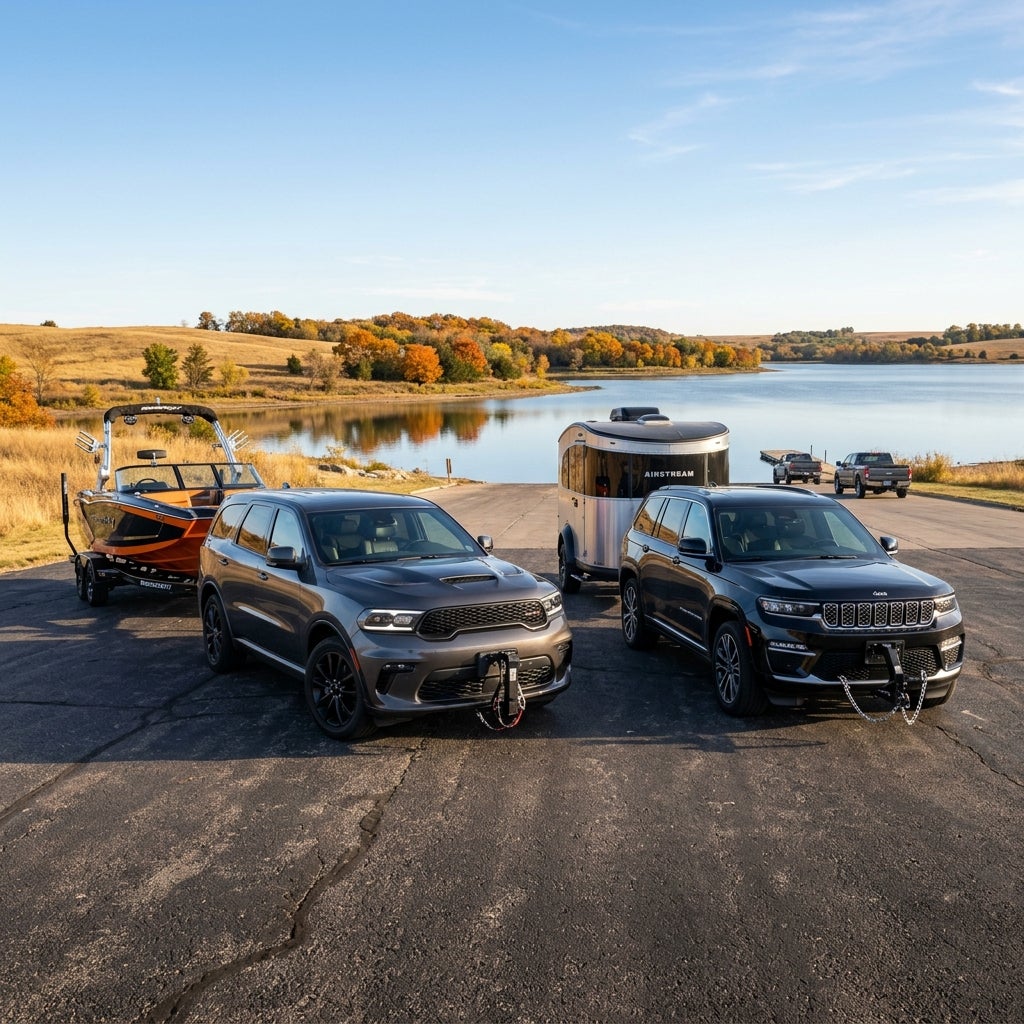
A grey Dodge Durango towing a boat and a black Jeep towing an Airstream trailer near a lake in autumn. (Representative image for illustration purposes only. Actual vehicle may vary based on trim and configuration.)

Dodge Durango Towing vs. Jeep Grand Cherokee L: Bottom-Line Towing Leader

Dodge Durango Towing vs. Jeep Grand Cherokee L: Towing Comparison Overview When evaluating heavy-duty capability in a full-size, three-row family crossover, towing maximums often define which vehicle earns a spot in your driveway. Drivers near Junction City and Manhattan, Kansas, frequently ask how two of Stellantis' most popular three-row SUVs stack up when hitching heavy loads. The key comparison is straightforward: the 2024 Dodge Durango is a strong heavy-duty towing option, boasting a class-topping maximum tow rating of up to 8,700 pounds when outfitted with its available 5.7L or 6.4L V8 engines and the specialized Tow N Go Package. By comparison, the Jeep Grand Cherokee L tops out at a respectable yet lower maximum towing rating of 6,200 pounds across both its standard 3.6L Pentastar V6 and available 5.7L HEMI V8 engine options. While both vehicles share impressive engineering heritage, their core missions diverge significantly. The Dodge Durango is engineered with an performance-focused character that prioritizes raw pulling power, aggressive torque delivery, and heavy-duty mechanical cooling. This makes it an ideal option for hauling 30-foot travel trailers, heavy livestock trailers, or large wakeboard boats to Milford Lake. Conversely, the Jeep Grand Cherokee L focuses on refined ride luxury, premium cabin quietness, and sophisticated 4x4 trail capabilities while retaining a solid 6,200-lb towing threshold that easily satisfies standard camper and recreational boating requirements. What Is the Towing Capacity of the 2024 Dodge Durango Across Engine Options? The 2024 Dodge Durango provides an exceptionally versatile range of powertrains designed to meet diverse driving and towing demands across Kansas. Understanding the specific capacity of each configuration is critical before hooking up your trailer: • 3.6L Pentastar® V6: Standard on SXT, GT, and Citadel trims, this legendary engine generates 295 horsepower and 260 lb-ft of torque. Coupled with an 8-speed automatic transmission, it delivers an impressive towing capacity of up to 6,200 lbs and payload ratings reaching nearly 1,400 lbs. • 5.7L HEMI® V8 (Standard): Standard on R/T models, this V8 produces 360 horsepower and 390 lb-ft of torque. Standard 5.7L setups provide a robust 7,400-lb maximum towing capacity. • 5.7L HEMI® V8 with Tow N Go Package: Outfitted with factory performance upgrades, the 5.7L Durango unlocks an extraordinary 8,700-lb towing rating. • 392 6.4L HEMI® V8 & SRT® Hellcat 6.2L Supercharged V8: Delivering 475 hp and 710 hp respectively, both SRT performance models come standard with an 8,700-lb maximum towing capacity. Engine Option Horsepower / Torque Max Tow Capacity 3.6L Pentastar V6 295 hp / 260 lb-ft 6,200 lbs 5.7L HEMI V8 Standard 360 hp / 390 lb-ft 7,400 lbs 5.7L V8 (Tow N Go) 360 hp / 390 lb-ft 8,700 lbs 6.4L SRT 392 V8 475 hp / 470 lb-ft 8,700 lbs 6.2L SRT Hellcat V8 710 hp / 645 lb-ft 8,700 lbs How Much Can the Jeep Grand Cherokee L Tow with V6 and V8 Powertrains? The 3-row Jeep Grand Cherokee L introduces refined architecture combined with standard-setting all-weather capability. However, its maximum towing capacities are structured differently than the Durango: • 3.6L Pentastar® V6: Standard on Laredo, Altitude, Limited, Overland, and Summit models, producing 293 hp and 260 lb-ft of torque. It achieves a maximum tow rating of 6,200 lbs when equipped with the factory Trailer Tow Package. • 5.7L HEMI® V8: Available on select high-tier 4x4 trims such as Overland and Summit, generating 357 hp and 390 lb-ft of torque. Interestingly, while the V8 provides extra low-end torque for smoother highway acceleration, Jeep caps the maximum towing rating of the Grand Cherokee L at 6,200 lbs. The Grand Cherokee L maintains a strict 620-lb maximum tongue weight restriction (10% of maximum trailer weight) and standard Gross Combined Weight Ratings (GCWR) tuned for luxury passenger transport and medium-duty trailering. While it does not reach the 8,700-lb limit of high-spec Durangos, 6,200 lbs is still plenty of power for single-axle camper setups, double-jet-ski trailers, and mid-sized utility loads. Drivers interested in exploring options can check our latest New Vehicle Listings to compare both models in person. Engine Option Horsepower / Torque Max Tow Capacity Max Tongue Weight 3.6L Pentastar V6 293 hp / 260 lb-ft 6,200 lbs 620 lbs 5.7L HEMI V8 357 hp / 390 lb-ft 6,200 lbs 620 lbs Which 2024 Dodge Durango Configurations Reach the 8,700-Pound Maximum Towing Capacity? Durango R/T Tow N Go Combines the 5.7L HEMI V8 with SRT-inspired hardware: adaptive damping suspension, active exhaust, Brembo brakes, electronic rear limited-slip differential, and heavy-duty cooling upgrades for 8,700 lbs of towing capacity. Durango SRT 392 Powered by a powerful 6.4L HEMI V8 delivering 475 horsepower. Comes factory equipped with all necessary heavy-duty mechanical cooling, trailer brake controller, and dynamic drive modes to pull up to 8,700 lbs from the factory. Durango SRT Hellcat Features a supercharged 6.2L V8 boasting 710 hp and 645 lb-ft of torque. Offers a balance of track-ready acceleration and 8,700-lb towing capability for your heaviest recreational trailers. Browse New Tow-Ready Inventory What Features Are Included in the Dodge Durango Trailer Tow Group IV? Achieving peak towing figures in the Dodge Durango requires ordering or installing factory-backed equipment package options. The Trailer Tow Group IV package provides essential heavy-duty hardware tailored for demanding towing tasks: • Class IV Hitch Receiver: Heavy-duty receiver rated to handle maximum vehicle trailer loads. • 4-Pin & 7-Pin Wiring Harness: Integrated connectors for standard auxiliary trailer power and dynamic lighting. • Integrated Trailer Brake Controller: Dash-mounted electronic brake controller allows drivers to fine-tune trailer electric brake intensity on the fly. • Rear Load-Leveling Air Suspension: Automatically adjusts rear ride height under heavy tongue weights to preserve level vehicle posture and headlight alignment. • Heavy-Duty Engine Cooling: High-capacity radiator and high-output alternator handle elevated thermal loads while towing up long Flint Hills grades. • Full-Size Spare Tire: Ensures peace of mind during long-distance road trips across Central Kansas. Does the Dodge Durango Have Electronic Trailer Sway Control and Safety Tow Tech? Yes! Standard across all 2024 Dodge Durango models is standard Electronic Trailer Sway Control (TSC). Integrated directly into the Electronic Stability Control system, TSC recognizes trailer sway movement and automatically applies individual wheel braking while moderating engine power to instantly bring the trailer back into alignment. Beyond TSC, the Dodge Durango offers an advanced suit of active driver-assist safety technologies that make towing seamless. Available Blind-Spot Monitoring with Automatic Trailer Detection dynamically senses the presence and length of your attached trailer, adjusting blind-spot alerts to cover the full length of the vehicle and trailer combined. Additional safety equipment includes Rear Cross-Path Detection, dynamic gridline backup camera views for easy solo hitch alignment, and Adaptive Cruise Control with Stop to keep safer follow distances on open Kansas highways. What Size Camper Can a Dodge Durango Tow Compared to a Grand Cherokee L? Lightweight & Pop-Up Campers Both SUV Models Weight range: 2,000 - 4,500 lbs. Easily handled by both V6 and V8 options in the Durango and Grand Cherokee L. Includes teardrop trailers, pop-ups, single-axle utility trailers, and jet skis. Mid-Size Travel Trailers (20-24 ft) Grand Cherokee L Limit Weight range: 4,500 - 6,200 lbs. The Grand Cherokee L comfortably handles 20 to 24-foot single- or light double-axle travel trailers, pontoon boats, and small ski boats for weekends at Tuttle Creek. Large Travel Trailers & Toy Haulers (28-32 ft) Durango V8 Exclusive Weight range: 6,500 - 8,700 lbs. Only the Dodge Durango with Tow N Go / SRT packaging can handle 28 to 32-foot dual-axle travel trailers, heavy toy haulers, and large cabin cruisers. Value Your Current Trade-In How Does Dodge Durango Towing Capacity Compare to the Ford Explorer? Another common competitor drivers evaluate in Junction City is the Ford Explorer. However, when comparing pure towing capabilities, the Dodge Durango holds a dominant advantage: • Ford Explorer 2.3L EcoBoost I-4: Tops out at 5,300 lbs max towing. • Ford Explorer 3.0L EcoBoost V6: Reaches a maximum towing capacity of 5,600 lbs. With an 8,700-lb max capacity, the Dodge Durango outperforms the Ford Explorer by over 3,100 pounds! Even the standard Dodge Durango V6 (6,200 lbs) out-tows the top-tier Ford Explorer V6 by 600 lbs, making Dodge a strong choice for family towing needs. Vehicle Model Engine Type Max Tow Capacity Dodge Durango SRT / Tow N Go 5.7L / 6.4L V8 8,700 lbs Dodge Durango V6 3.6L Pentastar V6 6,200 lbs Jeep Grand Cherokee L 3.6L V6 / 5.7L V8 6,200 lbs Ford Explorer ST / Platinum 3.0L EcoBoost V6 5,600 lbs Ford Explorer Base / XLT 2.3L EcoBoost I-4 5,300 lbs Towing in Junction City, Manhattan, and the Flint Hills: Real-World Highway and Lake Performance Towing in Central Kansas presents unique challenges—from severe prairie crosswinds along I-70 to steep, rolling grade climbs through the Flint Hills on K-18. Additionally, summer trips to Milford State Park or Tuttle Creek Lake demand strong low-end torque for launching heavy boats up steep, slippery concrete ramps. Both the Dodge Durango and Jeep Grand Cherokee L offer available all-wheel-drive/4x4 systems that deliver exceptional low-speed traction on boat ramps. The Durango's muscular rear-wheel-drive base architecture provides ideal weight transfer under acceleration, ensuring planted stability even when pulling heavy equipment during hot Kansas summer days. Essential Towing Accessories and Pre-Trip Maintenance at Valor CDJR Mopar Towing Gear Equip your SUV with OEM weight-distribution hitches, ball mounts, tow mirrors, and 7-pin wiring adapters from our factory Parts Department. Fluid & Brake Checks Before hitting the road for fall camping, schedule transmission fluid checks and brake pad inspections via our online Service Scheduler. Express Lane Inspection Stop by our Express Lane for quick tire pressure adjustments, alignment checks, and oil changes—appointment availability varies. Schedule Towing Maintenance Durango vs. Grand Cherokee L: Which 3-Row Tow SUV Fits Your Lifestyle? Selecting between these two outstanding 3-row SUVs comes down to your personal towing priorities and interior preferences: • Choose the Dodge Durango if: You need maximum 8,700-lb towing capacity for large travel trailers, crave aggressive V8 performance, love muscular athletic exterior styling, and want track-tuned suspension response when not hauling loads. • Choose the Jeep Grand Cherokee L if: Your towing demands fit comfortably within 6,200 lbs, you prioritize ultra-luxurious Palermo leather seating, demand Quadra-Lift® air suspension ground clearance for off-road trails, and prefer modern executive styling. Explore Tow-Ready Dodge Durango and Jeep Grand Cherokee L Models at Valor CDJR Ready to test drive a tow-ready SUV? At Valor CDJR in Junction City, KS, our team can help you match your trailering requirements with the ideal model and factory tow package configuration. Explore our wide selection of New Vehicle Listings or browse quality pre-owned options in our Used Vehicle Listings. You can also start your purchase online by getting pre-approved through our Get Pre-Approved credit application. Visit us today at 1825 Goldenbelt Blvd, Junction City, KS 66441 or reach our team directly. Get Directions to Valor CDJR or Call us at (785) 238-5114. Get Pre-Approved Online

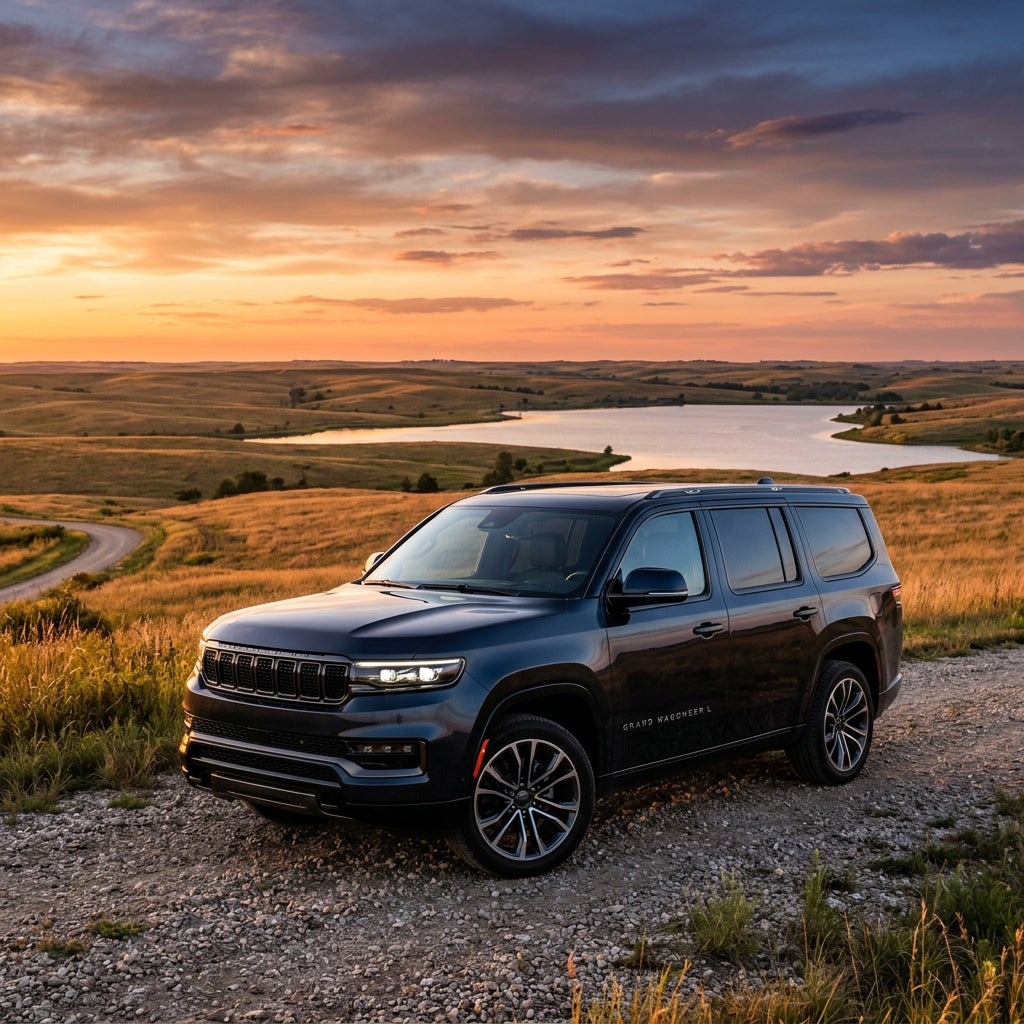
Dark blue Jeep Grand Wagoneer L parked on a gravel trail overlooking a prairie lake at sunset. (Representative image for illustration purposes only. Actual vehicle may vary based on trim and configuration.)

2026 Jeep Grand Wagoneer L: Trims, Towing, and Family Value

The 2026 Jeep Grand Wagoneer L is the right choice for families who need genuine seven-passenger space, up to 5,960 lbs of towing capacity, and a twin-turbocharged 420 hp Hurricane engine in a premium three-row SUV. Starting at $66,995 for the Grand Wagoneer 2WD and scaling to $103,310 for the Summit Reserve 4WD, the lineup covers a wide range of price ranges while delivering the same powertrain, about 43 cu ft of cargo space, and a comprehensive suite of standard safety technology across every trim. Explore Inventory How Well Does the 2026 Jeep Grand Wagoneer L Serve Military Families and Outdoor Enthusiasts in Junction City? The 2026 Jeep Grand Wagoneer L is purpose-built for exactly the lifestyle that defines Junction City — seven seats, a roomy cargo hold, confident towing for lake days, and premium comfort for families who spend long days between Fort Riley and home. For military households balancing base schedules with weekend outdoor adventures, few full-size SUVs match this combination of space, capability, and refinement at this price point. Families with four to seven members will appreciate the 2+2+3 seating configuration standard across all trims, with an available 8-Passenger Seating Package on the Grand Wagoneer 2WD and Grand Wagoneer 4WD that converts the second row to a 40/20/40 bench for three. Behind the third row sits about 43 cu ft of cargo space — enough for a weekend's worth of fishing gear, sports equipment, or camping supplies. Fold everything flat and that number expands to about 117 cu ft, which means the Grand Wagoneer L can haul serious loads when the need arises. The Hurricane twin-turbocharged inline-six produces 420 hp and 468 lb-ft of torque through a TorqueFlite® 8-speed automatic, giving drivers confident power on the flat-to-rolling Kansas plains. Whether the destination is Milford Lake, Tuttle Creek State Park, or simply the school run, the Grand Wagoneer L handles it with equal ease. Shoppers who want to explore the broader used-vehicle market alongside a new Grand Wagoneer L can browse our pre-owned SUV inventory at Valor CDJR to compare options and find the best fit for their budget. Bold Design Built for Historic Streets and Scenic Flint Hills Views The 2026 Grand Wagoneer L wears its size confidently. At 228.1 in long, 83.6 in wide, and 77.4 in tall, this is a genuinely large SUV — the extended wheelbase measures 130 in, which is the foundation for all that second- and third-row legroom. The body rides on a long-wheelbase platform with a standard roof and chrome/silver roof rails across most trims, while the Limited Altitude 4WD shifts the aesthetic with blacked-out exterior trim elements for a more aggressive stance. LED projector-beam headlights with auto high-beam control and LED daytime running lights are standard across all trims, giving the Grand Wagoneer L a distinctive light signature whether it's parked outside the Geary County Historical Museum or moving through evening traffic. Painted front and rear bumpers, chrome bright trim around the side windows on base trims, and body-color door handles round out a cohesive exterior that reads as premium without being ostentatious. Paint options span monotone metallic, monotone pearl, monotone gloss, two-tone metallic, and the exclusive Ghost Paint finish available as an option. The Black Roof option on the Grand Wagoneer 2WD and Grand Wagoneer 4WD adds a two-tone contrast that stands out on any road. Families upgrading from an older SUV can get an estimate on their current vehicle's trade-in value before visiting Valor CDJR — it's a straightforward first step toward getting into the Grand Wagoneer L. View Gallery Power and Traction Tailored for Towing Near Local Lakes with the 2026 Jeep Grand Wagoneer L Every single trim in the 2026 Grand Wagoneer L lineup — from the entry-level Grand Wagoneer 2WD to the range-topping Summit Reserve 4WD — shares the same 3L Hurricane twin-turbocharged inline-six producing 420 hp at 5,200 rpm and 468 lb-ft of torque at 3,500 rpm, paired with a TorqueFlite® 8-speed automatic. The only drivetrain split in the lineup is the Grand Wagoneer 2WD, which uses rear-wheel drive; every other trim ships with full-time 4WD. Feature 85th Anniversary 4WD Grand Wagoneer 2WD Grand Wagoneer 4WD Limited Altitude 4WD Limited Reserve 4WD Summit Obsidian 4WD Summit Reserve 4WD Drivetrain All-wheel drive Rear-wheel drive All-wheel drive All-wheel drive All-wheel drive All-wheel drive All-wheel drive Engine 3L 3L 3L 3L 3L 3L 3L Horsepower 420 hp 420 hp 420 hp 420 hp 420 hp 420 hp 420 hp Torque 468 lb-ft 468 lb-ft 468 lb-ft 468 lb-ft 468 lb-ft 468 lb-ft 468 lb-ft Transmission TorqueFlite® TorqueFlite® TorqueFlite® TorqueFlite® TorqueFlite® TorqueFlite® TorqueFlite® Towing capacity and payload vary by trim, largely driven by curb weight differences. The Grand Wagoneer 2WD is the lightest at 5,980 lbs curb weight and posts the highest towing figure at 5,960 lbs. The 4WD trims cluster at 5,770 lbs of towing capacity, with payload ranging from 1,415 lbs on the Limited Altitude 4WD and Limited Reserve 4WD to 1,515 lbs on the 85th Anniversary 4WD and Grand Wagoneer 4WD. Feature 85th Anniversary 4WD Grand Wagoneer 2WD Grand Wagoneer 4WD Limited Altitude 4WD Limited Reserve 4WD Summit Obsidian 4WD Summit Reserve 4WD Curb Weight 6,185 lbs 5,980 lbs 6,185 lbs 6,285 lbs 6,285 lbs 6,444 lbs 6,444 lbs Towing 5,770 lbs 5,960 lbs 5,770 lbs 5,770 lbs 5,770 lbs 5,770 lbs 5,770 lbs Payload 1,515 lbs 1,420 lbs 1,515 lbs 1,415 lbs 1,415 lbs 1,506 lbs 1,506 lbs Seating 7 7 7 7 7 7 7 Cargo (all seats up) 42.6 cu ft 42.6 cu ft 42.6 cu ft 42.6 cu ft 42.6 cu ft 42.6 cu ft 42.6 cu ft The HD Trailer Tow Group package — available on the Grand Wagoneer 4WD and Limited Altitude 4WD — adds front tow/recovery hooks, a trailer hitch assist, trailer brake control, removable roof rail cross bars, crawl control, and low/high gear ranges for those who need maximum towing capability at Milford Lake or Tuttle Creek. For towing accessories and genuine Jeep hitch equipment, Valor CDJR's parts and accessories department stocks what you need to outfit your Grand Wagoneer L properly. The 4WD system includes terrain type selection and descent control as standard on 4WD trims, with full-time and part-time four-wheel drive modes available. Ground clearance sits at 8.4 in with a 21.4-degree approach angle and a 21.2-degree departure angle — practical numbers for gravel roads and uneven terrain around the region's lakes and state parks. Luxury Cabin Comfort for Family Days Around Fort Riley and Downtown Areas Step inside the Grand Wagoneer L and the extended wheelbase immediately pays dividends. Front headroom measures 41.3 in, second-row headroom is 40 in, and third-row headroom reaches 39 in — generous figures for a three-row SUV. Legroom follows suit: 40.9 in up front, 42.7 in in the second row, and 36.6 in in the third row. Shoulder room spans 66.1 in up front, 65.2 in in the second row, and 64.4 in in the third row. All trims come standard with leather seating. The driver's seat is a power-adjustable bucket with 6-way electric adjustment, memory positioning, 2-way electric lumbar, and heated and ventilated functions. The front passenger seat matches with 6-way power adjustment and 2-way electric lumbar. Second-row captain's seats are standard in the 7-passenger configuration, with manual recline and reach adjustment. The 8-Passenger Seating Package swaps these for a 40/20/40 fold-flat bench with heated second-row seating. The Limited Altitude 4WD adds piano black interior trim on the instrument panel, doors, and center floor console — a detail that elevates the cabin's visual tone noticeably. The Premium Group II package available on the Limited Altitude 4WD upgrades the audio system to 19 speakers with a subwoofer and surround sound at 950 watts, replaces the fixed running boards with power-retractable electric steps, and adds a panoramic sunroof with one-touch electric operation and a sunshade. Three-zone automatic climate control is standard across all trims, with rear controls and secondary ventilation outlets at the passenger seat and rear seats. A wireless charging pad, 4 front USB charging ports, 2 rear USB charging ports, and 2 third-row USB charging ports are standard. The cargo area loading floor sits at 34.1 in — a comfortable lift height for loading gear after a day at the lake. Connected Tech That Keeps Households in Sync with the 2026 Jeep Grand Wagoneer L The Grand Wagoneer L's infotainment architecture centers on a 12 in touchscreen running 3D voice navigation with internet-connected data feed and real-time traffic information. A 10.25 in digital instrument cluster sits directly in the driver's sightline, and a second 10.25 in retractable touchscreen below the primary display handles climate and secondary controls. All three screens are standard across every trim. Apple CarPlay and Android Auto are both standard with available subscription terms, meaning the connection doesn't expire after a trial period. Bluetooth is standard, as is Amazon Alexa voice assistant integration — useful for hands-free control during school runs or long drives. The built-in Wi-Fi hotspot uses an embedded SIM card and comes with a 3-month complimentary data subscription, with extended fleet and consumer data packages available. Over-the-air (OTA) software updates keep the vehicle's systems current without requiring a dealership visit — a practical benefit for busy households. Remote services through the Safety & Security Package include remote start, remote lock/unlock, vehicle diagnostics, speed alerts, geo-fencing, theft alert, and a find-my-car function, all included for a 120-month subscription period. Steering wheel-mounted audio controls, a rain-sensing automatic wiper system, and an auto-dimming rearview mirror are standard. The Convenience Group I package on the Limited Altitude 4WD adds a full Surround View Camera, full auto-park with perpendicular and exit capability, and an electronic adaptive suspension with air springs at all four corners for a driver-selectable ride character — a meaningful upgrade for families who split time between smooth highway miles and rougher terrain. The Rear Seat Video Group I package, available on the Limited Altitude 4WD, adds a connected rear-seat entertainment system and increases rear USB charging ports to 5 — a clear win for families with kids on longer road trips. Advanced Protection for Military Families on Daily Commutes and Weekend Outings in the 2026 Jeep Grand Wagoneer L The 2026 Grand Wagoneer L carries a comprehensive safety suite as standard equipment across all seven trims, with with no additional package required to get core driver-assistance features. The airbag count stands at 8, covering front driver and passenger, front-side, side curtain across all three rows, and driver and passenger knee airbags. Pre-tensioning front seatbelts and height-adjustable front belt anchors are standard, as are 3-point belts for all third-row positions including the center seat. Active safety starts with Full Speed Forward Collision Warning Plus, which activates from as low as 3 mph and includes automatic emergency braking, seat belt pre-tensioning, and brake light activation. Active Lane Management provides lane departure warning with active steering correction. Blind Spot Monitoring monitors adjacent lanes without requiring a turn signal input, and Rear Cross-Path Detection uses radar to warn of crossing traffic when reversing — a genuinely useful feature in busy parking areas. ParkSense® Front and Rear Park Assist with Stop uses both cameras and sensors at the front, rear, and sides to detect obstacles and can bring the vehicle to a stop automatically. The full auto-park system with perpendicular parking and exit capability is available through the Convenience Group I package on the Limited Altitude 4WD. The vehicle supports Level 2 partial automation through the Active Driving Assist System, which combines adaptive cruise control with stop-and-go function and active lane centering for highway driving. NHTSA crash test results show a 5-star frontal crash rating and a 5-star side impact rating, with a 4-star overall score and a 3-star rollover rating. A rear seat monitoring camera is available through the Premium Group II package. Breaking Down 2026 Jeep Grand Wagoneer L Trim Pricing Buyers Seven trims cover a wide price range, from the accessible Grand Wagoneer 2WD at $66,995 to the fully-loaded Summit Reserve 4WD at $103,310. A destination charge of $2,795 applies to all trims. Feature 85th Anniversary 4WD Grand Wagoneer 2WD Grand Wagoneer 4WD Limited Altitude 4WD Limited Reserve 4WD Summit Obsidian 4WD Summit Reserve 4WD Base MSRP $78,990 $66,995 $69,995 $75,060 $82,960 $97,310 $103,310 Destination $2,795 $2,795 $2,795 $2,795 $2,795 $2,795 $2,795 The Grand Wagoneer 2WD and Grand Wagoneer 4WD represent the entry point, delivering the full Hurricane powertrain, leather seating, 12 in touchscreen navigation, and the complete active safety suite. The $3,000 step to the Grand Wagoneer 4WD adds full-time 4WD capability — a meaningful upgrade for families who regularly drive on uneven terrain or want the confidence of all-wheel traction year-round. The Limited Altitude 4WD at $75,060 introduces the blacked-out exterior package, piano black interior trim, and a broader package menu including the optional air suspension, 19-speaker audio, and rear-seat entertainment. The 85th Anniversary 4WD at $78,990 commemorates Jeep's heritage with unique badging and a standard 19-speaker audio system. The Limited Reserve 4WD at $82,960 steps up interior materials and feature content, while the Summit Obsidian 4WD at $97,310 and Summit Reserve 4WD at $103,310 represent the pinnacle of the lineup with the most complete standard feature sets. Shoppers ready to compare in-stock options can browse Valor CDJR's current new Grand Wagoneer L inventory to check availability across trims. Get Quote Warranty, Maintenance, and Service Insights for 2026 Jeep Grand Wagoneer L Owners Jeep backs the 2026 Grand Wagoneer L with a 3-year/36,000-mile basic warranty, a 5-year/60,000-mile powertrain warranty, and a 5-year/60,000-mile roadside assistance program. Paint coverage runs for 5 years with no mileage cap, and anti-corrosion protection covers the vehicle for 3 years with no mileage limit. The powertrain warranty is particularly relevant for buyers who plan to use the Hurricane engine hard — towing regularly to Milford Lake or Tuttle Creek, for example — because it covers the engine, transmission, and drivetrain components for five full years. The roadside assistance program, included for the same 5-year/60,000-mile period, provides Jeep-backed emergency support rather than a third-party service. The Grand Wagoneer L supports over-the-air software updates, which means many software-related service needs can be addressed remotely. The vehicle also includes a Safety & Security Package telematics subscription for 120 months — that's 10 years of remote services including vehicle diagnostics, which gives owners advance notice of potential maintenance needs before they become serious problems. An optional Myflexcare Service Plan is available for purchase at the time of sale, providing extended maintenance coverage tailored to the owner's driving habits. Military families and professionals with demanding schedules can take advantage of Valor CDJR's online service appointment scheduling to book maintenance at a time that fits their calendar — no waiting on hold required. Awards and Expert Recognition Highlighting the 2026 Jeep Grand Wagoneer L's Strengths for Kansas Buyers The Grand Wagoneer L's track record with industry evaluators is strong. The Jeep Wagoneer L earned recognition as a top pick in the 2025 Best Cars for Families Awards — U.S. News & World Report, a distinction that directly addresses the needs of the multi-member households common in the Junction City and Riley County communities. The platform also received the 2025 Best Value Award — Torque News for its strong positioning in the full-size SUV segment. According to Edmunds, the Grand Wagoneer L delivers a compelling combination of interior space and powertrain refinement that is often cross-shopped with the Chevrolet Suburban, Ford Expedition Max, and Lincoln Navigator L. Car and Driver has highlighted the Hurricane engine's smooth power delivery and the cabin's genuine three-row usability as key strengths. These third-party endorsements reinforce what the specs confirm: this is a capable, well-equipped, family-oriented SUV that delivers strong value. Buyers who want to start the purchase process before visiting the showroom can contact us for current financing information through Valor CDJR. Fuel Economy Fuel economy and range by trim Feature 85th Anniversary 4WD Grand Wagoneer 2WD Grand Wagoneer 4WD Limited Altitude 4WD Limited Reserve 4WD Summit Obsidian 4WD Summit Reserve 4WD MPG 16 city / 22 hwy / 18 combined 17 city / 24 hwy / 19 combined 16 city / 22 hwy / 18 combined 16 city / 22 hwy / 18 combined 16 city / 22 hwy / 18 combined 16 city / 22 hwy / 18 combined 16 city / 22 hwy / 18 combined Frequently Asked Questions from Buyers About the 2026 Jeep Grand Wagoneer L The EPA-rated fuel economy depends on drivetrain. The Grand Wagoneer 2WD — the only rear-wheel-drive trim — earns 17 mpg city / 24 mpg highway / 19 mpg combined and has a calculated range of 580 miles on its 30.5-gallon tank. All 4WD trims are rated at 16 mpg city / 22 mpg highway / 18 mpg combined with a calculated range of 549 miles. For daily commuting between Fort Riley and home, 18 combined mpg translates to manageable fuel costs across typical weekly driving distances. Six of the seven available trims — the 85th Anniversary 4WD, Grand Wagoneer 4WD, Limited Altitude 4WD, Limited Reserve 4WD, Summit Obsidian 4WD, and Summit Reserve 4WD — include full-time 4WD as standard equipment with both full-time and part-time modes, terrain selection, and descent control. The Grand Wagoneer 2WD is the only rear-wheel-drive option and is priced at $66,995 before destination. The standard configuration is 7 passengers in a 2+2+3 layout across all trims. The 8-Passenger Seating Package is available on the Grand Wagoneer 2WD and Grand Wagoneer 4WD, converting the second-row captain's chairs to a 40/20/40 fold-flat bench that accommodates a third passenger in the middle. This package also adds heated second-row seating and electrically folding second-row seats. The Grand Wagoneer 2WD leads the lineup at 5,960 lbs of towing capacity. All 4WD trims are rated at 5,770 lbs. For buyers who tow boats or trailers to Milford Lake regularly, the optional HD Trailer Tow Group on the Grand Wagoneer 4WD and Limited Altitude 4WD adds a trailer brake controller, trailer hitch assist, camera, crawl control, and low-range gearing for added confidence. Valor CDJR is located at 1825 Goldenbelt Blvd, Junction City, KS 66441. To confirm current inventory or schedule a test drive, give our team (785) 238-5114 — we're happy to answer questions about specific trim availability, package combinations, or financing options before you make the trip. Contact Dealer Vehicle specification data © JATO Dynamics Limited.

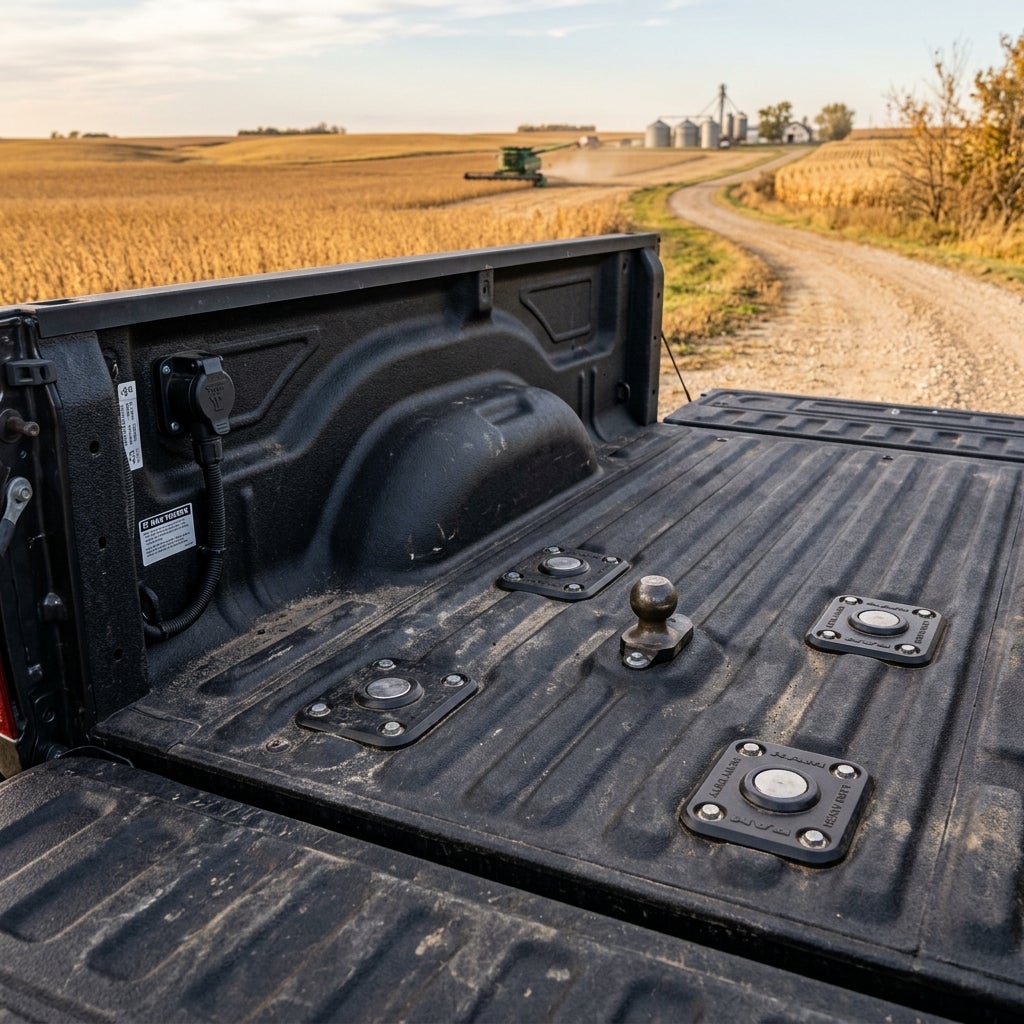
Bed of a black pickup truck fitted with a gooseneck hitch ball and puck system against a rural farm background. (Representative image for illustration purposes only. Actual vehicle may vary based on trim and configuration.)

What Factory Hardware Is Included in the RAM Fifth-Wheel / Gooseneck Prep Group?

What Factory Hardware Is Included in the Ram Fifth-Wheel / Gooseneck Prep Group? When you are preparing for heavy agricultural hauling across Riley County or hitching up a 35-foot livestock trailer in Junction City, knowing exactly what equipment comes integrated into your truck bed is critical. The Ram Heavy Duty Production Option Code AHU—officially designated as the Fifth-Wheel / Gooseneck Towing Prep Group—is a factory-engineered structural system built directly into the frame assembly during production. Rather than relying on aftermarket brackets, bed drilling, or welded subframes that compromise factory rust warranties, Option Code AHU delivers a seamless, flush-mounted towing foundation engineered specifically for extreme structural loads. Every Ram 2500 and 3500 equipped with the factory AHU Prep Group includes five essential hardware components engineered directly into the bed floor and frame architecture: • Integrated Fully Welded Frame Crossmembers: Below the stamped steel bed floor sit massive, factory-welded structural steel crossmembers attached directly to the hydroformed box frame rails. These crossmembers distribute tongue weights and vertical pin loads directly to the chassis rather than stressing the bed sheet metal. • Five In-Bed Mounting Pucks: Four outer receiver pucks arranged in a standard footprint for quick drop-in fifth-wheel hitches, plus a centralized fifth puck specifically designed for a 2-5/16 inch gooseneck ball. • Removable Cast-Aluminum Puck Covers: Durable, flush-fitting covers that seal each receiver hole when hitches are removed, preserving a completely flat bed floor for loose grain bags, tools, or lumber. • In-Bed 7-Pin Electrical Wiring Connector: Mounted conveniently into the rear driver-side bed wall, keeping trailer wiring harnesses off the tailgate and safely isolated inside the bed. • Pre-Drilled Bed Floor Ports with Reinforced Collars: Factory-punched bed openings featuring structural collars that prevent moisture penetration, bed flexing, and metal fatigue around the mounting points. Whether you are shopping our New Vehicle Listings or upgrading your current fleet, understanding this factory architecture ensures you maximize your truck's towing potential safely and legally. Anatomical Breakdown: Beneath the Bed Cover of Ram Production Option Code AHU Hydroformed Frame Integration & Structural Metallurgy To appreciate why option code AHU is superior to aftermarket hitches, you must look underneath the truck bed. Ram Heavy Duty chassis frames utilize 50,000 PSI steel hydroformed frame rails with fully boxed cross-sections. In factory AHU builds, additional structural steel crossmembers are Robotically Metal Inert Gas (MIG) welded directly between the main frame rails at the assembly plant in Saltillo. This direct frame attachment creates an uninterrupted load path. When a heavy gooseneck trailer applies 5,000 lbs of vertical pin weight while rolling down bumpy rural roads in Geary County, that force travels directly down through the cast steel puck housings, into the factory welded crossmembers, and evenly across both frame rails. Because no aftermarket drilling is performed on the high-strength frame flanges, structural integrity and factory rust-through warranties remain 100% intact. In-Bed Electrical Integration & Corrosion Prevention Beyond heavy iron, Option Code AHU includes a fully integrated 7-pin electrical harness extension connected directly to the primary vehicle body harness. Unlike aftermarket installations that splice into rear bumper wiring using clip-on connectors—which frequently corrode from winter road salt or mud—the factory harness uses weatherproof Deutsch-style sealed connectors. The bed-side outlet is inset flush into the rear driver-side inner quarter panel. This placement prevents cargo from crushing the plug while allowing full wire clearance when making sharp jackknife turns with tall gooseneck couplers. The integrated circuitry communicates seamlessly with the truck's central Body Control Module (BCM), enabling automatic trailer light checks, trailer anti-lock brake integration, and blind-spot monitoring trailer length detection. 2026 Ram 2500 vs. 3500: Realistic Towing and Payload Capacities for Heavy Agricultural Hauling Choosing between a 2026 Ram 2500 and Ram 3500 for high-payload fall harvest towing requires evaluating more than just horsepower. While both trucks offer the legendary 6.7L Cummins Turbo Diesel and the 6.4L HEMI V8, their rear suspension designs and Gross Vehicle Weight Ratings (GVWR) create distinctly different real-world capabilities when hooked to heavy gooseneck grain wagons or multi-axle livestock trailers. Model / Engine Configuration Rear Suspension Architecture Max Gooseneck Towing Max Payload Capacity Ideal Kansas Hauling Role 2026 Ram 2500 6.4L HEMI V8 5-Link Coil Spring / Auto-Level Air Up to 17,730 lbs Up to 4,010 lbs General ranch work, utility trailers, equipment shuttle 2026 Ram 2500 6.7L Cummins Diesel 5-Link Coil Spring / Auto-Level Air Up to 19,990 lbs Up to 3,150 lbs Medium livestock trailers, round-bale transportation 2026 Ram 3500 SRW 6.7L Cummins Hotchkiss Leaf Spring System Up to 25,650 lbs Up to 4,580 lbs Heavy gooseneck flatbeds, heavy machinery haulers 2026 Ram 3500 DRW 6.7L HO Cummins High-Capacity Leaf Springs + Air Up to 37,090 lbs Up to 7,680 lbs Maximum commercial grain hauling, multi-head livestock Ram 2500 Coil vs Air The Ram 2500 features a proprietary 5-link rear coil spring suspension that provides unmatched unladen ride quality. For gooseneck towing, opting for the factory Rear Auto-Level Air Suspension levels the truck bed automatically under high pin weights, preserving headlight alignment and front axle steering traction. Ram 3500 Leaf Springs Ram 3500 models utilize heavy-duty Hotchkiss leaf spring rear suspensions. This stiff architecture supports severe vertical pin weights (up to 7,680 lbs payload on dual-rear-wheel models) without excessive suspension squat, maintaining vehicle stability on Kansas highway routes. High-Output Cummins Power Paired with the AISIN 6-speed heavy-duty automatic transmission, the High-Output 6.7L Cummins Turbo Diesel generates up to 1,075 lb-ft of low-end torque. This torque peak arrives as low as 1,800 RPM, allowing heavy grain loads to pull smoothly out of soft field conditions. Browse Commercial Vehicle Inventory Understanding Gross Combined Weight Rating (GCWR) and How It Limits Ram Truck Hauling Defining Key Weight Limits: GCWR vs. GVWR vs. GAWR A common mistake among agricultural operators in Geary County is assuming that if a trailer hitch is rated for 30,000 lbs, the truck can legally tow 30,000 lbs under all conditions. Safety and legal compliance depend on respecting three distinct ratings specified on the driver's door pillar label: 1. Gross Vehicle Weight Rating (GVWR): The maximum total allowable weight of the truck alone, including fuel, passengers, cargo, and trailer pin weight. 2. Gross Axle Weight Rating (GAWR): The maximum weight allowed on the individual front and rear axles. On heavy goosenecks, rear GAWR is frequently breached before hitting total towing capacity. 3. Gross Combined Weight Rating (GCWR): The total maximum allowable combined weight of the fully loaded truck AND the fully loaded trailer together. Practical Calculation for Kansas Harvest Operations To calculate your true legal payload capability, consider a Ram 3500 Crew Cab 4x4 with a GCWR of 43,000 lbs. If the scale weight of the truck equipped with tools, auxiliary fuel tanks, driver, and passengers totals 9,200 lbs, your maximum allowable trailer weight (including trailer tare weight plus grain cargo) cannot exceed 33,800 lbs (43,000 - 9,200 = 33,800). Furthermore, gooseneck trailers transfer roughly 20% to 25% of their total weight onto the truck's bed as pin weight. A 20,000 lb gooseneck trailer places 4,000 to 5,000 lbs directly onto the truck's rear axle. If your truck has a payload capacity of only 3,200 lbs, you will exceed rear GAWR and GVWR even though you are well under maximum GCWR. To check your vehicle's payload status or evaluate your trade, visit our Trade In Evaluation page. Calibrating the Integrated Trailer Brake Controller: Recommended Gain Settings for Harvest Trailers Every Ram Heavy Duty truck equipped with Option Code AHU or towing packages includes an Integrated Trailer Brake Controller (ITBC) built directly into the center stack. This unit uses electronic proportional braking, sending voltage to trailer brakes based on hydraulic brake pressure generated by the truck's master cylinder. Calibrating gain settings correctly before hauling heavy harvest loads is crucial for preventing jackknifing or premature brake overheating. Trailer Type & Braking System Trailer Weight Condition ITBC Setting Mode Recommended Starting Gain Dual-Axle Electric Drum Brakes Unladen / Light Load Light Electric 4.0 to 5.5 Triple-Axle Electric Drum (Livestock) Fully Loaded (Harvest / Cattle) Heavy Electric 6.5 to 8.5 Electric-Over-Hydraulic Disc Brakes Loaded Commercial Flatbed EOH Heavy 5.5 to 7.5 Heavy Grain Gooseneck (Surge/EOH) Peak Harvest Weight (25k+ lbs) EOH Heavy 7.5 to 9.5 Step-by-Step Brake Calibration Procedure for Rural Kansas Roads: 1. Select the Correct Brake Type: In the Ram Instrument Cluster menu, navigate to Trailer Tow -> Trailer Select -> Brake Type. Choose between 'Light Electric', 'Heavy Electric', 'Light EOH', or 'Heavy EOH'. Electric-over-hydraulic (EOH) systems require specific pulse timings to prevent pump delay. 2. Set Initial Gain On Flat Ground: Accelerate truck and trailer to approximately 20 MPH on a clean, paved road (such as Goldenbelt Blvd near Junction City). 3. Manual Squeeze Test: Without touching the foot brake pedal, squeeze the manual slider switch on the dashboard brake controller completely. 4. Adjust Until Lockup Threshold: If trailer brakes lock up and slide tires, reduce gain by 0.5 increments. If trailer pushes the truck during braking, increase gain until you feel a firm, smooth drag that decelerates the rig without wheel lockup. 5. Gravel Road Verification: When operating on dirt or gravel township roads around Manhattan and Geary County, reduce gain settings by 1.0 to 1.5 points to prevent trailer tires from skidding on loose stone. Tire Pressure Best Practices: Should Heavy Harvest Trailer Tires Be Adjusted to Max PSI? Cold Inflation Ratings vs. Heat Expansion During peak fall harvest, ambient temperatures across Kansas fluctuate dramatically between crisp autumn mornings and warm afternoon highway runs on I-70. A critical question for agricultural haulers is whether heavy trailer and truck tires should be inflated to maximum sidewall PSI ratings. The unequivocal technical answer is **YES: Under full payload conditions, tires must be inflated to the manufacturer cold maximum PSI rating listed on the tire sidewall and vehicle certification label.** Heavy HD truck tires (typically Load Range E or F rated at 80 PSI cold) rely on internal air pressure to support vertical loads. Under-inflating a tire by just 10 PSI reduces load capacity by nearly 12% and causes rapid sidewall flexing. Avoiding Thermal Blowouts & Tire Degradation Sidewall flexing generates extreme thermal heat. When hauling a 24,000 lb gooseneck trailer across the Flint Hills at 65 MPH, an under-inflated tire can quickly exceed internal temperatures of 200°F, leading to tread separation or catastrophic blowouts. Never bleed air pressure from hot tires during mid-day stops. Tire manufacturers design tire carcasses to accommodate normal thermal pressure rises (10 to 15 PSI above cold rating) during highway operation. For fast tire inspections, routine fluid checks, and rapid maintenance, stop by our Express Lane at Valor CDJR. Schedule Service at Valor CDJR Fall Harvest Towing Checklist: Preparing Heavy-Duty Ram Trucks for High-Payload Hauling Before taking heavy gooseneck trailers into field harvest operations or embarking on multi-state livestock transports, complete this essential 8-point technical checklist engineered specifically for Ram Heavy Duty trucks equipped with the AHU Prep Group. 1. Ball & Pin Box Lubrication Apply heavy lithium grease to the 2-5/16 inch gooseneck ball surface or install a high-density polyethylene lubricant plate on fifth-wheel kingpins to prevent metal grinding and binding. 2. Safety Chain Anchor Torque Inspect drop-in safety chain loops in the bed pucks. Ensure the quarter-turn locking pins seat fully and retaining cotter pins are engaged without rust deformation. 3. 7-Pin Plug Voltage Testing Test auxiliary 12V charging terminals and trailer brake signal pins inside the in-bed 7-pin socket using a digital multimeter to confirm clean 13.8V+ alternator output. 4. Tire Tread & Sidewall Inspection Verify minimum 4/32 inch tread depth on truck drive tires and inspect inner duals for trapped stones or sidewall bulges that cause high-speed thermal failure. 5. Transmission Fluid & Cooler Check transmission fluid levels on 68RFE and AISIN transmissions. Ensure auxiliary transmission oil cooler fins behind the front grille are clear of crop chaff and debris. 6. Emergency Breakaway Battery Test the 12V gel-cell battery on the trailer breakaway system. Ensure the lanyard cable is correctly length-adjusted and clipped to a rigid bed anchor, never around the ball. Factory-Installed Puck System vs. Aftermarket Gooseneck Hitches: Cost, Warranty, and Structural Integrity When configuring a commercial or agricultural Ram Heavy Duty truck, buyers often evaluate whether ordering Option Code AHU from the factory is worth the investment compared to installing an aftermarket under-bed hitch later. A head-to-head comparison illustrates the long-term operational advantages of factory integration. Evaluation Criterion Ram Factory AHU Prep Group Aftermarket Under-Bed Gooseneck Hitch Installation Requirement 100% Robotically Welded at Factory 4-8 Hours Labor; Bed Removal or Cutting Required Bed Floor Finish Flush-fit puck covers; 100% flat bed when removed Exposed center hole; aftermarket trim rings can catch cargo Powertrain & Frame Warranty Preserves 5-Year/100,000-Mile Factory Warranty Risk of voiding frame anti-corrosion coverage due to drilling Integrated 7-Pin Electrical Factory sealed in-bed wiring harness included Requires aftermarket harness splicing into rear bumper wire Fifth-Wheel Compatibility Direct drop-in for standard 5th-wheel hitches Requires bulky adapter rails mounted above bed floor Essential Mopar Gooseneck & Fifth-Wheel Adapter Kits Available at Valor CDJR To turn your Ram factory prep group into a fully functional towing rig, Valor CDJR stocks authentic Mopar towing accessories engineered specifically for Option Code AHU receiver pucks. Ordering factory-approved components ensures proper metallurgy and precise lock-pin tolerances. Mopar 2-5/16 Gooseneck Ball Kit Features a patented lever-action quick-release locking mechanism that drops directly into the center bed puck. Includes two heavy-duty safety chain tie-down loops and a custom molded carrying case. Picture-Frame Fifth-Wheel Adapter Adapts outer bed pucks to accept traditional industry-standard fifth-wheel hitches from Curt, B&W, and Reese without installing elevated bed rails. In-Bed Plug Replacement Caps UV-resistant, weather-sealed replacement puck caps and 7-pin dust covers designed to withstand extreme winter weather and agricultural chemical exposure. Order Parts from Valor CDJR Navigating Flint Hills Terrain and Kansas Rural Highway Demands in Manhattan & Junction City Managing Steep Rolling Grades on I-70 & US-77 Towing heavy agricultural loads around Fort Riley, Junction City, and Manhattan presents distinct topographic challenges. Navigating the steep, rolling grade transitions of Interstate 70 through the Flint Hills requires constant vehicle control. When descending 6% grades with a 25,000 lb gooseneck trailer, relying solely on mechanical service brakes can lead to dangerous brake fade. Ram Heavy Duty trucks equipped with Cummins Turbo Diesel engines feature a driver-selectable **Smart Exhaust Brake**. Operating in either 'Full' or 'Automatic' mode, this system adjusts variable-geometry turbocharger vanes to generate reverse engine backpressure. Automatic mode maintains a set vehicle speed during downhill descents without requiring pedal input, dramatically extending brake pad life. Crosswind Stability & Prairie Road Traction Kansas prairie winds frequently blow sustained 35+ MPH gusts across north-south corridors like Highway 77. High-profile livestock or enclosed gooseneck trailers act like massive sails, creating lateral sway that tests chassis rigidity. The Ram AHU prep group places the gooseneck ball pivot point approximately 2 inches forward of the rear axle centerline. Positioning vertical tongue weight forward of the rear axle creates natural stability, transferring downward force to both front and rear axles. Combined with Ram Electronic Stability Control (ESC) and Trailer Sway Mitigation, your rig remains firmly planted in high crosswinds. If you are exploring pre-owned heavy-duty options, browse our Used Vehicle Listings. Step-by-Step Guide: How to Connect a Gooseneck Trailer to the Ram In-Bed Puck System Connecting a gooseneck trailer to the Ram factory puck system is a streamlined process that takes less than five minutes when following proper mechanical safety protocols: 1. Remove Center Puck Cover: Rotate the central cast-aluminum bed cover counterclockwise and lift it out to expose the factory gooseneck receiver socket. 2. Insert Gooseneck Ball: Lift the center locking lever on your Mopar 2-5/16 ball, insert the shank into the socket, and drop the lever down to engage the dual locking ball bearings underneath. 3. Install Safety Chain Loops: Insert the two drop-in safety chain loops into the designated rear diagonal outer puck sockets. Rotate each loop 90 degrees until the locking tab drops securely into place. 4. Align Truck & Coupler: Lower tailgate (or open 5th-wheel cutout gate), back truck into position until the trailer coupler aligns directly over the ball, and lower the trailer jack. 5. Lock Coupler & Engage Pin: Close the trailer coupler locking handle and insert the safety pin. Verify that the coupler collar has seated fully beneath the ball shoulder. 6. Attach Safety Chains & Breakaway Lanyard: Cross safety chains beneath the drawbar and hook into bed loops. Attach the breakaway cable to a rigid bed anchor. 7. Plug in 7-Pin Harness: Insert trailer electrical plug into the bed-wall socket and latch the spring-loaded socket lid over the plug connector lock edge. 8. Verify Dashboard Display: Start truck and check instrument cluster for 'Trailer Connected' notification and automated exterior trailer light check cycle. Schedule Heavy-Duty Ram Towing Service and Order Factory Parts at Valor CDJR in Junction City, KS Whether you are equipping a brand-new 2026 Ram 3500 dually for peak harvest or maintaining a commercial fleet in Junction City, Valor CDJR is your trusted regional heavy-duty truck authority. Our dealership features factory-trained Chrysler Dodge Jeep Ram Master Technicians who understand the exacting demands of Kansas agricultural and commercial towing. Visit our showroom at 1825 Goldenbelt Blvd to inspect our inventory of factory AHU-equipped Ram 2500 and 3500 models, order genuine Mopar gooseneck ball kits, or perform a pre-harvest towing system checkup. For current financing options for your farm or commercial business, contact our team through our Finance Center page. You can also Get Directions to Valor CDJR or Call us at (785) 238-5114 to speak directly with a truck specialist. Schedule Towing Service Inspection

View from inside a RAM truck dashboard showing the touchscreen trailer brake calibration screen and country road ahead. (Representative image for illustration purposes only. Actual vehicle may vary based on trim and configuration.)

How to Calibrate and Inspect the Integrated Trailer Brake Controller on a RAM HD Truck

How to Calibrate and Inspect the Integrated Trailer Brake Controller on a Ram HD Truck Calibrating and inspecting the Integrated Trailer Brake Controller (ITBC) on your Ram 2500 or Ram 3500 Heavy Duty truck is the foundation of safe, confident hauling across Kansas highways and rural farm roads. To calibrate the system correctly, start inside your truck's cab using the EVIC (Driver Information Display) or Uconnect 5 touchscreen menu. Navigate to Trailer Tow settings and select the precise brake type equipped on your rig: Light Electric, Heavy Electric, Electric-Over-Hydraulic (EOH) Light, or Electric-Over-Hydraulic (EOH) Heavy. Selecting the proper mode dictates the pulse-width modulation (PWM) signal sent from the factory ITBC module under the instrument panel down to the rear bumper harness. Once the correct trailer brake type is saved, establish an initial baseline gain setting between 5.0 and 6.0 using the (+/-) gain buttons integrated into the dashboard switch bank. Drive your truck and trailer onto a clean, flat, level paved road at approximately 20 mph. Squeeze the manual trailer brake lever fully without touching the truck’s brake pedal. If the trailer brakes lock up and slide the tires, decrease the gain by 0.5 increments. If you feel the trailer pushing the truck forward, increase the gain. The goal is maximum deceleration force right up to the threshold of wheel lockup. For comprehensive maintenance, inspect the bumper-mounted 7-pin connector for corrosion, test voltage on Pin #2 with a digital multimeter, and verify emergency breakaway switch battery output prior to towing heavy livestock or grain loads. Step-by-Step Ram HD Trailer Brake Controller Setup and Gain Adjustment Phase 1: Uconnect & Cluster Mode Selection Before adjusting gain numbers, your Ram HD must know what brake actuation system is attached. On the 12-inch or 8.4-inch Uconnect display, enter Vehicle Settings > Trailer Tow > Trailer Select. Choose or name your profile, then open Brake Type. • Light Electric: Tailored for single or tandem axle utility/camper trailers under 10,000 lbs gross trailer weight. • Heavy Electric: Engineered for triple-axle flatbeds, heavy goosenecks, and loaded commercial trailers requiring rapid voltage ramp-up. • Electric-Over-Hydraulic (EOH) Light/Heavy: Adjusts timing curves to eliminate hydraulic pump lag on disc brake actuators commonly found on large marine or heavy agricultural equipment. Phase 2: The 20 MPH Road Test Protocol 1. Connect your trailer 7-pin plug securely and verify the Instrument Cluster confirms connection. 2. Set initial digital gain readout to 5.5 using the dash switches. 3. Accelerate to 20 mph on smooth, dry pavement in a safe open area. 4. Fully pinch the manual squeeze slider together without applying the service brake pedal. 5. Observe braking reaction: If tires lock, tap the (-) button to drop gain to 5.0. If the truck feels pulled or pushed excessively, tap (+) up to 6.5 or 7.0. 6. Re-test after adding payload; a fully loaded grain wagon requires significantly higher gain settings than an empty trailer returning from the elevator. Inspecting the Rear Bumper 7-Pin Harness, Wiring, and Signal Output Physical Inspection Examine the rear bumper 7-pin blade socket for green copper corrosion, dirt build-up, or bent contact pins. Wash out debris using electrical contact cleaner spray and pack non-conductive dielectric grease into the socket terminals. Check the spring-loaded dust cover door to ensure it seals tightly against water and gravel spray. Multimeter Voltage Testing Connect a digital multimeter lead to Pin #2 (Brake Power output, usually 5 o'clock position) and Pin #1 (Ground). Have an assistant squeeze the manual slider inside the cab. You should observe smooth DC voltage scaling from 0V up to full battery voltage (~12.6V to 13.8V with engine running) proportionate to slider displacement. Breakaway & Ground Checks Inspect the trailer frame ground wire junction where it bolts to the tongue chassis; rust here is the #1 cause of intermittent ITBC disconnect warnings. Check the emergency breakaway switch lanyard cable and test the onboard 12V breakaway battery using a load tester to guarantee emergency locking if unhitched. Troubleshooting Common ITBC Error Messages: 'Trailer Brake Disconnected' and Blown Fuses Few things are more frustrating during harvest haulage than seeing an alert chime accompanied by a red or amber instrument cluster warning: 'Trailer Brake Disconnected' or 'Check Trailer Wiring'. Understanding the root causes of these ITBC fault codes saves hours of downtime on the farm. • Blown ITBC Power Fuses: Check the Power Distribution Center (PDC) fuse box located under the hood near the battery. On Ram HD models, inspect Fuse F30 (30A or 40A Cartridge Fuse for Trailer Tow Electric Brakes) and Fuse F11 (Trailer Tow Control Module). A short circuit in the trailer wiring or a pinched wire near the trailer axle will instantly pop this fuse. • Resistance Output Errors: The Ram ITBC continuously sends a small, harmless micro-amp sensing pulse down Pin #2 to detect the presence of brake magnet coils. If trailer brake magnets are worn through to the casing, rusty, or have high electrical resistance (above 3.8 to 4.2 ohms across the circuit), the module assumes the trailer has disconnected. • Poor Chassis Grounding: Agricultural trailers exposed to mud and fertilizer often lose ground continuity through the frame hitch ball. Always run a dedicated heavy-gauge white ground wire directly from the 7-pin plug to the trailer frame and brake magnets. Schedule Trailer Diagnostics at Valor CDJR What Engine Options Are Available in the 2025 Ram 2500 and 3500 Heavy Duty Trucks? 6.4L HEMI® V8 Gasoline Engine Standard across the Ram 2500 and 3500 lineup, the proven 6.4L HEMI V8 delivers an impressive 410 horsepower at 5,600 rpm and 429 lb-ft of torque at 4,000 rpm. Featuring variable valve timing (VVT) and Fuel Saver Technology (cylinder deactivation), this gas powerplant provides excellent payload capability and responsive acceleration for daily farm duties, equipment transfer, and utility trailering without needing diesel exhaust fluid (DEF). 6.7L Cummins® Turbo Diesel I6 For extreme heavy-haul towing, the legendary 6.7L Cummins Turbo Diesel inline-six reigns supreme. The standard output version produces 370 hp and 850 lb-ft of torque. On Ram 3500 models, the available High-Output 6.7L Cummins Turbo Diesel ramps up output to a earth-moving 420 hp and 1,075 lb-ft of low-end torque, allowing max gooseneck towing capacities exceeding 37,000 lbs. What Transmission Is Paired with the Cummins Turbo Diesel in 2025 Ram HD Trucks? AISIN® 6-Speed Heavy-Duty Paired exclusively with the High-Output 6.7L Cummins on Ram 3500 models, the AISIN AS69RC 6-speed automatic transmission features commercial-grade steel gear sets, high-capacity clutch packs, and advanced thermal management to withstand 1,075 lb-ft of continuous torque. 68RFE 6-Speed Automatic Paired with the standard output 6.7L Cummins (370 hp / 850 lb-ft), the sophisticated 68RFE transmission offers smooth electronically controlled shifting, driver-selectable gear range limits, and adaptive pressure controls designed for long-distance highway hauling. Tow/Haul & Exhaust Brake When Tow/Haul mode is activated, transmission shift schedules aggressively downshift during deceleration. This works in perfect harmony with Cummins Smart Exhaust Braking and the ITBC to hold heavy loads safely on steep down-grades with minimal pedal effort. How Does the 2025 Ram 2500 Compare to the Ford F-250 Super Duty for Agricultural Towing? For farm and ranch owners in Clay, Dickinson, and Riley Counties, selecting between the Ram 2500 Heavy Duty and Ford F-250 Super Duty comes down to real-world chassis dynamics, towing integration, and ride comfort. While both trucks offer stout diesel options, the Ram 2500 holds distinct advantages when transporting livestock, grain carts, and heavy machinery. Feature / Spec 2025 Ram 2500 HD 2025 Ford F-250 Super Duty Rear Suspension Architecture Exclusive 5-Link Coil Springs or Auto-Level Air Suspension Traditional Leaf Springs Diesel Torque (Standard Output) 850 lb-ft @ 1,700 rpm (6.7L Cummins) 1,050 lb-ft @ 1,600 rpm (6.7L PowerStroke) Brake Controller Integration Factory ITBC w/ Uconnect 5 Memory & EOH Modes Integrated Trailer Brake Controller High-Tongue Weight Stability Superior coil/air dampening; reduced unladen bounce Firm leaf spring stiffness when unladen Infotainment / Profile Memory 12-Inch Screen w/ Multiple Saved Brake Profiles 12-Inch SYNC 4 System The standout feature for Ram 2500 is its segment-exclusive five-link rear coil suspension and optional Auto-Level Rear Air Suspension. Traditional leaf springs on the F-250 can cause severe harshness and wheel hop over rutted farm lanes when unladen. In contrast, Ram's air suspension dynamically levels the truck bed under high gooseneck tongue weights, preserving proper headlight aiming, steering geometry, and trailer brake controller weight distribution across all four truck wheels. Fall Agricultural Harvest Guide: Preparing Your Ram 2500 and 3500 for Heavy Towing in Clay and Dickinson Counties Pre-Harvest Mechanical Checkup As Kansas autumn harvest gets underway in early September, local producers in Clay Center, Abilene, and Junction City prepare for heavy corn and soybean hauling. Inspect transmission fluid levels and cooler lines—sustained high ambient temperatures combined with heavy trailering put severe thermal stress on automatic transmissions. Check brake pad thickness on both truck and trailer axles. Ensure tires are load range E or F and inflated to maximum cold PSI specified on the door jamb platen (typically 60 PSI front / 80 PSI rear for maximum payload stability). Explore our Parts Department for factory hitch hardware, OEM brake pads, and heavy-duty towing accessories. Trailer Recalibration & Hitch Rating A trailer sitting idle all summer often develops rust on magnetic brake shoes or seized actuator pivot pins. Perform a trial recalibration run prior to loading the first bushel of grain. Verify receiver hitch ratings, safety chain grade specs (Grade 70 transport chain required for heavy loads), and inspect fifth-wheel or gooseneck ball torque specs. If you are upgrading your harvest fleet, view our current Commercial Vehicle Inventory for chassis cabs and factory gooseneck prep-equipped Ram HD trucks. Schedule Harvest Pre-Towing Inspection What Driver's License Requirements Apply When Towing Heavy Farm Trailers in Kansas with a Ram 3500? 26,001 LB GCWR Rules Under federal FMCSA and Kansas law, a Class A Commercial Driver's License (CDL) is required if the Gross Combination Weight Rating (GCWR) of truck and trailer exceeds 26,001 lbs AND the trailer's GVWR alone exceeds 10,000 lbs. A Ram 3500 Dually (GVWR 14,000 lbs) pulling a 20,000 lb gooseneck easily crosses this threshold in commercial operation. Kansas Farm Exemption Per K.S.A. 8-2,127, authentic farmers and farm employees operating covered farm vehicles are exempt from CDL requirements when transporting agricultural products, farm machinery, or supplies to or from a farm within 150 air miles of the farm location, provided the vehicle is not operated for-hire. KHP Highway Safety Even under farm exemptions, Kansas Highway Patrol enforces safety rules: working breakaway system, operational integrated trailer brake controller, dual safety chains, functioning turn signals/brake lights, and proper wide-load flags/slow-moving vehicle (SMV) emblems when transporting oversized equipment across state routes. Programming Custom Trailer Profiles and Memory Settings in Uconnect 5 The Uconnect 5 system in the 2025 Ram HD allows producers to store parameters for up to five distinct trailer profiles. You can manually recalibrate brake gain and recalculate blind-spot dimensions each time you switch from a grain wagon to a horse trailer. To set up a new profile, tap Vehicle > Towing > Add Trailer Profile. Input custom names such as '30ft Gooseneck' or 'Tandem Livestock'. Set the brake actuation type (Electric vs. EOH) and lock in your dialed-in gain level. Advanced Uconnect Towing Features: • Trailer Light Check: Cycle all exterior brake lights and turn signals automatically from inside the cab or via key fob without an assistant. • Blind Spot Monitoring w/ Trailer Detection: Measure trailer length from hitch ball to rear bumper; Uconnect automatically expands blind-spot radar coverage down the full length of your towed load. • Trailer Tire Pressure Monitoring (TTPM): Connect internal valve-stem sensors to display individual trailer tire pressures directly on the dashboard display. Navigating Flint Hills Terrain: Calibrating Gain for Steep Grades and Wet Gravel Roads Towing heavy agricultural loads through the rugged Flint Hills region around Junction City, Manhattan, and Geary County presents unique terrain challenges. Transitioning from smooth asphalt on K-18 or I-70 onto steep, unpaved gravel farm roads requires active adjustments to your trailer brake controller gain. On loose gravel or rain-slicked clay lanes, a high brake gain setting (e.g., 7.5 or 8.0) that worked well on highway asphalt will cause trailer tires to lock up immediately upon braking. Locked trailer tires turn into skids, causing the trailer tail to swing out of alignment (jackknife). When leaving paved routes for gravel, tap the (-) gain button down by 1.5 to 2.0 units. Rely on your Cummins Smart Exhaust Brake in 'Auto' or 'Full' mode to handle engine retardation down steep Flint Hills grades, allowing the trailer brakes to remain cool and ready for emergency stops. Browse our New Vehicle Listings or explore Used Vehicle Listings to find heavy-duty trucks built to conquer Kansas topography. Explore New Ram HD Inventory Schedule Ram Heavy Duty Service and Towing Diagnostics at Valor CDJR in Junction City, KS Whether you need a factory Integrated Trailer Brake Controller module replacement, 7-pin bumper harness rewiring, gooseneck/fifth-wheel prep kit installation, or a pre-harvest multi-point safety inspection, trust the certified Mopar technicians at Valor CDJR. We take pride in supporting the farmers, ranchers, and commercial haulers throughout Junction City, Manhattan, Fort Riley, Abilene, and Clay Center. Visit our state-of-the-art service department for quick turnaround on routine maintenance via our Express Lane, or evaluate your current truck's trade value using our online Trade In Evaluation tool. If you are financing a new work vehicle, start your application with Get Pre-Approved today. Get Directions to Valor CDJR located at 1825 Goldenbelt Blvd, Junction City, KS 66441, or Call us at (785) 238-5114 to speak directly with a truck service specialist. Schedule Service Appointment Online

A white Ram pickup truck driving down a winding rural highway while towing a trailer with a yellow skid steer. (Representative image for illustration purposes only. Actual vehicle may vary based on trim and configuration.)

Which Engine Delivers the 12,750-Pound Maximum Towing Capacity on the 2021 RAM 1500?

Which Engine Delivers the 12,750-Pound Maximum Towing Capacity on the 2021 Ram 1500? If you are looking to unlock the absolute maximum towing capability of the 2021 Ram 1500, the answer is definitive: you need the 5.7L HEMI® V8 engine with eTorque Mild Hybrid Technology. When properly equipped in a specific factory cab, bed, and axle setup, this legendary powertrain elevates the half-ton pickup to its peak 12,750-pound maximum towing capacity. Simply choosing the 5.7L HEMI V8 with eTorque isn't the whole equation. Ram's maximum rating requires a precise configuration: the Tradesman Quad Cab 4x2 with a 6'4" cargo bed, the mandatory 3.92 rear axle ratio, and the factory-installed Max Tow Package (or Trailer-Tow Group). Without every piece of this hardware combination, your overall tow rating will vary between 8,100 lbs and 11,610 lbs depending on trim level, cab choice, and drivetrain. Comparing the 2021 Ram 1500 Engine Options and Their Towing Limits For the 2021 model year, Ram offered five distinct engine choices under the hood of the 1500 series. Each powertrain serves a specific purpose, ranging from entry-level efficiency to supercharged off-road dominance. The standard 3.6L Pentastar® V6 with eTorque serves as the reliable base engine, offering up to 7,730 lbs of towing power. Moving up to the legendary 5.7L HEMI® V8 (Standard) increases tow limits up to 11,610 lbs. The 3.0L EcoDiesel V6 delivers massive low-end torque for a 12,560-lb rating, while the top-spec 5.7L HEMI® V8 with eTorque pushes capability to the class-topping 12,750-lb ceiling. Finally, the extreme 6.2L Supercharged HEMI® V8 in the Ram TRX focuses on 702 horsepower rather than maximum trailering, topping out at 8,100 lbs. Engine Option Horsepower / Torque Max Towing Capacity 3.6L Pentastar V6 with eTorque 305 hp / 269 lb-ft 7,730 lbs 3.0L EcoDiesel V6 260 hp / 480 lb-ft 12,560 lbs 5.7L HEMI V8 (Standard) 395 hp / 410 lb-ft 11,610 lbs 5.7L HEMI V8 with eTorque 395 hp / 410 lb-ft (+130 launch) 12,750 lbs 6.2L Supercharged HEMI V8 (TRX) 702 hp / 650 lb-ft 8,100 lbs How Much Can the 2021 Ram 1500 5.7L HEMI V8 Tow With and Without eTorque? Understanding the technical gap between the standard 5.7L HEMI V8 and the eTorque-assisted version helps explain why one engine outperforms the other on heavy towing days. The standard 5.7L HEMI V8 relies purely on traditional combustion, generating 395 horsepower and 410 lb-ft of torque for a respectable maximum towing rating of 11,610 pounds. Adding the eTorque Mild Hybrid System replaces the conventional alternator with a 48-volt belt-driven motor generator connected to a 430 watt-hour lithium-ion battery pack. While official horsepower and torque peaks remain 395 hp and 410 lb-ft, eTorque provides up to 130 lb-ft of supplemental launch torque directly to the crankshaft during initial acceleration. This immediate low-end power, combined with refined engine management, increases maximum trailer weight by 1,140 pounds, reaching the 12,750-lb mark. Planning to buy a pre-owned truck? Check out our Used Vehicle Listings and contact our team for current financing information. Browse Pre-Owned Ram 1500 Inventory Does the 2021 Ram 1500 Require a Special Package to Reach Max Towing Capacity? Yes. A stock 2021 Ram 1500 equipped with the 5.7L HEMI V8 eTorque engine cannot tow 12,750 pounds right off the assembly line unless specific factory tow packages and axle ratios were selected during manufacturing. 3.92 Rear Axle Ratio Standard Ram 1500 models feature a 3.21 gear ratio optimized for fuel economy. Reaching peak towing requires the shorter 3.92 rear axle ratio, which multiplies engine torque to launch heavy loads up steep inclines with ease. Max Tow Package The factory Max Tow Package includes an upgraded 9.75-inch anti-spin rear axle, heavy-duty engine cooling, Class IV receiver hitch, trailer brake controller, and tow mirrors for structural safety under heavy loads. Wheels & Tires The 12,750-lb rating requires factory 18-inch steel or aluminum wheels paired with heavy-duty load-rated tires. Larger 20- or 22-inch luxury wheels reduce overall payload and tow limits due to tire sidewall constraints. What Key Factors Affect the Real-World Towing Capacity of a 2021 Ram 1500? Beyond powertrain specifications, multiple vehicle variables dictate how much a specific 2021 Ram 1500 can safely pull on Kansas highways: 1. Cab & Bed Configuration: Quad Cab models weigh less than spacious Crew Cabs, reserving more Gross Combined Weight Rating (GCWR) for trailer capacity. The 6'4" bed Quad Cab 4x2 represents the lightest body configuration with maximum tow rating. 2. Drivetrain (4x2 vs. 4x4): Four-wheel-drive transfer cases, front differentials, and driveshafts add approximately 200–300 pounds of curb weight. As a result, 4x4 models typically cap out around 11,240–11,540 lbs maximum tow weight. 3. Trim Level Weight: Premium trims like the Limited or Longhorn feature luxury leather, power running boards, and panoramic sunroofs that reduce net payload capacity. 4. GCWR Limits: Your trailer weight plus vehicle curb weight, passengers, and cargo must never exceed the total Gross Combined Weight Rating limit. Need genuine Ram towing accessories, brake controllers, or hitch maintenance? Schedule an inspection with our certified technicians at the Service Scheduler or order OEM components directly from our Parts Department. Does the 2021 Ford F-150 Tow More Than the 2021 Ram 1500? On paper, the 2021 Ford F-150 equipped with the 3.5L EcoBoost® V6 and Max Trailer Tow Package boasts a maximum towing spec of up to 14,000 pounds, giving it a nominal advantage over the Ram 1500's 12,750-pound maximum rating. However, experienced truck owners in Junction City and Manhattan know that paper numbers only tell part of the story. While Ford focuses on maximum tow ratings, Ram offers a different trailering experience thanks to its five-link coil-spring rear suspension and available Active-Level™ Four-Corner Air Suspension. Instead of harsh, bouncy leaf springs found on competitive trucks, Ram's air suspension automatically levels heavy trailer loads, reduces sway, lowers drag at highway speeds, and maintains refined ride comfort even when hauling heavy equipment across the Flint Hills. Add in Ram's award-winning interior craftsmanship, Uconnect® 12-inch touchscreen with Trailer Reverse Steering Control, and whisper-quiet cabin acoustics, and it becomes clear why truck buyers choose Ram 1500 for everyday driving and long-distance hauling alike. Thinking about trading in your current truck or SUV for a pre-owned or new Ram 1500? Get an instant market estimate using our online Trade In Evaluation tool, then explore our latest New Vehicle Listings to find your next pickup. Value Your Trade Online Why the 3.0L EcoDiesel V6 Is a Strong Alternative for Long-Haul Towing in Riley County 480 lb-ft Low-End Torque The 3.0L EcoDiesel V6 produces 480 lb-ft of torque at just 1,600 RPM. This instantaneous diesel pull makes pulling heavy livestock, boat, or camper trailers effortless without revving the engine high into the powerband. 12,560-Lb Towing Capacity With a 12,560-pound maximum tow rating, the EcoDiesel trails the 5.7L HEMI eTorque by a mere 190 pounds while providing dramatically superior highway range and lower fuel consumption on long interstate trips. Flint Hills Efficiency Ideal for agricultural, contractor, and long-distance hauling across Riley County and Geary County. Check out our Commercial Vehicle Inventory or stop by our Express Lane for quick routine maintenance. Expert Towing Guidance & Ram Truck Service at Valor CDJR in Junction City, KS At Valor CDJR, we specialize in helping truck owners across Junction City, Manhattan, and Fort Riley select the exact truck setup for their trailering needs. Whether you need to verify axle ratios on a pre-owned Ram 1500, install a factory trailer brake controller, or perform scheduled transmission fluid changes, our factory-certified Ram technicians have you covered. Most routine Ram 1500 maintenance items take under an hour in our Express Lane, while complex diagnostic or brake repairs are handled promptly with genuine OEM Mopar parts. Visit our dealership located conveniently off Goldenbelt Boulevard in Junction City. Click to Get Directions to Valor CDJR or Call us at (785) 238-5114 to speak directly with our Ram truck specialists. Call Valor CDJR: (785) 238-5114

A dark gray SUV towing a white camper trailer along a winding scenic road through rolling hills. (Representative image for illustration purposes only. Actual vehicle may vary based on trim and configuration.)

What Is the Maximum Towing Capacity Available on a Properly Equipped Dodge Durango?

What Is the Maximum Towing Capacity Available on a Properly Equipped Dodge Durango? When properly equipped, the Dodge Durango achieves a impressive maximum towing capacity of 8,700 pounds. This standout pulling power is available across multiple high-performance V8 powertrains, including the 5.7L HEMI® V8 equipped with the factory Tow N Go Package, the 6.4L SRT® 392 V8, and the supercharged 6.2L SRT® Hellcat V8. For drivers choosing the standard 3.6L Pentastar® V6 engine, the Durango still delivers an impressive maximum towing capacity of 6,200 pounds, easily outpacing standard entry-level crossovers. What sets the Dodge Durango apart from conventional three-row midsize SUVs is its rear-wheel-drive-based muscle architecture and unibody platform constructed with high-strength steel. Unlike front-wheel-drive competitors that struggle with traction when hauling heavy trailers up incline ramps, the Durango distributes tongue weight evenly over its drive wheels. Whether you are transporting a ski boat to the marina, pulling a two-axle camper through rolling state parks, or hauling heavy equipment across Junction City, the Durango bridges the gap between midsize SUV passenger comfort and full-size truck pulling performance. Dodge Durango Towing Capacity Breakdown by Engine and Trim Level Understanding the precise towing capability of your Dodge Durango starts with identifying the underlying engine and factory packages. Dodge offers four distinct engine options across trims like SXT, GT, R/T, Citadel, SRT 392, and SRT Hellcat. Standard non-Tow N Go 5.7L HEMI models deliver a generous 7,200-pound rating, while adding the factory Tow N Go Package unlocks standard SRT performance hardware and jumps the capacity directly to 8,700 pounds. Check out our New Vehicle Listings to compare trim features. Engine Powertrain Horsepower / Torque Standard Max Towing Tow N Go Max Towing Max Payload Range 3.6L Pentastar V6 295 hp / 260 lb-ft 6,200 lbs N/A 1,380 - 1,420 lbs 5.7L HEMI V8 360 hp / 390 lb-ft 7,200 lbs 8,700 lbs 1,330 - 1,410 lbs 6.4L SRT 392 V8 475 hp / 470 lb-ft 读 8,700 lbs Standard (8,700 lbs) 1,390 lbs 6.2L Supercharged V8 710 hp / 645 lb-ft 8,700 lbs Standard (8,700 lbs) 1,350 lbs Tongue Weight Recommendations: Always observe the standard 10% to 15% rule when balancing your trailer. For an 8,700-pound maximum trailer, maximum allowed tongue weight sits between 870 and 1,200 pounds (subject to hitch receiver ratings). Keep in mind that tongue weight counts directly toward your vehicle's overall interior payload limit. What Size Camper Can You Tow with a V6 Dodge Durango? Drivers often wonder if the standard 3.6L Pentastar® V6 engine has enough muscle for weekend outdoor adventures. Rated at 6,200 pounds of max towing capacity, the V6 Durango is exceptionally capable and versatile for most light-to-medium recreational trailering needs. You do not necessarily need a V8 to enjoy camping excursions across Kansas. Compatible recreational options for the V6 Durango include: • Pop-Up Campers & A-Frame Trailers: Typically weighing 1,500 to 3,000 lbs dry, these are effortlessly pulled with minimal impact on fuel economy. • Teardrop & Overland Trailers: Ranging from 1,200 to 2,500 lbs, perfect for off-grid camping trips. • Lightweight Ultra-Lite Travel Trailers (up to 24 feet): Many modern single-axle camper models feature dry weights between 3,200 and 4,500 lbs, leaving ample margin for gear, propane, and water tanks under the 6,200-lb threshold. • Watercraft & Powersports: Easily hauls dual jet ski trailers, aluminum fishing boats, or twin ATV utility trailers. When evaluating campers for a V6 Durango, pay close attention to the trailer's Gross Vehicle Weight Rating (GVWR) rather than just its published dry weight. A camper listed with a 3,800-lb dry weight can quickly reach 5,000 lbs once loaded with freshwater, batteries, gear, and supplies. The TorqueFlite® 8-speed automatic transmission paired with the Pentastar V6 uses optimized gear ratios to keep the engine in its sweet spot. Electronic stability control with integrated Trailer Sway Control continuously monitors vehicle motion to counteract trailer movement caused by passing semi-trucks or crosswinds. Explore pre-owned options in our Used Vehicle Listings. Dodge Durango Towing Capacity Breakdown: Pulling Campers and Trailers in Northeast Kansas Milford Lake Boating & Launching: Located right near Junction City, Milford Lake requires dependable pulling power and wet-ramp traction. Launching a heavy pontoon or ski boat demands instant low-end torque and confident four-wheel-drive traction. The Durango's available AWD system easily grips slick concrete boat ramps when pulling watercraft back onto dry land. Flint Hills Rolling Terrain: Towing campers through Manhattan, Riley County, and the rolling Flint Hills along I-70 tests powertrain endurance. Heavy-duty cooling systems on V8 Tow N Go models prevent thermal buildup during sustained uphill pulls on warm Kansas summer afternoons. Kansas Crosswinds & Highway Stability: Strong regional winds across open farmland require vehicle weight and structural rigidity. The Durango's near 50/50 weight distribution and dynamic damping suspension keep your rig tracking straight. Visit our dealership to inspect inventory— Get Directions to Valor CDJR. Explore New Durango Towing Models Is a Pickup Truck Better for Towing Campers Than a Dodge Durango? For decades, conventional wisdom dictated that pulling any travel trailer required a traditional light-duty body-on-frame pickup truck like the Ram 1500. However, modern SUV engineering has changed the landscape. Choosing between a Dodge Durango and a full-size pickup comes down to how you balance passenger transport, cargo weatherproofing, and maneuverability. Advantages of the Dodge Durango over a Pickup Truck: • Enclosed 3-Row Seating: Seats up to seven passengers comfortably in climate-controlled luxury, whereas crew-cab pickups max out at five or six. • Weatherproof Indoor Cargo: Keep luggage, coolers, sleeping bags, and electronics secure and protected from rain, dust, and outdoor elements inside the cabin. • Shorter Wheelbase Maneuverability: Parallel parking, backing into tight campsite slips, and navigating suburban driveways are significantly easier in a Durango than in a 20-foot-long pickup truck. When a Pickup Truck Might Be Preferred: Full-size trucks excel when you need an open bed for hauling dirty cargo like gravel, firewood, dirt bikes, or fifth-wheel/gooseneck hitches. Pickups also generally offer higher maximum payload ratings in the bed. However, for families who spend 90% of their time commuting, running errands, and carpooling, but still want to tow an 8,000-pound travel trailer on weekends, the Dodge Durango offers the ideal compromise. You get genuine muscle-car performance, premium 3-row comfort, and heavy-duty towing capacity without driving a cumbersome truck every day. Thinking about upgrading? Start with a quick Trade In Evaluation. Which Factory Packages and Equipment Are Required for Maximum Durango Towing? Tow N Go Package (5.7L V8): Transforms the 5.7L HEMI Durango into an 8,700-lb towing juggernaut. Includes Brembo® performance brakes, active damping suspension, electronic rear limited-slip differential, performance exhaust, and drive modes (Track, Sport, Tow, Snow). Trailer Tow Group IV: Includes heavy-duty engine cooling, Class IV hitch receiver, integrated trailer brake controller, load-leveling rear suspension, 7-pin/4-pin wiring harness, and full-size spare tire. Why Factory Hardware Superiority Matters: Integrated trailer brake controls allow subtle electric brake adjustments right from the dashboard. Non-factory aftermarket hitches often lack load-leveling suspension integration and dynamic brake calibrations. Contact our Parts Department for factory accessories. What Driving Habits Help Protect a Durango While Towing Near Its Capacity? Driving near your vehicle's maximum towing capacity requires deliberate driving habits to protect transmission gears, brake rotors, and suspension components. Simple operational adjustments preserve long-term vehicle health: • Engage Tow/Haul Mode: Always activate Tow/Haul mode when pulling heavy loads. This recalibrates transmission shift points, holding gears longer during acceleration and providing engine braking when coasting downhill. • Smooth Throttle Management: Avoid wide-open throttle bursts from complete stops. Smooth progression minimizes strain on torque converters, driveshafts, and rear differentials. • Manual Gear Selection on Steep Grades: When descending rolling hills around the Flint Hills region, manually downshift using steering-wheel paddle shifters to engine-brake, reducing brake heat fade. • Increase Following Distances: Give yourself 4 to 6 seconds of stopping gap behind leading traffic. Even with trailer brakes properly gain-adjusted, stopping an extra 7,000+ pounds takes increased distance. • Monitor Gauge Cluster Temperatures: Use the Durango's customizable digital instrument cluster to monitor engine coolant, oil temperature, and transmission fluid temperatures during hot summer drives. • Verify Tire Pressures Cold: Under-inflated trailer or SUV tires generate excessive heat under heavy loads, increasing blowout risk. Adjust pressures to door-jamb specifications prior to loading. Schedule Towing Maintenance Inspection How Often Should You Change Transmission Fluid If Towing Regularly? Towing heavy trailers puts significantly higher thermal and mechanical stress on your Durango's powertrain. Under severe duty conditions—defined as towing a trailer, boat, or camper for more than 50% of your driving miles—standard fluid service intervals must be shortened to prevent premature fluid degradation and component wear. Recommended Severe-Duty Maintenance Schedule: • Transmission Fluid & Filter Replacement: Every 30,000 to 50,000 miles (compared to 100,000 miles under normal commuting conditions). • Front & Rear Differential Fluid Changes: Every 30,000 miles to clear metal shearing particles generated by heavy torque loading. • Transfer Case Fluid (AWD Models): Inspect and change every 30,000 to 45,000 miles. • Brake Fluid Flush: Flush brake lines every 2 years to remove absorbed atmospheric moisture that lowers fluid boiling points during downhill braking. • Cooling System Maintenance: Inspect coolant strength and hose integrity annually before summer trailering season starts. Keep your vehicle running smoothly with help from certified technicians at Valor CDJR. Stop by our Express Lane or book ahead using our Service Scheduler. Understanding Towing Math: Gross Combined Weight Rating, Payload, and Tongue Weight Safe towing requires understanding key weight terms so you don't exceed your vehicle's structural capacity: • Curb Weight: Total weight of the empty vehicle with standard equipment and full fuel tank, but no passengers or cargo. • GVWR (Gross Vehicle Weight Rating): Maximum allowable total weight of the vehicle itself, including passengers, cabin cargo, fuel, and trailer tongue weight. • GCWR (Gross Combined Weight Rating): The maximum permissible combined weight of the fully loaded Durango PLUS the fully loaded trailer combined. • Payload Capacity: The total weight you can add inside the cabin and cargo bay (typically 1,330 to 1,420 lbs depending on Durango trim). How Cabin Weight Directly Reduces Max Towing Limit: If your Durango has a Payload Limit of 1,400 lbs, and you load 5 passengers (total 800 lbs) plus 200 lbs of camping gear in the trunk, you have consumed 1,000 lbs of payload. This leaves only 400 lbs of remaining payload capacity for trailer tongue weight. Since tongue weight must equal roughly 10% to 15% of total trailer weight, a 400-lb tongue weight cap effectively restricts your maximum trailer weight to approximately 3,500–4,000 pounds, regardless of whether your SUV engine is rated for 8,700 lbs. Always perform your towing math before setting out! What Questions Should You Ask a Dealer About Durango Towing Specs Before Buying? 1. Is the Tow Package Factory-Installed? Confirm whether the vehicle features factory Trailer Tow Group IV or Tow N Go, rather than an aftermarket hitch receiver lacking heavy-duty engine cooling. 2. What Does the Door-Jamb Payload Sticker Say? Ask to inspect the physical tire/loading sticker on the driver door-jamb to confirm exact payload capacity for that vehicle's optional equipment package. 3. How Does My Trade-In Affect Deal Options? Evaluate your current vehicle value with a Trade In Evaluation, then choose to Get Pre-Approved. Have questions? Call us at (785) 238-5114. Contact us for financing information How Does the Dodge Durango Towing Rating Compare to Other 3-Row Midsize SUVs? When comparing 3-row midsize crossovers, the Dodge Durango offers strong towing capability in its class. While most competitors max out between 5,000 and 5,600 pounds, the Durango's 8,700-pound maximum rating gives drivers up to 3,700 additional pounds of pulling capacity —making the difference between hauling a full-size travel trailer or leaving it behind. Make & Model Engine Options Max Towing Capacity Drive Architecture Dodge Durango 3.6L V6 / 5.7L V8 / 6.4L V8 / 6.2L SC V8 8,700 lbs RWD / AWD Ford Explorer 2.3L I4 / 3.0L EcoBoost V6 5,600 lbs RWD / AWD Honda Pilot 3.5L V6 5,000 lbs FWD / AWD Toyota Grand Highlander 2.4L Turbo / 2.5L Hybrid / Max Hybrid 5,000 lbs FWD / AWD Kia Telluride 3.8L V6 5,500 lbs (X-Pro) FWD / AWD Hyundai Palisade 3.8L V6 5,000 lbs FWD / AWD Ready to experience strong 3-row towing power, muscular exhaust note, and luxury cabin comfort? Visit Valor CDJR in Junction City today to test drive the new Dodge Durango! Shop Dodge Durango at Valor CDJR

A grey pickup truck packed with tailgating gear and a portable grill, with friends standing nearby outside a stadium. (Representative image for illustration purposes only. Actual vehicle may vary based on trim and configuration.)

Yes, Genuine Mopar Tailgating Accessories Are Available at Valor Near Junction City

Yes, Genuine Mopar Tailgating Accessories Are Available at Valor CDJR Near Junction City As autumn approaches across the Flint Hills of Central Kansas, local sports enthusiasts and truck owners begin turning their attention to game-day preparations. Whether you are gearing up for Saturday afternoon college football in Manhattan or planning a weekend outdoor festival along the Republican River, having authentic gear designed specifically for your vehicle makes all the difference. For vehicle owners asking whether genuine Mopar tailgating accessories are readily available near Junction City, the definitive answer is yes. Parts Department specialists at Valor CDJR maintain an extensive inventory of Original Equipment Manufacturer (OEM) accessories designed, engineered, and tested by Chrysler, Dodge, Jeep, and Ram. Unlike generic aftermarket gadgets that rely on universal brackets, suction cups, or ill-fitting straps, authentic Mopar tailgating gear integrates directly into your truck bed or SUV cargo hold. From RamBox cargo bed storage dividers and lockable security lids to deployable tailgate steps, custom-fit tailgate awnings, and auxiliary power harness kits, local drivers can equip their vehicles with confidence. Located right here at 1825 Goldenbelt Blvd in Junction City, KS 66441, our team provides instant access to official Mopar catalogs, rapid parts fulfillment, and factory-trained technicians to handle complete installation before your next big game kickoff. Must-Have Genuine Mopar Accessories to Elevate Game-Day Tailgates Transforming your Ram truck or Jeep 4x4 into the ultimate game-day command post requires equipment built for durability, security, and extreme convenience. Mopar offers a curated suite of tailgating equipment specifically built for Kansas weather variations, heavy gear loads, and fast setup times. Cargo & Bed Access Deployable Bed Steps: Retracts smoothly with a foot tap, providing non-slip access to heavy coolers and grills even with the tailgate open. RamBox Storage System: Weather-resistant, lockable, and drainable bed side bins that function as built-in ice chests for beverages. Tri-Fold Tonneau Covers: Keeps tables, chairs, and electronics dry and secure during highway transit. Shade & Comfort Setup Custom Tailgate Tents: Connects directly to the rear aperture of your Jeep Wrangler, Gladiator, or Grand Cherokee for seamless indoor-outdoor shade. Mopar Retractable Awnings: Mounts to roof racks or bed rails to deliver instant relief from sunny Kansas afternoons. Tailgate Seating Pads: Cushioned, weatherproof padding tailored to fit your tailgate contour. Protection & Utility All-Weather Floor Liners: Deep-ribbed rubber mats engineered to contain mud, spilled drinks, and crushed grass from football fields. Bedliners & Protection: Spray-in or drop-in liners that prevent scratch damage from heavy metal grills and generator frames. Utility Power Outlets: Auxiliary 115V power upgrades to run fans, monitors, and sound systems. Preparing Your Jeep or Ram Truck for K-State Football Tailgating Season in Manhattan For fans traveling east from Junction City along K-18 Highway or US-40 to Bill Snyder Family Stadium in Manhattan, KS, game-day travel requires deliberate preparation. Game days bring dense traffic, tight parking spaces, and long hours in stadium lots where your vehicle acts as your home base. A smooth trip starts with a thorough pre-game vehicle check. Before loading your gear, verify tire pressures, engine oil levels, and brake performance, especially if you plan to pull a custom tailgating trailer. It is also wise to stop by our Express Lane for quick fluid top-offs and routine maintenance without needing an appointment. Organizing your truck bed or cargo area logically reduces stress upon arrival. Place large items—such as portable generators, heavy rotomolded coolers, and canopy weights—toward the front of the bed over the rear axle. Store quick-access items like folding chairs, trash bins, and table linens near the tailgate opening so you can begin setting up the moment you park. Can You Power a TV and Grill Using the Ram 1500 Onboard Power Outlets? Yes, absolutely. Modern Ram trucks, including the 2026 Ram 1500, offer advanced onboard power inverter systems capable of delivering up to 2.0 kW (2,000 Watts) of continuous household AC power through bed-mounted outlets and cabin receptacles. This system completely eliminates the need to haul noisy, heavy gas generators into stadium parking lots. With a 2.0 kW power output, you can simultaneously operate a 55-inch LED television (approx. 100-150W), a high-definition soundbar (approx. 50-100W), an electric pellet grill or slow cooker (approx. 300-800W continuous), and multiple smartphone charging docks without exceeding system thresholds. Best Practices for Game-Day Power: • Monitor Starting Surge Watts: Appliances like electric grills or blenders require a momentary starting surge higher than their running wattage. Keep total surge loads under 2,000 watts. • Engine Auto-Start Management: Ram's smart power management safe-guards your starting battery by cycling engine power automatically when battery threshold drop limits are met. • Weather-Protected Outlets: Ensure Mopar outlet covers remain snapped shut when not in use to protect against moisture or spilled liquid. Explore 2026 Ram 1500 Inventory Which Engine Options in the 2026 Ram 1500 Are Best for Towing a Loaded Tailgating Trailer? 3.6L Pentastar V6 with eTorque • Horsepower: 305 hp • Torque: 269 lb-ft (+90 lb-ft launch torque via eTorque) • Max Towing: Up to 7,730 lbs • Best For: Light trailers, pop-up canopy rigs, and daily driving efficiency around Junction City. 3.0L Hurricane I6 Turbo • Horsepower: 420 hp • Torque: 469 lb-ft • Max Towing: Up to 11,580 lbs • Best For: Heavy enclosed trailers, dual-smoker rigs, and effortlessly climbing rolling Flint Hills highways. High-Output 3.0L Hurricane I6 • Horsepower: 540 hp • Torque: 521 lb-ft • Max Towing: Up to 10,740 lbs • Best For: Maximum performance acceleration, heavy gear payload combinations, and ultimate towing power. How Much Can a 2026 Ram 1500 Tow for Hauling a Tailgating Trailer to K-State Football Games? When equipped with the 3.0L Hurricane I6 engine and Max Tow Package, the 2026 Ram 1500 delivers a maximum towing capacity of up to 11,580 pounds along with a maximum payload rating of 2,300 pounds. This capability ensures that even the largest tailgating mobile kitchens, flatbed trailer sound stages, or heavy pop-up campers can be hauled across Kansas highways with complete control. Beyond raw towing power, genuine Mopar towing technology built into the Ram 1500 provides crucial safety features on high-traffic game days. Towing Specification Ram 1500 Rating Max Towing Capacity Up to 11,580 lbs Max Payload Capacity Up to 2,300 lbs Hitch Receiver Class Class IV Integrated Receiver Trailer Brake Control Integrated Electronic Controller Guidance Tech Trailer Reverse Steering Control Which Vehicle Offers More Bed Space for Coolers, Tents, and Tailgating Gear? Choosing the right vehicle for game-day travel depends on the volume and type of tailgating gear you haul: • Ram 1500 Crew Cab (5'7" or 6'4" Bed): Offers maximum square footage (up to 61.5 cubic feet in 6'4" configuration). Ideal for large 100+ quart coolers, dual pop-up awnings, folding tables, and large smokers. • Jeep Gladiator (5' All-Steel Bed): Features 35.5 cubic feet of bed volume paired with integrated trail rails, 115V bed power, and open-air convertible freedom. Perfect for medium-sized groups heading down K-18. • Jeep Wrangler 4-Door (Rear Cargo Area): Provides 32 cu. ft. behind the rear seats and up to 72 cu. ft. with rear seats folded flat—great for enclosed, weather-protected storage. Explore our Used Vehicle Listings or browse new trucks at Valor CDJR to compare bed dimensions in person. What Are the Best Cargo Tie-Down Strategies to Prevent Gear Shift En Route to Manhattan, KS? 1. Mopar Bed Cleats Utilize factory heavy-duty adjustable bed cleats mounted on side rails. Adjust cleat locations to directly align anchor points with cooler handles and grill legs. 2. Cross-Pattern Strapping Apply heavy-duty ratchet straps in an 'X' cross-pattern across heavy items like generators and smokers to prevent lateral movement during cornering. 3. Elastic Cargo Nets Secure lighter loose items (folding chairs, canopy bags, sports balls) with a Mopar envelope cargo net stretched completely across the rear threshold. Shop Mopar Cargo Nets & Cleats How Do You Inspect and Prepare Battery Systems for Powering Accessories During Long Tailgates? There is nothing worse than finishing a day of pre-game celebrations only to find your battery drained when it is time to drive home. Running electrical devices, stereo speakers, and bed lighting for 6 to 8 hours puts significant demand on vehicle electrical systems. Pre-Game Electrical Checklist: 1. Battery Health Test: Have your battery load-tested at Valor CDJR. A healthy AGM starting battery should register 12.6V+ at rest and stay above 10V under crank load. 2. Terminal Cleaning: Ensure battery posts are clean and free of white corrosion crust, which hinders charging efficiency. 3. Auxiliary Power Monitors: Utilize Mopar auxiliary battery isolation kits if you run heavy continuous electrical draw. Schedule a fast battery diagnostic via our online Service Scheduler before game day. Why Genuine Mopar Accessories Outperform Generic Aftermarket Tailgating Gear While low-cost aftermarket accessories are common online, genuine Mopar accessories provide fundamental advantages engineered specifically for Chrysler, Dodge, Jeep, and Ram vehicles: Feature Comparison Genuine Mopar Accessories Generic Aftermarket Parts Fitment & Alignment Exact factory CAD precision; zero drilling Universal fit; often requires modifications Electrical Safety Plug-and-play factory harness integration Wire splicing required; potential fire risk Material Durability OEM weather, UV & corrosion testing Variable quality; subject to rust & fading Warranty Coverage Backed by CDJR Factory Warranty Limited third-party standard seller warranty Ordering and Installing Mopar Tailgating Accessories at Valor CDJR Near Junction City Equipping your vehicle for tailgating season is simple with Valor CDJR. Residents in Junction City, Manhattan, Fort Riley, and Abilene can easily search our digital Mopar eStore or consult directly with our certified parts advisors. Whether you need a simple bed step added or a full electrical inverter harness wired into your truck, our master technicians handle installation quickly to preserve factory warranties. Check out our financial options or Get Pre-Approved to learn more about current financing information. Order Genuine Mopar Parts Online Gear Up for Tailgating Season at Valor CDJR in Junction City, KS If your tailgating gear falls short, we can help you get prepared. Stop by Valor CDJR today to explore our complete lineup of new Ram trucks, Jeep SUVs, and genuine Mopar accessories designed to make every game day unforgettable. Whether evaluating your current vehicle with a Trade In Evaluation or looking for work-and-play capability with our Commercial Vehicle Inventory, our local dealership is here to help. Visit us at 1825 Goldenbelt Blvd, Junction City, KS 66441 or Call us at (785) 238-5114 to speak with a specialist today! Get Directions to Valor CDJR

Dark blue Ram heavy-duty pickup truck driving on a rural asphalt road during golden hour with scenic rolling hills. (Representative image for illustration purposes only. Actual vehicle may vary based on trim and configuration.)

2026 RAM 3500 Laramie Crew Cab 4x4 64' Box: Power Meets Premium

2026 Ram 3500 Laramie Crew Cab 4x4 64' Box: Power Meets Premium The 2026 Ram 3500 Laramie Crew Cab 4x4 64' Box is the right choice for buyers who need serious heavy-duty capability without sacrificing daily comfort. Powered by the Cummins High Output 6.7L I-6 turbo diesel engine producing 430 horsepower, paired with an 8-speed automatic transmission and 4WD, this truck is engineered for demanding towing and hauling. The in-stock unit at Valor CDJR carries an MSRP of $84,119 and arrives in striking Forged Blue Metallic with a premium Bison Brown/Sea Salt interior. Browse New Vehicle Listings How Much Can the 2026 Ram 3500 Laramie Crew Cab 4x4 64' Box Tow and Haul for Junction City Jobs? The 2026 Ram 3500 Laramie Crew Cab 4x4 64' Box is purpose-built for the kind of heavy-duty work that demands a truck you can genuinely rely on — not just one that looks the part. With the Cummins High Output 6.7L turbo diesel under the hood, this truck delivers the raw torque and pulling power that contractors, farmers, and military-affiliated professionals in Junction City depend on every single day. The 6'4" box on this Crew Cab configuration gives you meaningful bed space for hauling tools, lumber, equipment, or recreational gear without compromising rear passenger room. Whether you're loading up for a job site off the rolling plains east of town or hitching a trailer for a weekend run out to Milford Lake, this bed length hits a practical sweet spot between maximum cargo room and manageable overall truck length. The factory-installed 5th Wheel/Gooseneck Towing Prep Group is one of the most important options on this specific stock unit. This package prepares the truck to handle fifth-wheel and gooseneck trailer configurations, which are the preferred setups for heavy agricultural trailers, horse trailers, and large equipment hauls across the Flint Hills. That prep work from the factory means no aftermarket guesswork and no compromised warranty. For buyers cross-shopping this truck against pre-owned heavy-duty alternatives, it's worth browsing our pre-owned truck inventory to compare what's available at different price points — but the capability gap between a fresh Laramie with the High Output diesel and an older heavy-duty truck is significant, especially when fifth-wheel towing is part of the picture. The 4WD drivetrain adds another layer of confidence on unpaved rural roads and job sites where traction matters. When the ground is soft after a Kansas spring rain, or when you're navigating a gravel access road to a construction site, having a capable four-wheel-drive system means the truck keeps working even when conditions get difficult. Specification Detail Engine Cummins High Output 6.7L I-6 Turbo Diesel Horsepower 430 HP Transmission 8-Speed Automatic Drivetrain Four Wheel Drive Bed Configuration 6'4" Box Towing Prep 5th Wheel/Gooseneck Towing Prep Group This combination of diesel power, a capable bed, and factory towing prep makes the Ram 3500 Laramie one of the most complete heavy-duty packages available in the segment today. Exterior Styling That Matches Worksites and Weekend Adventures Bold, purposeful, and unmistakably Ram — the 2026 Ram 3500 Laramie Crew Cab 4x4 makes a strong visual statement whether it's parked at a job site or rolling through downtown Junction City on a Friday evening. The in-stock unit at Valor CDJR wears Forged Blue Metallic paint, a deep, sophisticated color that reads differently depending on the light. In direct Kansas sunshine, it carries a rich metallic shimmer. On overcast days, it settles into a commanding, almost steely tone. It's a color that works equally well for a working professional heading to Fort Riley and a family loading up for a weekend at the lake. The Crew Cab body style brings four full-size doors and a roofline that gives the truck a strong, upright presence. The Laramie trim level adds premium exterior detailing — body-side badging, chrome and body-color accents, and a grille treatment that signals this isn't a base-spec work truck. It sits at a confident ride height on its 4x4 suspension, with the kind of stance that communicates capability without being cartoonish about it. The 6'4" box integrates cleanly into the overall profile. It's long enough to look proportional on a truck this size while remaining practical for everyday hauling tasks. If you're currently driving an older truck or SUV and considering an upgrade, it's worth taking a moment to get a current value on your trade-in before you visit — knowing that number upfront makes the conversation at the dealership much more straightforward. The Forged Blue Metallic exterior paired with the Bison Brown/Sea Salt interior creates a color combination that feels intentional and premium rather than generic. This is a truck that earns a second look in any setting. Get Trade In Evaluation Powertrain Performance Built for Hauling and Towing Demands Straight to the point: the Cummins High Output 6.7L I-6 turbo diesel in this 2026 Ram 3500 Laramie is one of the most capable powertrains available in a heavy-duty pickup truck. At 430 horsepower, it delivers the kind of confident, effortless power that makes towing heavy loads feel controlled rather than stressful. Diesel engines earn their reputation in heavy-duty applications because of how they deliver power. The turbocharged diesel produces its peak torque low in the rev range, which means the truck feels strong and responsive the moment you ask it to move a loaded trailer. There's no waiting for the engine to build rpm before the power arrives — it's there immediately, which matters enormously when you're pulling onto a highway with a heavy fifth-wheel trailer or climbing a grade on a rural Kansas road. The 8-speed automatic transmission manages that power efficiently, finding the right gear whether you're cruising at highway speed, descending a grade with a trailer in tow, or crawling through a muddy job site. Eight ratios give the transmission enough range to keep the diesel in its efficiency sweet spot during light-load highway driving while still having the low gearing needed for maximum tractive effort. Diesel engine technology on this engine contribute to a balance of power and fuel efficiency that naturally aspirated gasoline engines in this class simply cannot match for heavy hauling applications. The intercooled turbo system manages intake charge temperatures, which helps maintain consistent power output even on hot Kansas summer days when ambient temperatures are working against engine efficiency. The four-wheel-drive system gives this truck the traction foundation to put all that diesel power to the ground in challenging conditions. From wet grass at a rural job site to loose gravel on a farm access road, 4WD means the truck works when you need it most. Buyers who are ready to move forward on this specific unit can start the financing process online before visiting Valor CDJR, which streamlines the purchase experience considerably. Powertrain Specification Detail Engine Cummins High Output 6.7L I-6 Diesel Direct Injection Induction VVT Intercooled Turbo Fuel Type Diesel Horsepower 430 HP Displacement 6.7L Cylinders 6 Transmission 8-Speed Automatic Drivetrain Four Wheel Drive The Cummins name carries real weight in the heavy-duty segment — it's a diesel engine with a long track record of durability in commercial and agricultural applications, which matters to buyers who plan to put serious miles and serious loads on their truck over the years ahead. Get Pre-Approved Crew Cab Comfort Designed for Families and Military Households A truck that works this hard deserves an interior that makes the time behind the wheel genuinely comfortable — and the 2026 Ram 3500 Laramie Crew Cab delivers exactly that. The in-stock unit features a Bison Brown/Sea Salt interior with simulated suede and leather front seat upholstery — a combination that looks premium and feels substantial without being fussy. The bucket seats up front provide individual support and bolstering that makes long drives more comfortable than a bench seat configuration. 4-way front headrests and 2-way rear headrests allow passengers of different heights to dial in their preferred position. The Crew Cab body style is the right choice for families and work crews alike. Four full-size doors mean rear passengers don't have to climb into a cramped space, and the rear seating area offers genuine legroom for adults. For military families making the drive between Junction City and Fort Riley, or for contractors transporting a crew to a job site, rear passenger comfort isn't a luxury — it's a practical requirement. Folding flat load floor storage in the rear cab area adds a useful secondary storage zone for items you want to keep secure and out of the weather. Tools, gear, documents, and personal items all have a logical home inside the cab. The #1 Seat Foam Cushion specification on this unit indicates enhanced seat cushioning, which contributes to comfort on longer drives. Small details like this matter when the truck is also a daily driver covering significant miles. For owners who want to customize or accessorize their Ram 3500 after purchase, the Valor CDJR parts and accessories department carries genuine Ram accessories that are engineered to fit and function correctly with your specific truck. The 115V auxiliary rear power outlet adds practical utility for passengers who need to charge devices or power small equipment during transit — a genuinely useful feature for families and work crews in equal measure. Parts Department Infotainment and Connectivity Features to Stay Linked The 2026 Ram 3500 Laramie in Valor CDJR's inventory comes equipped with a connectivity package that keeps drivers and passengers linked to their digital lives without creating distraction behind the wheel. The centerpiece is the Disassociated Touchscreen Display — a screen configuration that separates the display from the primary instrument cluster, allowing the infotainment interface to be used without interfering with critical driving information. This architecture keeps navigation, media, and communication controls accessible while keeping your eyes focused on the road. Apple CarPlay integration connects iPhone users directly to their phone's navigation, messaging, music, and calling apps through the truck's display and speakers. This means familiar apps — Maps, Messages, Spotify, Podcasts — appear on the truck's screen in a format optimized for in-vehicle use. No fumbling with a phone mount or looking away from the road to check a notification. Alexa Built-In adds Amazon's voice assistant as a native function, allowing hands-free access to information, smart home controls, shopping lists, and more. For drivers who use Alexa at home, the continuity between home and vehicle is a genuine quality-of-life improvement. The 4G LTE Wi-Fi Hot Spot turns the truck into a mobile connectivity hub, supporting multiple devices simultaneously. For a contractor who needs a crew member to pull up project plans on a tablet, or a family on a long drive where kids need entertainment, the onboard hotspot eliminates dependence on cellular data plans for individual devices. Connected Travel and Traffic Services provide real-time traffic information to support smarter routing decisions, helping drivers avoid delays on busy corridors. The Dual Wireless Charging Pad means two devices can charge simultaneously without cables cluttering the center console area. connected safety alert feature uses connected services to alert the driver when emergency vehicles are approaching — a safety-relevant feature that earns its place in the technology suite rather than just the safety section. Together, these features create a connected cabin environment that supports both productive work use and family travel without requiring technical expertise to operate. Safety Systems Tailored for Busy Fort Riley Commuters and Families A truck this capable deserves safety systems that match its performance — and the 2026 Ram 3500 Laramie comes equipped with technology designed to protect occupants and reduce the likelihood of accidents in both urban and rural driving environments. The Emergency Vehicle Alert System (EVAS) is worth calling out specifically. This connected-services feature monitors for approaching emergency vehicles and alerts the driver before they're visible or audible in the cab. On busy multi-lane roads near Fort Riley or in downtown Junction City, where emergency response vehicles move frequently, this system gives drivers a meaningful advance warning. The 50 State Emissions compliance confirms this truck meets the most stringent emissions standards in the country — California and the other states that follow California Air Resources Board standards. This matters for resale value and regulatory compliance regardless of where the truck operates. The Connectivity — US/Canada package ensures that connected safety services function reliably across the full range of travel this truck is likely to see, including cross-border trips and remote areas where connectivity infrastructure varies. Heavy-duty trucks present unique safety considerations compared to passenger vehicles. Their mass and towing capacity mean braking distances are longer, and trailer sway is a real concern when towing near maximum capacity. The 8-speed automatic transmission with its wide ratio spread supports controlled engine braking on descents, reducing reliance on the service brakes when towing heavy loads downhill. The bucket seat configuration up front, combined with 4-way front headrests, positions occupants correctly relative to the airbag deployment zones — a detail that matters in a collision event. The Crew Cab body structure provides a substantial safety cell for rear passengers, with full-size rear doors that include proper door-mounted protection. For families with children, the rear seating area's access via full-size doors makes securing child safety seats significantly easier than in an extended-cab configuration. The 2-way rear headrests accommodate passengers of varying heights safely. 2026 Ram 3500 Laramie Crew Cab 4x4 64' Box Pricing Breakdown The specific 2026 Ram 3500 Laramie Crew Cab 4x4 64' Box in stock at Valor CDJR carries an MSRP of $84,119. That figure reflects a well-equipped heavy-duty truck with the Cummins High Output 6.7L turbo diesel, 8-speed automatic transmission, 4WD, and a substantial list of factory-installed options and packages. Understanding what's included at that price point helps put the number in context. This isn't a stripped work truck — it's a Laramie trim, which sits in the upper tier of the Ram 3500 lineup and includes premium interior materials, advanced connectivity, and comfort features that buyers in lower trims would need to add through packages or aftermarket upgrades. The factory-installed options on this specific unit include: Option / Package Included Cummins High Output 6.7L Turbo Diesel Yes 5th Wheel/Gooseneck Towing Prep Group Yes 4G LTE Wi-Fi Hot Spot Yes Apple CarPlay Yes Alexa Built-In Yes Disassociated Touchscreen Display Yes Dual Wireless Charging Pad Yes Emergency Vehicle Alert System (EVAS) Yes Connected Travel and Traffic Services Yes 115V Auxiliary Rear Power Outlet Yes Folding Flat Load Floor Storage Yes Bucket Seats Yes Bison Brown/Sea Salt Simulated Suede and Leather Upholstery Yes 50 State Emissions Yes When you evaluate the $84,119 MSRP against this option list, the value proposition becomes clearer. The 5th Wheel/Gooseneck Towing Prep Group alone represents significant value for buyers who plan to tow fifth-wheel or gooseneck trailers, as factory-installed prep work is more reliable and warranty-supported than aftermarket alternatives. Buyers comparing this truck against competitors like the Ford F-350 or the Chevrolet Silverado 3500HD in comparable configurations will find that the Cummins diesel and Laramie feature content position this truck competitively in the heavy-duty segment. The Forged Blue Metallic exterior and Bison Brown/Sea Salt interior also give this unit a distinctive, premium appearance that stands apart from more common color combinations on dealer lots. The 15 miles on the odometer confirm this is a new, unregistered vehicle — buyers receive the full new-vehicle warranty and the confidence that comes with a truck no one else has put to work. For working professionals and military families balancing capability needs against budget, the Laramie trim represents a considered middle ground: more feature content and interior quality than base and mid-range trims, without the price premium of the top-tier configurations. Commercial Vehicle Inventory Express Lane Services Warranty, Maintenance, and Service Options Supporting Owners Ram backs the 2026 Ram 3500 with a manufacturer's new-vehicle limited warranty — contact Valor CDJR directly for the specific terms and coverage periods applicable to this model year, as warranty details are best confirmed at the time of purchase to ensure accuracy. What matters practically for owners is having a trusted service center nearby that knows these trucks. Valor CDJR's service team works on Ram heavy-duty trucks regularly, which means technicians understand the specific maintenance requirements of the Cummins diesel — diesel fuel filters, DEF (Diesel Exhaust Fluid) system maintenance, and the service intervals that keep a high-output diesel running at its best over a long service life. The Cummins High Output 6.7L diesel is a robust engine, but it rewards attentive maintenance. Diesel fuel filter changes, oil changes with the correct specification diesel engine oil, and periodic DEF system checks are the core of a diesel maintenance routine. Having these services performed at a Ram-authorized facility ensures the work is done to manufacturer specifications with the correct parts and fluids. For owners who put significant annual miles on their truck — whether through daily commuting, job site runs, or towing — staying on schedule with maintenance is the most cost-effective way to protect a substantial investment. Valor CDJR makes it easy to stay on track: you can book a service appointment online at a time that fits your schedule, without needing to call during business hours. Supporting local military families is a priority at Valor CDJR, and the service team is committed to making ownership of a Ram truck as straightforward and stress-free as possible for the entire Junction City community. Schedule Service Online Frequently Asked Questions from 2026 Ram 3500 Buyers Q: What engine does the 2026 Ram 3500 Laramie Crew Cab 4x4 64' Box have? The specific unit in stock at Valor CDJR is equipped with the Cummins High Output 6.7L I-6 turbo diesel engine producing 430 horsepower. This engine uses direct injection, variable valve timing, and an intercooled turbo system. It is paired with an 8-speed automatic transmission and a four-wheel-drive drivetrain. The Cummins diesel is widely regarded as one of the most capable and durable powerplants available in a heavy-duty pickup truck, with a strong track record in both commercial and personal-use applications. Q: Does this Ram 3500 come ready for fifth-wheel or gooseneck towing? Yes. The in-stock 2026 Ram 3500 Laramie at Valor CDJR includes the factory-installed 5th Wheel/Gooseneck Towing Prep Group. This package prepares the truck for fifth-wheel and gooseneck trailer hitch installations, which are the standard configurations for heavy agricultural trailers, large RVs, and commercial equipment trailers. Factory-installed towing prep is preferable to aftermarket alternatives because it is engineered to the truck's specific frame and electrical architecture and is covered under the manufacturer's warranty. Q: What is the MSRP on the 2026 Ram 3500 Laramie Crew Cab 4x4 64' Box at Valor CDJR? The 2026 Ram 3500 Laramie Crew Cab 4x4 64' Box currently in stock at Valor CDJR (Stock #26DT81, VIN: 3C63R3EL4TG304267) carries an MSRP of $84,119. This is a new vehicle with 15 miles on the odometer. The price reflects the Cummins High Output diesel, 4WD, Laramie premium trim content, and a comprehensive list of factory-installed options including the 5th Wheel/Gooseneck Towing Prep Group, Apple CarPlay, Alexa Built-In, and Dual Wireless Charging Pad, among others. Browse our current new-vehicle inventory to confirm availability and current pricing. Q: Does Valor CDJR offer military incentive programs on the Ram 3500? Valor CDJR is proud to support the military community in Junction City and the surrounding area. For specific information about military incentive programs available on the 2026 Ram 3500, give our team (785) 238-5114 a call directly — incentive programs can change, and our team can confirm exactly what's available at the time of your purchase. Ram also offers manufacturer-level military appreciation programs through FCA that may apply to this purchase. Q: Where is Valor CDJR located, and how do I get there? Valor CDJR is located at 1825 Goldenbelt Blvd, Junction City, KS 66441. The dealership serves buyers from across the region, and customers have consistently praised the team's professionalism and no-pressure approach. As one recent Google reviewer noted, Anthony Carpenter called the Valor team "fantastic to work with," and another customer highlighted that "the staff was friendly, professional, and easy to work with from start to finish." Schedule a test drive and experience the 2026 Ram 3500 Laramie in person — it's the best way to understand what this truck is genuinely capable of. Q: What connectivity features come standard on this Ram 3500 Laramie? The in-stock unit includes Apple CarPlay, Alexa Built-In, a 4G LTE Wi-Fi Hot Spot, a Disassociated Touchscreen Display, Dual Wireless Charging Pad, and Connected Travel and Traffic Services. The Emergency Vehicle Alert System (EVAS) is also included as part of the connected-services package. These features are factory-installed and fully integrated with the truck's electrical system, meaning they function reliably and are supported under the manufacturer's warranty — not aftermarket add-ons that may require separate support. © 2026 Valor CDJR. All rights reserved.

A gray RAM pickup truck towing a green tractor on a trailer along a scenic country road at sunset. (Representative image for illustration purposes only. Actual vehicle may vary based on trim and configuration.)

What is the Maximum Towing Capacity of the 2021 RAM 1500 EcoDiesel V6?

What is the Maximum Towing Capacity of the 2021 Ram 1500 EcoDiesel V6? For truck buyers in Kansas who demand both relentless utility and exceptional highway efficiency, the 2021 Ram 1500 EcoDiesel V6 stands out as a masterpiece of modern engineering. Combining the refined comfort of a high-end half-ton pickup with the torque-rich pulling power of a diesel powertrain, this legendary machine achieves a spectacular maximum towing capacity of up to 12,560 pounds when properly configured. Whether you are hauling massive flatbeds loaded with agricultural equipment across Junction City, pulling heavy recreational trailers for a weekend getaway in the Flint Hills, or transporting construction materials to local jobsites, this light-duty diesel truck delivers the kind of capability once reserved exclusively for three-quarter-ton heavy-duty rigs. What makes the 2021 Ram 1500 EcoDiesel V6 so unique is its ability to blur the lines between working muscle and daily commuting practicality. Under the hood lies the highly advanced third-generation 3.0-liter EcoDiesel V6 engine, which has been meticulously optimized to produce 260 horsepower alongside an extraordinary 480 lb-ft of torque. Unlike traditional gasoline engines that require high revs to find their sweet spot, this diesel powerplant delivers its muscle right off the line, giving you maximum control and effortless acceleration when pulling massive loads. For local truck buyers looking to upgrade their capability, exploring our diverse Used Vehicle Listings at Valor CDJR is the first step toward finding a vehicle that tackles tough jobs without breaking a sweat. This comprehensive guide will dive deep into every aspect of the 2021 Ram 1500 EcoDiesel’s towing performance. We will examine how different cab sizes, bed configurations, drivetrain choices, and axle ratios impact your actual on-road capabilities. We will also explore the advanced trailering technologies available on this truck, analyze how it compares to the legendary 5.7L HEMI V8, outline the critical maintenance practices required to preserve its longevity under heavy loads, and show why this vehicle is the perfect companion for navigating the rolling hills and high-wind environments of Riley County and beyond. Understanding the Numbers: What is the Towing Capacity Across Different Configurations? When configuring a 2021 Ram 1500 EcoDiesel V6, it is vital to understand that towing capacity is not a single, static number. Instead, the maximum trailer weight you can safely pull is determined by a combination of key mechanical and structural factors. The headline-grabbing 12,560-pound maximum is achieved specifically with a Quad Cab configuration, a 6-foot-4-inch bed, a 4x2 rear-wheel-drive layout, and the aggressive 3.92 rear axle ratio. As you adjust these choices to suit your personal lifestyle, the towing capability shifts. For example, opting for the larger and highly popular Crew Cab configuration—which offers class-leading rear-seat legroom for families and work crews—adds extra base curb weight to the truck. Because the overall Gross Combined Weight Rating (GCWR) remains fixed by the manufacturer, this extra cabin weight directly reduces the remaining capacity available for towing. Similarly, choosing a 4x4 four-wheel-drive system adds mechanical components like a transfer case and front differential, which increases empty vehicle weight and slightly lowers the maximum tow rating compared to an identical 4x2 model. Another critical piece of the towing puzzle is the rear axle ratio. The 2021 Ram 1500 EcoDiesel typically comes with either a standard 3.21 axle ratio or an optional 3.92 axle ratio. The 3.21 gear ratio is engineered for maximum fuel efficiency, allowing the engine to run at lower RPMs during highway cruising. However, this comes at the cost of leverage when pulling heavy loads. If your primary goal is heavy hauling, seeking out a model equipped with the 3.92 axle ratio is essential. This shorter gearing provides the engine with greater mechanical advantage, allowing it to move heavy trailers off the line with significantly less effort and raising the maximum towing limits across all cab styles. Before finalizing your decision, we highly recommend utilizing our Trade In Evaluation tool to see how much equity you have in your current vehicle, which can easily be applied toward upgrading to a properly geared EcoDiesel model. Cab & Bed Style Drivetrain Axle Ratio Max Towing Capacity (lbs) Quad Cab 6'4" Bed 4x2 3.92 12,560 Quad Cab 6'4" Bed 4x4 3.92 11,060 Crew Cab 5'7" Bed 4x2 3.92 11,540 Crew Cab 5'7" Bed 4x4 3.92 11,100 Crew Cab 5'7" Bed 4x4 3.21 9,500 At What RPM Does the EcoDiesel Engine Reach Its Peak Torque for Heavy Hauling? The Power of Low-End Grunt In the world of trailering, torque is the absolute king. The third-generation 3.0-liter EcoDiesel V6 engine reaches its spectacular peak torque of 480 lb-ft at a remarkably low 1,600 RPM. This engineering milestone means you do not have to rev the engine into high-decibel screaming ranges to get your heavy load moving. Why RPM Matters When pulling a heavy boat ramp or climbing a steep grade, having access to maximum torque at 1,600 RPM provides immediate, confident acceleration. Traditional gas engines often require revving up to 4,000 RPM or higher to find their strength, causing cabin noise, high heat, and significant mechanical stress. Effortless Delivery By keeping the engine operating in its sweet spot, the EcoDiesel maintains speed with minimal downshifts. The 8-speed automatic transmission works in perfect harmony with this low-RPM power band, offering buttery-smooth transitions and a relaxing, peaceful driving experience even with a massive camper attached. How Does the Towing Experience Differ Between the EcoDiesel and the HEMI V8? Choosing between the 3.0L EcoDiesel V6 and the legendary 5.7L HEMI V8 is one of the most common dilemmas for Ram truck buyers. While both engines are immensely capable, they deliver their power in completely different ways, leading to highly distinct driving experiences. The 5.7L HEMI V8 is a high-horsepower, high-RPM machine that loves to roar. It offers rapid, punchy acceleration and a classic exhaust note that truck enthusiasts adore. However, when towing heavy trailers on long-distance highway journeys, the HEMI requires the transmission to downshift more frequently to maintain speed on uphill climbs, keeping engine revs high and increasing interior noise. In contrast, the EcoDiesel V6 is the epitome of quiet confidence and steady determination. Because its peak torque is achieved so early in the power band, the diesel truck glides up hills with almost no drama. The transmission can stay in its higher overdrive gears, keeping cabin noise exceptionally low and creating a peaceful, fatigue-free cruising environment. The sheer stability of the diesel power delivery builds incredible driver confidence, making long trips feel short. Another significant differentiator is engine braking. Diesel engines naturally provide superior retarding force when decelerating compared to traditional gasoline alternatives. When descending steep grades with a heavy trailer in tow, the EcoDiesel helps control your vehicle’s descent speed without requiring you to constantly ride and overheat your service brakes. This added layer of safety and control is highly valued by experienced towers who routinely navigate demanding routes. Ultimately, if you prefer high-revving muscle and lightning-fast empty-bed acceleration, the HEMI is a fantastic option. But if your goal is long-range cruising, smooth low-end grunt, and maximum fuel range while under heavy loads, the EcoDiesel is unmatched. We invite you to explore our wide selection of capable half-ton pickups by browsing our Used Vehicle Listings today to find the power plant that fits your precise lifestyle. Browse Pre-Owned Ram 1500 Inventory What is the Fuel Economy When Not Towing with the 2021 Ram 1500 EcoDiesel? While towing capability is a primary reason to choose the EcoDiesel, its daily driving efficiency is the pleasant surprise that seals the deal for many Riley County truck owners. When you unhook the trailer and head out for your daily commute, the 2021 Ram 1500 EcoDiesel transforms into a fuel-efficient highway cruiser. In rear-wheel-drive (4x2) configurations, this truck achieves an EPA-estimated fuel economy of up to 22 mpg in the city and a impressive 32 mpg on the highway. Even when equipped with the highly capable 4x4 system, it still maintains an impressive EPA rating of up to 21 mpg city and 29 mpg highway. These efficiency numbers mean that the EcoDiesel easily outperforms standard gasoline V8 and V6 competitors on long-distance road trips. With its large fuel tank, you can realistically achieve a highway driving range of over 900 miles on a single fill-up, allowing you to bypass fuel stations and enjoy uninterrupted travel. For local families and business owners in Junction City, this dual-purpose nature—acting as a robust weekend workhorse and a highly efficient, comfortable weekday commuter—makes the 2021 Ram 1500 EcoDiesel a practical choice for many drivers today. Is the Base V6 Pentastar Engine Enough for Most Camping Trailers, or Do You Need the EcoDiesel? To determine whether the standard 3.6L Pentastar V6 gasoline engine is sufficient for your needs or if you should upgrade to the EcoDiesel V6, you must look closely at the weight and aerodynamics of the trailers you plan to pull. The base Pentastar engine is a highly reliable, award-winning powerplant that offers a maximum towing capacity of up to 7,730 pounds when properly configured. For casual weekend campers who own lightweight fiberglass tear-drop trailers, small popup campers, or lightweight utility trailers carrying recreational toys like ATVs, the Pentastar V6 is more than capable of handling the load. However, problems arise when you begin pushing closer to that maximum limit or towing in windy, hilly environments. A trailer's weight is only part of the equation; its aerodynamic profile plays a massive role in how hard your engine must work. Large travel trailers with high front-facing profiles act as massive sails on the highway, creating immense aerodynamic drag that can severely strain a naturally aspirated gasoline engine, causing it to hunt for gears and run at high RPMs. This is precisely where the EcoDiesel V6 shines. With its 12,560-pound maximum towing ceiling, pulling a 6,000-to-8,000-pound medium-sized family travel trailer feels absolutely effortless. Rather than screaming at 5,000 RPM on a highway incline, the EcoDiesel quietly hums along, utilizing its 480 lb-ft of low-end torque to slice through wind resistance and handle rolling hills without hesitation. If you plan on towing regularly, traveling long distances, or purchasing a camper with a dry weight exceeding 5,000 pounds, the upfront investment in the EcoDiesel V6 engine can deliver strong benefits in driver comfort, peace of mind, and fuel efficiency. For those looking to browse our latest vehicle arrivals to compare these options in person, we invite you to view our New Vehicle Listings to see what we have waiting for you on our showroom floor. Key Towing Technology and Features of the 2021 Ram 1500 Active-Level Air Suspension One of the most revolutionary features available on the 2021 Ram 1500 is the class-exclusive Active-Level Four-Corner Air Suspension. This advanced system automatically detects when a heavy trailer is attached and inflates the air bladders to perfectly level the truck, preventing rear sag, maintaining proper headlight alignment, and ensuring stable steering geometry. Trailer Brake & Control Every serious towing rig requires precise braking management. The Ram 1500 features an integrated trailer brake controller conveniently located on the dashboard. This system allows you to adjust the braking force sent to the trailer, while Electronic Stability Control and Trailer Sway Control work automatically in the background to prevent dangerous swaying. Smart Blind Spot Tech Navigating multi-lane highways with a massive trailer can be nerve-wracking. The available Blind Spot Monitoring system with Rear Cross Path and Trailer Detection automatically scans the blind spots of both your truck and the entire length of your trailer. This ensures you can make confident, safe lane changes on busy interstates. What Maintenance is Important for a 2021 Ram 1500 EcoDiesel Used Primarily for Towing? Owning a diesel pickup truck brings incredible towing advantages, but it also demands a structured and disciplined approach to routine maintenance—especially if the vehicle is frequently subjected to the heavy thermal and mechanical stresses of pulling heavy trailers. To preserve the reliability of your 3.0L EcoDiesel V6, you must stay on top of several key areas. First and foremost is fluid management. Diesel engines run hotter and experience higher internal cylinder pressures than gas vehicles. Utilizing high-quality, manufacturer-specified synthetic motor oil and changing it at regular intervals is critical to preventing oil breakdown and ensuring proper lubrication of the turbocharger bearings. Additionally, diesel exhaust fluid (DEF) management is vital. Under heavy towing workloads, the engine will consume DEF at a significantly higher rate than it does during empty-bed highway cruising. Keeping a close eye on your DEF gauge and refilling the reservoir with fresh, high-quality fluid prevents your vehicle from entering a restricted performance mode. It is also highly recommended to visit our professional Parts Department to source genuine OEM filters and fluids designed specifically for your Ram EcoDiesel. Another critical maintenance point for diesel owners is the fuel filtration system. Diesel fuel is naturally more susceptible to water contamination and particulate debris than gasoline. The 2021 Ram 1500 EcoDiesel features a robust fuel-water separator filter that must be drained and replaced at regular intervals. Failing to change this filter can allow water to reach the highly sensitive high-pressure common-rail fuel injectors, leading to catastrophic and expensive engine damage. Lastly, don't overlook the health of your cooling systems. Towing generates tremendous heat in both the engine coolant and the automatic transmission fluid. Regularly inspecting hoses for wear, ensuring the coolant mixture is fresh, and having the transmission fluid checked and serviced ensures your truck remains resilient on long summer hauls. If your vehicle is due for a checkup before your next big trip, do not hesitate to use our online Service Scheduler to book an appointment with our factory-trained diesel technicians here in Junction City. Schedule a Certified Diesel Service Real-World Capability: Towing Through the Flint Hills and Riley County Terrain To truly appreciate the towing prowess of the 2021 Ram 1500 EcoDiesel V6, one must experience driving it through the local terrain of Junction City, Manhattan, and the surrounding Flint Hills region. This gorgeous area of Kansas is characterized by rolling limestone hills, sweeping vistas, and demanding elevation changes that can quickly expose the weaknesses of lesser tow vehicles. Pulling a heavy trailer eastbound on Interstate 70, for instance, requires a truck that can maintain highway speeds while climbing steady grades against strong, persistent prairie crosswinds. While a traditional gasoline truck might constantly shift gears, rev loudly, and struggle to find a stable rhythm in these conditions, the EcoDiesel handles the Flint Hills with serene composure. The massive 480 lb-ft of torque allows the vehicle to hold its gear and climb grades at a relaxed 1,600 to 2,000 RPM, resulting in an incredibly quiet cabin and a relaxed driving experience. Furthermore, the Ram's sophisticated coil-spring rear suspension (or optional air suspension) works beautifully to absorb the road imperfections and bridge expansion joints common on Kansas highways, preventing the jarring, bouncy ride often associated with towing on concrete interstates. No matter the season or the wind direction, the EcoDiesel makes local travel feel effortlessly smooth. What Should I Ask a Dealer to Confirm the Towing Specs of a 2021 Ram 1500 EcoDiesel I’m Considering? 1. Request the Door Jamb Sticker Details Every individual truck has a unique payload and towing capacity based on its exact factory build. Ask the dealer to provide a clear photo of the tire and loading information sticker on the driver-side door jamb. This reveals the exact payload rating, which is crucial for calculating trailer tongue weight safety. 2. Confirm the Rear Axle Ratio As discussed, the difference between the 3.21 and 3.92 axle ratios dramatically changes the towing limits. Ask our sales specialists to pull the vehicle's original build sheet or window sticker to verify exactly which ratio is installed, ensuring it matches your specific trailering and efficiency requirements. 3. Verify the Towing Packages Ensure the truck is equipped with a factory-installed Class IV receiver hitch, 7-pin and 4-pin wiring harnesses, and the integrated trailer brake controller. Vehicles with aftermarket hitches may not feature the optimized engine cooling or transmission programming that comes with factory-packaged towing setups. Valuing Your Trade-In and Financing Your Next Ram 1500 Transitioning into a highly capable, fuel-efficient 2021 Ram 1500 EcoDiesel V6 is a seamless and exciting process at Valor CDJR. We understand that buying a truck is a significant investment, which is why we offer a suite of convenient online tools to help you plan your purchase from the comfort of your home. Before you even visit our showroom, you can get a fast, highly accurate estimate of your current vehicle's worth using our simple online Trade In Evaluation tool. Whether you are trading in an older truck, an SUV, or a passenger car, our team is dedicated to offering competitive, top-dollar trade values that you can immediately apply as a down payment toward your next Ram purchase. In addition to maximizing your trade value, our experienced finance department works with a vast network of local and national lenders to secure the most competitive loan terms and interest rates available. To save valuable time at the dealership and shop with absolute confidence, we highly encourage you to complete our secure online form to Get Pre-Approved. This simple step allows our finance specialists to help you explore current payment options, so you can focus entirely on selecting the perfect cab, bed, and towing configuration for your lifestyle. Test Drive the 2021 Ram 1500 EcoDiesel V6 at Valor CDJR in Junction City There is only so much you can learn from reading specifications on a screen. To truly understand why the 2021 Ram 1500 EcoDiesel V6 is the ultimate light-duty towing machine, you need to get behind the wheel, feel the immediate surge of 480 lb-ft of low-end torque, and experience its legendary cabin refinement firsthand. At Valor CDJR, we pride ourselves on being a trusted community resource for truck buyers across Junction City, Manhattan, and the surrounding areas. Our friendly, knowledgeable sales professionals are here to answer your technical questions, walk you through the various towing packages, and help you find the perfect truck to fit your needs. We invite you to visit our dealership today to explore our extensive inventory of new and pre-owned Ram trucks. We are conveniently located at 1825 Goldenbelt Blvd, Junction City, KS 66441. To make your trip as simple as possible, click here to Get Directions to Valor CDJR and find the quickest route to our showroom. If you would like to speak directly with one of our truck specialists, ask about vehicle availability, or schedule a personalized test drive, please Call us at (785) 238-5114 today. Let us help you unlock the power, efficiency, and relentless capability of the Ram EcoDiesel V6! Get Pre-Approved Online

Grey pickup truck towing a white Imagine travel trailer along a winding road through rolling green hills. (Representative image for illustration purposes only. Actual vehicle may vary based on trim and configuration.)

Mastering Heavy Hauls: How the 2021 RAM 1500 Trailer Brake Controller Keeps You in Control

Mastering Heavy Hauls: How the 2021 Ram 1500 Trailer Brake Controller Keeps You in Control Towing across the rolling landscapes of the Flint Hills or heading out for a weekend at Milford Lake requires more than just raw horsepower; it demands total, unyielding control over your rig. When you are pulling a multi-ton travel trailer, a heavy boat, or a loaded flatbed utility trailer behind your 2021 Ram 1500, stopping safely is just as critical as moving forward. This is where the Integrated Trailer Brake Controller (ITBC) steps in. Far from being a simple, passive add-on, this sophisticated system acts as the primary communication link between your truck's advanced braking architecture and your trailer's electronic brakes. Rather than forcing your truck's brakes to bear the brunt of stopping both vehicles, the ITBC orchestrates a synchronized braking effort that makes towing feel smooth, predictable, and remarkably stress-free. For Ram truck owners in Junction City, KS, and the surrounding Manhattan areas, mastering this technology is key to safe driving. The Flint Hills are famous for their sudden, sweeping elevation changes, and navigating these grades with a massive load can quickly turn hazardous without properly synchronized braking. The 2021 Ram 1500’s optional factory trailer brake controller is neatly integrated into the lower dashboard, just below the climate controls, placing tactile control right at your fingertips. By seamlessly linking the truck's hydraulic brake pressure and deceleration sensors with the trailer's electric brakes, this system ensures that when you tap the pedal, your trailer slows down in perfect harmony with your truck, preventing the trailer from pushing against the tow vehicle or jackknifing. Whether you are a seasoned towing veteran or a newcomer preparing to hook up your first camper, understanding the inner workings of this system is essential. From its foundational electronic programming to real-world adjustment techniques, the 2021 Ram 1500 trailer brake controller is engineered to provide peace of mind on every journey. Let's dive deep into the mechanics, calibration, and optimization of this vital towing tool, ensuring that your next trek down I-70 is as secure as possible. Is the 2021 Ram 1500’s Trailer Brake Controller Proportional or Time-Delay? When evaluating trailer brake controllers, the most critical technical distinction lies in how they apply stopping power. We are proud to confirm that the 2021 Ram 1500 features a fully proportional integrated trailer brake controller. In the world of towing, a proportional system is the common benchmark. It uses internal inertia sensors (accelerometers) and monitors the truck's hydraulic brake pressure to measure exactly how hard the tow vehicle is decelerating. It then instantly applies a matching, proportional amount of braking voltage to the trailer's brakes. This means that if you gently tap your truck's brakes while approaching a stoplight in Riley County, the trailer will apply light, gentle braking. If you must slam on the brakes in an emergency on the highway, the controller sends maximum power to the trailer instantly, ensuring both vehicles stop in a straight, controlled line. It creates a unified, single-vehicle braking feel that minimizes stress on your truck's rotors and pads. In contrast, aftermarket systems often use time-delay technology. Time-delay controllers do not sense how hard you are braking; instead, they apply a pre-set amount of braking power that increases over a predetermined period whenever you press the brake pedal. This means if you brake gently, the trailer might still apply heavy, jerky stopping force after a few seconds, leading to premature wear and a highly uncomfortable 'tugging' sensation behind your truck. Conversely, in a sudden emergency, a time-delay system will not deliver immediate full power, potentially increasing your stopping distance when you need it most. The Ram's proportional system completely eliminates this lag, adapting dynamically to real-time road conditions. This is particularly beneficial when navigating the winding, hilly terrain of Kansas, where continuous, smooth adjustment is the difference between a relaxing drive and a white-knuckled ordeal. How Does the Trailer Brake Controller Work on the 2021 Ram 1500 in Real-World Towing? In practice, the integrated trailer brake controller functions as an intelligent translator. When you connect your trailer's 7-pin wiring harness to the bumper of your 2021 Ram 1500, the truck instantly recognizes the connection and begins communicating with the trailer's electric or electric-over-hydraulic (EOH) braking systems. As you drive, the truck's central computer monitors variables such as speed, brake pedal force, and stability control data. The moment you apply pressure to the brake pedal, the controller sends an electrical current down the dedicated brake line in the 7-pin connector. This current activates the electromagnets inside the trailer’s brake drums, which pull against the spinning armature, forcing the brake shoes outward against the drum to slow the trailer down. This happens in milliseconds, ensuring that the trailer slows down concurrently with the truck. Beyond this automated braking sequence, the physical interface on the dashboard gives you complete manual control when needed. The controller features a manual override slider—two pinch-style tabs that you can squeeze together with your fingers. Squeezing this slider applies the trailer brakes independently of the truck's brakes. This is an incredibly useful safety feature; if you feel your trailer beginning to sway or fish-tail due to a sudden gust of Kansas wind, gently squeezing the manual slider will immediately apply the trailer's brakes, pulling the trailer back into a straight line behind the truck. The dashboard cluster also provides instant visual feedback, showing a dedicated trailer brake menu that displays the output voltage and gain settings in real-time, keeping you fully informed of your system's status as you cruise through Junction City. To ensure your vehicle's physical connections are secure before a big haul, check out our comprehensive Used Vehicle Listings or explore brand-new configurations in our New Vehicle Listings to see models already equipped with this state-of-the-art tech. This real-world integration ensures that whether you're climbing up steep highway ramps or descending into valleys, the trailer remains a cooperative extension of your truck, rather than an unpredictable weight pushing from behind. What Does the Gain Setting on the Ram 1500 Trailer Brake Controller Do? The 'Gain' setting is the heart of customizing your Ram 1500's towing dynamics. Think of the gain as a volume knob for your trailer's brakes—it controls the maximum amount of electrical current (or voltage) sent to the trailer brakes when you step on the truck's brake pedal. A higher gain setting means the trailer brakes will apply more stopping power, while a lower gain setting reduces the braking force. Because trailers vary wildly in weight—from a lightweight, empty single-axle utility trailer to a dual-axle 5th wheel camper loaded with water, gear, and supplies—a single static braking profile simply won't work. Adjusting the gain ensures that your trailer always contributes its fair share of stopping power without locking its tires or causing the truck's brakes to overheat. It allows you to dial in the perfect balance of stopping power for whatever load you are pulling. If your gain is set too low, the trailer's brakes won't have enough power to slow its weight, forcing your Ram 1500 to do all the work, which rapidly accelerates brake wear and increases your stopping distance. If the gain is set too high, the trailer's brakes will grab too aggressively, potentially locking up the tires, flat-spotting your rubber, and causing a highly unstable towing experience. Our dedicated service department is always on hand to help you master these settings. If you ever feel like your brakes aren't responding as they should, or if you need an inspection before a long road trip, don't hesitate to utilize our online Service Scheduler to book an appointment with our master technicians. Schedule Towing Inspection What Is the Correct Way to Set the Initial Gain on a Ram 1500 Trailer Brake Controller? Step 1: Prep & Find an Open Area Before making any adjustments, ensure your trailer is fully loaded to its typical towing weight, as empty versus loaded weights require completely different gain settings. Connect the 7-pin harness and verify that all lights are functioning. Find a large, open, and flat paved area with zero traffic—such as an empty parking lot or a quiet, level rural road near Junction City. This allows you to perform calibration maneuvers safely without worrying about surrounding vehicles. Step 2: Perform the Calibration Test With your Ram 1500 in gear, accelerate slowly to a steady speed of 20 to 25 mph. Once you reach this speed, let off the accelerator pedal completely. Using only your fingers, gently squeeze the manual slider on your integrated trailer brake controller on the dashboard. Do not press the truck's brake pedal. The trailer brakes should engage, slowing both the truck and the trailer to a gentle stop. Step 3: Adjust Until Lockup, Then Back Off If the trailer brakes do not slow the vehicle, increase the gain using the buttons next to the slider and try again. Repeat this process, gradually increasing the gain, until you feel the trailer tires begin to lock up or skid slightly. Once you find that lockup point, immediately decrease the gain setting by 0.5 units. This ensures you have the absolute maximum stopping power available without the risk of skidding during an emergency stop. How Do You Adjust the Integrated Trailer Brake Controller on a 2021 Ram 1500 for Different Trailers? The 2021 Ram 1500’s towing capability is further enhanced by its seamless integration with the Uconnect infotainment system. Unlike older trucks where you had to rely solely on physical knobs, the Ram allows you to program specific trailer profiles directly through your touchscreen display. This is critical because different trailers utilize different braking technologies. Some trailers feature standard electric drum brakes, while others—particularly larger boat trailers or high-end RVs—use Electric-over-Hydraulic (EOH) systems. EOH systems use an electric pump to drive hydraulic fluid to disc or drum brakes, which requires a completely different electrical voltage profile from the controller to operate smoothly and prevent lag. If you try to run an EOH trailer on a standard electric drum profile, you may experience delayed braking or erratic performance. To configure these settings, turn your truck's ignition to 'On' or run the engine, then navigate to the Uconnect screen. Select the 'Settings' menu, scroll down to 'Trailer', and choose the specific trailer profile you wish to edit. Here, you can select the trailer type and, crucially, the brake type: Light Electric, Heavy Electric, or Electric-Over-Hydraulic. Selecting the correct type changes how the ITBC pulses and delivers voltage. For example, EOH systems require a steady, sustained voltage signal to keep the hydraulic pump primed, whereas standard electric brakes utilize rapid, variable pulses. By matching these settings to your physical trailer, you ensure optimal braking response, preventing jerkiness and protecting your trailer’s braking components from electrical strain, making every trip through Riley County incredibly safe. Can I Add a Trailer Brake Controller to a 2021 Ram 1500 That Didn’t Come with One? If you purchased a pre-owned 2021 Ram 1500 that didn't include the factory-installed integrated trailer brake controller, you might worry that you're limited to ugly, knee-bumping aftermarket boxes. Fortunately, you can absolutely retrofit the genuine OEM Mopar integrated trailer brake controller to your truck! This factory-style upgrade replaces the small storage cubby on your lower dash with the official dual-pinch manual slider and adjustment buttons, giving your truck the exact same clean, integrated look and high-end proportional functionality as a Ram that rolled off the assembly line with it. However, this is not a simple plug-and-play DIY project. While physically mounting the switch and the module behind the dash is relatively straightforward, the truck's central computer (the Body Control Module) will not recognize the new hardware automatically. To activate the system and enable it to communicate with your instrument cluster and Uconnect screen, the truck must be connected to a dealer diagnostic computer to flash the official sales code (typically code XHC). Our certified service technicians at Valor CDJR are fully equipped to perform this programming, ensuring your new controller integrates seamlessly with your truck's safety and display systems. To order the necessary Mopar parts, visit our Parts Department or get started by applying for financing on upgrades with our secure Get Pre-Approved form. Our team is ready to assist you in selecting the precise module for your truck's specific trim level and completing the installation quickly. Order OEM Mopar Parts Why Do Some Owners Prefer Aftermarket Trailer Brake Controllers Over the OEM Ram Controller? While the vast majority of Ram owners prefer the clean, factory-integrated look of the OEM controller, some high-volume towers occasionally consider aftermarket alternatives, such as units from Tekonsha, Curt, or Redarc. The primary argument in favor of aftermarket controllers is often initial cost or niche customization. For example, some advanced aftermarket units allow users to store multiple independent trailer profiles with completely custom braking curves that can be fine-tuned via smartphone apps. Additionally, if a truck was purchased without the factory wiring pre-installed, installing a basic aftermarket controller can sometimes be less intensive than performing a full OEM retrofit, which requires dealer-level software flashing. For budget-conscious towers, aftermarket models present a simple alternative. However, aftermarket controllers come with significant drawbacks that make the OEM controller the clear winner for most drivers. Aftermarket units must be physically mounted somewhere under or on top of the dashboard, which often results in exposed wiring, knee-bruising brackets, or damaged trim panels. They disrupt the beautiful, clean design of your Ram 1500’s cabin. More importantly, aftermarket controllers do not integrate with the Ram's safety systems. The factory OEM trailer brake controller works in perfect tandem with the Ram 1500's Electronic Stability Control, Trailer Sway Control, and anti-lock braking systems. If the truck detects a dangerous sway condition, it can automatically apply precise trailer braking to stabilize the vehicle—a level of safety and integration that aftermarket units simply cannot replicate. Is There a Recall or Technical Service Bulletin (TSB) for the Ram 1500 Trailer Brake Module? When it comes to safety-critical components like trailer brakes, staying informed about manufacturer recalls and Technical Service Bulletins (TSBs) is paramount. Over the years, Ram has issued a few specific TSBs and software updates addressing the trailer brake module on the 2021 Ram 1500. Some owners have reported occasional 'Trailer Brake Disconnected' warnings appearing on their digital instrument cluster, even when the trailer is securely plugged in. In many cases, this is not a mechanical failure of the trailer's brakes, but rather a software glitch within the truck's module that causes it to misinterpret minor voltage fluctuations as a physical disconnection. Fortunately, these issues are highly manageable. Ram has released targeted software updates that recalibrate the diagnostic sensitivity of the controller, effectively eliminating false disconnect warnings. In some instances, physical connectors behind the bumper may need to be inspected for moisture intrusion or corrosion, which can also trigger these alerts. If you suspect your truck is experiencing these issues, or if you want to verify whether your vehicle has any outstanding recall campaigns, our service team in Junction City is ready to help. Bring your truck in to our center, and our technicians can pull up your vehicle's VIN, perform a quick diagnostic scan, and flash the latest official software to your controller to restore flawless operation. Reach out to us or use our online Service Scheduler to keep your truck in peak condition and ensure total towing reliability. Safe Hauling Across the Flint Hills: A Pre-Trip Towing Checklist Step 1: Hitch & Safety Connections Ensure the coupler is completely locked onto the ball and secured with a safety pin. Cross the safety chains under the trailer tongue to create a cradle, attaching them securely to the truck's receiver. Ensure the emergency breakaway cable is clipped directly to the truck's frame, not wrapped around the safety chains or hitch ball. Step 2: Electrical & Brake Sync Plug in the 7-pin connector and verify that all running lights, brake lights, and turn signals are fully operational on both the truck and trailer. Start the engine and look at your Ram's digital cluster to confirm that the 'Trailer Connected' message is displayed and that no error codes or warning lights are present. Step 3: Gain & Road Verification Before hitting the highway or heading out to Milford Lake, perform a quick manual brake check at low speed. Squeeze the controller's manual slider to confirm the trailer brakes engage immediately. If you've changed your load since your last trip, re-calibrate your gain settings to match the new weight profile. Value Your Current Trade-In Get Your Ram 1500 Tow-Ready at Valor CDJR in Junction City At Valor CDJR, we are passionate about helping our customers tow with confidence, safety, and ease. Our state-of-the-art service facility in Junction City, KS, is staffed by factory-certified Chrysler, Dodge, Jeep, and Ram technicians who understand every nuance of your truck's complex electrical and mechanical systems. Whether you need a brand-new OEM integrated trailer brake controller installed and programmed, a diagnostic check on a finicky electrical connection, or a complete brake system inspection on both your truck and trailer, our team has the specialized tools and genuine Mopar parts to get the job done right the first time. We also make it easy to maintain your vehicle without disrupting your busy schedule. For quick oil changes, tire rotations, and multi-point inspections, feel free to stop by our convenient Express Lane —no appointment necessary. If you're managing a local business or agricultural operation in Riley County, explore our robust Commercial Vehicle Inventory to find heavy-duty haulers equipped with maximum trailering packages. No matter what your towing needs may be, we are dedicated to providing the expert advice, quality service, and friendly local hospitality you deserve. Our dealership is proud to serve the entire Junction City, Manhattan, and Fort Riley community, offering a trustworthy destination for all things Ram. Beyond installations, we are happy to walk you through your truck's towing menus, help you set up your trailer profiles, and demonstrate how to adjust your gain for different loads. We treat our customers like family, meaning we prioritize your safety on the road above all else. When you choose Valor CDJR, you're choosing a partner dedicated to keeping your truck performing at its absolute best, whether you're hauling hay across the Flint Hills or pulling your family camper to Milford Lake. Experience the difference that expert care and factory-authorized engineering can make for your vehicle's performance and longevity. Ready to Tow with Confidence? Schedule Your Ram Service or Upgrade Today Don't let trailer brake worries hold you back from your next big adventure or demanding job. Whether you need a software update for your 2021 Ram 1500's brake module, a brand-new OEM controller retrofitted, or a complete tow-readiness check, the expert team at Valor CDJR is here to help you hit the road with absolute peace of mind. Get Directions to Valor CDJR and visit our modern facility today, or Call us at (785) 238-5114 to speak directly with one of our friendly service advisors. You can also use our convenient online Service Scheduler to book your appointment in seconds. Let's make sure your Ram 1500 is fully equipped, perfectly calibrated, and ready for every haul! Schedule Your Service Now

Contact Us

Fill out this form below and we'll contact you shortly
*Required Fields